Quotulatiousness

June 3, 2011

“The Amnesty film … was documentary as corporate hagiography”

Filed under: History, Liberty, Media — Tags: , , , , , — Nicholas @ 09:04

David Bowden reviews Amnesty! When They Are All Free, a BBC documentary on the 50th anniversary of Amnesty International:

The Amnesty film, by contrast, was documentary as corporate hagiography, evading nuance in favour of quick and easy narrative with a facile message: it ain’t easy being righteous.

It was a shame, because the story it told was potentially a fascinating one. Amnesty was born in the first wave of Sixties radicalism, and faced with the realisation that the apparently progressive politics of universal human rights adopted after the Second World War was being hijacked in the interests of Cold War realpolitik. The organisation began as a documentary news organisation, chronicling the disappearances and abuses under repressive regimes around the world. In the spirit of its famous torch image, Amnesty shone a light on human-rights abuses wherever it found them.

Certainly, as a product of the British postwar liberal intelligentsia, much of the organisation’s self-proclaimed apolitical stance smacked of naivety from the off; founder Peter Benenson was quickly forced to fall on his sword after accepting funding from the British government. Yet this overview of its early days was captivating stuff, offering a reminder of the genuine risks posed to its researchers and witnesses as this small organisation routinely found itself on the wrong side of Western and Soviet-backed juntas alike in its pursuit of accurate reporting of the human costs of the broader superpower struggle.

But Amnesty’s interventions were having distressing and unintended side effects — notably, the new tactic of ‘disappearing’ political prisoners before they became international causes célèbres. In the film, this raised interesting questions of journalistic ethics and apolitical campaigning, particularly pertinent in the context of the more cavalier instincts of the Wikileaks era.

Sadly, however, while willing to touch upon some of the uglier aspects of Amnesty’s growth from small, earnest campaign into the international China-baiting behemoth it is today, When They Are All Free tended to sideline difficult questions in favour of its heartwarming narrative. While there was a degree of soul-searching on offer, the problem with critiquing human rights as a political agenda today is that much of it is done by those on the inside. As Alex de Waal once remarked, ‘it is as though the sociological study of the church were undertaken by committed Christians only; criticism would be solely within the context of advancing the faith itself’.

June 2, 2011

It actually does explain why the “prequels” sucked

Filed under: Humour, Media — Tags: , , , — Nicholas @ 16:11

H/T to Cory Doctorow for the link.

Pity the poor, over-used em-dash

Filed under: Media, Randomness — Tags: , , , , — Nicholas @ 09:39

Noreen Malone — who admits to being an em-dash abuser herself — makes an appeal for everyone to just leave the em-dash alone!

According to the Associated Press StylebookSlate‘s bible for all things punctuation- and grammar-related — there are two main prose uses— the abrupt change and the series within a phrase — for the em dash. The guide does not explicitly say that writers can use the dash in lieu of properly crafting sentences, or instead of a comma or a parenthetical or a colon — and yet in practical usage, we do. A lot — or so I have observed lately. America’s finest prose — in blogs, magazines, newspapers, or novels — is littered with so many dashes among the dots it’s as if the language is signaling distress in Morse code.

What’s the matter with an em dash or two, you ask? — or so I like to imagine. What’s not to like about a sentence that explores in full all the punctuational options — sometimes a dash, sometimes an ellipsis, sometimes a nice semicolon at just the right moment — in order to seem more complex and syntactically interesting, to reach its full potential? Doesn’t a dash — if done right — let the writer maintain an elegant, sinewy flow to her sentences?

Nope — or that’s my take, anyway. Now, I’m the first to admit — before you Google and shame me with a thousand examples in the comments — that I’m no saint when it comes to the em dash. I never met a sentence I didn’t want to make just a bit longer — and so the dash is my embarrassing best friend. When the New York Times‘ associate managing editor for standards — Philip B. Corbett, for the record — wrote a blog post scolding Times writers for overusing the dash (as many as five dashes snuck their way into a single 3.5-paragraph story on A1, to his horror), an old friend from my college newspaper emailed it to me. “Reminded me of our battles over long dashes,” he wrote — and, to tell the truth, I wasn’t on the anti-dash side back then. But as I’ve read and written more in the ensuing years, my reliance on the dash has come to feel like a pack-a-day cigarette habit — I know it makes me look and sound and feel terrible — and so I’m trying to quit.

Bloggers (some of us, anyway) tend to use the em-dash a bit too frequently, and that’s one of the downsides to being one-person shows — there’s no kindly editor to strike through the excess punctuation with a red pen.

May 31, 2011

QotD: The paternalistic view of (some) crime victims

. . . there are certain regularities, and one of them is the way in which the victims of men such as Griffiths are described in the Guardian, the house journal of the British intelligentsia and its bureaucratic hangers-on. This is important because it illustrates the way in which a dominant elite — dominant de facto if not always de jure — thinks about social problems.

An article describing the victims of Wright, the Ipswich murderer, was titled THE WOMEN PUT INTO HARM’S WAY BY DRUGS. A similar article about Griffiths’s victims was headed “CROSSBOW CANNIBAL” VICTIMS’ DRUG HABITS MADE THEM VULNERABLE TO VIOLENCE. In other words, these women became prostitutes by force majeure, on the streets not because of choices they had made but because of chemical substances that controlled them without any conscious intervention on their part — no more than if, say, an abyss caused by an earthquake had suddenly opened up and swallowed them.

Now either we are all like this — no different from inanimate objects, which act and react mechanically, as Descartes supposed that dogs and cats did — or we are not. The view that we are brings with it certain difficulties. No one could live as if it were true; no one thinks of himself, or of those about him, as automatons; we are all faced with the need to make conscious decisions, to weigh alternatives in our minds, every waking hour of every day. Human life would be impossible, literally inconceivable, without consciousness and conscious decision making. It is true that certain medical conditions, such as temporal-lobe epilepsy during fits, deprive people of normal consciousness and that they nevertheless continue to behave in a recognizably human way; but if all, or even most, of humanity suffered from those conditions, human life would soon be at an end.

Assuming, then, that not everyone is driven to what he does by his own equivalent of drug addiction, the Guardian must assume that Wright’s and Griffiths’s victims were fundamentally different from you and me. Unlike us, they were not responsible for their actions; they did not make choices; they were not human in the fullest sense. Not only is this a view unlikely to find much favor with women who resemble the victims in some way; it also has potentially the most illiberal consequences. For it would justify us, the full human beings, in depriving such women of liberty. If “their hopeless addiction to heroin, alcohol or crack cocaine led them to sell their bodies in the red light district on the edge of Bradford city centre and made them vulnerable to violence,” as the article tells us, surely we should force our help on them to recover their full humanity, or, if that proves impossible, take them into preventive detention to protect them. They are the sheep, we the shepherds.

Theodore Dalrymple, “Murder Most Academic: A British Ph.D. candidate puts “homicide studies” into practice”, City Journal, 2011-05-31

May 30, 2011

Cory Doctorow: “Every pirate wants to be an admiral”

Filed under: Economics, Law, Liberty, Media, Technology — Tags: , , , , — Nicholas @ 10:09

May 29, 2011

Ace declares his lust for Christina Hendricks

Filed under: Media, Randomness — Tags: , , — Nicholas @ 11:42

I dropped by Ace of Spades H.Q. to steal borrow their nifty little “DOOM” graphic to slap on to the last post about the coming collapse of the US dollar, when I happened to read a paean to the lovely Christina Hendricks by Ace. He out-and-out declares his lust for her.

No, I mean he really does:

By The Way: Christina Hendricks Is Hot

I guess I didn’t telegraph this enough, but I was kidding when I said I might not “hit” Christina Hendricks.

I mean: Seriously.

It looks like two polar bears in a Greco-Roman wrestling match.

I didn’t have an “I’d hit that like…” joke so I went the other way and pretended she wasn’t hot. I thought it would be obvious I was kidding.

I’ve written fan fic for an attempted Firefly spin-off series I call Saffron: Intergalactic Space Whore (Moderate Content Warning).

I know I didn’t telegraph this because people are still asking, “Dude, do you not think she’s hot?” So it’s on me.

So, for the record: She’s hot.

I’d hit that with the berserker fury of a dozen Norsemen. I’d hit that so hard she’d sing the aaa-aaa chorus of The Immigrant Song.

As the cool kids used to say . . . THIS.

May 28, 2011

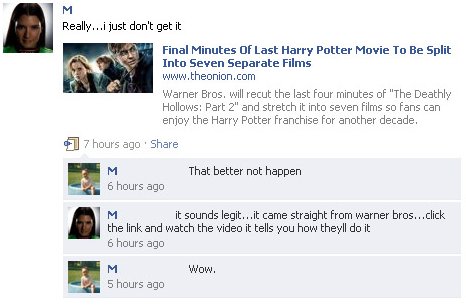
Feeling optimistic about peoples’ common sense?

Filed under: Humour, Media, Technology — Tags: , , — Nicholas @ 00:15

A few visits to this site will quickly disabuse you of that feeling.


It’s how some folks on Facebook react to stories from The Onion as if it was real news.

May 27, 2011

Swedish subway stations or hallucinatory flashbacks to a 1975 shopping mall?

Filed under: Europe, Media, Railways, Randomness — Tags: , , — Nicholas @ 13:10

Andrew Coyne linked to this set of photos of Swedish subway stations saying “Good LØRD. Who was their designer, Willy Wonka?”


I shared the link with Jon, my former virtual landlord, who responded:

Tonight’s nightmares are going to leave a mark.

I can only imagine what the flashbacks must be like for you, though. I suspect that these stations look remarkably like Sherway Gardens did to you and your friend after you guys went drinkin’ at the Steak’n’Burger.

If there is a 1970’s-era Sherway Gardens in Hell, this is what it looks like.

I had a similar reaction to the photos . . . strikingly ugly where they’re not just flat-out disturbing. But what else could we expect from publicly funded artists selected by public transit officials?

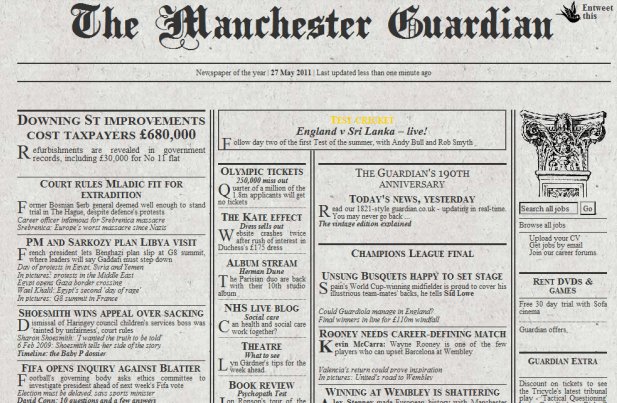
Happy 190th anniversary to the good old Grauniad

Filed under: Britain, History, Media — Tags: , — Nicholas @ 12:08

It’s the 190th anniversary, so the folks at The Guardian have virtually turned the calendar back:

More information about the “experiment in the typesetting of the mechanical facsimile we operate at guardian.co.uk” here.

Powerpoint: it’s not presentation software, it’s visual assault software

Filed under: Media, Technology — Tags: , , , — Nicholas @ 11:54

I’ve attended lots of meetings where the Powerpoint slides have been really bad, but I’m happy not to have encountered anything quite as bad as this:

One of this year’s winners in the InFocus Worst Powerpoint Slide Contest.

Our “What Not to Present” contest was epic! Many thanks to all of you kind folks that submitted entries and spread the word about it. Many amazingly horrendous slides were sent in from all around the world. We laughed. We cried. We cringed.

[. . .]

We randomly chose our top 3 winners, but then quickly realized that we had to do more. So we are giving away ANOTHER projector to the slide we thought was the most horrendous. We passed the ugliness around the InFocus offices and to many of our partners pandering for votes — and we have a winner!

Update: While I’m busy poking fun at PowerPoint, here’s the Gettysburg Powerpoint Presentation. H/T to Paul “Inkless” Wells for the link.

May 25, 2011

Netflix now the 500lb gorilla sitting on your internet bandwidth

Filed under: Economics, Media, Technology — Tags: , , , — Nicholas @ 07:41

In a shocking display that if you make something legally accessible, people are willing to pay for it (who’d ever have expected that?), Netflix has supplanted Bittorrent as the largest user of peak-time internet traffic:

Is solving the copyright “wars” really so difficult? New traffic research shows that Netflix has overtaken Bittorrent as America’s favourite internet application, knocking http into third place. “P2P is here to stay,” note the authors in Sandvine’s Global Internet Report, Spring 2011 edition, which shows that demand for legal, paid-for stuff is the single biggest internet traffic trend.

Copyright-holders who are slow to bless legal services, by contrast, find themselves being swamped by pirates.

Netflix now accounts for 24.71 per cent of peak time aggregate traffic in the US, pushing Bittorrent into second place with 17.23 per cent. By contrast, the Sandvine numbers show that in markets where there are no legal services, pirate services flourish. In Latin America, file-sharing program Ares grabs 15.48 per cent of peak-time (fixed line) internet traffic, behind http. In Europe, Bittorent rules, with 28.4 per cent of peak-time traffic, ahead of http. Here, YouTube grabs third place, with almost 12 per cent of peak-time traffic.

We signed up for a month-long trial of Netflix (on the recommendation of Dark Water Muse) and have been quite happy with the service. In fact, it was a major factor in our buying a PS3 over the weekend, as our existing Blu-Ray player was incompatible with Netflix.

How to analyze bubbles and crashes

Filed under: Books, China, Economics, History, Media — Tags: , , — Nicholas @ 07:06

Warren C. Gibson reviews Boombustology by Vikram Mansharamani, which looks at the boom and bust pattern frequently seen in economics, with special emphasis on China:

The author’s macro lens includes Austrian business cycle theory. That theory says inflation of the money supply causes a drop in interest rates, which is misinterpreted as an increased aggregate preference for saving over consumption, leading to investments in more roundabout means of production. When it becomes clear that there has been no such preference shift, these undertakings are seen to be at least partial mistakes, requiring write-offs and retrenchment — a bust. The boom is the problem, not the bust, which is the market’s attempt to realign itself to the realities of time preference. Austrian business cycle theory has great merit but leaves some things unexplained.

Mansharamani’s micro lens includes the concept of reflexivity. Market participants don’t just observe prices but also influence them. Reflexive dynamics occasionally give rise to instabilities in which rising prices lead to increased demand. A simpler term would be a “bandwagon effect.” I recall an office party in 1980 where one of the secretaries asked about buying gold — precisely at the peak, as it turned out. All she knew about gold was that it was way up and therefore must be going higher. I should have realized that when you see financially unsophisticated people like her climbing on a bandwagon, you can be pretty sure there’s no one left to sell to and nowhere for prices to go but down, which is where gold and silver prices went in 1980, and in a big hurry.

From psychology Dr. M. borrows ideas and data about cognitive biases. For example, subjects asked to guess some bland statistic, like the number of African countries that belong to the UN, are influenced by the spin of a wheel of fortune: When the wheel lands on a high number, they guess higher. He translates this and a dozen other cognitive biases into irrational market behavior that can foster booms and busts.

He introduces his biology lens with an analogy to the spread of an infectious disease. When the prevalence of a disease reaches a high level, the infection rate necessarily slows and the disease begins to wane, just like the 1980 gold market. But it is devilishly difficult to “inoculate” oneself against infectious ideas. Individual investors who can do so have a decent chance to beat the market averages over time, I believe. (Those who would pursue these ideas in greater depth would do well to find James Dines’s quirky and expensive but worthwhile book, Mass Psychology.)

Governments don’t have the power to prevent booms and busts — but they sure do have the ability (and too often, the will) to extend booms as long as possible, which only makes the necessary correction that much more painful.

May 24, 2011

“Why does dubious social science keep showing up in medical journals?”

Filed under: Economics, Media, Science — Tags: , , , , — Nicholas @ 10:08

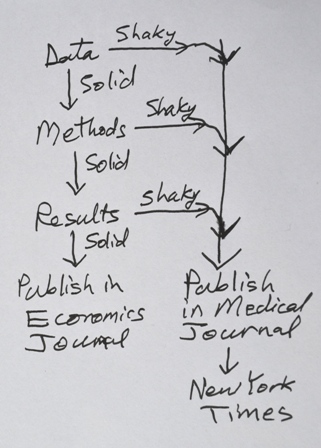
William Easterly and Laura Freschi have determined the decision tree for publishing crappy social science research:

Aid Watch has complained before about shaky social science analysis or shaky numbers published in medical journals, which were then featured in major news stories. We questioned creative data on stillbirths, a study on health aid, and another on maternal mortality.



Just this week, yet another medical journal article got headlines for giving us the number of women raped in the DR Congo (standard headline: a rape a minute). The study applied country-wide a 2007 estimate of the rate of sexual violence in a small sample (of unknown and undiscussed bias). It did this using female population by province and age-cohort — in a country whose last census was in 1984.

We are starting to wonder, why does dubious social science keep showing up in medical journals?

The medical journals may not have as much capacity to catch flaws in social science as in medicine. They may desire to advocate for more action on tragic social problems. The news media understably assume the medical journals ARE vetting the research.

H/T to Tim Harford for the link.

Forget May 21st: world now ending October 21st says Camping

Filed under: Humour, Media, Religion — Tags: , — Nicholas @ 09:42

If you were terribly let down not to ascend on Saturday, don’t worry: Harold Camping has recalculated the correct day of the Rapture!

California preacher Harold Camping is unrepentant following his second unsuccessful attempt to predict Judgment Day, and now says true believers should pack their bags for ascension to heaven on 21 October.

Camping’s first stab at nailing the Rapture advised Christians to get their earthly affairs in order before 6 September 1994. When the world failed to end, due to a “mathematical error”, he reset the clock for last Saturday at 6pm EST.

Christians expecting a rapturous elevation to glory were once again left twiddling their thumbs and their Bibles, but Camping now says he simply misinterpreted the word of God and 21 May “was not really the end of the world but the spiritual beginning of the physical end”, as the San Francisco Chronicle explains.

So the good news is that the world didn’t experience the Rapture on Saturday, and that we don’t get five months of Satan striding among us waving his evil appendages in the faces of the doomed, while those taken up in the Rapture watch us from Heaven, exulting in our pain and suffering while gobbling down popcorn-flavoured Manna bits. The bad news is it all comes to an end on October 21st anyway.

Why is the move to IPv6 so important?

Filed under: Media, Technology — Tags: , — Nicholas @ 08:42

As you may remember, June 8th is World IPv6 Day, where hundreds of major players including Google, Facebook, and Yahoo will all turn on IPv6 access (but then turn it off again at the end of the day). It seems odd to make a big to-do about IPv6 Day then go back to business as usual after 24 hours. Most end users will not notice the change, as most of us connect through our various ISP networks using IPv4 addresses anyway.

So, what happens if IPv6 isn’t taken up by the movers and shakers of the networking world?

Proponents of IPv6 make dire predictions about the fate of the Internet if usage of IPv6 doesn’t rise dramatically in the next few years. They say the complexity of the Internet infrastructure will increase, network operations costs will rise, and innovation will be hampered. This is due to the multiple layers of network address translation (NAT) devices that will be required to share limited IPv4 addresses among a rapidly growing base of users and devices.

“If IPv6 fails to catch on, then the Internet will include nesting of NAT upon NAT,” says Russ Housley, chairman of the Internet Engineering Task Force (IETF), the Internet standards body that created IPv6. “I hope this is not our future because it would be a very fragile Internet, making innovation more difficult. On the other hand, IPv6 will greatly reduce the need for NAT, restoring the opportunities for innovation that were envisioned by the original Internet architecture.”

Dorian Kim, vice president of IP engineering, Global IP Network at NTT America, a leading provider of IPv6 services in the United States, says that without IPv6 the Internet “will be even more heavily NATed than it currently is, but life will mostly go on. Unfortunately, such an Internet likely will have a negative effect on potential development of application or service innovation due to inherent issues with NATs. Additionally, should service providers become more and more reliant on NATs, this will probably change the cost and scaling trajectories of Internet services over time due to high cost and limited scalability of large-scale NAT solutions.”

« Newer PostsOlder Posts »

Powered by WordPress