
Quotulatiousness

May 9, 2012

Misreading the European electoral tea leaves

Filed under: Economics, Europe, France, Government, Greece, Italy, Media — Tags: , , — Nicholas @ 10:19

Brendan O’Neill points out that there’s something lacking in the analyses of all the recent electoral upheavals in Europe:

Great claims are being made in the wake of the local elections in Britain, the presidential elections in France, and the legislative elections in Greece. Britain’s Labour Party may have secured the votes of just 12.5 per cent of the eligible electorate, but it came top in the local elections, and so we’re told that ‘Labour is back’. The victories of Hollande in France (where he won 51.63 per cent of the vote to Nicolas Sarkozy’s 48.37 per cent), and of SYRIZA in Greece (the anti-austerity, radical left coalition which won 16.78 per cent of the vote), are being talked up as a ‘new dawn’ for European social democracy. According to a Guardian editorial, we have witnessed a ‘stunning victory… for the left in Europe’.

These observers urgently need to take a reality check. Because in truth, the most striking thing about the recent elections in Europe has been the utter absence of any matters of doctrine, of principle, of ideological outlook. In England, France, Greece, Italy, no doctrinal matters whatsoever have been raised, far less contested. These elections are best seen, not as a new dawn for social democracy, but as an unfocused emotional reaction against things — against Sarkozy, austerity, Brussels. Actually, it’s worse than that. Where once the left was concerned with creating a new reality, one based on systems and values quite distinct from those of traditionalists, today’s emerging left is obsessed with avoiding reality, with hiding away from the harshness of economic life in 2012 and simply saying: ‘Be gone!’ The problem with the newly successful left movements is not just that they’re attracting shallow protest votes, but that they’re extraordinarily infantile, blinkered outfits.

The only ‘doctrine’ uniting the various movements against austerity in modern Europe (both the left-wing and right-wing ones) is the doctrine of responsibility aversion, of shirking seriousness in favour of emotionalism. What the cheerleaders of these movements fail to realise is that being anti-austerity without positing an alternative route out of recession, without any serious proposals for stabilising economic life in Europe, is mere gesture politics. In fact it’s an act of irresponsibility, of wilfulness, where the key aim is to insulate oneself and one’s supporters from the harsh realities of our recessionary times rather than face up to those realities and potentially transform them. The new anti-austerity posturing, to quote an old communist, is an infantile disorder.

Bishop Hill outlines the Yamal deception

Filed under: Environment, Media, Science — Tags: , , — Nicholas @ 08:22

At the Bishop Hill blog, the twisty-turny story of the bristlecone pine temperature reconstruction effort:

The story of Michael Mann’s Hockey Stick reconstruction, its statistical bias and the influence of the bristlecone pines is well known. Steve McIntyre’s research into the other reconstructions of the temperatures of the last millennium has received less publicity, however. The story of the Yamal chronology may change that.

The bristlecone pines that created the shape of the Hockey Stick graph are used in nearly every millennial temperature reconstruction around today, but there are also a handful of other tree ring series that are nearly as common and just as influential on the results. Back at the start of McIntyre’s research into the area of paleoclimate, one of the most significant of these was called Polar Urals, a chronology first published by Keith Briffa of the Climate Research Unit (CRU) at the University of East Anglia. At the time, it was used in pretty much every temperature reconstruction around. In his paper, Briffa made the startling claim that the coldest year of the millennium was AD 1032, a statement that, if true, would have completely overturned the idea of the Medieval Warm Period. It is not hard to see why paleoclimatologists found the series so alluring.

Yamal saves the day

Some of McIntyre’s research into Polar Urals deserves a story in its own right, but it is one that will have to wait for another day. We can pick up the narrative again in 2005, when McIntyre discovered that an update to the Polar Urals series had been collected in 1999. Through a contact he was able to obtain a copy of the revised series. Remarkably, in the update the eleventh century appeared to be much warmer than in the original — in fact it was higher even than the twentieth century. This must have been a severe blow to paleoclimatologists, a supposition that is borne out by what happened next, or rather what didn’t: the update to the Polar Urals was not published, it was not archived and it was almost never seen again.

With Polar Urals now unusable, paleclimatologists had a pressing need for a hockey stick shaped replacement and a solution appeared in the nick of time in the shape of a series from the nearby location of Yamal.

A call to ban college football

Filed under: Economics, Education, Football, Government, Media, USA — Tags: , , , — Nicholas @ 00:02

This Wall Street Journal piece by Buzz Bissinger is guaranteed to stir up controversy:

In more than 20 years I’ve spent studying the issue, I have yet to hear a convincing argument that college football has anything do with what is presumably the primary purpose of higher education: academics.

That’s because college football has no academic purpose. Which is why it needs to be banned. A radical solution, yes. But necessary in today’s times.

[. . .]

Who truly benefits from college football? Alumni who absurdly judge the quality of their alma mater based on the quality of the football team. Coaches such as Nick Saban of the University of Alabama and Bob Stoops of the University of Oklahoma who make obscene millions. The players themselves don’t benefit, exploited by a system in which they don’t receive a dime of compensation. The average student doesn’t benefit, particularly when football programs remain sacrosanct while tuition costs show no signs of abating as many governors are slashing budgets to the bone.

If the vast majority of major college football programs made money, the argument to ban football might be a more precarious one. But too many of them don’t—to the detriment of academic budgets at all too many schools. According to the NCAA, 43% of the 120 schools in the Football Bowl Subdivision lost money on their programs.

The other big beneficiaries of the college football system is, of course, the NFL. Unlike baseball or NHL teams, it doesn’t have to maintain a “farm team” league or leagues to provide training and play opportunities for would-be professional football players. This burden, instead, is carried by the taxpayer as part of their share of higher education.

May 8, 2012

Absurd meme of the month: that European countries have imposed draconian fiscal austerity

Filed under: Economics, Europe, Government, Media — Tags: , , , , — Nicholas @ 11:00

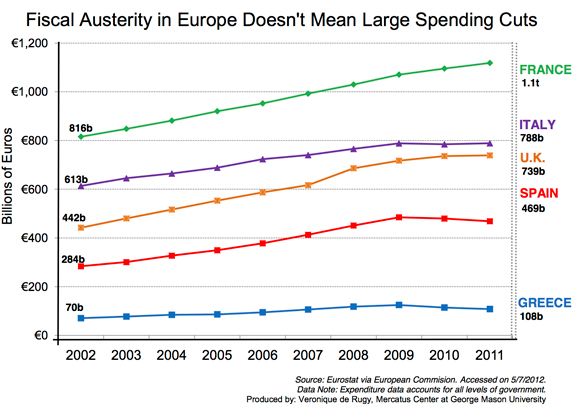
For all the gasping about the impact of fiscal austerity on weakened European economies, it’s hard to detect from the actual numbers:


(Image from the Mercatus Center)

See all those coloured lines dropping precipitously? Me neither.

Veronique de Rugy asks where the “savage” spending cuts can be seen:

Austerity is destroying Europe, we are told. In fact, this “anti-austerity” slogan was a big reason for the victory of newly elected socialist François Hollande to the presidency of France. Interviewed in The Economist a few weeks ago, Hollande’s campaign director said “We are not disciples of savage spending cuts.”

But then, I look at the data and I am asking: What “savage” spending cuts?

Look at [the chart above]. It is based on Eurostat data which you can find here. Following years of large spending increases, Spain, the United Kingdom, France, and Greece — countries widely cited for adopting austerity measures — haven’t significantly reduced spending since 2008. As you can see on this chart:

  • These countries still spend more than pre-recession levels
  • France and the U.K. did not cut spending.
  • In Greece, and Spain, when spending was actually reduced — between 2009–2011 — the cuts have been relatively small compared to what is needed. Also, meaningful structural reforms were seldom implemented.
  • As for Italy, the country reduced spending between 2009 and 2010 but the data shows and uptick in spending 2011. The increase in spending represents more than the previous reduction.

In addition to failing to curb spending, several governments have raised taxes (which has a negative effect on growth in the economy and can — contrary to popular wisdom — actually reduce the total tax collected as people and companies change their habits to minimize the impact of the tax change).

Hayek and Keynes

Filed under: Books, Economics, History, Media — Tags: , , , — Nicholas @ 08:32

Brian Lee Crowley recounts some of the interactions between F.A. Hayek and John Maynard Keynes in the National Post:

This year marks the 20th anniversary of the death of Friedrich August Hayek, the Viennese-born Nobel Prize-winning economist and philosopher, who led the intellectual equivalent of the D-Day charge against central planning in the postwar era. His lessons are worth remembering in 2012, especially now that left-wing politicians in France, Greece and elsewhere seem intent on forgetting them.

Hayek’s great adversary was John Maynard Keynes, whose faith in the ability of government economic planners to “correct” the operation of markets inspired generations of disciples in government and academe. In the long run, Hayek got the better of the argument with Keynes. Indeed, his ideas contributed to the fall of the Berlin Wall, and continue to influence economic thought to this day.

Hayek and Keynes were punctilious professional colleagues and scholarly rivals. Yet for all the correctness that characterized their relations — Hayek was, for example, Keynes’s guest when the London School of Economics fled the Nazi bombings to the relative safety of Cambridge — the Austrian could not shake a profound distrust of Keynes.A brilliant economist, captivating teacher, witty conversationalist and bon vivant, Keynes seemed to almost everyone who knew him a Renaissance man and one of his country’s most powerful minds. Hayek found Keynes glib and superficial, but it was Keynes’ intellectual dilettantism that most appalled him. When Keynes wrote A Treatise on Money in 1930, Hayek spent a year carefully analyzing it, and then wrote a devastating review. At their next meeting, Hayek was outraged when Keynes airily said that he now agreed with Hayek, having long since changed his mind. Hayek always regretted that this incident led him to neglect replying to Keynes’ next book. By the time Hayek was alive to the danger, it was too late.

Celebrating the birthday of F. A. Hayek

Filed under: Economics, History, Humour, Media — Tags: , , , , — Nicholas @ 08:16

And the sequel, which some think is even better than the original, Fight of the Century:

May 7, 2012

This is not how the typical Barbara Amiel column begins

Filed under: Books, Media — Tags: , , — Nicholas @ 12:54

Barbara Amiel reviews a popular book for Maclean’s:

The question of whether it is truly sexually gratifying to have a Wartenberg pinwheel roll over your nipples while handcuffed to a stretcher bar with a ball gag in your mouth is something I hadn’t really thought about in the sheltered life I lead. I haven’t even been beaten with a Perspex ruler. I did once go out with an Englishman who was reputed to have an extraordinary collection of canes and crops for flogging but, apart from asking if I rode, which I did not, nothing in our brief acquaintance seemed to unlock that door.

These arcane sexual matters now have a pass into normal conversation ever since the breathtaking success of the new trilogy of novels Fifty Shades of Grey set in an idealized world of BDSM (bondage, domination, sadism, masochism) and all their sex toys. The author, under the pseudonym E.L. James, was on Time’s 2012 100 Most Influential People in the World list, which tells us something, I expect, but probably nothing good. The plot of the novels is bog standard Cinderella with a modern twist: a young virgin, Anastasia, meets an extremely wealthy unable-to-commit Adonis, Christian Grey, who has a thing for inflicting physical pain because of—here comes the contemporary bit — his abused childhood involving a crack cocaine-addicted mother. By the end of the second novel, Christian has reformed and he marries Ana in book three.

I was genuinely riveted for at least the first 20 chapters. One always likes learning about a new culture. Now I know that the beginning position for a submissive is sitting on her ankles, hands positioned on spread thighs and head down until Master allows you to look up. The novel is a tease: you get to see the drawer of sex toys in volume two — clamps and various devices to wear in one’s bottom or front — but the actual descriptions of congress are, apart from explicit names for various bits of the body, pretty tame. Like much soft pornography, this book has the sound and scope of a prudish author and a legalistically prudent publisher.

May 6, 2012

The free speech baby with the Citizens United bathwater

Filed under: Government, Law, Liberty, Media, USA — Tags: , , , , , , — Nicholas @ 10:32

George Will on the rather impressive sweep of a new proposal to circumvent the US Supreme Court’s decision in Citizens United:

Now comes Rep. Jim McGovern, D-Mass., with a comparable contribution to another debate, the one concerning government regulation of political speech. Joined by Minority Leader Nancy Pelosi, 26 other Democrats and one Republican, he proposes a constitutional amendment to radically contract First Amendment protections. His purpose is to vastly expand government’s power — i.e., the power of incumbent legislators — to write laws regulating, rationing or even proscribing speech in elections that determine the composition of the legislature and the rest of the government. McGovern’s proposal vindicates those who say most campaign-finance “reforms” are incompatible with the First Amendment.

His “People’s Rights Amendment” declares that the Constitution protects only the rights of “natural persons,” not such persons organized in corporations, and that Congress can impose on corporations whatever restrictions Congress deems “reasonable.” His amendment says it shall not be construed “to limit the people’s rights of freedom of speech, freedom of the press, free exercise of religion, freedom of association and all such other rights of the people, which rights are inalienable.” But the amendment is explicitly designed to deny such rights to natural persons who, exercising their First Amendment right to freedom of association, come together in corporate entities to speak in concert.

McGovern stresses that his amendment decrees that “all corporate entities — for-profit and nonprofit alike” have no constitutional rights. So Congress — and state legislatures and local governments — could regulate to the point of proscription political speech, or any other speech, by the Sierra Club, the National Rifle Association, NARAL Pro-Choice America, or any of the other tens of thousands of nonprofit corporate advocacy groups, including political parties and campaign committees.

Newspapers, magazines, broadcasting entities, online journalism operations — and most religious institutions — are corporate entities. McGovern’s amendment would strip them of all constitutional rights. By doing so, the amendment would empower the government to do much more than proscribe speech. Ilya Somin of George Mason University Law School, writing for the Volokh Conspiracy blog, notes that government, unleashed by McGovern’s amendment, could regulate religious practices at most houses of worship, conduct whatever searches it wants, reasonable or not, of corporate entities, and seize corporate-owned property for whatever it deems public uses — without paying compensation. Yes, McGovern’s scythe would mow down the Fourth and Fifth Amendments, as well as the First.

May 5, 2012

Why most SF (and SF-ish) movies suck

Filed under: Books, Media — Tags: , — Nicholas @ 11:29

In a long post about the death of genre, Charles Stross explains why most science fiction movies are awful:

Well, the process has already begun (indeed, is well under way) in some other media: in film, for example, around 30% of the big budget movies to come out of Hollywood each year are recognizably science fiction. I mean, aliens: that’s a pretty obvious signifier, isn’t it? And Hollywood feels no need to market these movies as SF; they just are, big budget glossy special-effects beanfests featuring aliens. They’re grown-up, quite capable of finding their own audiences. But something is missing upstairs. They’re the sixty-foot-tall armoured cyborg idiot children of our genre. All fire and tantrums and no cerebral context whatsoever. There’s no internal genre dialog going on, and precious little introspection. (Yes, you can name exceptions like “GATACA”; the fact that you have to note the exceptions is itself a warning sign.)

I am not sure it is possible to write introspective, complex SF as a screen medium. The natural length of a feature movie is around 120 minutes; the traditional movie script runs at one page per minute, with 250 words per page — that buys you, in literary terms, a novella. Add in the expectations of studio executives and the dumbing-down effects of editing by committee you end up with huge pressure to make the script commercial rather than complex. Some director/scriptwriters have the clout to get what they want: but then you end up, as often as now, with George Lucas. Nor is there much scope for a dialog in which directors build on someone else’s ideas. So a large chunk of cinematic SF is stuck, spinning its wheels, mistaking ever better special effects and ever bigger first weekend box-office draws for progress.

Rick Santelli goes to the white board

Filed under: Economics, Media, Politics, USA — Tags: , , , — Nicholas @ 08:59

H/T to Kate at Small Dead Animals.

May 4, 2012

A skeptical review of Get Real

Filed under: Books, Environment, Media, Politics, Science — Tags: , , , , — Nicholas @ 08:14

Tim Black reviews the new book Get Real: How to Tell it Like it is in a World of Illusions by Eliane Glaser, calling it “enjoyably hyperactive”, but also pointing out some quite glaring flaws:

Politicians marshalling an army of PR consultants to appear authentic. Multinational companies selling products with folksy, homespun brands. Public inquiries that have nothing to do with the public. The paradoxes proliferate in journalist and academic Eliane Glaser’s enjoyably hyperactive new book, Get Real: How to Tell it Like it is in a World of Illusions. Her ambition is overarching: she wants to show us the way to the truth of the matter. She wants to cut through the crap. She wants us to follow the royal road of social critique. In short, she wants us to see things for what they are. (A bit rubbish, as it turns out.)

[. . .]

Glaser is even better when it comes to ‘scientism’. Awe-struck deference is everywhere, she argues, from Brian Cox’s television series Wonders of the Universe to the World of Wonders science museum in California. ‘Scientific wonder carries with it a sense of humility, which is ostensibly about meekness in the face of extraordinary facts’, she writes. ‘But it blurs into deference towards scientists, with their privileged access to those facts.’ Indeed, anything that Stephen Hawking says, be it about the existence of God or the plight of the planet, is treated as if it comes straight from the oracle’s mouth. ‘In modern culture, scientism is the new religion. God knows what happened to scepticism.’

This conflation of fact with value, this belief that science, having seemingly supplanted moral and political reasoning, can tell us what to do, is highly damaging, Glaser argues. Political decisions, necessitated by science, become a fait accompli. So when, in 2009, US President Barack Obama lifted the ban on federal funding for stem-cell research, he felt no need to make a moral, political case for the decision: ‘The promise that stem cells hold does not come from any particular ideology; it is the judgement of science.’ This is not to say that stem-cell research is a bad thing; rather, it is to say that a politician needs to make the case for it being a good thing.

Yet while there is plenty of critique in Get Real, there is plenty that is unquestioned, too. So no sooner has Glaser put scientism on the rack than, a few pages on, she’s espousing its most prominent manifestation: environmentalism. The chapter even begins with some all-too-persuasive facts from the mouths of Those To Whom We Must Defer: ‘Climate scientists generally agree that the safe limit for the concentration of carbon dioxide in the atmosphere is 350 parts per million (ppm). As I write this, we’re already at 390ppm.’ She soon proceeds to read off a number of Malthus-heavy assertions passed off as fact: ‘Global warming, population explosion, peak oil, biodiversity in freefall: Planet Earth is facing unprecedented and multiple crises. It is little wonder, therefore, that as the situation becomes more desperate, self-deception becomes more attractive. If the world is turning into a desert, it’s tempting to put your head in the sand.’

It’s a bizarre reversal. Having eviscerated the deference towards science in one section, in another she proceeds to lambast those who resist the science for their ‘denialism’. It does not seem to occur to Glaser that a principal reason for opposing the environmental orthodoxy is that it attempts to pass off a moral and political argument about how we should live our lives — low-consumption, little procreation and an acceptance of economic stagnation — as a scientific necessity. Could there be a more flagrant form of the scientism that Glaser so eloquently takes to task elsewhere?

Conrad Black is now, in Margaret Atwood’s words, “a very informed and outspoken commentator on prison reform”

Filed under: Cancon, Law, Media, USA — Tags: , , , — Nicholas @ 00:09

Margaret Wente on the return of Conrad Black:

Margaret Atwood is delighted that Conrad Black is coming back to Canada. “He has a lot to say and contribute,” she e-mailed from New York on Wednesday. But she thinks the Harper government may not be delighted. Lord Black, she notes, “is now a very informed and outspoken commentator on prison reform, and does not think the government’s expensive mega-jails plan will work.”

Believe it or not, Ms. Atwood and Lord Black have become BFF. When Payback, her book on debt, came out in 2008, he gave it a favourable review from his jail cell. She likes his book too. “Conrad Black’s A Matter of Principle is a fascinating, erudite, & defiant prison memoir — must-read for lawyers, politicos, & gossips alike!” she tweeted after it came out last fall. Lord Black even made a guest appearance in the new documentary based on her book. At the premiere, she declared that he is “a new and different kind of Conrad.”

[. . .]

During his 37 months as a guest of the U.S. Federal Bureau of Prisons, Lord Black experienced several jailhouse conversions. Most notably, he became an impassioned advocate for prison reform. U.S. prisons, he argues, are full of millions of innocent, near-innocent, impoverished, unlucky wretches who are victims of “the carceral state.” He is convinced that the war on drugs is an abject failure, and he has called the Harper government’s crime policies “sadistic and malicious.” Not even Mr. Mulcair went that far.

Lord Black has also fallen out of love with the United States, a nation he once idolized. “Its greatness survives, certainly, despite chronic misgovernment, but my affection for it has faded,” he has written. Last fall he wrote that after his release, “I will leave the United States forever, all passion spent.” He has also rekindled a genuine appreciation for Canada, a nation he harshly criticized for years. The rapacious capitalism he once celebrated is less attractive to him now. He seems to have developed — dare I say it? — a social conscience.

May 3, 2012

Reason.tv: Brian Doherty on Ron Paul’s Revolution

Filed under: Economics, Liberty, Media, USA — Tags: , , , , — Nicholas @ 10:39

“Ron Paul invented the notion of a populist, activist, modern movement thats transpartisan” says Reason’s Brian Doherty

Brian Doherty sat down with ReasonTV to talk about his new book and how Ron Paul has changed politics in America. Doherty wrote about the evolution of the libertarian movement in his 2007 book “Radicals for Capitalism: A Freewheeling History of the Modern American Libertarian Movement”. He has been following and writing about Ron Paul and his movement since then. Doherty examines Ron Paul’s influence in a new book out May 15, “Ron Paul’s rEVOLution: The Man and the Movement He Inspired”.

Identifying activists

Filed under: Liberty, Media, Politics — Tags: — Nicholas @ 07:56

Kelly McParland explains some of the ways people come to identify themselves as “activists”:

You come across activists all the time. They are often quoted by legitimate news organizations, offering opinions on issues of the day. Generally their qualifications appear to be limited to an interest in the subject matter. So anyone involved in organizing a Root Vegetable Consumers Against Frozen French Fries (RVCAFFF) protest march can legitimately identify themselves as an “activist”.

No expertise is required, nor any specific experience, though activists often appear to have plenty of background in activism itself, i.e. they’ve been complaining about the same thing for a long time. There was a time when environmentalists needed nothing more than a desire to live in a remote hut without electricity or access to commercial television to consider themselves fully qualified to assess an energy plan that might impact millions of people. Since then, however, universities have discovered they can fill entire buildings with students eager to memorize environmental slogans and other arcania, and “environmentalism” has become a recognized discipline. But you can still be an “activist” by just registering to show up at a review hearing to condemn Big Oil, knowing little more than the price at the pump.

I was reminded of this when I saw the list of activist groups that are supporting the agenda of May Days of Action for Immigrant and Worker Rights and Economic, Social and Environmental Justice. (It’s a peculiarity of activist organizations that they require long titles. This is generally because slotting anyone into a particular identity goes against the activist code of conduct — as does having a code of conduct — so naming the group itself constitutes a balancing act that touches on the full range of obsessions held by its members. It’s a bit like forming a federal cabinet).

May 1, 2012

The Duel at Blood Creek, a short film

Filed under: History, Humour, Media — Tags: — Nicholas @ 10:30

A lovely little film that works well on several different levels.

« Newer PostsOlder Posts »

Powered by WordPress

