
Quotulatiousness

February 20, 2013

Publicly funded research results should be available to the people who paid for them

Filed under: Books, Government, Media, Science, USA — Tags: , , , — Nicholas @ 09:52

At Techdirt, Mike Masnick explains why publishers are losing their collective shit over a new bill that would require almost all government-funded research to be made generally available:

A year ago, we wrote about Rep. Mike Doyle introducing an important bill to provide public access to publicly funded research. As we’ve been discussing for years, the academic journal business is a huge boondoggle. Unlike just about any other publication, the journals don’t pay their writers (and in many subject areas, authors need to pay to submit), they don’t pay the peer reviewers — and then they charge positively insane amounts to university libraries, often knowing that those libraries feel obligated to pay. Oh yeah, and the journals keep the copyright on everything. I’ve heard of researchers having to redo basic experiments because they were worried they couldn’t even reuse data from earlier experiments due to the copyright assignment agreement they had to sign.

Thankfully, for years, there’s been a law on the books for any NIH-funded research to guarantee that 12-months after publication, those works also had to be published openly. While some publishers have tried to game this system (such as by demanding a mandatory fee to “deposit” the work in an open access database), on the whole this has been hugely important in making sure that taxpayer funded research is actually available and can be built upon. Over the years, there have been multiple bills introduced in both directions on this issue. There have been some bills that sought to take away this requirement under NIH funding and there have been bills that have tried to expand it to the rest of the federal government and any of the research they sponsor.

[. . .]

But, of course, the publishers are really not happy about all of this, calling it “different name, same boondoggle.” This is quite incredible, really, since it’s really the publishers who have been getting away with a giant boondoggle for ages. If that gives you an idea about just how ridiculous the publishers’ claims are, read on. Nearly every claim they make in attacking the bill actually applies to the publishers themselves much more than to the bill [. . .]

Basically, the publishers know that their current position with these journals is such a sweet deal that they don’t want anything to mess with it at all. That’s ridiculous. While they’re fighting for ever bigger profits, we’re talking about access to research that was funded with our own dollars. It’s really sad that the publishers would fight such a thing, though it shows what they really think concerning education. To them, it’s not about how best to disseminate information, but how to lock it up and charge insanely high prices for it.
February 19, 2013

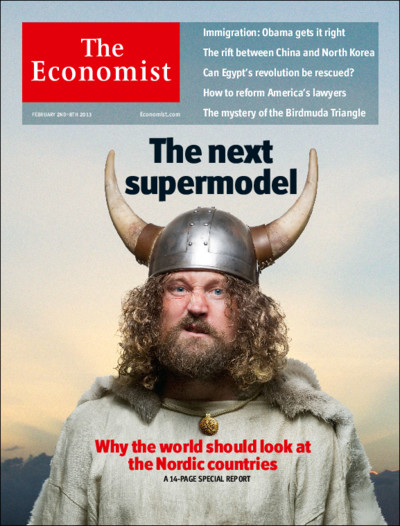
Horns on Viking helmets? Let’s all agree to blame Wagner…

Filed under: Europe, History, Media — Tags: , , — Nicholas @ 11:37

In The Economist, a sort-of-apology for perpetuating the myth that Vikings wore helmets with horns:

Economist cover with Viking horns

The practice of burying the dead with their goods has left archaeologists with lots of evidence about the Vikings, who were arguably the first maritime superpower. Unfortunately, few Viking helmets survive intact. The small sample size cannot prove the point definitively, but they are all horn-free.

Why, then, do cartoon Vikings, Scandinavian football fans and Economist covers persist in giving their helmets horns? As in the rest of Europe, Scandinavia saw an upsurge of interest during the 19th century in home-grown cultural traditions and images. Folk dances, songs, sagas — all were revived and celebrated. The 18th century had seen most of Europe trying to imitate sophisticated Parisian fashions. Now trolls were cool. Where there were gaps in the historical record, artists often used their imagination to reinvent traditions. Painters began to show Vikings with horned helmets, evidently inspired by Wagner’s costume designer, Professor Carl Emil Doepler, who created horned helmets for use in the first Bayreuth production of “Der Ring des Nibelungen” in 1876, as a reader points out in a letter we publish this week. (For the full story, see Roberta Frank, “The Invention of the Viking Horned Helmet“, published in International Scandinavian and Medieval Studies in Memory of Gerd Wolfgang Weber, 2000.)

Orwell updated: how politicians lie in “plain speech”

Filed under: Government, Media, Politics — Tags: , , , — Nicholas @ 10:25

Ed Smith shows how Orwell’s warning about politicians lying is now out of date because they’ve mastered the art of using “plain language” in aid of untruth:

Orwell season has led me back to his famous essay “Politics and the English Language”, first published in 1946. It is written with enviable clarity. But is it true? Orwell argues that “the great enemy of clear language is insincerity. When there is a gap between one’s real and one’s declared aims, one turns as it were instinctively to long words.”

I suspect the opposite is now true. When politicians or corporate front men have to bridge a gap between what they are saying and what they know to be true, their preferred technique is to convey authenticity by speaking with misleading simplicity. The ubiquitous injunction “Let’s be clear”, followed by a list of five bogus bullet-points, is a much more common refuge than the Latinate diction and Byzantine sentence structure that Orwell deplored.

We live in a self-consciously plain-spoken political era. But Orwell’s advice, ironically, has not elevated the substance of debate; it has merely helped the political class to avoid the subject more skilfully. The art of spin is not (quite) supplanting truth with lies. It aspires to replace awkward complexities with catchy simplicity. Successful spin does not leave the effect of skilful persuasiveness; it creates the impression of unavoidable common sense. Hence the artifice becomes invisible — just as a truly charming person is considered nice rather than “charming”.

February 18, 2013

Did you know … that Wikipedia has an obsession over Gibraltar?

Filed under: Britain, Europe, Media — Tags: , — Nicholas @ 11:00

I’d noticed one or two of these “Did you know…” entries on the Wikipedia site, but I didn’t realize just how much of a fixation the online encyclopedia has for “The Rock”:

Last October Wikipedia‘s supreme leader Jimmy Wales called for a “strong moratorium” on the online project’s strange obsession with promoting Gibraltar — even suggesting a five-year ban on Gibraltar-loving Did You Know… posts on Wikipedia‘s front page.

“I think it is clear that there should be a strong moratorium on any Gibraltar-related DYKs on the front page of Wikipedia. I would recommend a total ban on them for five years, but that might be too extreme. I support that we get wider community attention on the issue,” he wrote in October last year.

The moratorium was opposed by Wiki editors but they did agree on certain guidelines. Every Gibraltar DYK has to be reviewed by two reviewers to check for conflict-of-interest issues or promotionalism, and no more than one Gibraltarpedia hook is allowed in one a day. Also, Bamkin (user name Victuallers) is not allowed to create or nominate Gibraltar-related articles to DYK.

Jimmy Wales speaks, and Wikipedia leaps into action. In December, they restricted themselves to a mere nine Gibraltar DYK entries. January saw 12 Gibraltarpedia links. As of today, there have been six Gibraltar-related posts in February.

February 17, 2013

The case of the over-extended copyright

Filed under: Books, Law, Media — Tags: , , — Nicholas @ 10:28

In this story, Sherlock Holmes and Doctor Watson encounter a true mystery: why the heirs of author Sir Arthur Conan Doyle are still able to pressure publishers for licensing fees long after the original stories should have been fully in the public domain:

It isn’t often one gets a ringside seat at a legal-literary battle royal, but it would seem that we’re about to bear witness to some activity in that particular area.

Of course, you’ll recall that recent legal battles in England have revolved around Undershaw, Conan Doyle’s home for about a decade that included when he wrote The Hound of the Baskervilles. [. . .] But this is wholly different.

The noted Sherlockian scholar, Baker Street Irregular and prominent attorney Leslie Klinger, editor of The New Annotated Sherlock Holmes, The Sherlock Holmes Reference Library and The Grand Game: A Celebration of Sherlockian Scholarship, to name a few, has filed a civil lawsuit against the Conan Doyle Estate to determine that the characters of Sherlock Holmes and Dr. Watson are in fact in the public domain.

Currently, the so-called estate undertakes high-handed legal action to levy royalties and other payments from authors who use the characters in their own works. This is despite the fact that there are only 10 stories in the entire Canon that are still under copyright protection (in the United States). Klinger, for one, will not stand for this bullying, and has formally filed suit and issued a press release.

H/T to Tim Harford (and Cory Doctorow) for the link.

February 16, 2013

“The mainstream news has become the Boy who Cried Internet”

Filed under: Media, Technology — Tags: , , , , , , — Nicholas @ 11:29

In Maclean’s, Jesse Brown explains why the mainstream media still doesn’t seem to “get” the internet or social media channels like Twitter, Google+, and Facebook:

While I was delivering some talking-head sound-bites on this item for a certain newscast, the reporter asked me why the Twitter hack was such a huge deal. I was stumped – it wasn’t. So she asked me why it was getting so much attention. I knew the answer, but held my tongue.

Here’s what I was thinking: it gets so much attention because print and TV news love to bash technology, especially social media, and can’t resist a scary story about how the people who use it should be very, very afraid. The truth is, despite years of fear-mongering stories about Facebook identity theft, Gmail phishing attacks and massive Twitter hacks, public interest and concern about these things remains very low. That’s because these things haven’t happened to the vast majority of us, or to anyone we know. For the small number of people this has happened to, the impact is typically minimal. The mainstream news has become the Boy who Cried Internet.

This is not to say privacy isn’t a valid concern when it comes to free Internet services. There’s much to worry about, but little of it has to do with Russian digital mobsters, Chinese military hackers or spammy Nigerian princes. The real data privacy danger – with social media, and beyond – comes from government.

Nova Scotia Islands

Filed under: Cancon, History, Media — Tags: , — Nicholas @ 10:34

I got a press release to let me know that “Nova Scotia Islands” will be shown on CBC this Sunday. It looks interesting:

Nova Scotia Islands will have its world broadcast premiere on Sunday, February 17, 2013 at 12 Noon on CBC TV’s Land & Sea.

Islands are part of the geography and history of the Maritimes, nowhere more so than Nova Scotia. Jutting out into the Atlantic Ocean, there are more than 3,800 islands that lie scattered along nearly 5,000 miles of coastline.

Nova Scotia Islands is a half hour documentary that explores some of the most interesting islands in the province, their little known histories, and in some cases their uncertain futures.

February 15, 2013

A self-described hippie who loves capitalism. Ladies and gentlemen, please welcome Neil Young!

Filed under: Books, Business, Cancon, Media — Tags: , , — Nicholas @ 09:29

In sp!ked, Patrick Hayes reviews Neil Young’s new book, Waging Heavy Peace: A Hippie Dream.

Neil Young, the man who penned wistful lyrics about silver spaceships flying and about sleeping with Pocahontas, is, he openly admits in his autobiography, ‘a material guy’. After completing a project, he would ‘buy a car or something to celebrate’. He lavishes praise on Bill Ford, the executive chairman of Ford Motor Company. He gushes about the disruptive nature of new technologies. And he speaks romantically about developing business plans and navigating ‘the waters of venture capitalism’. When raving about being able to buy a green card to live in the US, Young even goes as far as to announce: ‘Capitalism rocks.’

In fact recently, he tells us, he has been dreaming more. Since his life-threatening brain aneurysm in 2005, when he decided to ditch his various narcotics, he dreams ‘every night, not like before, when I induced dreams in the waking hours to snatch them in their innocence and commit them to song and melody and words captured’.

While he has far from quit songwriting, kicking the drink and drugs has given Young a new sense of mission, something that makes him feel alive – in fact, a mission that makes him question whether he has ‘been asleep’ over the past 40 years. Young is currently ‘trying to rescue recorded sound so people can feel music again’. While a huge fan of the internet, Young has become increasingly infuriated that current methods of reproducing music digitally keep very little of the quality of the original. But he is never one to sit back and moan about how things were better in the days of vinyl. He has instead become obsessed with finding a solution.

And, with additional time due to a broken little toe, he also decided to tick another box by following in the footsteps of his father, famous Canadian author Scott Young, by writing a book. In this instance, an autobiography, with a second book tentatively titled Cars and Dogs planned, but ‘no matter how many books I write, I will eventually get to fiction’. He comments on the ease of writing: ‘No wonder my dad did this… writing could be just the ticket to a more relaxed life with fewer pressures and more time to enjoy with my family and friends – and paddleboarding!’

February 14, 2013

The LCBO crowds out another private business

Filed under: Cancon, Economics, Media, Wine — Tags: , , , — Nicholas @ 09:50

In the latest Ontario Wine Review, Michael Pinkus writes an obituary for Wine Access magazine and hurls “J’accuse!” at the Ontario government’s liquor monopoly for the murder:

Now there are some of you out there who will be asking how can the Ontario Liquor Monopoly put an Alberta-based magazine out of business — well it’s actually quite simple, if you’re willing to connect the dots: if you only have a certain amount of advertising dollars to spend in Canada how much are you going to allocate to the largest population in the country (Ontario); even more to the point, how much do you put into the Liquor Board willing to buy more product if you’ll spend more of your ad budget with them versus a magazine that might (or might not) increase your sales.

I have long advocated for the LCBO to cease publication of this magazine. Don’t get me wrong, it’s a beauty of a publication — my wife fawns over the pictures every issue — but it’s a publication that competes against private enterprise, and the LCBO is after all an extension of the government — so what I, and many others have said is unfortunately true: the government in essence, taking thousands of dollars out of the hands of the companies that pay taxes, their own populace, and competing against them. Sure I hear many of you saying “finally my tax dollars hard at work”: but ask yourself this question: how would you like the government competing against your business?

People don’t see the problem with Food & Drink magazine because they aren’t in the publishing business and are not affected by its publication, but consider these numbers: in the Holiday 2011 issue of said magazine, an almost Sears catalogue sized edition, there were 308 pages total, 140 of those were advertising (not including product placement and promotions within editorial / advertorial which is no doubt paid for as well — and don’t forget the 6 hefty inserts included inside the plastic wrapper) … that’s money that was not spent with privately run magazines that could have, and most likely, would have. Here are some more numbers to boggle the mind. According to the Luxury Media Sales website a full page in F&D magazine is $20,588 (2012 rate) — that’s a lot of money the government of Ontario is taking from their tax paying private enterprise magazines (in a democratic, free market system — who would believe the government is competing against their own populace). Think about that kind of money funneling out of your business sector, your chosen profession or what you do for a living (it’s close to 3 million dollars – 140 x $20,588) … do you think you’d be making the kind of money you are now? Would you welcome that kind of competition? And before you crassly answer “sure, the government can’t do anything right” also put in the fact that they’re the biggest game in town and control what you sell. The nightmare scenario is the closing of your business due to unfair competition and lack of revenue (but it’s the government, so what can you do) — in the publishing game you just shuttered a magazine because of lack of revenue and unfair competition. If you’re RedPoint Media you close down Wine Access magazine.

So, in Clue fashion, who killed Wine Access? It was Colonel LCBO, in the wine cellar, with the government monopoly privilege.

February 13, 2013

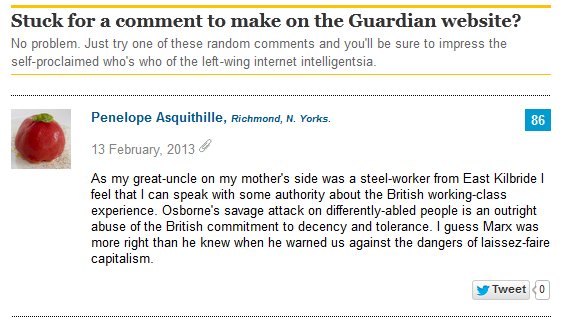
Can we get versions of this for the Toronto Star and National Post?

Filed under: Humour, Media — Tags: , — Nicholas @ 11:49

The Guardian-style comment generator:

Guardian-style comment generator

Amity Shlaes on Coolidge

Filed under: Books, History, Media, Politics, USA — Tags: , — Nicholas @ 11:21

Ed Driscoll has an interview with author Amity Shlaes at PJMedia:

MR. DRISCOLL: How long after finishing The Forgotten Man did you start work on Coolidge, and how did you do your research?

MS. SHLAES: I think I started working on Coolidge while I was writing The Forgotten Man because I wrote one draft of Forgotten Man, this history in the 1930s. And then I thought well, this doesn’t work narratively because I didn’t describe what the change was from; where they started, what were their premises. Their premises were the premises of the ’20s and, you know, the ’20s premises were maybe smaller government is better, maybe still the pendulum of government action, reduce uncertainty in the policy environment so that a business can go forward. All these ideas were ideas from the ’20s, and whose ideas were they? Well, they were Calvin Coolidge’s and before Coolidge, Harding’s ideas. But mostly Coolidge’s, I think he’s the hero of the ’20s.

So I went back at the very last minute with Forgotten Man and put Coolidge in and he felt just right. I really liked him. And I thought well, we don’t — we don’t appreciate him much and what I learned in that short look for writing the new beginning to Forgotten Man made me want to go back and give him his own show.

MR. DRISCOLL: Coolidge is sadly remembered today by many people for only one quote and that’s “The business of America is business,” which is actually a bastardization of what Coolidge really said. Could you place that quote into context?

MS. SHLAES: Yes, that’s from a nice speech to newspaper people, actually. And he says the chief business of America is business, and he also says the chief ideal of Americans is idealism. So there’s a yoking together of two concepts, if you go back and read the whole speech, and it’s not fair to paint him as a only capitalism or capitalism to the exclusion of other areas. He’s not like Ayn Rand, for example, because he always tends to bring in the spiritual — other spheres in — and he doesn’t think only capitalism always prevails. He sees a balance. What he doesn’t like is when capitalism or business intrudes upon spiritual. And that’s very different from modern libertarianism.

So anyway it’s all there and that’s — he was extremely idealistic and extremely spiritual, some would say pious. Herbert Hoover called him a fundamentalist, and that was not a compliment coming from Herbert Hoover.

The imaginary trade-off between ecology and economics

Filed under: Economics, Environment, Food, Media, Technology — Tags: , , — Nicholas @ 09:37

Matt Ridley on the improvements in the environment in the western world:

Extrapolate global average GDP per capita into the future and it shows a rapid rise to the end of this century, when the average person on the planet would have an income at least twice as high as the typical American has today. If this were to happen, an economist would likely say that it’s a good thing, while an ecologist would likely say that it’s a bad thing because growth means using more resources. Therein lies a gap to be bridged between the two disciplines.

The environmental movement has always based its message on pessimism. Population growth was unstoppable; oil was running out; pesticides were causing a cancer epidemic; deserts were expanding; rainforests were shrinking; acid rain was killing trees; sperm counts were falling; and species extinction was rampant. For the green movement, generally, good news is no news. Many environmentalists are embarrassed even to admit that some trends are going in the right direction.

[. . .]

Why are environmental trends mainly positive? In short, the gains are due to “land sparing,” in which technological innovation allows humans to produce more from less land, leaving more land for forests and wildlife. The list of land sparing technologies is long: Tractors, unlike mules and horses, do not need to feed on hay. Advances in fertilizers and irrigation, as well as better storage, transport, and pest control, help boost yields. New genetic varieties of crops and livestock allow people to get more from less. Chickens now grow three times as fast in they did in the 1950s. The yield boosts from genetically modified crops is now saving from the plow an area equivalent to 24 percent of Brazil’s arable land.

What is really making a positive dent in the environmental arena is the unintended effects of technology rather than nature reserves or exhortations to love nature. Policy analyst Indur Goklany calculated that if we tried to support today’s population using the methods of the 1950s, we would need to farm 82 percent of all land, instead of the 38 percent we do now. The economist Julian Simon once pointed out that with cheap light, an urban, multi-story hydroponic warehouse the size of Delaware could feed the world, leaving the rest for wilderness.

It is not just food. In fiber and fuel too, we replace natural sources with synthetic, reducing the ecological footprint. Construction uses less and lighter materials. Even CO2 emissions enrich crop yields.

Debunking the “1970s had a higher standard of living than today” meme

Filed under: Economics, Food, Health, Media, Technology, USA — Tags: , , , , — Nicholas @ 00:02

Don Boudreaux produces an anecdotal list of things that refute the inane notion that America’s standard of living peaked in the 1970s:

What follows here is drawn from memory. Perhaps my memory is grossly distorted, but my report of it here is an undistorted reflection of that memory. Here’s some of what I recall, of relevance to this discussion, from middle-class America of the 1970s; I offer the 25 items on this list in no particular order, except as they come to me.

(1) Automobiles broke down much more frequently than they break down today, hence, leaving motorists stranded, sometimes for hours, more often than is the case today.

(2) Automobiles rusted faster and more thoroughly than they do today.

(3) Someone in his or her early 70s was widely regarded as being quite old.

(4) “Old” people back then were much more likely to wear dentures than are “old” people today.

(5) Frozen foods in supermarkets were gawdawful by the standards of today – in terms both of quality and of selection.

[. . .]

(21) Coffee sucked. (It was almost all made from robusta beans.) And the selection of teas was pretty much limited to whatever Lipton sold.

(22) A diagnosis of cancer was far more frightening than it is today. Any person so diagnosed was regarded as being as good as dead.

(23) Going to college was much more unusual than it is today.

(24) Contact lenses were much more expensive than they are today. I purchased insurance (!) on my first pair of soft contact lenses (which I bought in 1980) in order to protect myself against the financial consequences of losing or damaging the one pair that I bought. (Such lenses were bought one pair at a time.)

(25) The idea of widespread use of personal computers seemed like science fiction. I very clearly recall overhearing, in the Spring of 1980, one of my economics professors, Wayne Shell (who also taught computer science), telling someone that he believed that, within a few years, many American households will have a computer. I thought at the time that Dr. Shell’s prediction was fancifully far-fetched.

I could go on, listing at least another 50 such recollections. But instead I’ll end this post here.

The Jazz Sweatshop (or the Harvard University of Jazz)

Filed under: History, Media, USA — Tags: , , — Nicholas @ 00:01

In the New York Review of Books, Christopher Carroll discusses the great Charles Mingus:

Mingus (1922-1979) would have turned ninety last year, and in celebration, Mosaic has released The Jazz Workshop Concerts: 1964-1965, a new box set with rare and previously unreleased performances by some of Mingus’s greatest ensembles. These concerts, recorded near the apex of Mingus’s career, are visceral and often unvarnished. At times, the music here can be forbidding — several tracks run beyond thirty minutes — and though it may not be as uniformly polished as some of his studio albums, at its best this set captures an element of shock and surprise that Mingus’s studio recordings sometimes don’t.

“Mingus music,” as he called it, was so complex and so much an extension of his own personality that it was largely played only by his own group, the Jazz Workshop. Turnover in the Workshop was high, partly because he couldn’t afford to pay his musicians very well, partly because the experience was so grueling (members called it the Jazz Sweatshop), and partly because so many of them, after sharpening their skills with Mingus, went on to lead their own bands (Gary Giddins once called it the Harvard University of Jazz).

Even with Mingus at the helm playing bass (and sometimes piano), Workshop performances often resembled practice sessions more than concerts. He did everything in his power to push his players beyond their limits: while a musician was soloing, he might double the tempo, cut it in half, or drop the accompaniment of the bass, drums, and piano entirely, all without warning. Often, players would buckle under the pressure and songs would grind to a halt, with Mingus screaming recriminations and heaping shame on everyone in sight. But sometimes his musicians would rise to the challenge, and it was the possibility of this transcendence that gave Jazz Workshop performances such an electrifying sense of expectation and adventure.

February 12, 2013

Calvin Coolidge — The Great Refrainer

Filed under: Books, History, Media, Politics, USA — Tags: , , , , — Nicholas @ 11:37

Amity Shlaes has written a new biography on President Calvin Coolidge, reviewed here by Gene Healy:

If there was ever a time when the president could simply preside, it has long passed. As early as the Eisenhower era, political scientist Clinton Rossiter observed that the public had come to see the federal chief executive as “a combination of scoutmaster, Delphic oracle, hero of the silver screen, and father of the multitudes.” Under the pressure of public demands, the office had accrued a host of responsibilities over and above its constitutional ones: “World Leader,” “Protector of the Peace,” “Chief Legislator,” “Manager of Prosperity,” “Voice of the People,” and more.

To that daunting portfolio add “Feeler-in-Chief,” a term coined in all earnestness by The New York Times‘s Maureen Dowd in 2010 while lashing out at Barack Obama for being insufficiently emotive about the BP oil spill. Obama, she wrote, had “resisted fulfilling a signal part of his job: being a prism in moments of fear and pride, reflecting what Americans feel so they know he gets it.”

Poor MoDo would have kicked the cat in sheer frustration if confronted by the implacable, inscrutable Calvin Coolidge, whose reaction to the job’s more unreasonable demands was a Bartleby-like “I prefer not to.”

[. . .]

Here was “a rare kind of hero: a minimalist president,” Shlaes argues. And though history remembers “Silent Cal” mostly for his reticence and frequent napping, Shlaes reminds us that “inaction betrays strength.” In politics, it’s often easier to “do something,” however unwise, than it is to hold firm: “Coolidge is our great refrainer.”

Alas, after Coolidge‘s elegant introduction, the sledding gets much tougher. Long stretches of this 456-page tome read like an info-dump from Shlaes’s clearly formidable research files. Like the hardscrabble farmers of Plymouth Notch, you need to set your jaw grimly and persevere through a long winter of sentences that should have been left on the cutting room floor, like: “Coolidge met with [Budget Director Herbert] Lord six times and reduced a tariff on paintbrush handles by half, his second cut that year, the other a reduction in duty on live bob quail.” Shlaes should have followed the example of her famously taciturn subject, who in his 1915 opening address as president of the Massachusetts Senate delivered a crisp little homily of 44 words, ending in “above all things, be brief.”

Still, the level of detail she provides inspires reflection on the vast gulf between today’s GOP and the grand party of old. Presidents Warren Harding and Calvin Coolidge cut taxes and shrank spending. They were pro-peace and anti-wiretapping. They embraced “normalcy” instead of stoking fear. And — go figure — they were also popular. Today’s Republicans could profit from studying their example.

« Newer PostsOlder Posts »

Powered by WordPress


