Quotulatiousness

November 21, 2020

About that “Canadian content crisis” the feds are trying to “fix” with Bill C-10

Filed under: Cancon, Government, Law, Media — Tags: , , , , , — Nicholas @ 03:00

Michael Geist begins a series of posts on the ongoing blunder that is the federal government’s “get money from the web giants” proposed legislation:

Canadian Heritage Minister Steven Guilbeault, 3 February 2020.
Screencapure from CPAC video.

Canadian Heritage Minister Steven Guilbeault rose in the House of Commons yesterday for the second reading of Bill C-10, his Internet regulation bill that reforms the Broadcasting Act. Guilbeault told the House that the bill would level the playing field, that it would establish a high revenue threshold before applying to Internet streamers, would not impact consumer choice, or raise consumer costs. He argued that even if you don’t believe in cultural sovereignty, you should still support his bill for the economic benefits it will bring, warning that Canadian producers will miss out on a billion dollars by 2023 if the legislation isn’t enacted. He painted a picture of Internet companies (invariably called “web giants”) that have millions of Canadian subscribers but do not contribute to the Canadian economy.

Guilbeault is wrong. He is wrong in his description of the bill (it does not contain thresholds), wrong about its impact on consumers (it is virtually certain to both decrease choice and increase costs), wrong about the contributions of Internet streamers (who have been described as the biggest contributor to Canadian production), wrong about level playing field claims (incumbent broadcasters enjoy a host of regulatory benefits not enjoyed by streamers), wrong about the economic impact of the bill (it is likely to decrease investment in the short term), and wrong about cultural sovereignty (it surrenders cultural sovereignty rather than protect it).

With the bill starting its Parliamentary review, this is the first in a new series of posts on why a careful examination of the data and the bill itself reveals multiple blunders. There are good arguments for addressing the sector, including tax reform, privacy upgrades, and competition law enforcement. There are also benefits to updating the Broadcasting Act, but in an effort to cater to a handful of vocal lobby groups over the interests of the broader Canadian public, Guilbeault’s bill will cause more harm than good. The series will run each weekday for the next month, first addressing the weak policy foundation that underlies Bill C-10, then a series a posts on the uncertainty the bill creates, a review of the trade threats it invites, and an assessment of its likely impact on consumers and the broader public.

The series begins with a post on the fictional Canadian content “crisis.” Canadians can be forgiven for thinking that the shift to digital and Internet streaming services has created a crisis on creating Canadian content. Canadian cultural lobby groups regularly claim that there is one (Artisti, CDCE) and Guilbeault tells the House of Commons that billions of dollars for the sector is at risk. Yet the reality is that spending on film and television production in Canada is at record highs. This includes both certified Canadian content and so-called foreign location and service production in which the production takes place in Canada (thereby facilitating significant economic benefits) but does not meet the narrow criteria to qualify as “Canadian.” I have written before about the need to revisit the Canadian content qualification rules which enable productions with little connection to Canada to receive certification and some that directly meet the goal of “telling Canadian stories” that fail to do so.

QotD: Using a “wokescreen”

Filed under: Media, Politics, Quotations, Religion — Tags: , , , , — Nicholas @ 01:00

To better understand the era we are living through, it might help to first understand the nature of the “wokescreen”. Like those billowy emissions of dry-ice in a 1980s pop video, this device is useful if you want to hide bad and egregious behaviour from public view.

It is, essentially, a new iteration of an old rule: the one stating that the person commonly to be found complaining most vociferously about a particular vice is the one disproportionately likely to be guilty of said vice.

Through decades past, this rule applied to people who were literally in the clerical class. It was, for instance (see the late Cardinal Keith O’Brien), the priest or bishop who denounced homosexuality in the most vociferous terms who would turn out to have their own peculiar interpretation of “the laying on of hands”, tending to revolve around the knees of young male seminarians.

And there is sense in this of course. Through overt displays of moral opprobrium, the petitioner imagines that everyone’s attention will be diverted. Through stressing their virtue overmuch, however, such people raise a perceptible flag to anyone with an eye for human hypocrisy.

Today, of course, the clerical class is not the clergy. It is generally a rich, massively protected, metropolitan and often corporate or corporate-backed class which poses as the defender and then enforcer of all the easiest, least-controversial causes of the time. These shift, naturally, but today a person who wishes to cloak themselves in virtue will talk up their “anti-racism” credentials; will talk about “feminism” as though women’s rights have only just occurred to them; they will stress their green credentials; and of course they will rush to the defence of anyone who claims to identify as a tree or a hedgerow and assert that said person’s right to so identify is not just ancient and long-established but biologically incontrovertible. All give off immense warning-signs.

Douglas Murray, “Do you know what a wokescreen is?”, UnHerd, 2020-08-13.

November 20, 2020

A Swedish Trilogy Pt. 3 – Return of the … King – Sabaton History 094 [Official]

Filed under: Europe, History, Media, Military, Russia — Tags: , , , , — Nicholas @ 04:00

Sabaton History
Published 19 Nov 2020

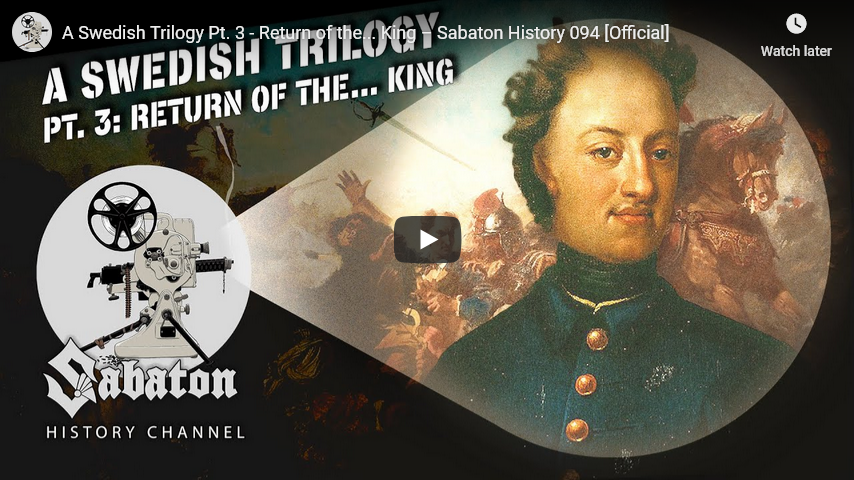
The defeat in the Battle of Poltava had shattered the Swedish Army of King Charles XII. Retreating south into the territory of the Ottoman Empire, the “Northern Paladin” becomes the honored guest of the Sultan. But Charles XII. is restless. Despite the comforts and luxury, he enjoys at the fortress of Bender, the King yearns for a chance to regain the initiative. More and more he gets involved in Ottoman politics, urging the High Porte to renew its enmities with the Russian Tsar. But even a famous King has to learn that hospitality has its limits.

Support Sabaton History on Patreon:
https://www.patreon.com/sabatonhistory

Listen to “Shadows” on the album Metalizer: https://music.sabaton.net/Metalizer

Listen to Sabaton on Spotify: http://smarturl.it/SabatonSpotify
Official Sabaton Merchandise Shop: http://bit.ly/SabatonOfficialShop

Hosted by: Indy Neidell
Written by: Markus Linke and Indy Neidell
Directed by: Astrid Deinhard and Wieke Kapteijns
Produced by: Pär Sundström, Astrid Deinhard and Spartacus Olsson
Creative Producer: Maria Kyhle
Executive Producers: Pär Sundström, Joakim Brodén, Tomas Sunmo, Indy Neidell, Astrid Deinhard, and Spartacus Olsson
Community Manager: Maria Kyhle
Post-Production Director: Wieke Kapteijns
Editor: Karolina Dołęga
Sound Editor: Marek Kamiński
Maps by: Eastory – https://www.youtube.com/c/eastory
Archive: Reuters/Screenocean – https://www.screenocean.com

Sources:
The Poltava Battle History Museum
Library o of Congress
Livrustkammaren
Nationalmuseum
Musée de l’Ermitage
Battle of Prut 1711 courtesy of Charles Alexis Gérard
Cannon by Graphic Nehar from the Noun Project

All music by: Sabaton

An OnLion Entertainment GmbH and Raging Beaver Publishing AB co-Production.

© Raging Beaver Publishing AB, 2019 – all rights reserved.

November 19, 2020

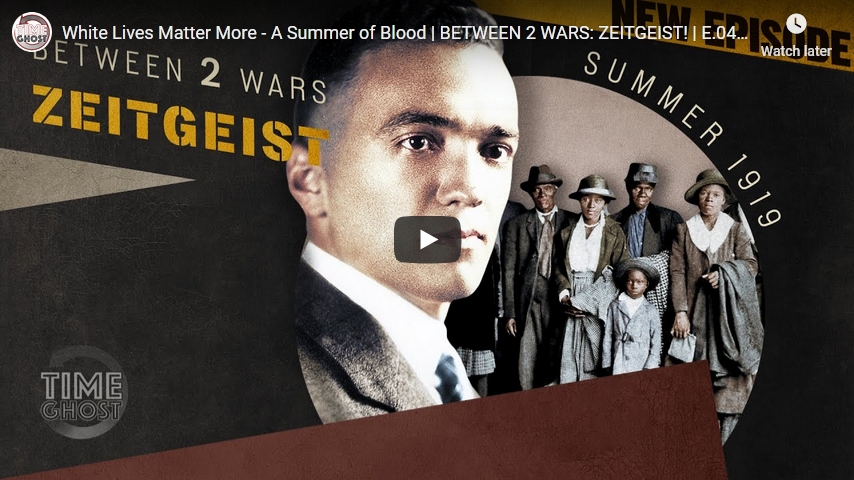
White Lives Matter More – A Summer of Blood | BETWEEN 2 WARS: ZEITGEIST! | E.04 – Summer 1919

TimeGhost History
Published 18 Nov 2020

Technology promises a better and more connected world in the summer of 1919. But battles still rage everywhere over who will inherit it.

Join us on Patreon: https://www.patreon.com/TimeGhostHistory

Subscribe to our World War Two series: https://www.youtube.com/c/worldwartwo…
Like TimeGhost on Facebook: https://www.facebook.com/TimeGhost-16…

Hosted by: Indy Neidell
Written by: Indy Neidell and Francis van Berkel
Director: Astrid Deinhard
Producers: Astrid Deinhard and Spartacus Olsson
Executive Producers: Astrid Deinhard, Indy Neidell, Spartacus Olsson, Bodo Rittenauer
Creative Producer: Maria Kyhle
Post-Production Director: Wieke Kapteijns
Research by: Indy Neidell and Francis van Berkel
Image Research by: Miki Cackowski and Michał Zbojna
Edited by: Michał Zbojna
Sound design: Marek Kamiński

Colorizations:
Mikołaj Uchman
Spartacus Olsson

Sources:
From the Noun Project: bridge by Adrien Coquet, Delete by Kevin Eichhorn, Fire by Sweet Farm, Model T by Alex Valdivia, people by Anastasia Latysheva, peoples by Musmellow, revolt by Symbolon, Smoke by Krish, people by Nithinan Tatah, explosion by Aldric Rodríguez

Archive by Screenocean/Reuters https://www.screenocean.com.

A TimeGhost chronological documentary produced by OnLion Entertainment GmbH.

From the comments:

TimeGhost History
21 hours ago
Four episodes into this new series and we think it’s going pretty well. Behind-the-scenes we have been getting ahead with our planning to make make things as laser-focused as possible and we have some pretty fascinating pieces of history we want to talk about.

But we know that there is always a learning curve with a new series and we care what our community thinks. It’s the TimeGhost Army who make our content possible so we’d like to hear from you what you think about Season Two of Between 2 Wars. What are you enjoying about it? Is there anything you think we should work on? How do you feel about Indy’s outrageous suits and ties?

November 18, 2020

Trudeau’s internet policy — cash grab or power grab? Embrace the healing power of “and” (TM Instapundit)

Filed under: Business, Cancon, Government, Media, Technology — Tags: , , , , , , — Nicholas @ 03:00

The Canadian government is taking advantage of the ongoing economic and social disruption of the Wuhan Coronavirus to widen their existing regulation of both broadcasting and internet entertainment. It’s not just a bit of maple-flavoured cultural imperialism, but it’s also a blatant cash grab:

Canadian Heritage Minister Steven Guilbeault, 3 February 2020.
Screencapture from CPAC video.

I see, in the Globe and Mail, that Justin Trudeau and Steven Guilbeault want to further regulate the broadcasting services in Canada. Their goals seem to be, in part, a cash grab ~ online streaming services, like Netflix, are offering Canadians, for a price, what they want, while the CBC offers Canadians, thanks to a $1+ Billion annual subsidy from taxpayers like you and me, what we, pretty clearly, do not want to watch and the Liberals want a share of that money ~ and also an appeal to those who play identity politics.

I think we need to look at the “products” of broadcasting ~ information (news and “public affairs” and documentary programmes) and entertainment, including sports, as “consumable products,” rather like food and, say, soft drinks.

We do allow, even demand that governments exercise some important regulatory functions in regard to food and soft drinks: we want to make sure that they are safe to consume and Canadians want to know what is in the food we consume.

The Canadian Radio-television and Telecommunications Commission (CRTC) was, originally, conceived to solve a fairly simple problem: allocating broadcast licences. Government engineers calculated how many radio channels could be used in any given place but they didn’t want to have to decide who should get to use them. Politicians didn’t want to do it, either, because while the successful applicant was (usually) happy the more numerous unsuccessful ones were disappointed and politicians hate to disappoint people. Thus they created an arms length agency to make the tough decisions for them. Licence allocation is still an important job for the CRTC. But the CRTC’s mandate was expanded with the birth of cable TV. Companies, like Rogers, built cable systems ~ and they received both direct and indirect government support to reach more and more Canadians ~ and then “sold” access to consumers. In the normal course of events one might have thought that the government would attach some business conditions to its loans, grants and tax deductions, but there was an ever-growing demand, from the Canadian cultural community ~ based almost entirely in Montreal and Toronto ~ to regulate the fledgling cable and “pay TV” market to ensure that Canadian programmes were not shut out but, in fact, could have privileged positions in the cable lineup, which led to the government, in the 1960s, telling the CRTC to regulate how companies like Famous Players, Maclean Hunter and Rogers configured the private product they sold to individual consumers.

The initial government argument was “we regulate all kinds of things for the common good: that’s why we all drive on the right, for example, and the delivery of broadcasting by cable is like that.” “No it’s not,” the cable operators replied, “you build and maintain the roads, using taxpayers’ dollars, so you’re allowed to regulate how they’re used, plus it’s a safety issue. Cable service and ‘pay TV’ are private, commercial transactions between us, the companies who built and operate the systems, and the individual consumer who wants to subscribe to what we offer. You don’t presume to regulate, beyond the laws against libel and pornography, what people can read in MacLean’s magazine or the Globe and Mail, why is ‘pay TV’ and cable different?” It’s still a good question. But the cable operators surrendered gracefully and the CRTC has been, broadly, for the last half-century, protective of the rights of incumbents in the infotainment markets. In return the cable and internet operators have agreed to “tiers” of programming which means that if you want to watch, say, BBC World Service or Deutsche Welle or Fox News, you must also pay for CBC News Network and CTV News Channel and, no matter who you are and what your individual preferences might be, when you subscribe to a cable/internet service you must also support a number of French stations/channels; it’s the law. And now Minister Guilbault wants to ensure that you pay for the output of indigenous producers, writers, actors and so on, on both indigenous networks ~ to which you must already subscribe if you have a “basic” Canadian cable or satellite TV package ~ and, it appears to me, in programmes produced by Canadians and even by Netflix.

November 15, 2020

Mark Steyn is looking for an argument

Filed under: Britain, Media, Politics, USA — Tags: , , , , — Nicholas @ 05:00

I somehow missed this when it went up on Mark’s website:

“Polling Place Vote Here” by Scott Beale is licensed under CC BY-NC-ND 2.0

One of Mrs Thatcher’s great insights was: First you win the argument; then you win the election.

To win the argument, you have to make it. In the Westminster system, you make the argument for three or four years, then you have a six-week election campaign. That’s when the system’s functioning, which it certainly wasn’t under, say, Andrew Scheer’s Tory leadership in Ottawa.

But, even when it’s not functioning, somebody’s making an argument. Thus the fatal miscalculation of David Cameron when he decided that the Brexit referendum would be the best way to put the EU issue to bed once and for all. By then every electorally viable political party — from the Tories to Sinn Féin — was “pro-Europe”. Nigel Farage had been making the argument for twenty years, but, because he had no real political party to advance it, it didn’t get him anywhere at UK general elections. So, the minute Cameron called a referendum on Nigel’s issue in splendid isolation, it gave Farage a shot at the second half of Maggie’s great formulation: He’d won the argument; and Cameron delivered up a mechanism that allowed him to win the vote.

In the American system, it is, as the Brits say, arse over tit: As Monty Python once asked, where’s the room for an argument? There are no parliamentary debates, so you never see a Dem senator going at it with a GOP senator. Even more strikingly, there are a bazillion political talk shows, none of which ever features a Dem senator going at it with a GOP senator — the way that even the most despised BBC, CBC, ABC yakfests routinely feature opposing legislators debating health care or the Irish backstop or Covid response.

Instead, there is a multi-billion-dollar two-year campaign, which is all polls, fundraising, horse race piffle, telly ads for the halfwitted, plot twists of no interest to anybody normal (ooh, look, Cory Booker is up from point-three to point-four in Iowa!), all culminating in a stilted pseudo-debate tediously moderated by a pompous mediocrity asking questions all framed from the left’s point of view. You’d almost get the idea that the entire racket was designed to eliminate the very possibility that someone might make an argument.

November 14, 2020

“… we all know that Wrong Opinions Are No Longer Allowed On The Internet”

Filed under: Health, Media, Politics — Tags: , , , , , , — Nicholas @ 05:00

Jen Gerson has some Wrong Opinions that she shared On The Internet, so Dr. Bradley Mitchelmore, BSc. (Pharm), ACPR, PharmD, RPh has has taken it upon himself to try to get her cancelled:

Firstly, to explain how this little gem fell into my lap, some context is required. While I was avoiding the interminably dull task of invoicing our fine writers of The Line the other day, I threw out a position that some might find controversial.

That is, I find the trend towards identifying women by terms like “birthing people,” “menstruators,” “front-hole possessors” and “uterus bearers,” to be both reductive and offensive. I have no objection to finding more inclusive language for circumstances in which we want to acknowledge trans and non-binary people (ie; a phrase like “pregnant people” seems clunky, but inoffensive to me); but to date, all of this new language reduces the class of “women” to either a biological function or a bodily part.

Pregnancy is a particularly sensitive topic for a lot of women because, for most of us, the process is terrifying. To go through childbirth is the most profound loss of bodily autonomy imaginable and many women I know struggle with the after effects of feeling as if we’ve been treated like interchangeable breeding sows by some doctors and nurses. If a doctor started calling me a “birther” or a “uterus-bearer” while stretching my cervix apart knuckles-deep with two fingers, my response would not be welcoming.

I also don’t think it’s a coincidence that linguistic shifts that re-frame an entire biological sex class as “breeders” only ever seems to target one sex. Very few well-intentioned and committed activists are waging war online over the definition of “men.”

A lot of this is misogyny gilded in progressive language. And very few women want to stand up to the misogyny on the “pro-woman” team, nor suffer the consequences of pissing that team off. So most stay silent until they see a tweet like the one above, at which point they flood my DMs with private statements of support and relief. I’m happy to serve as a psychological outlet in that regard, but I’ll show you in a moment why they’re so afraid to say what they think.

Anyway, this is all just my opinion. I’m not married to it. If the trend comes around to allowing us to call all “male-bodied” people “dicks,” I might reconsider the position entirely. But we all know that Wrong Opinions Are No Longer Allowed On The Internet and therefore a doctor jumped in with one of the most delightfully fatuous replies I’ve ever received.

November 13, 2020

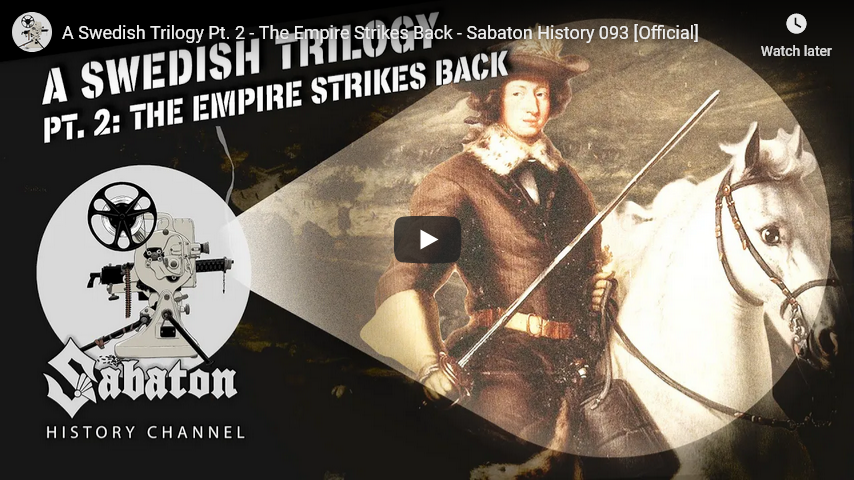
A Swedish Trilogy Pt. 2 – The Empire Strikes Back – Sabaton History 093 [Official]

Filed under: Europe, History, Media, Military — Tags: , , , , — Nicholas @ 04:00

Sabaton History
Published 12 Nov 2020

The Swedish Empire was on the verge of collapse. After years of mismanagement and neglect, King Charles XI. could only stand and watch as a huge Danish army invaded the realm from the south. Fortress after fortress fell in front of the Danish advance into Scania. With his back to the wall, King Charles XI. had only one option left: To fight! The Swedish Empire rallied its remaining forces and prepared to strike back with the fury of desperation. With the future of Sweden on the line, the two armies met on the frozen battlefield of Lund.

Support Sabaton History on Patreon: https://www.patreon.com/sabatonhistory

Listen to Sabaton on Spotify: http://smarturl.it/SabatonSpotify
Official Sabaton Merchandise Shop: http://bit.ly/SabatonOfficialShop

Hosted by: Indy Neidell
Written by: Markus Linke and Indy Neidell
Directed by: Astrid Deinhard and Wieke Kapteijns
Produced by: Pär Sundström, Astrid Deinhard and Spartacus Olsson
Creative Producer: Maria Kyhle
Executive Producers: Pär Sundström, Joakim Brodén, Tomas Sunmo, Indy Neidell, Astrid Deinhard, and Spartacus Olsson
Community Manager: Maria Kyhle
Post-Production Director: Wieke Kapteijns
Editor: Karolina Dołęga
Sound Editor: Marek Kaminski
Archive: Reuters/Screenocean – https://www.screenocean.com

Sources:
Nationalmuseum
Finnish National Gallery
Icons from The Noun Project: Cannon by Graphic Nehar, Skull by Muhamad Ulum, prisoner by Luis Prado
Song:You Might Have Heard of Me – Arthur Benson

Music by: Sabaton

An OnLion Entertainment GmbH and Raging Beaver Publishing AB co-Production.

© Raging Beaver Publishing AB, 2019 – all rights reserved.

Oddly, the Canadian media evince no interest whatsoever in the Trudeau government’s malign plans for the Internet

Filed under: Business, Cancon, Government, Media — Tags: , , , , , , — Nicholas @ 03:00

In The Line, Peter Menzies shows how little the mainstream media outlets in Canada care about the power grab the feds are attempting with their proposed “get money from web giants” shakedown:

Canadian Heritage Minister Steven Guilbeault, 3 February 2020.
Screencapure from CPAC video.

In order to understand where media and public attention has been the past couple of weeks, all you had to do was listen in on Monday morning’s Ottawa news conference.

Six days after Heritage Minister Steven Guilbeault had introduced ground-breaking legislation to regulate content online, Prime Minister Justin Trudeau announced more cash to bring better Internet to rural and remote communities. There were also some COVID-19 updates and something about help for agriculture.

And, of course, the questions asked by the media were about the U.S. election. What else could possibly be of interest?

Eventually there were a few inquiries about Telesat and low-Earth-orbit satellites, but you get the point: things that matter to people’s daily lives such as cable bills, data plans, Netflix, cellular service, crappy WiFi and slow Internet connections haven’t been of much interest to Canadian media lately.

So there has been a dearth of chatter about Guilbeault’s controversial plan to (my words, not his): restrict consumer choice, tax Netflix to finance certified Canadian content (Cancon) and bring to an end the greatest period of prosperity in the history of the Canadian film and television industry. Did I mention stifling innovation, increasing streaming subscription costs and scaring away investment? No? My bad. Those too.

Guilbeault has decided that the agency dedicated to defining the nation’s TV and radio diet — the Canadian Radio-television and Telecommunications Commission (CRTC) — is now going to be in charge of what you are allowed to dine on online as well. No longer will you be able to manage your preferences. No more popcorn and candy for you. Going forward, Cancon spinach and broccoli will be on your plate every evening. Breathtakingly, Guilbeault has “modernized” communications legislation by giving authority over the Internet to something called a “radio-television” commission by using something still called the “broadcasting” act.

November 12, 2020

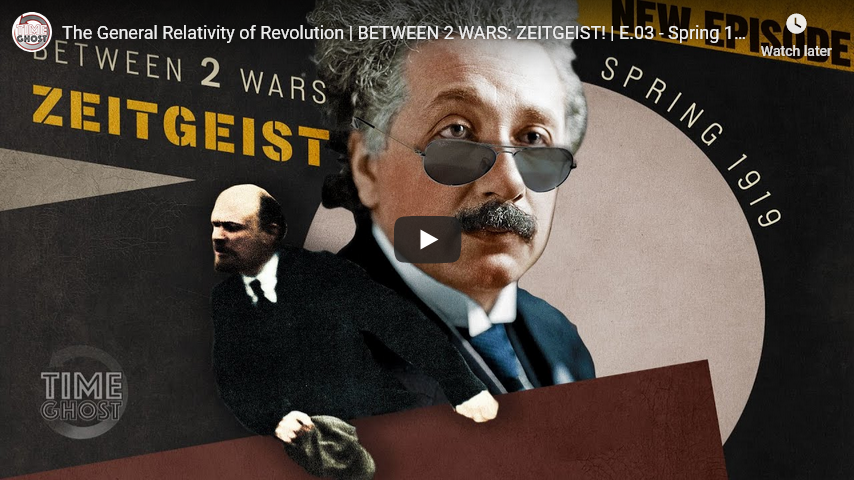
The General Relativity of Revolution | BETWEEN 2 WARS: ZEITGEIST! | E.03 – Spring 1919

Filed under: Architecture, Germany, History, Media, Russia, Technology, USA — Tags: , , , , — Nicholas @ 04:00

TimeGhost History
Published 11 Nov 2020

It is a springtime of revolution throughout the world in 1919 and not just the political kind. Era-defining advances in science and technology and iconic cinematography are made this season.

Join us on Patreon: https://www.patreon.com/TimeGhostHistory

Hosted by: Indy Neidell
Written by: Indy Neidell and Francis van Berkel
Director: Astrid Deinhard
Producers: Astrid Deinhard and Spartacus Olsson
Executive Producers: Astrid Deinhard, Indy Neidell, Spartacus Olsson, Bodo Rittenauer
Creative Producer: Maria Kyhle
Post-Production Director: Wieke Kapteijns
Research by: Indy Neidell and Francis van Berkel
Edited by: Michał Zbojna
Sound design: Marek Kamiński

Colorizations:
Klimbim
Mikołaj Uchman
Wayne Degan
metacolor.org

Sources:
Library of Congress
Bundesarchiv
Icons from The Noun Project:
– retro computer By Tinashe Mugayi, MY
– audio sound recorder By Vectors Point, PK
– Radio by Bill Denk
– Old TV By Pascal Heß, DE
– Radio Tower by Iris Sun

Soundtracks from Epidemic Sound:
– “British Royalty” – Trailer Worx
– “Flight Path” – Cobby Costa
– “Deflection” – Reynard Seidel
– “Flight Path” – Cobby Costa
– “A Single Grain Of Rice” – Yi Nantiro
– “Trapped in a Maze” – Philip Ayers
– “Symphony of the Cold-Blooded” – Christian Andersen
– “Rainy Landscapes” – Farrell Wooten
– “Ancient Saga” – Max Anson

Archive by Screenocean/Reuters https://www.screenocean.com.

A TimeGhost chronological documentary produced by OnLion Entertainment GmbH.

From the comments:

TimeGhost History
1 day ago
J’accuse is one of the many iconic films we’ll explore in this series. The interwar period is when European cinema really starts to hit its stride again after some serious setbacks during the Great War. In those years, American cinema rocketed to the mainstream both at home and abroad, with revolutionary filmmaking techniques being developed that we still see today such as close-ups, huge cast lists, and realistic set design.

The post-Great War is set to be a great era in the history of cinema and not just because of the films themselves, J’accuse and other films are important as historical movers in their own right! They shape public perceptions, influence political change, and inspire whole social movements, so make sure you stay tuned to find out.

And in the meantime, are there any iconic interwar films you think deserve to be in this series?

November 7, 2020

Trump-supporting ethnic minorities were “enacting a form of white mimicry, or ‘white adjacency'”

Filed under: Media, Politics, USA — Tags: , , , , , , — Nicholas @ 03:00

In The Line, Kaveh Shahrooz looks at the accusations among the ultra-woke that members of ethnic minorities in the United States who voted for Trump can no longer be considered ethnic minorities and are guilty of variant forms of white supremacy:

Did self-hating racist Hispanic and Black people help Donald Trump? Did sexist women stop the promised Democratic blue wave?

Those may seem like bizarre questions, but according to the woke left, the answer is: yes.

A new narrative began to emerge on election night, after it became clear that Miami-Dade County — a heavily populated area in southern Florida — would go to Trump, thus preventing an early Joe Biden blowout. To the woke left’s chagrin, it was Trump’s significant support among Miami-Dade’s Hispanic voters, namely those in the Cuban-American and Venezuelan-American communities, that kept the state in the Republican column.

In a direct challenge to the widely held belief that Trump’s presidency is the result of a simple racist white patriarchal backlash, the incumbent president actually increased his support among Latinos, black males, Muslims, and Native Americans on election night. He also appears to have maintained much of his support among women.

To compensate for this cognitive dissonance, standard bearers of the woke left explained this phenomenon by implying that these ethnic minorities were enacting a form of white mimicry, or “white adjacency.” First out of the gate was the New York Times journalist Nikole Hannah-Jones, fresh off the controversy surrounding her 1619 Project, who tweeted that “white Cubans” should not be lumped in with “Black Puerto Ricans and Indigenous Guatemalans.”

Insofar as ethnic communities should not be assumed to share political interests simply because they speak the same language and come from roughly the same broad geographic region, it is hard to disagree with her. But her point was not anything nearly so straightforward. As she made clear in subsequent tweets, she believes that the Miami Cubans should more accurately be viewed as white because they sit atop “racial hierarchies based on whiteness.”

November 6, 2020

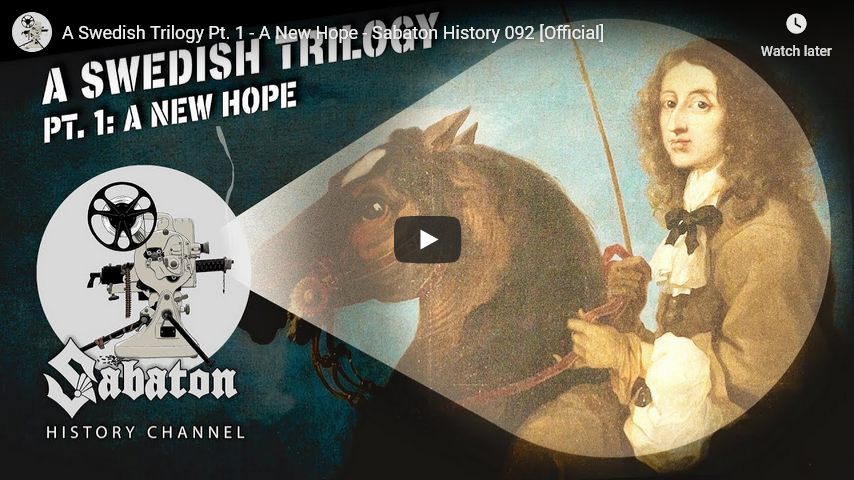
A Swedish Trilogy Pt. 1 – A New Hope – Sabaton History 092 [Official]

Filed under: Europe, History, Media, Military — Tags: , , , , , — Nicholas @ 04:00

Sabaton History
Published 5 Nov 2020

The Swedish nation was in turmoil, as news spoke of King Gustavus Adolphus’ death on the battlefield of Lützen in 1632. The Lion from the North was slain — but who would reign in his stead? Gustavus had fathered a young daughter, the 6-year old Christina. Torn between a grief-stricken Queen Mother and the overbearing duties to monarchy and country, Christina grew into an unhappy and troubled woman. Much was expected of her, as she was still the daughter of the legendary warrior-king. But was she able and willing to continue his legacy? Or would she rather forsake her throne in order to find her own future far away from Sweden?

Support Sabaton History on Patreon: https://www.patreon.com/sabatonhistory

Listen to Sabaton on Spotify: http://smarturl.it/SabatonSpotify
Official Sabaton Merchandise Shop: http://bit.ly/SabatonOfficialShop

Hosted by: Indy Neidell
Written by: Markus Linke and Indy Neidell
Directed by: Astrid Deinhard and Wieke Kapteijns
Produced by: Pär Sundström, Astrid Deinhard and Spartacus Olsson
Creative Producer: Maria Kyhle
Executive Producers: Pär Sundström, Joakim Brodén, Tomas Sunmo, Indy Neidell, Astrid Deinhard, and Spartacus Olsson
Community Manager: Maria Kyhle
Post-Production Director: Wieke Kapteijns
Editor: Karolina Dołęga
Sound Editor: Marek Kaminski
Archive: Reuters/Screenocean – https://www.screenocean.com

Sources:
– Nationalmuseum
– Statens Museum for Kunst
– Livrustkammaren
– Herzog Anton Ulrich Museum
– Swedish capture of Kauzenburg 1631 colorized by Dextwin

All music by: Sabaton

An OnLion Entertainment GmbH and Raging Beaver Publishing AB co-Production.

© Raging Beaver Publishing AB, 2019 – all rights reserved.

QotD: When you use a racist lens, everything looks like racism

Filed under: Books, Media, Politics, Quotations, USA — Tags: , , , , — Nicholas @ 01:00

[White Fragility author Robin] DiAngelo uses similar techniques to support her second core theory that all white people are racist. For example, DiAngelo lays another trap that makes it impossible for white people to speak ill of any neighborhood with high crime rates in which many people of color reside. When DiAngelo’s friends warned her not to buy a home in neighborhoods with relatively high crime rates and poorly rated schools, DiAngelo later discovered that the neighborhoods had a high percentage of black and brown residents. From this, she concluded that her friends’ warnings were racially motivated and that “my fellow whites had communicated the racial boundaries to me.” Did you spot the trap?

If DiAngelo’s friends had told her not to live in the neighborhoods because they had black and brown residents, she could call them out for overt racism. But even when her friends made no mention of race whatsoever, DiAngelo attributed their warnings to racism as well. There was no way for her friends to mention the neighborhood’s high crime rates without DiAngelo finding them guilty of racism.

DiAngelo also supports her theory that all white people are racist by interpreting ambiguous events to support her conclusions, despite other plausible explanations. In one anecdote, DiAngelo describes an incident in which a white female teacher had two black students at her desk. The teacher prefaced something she said with the word “girl.” One student felt that the use of the word “girl” was racist. The other student disagreed, saying that the teacher called all her students “girl” regardless of their race.

Any reasonable person would conclude that if the teacher called every student — white, black, Asian, Latinx — “girl,” the teacher’s use of the word resides somewhere between “not racist” and “open to interpretation.” But DiAngelo reached a different conclusion, demonizing the teacher’s lack of concern for the offended student’s feelings, and calling the teacher arrogant for thinking the use of “girl” was not racist. To be clear, while teachers should listen to their students’ concerns, there is no proof this teacher’s word choice was racially motivated. And ironically, DiAngelo is guilty of everything she criticizes the teacher for because DiAngelo arrogantly ignores the other black student who did not think the comment was racist.

David Edward Burke, “The Intellectual Fraud of Robin DiAngelo’s White Fragility“, The Logical Liberal, 2020-06-13.

November 5, 2020

America on the Brink of Revolution? | BETWEEN 2 WARS: ZEITGEIST! | E.02 – Winter 1919

Filed under: Britain, Business, France, History, Media, USA — Tags: , , , , , , , — Nicholas @ 04:00

TimeGhost History
Published 4 Nov 2020

There is revolution and fear of revolution throughout the world in the winter of 1919. But cultural and technological revolutions are also bringing hope to many. A new age of Jazz and Cinema is about to reach America and Europe.

Join us on Patreon: https://www.patreon.com/TimeGhostHistory

Hosted by: Indy Neidell
Written by: Indy Neidell, Francis van Berkel, and Spartacus Olsson.
Director: Astrid Deinhard
Producers: Astrid Deinhard and Spartacus Olsson
Executive Producers: Astrid Deinhard, Indy Neidell, Spartacus Olsson, Bodo Rittenauer
Creative Producer: Maria Kyhle
Post-Production Director: Wieke Kapteijns
Research by: Indy Neidell, Francis van Berkel, and Spartacus Olsson.
Archive Research: Daniel Weiss
Edited by: Daniel Weiss
Sound design: Marek Kamiński

Colorizations:
Daniel Weiss – https://www.facebook.com/TheYankeeCol…
Mikołaj Uchman
Norman Stewart – https://oldtimesincolor.blogspot.com/

Sources:

From the Noun Project:
– Money by Gilberto
– lightbulb By Maxim Kulikov

Soundtracks from Epidemic Sound and ODJB:
– “One More for the Road” – Golden Age Radio
– “The Last Journey” – Line Neesgaard
– “Tiger_Rag” – ODJB
– “Not Safe Yet” – Gunnar Johnsen
– “Please Hear Me Out” – Philip Ayers
– “Dark Shadow” – Etienne Roussel
– “The Inspector 4” – Johannes Bornlöf
– “I Won’t Give You Up” – Almost Here
– “The Charleston” – Macy’s Voice
– “Defeated” – Wendel Scherer

Archive by Screenocean/Reuters https://www.screenocean.com.

A TimeGhost chronological documentary produced by OnLion Entertainment GmbH.

From the comments:

TimeGhost History
2 days ago (edited)
As in life, this series will always be a curious balance of light and dark. In the winter of 1919, one Parisian might have tickets to see the Original Dixieland Jass Band while their neighbour lies destitute after the war, and a well-to do man in Glasgow might be at the cinema while tanks rolls into his city to quell industrial unrest.

Troubled and fascinating times then and troubled fascinating times now here in 2020. All of us here at TimeGhost hope that all of you are healthy and staying safe. And hey, if you need some entertainment to pass the time, you can find plenty of Between 2 Wars episodes alongside WW2 In Real Time and BIO Specials!

November 4, 2020

The replication crisis in all fields is worse than you imagine

Filed under: Media, Science — Tags: , , , — Nicholas @ 03:00

It may sound like a trivial issue, but it absolutely is not: scientific studies that can’t be replicated are worthless, yet our lives are often impacted by these failed studies, especially when politicans are guided by junk science results:

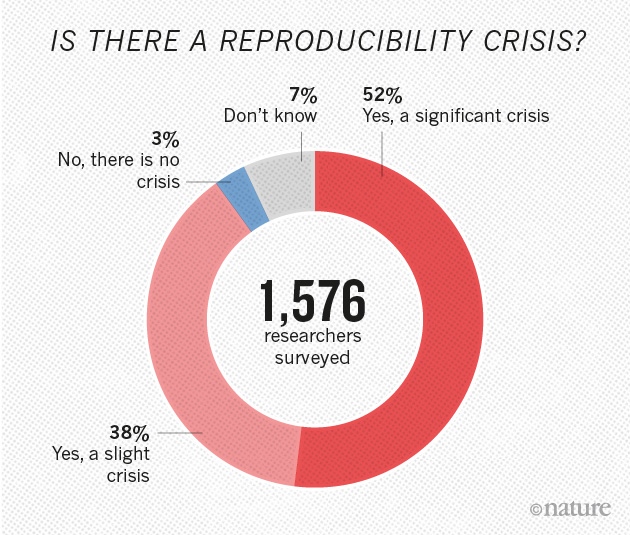
More than 70% of researchers have tried and failed to reproduce another scientist’s experiments, and more than half have failed to reproduce their own experiments. Those are some of the telling figures that emerged from Nature‘s survey of 1,576 researchers who took a brief online questionnaire on reproducibility in research.

The data reveal sometimes-contradictory attitudes towards reproducibility. Although 52% of those surveyed agree that there is a significant ‘crisis’ of reproducibility, less than 31% think that failure to reproduce published results means that the result is probably wrong, and most say that they still trust the published literature.

Data on how much of the scientific literature is reproducible are rare and generally bleak. The best-known analyses, from psychology and cancer biology, found rates of around 40% and 10%, respectively. Our survey respondents were more optimistic: 73% said that they think that at least half of the papers in their field can be trusted, with physicists and chemists generally showing the most confidence.

The results capture a confusing snapshot of attitudes around these issues, says Arturo Casadevall, a microbiologist at the Johns Hopkins Bloomberg School of Public Health in Baltimore, Maryland. “At the current time there is no consensus on what reproducibility is or should be.” But just recognizing that is a step forward, he says. “The next step may be identifying what is the problem and to get a consensus.”

Failing to reproduce results is a rite of passage, says Marcus Munafo, a biological psychologist at the University of Bristol, UK, who has a long-standing interest in scientific reproducibility. When he was a student, he says, “I tried to replicate what looked simple from the literature, and wasn’t able to. Then I had a crisis of confidence, and then I learned that my experience wasn’t uncommon.”

The challenge is not to eliminate problems with reproducibility in published work. Being at the cutting edge of science means that sometimes results will not be robust, says Munafo. “We want to be discovering new things but not generating too many false leads.”

« Newer PostsOlder Posts »

Powered by WordPress