
When I was in college, “grunge” was all the thing … except for the really cool alterna-kids, who were going through a Sixties retro phase. As much as I hate to think of anyone taking their cultural cues from Bill Clinton, that’s what happened. 1988-2001 was the great swan song of Boomerism; Bill Clinton was their avatar; Forrest Gump their valedictory (and, really, what could possibly sum up the Baby Boomers better than the story of a simpleton who lucked into a starring role in the greatest, wealthiest, healthiest, freest society on earth … then fucked it up and threw it all away on some dumb broad, because they were too goddamn stupid to see what they were doing? Hillary Clinton being the dumb broad in question).
If that’s harsh on the Boomers, well, sorry, Moonbeam — History don’t care about your feelings. But “the Sixties” isn’t the gravest charge History can lay against you. This is: After all that, you gave the world us, Gen X, the Dumbest Generation of Narcissists in the History of the World. Yes, you guys are responsible for both “Rocky Raccoon” and “Smells Like Teen Spirit.”
Severian, “The Look”, Rotten Chestnuts, 2020-10-09.
February 7, 2021
QotD: The greatest sin of the Baby Boomers
February 4, 2021
The New World: A Beautiful Mess
Atun-Shei Films
Published 3 Feb 2021A review of the Terrence Malick film The New World, a lavish and beautifully shot historical epic that nonetheless falls short in a few important ways.
Support Atun-Shei Films on Patreon ► https://www.patreon.com/atunsheifilms
Leave a Tip via Paypal ► https://www.paypal.me/atunsheifilms
Buy Merch ► teespring.com/stores/atun-shei-films
#TerrenceMalick #Jamestown #Pocahontas
Original Music by Dillon DeRosa ► http://dillonderosa.com/
Reddit ► https://www.reddit.com/r/atunsheifilms
Twitter ► https://twitter.com/atun_shei

February 2, 2021
When the self-defined elites achieved class consciousness
At Rotten Chestnuts Severian adds to his ongoing series of posts identifying areas where Marx was right:
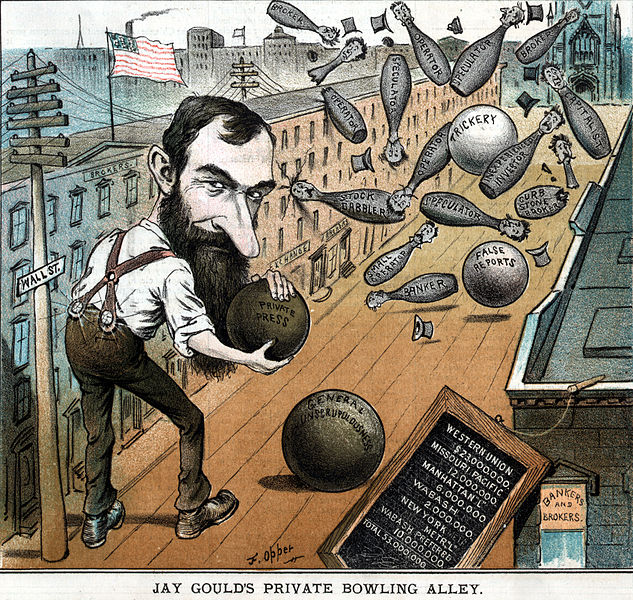
“Jay Gould’s Private Bowling Alley.” Financier and stock speculator Jay Gould is depicted on Wall Street, using bowling balls titled “trickery,” “false reports,” “private press” and “general unscrupulousness” to knock down bowling pins labeled as “operator,” “broker,” “banker,” “inexperienced investor,” etc. A slate shows Gould’s controlling holdings in various corporations, including Western Union, Missouri Pacific Railroad, and the Wabash Railroad.
From the cover of Puck magazine Vol. XI, No 264 via Wikimedia Commons.
… I liken Karl Marx to one of those bird-masked medieval Plague doctors — he sees the pathology clearly, indeed far faster and better than anyone else, but his proposed “cure” is far likelier to kill you than the actual disease. Worse, what makes Marx’s cure especially lethal is what ends up making his diagnosis essentially right: It’s a self-fulfilling prophecy.
The proletariat is achieving class consciousness, all right — look no further than the GameStop “short squeeze” for proof. But the only reason the proles are achieving class consciousness is because the “capitalists” forced them to, just like Marx said they would. The Elite and the Bureaucracy (usually, but not always, a distinction without a difference) finally achieved class consciousness through the combination of NAFTA and the Louvre Accords. Starting around 1990, then, the Elite self-consciously embraced their role as rootless, stateless, jet-setting parasites (with the wannabe-Elites in the Media, academia, and the bureaucracies signing up for tours of duty as fart-catchers, both to bask in reflected glory and in hopes of being promoted).
In short, our “Capitalists” — really, “financial-ists” or “spreadsheet gangsters,” since they don’t actually make anything, they just bust out existing firms via debt manipulation — behave exactly as Marx described factory owners behaving all the way back in the First Industrial Revolution.In my naivete, I used to think Marx’s ranting was hyperbole. I cited the example of Andrew Carnegie — a real bastard in his youth, who went on to be one of the world’s great philanthropists. That’s human behavior, I said, as opposed to the bloodthirsty caricature of Marx’s fantasies … but I was wrong, comrades. Carnegie happily would’ve sold his fellow Americans down the river, just as Bezos, Gates, and the rest of the pirates-in-neckties are happily selling us down the river now. Only two things prevented it back then: one structural, one cultural.
The structural one is simply technology, and therefore uninteresting. Britain’s “free traders” — you know, the Jardine-Matheson types who started the Opium Wars for fun and profit — would’ve happily outsourced Britain’s entire industrial base to China if they hadn’t been hampered by wind speed. By the time this was technically feasible — which is about 1860, if you’re keeping score — simple inertia had taken over. They didn’t retool until they had to, at which point instant communications and modern ships … well, you know the rest. Like I said, it’s vital, but boring.
The cultural one is much more interesting. You might be tempted to say, as I did, that Jardine and Matheson were always on the lookout for #1, of course, but were sincere British patriots for all that, just as Carnegie for all his faults was an authentic American. I doubt it, comrades. I sincerely doubt it. What kept these guys in check wasn’t patriotism, or even culture. Rather, it was fear.
The History of Hollywood
The Cynical Historian
Published 3 Sep 2020This episode is about the history of Hollywood, and it’s quite a long one. This is part 9 in a long running series about California history.
————————————————————
references:
Bernard F. Dick, Engulfed: The Death of Paramount Pictures and the Birth of Corporate Hollywood (Lexington: The University Press of Kentucky, 2001). https://amzn.to/3f2Yb0SHollywood’s America: United States History Through its Films, eds. Mintz, Steven and Randy Roberts (St. James, N.York: Brandywine Press, 1993). https://amzn.to/2tZIoJT
Richard Slotkin, Gunfighter Nation: The Myth of the Frontier in Twentieth-Century America (New York: Atheneum Books, 1992). https://amzn.to/2KX0jI2
Kevin Starr, Inventing the Dream: California through the Progressive Era, (Oxford, U.K.: Oxford University Press, 1985). https://amzn.to/2VPTbVX
————————————————————
Support the channel through PATREON: https://www.patreon.com/CynicalHistorian
or by purchasing MERCH: teespring.com/stores/the-cynical-hist…LET’S CONNECT:
Twitch: https://www.twitch.tv/cynicalhistorian
Discord: https://discord.gg/Ukthk4U
Twitter: https://twitter.com/Cynical_History
Subreddit: https://www.reddit.com/r/CynicalHistory/————————————————————
Wiki: By 1912, major motion-picture companies had set up production near or in Los Angeles. In the early 1900s, most motion picture patents were held by Thomas Edison’s Motion Picture Patents Company in New Jersey, and filmmakers were often sued to stop their productions. To escape this, filmmakers began moving out west to Los Angeles, where attempts to enforce Edison’s patents were easier to evade. Also, the weather was ideal and there was quick access to various settings. Los Angeles became the capital of the film industry in the United States. The mountains, plains and low land prices made Hollywood a good place to establish film studios.
Director D. W. Griffith was the first to make a motion picture in Hollywood. His 17-minute short film In Old California (1910) was filmed for the Biograph Company. Although Hollywood banned movie theaters — of which it had none — before annexation that year, Los Angeles had no such restriction. The first film by a Hollywood studio, Nestor Motion Picture Company, was shot on October 26, 1911. The H. J. Whitley home was used as its set, and the unnamed movie was filmed in the middle of their groves at the corner of Whitley Avenue and Hollywood Boulevard.
The first studio in Hollywood, the Nestor Company, was established by the New Jersey–based Centaur Company in a roadhouse at 6121 Sunset Boulevard (the corner of Gower), in October 1911. Four major film companies – Paramount, Warner Bros., RKO, and Columbia – had studios in Hollywood, as did several minor companies and rental studios. In the 1920s, Hollywood was the fifth-largest industry in the nation. By the 1930s, Hollywood studios became fully vertically integrated, as production, distribution and exhibition was controlled by these companies, enabling Hollywood to produce 600 films per year.
Hollywood became known as Tinseltown and the “dream factory” because of the glittering image of the movie industry. Hollywood has since become a major center for film study in the United States.
————————————————————
Hashtags: #history #Hollywood #California

Well, it is a very, very cunning plan …
In the latest Libertarian Enterprise, Sarah Hoyt explains why the progressives’ cunningest of cunning plans may not be cunning enough:

The left has a plan so cunning that if it were a person, it would be teaching cunningology at Oxford. And the ones who get the reference will also know that their plan is about to go pear shaped in all sorts of interesting ways, and at the end of it there might very well be a turnip or two involved, but not as the only item available in the shelves of the grocery store.
Look, someone pointed out in the comments the left are trying to follow the “plan” for other communist revolutions round the world.
He’s right. They’re trying to follow it to the letter. Partly because it’s worked before, and partly, because to be fair, they’re a cult, and cults don’t know the reason for the ritual, they just follow it.
… but it’s already going wrong. And it’s only going to get worse.
You see, part of the problem is that the cult of communism and the procedures for “the revolution” were set in the early twentieth century. And it’s designed for the early twentieth century. To the extent they worked in places like Venezuela, it is because the underlying structures of the society were still very much “early twentieth century.”
The US? Well, not so much. In fact we never were much like the early twentieth century in Europe, which is why they’ve had a hell of a time getting a foothold here.
The communist revolution is designed to work in a country that is mostly urban, with a vast urban underclass that can’t rise above for reasons both internal and external despite working unreasonable hours. It’s designed for a country with a firm aristocracy of the hereditary sort (even if that aristocracy is often from trade), it is designed for a country with a conscript army where the plum assignments go to the “good families” as a matter of course, it is designed to work — most of all and very importantly — in a country where they ABSOLUTELY control all the means of mass communication and do so without the vast majority of the people being aware of it.
The last time they could have pulled that off in the US was in the mid seventies. And my guess, honestly, is that they tried. I don’t know for sure, since the news of the time were all reported by biased sources, and besides I’m too lazy and too busy […] to spend my day chasing down hints. I bet they did try, though. I bet they gave it a sporting try. And I bet part of the issue back then — as now, btw — is that they were pinning their hopes on a race war, having both not realized how much of a minority people of African descent are in the US (last estimate is what? 14%? Sizeable, sure, but not a large minority and certainly not a majority. Also, and seriously, a lot of that minority is middle class and whatever they voice from the mouth-out as uninterested as the rest of us in having the apple cart overturned. Apples are tasty. Genocide not so much.) Mostly because that sh*t was so successful in Africa, and again the left doesn’t think. It ritualistically applies “what worked” without being able to account for changed conditions.
Anyway, that was the last time they could have MAYBE credibly have followed their little red map to revolution and have it work. And even then Americans were just too darn contrarian. Why everyone and their parents were telling us that Republicans were so dangerous, that they were going to start the nuclear war, that — And we went and voted Reagan in. (Well, not me. I only worked towards it. I didn’t vote. I wasn’t a citizen and I’m not a democrat.)
In fact, America could have engraved on its door lintel “authorities can go f*ck themselves.” The left keeps forgetting that. And sometimes justifiably. Take their Covid-psy-ops. It worked. And it was all run on the “experts” and how important it was.
Uh uh. So, they think their control is back! They’re golden again, baby!
QotD: Why “artistes” defended Roman Polanski before #MeToo
There’s a good deal of perplexity being expressed about this, and some predictable chuntering from right-wingers about lefties being moral degenerates. But this flap isn’t really about politics at all — it’s much simpler than that. It’s about people who think of themselves as “artistes” reserving themselves a get-out-of-jail card when they feel like behaving like repellent scum of the earth, too.
[…]
If you want to make that argument, Roman Polanski makes a great stake in the ground — not in spite of the heinousness of his crime, but because of it. If even a child-raper can invoke the all-purpose artiste excuse for scumminess, than the merely ordinary transgressions of artistes become trivia to be airily dismissed. And if the Polanski case becomes a “teachable moment” whereby people can be talked into feeling like boors or philistines for even thinking that artistes should be held to civilized standards of behavior, so much the better!
None of this is more than tenuously connected to leftism, and I have to say the the right-wing efforts to gin up indignation on that score sound quite contrived and stupid to me. This dispute isn’t about politics, it’s about privilege — not just whether Roman Polanski is above the law, but about whether his defenders can claim to be too.
Eric S. Raymond, “Why artists defend Roman Polanski”, Armed and Dangerous, 2009-09-29.
January 31, 2021
Adapting Noël Coward’s Blithe Spirit for the screen – “The ensuring film has all the light charm and witty élan of a documentary about slaughterhouses”
At The Critic, Alexander Larman is not happy with the latest attempt to translate a Coward play to the big or small screen:
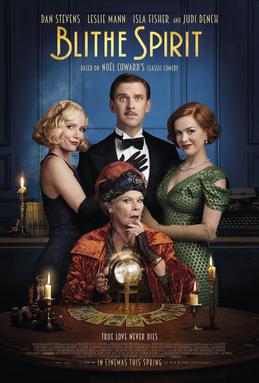
Original theatrical release poster.
Wikimedia Commons.
Recently, the new film of Noël Coward’s masterly play Blithe Spirit was released on various streaming services, after its cinematic release was cancelled due to the irritating absence of open cinemas to show it. I had been looking forward to it for some time. It had a fine cast of hugely talented comic actors, led by Dan Stevens and including Isla Fisher, Leslie Mann, Julian Rhind-Tutt, and, in the great role of the fraudulent medium Madame Arcati, none other than Judi Dench. It was directed by Peter Hall’s talented son Edward, and its inspiration remains one of the most uproariously entertaining plays of the twentieth century, complete with some of Coward’s finest dialogue. It would be hard to mess it up.
Alas, “messed up” is an understatement when it comes to describe what has happened to the film. A clue comes in the credit: “adapted by Piers Ashworth, Meg Leonard and Nick Moorcroft”. The three of them were previously responsible for the mediocre sea-shanty comedy (not words one often writes) Fishermen’s Friends, and Ashworth and Moorcroft should be prosecuted at the cinematic equivalent of the Hague for their shameful bastardisation of Ronald Searle’s St Trinian’s series into two terrible films that bear as much relation to Searle’s illustrations as they do to Noël Coward. So it is little surprise that they have decided to “improve” on the original play. The writers throw out most of the original dialogue, retain only the bare bones of the storyline, introduce an irrelevant and mawkish subplot for Madame Arcati (who is now bewilderingly played mostly straight) and generally commit artistic vandalism.
The ensuring film has all the light charm and witty élan of a documentary about slaughterhouses. The cast do their best with the terrible material, but as Stevens manfully tries to make lines about erectile dysfunction amusing – “Mr Peasbody’s got stage fright” – the look of deep shame that occasionally comes over their faces cannot be disguised by the over-bright lighting and incongruously jaunty music. Had it been given a cinematic release, there may well have been indignant walkouts and outraged complaints at the box office. As is, I doubt that many disappointed viewers, expecting a more enjoyable film, will bother watching this travesty to the end.
QotD: Sixties music wasn’t what you think it was
Tom Jones is great, I love his stuff, but he’s not going to melt your face with his guitar riffs, and he’s there at #8, right in front of “Build Me Up, Buttercup.” Which is one hell of a catchy tune, and compared to “Love Theme from Romeo and Juliet” (#15) it’s practically Slayer, but rock it ain’t. Ray Stevens is at #61, for pete’s sake, with “Guitarzan.” If that hasn’t convinced you that The Sixties were nothing like they show in the movies (and that maybe the Viet Cong deserved to win), I don’t know what would.
Severian, “Entertainers (III): Hair Metal Attains Nirvana”, Rotten Chestnuts, 2020-10-08.
January 28, 2021
Blade Runner 1921?! – Robot Apocalypse Now | B2W: ZEITGEIST! | E.10 – Winter 1921
TimeGhost History
Published 27 Jan 20201Modern technology promises a lot, but it can also bring unprecedented horror. This season, the people of Czechoslovakia get to see that for themselves.
Join us on Patreon: https://www.patreon.com/TimeGhostHistory
Hosted by: Indy Neidell
Written by: Francis van Berkel
Director: Astrid Deinhard
Producers: Astrid Deinhard and Spartacus Olsson
Executive Producers: Astrid Deinhard, Indy Neidell, Spartacus Olsson, Bodo Rittenauer
Creative Producer: Maria Kyhle
Post-Production Director: Wieke Kapteijns
Research by: Francis van Berkel
Edited by: Michał Zbojna
Sound design: Marek KamińskiColorizations:
Daniel Weiss – https://www.facebook.com/TheYankeeCol…
Mikołaj Uchman
Norman Stewart – https://oldtimesincolor.blogspot.com/
Mikołaj Cackowski
KlimbimSources:
Some images from the Library of Congress
Bibliotheque nationale de FranceIcons from The Noun Project:
– noun_Sound_3530255
– Microphone by Agung Cahyo sSoundtracks from Epidemic Sound:
“Epic Adventure Theme 3” – Håkan Eriksson
“I Am Unbreakable” – Niklas Johansson
“Waiting like the Storm” – Rand Aldo
“Le Chat Noir 1” – Martin Landh
“A Single Grain Of Rice” – Yi Nantiro
“Alleys of Buenos Aires” – Tiki Tiki
“Age Of Men” – Jo WandriniArchive by Screenocean/Reuters https://www.screenocean.com.
A TimeGhost chronological documentary produced by OnLion Entertainment GmbH.
From the comments:
TimeGhost History
1 day ago (edited)
Episode 10 of the series and for the first time we’re looking at a decidedly negative outcome that people imagined might come with further technological progress. Over 100 years later and it’s still something people are fearful of, and it often feels like Artificial Intelligence providing a real threat to humanity’s existence is just around the corner.We’d be interested to know what you guys all think. Is there a chance that something along the lines of what Čapek imagined actually happening? Let us know in the comments.
NOTE: Unfortunately an error has snuck into this week’s episode. The portrait that is supposed to show Herbert Hoover is in fact of his son, Herbert Hoover Jr. We are working on getting this fixed as fast as possible, and we apologize for the inconvenience in the meantime.

QotD: Art for art’s sake
Severian, “The Entertainer”, Rotten Chestnuts, 2020-10-08.
January 27, 2021
Behind the Scenes of WW2 – TimeGhost Cribs
World War Two
Published 26 Jan 2021This week we will start a series of videos where you get to know the team that makes this magnificent content.
Join us on Patreon: https://www.patreon.com/TimeGhostHistory
Or join The TimeGhost Army directly at: https://timeghost.tvFollow WW2 day by day on Instagram @ww2_day_by_day – https://www.instagram.com/ww2_day_by_day
Between 2 Wars: https://www.youtube.com/playlist?list…
Source list: http://bit.ly/WW2sourcesHosted by: Indy Neidell & Spartacus Olsson
Director: Astrid Deinhard
Producers: Astrid Deinhard and Spartacus Olsson
Executive Producers: Astrid Deinhard, Indy Neidell, Spartacus Olsson, Bodo Rittenauer
Creative Producer: Maria Kyhle
Post-Production Director: Wieke Kapteijns
Edited by: Karolina Dołęga
Sound design: Marek KamińskiA TimeGhost chronological documentary produced by OnLion Entertainment GmbH.

January 25, 2021
QotD: Indira Gandhi’s exploitation of the goddess Kali
Indira Gandhi — the daughter of one of the freedom movement’s protagonists Pandit Nehru and India’s first and only female prime minister — chose consciously to co-opt this divinity in service of burnishing her own self-image. Indeed, during her first spell in office, from 1966-1977, Indira’s image was as prolific as the colourful printed pictures of the tantric goddess splashed across India’s towns and bazaars. Her appearance was, understandably, more benign. But in India’s jostling visual marketplace her image — big smile and bobbed black hair shot with a streak of white framed by a demure uttariya (veil) — was as inescapable as any deity’s.
Indira played the demagogue superbly. But just as her popularity among Indians soared, and her political confidence grew, those around her began equating her strong, intolerant, and cold politics with female divinities and their overwhelming powers. According to a hugely contentious apocryphal story, Indira’s young rival Atal Bihari Vajpayee, who would go on to succeed her as prime minister, was so overcome by devotion at the sight of her gallantry during India’s war with Pakistan in 1971 that he called her Ma Durga — Kali’s mother.
Cleo Roberts, “Indira Gandhi: a gift from the gods?”, The Critic, 2020-10-15.
January 24, 2021
The dangers of depending on “experts”
David Warren considers the vastly expanded role of “experts” in our public discourse:

Having no degree in either field, I try not to write what will be contradicted by an expert. On the other hand, “expert” has become a murky concept. Once we had to distinguish only between demonstrated credible experts, and villains. Common sense could usually tell them apart. But with the growth of our “sophistication,” the category of villainy has been much expanded. We have a category of institutionally credentialled experts who aren’t exactly liars, but more like what Harry G. Frankfurt defined as “bullshitters.” They struggle to remain plausible, but are using their expertise to advance interested views. And, having such motives — in opposition to the plain pursuit of truth — they seek publicity, and angle to obtain it.
As Dr Frankfurt hinted, in his short philosophical treatise on this topic (On Bullshit, 2005), these can be, and usually are, more trouble than old-fashioned liars. For a real liar knows he is lying, and can be caught out. By comparison, the modern media expert avoids what is strictly checkable, not only to protect himself, but from indifference for truth. He is, according to me, the intellectual descendant of the mediæval Nominalists, adumbrating words, not realities. While less intelligent than his predecessors, he carries on the tradition of saying that something is true because he says so.
“Consensus science” is of this nature. In it, truth can be negotiated, or imposed. While the weather next Saturday will be known to the living, a prediction for much later in the century has no meaning. From the number of variables in play, I can tell you with certainty, that woke “climatologists” are talking bosh; and every signature on their consensus I may add to my list of persons to ignore. This is elementary stuff: and I do try to stick to what is elementary, and foreseeable.
The success rate, for elaborate predictions, remains, at this point in our history, zero-point-zero. But it is becoming so also for the present, and past. The Batflu, here, is current primary example. Owing to obvious manipulation, we cannot know much about its effects. In rough terms, we can know that they are exaggerated, because almost every expert has a vested interest in getting the numbers up, and those who disagree will be punished. The same is true for all the popular remedies, including such nonsense as mangle-wearing, and obsessive social distancing. No legitimate research lies behind either, so we must assume the purposes for various lockdown orders are not actually the Batflu.
January 23, 2021
Scott Alexander returns
Having been driven from his original blog due to a doxxing threat from a New York Times reporter, Scott Alexander has resumed his public blogging, this time on Substack:

Welcome to Astral Codex Ten! Some of you are probably veterans of my old blog, Slate Star Codex. Others may be newbies wondering what this is all about.
I’m happy to finally be able to give a clear answer: this is a blog about ṛta.
Ṛta is a Sanskrit word, so ancient that it brushes up against the origin of Indo-European languages. It’s related to English “rationality” and “arithmetic”, but also “art” and “harmony”. And “right”, both in the senses of “natural rights” and “the right answer”. And “order”. And “arete” and “aristos” and all those other Greek words about morality. And “artificial”, as in eg artificial intelligence. More speculatively “reign” and related words about rulership, and “rich” and related words about money.
(also “arthropod”, but insects creep me out so I’ll be skipping this one)
The dictionary defines ṛta as “order”, “truth”, or “rule”, but I think of it as the intersection of all these concepts, a sort of hidden node at the center of art and harmony and rationality and the rest. What are the laws of thought? How do they reveal themselves, at every level, from the flow of electricity through the brain to the flow of money through the global economy? How can we cleave to them more closely, for our own good and the good of generations still to come?
In practice, articles (another ṛta relative!) here tend to focus on reasoning, science, psychiatry, medicine, ethics, genetics, AI, economics and politics. The political posts sometimes stray into choppy waters, and I have immense sympathy for people who are sick of that and prefer to pass.
As with most Substack blogs, it’s a subscriber-supported effort with limited public posts available to non-paying subscribers (like me).
QotD: “Genetics is interesting as an example of a science that overcame a diseased paradigm”
Genetics is interesting as an example of a science that overcame a diseased paradigm. For years, basically all candidate gene studies were fake. “How come we can’t find genes for anything?” was never as popular as “where’s my flying car?” as a symbol of how science never advances in the way we optimistically feel like it should. But it could have been.
And now it works. What lessons can we draw from this, for domains that still seem disappointing and intractable?
Turn-of-the-millennium behavioral genetics was intractable because it was more polycausal than anyone expected. Everything interesting was an excruciating interaction of a thousand different things. You had to know all those things to predict anything at all, so nobody predicted anything and all apparent predictions were fake.
Modern genetics is healthy and functional because it turns out that although genetics isn’t easy, it is simple. Yes, there are three billion base pairs in the human genome. But each of those base pairs is a nice, clean, discrete unit with one of four values. In a way, saying “everything has three billion possible causes” is a mercy; it’s placing an upper bound on how terrible genetics can be. The “secret” of genetics was that there was no “secret”. You just had to drop the optimistic assumption that there was any shortcut other than measuring all three billion different things, and get busy doing the measuring. The field was maximally perverse, but with enough advances in sequencing and computing, even the maximum possible level of perversity turned out to be within the limits of modern computing.
(This is an oversimplification: if it were really maximally perverse, chaos theory would be involved somehow. Maybe a better claim is that it hits the maximum perversity bound in one specific dimension)
Scott Alexander, “The Omnigenic Model As Metaphor For Life”, Slate Star Codex, 2018-09-13.


