
SO YOU’RE SAYING CELEBRITIES ARE A CULTURE PROBLEM?
Well, actually, I’m asking.
Are celebrities one of the reasons our culture is now so chaotic and unstable?
There is a strong case for “yes”.
For starters, celebrities have many flaws.
They can be self centered, as when Madonna was asked to celebrate Aretha Franklin. She referenced herself more than 50 times, and Ms. Franklin 4 times.
They can be naive, as when Gal Gadot lead a sing-along with fellow celebrities from the comfort and protection of their beautiful homes. She now agrees this was “in poor taste”.
Celebrities are not durable. That’s our our fault. We raise them up and we strike them down. And because we have the attention span of a French monarch, their moment in the spot light is fleeting. But it means our relationship with them is often fleeting.
Celebrities are vulnerable. Being a celebrity is incredibly perilous. Living in the very thin air up there, no mortal should wish for this. So celebrities suffer. They have break downs. They slide into drug dependency and bad relationships. At this point it is hard for them to be exemplars. Unless of course we are struggling too.
But here’s the key reason to treat celebrities as a culture problem.
In the course of the 20th century, celebrities ate their way through Western society, consuming or discrediting any and every elite that dared compete with them.
In this period, people still cared about scientists and other experts. They saw editors, publishers, judges, and professors as figures of authority. They admired and sought to emulate people of exalted social standing. They looked to religious leaders to address the big issues of the day. Artists, a few of them, were consulted. Designers, some of them, were gods.
This is mostly gone. Celebrities brought them low. It’s not clear that they meant to. It’s more likely that the simply won the popularity contest of contemporary culture.
We could choose between (nearly) dead white males, cranky, pipe smoking, vest wearing, utterly pompous creatures who would occasionally stoop to correct us. Or we could go with the effortlessly charismatic, blindingly beautiful, funny, endearing, eager-to-please people. I mean just look at the people in the “selfie” above. You can’t help but be wowed. Game, set and match to the movie star.
Celebrities remind me of the Rem Koolhaas library in Seattle.
This never fails to make me think of a mechanical monster that’s just crawled out of Seattle’s Elliot Bay and climbed the hill looking for lunch.
That’s what celebrities did. They came up out of the lagoon and helped themselves to all the culture they could find. They just ate everything.
It started with children’s books. They had to write em. Then it was lines of perfume and clothing. They had to design em. Then of course it was politics. How could we possibly do without em? Most of the people running for office in the US are now strikingly attractive. Some of them could actually be part-time models. This is the celebrity effect.
But here’s the other reason that the celebrity influence might be a cause of our instability. It is that they have colonized our young. There are lots of ways of making this argument, but I think “exhibit A” is probably TikTok. This platform matters because it mints celebrity. And that matters because a fifteen year old typically believes he or she matters in exact proportion to his or her fame.
Grant McCracken, “Culture Problem: celebrities”, Future Watch: an anthropological pov, 2022-03-17.
June 18, 2022
June 17, 2022
Oikophobia run rampant
In the New English Review, Theodore Dalrymple considers the prevalence of oikophobia in western culture:
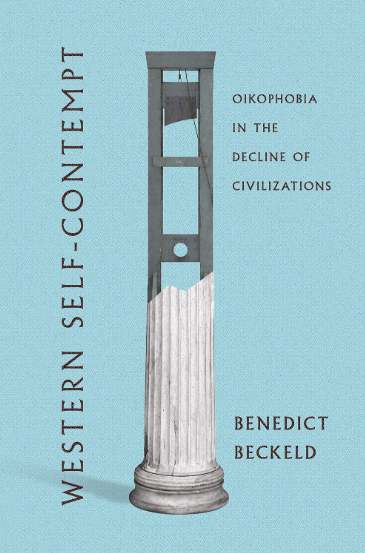
In an article for the American Mind, Daniel Mahoney draws our attention to a recent book on the phenomenon of oikophobia, the dislike or even hatred of one’s own country or culture, which now seems so prevalent in western academic and intellectual circles as to be almost an orthodoxy or requirement for acceptance into the intellectual class. Of course, no social trend or phenomenon is entirely new or has an indisputable starting point: for example, George Orwell drew attention to English self-hatred many years ago. But the spread of oikophobia has been of epidemic proportion in late years.
It seems to me that Mr. Mahoney’s analysis can be extended. The first question to ask is why oikophobia should now be so prevalent. To this, I should tentatively reply that it is because of the mass intellectualization of society consequent upon the spread of tertiary education. Intellectuals have an inherent tendency to be oppositional to all received opinion or feeling, for there is no point in going to the trouble of being an intellectual if one ends up thinking and feeling what the great mass of the people around one think and feel. Love of country and inherited custom is so commonplace as to appear almost normal or natural, and much of it, of course, is unreflecting.
But intellectuals are supposed to reflect. That is their function, and they are inclined to reject received opinion, not because it is wrong but because it is received. It goes without saying that received opinion can be wrong and even wicked or evil, in which case the strictures of intellectuals are necessary and salutary; but intellectuals themselves may promote wrong or even wicked opinions, partly from the a priori need to distinguish themselves from the run of mankind.
The phobia in oikophobia is the fear of being taken for one of the common run of mankind.
The second question about oikophobia is the old one of cui bono? Again, one must not confuse the psychological or social origin or function of an opinion with its justification or correctness in the abstract, but once one has decided that an opinion is mistaken or deleterious in its effect, it is natural to ask where it comes from and what interests it serves.
In my opinion, oikophobia is generally bogus, that is to say insincere, as is its cognate, multiculturalism. The oikophobe and the multiculturalist are not really interested in other cultures, except as instruments with which to beat their fellow citizens. The reason for their lack of real interest in other countries is not difficult to find and is of very common application. The fact is that it is very difficult genuinely to enter into a culture, or subculture, other than one’s own, even when that culture or subculture is close to or adjacent to one’s own.
The dark side of Tim Berners-Lee’s statement “When something is such a creative medium as the web, the limits to it are our imagination”
In The Critic, Tom Farr wonders about the wider meaning of the Eugenia Cooney story:
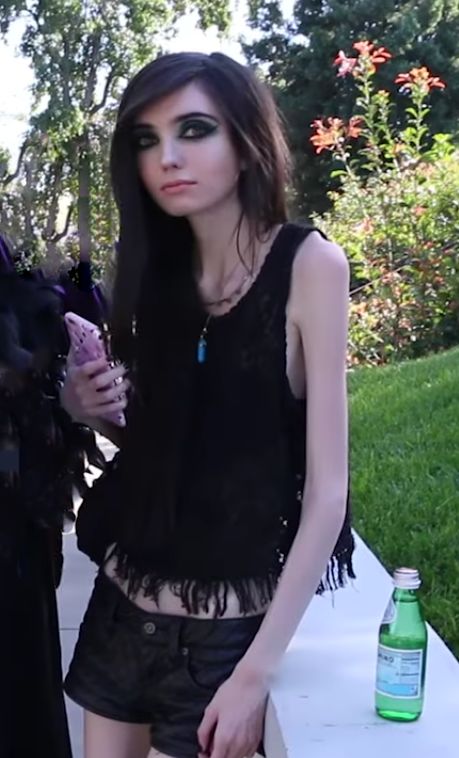
Eugenia Cooney in 2016.
Photo by Lilg54g – CC-BY-SA 4.0 via Wikimedia Commons.
Journalist and author Mandy Stadtmiller shared a new article last week on her excellent Substack series Rabbitholed entitled: “Why is Jeff Bezos Allowing Millions of Teenage Girls to Watch the Severely Anorexic Influencer Eugenia Cooney Slowly Kill Herself On Stream?”
The article itself received widespread attention for its harrowing coverage of the story of Eugenia Cooney, a 20-something Twitch streamer and YouTuber, who has built a global fanbase off vlogs featuring her cosplaying, and giving makeup and beauty tips amongst other things, as well as her distinctive early 2000s emo aesthetic.
Cooney is also severely anorexic. As Stadtmiller’s article succinctly explains:
Cooney’s horrific skeletal appearance is documented lavishly by her sick and enabling mother, Debra Cooney, who is seemingly keeping her daughter trapped and isolated at home with almost no contact with the outside world outside of the online predatory men who pay her daughter tips to spin around, crawl around on the floor, act like a cat and show how weak she is when trying to lift things.
Whilst Cooney’s story warrants attention, that isn’t the purpose of this article. In order to understand fully the social apparatus that allows and encourages Cooney’s mother to disturbingly parade her young daughter around for tens of thousands of digital voyeurs, no better explanation can be found than the one that actually answers Stadtmiller’s original question: Just why is Jeff Bezos allowing millions of teenage girls to watch Eugenia Cooney slowly kill herself on stream?
Whilst Jeff Bezos could and should be skewered for his role in amassing grotesque, Scrooge McDuck levels of wealth at the expense of anyone with the temerity to want to use the toilet during their working hours, in this instance he is merely a symptom of a deeper rot that has taken hold of our society, aided in part by the explosion of the internet in the late 90s.
Sir Tim Berners-Lee, the founder of the World Wide Web, once said: “When something is such a creative medium as the web, the limits to it are our imagination.” Berners-Lee was not wrong, but it would be unfair to stick him with the responsibility for what the depraved depths of some individuals’ “imagination” have conjured up in the subsequent decades since the web’s mass adoption.
Those of us who grew up in the 90s and early 2000s — ostensibly the first generation to be exposed from an early age to the internet in its more rudimentary form – will surely remember the sporadic emergence of individual “shock videos”: from the fairly benign (“Meatspin”, anyone?) to videos of murder (“Three Guys One Hammer”), the internet was a developing digital territory that its early adopters were still testing the limits of. These videos were occasionally linked to entire websites that would host videos depicting varying degrees of degeneracy, but they operated mainly in the darker corners of the web, reliant on people sending links to each other on MSN with a description that would lull the recipient into a false sense of security in order to get them to click on it.
Such content ran, if not explicitly then certainly conceptually, parallel to another early-2000s meme: Rule 34. In short, Rule 34 stated: “Rule #34 There is porn of it. No exceptions.” It doesn’t really require Einstein’s intellect to parse what was meant by this aphorism: as the porn industry was finding its footing in the new digital age, the type of pornographic content that was readily available was also breaking new ground. Initially, those shock videos existed in a slightly separate orbit to that of more mainstream pornography, but their intersection was by no means a rarity, even in those early days. This somewhat grimly operates as the perfect example of Berners-Lee’s observation that the creativity fostered by the internet is only constrained by our collective imaginations.
June 16, 2022
Paul Wells takes in a current movie … and likes it
I’ve never been much of a movie-goer, even before the neverending pandemic lockdown theatre landed on us in 2020, so the chances of me going to see something like Top Gun: Maverick were pretty low (especially as I never bothered to watch the original, back in the day). Paul Wells is in the middle of a European trip, so he did what every travelling North American would do somewhere on the continent of history and culture: he watched a current-release American movie:

The mystery of Maverick is why, by next weekend, it will pass Doctor Strange in the Convolution of Fan Service as the year’s biggest movie, why it is the biggest film of Tom Cruise’s charmed life — why it strikes such a chord in this moment, even though its premises, visual vocabulary and soundtrack are 36 years old. In terms of chronological distance from the original Top Gun, it’s as though the top-grossing movie of 1986 had been a sequel to 1950’s Annie Get Your Gun. (“And there has never been a star as sensational as Betty Hutton!” Annie‘s trailer proclaims. Switch Tom Cruise in for poor Betty and suddenly the claim may actually be true.)
The simplest hypothesis is that Maverick is just big and loud, so you can leave your brain at home and enjoy the spectacle. But lots of lousy movies nobody watched were big and loud, including Matrix: Resolutions and Ghostbusters: Afterlife, so there must be some fuller explanation.
This being a Substack newsletter, I suspect I’m contractually encouraged to argue that Maverick wins because it isn’t woke. I’m afraid I can’t oblige. I mean, the movie definitely makes only the barest acknowledgment of taking place in the 21st century. None of the hotshot young recruits pauses from the action to specify their pronouns. None decorates their flight helmets with empty square brackets to acknowledge their privilege. The film’s few concessions to cultural change since the MTV era have the effect, not of engaging today’s fights on provocatively old-fashioned terms, but of declining to engage. Joseph Kosinski, the journeyman special-effects technician brought in to direct this film in note-perfect homage to the style of the original Top Gun director Tony Scott, doesn’t even bother to make the film’s racial politics as minimally complex as Scott did in 1995’s Crimson Tide. Maverick‘s young recruits, diverse in gender and ethnicity, are awesomely interchangeable in every other way. One smirks, one has a moustache; the others have no identifying characteristics. (When half the recruits get cut from the big mission at the 90-minute mark, there is no dramatic payoff because it’s impossible to tell these people apart. “Sorry, Component A, I’ve decided to go with Component B.”) Nobody under 30 in this film has sex for either pleasure or procreation. Yearning for intimate touch is plainly something only old people do, like writing in cursive script or owning books.
As a cultural argument, Maverick is so close to being tabula rasa that there’s no real point interrogating it. But on another front, it succeeds resoundingly in popular art’s primary function of tantalizing simplification. It started to make sense when I realized that Cruise’s character, despite the denial inherent in his call sign, is a career civil servant.
This is a movie about the action of a large modern state. It’s a film about public policy. Its central claim is a cathartic feat of Avengers-level denial. Just as the superhero movies offer us a made-up universe in which we have any hope of telling the good characters and the evil characters apart, Maverick posits a world in which modern governments can get anything done at all.
I may be influenced in this reading by the fact that I work in contemporary Ottawa. I’ve been writing variations on a simple question — Can Justin Trudeau get big things built? — since 2017. I’m hardly alone. And it’s hardly just a question about Trudeau, Ottawa or Canada. It’s been fun reading about chaos at Toronto’s Pearson airport, but last week the Financial Times ran a “big read” feature story about global airport chaos that didn’t even mention Pearson, Toronto or Canada. Joe Biden promised to Build Back Better. It’s not going great. Here in France, Emmanuel Macron is the first president to be re-elected in 20 years, a genuine feat, but it’s not going great. Brexit? Don’t ask.
A generic term for the ability of governments to do stuff is “state capacity”, and there’s a vague sense in the quasi-academic literature that it’s in decline, although, the real world being the real world, every element of this claim — that state capacity is declining, that it can be measured, that it even exists in any measurable form — is open to dispute. Still, it feels true, don’t it? The world was never great. In important ways it was worse than today. But it used to feel like it was possible to improve the thing, and now it just feels like everyone’s just firing blind and hoping for the best. COVID is a dynamite demonstration of this. Three successive Canadian federal health ministers were told, by a prime minister who prides himself on his ability to read the room, to get cracking on plain-paper packaging for tobacco products. And then the biggest public-health disaster of our lifetimes opened up its jumbo can of whup-ass, and it wasn’t even in the mandate letters. And it’s hard to blame anyone involved. All the chaos that has ensued had its roots in the original chaos. Real life doesn’t have a plot. As Homer Simpson said, it’s just a bunch of stuff that happens.
QotD: The Guardian and “capitalism”
It’s practically a rule. If a Guardian contributor drinks too much, eats too much, buys too many shoes … well, obviously, they’re the victim because consumerist peer pressure somehow made them do it against their will, such as it is. The premise is generally “capitalism made me fat”, followed by “capitalism made me anxious about being fat”, followed by “tax such-and-such to buggery, or ban it altogether, and then I’ll be thin”.
David Thompson, from the comments to “Reheated (55)”, DavidThompson.com, 2019-04-01.
June 15, 2022
When adult responsibilities become overwhelming, the retreat into childish things beckons … hence the cultural dominance of “British Twee”
Ed West isn’t a fan of Britain’s universal adoption of “British Twee” as an escape from the burdens of “adulting” (as the Millenials call it):

James Marriott wrote about the phenomenon in the Times last week; noting the strangeness of seeing a drone corgi in the sky at the Jubilee, he felt “awe at this almost imperial triumph of twee”.
“Once culturally marginal — a series of aesthetic mannerisms associated with greetings cards and downmarket children’s books — twee is now the establishment style”, he wrote: “When the Queen was presented to her subjects at the coronation 70 years ago, the emphasis was on dignity and mystery: uniformed soldiers, a naval review, the BBC’s cameras forbidden from capturing the sovereign’s face in close-up. In the 1950s, this was still the language of power: formal, pompous, sternly detached. Parading for the Queen in 2022 were Teletubbies, a man in a Shaun the Sheep costume, women dressed as afternoon tea, a towering motorised cake.
“Twee is now a cultural default; the distinctive style of our age. Our emojis, gifs and memes will mark us as surely to the generations of the future as the wing collars, tailcoats and elaborate ceremonies of social deference marked our ancestors. Grown-up men and women love Disney and Harry Potter.”
Twee is egalitarian, anti-highbrow and obsessed with childhood, he says. “A love of childish things is a mark of democratic taste and an aversion to pomposity. Britain, with its long (often admirable) tradition of anti-intellectualism is especially vulnerable.”
Marriott concludes that “I can’t bring myself to hate Paddington and corgis but twee can be as oppressive as the formal, serious culture that preceded it. If our ancestors denied themselves the silly, child-like side of human nature, we now ourselves deny its solemn and difficult aspects. Twee is an aesthetic for an age uninterested in ethical complexity, which prefers good and bad as neatly separated as they are at Hogwarts. It fits the childish behaviour of social media’s most active users who swing between condemnatory temper tantrums and cooing over anthropomorphised animal.”
He also notes how twee has been “appropriated by powerful corporations” because “it’s easier to rip someone off with a smiling wide-eyed chatbot.” In my experience, the more informal and “I’m yer mate” a service provider is, the worse it treats its customers.
And that applies to social classes, too; the more informal a ruling elite behaves, the less they care about boring old customs, the less they can be trusted to do the right thing for the people they’re supposed to lead.
Tweeness is terrible, but there’s a particular indefinable, British kind of twee, which is infuriating but hard to articulate. British Twee, or British Cringe, is not so much a definable illness as more like a cluster of symptoms.
Cockwomble, as explained by Ben Sixsmith, is British Twee. Needless posh swearing is very British Twee; used sparsely, swearing is very effective, especially by people with RP accents; used liberally, it’s cringeworthy, especially when discussing politics. The post-referendum anti-Brexit campaign was filled with British Twee, mixing both a loathing of the country with an assumption of cultural superiority, all done in a self-consciously frivolous way.
This kind of Twee British Cringe, because it’s at once both self-hating and also uniquely self-obsessed, seems to suppose that certain British things are uniquely terrible — the awfulness of our government, or the prejudice of our great unwashed — but certain British things are uniquely brilliant and envied, such as the BBC and NHS, not to mention our famous sense of humour.
British Twee is the patriotism of the soft-left. While consciously anti-nationalist, this kind of tweeness is obsessed with defining British national character and values. This reaches its peak with pride about Britain’s universal healthcare, something enjoyed by literally every developed country except the United States.
June 13, 2022
The idealized EU that British “Remainers” still long for
The Brexit debate was at least as much a cultural as it was an economic or political struggle. Many of the people who wanted the UK to remain within the European Union would be instantly comfortable as members of Canada’s Liberal or New Democratic parties, as our “Laurentian elite” are culturally much more attuned to their European elite counterparts than they are to ordinary Canadians. British “Remainers” similarly have much more in common with their Euro counterparts than with ordinary Brits:
For many in the British cultural establishment, Brexit was (and still is) an incomprehensible, foolish rejection of the unqualified benefits of the European Union. The creative industries, according to one noted poll in the lead-up to the 2016 referendum, were 96 per cent in favour of staying in the EU, and many working in the arts and culture have been raging ever since. Britain’s contemporary artists are some of the most outspoken about Britain leaving the EU, to the point that some of them would rather leave Britain. Last week, speaking at an exhibition opening in the Netherlands, famed sculptor Antony Gormley announced that such were his strong feelings over Brexit that he had applied for German citizenship. “I’m embarrassed about Brexit”, he lamented, “it’s a practical disaster, a betrayal of my parents’ and grandparents’ sacrifice to make a Europe that was not going to be divided again”.
[…]
None of our parents and grandparents who experienced the war, and the postwar reconstruction, would have envisioned the EU in its current form. It is a backroom technocracy of elites, making decisions beyond the reach of popular accountability, increasingly hostile to democracy and the aspirations of its millions of citizens. As many of us have always maintained, it’s possible to be for Europe, for fellow Europeans and for European culture – but against the EU.
The “little Englander” slur is one of the more ingrained prejudices of cultured Remainers. It has always been a way of expressing their contempt for those stuck with the consequences of the European project, those people unable or unwilling to shift from their “little”, provincial world and attitudes. These are the people, moreover, who the cultural establishment spent two decades up until the referendum patronising and cajoling. Arts policies and newbuild art galleries imagined that culture would rehabilitate the left-behind provincials of post-industrial Britain. Until, that is, post-industrial Britain voted the “wrong” way. (Gormley, with haughty disdain, has previously described Brexit as “a stupid moment of collective fibrillation” and “a disease”.)
Prominent Remainers profess their love for EU free movement, but studiously look the other way when it comes to its less romantic reality. Its only real achievement has been to facilitate the flow of cheap labour from poorer to richer EU states. This is the dominant economic reality of the free movement of labour, not the individualist idyll of foot-loose, self-determining bohemianism, or the career mobility of the well-paid creative. The latest Home Office figures for applications to the EU settled-status scheme reveal the stark trends in where Europeans, settling in Britain post-Brexit, are from: while the table is headed by poorer Eastern European Romania and Poland, these are followed by Italy, Portugal and Spain – southern Eurozone countries which were battered by the consequences of the EU’s stubborn and heedless imposition of the single currency.
While Remainers crow about insularity and “little Englanders”, it turns out that Britain is actually becoming more cosmopolitan, not less, since Brexit – just not in the way they mean it. Not only are 3.2million European citizens now fully settled and 2.6million “pre-settled” (meaning they’ll be fully settled after five years of residence), but also the British population is becoming more international. Recent ONS figures show that the number of workers not born in the UK has increased as a share of the labour force, from 17 per cent in June 2016 to 19 per cent in March 2022, with the increase made up of non-EU workers.
Update: Added the link to J.J. Charlesworth’s article at Spiked.
June 12, 2022
The “w-word” is no longer allowed, please update your Newspeak Dictionary, citizens
Brendan O’Neill on how the dreaded “w-word” is being actively erased from woke vocabulary [Note — to avoid being prosecuted under some progressive British law, I’m protecting the innocent eyes of my readers by substituting [the “w-word”] in this article to avoid offence]:
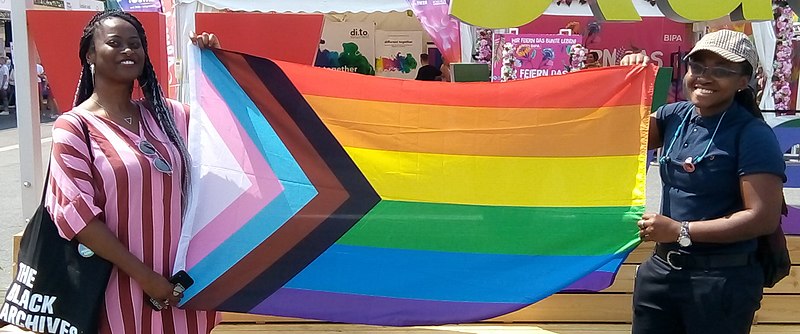
Two people at EuroPride 2019 in Vienna holding an LGBTQ+ pride rainbow flag featuring a design by Daniel Quasar; this variation of the rainbow flag was initially promoted as “Progress” a PRIDE Flag Reboot.
Photo by Bojan Cvetanović via Wikimedia Commons.
Over the past week we have witnessed two biological males – or men, as we used to call them – winning first and second place in a [the “w-word”]‘s cycling race. We’ve watched as the Crown Prosecution Service has hired a diversity consultant who is trans and who has previously suggested that [the “w-word”] could be replaced with “womxn”. We’ve heard that civil servants have received equality training telling them that the phrase “adult human female” – which is the dictionary definition of [the “w-word”] – is a transphobic dogwhistle. We’ve seen the publication of a new study by King’s College London which suggests that one way around sex / gender controversies might be to change the wording of questions in official documents like the census. For example, you could ask respondents “Do you menstruate?” rather than “Are you a [the “w-word”]?”.
Anyone who doubts that the word [the “w-word”], and the entire idea of [the “w-word”]hood, is being erased, sacrificed at the altar of the ideology of transgenderism, will surely have had a rude awakening these past few days. When men can claim [the “w-word”]‘s sporting prizes, it is clear that [the “w-word”]‘s sport risks becoming a thing of the past. When powerful institutions like the CPS and the civil service flirt with the idea that it is sinful to utter the words “adult human female”, it is obvious that even talking about [the “w-word”] has become a risky business. When even someone as globally influential as Michelle Obama uses the unpronounceable word “womxn”, as she did in a story shared to her Instagram page, you know that it’s not just time-rich, purple-haired campus crazies who have tumbled down the rabbit hole of genderfluidity. No, from the sporting world to the political world, from the justice system to the state bureaucracy, the idea that sex can be changed, and that language must be changed to avoid offending the trans minority, is orthodox now.
Strikingly, Mrs Obama’s use of the word “womxn” was related to the Roe v Wade controversy. She shared on Instagram a series of slides created by the nonprofit campaign group When We All Vote. One of them said: “State lawmakers will have the power to strip womxn of the right to make decisions about their bodies and their healthcare.” There is a dark irony to this comment, and one that exposes just how messed up the war on [the “w-word”]hood has become. That Obama-endorsed IG slide frets about [the “w-word”] being stripped of the right to control their bodies and yet it implicitly strips [the “w-word”] of the right to use certain words when they talk about themselves and what they need. “Womxn” is a reprimanding word, used to remind the female masses that their kind includes men now too. As Dictionary.com said of “womxn” when it added it in 2019, it is designed to be “inclusive of trans and non-binary” people. That is, blokes. In stripping out the old, supposedly problematic word “[the “w-word”]“, even as it wrings its hands over [the “w-word”] – sorry, womxn – being stripped of their bodily autonomy, When We All Vote unwittingly highlights the profound confusions and deep illiberalism behind today’s erasure of [the “w-word”]hood.
Barely a day passes without fresh reports about the linguistic war on [the “w-word”]kind. So the recent civil-service story involves a group called A:gender, which supports trans and intersex people who work in government departments. The Times got hold of some training videos A:gender has produced, which are shown to thousands of civil servants every year, one of which claims that it is impossible to define [the “w-word”] and that saying “adult human female” can be “transphobic”. Beware, these woke educators warn the civil service, of “transphobia [that] is increasingly presented as feminism”. To reiterate, this is civil servants we’re talking about, the people responsible for the smooth functioning of the nation. And they’re being told that if you say out loud what the dictionary says [the “w-word”] is, then you are a bigot. They’re being told that the likes of JK Rowling, whose great thoughtcrime is to understand biology, promote hatred dressed up as feminism.
“Culture is upstream of politics; and the culture is clearly changing”
In the free-to-cheapskates segment of Andrew Sullivan’s Weekly Dish, he discusses some of the cultural sea change convulsing American society and how that will inevitably feed into the political situation in an election year:
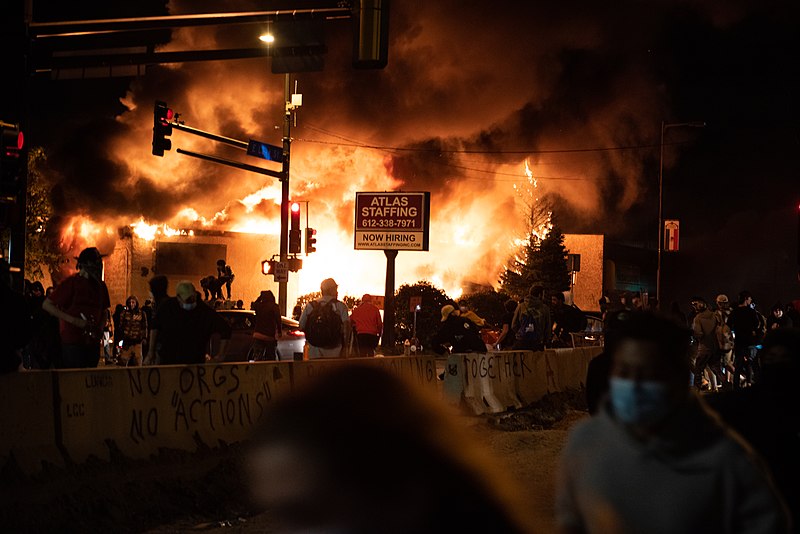
A building burning in Minneapolis following the death of George Floyd.
Photo by Hungryogrephotos via Wikipedia.
We]re now two years out from what may in retrospect be seen as peak “social justice”. In the summer of 2020, a hefty section of the elite was enthralled with the idea of the police being defunded, demobilized and demonized. Critical theory’s critique of liberal democracy as a mere mask for “white supremacy” everywhere. Countless people were required to read woke tracts — from DiAngelo to Kendi — as part of their employment. Corporate America jumped in, shedding any pretense of political neutrality; mainstream media swiftly adopted the new language and premises of critical theory. The Trump madness, and his attempted sabotage of an election, largely silenced liberals in their clash with the left. They had a more immediate threat. And rightly so.
But now look where we are.
Last year, Eric Adams became mayor of New York City, propelled by minority voters horrified by surging crime and chaos. This past week, DA Chesa Boudin, scion of leftwing terrorists, was ousted by minority voters in San Francisco, after he allowed much of the city to become a chaotic hellhole in pursuit of “racial justice”.
Recent polling suggests a sea-change in attitudes. Pew found that only three percent of African-Americans put “racism/diversity/culture” as the most important issue to them while 17 percent cited “violence/crime”, and 11 percent said “economic issues”. (Among Democrats overall, “49% now view racism as a major problem, down from 67% about a year ago”.) New York City voters now put “crime” ahead of “racial inequality” as their most urgent concern by a huge ratio of 12:1. Polling in San Francisco found that 67 percent of Asian-Americans wanted Boudin gone — a sign that the Democrats’ ascendant coalition of non-whites is now fast-descendant.
Hispanics also appear to be fleeing the left. In the usually Dem-friendly Quinnipiac poll last month, “48% of Hispanic registered voters said they wanted Republicans to take control of the House of Representatives, while just 34% said they wanted Democrats in power. In addition, 49% of Hispanic voters said they wanted the GOP to win the Senate, while 36% said they wanted Democrats to remain in control of the chamber.” Biden’s approval among Hispanics is now 24 percent. I’m not sure what to make of this, but even if it’s half true, it’s an electoral emergency for Democrats.
Some Dem pols have noticed the vast cultural gap between most Latino voters and wealthy white leftists, and adjusted. Democratic Congressman Ritchie Torres last week criticized the use of the absurd term “Latinx” — because denying the sex binary is not exactly integral to a culture where the language itself is divided into masculine and feminine. AOC, of course, demurs.
Elite imposition of the new social justice religion — indoctrinating children in the precepts and premises of critical race and gender theory — has also met ferocious backlash as parents began to absorb what their kids were being taught: that America is a uniquely evil country based forever on white supremacy; that your race is the most important thing about you; that biological sex must be replaced by socially constructed genders of near-infinite number; and that all this needs to be taught in kindergarten. Yes, some of this was politically exploited or hyped by the right. But if you think there is no there there in this concern about schooling, you’re dreaming.
Across the country, school boards are thereby in turmoil, with those supporting less ideological education on the march. On the question of trans rights, there is broad support for inclusion — but most Americans are understandably uncomfortable with pre-pubescent kids having irreversible sex changes, and with trans women competing with women in sports. For which those normies are called “hateful”.
June 11, 2022
As federal minister of public safety, it’s Marco Mendicino’s job to lie to Canadians
At least, the headline is my interpretation of Matt Gurney‘s somewhat more cautious and measured assessment of the minister’s recent performance:
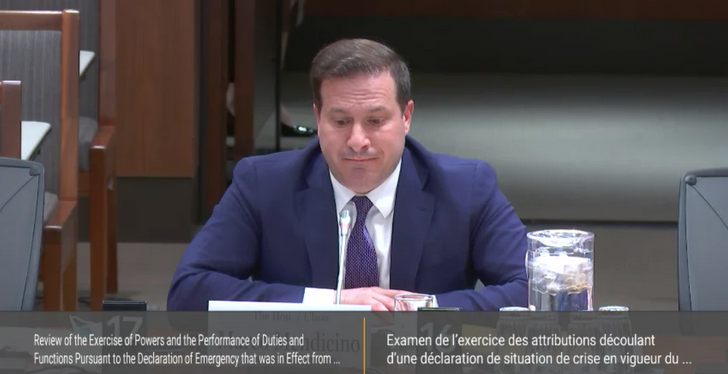
To celebrate World Press Freedom Day last month, Prime Minister Justin Trudeau said some wonderful things about the importance of truth.
“In the age of disinformation and misinformation,” the statement read, “independent, fact-based reporting is vital. We must all come together to support the work of journalists and double down in the fight against disinformation.”
Stirring stuff. But does the prime minister, his government and the Liberals’ many supporters think any of that actually applies to them?
Marco Mendicino is the federal minister of public safety — a tough job in challenging times. But I’ve come to the unsettling conclusion that Minister Mendicino is not being honest with Canadians.
On the issue of gun control, I’m sorry to say he’s simply lying.
Last week here at The Line, I analyzed the Liberals’ proposed Bill C-21, a package of gun-control measures. My views on this file differ sharply from the government’s. But I’d have hoped that we could at least agree that honesty should be central to the government’s proposals and publicity.
No dice. Last weekend, on CTV’s Question Period, the minister said this: “Bill C-21 doesn’t target law-abiding gun owners, it targets handgun violence, it targets organized crime … I have enormous respect for law-abiding gun owners …”
Well, let’s just go have a gander at the minister’s own webpage, eh? The Public Safety Ministry summarized the proposed legal and regulatory changes. There are 13 specific proposed changes to the Firearms Act. Two are “internal” to the government itself and don’t directly bear on gun owners, law-abiding or otherwise. One targets firearms-related marketing, another is exemptions for “elite sports shooters”. The remaining nine are entirely aimed at the “law-abiding gun owners” the minister insists aren’t being targeted. The page also notes that the government will also be changing regulations (separately from the proposed bill) relating to the safe storage of firearms and ammunition magazine limits … again, aimed entirely and solely at law-abiding gun owners. Indeed, along with some entirely process-focused Criminal Code proposals, there’s only one — one — proposed change that actually focuses on gun smuggling, which is widely believed by law enforcement to be the primary driver of firearms homicides in Canada. (Other planned changes are too vague to be properly analyzed in this context, but could plausibly be aimed at smuggling or blackmarket sales.)
But do the math. One clear mention of smuggling, at least 11 that only affect licensed owners. Denying this is dishonest, full stop.
Let’s be clear: the minister is entirely within his rights to argue that the proposed measures targeting lawful owners are necessary, appropriate and reasonable. These are legitimate debates. What is not up for debate is that the majority of these proposals exclusively target and/or affect law-abiding gun owners. There’s no ambiguity here. The meaning and purpose of C-21 is clear.
June 10, 2022
The common male delusion that they “age like fine wine”, unlike women who “hit the wall”
Ed West considers the brutal truth that while beauty may indeed be fleeting, ugliness is life-long:
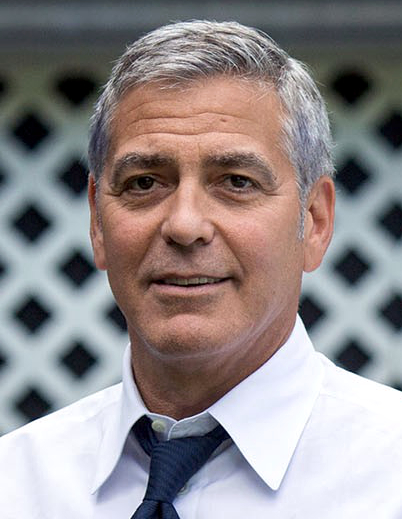
George Clooney at the White House, 12 September, 2016.
Official White House photo by Pete Souza via Wikimedia Commons.
The male psyche is filled with delusions, forming a sort of psychological protection against real life. Just as men tend to overestimate how competent they are at any given task, they are programmed to wildly overestimate their value in the mating market. The brutal truth of dating apps has shown that around 80% of men are basically unattractive and, in many societies, a significant chunk would fail to find a mate at all, forced to set out on a longship in the hope of winning glory and a girlfriend. We don’t contemplate this, because reality would be just too much to take for most of us.
Among the many delusions males have is the idea that, unlike women, they don’t become less attractive with age; in the minds of many men, female attractiveness peaks early and, while most men don’t improve with age, looks are less important for us so female preference doesn’t really change.
That explains the popularity of a certain genre of feature piece, usually in the Daily Mail, in which women in their 30s lament that there aren’t any available men left, and they can’t get a date despite being beautiful and wealthy and having their own career. Many quite embittered men take pleasure in these pieces, gleeful that the shoe is now on the other foot, and that the women who spurned them have hit “The Wall”.
The Wall is the name given to the drop in female attractiveness that comes with age, the decline beginning quite early, around 20 or 21, as judged by searches on dating sites and the number of approaches a woman receives. There are even cruder measurements, such as the average hourly earnings of strippers, lap dancers or prostitutes, and which again show a decline from the early 20s which becomes steep after 30. If you think that’s a depressing measurement, there are even bleaker ones highlighted by Louise Perry in her new book, on rape victims, which show a very similar pattern.
These are all quite horrible measurements, but then science is an empty moral void and the data only has deeper meaning if you choose to give it any. It doesn’t measure attractiveness as most of us feel it; people become more interesting as they get older, and as men mature their interests change, too. What’s strange about our species is that men’s prefrontal cortex — the part of the brain concerned with judgement — doesn’t fully mature until around 25. As women enter their peak for male attention, their male contemporaries have not even finished maturing yet, and are at the pinnacle of stupid behaviour (as measured by things like car accidents).
Some men take pleasure in female contemporaries hitting the Wall, because while those contemporaries became very desirable in their late teens, they struggled to find a date, and so convinced themselves that they were playing a long game. But it just isn’t true — men hit the Wall, too, and it’s not even that much later.
Many men seem blissfully unaware that, while the dating game may seem brutal and unfair in adolescence, it’s going to remain brutal and unfair later, just in different ways. They’re not going to mature into a debonair George Clooney-type who has the women gushing over his overgrown ear hair. They’re just going to become increasingly repulsive as they age.
June 9, 2022
Moving Sprinting to the extremes
Scott Alexander considers the passion-provoking question, “which US political party has moved further/faster to the extreme end of the spectrum?”
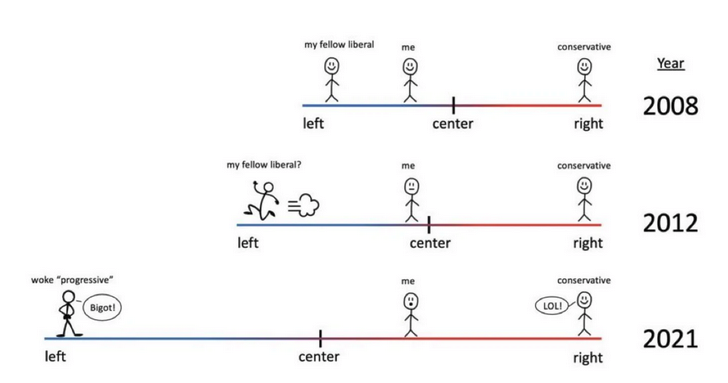
Matt Yglesias has written a couple of posts […] on the subject of this meme (originally by Colin Wright, recently signal-boosted by Elon Musk):
He concludes that, contra the image where the Right stays in the same place and the Left moves, both Republicans and Democrats have “changed a lot” since 2008. He wisely avoids speculating on whether one party has moved further or faster than the other.
I’m less wise, so I’ve been trying to look into this question. My conclusion is: man, people really have strong emotions on this.
I think a lot of the disagreement happens because this is more than one question. You can operationalize it a couple different ways:
- Which party’s policy positions have changed more in their preferred direction (ie gotten further left for the Democrats, or further right for the Republicans) since 2008 — or 1990, or 1950, or some other year when people feel like things weren’t so partisan?
- Which party has diverged further from ordinary Americans?
- Which party has become more ideologically pure faster than the others (ie its members all agree and don’t tolerate dissent)?
- Which party has become crazier in terms of worldview and messaging, in a way orthogonal to specific policy proposals? That is, suppose one party wants 20% lower taxes, and plans to convene a meeting of economists to make sure this is a good idea. The other party wants 10% higher taxes, and says a conspiracy of Jews and lizardmen is holding them back, and asks its members to riot and bring down the government until they get the tax policy they want. The first party has a more extreme policy position (20% is more than 10%), but the second party seems crazier.
I think these subquestions are easier to get clear answers on and will hopefully start less of a fight, starting with …
June 8, 2022
With the ACLU no longer fit for purpose, FIRE steps up to protect freedom of speech on and off the campus
Matt Taibbi talks to Nico Perrino about the Foundation for Individual Rights in Education (FIRE) moving beyond protecting free speech for university students to protecting those rights for all Americans:

After years of planning, the Foundation for Individual Rights in Education, better known as FIRE, announced a major expansion Monday, moving “beyond college campuses to protect free speech — for all Americans”.
FIRE was the brainchild of University of Pennsylvania history professor Alan Charles Kors and Boston civil liberties lawyer Harvey A. Silverglate, who co-authored the 1999 book, The Shadow University: The Betrayal of Liberty on America’s Campuses. To the modern reader the book reads like a collection of eccentric cases of students and teachers caught up in speech code issues, most (but not all) being conservative.
To take just one of countless nut-bar examples, Kors and Silverglate told the story of a professor in San Bernardino reprimanded for violating sexual harassment policies because, among other things, “he assigns provocative essays such as Jonathan Swift’s ‘A Modest Proposal'”, as the court case later put it. This was apparently the “cannibalism” portion of the accusation that he delved into such subjects as “obscenity, cannibalism, and consensual sex with children”.
The book triggered such an overwhelming number of responses from other faculty members and students that the pair decided to set up an organization to defend people who found themselves in tricky speech controversies on campuses. They soon found they had plenty of work and, by 2022, enough of a mandate to expand beyond colleges and universities into America at large. According to FIRE CEO Greg Lukianoff, as quoted in a Politico story, the group has already raised over $28 million toward a $75 million “litigation, opinion research and public education campaign aimed at boosting and solidifying support for free-speech values”.
As noted in another story I put out today, FIRE will be doing a lot of stepping into a role semi-vacated by the American Civil Liberties Union. I spoke with Nico Perrino of FIRE, producer and co-director of the excellent documentary about former ACLU chief Ira Glasser (see review here), to ask what the expansion would entail …
June 5, 2022
QotD: The Matrix
The point is Andy and Larry Wachowski figured they’d hit on the perfect wrinkle for a classic postmodern nerd franchise — the Star Wars of our generation. And if you say, “Hang on, old boy, surely Star Wars is the Star Wars of our generation?”, I’d say, nah, it’s too 1930s radio serial, and its grandiosity is plonkingly earnest and squaresville instead of as coolly meta as Keanu Reeves’ too-bored-to-act acting style. The Matrix was quickly followed by The Matrix Revisited, The Matrix Reloaded, The Matrix Recycled, and Neo got paleo pretty quick. None of the sequels could quite match the initial red-pilling of surface reality, and so they simply dug the rabbit hole deeper. Zion is the last outpost of humanity — but maybe it’s merely a Matrix-within-the-Matrix? Ever consider that, huh? And what if Neo himself is a Matrix-within-the-Matrix-within-the-Matrix? He was supposed to be “The One” — but maybe one of the others is The One. Maybe The One flew over the cuckoo’s nest.
By the sequel, the Wachowskis’ “innovative visual style” (a Cecil B De Mille-scale computer game peopled by sullen pouters) was looking a lot less innovative: they did all the same things they did in the first film all over again, just more expensively and even more arbitrarily — the scene in which Keanu/Neo is fighting a hundred guys in black and doesn’t win, doesn’t lose, but just finds himself fighting vainly the old ennui and so buggers off after 15 minutes pretty much sums it up. By the second movie, Keanu had perfected his morose blank look, and fine actors like Laurence Fishburne were turning in performances so clunkily solemn you’d think they were auditioning for George Lucas. As usual, the subterranean city of Zion proved to be just another generic dystopian underground parking garage; and the orgiastic dance party looked like a weekend rave in Huddersfield.
Mark Steyn, “The Matrix”, Steyn Online, 2019-04-06.
June 4, 2022
Ontario’s election – “This was a weird campaign during a weird moment in history. Adjust your hot-takes accordingly, friends.”
From the Ontario election wrap-up post from the editors of The Line:
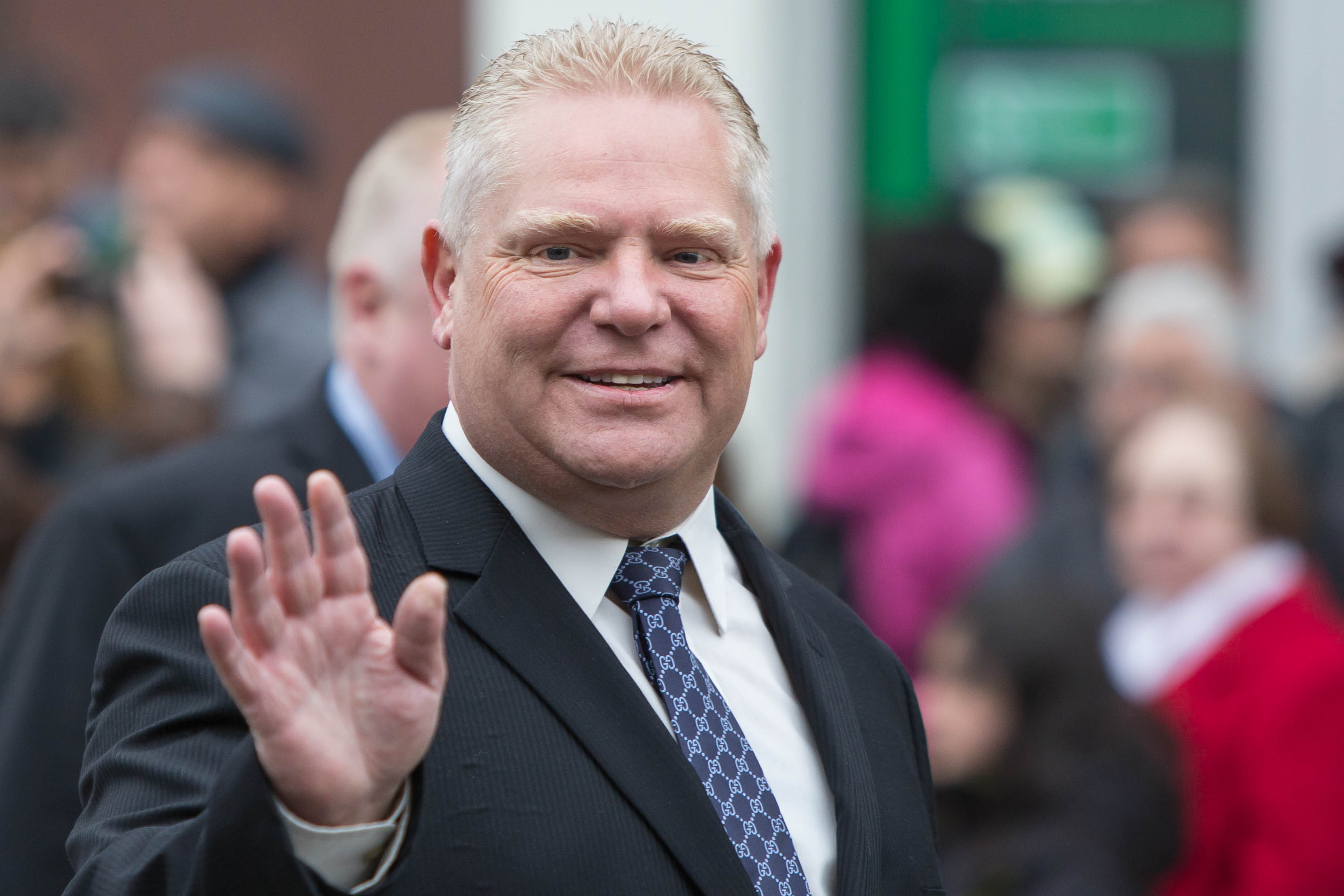
Newly re-elected Ontario Premier Doug Ford, seen here at the 2014 Good Friday procession in East York, Canada.
Photo via Wikimedia.
Doug Ford and the Ontario Progressive Conservatives obviously feel pretty good this Friday. They really did about as well as they could possibly have hoped to do. Still, we urge our readers and all the analysts and pundits out there not to overreact to Ford’s victory. He’s not a political genius, he’s not some sort of colossus standing astride our politics, and he is not the man who must be immediately beamed into the federal Conservative leadership so that he can slay Trudeau’s government and win 200 seats.
Doug? He’s just a guy who got lucky last night. (Politically, we mean. Get your minds out of the gutter.)
We’re not taking anything away from Ford, or his campaign leadership, or all the people who worked hard for the PCs over the last month. They did a lot of smart things, they did them well, and they are reaping the benefits. It was an effective campaign. It rubbed a lot of people the wrong way, but your Line editors suspect it rubbed people the wrong way precisely because it was an effective campaign. Keeping Ford out of sight, avoiding a lot of questions, keeping things low-key … these weren’t accidents. These were deliberate decisions. You have to start any analysis of the PC campaign by granting that. Yeah, it was well conceived and well executed. A hat tip to the people behind it.
But the point that we want to make, and it shouldn’t take away from anything said above, is that the Progressive Conservatives maxed out the luck-o-meter. If this election had been a year ago, coming off the government’s catastrophic handling of Ontario’s third wave, it probably would have been Doug Ford resigning last night. The government caught an enormous break because factors well beyond its control shifted the public’s focus off its greatest vulnerability, the management of the pandemic, and put it solidly on economic and cost-of-living issues that the PCs are much, much more comfortable talking about.
So yeah, the PCs had a good campaign, but you couldn’t buy that kind of luck. None of it happened in Ontario or even Canada. This was a global trend. After two years of pandemic, people are tired and they’re getting worried about other things. The timing for Ford could not have been better. So we absolutely give full credit to his campaign for a good job, but we also insist on acknowledging the huge role of luck and timing. We don’t know if it’s better to be lucky than good. But we certainly know it’s nice to be both at once.
We raise this as a note of caution before the punditry gets too carried away. This election is undoubtedly a huge victory for the Tories. But it is also a really, really weird election. The circumstances of it are very unique. The combination of low turnout, pandemic fatigue, Ford’s personal political brand in Ontario, bizarrely lacklustre campaigns by the opposition, and a confluence of global trends that all netted out in Ford’s favour don’t tell us anything about the state of the conservative coalition in Canada, who would make a good federal leader, or what’s going to happen at the next federal election. This was a weird campaign during a weird moment in history. Adjust your hot-takes accordingly, friends.
Campaigning from your basement worked very well for Joe Biden, and now it’s done the job for Doug Ford. It probably wouldn’t work for Justin Trudeau — if he’s not performing for the camera, it’s not clear whether he actually exists. Ford certainly benefitted from the small attention his opponents on the right — the New Blue and Ontario parties — although minor parties have pretty much always been a non-factor in Ontario politics. They were summoned into existance by the way Ford and the Progressive Conservatives governed during the pandemic … almost indistinguishable from the federal Liberals under Justin Trudeau. The PCs seemed to rely on their “progressive” urges at the expense of anything remotely “conservative”.
Moving on to the other two major parties … it’s not pretty:
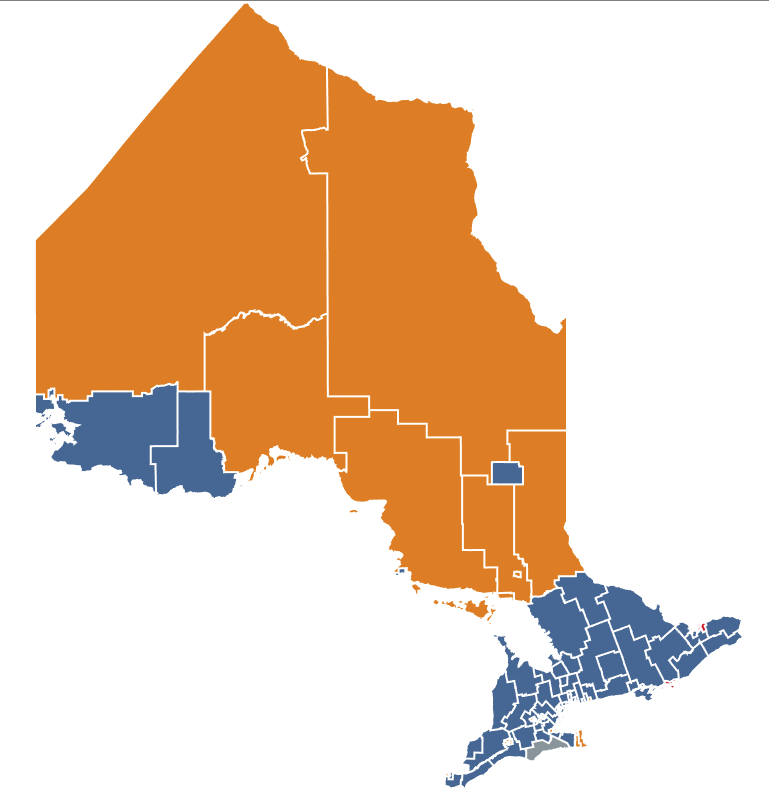
Preliminary riding-by-riding results from the 2022 Ontario election.
Blue – Progressive Conservative, Orange – New Democratic Party, Red – Liberal Party, Green – Green Party
Okay, let’s do the NDP first. The NDP is probably feeling pretty good today. We get it. Even a week or two ago polls were suggesting they were about to lose their hold on official opposition to the Liberals. That would’ve been a disaster for the party. There’s no way around that. They’ve avoided that fate. The NDP has remained in second, although they lost a bunch of seats to the PCs (see above). In the days to come, the party is going to have to take a few cold showers, give their heads a vigorous shake, and realize that warm feeling they’re enjoying right now isn’t the afterglow of victory, it’s the fading adrenaline rush of a near-death experience. Avoiding annihilation shouldn’t be good enough. But that’s all they did.
Andrea Horwath, long-time leader of the party, has already announced that she is stepping down. And rightly so. The Line has some fondness for Andrea. God knows we’ve had the opportunity to get to know her during her tenure as provincial NDP leader, which basically overlaps entirely with our entire careers in journalism. She is a decent person with a better sense of humour than often comes across in public, and she has nothing to be ashamed about. She has taken the party as far as she can, and it’s time for someone else to take over and deal with what might be a changing environment — one that is not obviously changing in the NDP’s favour (again, see above).
[…]
Writing critically about the Liberal campaign today feels a little bit like flogging a dead horse, and then shooting it a bunch of times, and then setting it on fire, and then hunting down all of its little horsey relatives and shooting all of them too. And then peeing on them. But still. It was a really bad campaign by the Liberals. The leader was bad. We’re sorry, but he was. If Steven Del Duca ever encountered charisma we suspect his body would reject it like a donated kidney. The party’s campaign platform was a weird mishmash of stuff that sounded vaguely on point for 2022, but also often read like something copied and pasted directly out of Ontario Liberal campaign platforms going back as far as the 1990s.
Some of the problems the campaign experienced had easy explanations. The party’s 2018 performance was so terrible they lost official party status, and the access to budgets and staff in the legislature that goes along with that status. The party has been trying to rebuild with at least one hand tied behind its back ever since. The campaign team was quite lean, and as a series of ejected candidates show, it was not able to properly vet the full slate of candidates it ran. You can understand how the lack of personnel and money contributed to those problems. But what we can’t understand is why the campaign insisted on making so many weird decisions. Handguns and abortion as campaign issues? In a provincial campaign? Talking up free transit rides, which will only appeal in the deepest downtown cores, where all they could do was hurt the NDP? A mid-campaign pledge to make COVID-19 vaccinations mandatory for school children, which was then never really mentioned again?
The NDP ran a bad campaign, but the Liberals just seemed to be totally disjointed, as if there wasn’t any agreement among the party leadership on what the platform should be so random unrelated items got floated as trial balloons on almost a daily basis, with no follow-up on most of them. Perhaps the party couldn’t afford the cost of proper in-depth pre-election polling or perhaps this was the party leadership’s belated buyer’s remorse over the leader they’d elected.


