
[The] CBC’s attitude towards economics journalism is the same as a teenager’s attitude towards household chores: If they do it badly enough, they won’t be asked to do it again.
Stephen F. Gordon, Twitter, 2019-05-06.
July 1, 2022
QotD: The CBC doesn’t want to do economic journalism
Comments Off on QotD: The CBC doesn’t want to do economic journalism
June 29, 2022
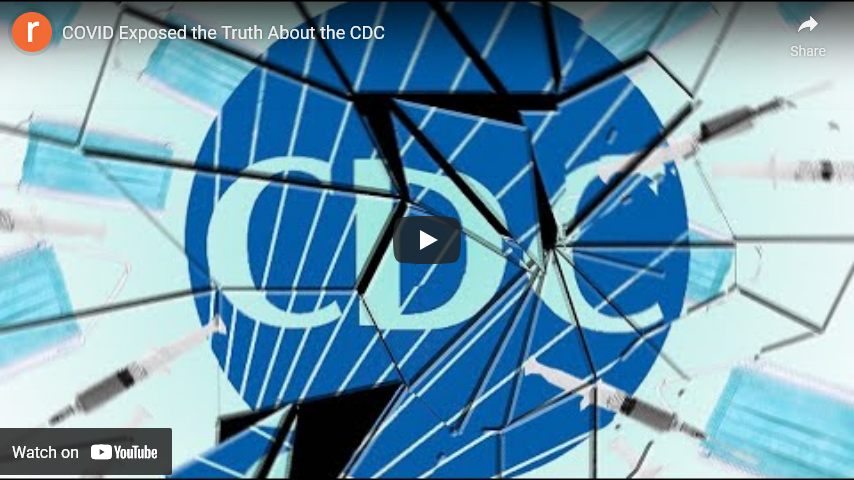
COVID Exposed the Truth About the CDC
ReasonTV
Published 28 Jun 2022The agency will never be controlled by fact-driven experts shielded from politics.
——————-
The Centers for Disease Control and Prevention (CDC) was once widely viewed as the gold standard in public health, considered an apolitical, science-driven bulwark against all pathogen threats, foreign and domestic.Today, trust in the agency has plummeted because COVID-19 exposed the truth: The CDC is thoroughly corruptible, and federal regulators will never be impartial experts. They respond to political incentives just like everyone else, and a fact-driven, purely technocratic state is an impossible dream.
The Trump administration pressured the CDC to narrow the scope of testing so case counts would drop, blocked officials from doing interviews, and edited its flagship scientific reports. The CDC provided a scientifically dubious public health rationale for rejecting migrants at the southern border. President Joe Biden continued that policy, and under his purview, CDC guidance on school closures was surreptitiously written by leaders of the country’s second-largest teachers union.
Tom Frieden, a former CDC director, co-authored a 2021 op-ed with three other former agency heads expressing hope that Biden’s incoming CDC Director Rochelle Walensky would “restore the public’s confidence in the CDC’s scientific objectivity,” with its reputation “a shadow of what it once was.” Yet, Frieden endorsed large-scale protests against racial injustice two months after writing in The Washington Post that “the faucet of everyday activities needs to be turned on slowly. We cannot open the floodgates.” Meanwhile, public health officials were keeping people from attending the funerals of their loved ones.
And could it be pure coincidence that the CDC chose the Friday before President Biden’s State of the Union address to drop its indoor mask recommendation for the majority of Americans, even though the supporting data were months old?
In other words, it doesn’t matter who occupies the White House — political incentives mean that, no matter how dedicated or competent the career scientists who work at the CDC are, the agency will never be controlled by fact-driven experts shielded from the “hurry and strife of politics,” as Woodrow Wilson wrote. After decades of mission creep, the CDC’s role should be strictly narrowed, limited to surveillance and coordination, leaving the heavy lifting to local officials and private and academic researchers who are more reactive to direct feedback from their communities.
Written and produced by Justin Monticello. Edited by Isaac Reese. Graphics by Reese, Tomasz Kaye, and Nodehaus. Audio production by Ian Keyser.
Music: “Robotic Butterflies” by Evgeny Bardyuzha; “We Fall” by Stanley Gurvich; “Free Radicals” by Stanley Gurvich.
Photos: BSIP/Newscom; BSIP/Newscom; Sarah Silbiger/UPI/Newscom; Shawn Thew – Pool via CNP/ZUMAPRESS/Newscom; Alex Edelman/ZUMA Press/Newscom; SMG/ZUMA Press/Newscom; Simon Shin/ZUMA Press/Newscom; Michael Brochstein/ZUMAPRESS/Newscom; Adam Schultz/White House/Newscom; Brazil Photo Press / SplashNews/Newscom; Tom Williams/CQ Roll Call/Newscom; Polaris/Newscom; Jonathan Alpeyrie/Polaris/Newscom; Aimee Melo/dpa/picture-alliance/Newscom; Julian Stratenschulte/dpa/picture-alliance/Newscom; Sven Hoppe/dpa/picture-alliance/Newscom; CNP/AdMedia/Newscom
Comments Off on COVID Exposed the Truth About the CDC
June 28, 2022
Pierre Poilievre … not the Canadian Trump?
Allan Stratton points out to sheltered central Canadian urban voters that populism has a long history in Canadian politics, and didn’t need to be imported from the US:

Conservative MP Pierre Poilievre at a Manning Centre event, 1 March 2014.
Manning Centre photo via Wikimedia Commons.
Conservative leadership candidate Pierre Poilievre is oft accused of importing divisive American right-wing populism to our politics. His endorsement of the trucker protest against vaccine mandates — though not the legal violations of its organizers — has been portrayed as a play for Christian nationalists, racists and fascists. Likewise, his attacks on Davos and the World Economic Forum are said to welcome Trumpian conspiracy theorists, anti-Semites and Great Replacement nativists.
Common wisdom suggests that this strategy may win Poilievre the Conservative party leadership, but will render his party toxic to respectable, mainstream Canadian voters.
There’s a lot of smoke and at least some fire to this critique: The People’s Party of Canada will find it hard to tag Poilievre as a centrist squish.
But thanks to our constitution, the Supreme Court and our general political culture, all more liberal than their American counterparts, social conservative attacks on abortion and LGBT rights seem off the table.
Further, far from a Trumpian nativist, Poilievre is in favour of immigration and wants to cut the red tape that blocks immigrants from employment in their fields, something the current federal government has failed to accomplish into its third mandate.
My fear, as someone who shares many concerns about the prospect of a Poilievre government, is that commentators are misreading the broad appeal of his populism, leading Liberals to unwarranted overconfidence.
Sure, Poilievre’s strategy shares some Trumpian elements, but it’s equally rooted in a progressive Canadian tradition that dates back to the early 19th century and was prominent in the last half of the 20th.
If the Liberals don’t course correct, they may discover that while they are attacking Poilievre as a far-right extremist, he is eating their traditional liberal, working-class lunch.
In broad strokes, I imagine Poilievre channelling Louis-Joseph Papineau and William Lyon Mackenzie during the Rebellions of 1837-38. Instead of the Château Clique and the Family Compact, I see him fighting the Laurentian Consensus, another powerful, unelected group, this time composed of academics, bureaucrats, media apparatchiks and Central Canada think-tankers who dominate our culture and financial establishment — and who arrogate to themselves the right to determine Canadian values and the ways in which we are allowed to describe and think about ourselves as a nation.
For those of us who grew up on the left under Mike Pearson, Tommy Douglas, Pierre Trudeau and David Lewis, it is hard to stomach the recent illiberal turn in elite liberal discourse. It once assumed the importance of free speech, understanding that censorship has always been used by the powerful to suppress the powerless. Yet today, in academia and the arts, free speech has been recast as “hate speech”, and our Liberal government is passing C-11, which seeks to regulate what we read and how we express ourselves online.
Comments Off on Pierre Poilievre … not the Canadian Trump?
June 24, 2022
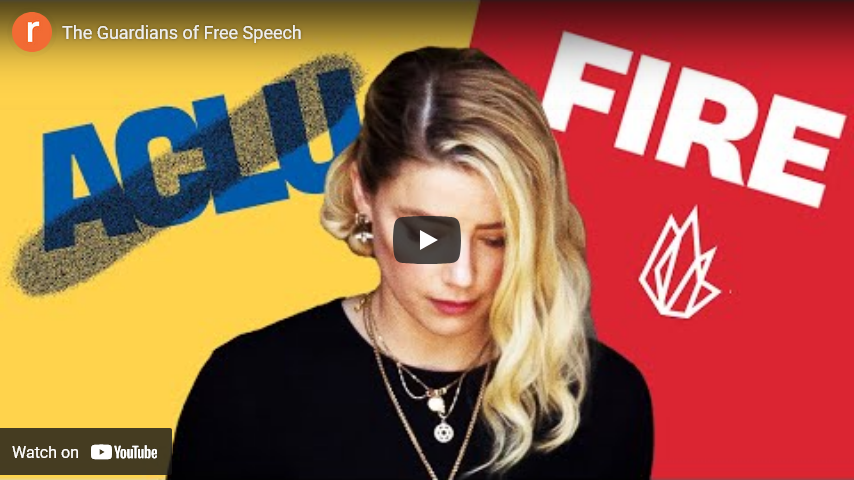
The Guardians of Free Speech
ReasonTV
Published 23 Jun 2022Because of the social media circus surrounding the Johnny Depp/Amber Heard defamation trial, it was easy to overlook one of the principal — yet least likely — actors in the courtroom drama: the American Civil Liberties Union (ACLU), which ghostwrote and placed the 2018 Washington Post op-ed by Heard about surviving domestic abuse that was the basis of the trial.
——————-
It’s only the latest example of how the group has in recent years strayed from its original mission of defending speech, no matter how vile. Awash with money after former President Donald Trump was elected, the ACLU transformed into an organization that championed progressive causes, undermining the principled neutrality that helped make it a powerful advocate for the rights of clients ranging from Nazis to socialists.
It questioned the due process rights of college students accused of sexual assault and harassment under Title IX rules. It ran partisan ads against Supreme Court nominee Brett Kavanaugh and for Georgia gubernatorial candidate Stacey Abrams, a move that current Executive Director Anthony Romero told The New York Times was a mistake. The ACLU also called for the federal government to forgive $50,000 per borrower in student loans.
As the ACLU recedes from its mission, enter another free speech organization, the Foundation for Individual Rights in Education, or FIRE. Founded in 1999 to combat speech codes on college campuses, FIRE is expanding to go well beyond the university and changing its name to the Foundation for Individual Rights and Expression. The group has raised $29 million toward a three-year “litigation, opinion research and public education campaign aimed at boosting and solidifying support for free-speech values.”
“I think there have been better moments for freedom of speech when it comes to the culture,” says FIRE’s president, Greg Lukianoff. “When it comes to the law, the law is about as good as it’s ever been. But when it comes to the culture, our argument is that it’s gotten a lot worse and that we don’t have to accept it.”
Lukianoff tells Reason that FIRE’s new initiatives have been in the works for years, but gained urgency during the COVID lockdowns. “Pretty much from day one, people have been asking us to take our advocacy off campus to an extent nationally,” he says. “But 2020 was such a scarily bad year for freedom of speech on campus and off, we decided to accelerate that process.” Despite 80 percent of campuses being closed and doing instruction remotely, Lukianoff says that FIRE received 50 percent more requests for help from college students and faculty. He also points to The New York Times‘ editorial page editor, James Bennet, getting squeezed out after running an article by Sen. Tom Cotton (R–Ark.) and high-profile journalists such as Bari Weiss, Andrew Sullivan, and Matt Yglesias “stepping away from [their publications], saying that the environment was too intolerant.”
FIRE is also expanding its efforts beyond legal advocacy and into promoting what Lukianoff calls “the culture of free speech.” As Politico reports, it will spend $10 million “in planned national cable and billboard advertising featuring activists on both ends of the political spectrum extolling the virtues of free speech.”
He says that people in their 40s and 50s grew up in a country where the culture of free speech was embedded in colloquial sayings and common attitudes. “Things like everyone’s entitled to their opinion, which is something you heard all the time when we were kids. It’s a free country, to each their own, statements of deep pluralism, like the idea that [you should] walk a mile in a man’s shoes,” he explains. “All of these things are great principles for taking advantage of pluralism, but they’ve largely sort of fallen out of usage due to a growing skepticism about freedom of speech, particularly on campus, that’s been about 40 years in the making.”
Lukianoff has nothing negative to say about the ACLU (in fact, he used to work there) and stresses that FIRE has worked with the organization since “day one” and continues to do so. But unlike the ACLU, FIRE isn’t at risk of turning into a progressive advocacy organization, partly because its staff is truly bipartisan.
That pluralistic pride extends to the groups funding FIRE, too. Lukianoff thinks that despite the rise of cancel culture, most Americans still understand the value of free speech, but they need to be encouraged to stand up for it. FIRE’s polling, he says, reveals that “it’s really a pretty small minority, particularly pronounced on Twitter, that is anti-free-speech philosophically and thinks that people should shut up and conform.”
For that reason, he’s upbeat that FIRE will succeed in helping to restore belief in the value and function of free speech.
Interview by Nick Gillespie. Edited by Regan Taylor.
Comments Off on The Guardians of Free Speech
What happens when the proles stop listening to elite Chicken Littles?
Chris Bray suggests that we should call it “class formation psychosis” instead of “mass”, because it’s the kakistocrats who are doing everything they can to induce “the masses” to feel the fear and obey:
… here’s a picture of a recent panel discussion among public health experts in Los Angeles County, which I wrote about here:
So the normals are just living their lives, and appearing to enjoy it, while the status-projecting elite are engaged in an effort to signal fear and control.
I encourage you to read [Mattias Desmet’s new book] The Psychology of Totalitarianism, especially as an account from an early adopter of the view that our pandemic hysteria has been irrational. But I’m surprised to find myself not buying the argument. Desmet gets the dynamic, but misses the subject: He sees what’s happening, but not who’s doing it. The book is about “the masses”, as in this passage from Chapter 6:
We have to add one more important characteristic to the problematic psychological properties of mass formation: radical intolerance of other opinions and a strong tendency toward authoritarianism. To the masses, dissident voices appear 1) antisocial and devoid of solidarity, because they refuse to participate in the solidarity that the mass formation creates; 2) completely unfounded, as critical arguments are not assigned any cognitive or emotional weight within the narrow circle of attention of the masses; 3) extremely aversive because they threaten to break the intoxication, and in this way confront the masses again with the negative situation that preceded the mass formation (lack of social bond and meaning, indefinable fear and unease); 4) extremely frustrating because they threaten to remove the venting of latent aggression.
This radical intolerance ensures that the masses are convinced of their superior ethical and moral intentions and of the reprehensibility of everything and everyone who resists them: Whoever does not participate is a traitor of the collective.
As someone who spent every moment of the pandemic traveling all over the place, family camping our way through a dozen states and visiting national parks and other tourist-centered destinations, I’ve never met the masses who were consumed with this fearful aggression. In South Dakota in the summer of 2020, I was sitting next to my tent in a state park when some dads on another campsite saw my license plate, then marched over and said that holy shit, man, did you really drive all the way here from California? I hadn’t seen a mask in days, and no one maintained six feet of social distance. As I experienced all over the state, we shook hands and talked. A few days before, at a state park in eastern Wyoming, the couple in the neighboring campsite walked over and offered us dinner, then got trashed on Bud Light — which I didn’t know was possible, on the grounds of “making love in a canoe” — while they hung out by our campfire.
But where we found intolerance and enforced fearfulness was in space controlled by government, as when we got in line outside the Jenny Lake store and quickly drew the attention of the, I am not making this up, line monitor. Masks! Masks! Masks! she helpfully explained, pointing at her masked face to show us what a mask was. Maskless people swarmed around us on all sides, a fact I mentioned to her. “But they’re not in line,” she explained, finding the explanation complete.
Our mass formation psychosis didn’t form in the masses; it formed in policy, and as a social performance among people who wish to be perceived as cultural elites, sniffing at the trash who don’t believe in science. Professors and politicians were highly mask-compliant, and wanted you to know it. My impression is that a quarter to a third of the population locked arms with them and fought proudly for their fear performance, while another third-plus went along to get along, and the balance — especially outside the Blue Zones — just completely ignored the whole mess.

Comments Off on What happens when the proles stop listening to elite Chicken Littles?
June 23, 2022
The government believes that anyone opposed to Bill C-11 is “spreading misinformation”
Happily for the Canadian government (if not for Canadian internet users), if Bill C-11 gets passed, they can sic the CRTC on those critics … isn’t that convenient?

Last week, shortly after midnight in Ottawa, the House of Commons Heritage Committee concluded its deliberations on the Online Streaming Act, which will grant a federal regulator authority over the global Internet.
You may think putting the Canadian Radio-television and Telecommunications Commission (CRTC) and its nine government-appointed commissioners in charge of the entire online world is a good thing. Or you may think it’s a bad thing. But I’m guessing we can all agree that Bill C-11, the world’s most extensive internet regulation legislation so far, is a Thing.
And you’d think a thing that big would be deserving of respectful, honest debate and thoughtful review. If there’s something in the legislation that is bad in a way that isn’t intended, you’d want it caught and fixed, right? We are, after all, about to grant authority over 21st-century communications to people in charge of something called The Broadcasting Act. An act that was passed in 1993 to make sure nothing terrible — like people preferring NFL over CFL football or the Oscars over the Genies — results from watching too much American TV. Given that thousands of successful Canadian free enterprise Tik-Tokers and YouTubers fear new rules will disadvantage them in favour of the CRTC’s certified cultural broccoli, you’d think that’d be worth a think.
But you’d be wrong.
[…]
But then Liberal MP Tim Louis of Kitchener took this government’s truth-torquing communications strategy to a breathtaking level of self-righteous fantasy — one that dripped with contempt for all but he and his clan.
He calmly rose in the House of Commons and quietly accused C-11’s critics of deliberately spreading “misinformation” — a chilling threat given the government’s plans to deal with he same in “Online Harms” legislation later this year.
Louis did not even try to say, as did Mendicino’s deputy minister, that there was a misunderstanding of some kind. He did not attempt to make it clear that there are people who — as reasonable people often will — disagree. He did not dismiss the bill’s critics as being overwrought, incorrect and yet honourable. He stood up in the House of Commons and, barefaced, declared that views, lived experiences and legal analyses — including the testimony of CRTC Chair Ian Scott — are “simply untrue”. In other words, it’s all #fakenews.
And we are all liars.
Comments Off on The government believes that anyone opposed to Bill C-11 is “spreading misinformation”
June 22, 2022
Puberty, “white guilt”, and social contagion helps drive huge numbers of teen girls to think they are transgender
Until a few years ago — a blink of the eye in social terms — most individuals who wanted to transition to the other gender were born male. That is no longer the situation in North America, as vast numbers of young teens have been hammered with accusations of “privilege” for being white, while already undergoing the stresses and social disruption of puberty, seem to be deciding in groups that they must have been “assigned the wrong gender” at birth. In City Journal, Leor Sapir tells some of their stories:
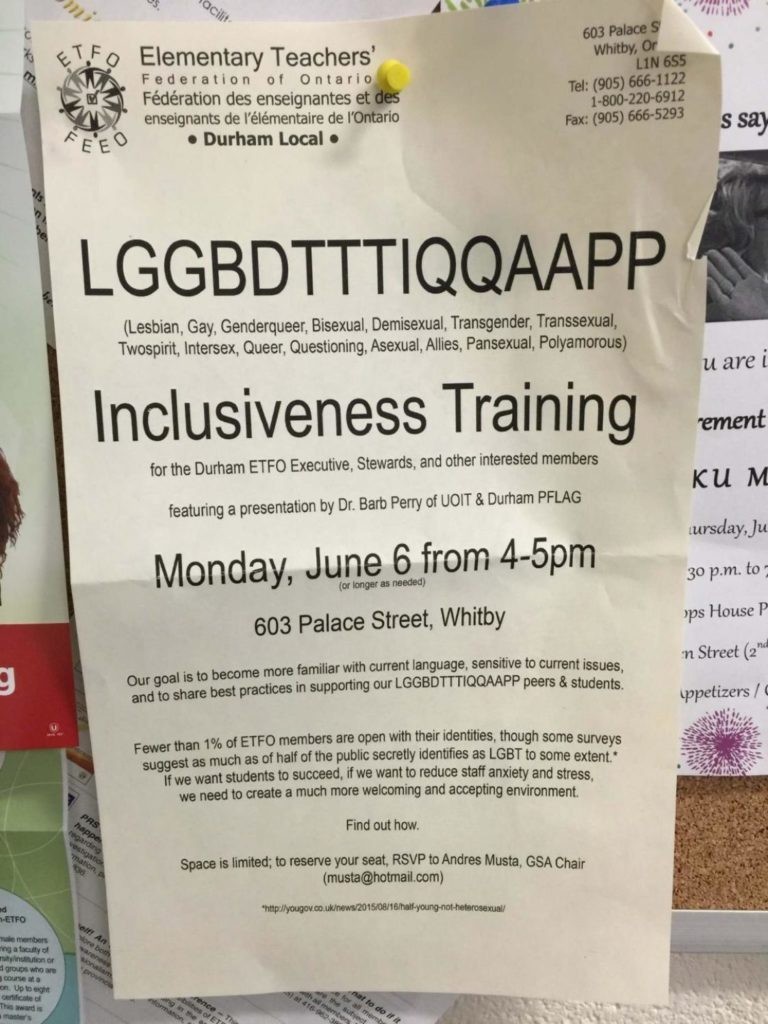
Patricia (a pseudonym) is the mother of a teenage girl who in recent years has come to identify as transgender. She lives in California, considers herself progressive, votes Democrat, and leads a group for parents of children with rapid onset gender dysphoria (ROGD) — that is, youth who suddenly experience distress with their bodies and believe that undergoing medical “transition” will make them whole again. When I spoke to her recently, she recounted how her daughter’s at-first-lesbian and then trans identity emerged in response to feelings of shame about being white.
I have since spoken to more than a dozen ROGD parents and parent-group leaders who tell a similar story. Their schools compulsively tell their children how awful it is to be white, how white people enjoy unearned “privilege”, how they benefit from “systems” put in place by and for white people for the sole purpose of oppressing “people of color”. Plagued by guilt, the children — almost all of them girls — rush to the sanctuary of “LGBTQ+” identity. Once there, they are catapulted into hero status. According to Patricia, some teachers at her daughter’s school are more forgiving toward “queer” and “trans” kids who hand in their homework late.
The students, especially the girls, absorb this messaging. They are acutely sensitive to how identity affects their social status and academic fortunes. They want the warmth that comes with queer/trans identity, but above all they don’t want to be thought of as vicious oppressors. Lacking maturity and self-confidence, they fail to put “anti-racist” indoctrination in its proper context. They do not appreciate its ahistorical, anti-intellectual, and anti-humanist foundations, nor are they aware of the incentives leading teachers and administrators to foist it on them. Being white is not something these teenagers can escape, but they can mitigate its social costs by declaring themselves part of an oppressed group.
The wages of whiteness for teenagers are, however, only half of the story. Decades of gay rights activism have taught us that being gay or lesbian is not something one chooses. The mainstream narrative of transgenderism — promoted aggressively in the context of civil rights policymaking — holds that even being transgender is something people have little control over. Gender identity, experts have argued in Title IX lawsuits, is innate, immutable, and “primarily dictated by messages from the brain”. Thus, membership in the “LGBTQ+ community” would seem to be nonvoluntary. One is either “born that way” or not.
[…]
Several of the parents I spoke to told me that their daughters’ friends all identify as non-heterosexual, despite none having ever kissed another teenager or been in a romantic relationship. LGBT identity is, for them, not related to sexual attraction or behavior. As Kate Julian has written in The Atlantic, America is going through a “sex recession”. Whereas in 1991, most teenagers would have had at least one sexual encounter by the time they graduated high school, by 2017 most had had none. The vacuum left by the hollowing out of courting and relationships has been filled, so it would seem, by a new, inward form of “sexuality” in which the sexual side of our nature is purely a private experience. The 1960s sexual-liberation movement has somehow bred asexual atomism.
Comments Off on Puberty, “white guilt”, and social contagion helps drive huge numbers of teen girls to think they are transgender
Riding the tiger almost always ends badly for the rider
Christian Watson considers the plight of so many consciously progressive organizations as they discover that there are no limits to wokeness:
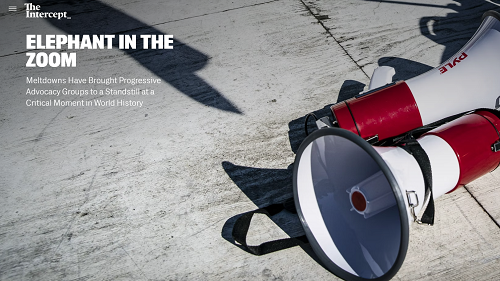
Leftists created wokeism. They claimed it was about justice, inclusion for all, diversity, equity and more, much much more. However, this ill-defined “theology” has become a self-destructive nihilism.
Now, leftist organizations are being eaten from within over the no-bounds, no-rules wokeism.
Wokeism essentially empowers any person – except straight white males – to claim grievances. There are no limits as to what can be called a “microaggression” or upon which one can claim to be harmed. With wokeism, “my truth” matters — even if it is not at all based in reality.
A recent report from The Intercept outlined the many ways leftist organizations are imploding due to this open-ended invitation for people to claim grievances. Leftist organizations found themselves mired in “Slack wars, and healing sessions, grappling with tensions over hierarchy, patriarchy, race, gender, and power.”
Some executives claim they spend “90 to 95 percent” of their time addressing office drama. They’re being forced to address issues that have nothing to do with the organization’s mission or the donors’ wishes.
Executives at the Guttmacher Institute, the American Civil Liberties Union, Sierra Club, and elsewhere are now the targets of their own employees for failing to meet their woke expectations.
Many executives have quit, leaving behind prominent positions because they simply cannot stand their employees. As one executive put it, “This is out of control. No one can be a leader in this culture. It’s not sustainable. We’re constantly being called out from the bottom.”
“I also see a pattern of … people who are not competent in their orgs getting ahead of the game by declaring that others have engaged in some kind of -ism, thereby triggering a process that protects them in that job while there’s an investigation or turmoil over it,” a separate executive stated.
That process leads to internal divisions as employees take sides. And when the woke rules are violated, no apology is ever good enough.
Comments Off on Riding the tiger almost always ends badly for the rider
June 21, 2022
“Schlimmbesserung is a lovely German word which means making something worse by trying to improve it”
In the New English Review, Armando Simón considers some of the oddities of American worldview that seem so often to make worse the very things they try to “fix”:

Americans’ ignorance of other countries, their cultures, their history and their geography is legendary and world renowned and the subject of countless anecdotes and jokes by foreigners. This ignorance is inexplicable, as it is not found in America’s northern or the southern neighbors, so it cannot be due to geographical isolation. It is also a fact that foreigners know more about America than Americans know of their countries. Or even their own.
It is also a paradox. One would expect logically that a country that is principally composed of immigrants and the descendants of immigrants would have an encyclopedic knowledge of other countries, as is the case with Britain, which had a world-wide empire. Not so.
And this may explain America’s unintentional policy of schlimbesserung, the worsening of something that it is trying to improve, or as Greene described it so aptly of an American character in one of his novels, “armored in his ignorance and good intentions”.
As an aside, let me also say that this naïve optimism — to put it charitably — has enabled foreign governments to easily steal diplomatic and military secrets with little trouble, according to Gordievsky’s KGB: The Inside Story of Its Foreign Operations from Lenin to Gorbachev. John Walker, an American traitor who spied for the Russians for 17 years once said in a public interview that Walmart guards a tube of toothpaste better than the Navy guards its secrets. He should know.
Many individual American philanthropists and government bureaucrats go energetically out in the world upon hearing of some terrible condition in some part of the world through the television, convinced that they, yes they, can personally correct the situation when in reality they have no idea of what the hell they’re doing, who they are dealing with, or what is really going on in that part of the world, nor of the cultural, historical, and geographical circumstances. Nor can they even speak the local language! They are simply confident that they will solve the problem. And so they will feel good about themselves (for example, there is no question in my mind that some dirt-poor African doctors, upon learning that some idiot Americans, obsessed with AIDS, were going to send millions upon millions of dollars in their countries “to combat AIDS”, and having very few actual cases of infected patients, simply falsified the statistics. Or worse.). It is as if they were hopscotching across a cultural minefield with an idiotic grin.
The cultural values that one takes so much for granted that one is not conscious of may not be present elsewhere. For example, Americans do not understand that many countries e.g., Greece, Ireland, tend to explain their present problems by blaming other countries (Turkey, Germany, England) over what happened centuries ago instead of actually solving the problems. People in other countries are backward looking in that their sights are rigidly focused on their past, whereas Americans’ eyes are always on the future (and which might explain why Americans are addicted to science-fiction) while being generally ignorant about their past.
Also, it is a general truism that the majority of persons who run for office in North America and various European countries do so because they sincerely want to help and improve their communities/countries. However, in all of Africa and most of Asia, persons who seek public office do so for one purpose, and one purpose only: to steal everything that they can get away with. So when some ignorant, naïve, American shows up with buckets full of money, oblivious of the culture and the longstanding, entrenched, corruption, and with an announced intention to make the local community more like an American community, they are welcomed with open arms while suppressing their snickering. This also explains something where Americans exhibit willful blindness: other cultures don’t play fair. Honesty is seen as the trait of fools. Fools are to be taken advantage of. Especially in trade and diplomacy. Just look at China.
Comments Off on “Schlimmbesserung is a lovely German word which means making something worse by trying to improve it”
“Maybe black people generally prefer black music because it’s far superior to the standard ‘landfill indie’ that ‘Glasto’ is mired in?”
At Spiked, Julie Burchill wonders what happened to Lenny Henry:
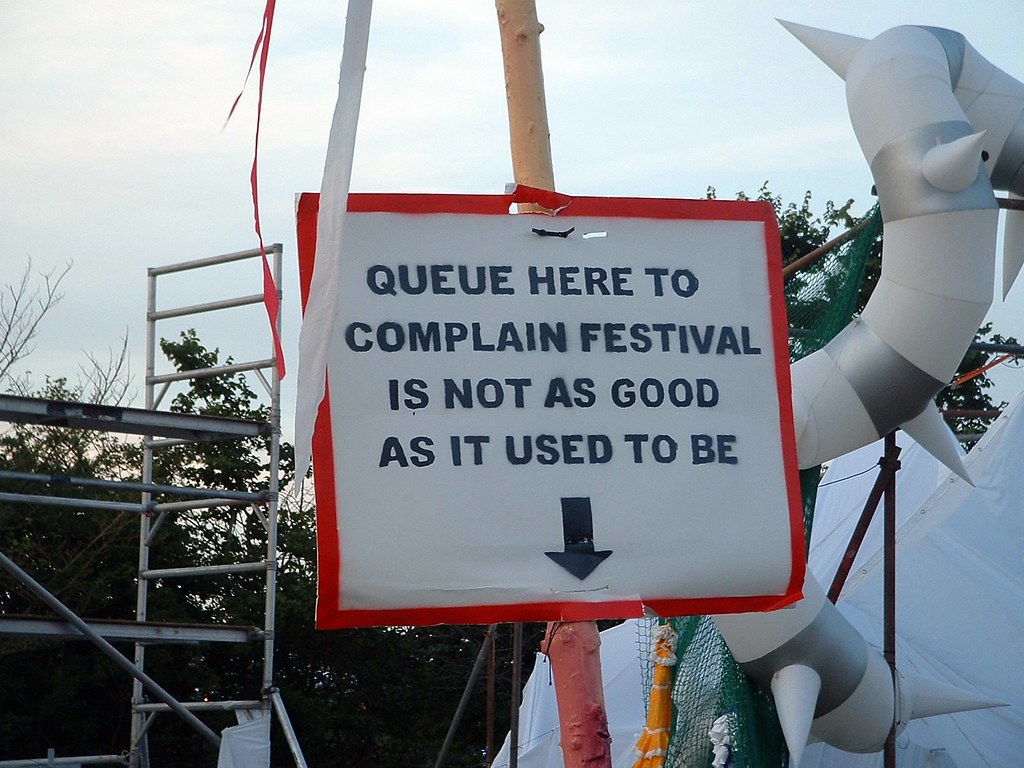
“Sign of the times @ Glastonbury Festival” by timparkinson is licensed under CC BY 2.0 
 .
.
Spare a thought for Sir Lenworth George Henry, Commander of the Order of the British Empire and knight of the realm. He works without interruption or unemployment at a job he loves (and in his spare time makes television commercials for Premier Inn hotels – megabucks payday ahoy!) and has done so from the age of 16. He is now 63 and, unusually, is becoming more attractive as he ages. He has sailed a trimaran from Plymouth to Antigua, performed on a record alongside Kate Bush and Prince, and escaped from marriage to Dawn French. Whereas some comedians become sad shadows of themselves – capering clowns who are laughed at, not with – in middle age he became a serious actor. His radio documentary, Lenny and Will, sent him “in search of the magic of Shakespeare”, whose plays he has since performed in to great acclaim. Not only is he very rich, he has also helped raise millions of pounds for charity as co-founder of Comic Relief.
But despite all of this wonderful success, Henry has in recent years taken to griping about things which really aren’t worth bothering about. Sir Len, where did it all go wrong? Well, I’d wager that it went wrong when Henry realised that if he identified as happy people might start thinking that he chose showbiz as a way to show off and get handsomely rewarded for it. And where would that leave him in the Victimhood Olympics? Nowhere near the podium.
His latest gripe is about Glastonbury. “It’s interesting to watch Glastonbury and look at the audience and not see any black people there. I’m always surprised by the lack of black and brown faces at festivals. I think, ‘Wow, that’s still very much a dominant culture thing'”, he told the Radio Times this week.
Here’s a thought. Maybe black people generally prefer black music because it’s far superior to the standard “landfill indie” that “Glasto” is mired in? And maybe they’re keener on personal hygiene than a bunch of scruffy, middle-class students roughing it on their gap year before going home to a cushy billet arranged by a friend of their father? You won’t find many white working-class people at festivals, either, for the same reasons.
I speak from personal experience. As a teenage reporter at the New Musical Express I got sent to a festival – Reading – as punishment for one of my many juvenile misdemeanours. The moment my stilettos sunk into the mud, I turned back to the station, thus facing a further trouncing from the editor. Every night, after an evening watching some rubbish punk band, I would go home and dance around the room to the sweet soul licks of the Isley Brothers until the awful white racket was forgotten.
I prefer more foreign things than I do indigenous things – from curry to gospel music – but I’m not some self-loathing idiot who believes that this country was worthless when it was white; if diversity is so great, does that mean that India and China and Africa were uninteresting before the West barged in? And don’t bother trying to make the countryside “more accessible” – I’ve never wanted to go on a ramble in my life. Why should I and my fellow mud-dodging citizens of various ethnic heritage be bussed into the racist countryside from the cities we built and love?
Comments Off on “Maybe black people generally prefer black music because it’s far superior to the standard ‘landfill indie’ that ‘Glasto’ is mired in?”
QotD: The modern age of ad hominem
Hence, I myself have developed a particular enmity and impatience with the art of merely labeling opposing viewpoints as anathema, and dismissing them, sight unseen, with no further investigation.
These are not cases where a particular person known to have an ulterior motive or suffering a well earned reputation for dishonesty find his remarks being regarded with judicious skepticism. These are cases where to disagree with the party line or popular gossip provokes the accusation of being such a person.
While not all scalawags are Morlocks, all Morlocks are scalawags. Scalawaggery is the core of their philosophy. Morlock borrowed from the generous genius of HG Wells, for anyone who imagines himself to be evolved beyond human norms and into the realm of moral inversion, so that all rules of right and wrong, only for oneself, are flipped downside up.
In Wells, the Morlock is a cannibal troglodyte who treats other human descendants as cattle. In my wry jest, a Morlock is an intellectual trapped in a structure of reasoning he erected, at first, to justify his inhumanity toward his fellow human beings. That structure has since become for his his thought-prison. The bars and chains are mental and spiritual. Impalpable, they are unbreakable.
Their inhumanity include treating the children of other men as lab experiments and a mass attempt at sexual social engineering, namely, the elimination of the two sexes. Inhumanity also includes treating individuals as fungible and interchangeable nonentities in the great game of identity politics, so that simplistic and bigoted generalizations about minorities or majorities become not merely permitted, but mandatory. Inhumanity includes treating the prosperity and freedom of other men as optional, or even as hindrances, in the headlong panics and stampedes inspired by orchestrated ecological scaremongering and virtue-signaling.
Inhumanity includes regarding other men as meat-robots, or hairless apes, or helpless cells of blind historical forces, and hence as nothing more than the raw materials to be bred like livestock or organized like chain gangs or stacked like cordwood or slaughtered like scapegoats to create the foundations of the towers of Utopia.
The inhumanity, sadly, also and finally includes an inhumanity toward themselves, whenever a godless and soulless mind turns inward, and develops terminal narcissism. All men beyond the narrow orbit of self-absorbed self-regard are reduced to flitting shadows, and seem to Narcissus to be merely echoes, not real.
John C. Wright, “Ad Hominem and Illusion”, John C. Wright, 2022-03-18.
Comments Off on QotD: The modern age of ad hominem
June 20, 2022
The blight of the 21st century – the dictatorship of the experts
Oliver Traldi considers the role of experts in the modern world:
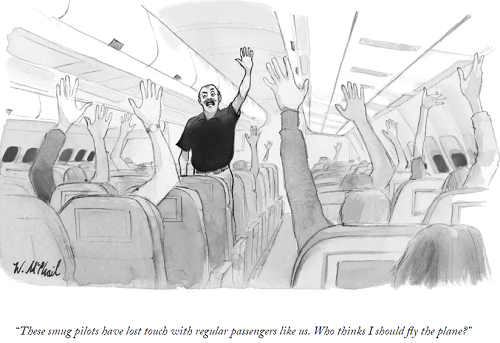
Click to see full-size image at The New Yorker.
A few weeks before Donald Trump’s inauguration as President, the New Yorker published a cartoon depicting a mustached, mostly bald man, hand raised high, mouth open in a sort of improbable rhombus, tongue flapping wildly within, saying: “These smug pilots have lost touch with regular passengers like us. Who thinks I should fly the plane?” The tableau surely elicited many a self-satisfied chuckle from readers disgusted by the populist energy and establishment distrust that they perceived in Trump’s supporters.
But what exactly is the joke here? Citizens in a democracy are not akin to airline passengers, buckled quietly into their seats and powerless to affect change, their destinations and very lives placed in the hands of professionals guarded by a reinforced door up front. Even brief reflection reveals the cartoonist’s analogy to be comparing like to unlike.
That none of us thinks we know better than a plane’s captain, yet we often think we know better than experts in matters of politics, suggests differences between those domains. And it highlights a vexing problem for modern political discourse and deliberation: We need and value expertise, yet we have no foolproof means for qualifying it. To the contrary, our public square tends to amplify precisely those least worthy of our trust. How should we decide who counts an expert, what topics their expertise properly addresses, and which claims deserve deference?
* * *
We all rely upon experts. When something hurts, we consult a doctor, unless it’s a toothache, in which case we go to a dentist. We trust plumbers, electricians, and roofers to build and repair our homes, and we prefer that our lawyers and accountants be properly accredited. Some people attain expertise through training, others through experience or talent. I defer to someone who’s lived in a city to tell me what to do when I visit, and to a colleague who’s studied a particular topic at length even though we have the same mastery of our field overall. A friend with good fashion sense is an invaluable aid in times of sartorial crisis.
In all these cases, our reliance on expertise means suspending our own judgment and placing our trust in another — that is, giving deference. But we defer in different ways and for different reasons. The pilot we choose not to vote out of the cockpit has skill, what philosophers sometimes call “knowledge how”. We need the pilot to do something for us, but if all goes well we need not alter our own beliefs or behaviors on his say so. At the other extreme, a history teacher might do nothing but express claims, the philosopher’s “knowledge that”, which students are meant to adopt as their own beliefs. Within the medical profession, performing surgery is knowledge-how while diagnosing a headache and recommending two aspirin as the treatment is closer to knowledge-that.
But how are those without expertise to determine who has it? Generally, we leave that determination to each individual. A free society and the free market allow for widely differing judgments about who to trust about what, with credentialing mechanisms in place to facilitate signaling and legal consequences for outright fraud. Speculative bubbles notwithstanding, the market also helps to aggregate countless individual judgments in ways that yield socially valuable outcomes. Two New York City diners may have signs promising the “World’s Best Cup of Coffee”, but the one that actually has good coffee is more likely to be bustling on any given day and to thrive in the long run.
H/T to Ed West’s weekly round-up post for the link.
Comments Off on The blight of the 21st century – the dictatorship of the experts
Criminal justice reform
At Time Well Spent, an interview with Charles Fain Lehman that considers the divergence between “what everyone knows” (based on how or if the media reports on an issue) and reality in the criminal justice system:

“Tombstone Courthouse State Historic Park” by August Rode is licensed under CC BY-NC-SA 2.0


I want to really dive into your work at City Journal and elsewhere because you’ve produced some of the most informative and sensible material on crime and crime policy I’ve found online, but before that I’m wondering: where does your interest in crime reporting come from, and what inspires you to keep going in the wake of what seems like a pro-crime movement capturing our newsrooms, elite colleges, and preeminent government institutions? You were the first person to support my interest in converting to Judaism as a black dude (as I mentioned in our dms), and so I have to ask also if Jewish culture centralizes the importance of issues of public safety in some way? Let’s get into it.
In some senses, my interest in crime is just a product of my natural contrarianism — I am rarely satisfied with the popular explanation. When I first started out as a reporter (at the Washington Free Beacon), I focused on domestic policy broadly, which I still do to some extent. I have a fluency with numbers, and so my first intuition was to dig into publicly available data. What I regularly found was that data about the criminal justice system simply did not align with the account of reality pushed by the criminal justice reform movement. Books like The New Jim Crow and documentaries like Thirteen give the impression that most people are in prison for marijuana possession on trumped up mandatory minima, all at the behest of the private prison-industrial complex. In reality, the majority of offenders are in prison for murder, marijuana possession is barely an asterisk in prison populations, mandatory minima explain little of the growth in prison populations, and few prisoners are held in private prisons at all. So I began to develop the sense that perhaps the story popular with people, even conservatives, my age was not precisely up to snuff.
The other issue that I think started me down the road to my “tough on crime” stances today was learning about death penalty abolitionism. I wrote a long essay (unfortunately never published) about the death of Clayton Lockett, who was executed in Oklahoma with a drug called midazolam, which lead to a fairly horrible death. What became apparent to me in researching the piece is that Oklahoma only used midazolam because anti-death-penalty activists had lobbied pharmaceutical firms to stop selling more reliable drugs, namely pentobarbital and thiopental, to states, forcing them to switch to less reliable methods. This sort of unintended consequence is actually a common theme across abolitionist activism. For example, in 2019 the Supreme Court blocked the execution of Vernon Madison, a 68-year-old man whose lawyers argued that dementia rendered him incompetent for execution. But of course, Madison only developed dementia because he’d been awaiting execution for literal decades, since he murdered a police officer in 1985.
These may seem like fairly specific issues, but I think they can allow us to identify a common theme with the progressive current in criminal justice reform, namely a belief that “justice” is primarily a concern of the accused — protecting his rights, defending him against the state, etc. Values like due process are, of course, important. But our discourse obfuscates entirely the basic fact that most criminals have committed heinous acts, and that the first responsibility of justice is to redress those harms through punishment. I am motivated, in other words, by a basic belief that justice matters, and that many reformers, in their zeal for fairness or equity or whatever, actively undermine the pursuit thereof.
I don’t think this is consciously a Jewish attitude, which is to say I don’t think I came to this sentiment because I was taught at some point that this is what Jews believed. That said, I tend to think the view that one of the ways that Judaism is distinguished from Christianity is the primacy of justice in the former, compared to the primacy of mercy in the latter. To the Christian, everyone is a sinner, and so the differences between me and the death row prisoner are ontologically trivial. (A view like this I think motivates someone like the Atlantic‘s Liz Bruenig, whom I credit as one of the few honest death penalty opponents, even as I disagree with her.) Judaism, by contrast, is fundamentally a religion of law: God says that these things ought to be done, and to live well is to do them. Of course, Judaism thinks a great deal about the balance of justice and mercy — the Talmud blunts the Torah‘s death penalties, for example. But Judaism always proceeds from the view that there are laws which should be respected, and that violating those laws requires consequences. So in that regard, I suspect that my views are inflected by Judaism. And indeed, coming around to those views I think helped me to think more about Judaism, too.
Comments Off on Criminal justice reform
June 19, 2022
Has anyone checked the “Best Before” date on the federal government lately?
In the free-to-cheapskates abridged edition of The Line‘s weekly dispatch, the editors wonder if the Trudeau government may have inadvertently entered the end-game phase of its life:

Your Line editors have grown wary of making firm predictions. We’ve been burned a few times before, plus, the last two years have been so wild it’s almost impossible to take seriously any prediction with a time horizon longer than a week or two. All that being said, one of your Line editors did have something of a prediction this week. Honestly maybe something more akin to an intuition or a Spidey sense tingling. But as he watched the news over the last 10 days or so, he found himself wondering: is this it for the Liberals? Is this the start of a death spiral? Is this what we will look back to in years to come as the moment they crossed the point of no return?
The Liberals started to look and feel really burnt out and exhausted this week. Of course they’re burnt out and exhausted. It’s been a hellish two years for everyone, and they were dealing with the Trump circus for years before that. They haven’t usually looked exhausted, though. Even when they have no doubt been running on adrenaline, existential terror, caffeine and digestive bile, they kept running. That’s not sustainable forever, though, and sooner or later, a government slips into the terminal phase of democratic politics. We’ve all seen that before, and we recognize the signs when we see it.
Just think about the stories over the last few days. Public Safety Minister Marco Mendicino has come in for widespread criticism, and not just from here at The Line, for his handling of the gun control and Emergencies Act files. Chrystia Freeland, for her part, made a wholly uninspiring appearance before the committee investigating the Emergencies Act, and followed that up with a speech to a Toronto business crowd where she rolled out the Liberal plan to help Canadians cope with inflation. It was nothing but a repackaging of previously announced initiatives, some of which are fine on their merits, but none of which, even in total, will make a dent against inflation. Mélanie Joly’s office, as noted in greater detail in the full, subscribers-only version of the dispatch, has become a complete clown show of absurdity this week. Karina Gould, normally one of Trudeau’s less trouble-making ministers, had to issue a mea culpa over a minor ethics breach. The Liberals rammed Bill C-11, which would regulate internet content, through the House with unseemly speed, and the Senate is pledging to do the thorough review that the House Liberals clearly wished to avoid.
And then there was the sudden evolution of Liberals’ stand on vaccine mandates, and the pandemic more generally. Facing enormous public pressure over delays at the airports, the Liberals first agreed to “suspend” random COVID-19 testing of passengers landing in Canadian airports from international arrivals. This week, they followed that by suspending the vaccine mandate for air and rail travel. In both cases, the government had been overtly defending both of those measures as absolute necessities just hours or days before scrapping — sorry, “suspending” — them. We won’t even try to summarize this better than the National Post‘s Chris Selley did in a recent column, because we won’t do better than his absolute perfection: “By now, the Liberal playbook on untenable pandemic-related policies is clear: They defend each square inch of policy territory like Tony Montana at the top of the staircase until ordered to retreat, at which point they drop their weapons, flee into the night and claim science made them do it.”
Yuuuup.
In a political sense, none of these would amount to all that much in isolation. (Some of them should amount to a whole lot, because they’re legitimate issues, but we know how politics works in this country.) When viewed in their totality, though, all these (and more) stories over the last week or two start to look and feel like a government that has basically exhausted itself and run out of gas. When you consider the fact that, if anything, the situation facing the country is getting worse on many fronts — hello, inflation! — not better, it’s not at all difficult to imagine them struggling to ever really recover from this.
Comments Off on Has anyone checked the “Best Before” date on the federal government lately?
June 18, 2022
Do you remember Julia from 2012?
If you don’t remember the amazing life story of Julia Faceless, here’s Chris Bray to refresh your memory:
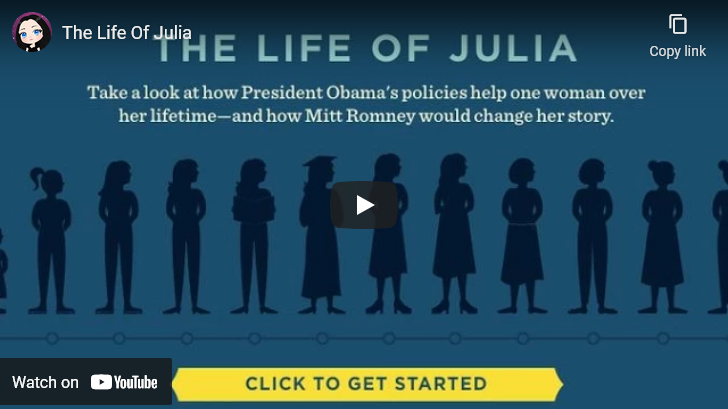
In 2012, the Obama campaign released a cartoon depiction of the choice America was facing, boiled down to a single figure: The Life of Julia.
Julia was actually, literally faceless, and entirely alone, traveling through life without family, friends, or colleagues. But ahh, like the story about the guy who asks God about the two sets of footprints, Julia wasn’t alone alone: She was supported, at all times, by the endless beneficence of the centralized state, our one true parent and deity, the very lifesource. She was able to begin learning as a child because Barack Obama gave her a HeadStart program; she was able to start a business as an adult because Barack Obama gave her an SBA loan. The God-Patriarch Barack walked with her always, enabling her to live, giving her the substance of her life.
That’s how it works, of course: You need programs so you can do stuff. How can a human being possibly reproduce without government programs to support and subsidize reproduction? It’s a biological impossibility — as is well known, the uterus isn’t even activated until the first government check arrives. You can’t do things on your own, and you certainly can’t do things with the informal support of family, friends, or community. Life requires the empowerment that comes with formalized systems of dependency.
Chris then follows up an earlier post on the administration’s muscular deconstruction of student-led activities and organizations at Stanford with some further evidence that even at the college campus level, deliberate infantilization of adults continues at an ever-increasing pace. Adulting is hard, man!
That’s way beyond you, poor debilitated child. Why don’t you try something that’s within your range of ability, like going for a walk around campus? You know, we have a formal organization that can support you in the attempt. To take a walk. Here. On campus.
The message of stories like this, and the message of the administrative actions they describe, is a message of weakness, fearfulness, debilitation, and dependency: You can’t. Imagine telling a healthy twenty year-old that he shouldn’t try to go camping in the mountains, ’cause it’s probably just way too hard for him. See, Stanford’s student life administrators are helping.
What you’re doing in your late teens and early twenties, whether you go to college or not, is learning adulthood — acquiring habits of independence and resourcefulness that you’ll carry for the rest of your life. (Ideally your parents will already deliver you to legal adulthood with a big part of this training already in place.) The message, don’t try to take a trip to the mountains, it’s too hard for you, is a knife in the heart of that journey. It’s a disgusting and shameful thing to communicate to young adults.
Comments Off on Do you remember Julia from 2012?


