Last time we discussed Rome’s popular assemblies, which at least notionally expressed the will of the people. One of the key tasks those assemblies had, we noted, was the election of magistrates, the executive officials of the Roman state. Those magistrates will be our focus this week, though we’re not going to get through all of them. Today we’re going to focus on the structure of a Roman political career, the cursus honorum and the first few steps on that career: serving as military tribunes, quaestors and aediles.
Similar to the magistrates in the Greek polis, Roman magistrates should not be thought of as bureaucrats within a unitary governing institution. Rather each magistrate is an independent actor, granted certain powers to oversee the public interest in a specific field. This is perhaps even more true of Roman magistrates, who rarely function as “boards” the way Greek magistrates often do (none of the senior magistrates in Rome function as a board, they are all individual actors). Instead of having an chief executive (like a president or prime minister) to coordinate the different actions of government, the Romans in the Middle Republic instead rely on the Senate, which will be our topic for next week, though the Senate’s guidance is going to show up a fair bit here as well.
Each of these offices has a range of functions and some interesting powers and prerogatives, so it is worth discussing each one in turn.
Bret Devereaux, “Collections: How to Roman Republic 101, Part IIIa: Starting Down the Path of Honors”, A Collection of Unmitigated Pedantry, 2023-08-11.
April 27, 2024
QotD: Roman magistrates during the middle Republican period
April 24, 2024
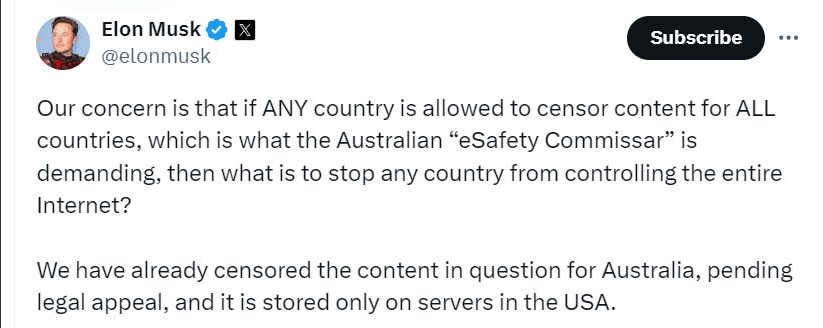
Australia cribs from Trudeau’s notes and tries to censor the internet outside their borders
Tim Worstall explains to the Australian federal government why their attempt to force Elon Musk to obey Australian diktats on Twit-, er, I mean “X” outside Australia is extreme over-reach and should be firmly rejected:
It’s entirely true that Elon Musk is a centibillionaire currently telling the Australian Government that they can fuck off. It’s also true that if Elon Musk were of my level of wealth — or perhaps above it and into positive territory — he should be telling the Australian Government to fuck off.
This also applies to the European Union and that idiocy called the right to be forgotten which they’ve been plaguing Google with. Also to any other such attempts at extraterritoriality. Governments do indeed get to govern the places they’re governments of. They do not get to rule everyone else — the correct response to attempts to do so is fuck off.
So, Musk is right here:
What this is about doesn’t really matter. But, v quickly, that attack on the Armenian Church bishop is online. It’s also, obviously, highly violent stuff. You’re not allowed to show highly violent stuff in Oz, so the Oz government insist it be taken down. Fair enough – they’re the government of that place. But they are then demanding further:
On Monday evening in an urgent last-minute federal court hearing, the court ordered a two-day injunction against X to hide posts globally….
Oz is demanding that the imagery be scrubbed from the world, not just that part of it subject to the government of Oz. Leading to:
Australia’s prime minister has labelled X’s owner, Elon Musk, an “arrogant billionaire who thinks he is above the law”
And
Anthony Albanese on Tuesday said Musk was “a bloke who’s chosen ego and showing violence over common sense”.
“Australians will shake their head when they think that this billionaire is prepared to go to court fighting for the right to sow division and to show violent videos,” he told Sky News. “He is in social media, but he has a social responsibility in order to have that social licence.”
To which the correct response is that “Fuck off”.
For example, I am a British citizen (and would also be an Irish one if that country ever managed to get up to speed on processing foreign birth certificates) and live within the EU. Australian law has no power over me — great great granny emigrated from Oz having experienced the place after all. It’s entirely sensible that I be governed by whatever fraction of EU law I submit to, there are aspects of British law I am subject to as well (not that I have any intention of shagging young birds — or likelihood — these days but how young they can be is determined not just by the local age of consent but also by British law, even obeying the local age where I am could still be an offence in British law). But Australian law? Well, you know, fu.. … .
April 20, 2024
How much of your language do you have to destroy to avoid the taint of historical fascist usage?
For understandable reasons, German governments since the end of World War 2 have been twitchy about any symbols, songs, words and phrases that were used by Hitler’s various fascist organizations … to the point of making many things illegal. eugyppius outlines one particular case where the use of a simple German phrase by an AfD politician has landed him in court, facing a possible three-year prison sentence even though he denies that he knew the phrase had such connotations:

Today, the leader of the Alternative für Deutschland faction in the Thuringian state parliament, Björn Höcke, appeared before the district court in Halle for the first day of his long-awaited speech trial. He stands accused of having used a forbidden Nazi slogan favoured by the Sturmabteilung at a political rally in Merseburg on 29 May 2021. Höcke pleads that he used the three-word phrase in a moment of spontaneous elaboration at the end of his speech, without knowing its National Socialist associations. Out of an abundance of caution, I won’t quote the phrase here, even in translation, but I’ll provide it in context below; it begins with the words “Everything for” (“Alles für“) and concludes with the name of the Federal Republic. As slogans go, it is so seemingly banal that before the trial many Germans would have been surprised to know it had any Nazi associations at all.
For the moment, not much has happened. Höcke’s lawyers filed a variety of requests, among them that the Federal Constitutional Court answer a question surrounding the court’s jurisdiction. In consequence, it’s unclear whether the trial will continue as scheduled next week or whether it will have to be substantially delayed. The state prosecutor’s position is that Höcke’s background as a history teacher makes his claims of ignorance implausible. The prosecutors’ office have also added an additional charge for Höcke’s defiance at a rally in Gera last December, where he shouted the first two words of the slogan at the crowd, and invited them to supply the last one. I fear that this was a grave mistake, because as we will see, the original case against Höcke is laughably weak.
If found guilty, Höcke could be fined or sentenced to prison for up to three years. It is also conceivable that his right to vote and run for office could be suspended. Whatever you think of Höcke or his politics, the political dimensions of this trial are undeniable, as it is occurring mere months ahead of the Thuringian state elections, and as Alternative für Deutschland commands a solid plurality of polling numbers in that state.
[…]
That Höcke deliberately used the SA slogan as a subtle enticement to the extreme right is more than doubtful; that he also did so in hopes that he would be prosecuted and profit politically from his victimisation is so ridiculous, I can’t imagine that even Hillje really believes this. This obnoxious thesis nevertheless recurs whenever the German press report on the harassment of AfD politicians; it is somehow their fault, because they are held to benefit from it.
Der Spiegel, always a source of unintentional amusement, ran a headline today mocking Höcke as a “history teacher with no knowledge of history“. “He claims not to know it was an SA slogan”, they report, “but there are doubts about this”. Alas, the very same news magazine last September accidentally used the forbidden phrase to headline an approving article on Olaf Scholz’s proposed “Germany Pact”. They rapidly changed the headline, appending this brief and embarrassing correction to the bottom:
An earlier version of the article was headed with a line that was used by the SA as a slogan. This was not intended by the author and editors and has now been changed.
April 19, 2024
Yet another unintended consequence of the Online Harms Act – easier deportation of non-citizens
In The Line, Kevin Wiener explains another of the hidden “gems” of the Trudeau government’s ill-considered and repressive Online Harms Act that at least will please a few anti-immigration activists:
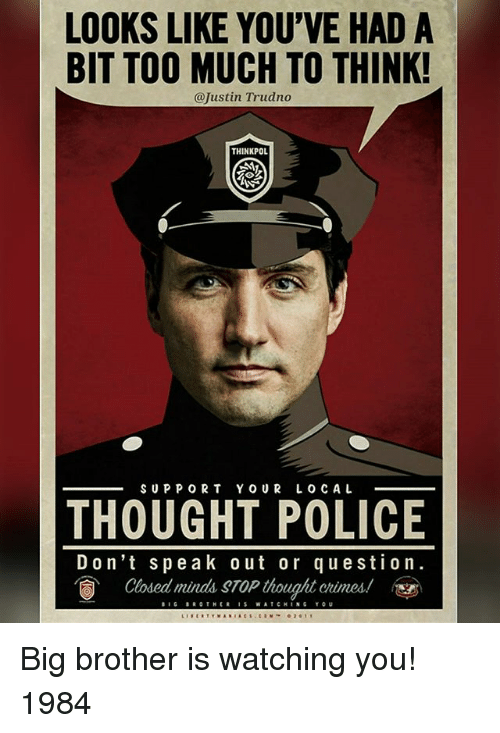
According to the Trudeau government and its defenders, the Online Harms Act is nothing to worry about. This is supposed to be a bill that will protect equity-seeking groups like racial minorities — yet one little-discussed provision will make millions of permanent residents open to deportation for even the most minor criminal offences, as long as a prosecutor can show that the crime was hate-motivated.
The resulting power to turn any crime into a deportable offence will make non-citizens — many of whom are racial and religious minorities — even more vulnerable in the criminal justice system compared to citizens.
The main focus of the Online Harms Act is regulating online platforms, but it also makes major changes to the way the criminal justice system deals with hate-motivated crimes. Under current law, if a crime is motivated by hate based on a protected characteristic, that’s considered an aggravating factor at sentencing. That means the judge can impose a higher sentence than they normally would, although they can never exceed the maximum sentence for the underlying crime. For many minor crimes, that maximum sentence is two years less a day.
The Online Harms Act uses a totally different approach to hate crimes. Rather than just being a sentencing factor, the Act would create a brand-new hate crime offence. Committing any crime, if motivated by hatred, would make someone guilty of a second crime, with a maximum sentence of life imprisonment. To counter public concern, the Trudeau government has recently sent one of its senior advisors, Supriya Dwivedi, to argue that critics of this provision are “engaging in bad faith tactics”, going so far as to make the absolutely false statement that the bill won’t allow an increased sentence unless the underlying crime already had that sentence.
That is an accurate description of the current sentencing regime, but the text and clear purpose of the new bill is to let judges go further: a serious aggravated assault that might normally attract the maximum 14-year sentence can lead to life imprisonment if the attack was hate-motivated.
Further, Dwivedi’s defence of the bill ignores that maximum sentences play an important role in Canada’s immigration policy. If someone is neither a citizen nor a permanent resident, they can only be deported if they commit a more serious (called an “indictable”) offence, or two separate less serious (or “summary”) offences.
The new hate crime provision would be an indictable offence.
April 16, 2024
QotD: Binding and non-binding rules
An omniscient being would be foolish to bind itself to rules.
When we adopt a rule, we wisely admit our ignorance. For a clever assistant professor or ambitious politician to then describe situations in which violating this or that rule will make the world a better place is to achieve absolutely nothing. Although such descriptions often appear to be ingenious discoveries of means for improving the human condition, such descriptions are nearly always nothing but trite demonstrations that if we knew what we do not and cannot know, then acting in disregard of the rule would bring about a state of affairs better than the state of affairs that would be brought about by following the rule.
Well duh.
As a rule, whenever you encounter someone peddling a scheme for improving the world by giving the state discretion to act in violation of well-established rules – for example, to make workers better off by blocking the operation of the price system with minimum wages, or to enrich residents of the domestic economy by substituting free trade with “strategic trade policies” or “optimal tariffs” – recognize that these scheme peddlers arrogantly assume that they or those who will carry out their schemes possess knowledge and information that human beings, as a rule, do not and cannot possibly ever possess.
Don Boudreaux, “Quotation of the Day…”, Café Hayek, 2019-08-20.
April 15, 2024
El Salvador’s approach to fighting serious crime draws gasps of horror from NGOs
In Niccolo Soldo‘s weekend collection of links, he devotes some attention to the amazing success of El Salvador’s current government in driving down the murder rate and why it’s causing much pearl-clutching and dives for the fainting couches among the transnational “elites” and their media handmaidens:
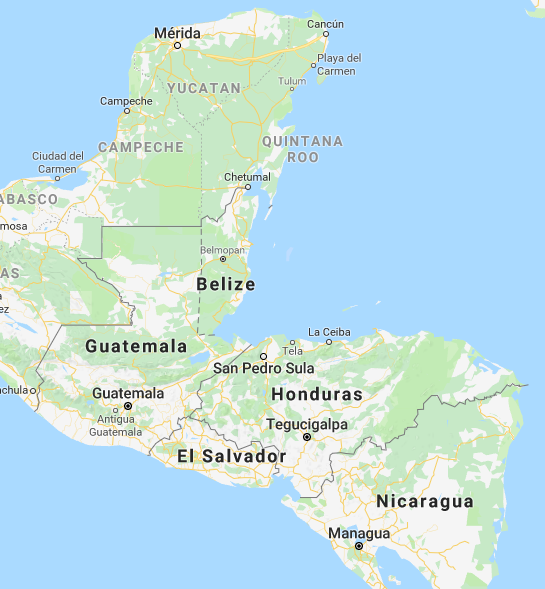
Honduras, Guatemala and El Salvador
Image via Google Maps.
We are bombarded daily with news of mass/random shootings, subway stabbings, and so on. Many of the perpetrators of these violent acts are repeat offenders who for some reason or another (politics) are allowed to roam the streets and attack innocent bystanders. The effect of these lax policies on law and order is the condition known as “anarcho-tyranny” i.e. where the state permits random acts of violence while offering/permitting no solution/resolution … until it has no option but to try and do so.
In NYC, the National Guard is now patrolling the subway. This is a band-aid solution for a problem that was largely fixed already via the policy known as “stop and frisk”. This policy was deemed “racist”, so it had to end. The price of ending this successful policy was a bit of the ol’ anarcho-tyranny. The conflict between rights and law and order continues unabated for the foreseeable future, at least in the USA.
El Salvador has taken a different approach. Since taking office, President Bukele has arrested some 77,000 gang members, locking them up in prisons throughout the country. In one fell swoop, its notoriously high homicide rate has collapsed. Bukele’s law and order policy has resolved El Salvador’s internal security issue … but at what cost? Western media and human rights NGOs insist that the cost has been El Salvador’s democracy:
Under President Nayib Bukele, El Salvador has experienced one of the most spectacular declines in violent crime in recent memory, anywhere in the world. Despite ranking among the most dangerous countries on the planet a mere decade ago, the Central American state today boasts a homicide rate of only 2.4 per 100,000 people — the lowest of any country in the Western Hemisphere other than Canada.
El Salvador owes much of its dramatic drop in crime to Bukele’s crackdown on street gangs and criminal organizations, including MS-13 and Barrio 18. Although homicide rates were trending downward before Bukele took office in 2019, violent crime declined sharply after March 2022, when his government declared a state of emergency following a spike in murders, allowing the government to suspend basic civil liberties and mobilize the armed forces to carry out mass arrests. This state of exception granted Bukele’s administration a blank check to fight gangs and detain suspects without consideration for transparency, due process, or human rights.
Bukele is wildly popular at home, and his policy is now gaining currency elsewhere in Latin America:
Bukele’s iron-fist measures and their apparent results have not only made him wildly popular in his country — earning him a landslide reelection in February 2024 — but also captured the imagination of politicians elsewhere grappling with rapidly deteriorating public safety. Members of the political elite in other states are now toying with the so-called Bukele model. In Ecuador, for instance, President Daniel Noboa has unabashedly followed in Bukele’s footsteps in response to prison riots and a major surge in homicides, declaring a state of emergency in January that gave the armed forces free rein to detain suspects and to take over control of the country’s prisons. The Bukele-style security measures appear to be succeeding there, as well: a little over a month into the crackdown, the government reported that the daily average of homicides had fallen from 28 to six. The fact that militarized public safety campaigns are proving effective outside El Salvador has only enhanced the model’s growing appeal across Latin America, which has long suffered the highest rate of violence of any region in the world.
Here’s the part where the author lodges his protest, and suggests alternative models:
But as appealing as a Bukele-style crackdown might seem, these punitive campaigns against organized crime come at a serious cost to democracy and human rights. These measures concentrate power in the hands of the executive, chipping away at other democratic institutions, such as Congress and the judiciary, that are critical bulwarks against governmental abuse. They also fail to solve the underlying problems, such as corruption and impunity, that generate such violence and instability in the first place.
There are alternatives to the Bukele model for reducing crime. In cities in Brazil, Colombia, and Mexico, politicians have managed to decrease homicides without eroding civil and human rights by making sustained investments in democratic policing, which emphasizes transparency, accountability, and civil liberties. These measures may not work as quickly, and they may not be as conspicuous. But they do not sacrifice democracy on the altar of public safety. Militarized states of emergency are no silver bullet: for any public safety measures to permanently succeed, they must not come at the expense of the democratic institutions that protect civilians from abuse at the hands of the government.
El Salvador has traded off some civil liberties for public safety, but to suggest examples from Brazil, Colombia, and especially Mexico as workable alternatives boggles the mind. This isn’t the first essay written about El Salvador that laments its “loss of democracy” … The Economist keeps pumping out this same argument over and over again. What these articles do tell us is that for many, democracy is indeed a god, and being a god, it is infallible. Not only can the openness of liberal democratic societies not be at fault for some of the crime that has plagued these countries, but Bukele’s heavy-handed approach is doomed to failure in the long run because it is not based on democratic principles. These democratic critics of Bukele are engaging faith-based reasoning, because their god cannot fail.
April 14, 2024
More evidence of Canada’s dwindling state capacity – not enough judges
Matt Gurney discussed this issue along with several others in this week’s Line podcast (highly recommended listening/watching, by the way):
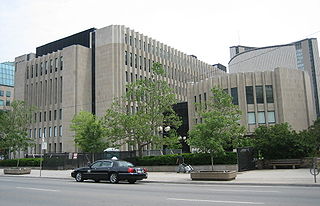
Superior Court of Justice building on University Avenue in Toronto (formerly the York County Court House).
An evolving line of defence we see from the federal Liberals is that they’re actually doing a great job. It’s those darned provincial premiers that are screwing things up.
We touched on this in our last dispatch. And you know what? There’s some truth to it. Some, I stress. A lot of issues that are much vexing Canadians today aren’t fully or even primarily in federal jurisdiction. Health care and housing are two obvious examples. Canada is a complicated place, and the Liberals no doubt prefer to not talk about things that they’ve done that have exacerbated challenges faced by other orders of government. But the basic point is fair: Justin Trudeau ain’t to blame for all that ails you. Or at least, the blame ought to be spread around some.
This national disgrace, though, lands squarely on him.
You might have read about the shortage of judges across the country. It’s a pretty niche issue, so you might have missed it. Even if you’ve heard about it, you may not have paid much attention to it. Most Canadians won’t have much contact with the criminal justice system over their lives, let alone make their careers in it. But the crux of the issue is this: appointing judges to provincial superior courts, where many of the most serious matters are heard, is in the federal jurisdiction. Solely. Ditto appointments to the courts of appeal: totally in the federal jurisdiction. And the feds have fallen way behind on filling vacancies and aren’t appointing judges fast enough to erase the backlog. Despite a spate of recent appointments, there are dozens of vacancies across the country. These are funded positions that ought to be filled and overseeing cases. But they aren’t, entirely because the feds haven’t made the necessary appointments. That’s the issue.
A lack of judges is creating bottlenecks in the justice system. Arrests are being made and charges are being laid and cases are being prepared and then … nothing happens. Because you can’t hold a trial if there isn’t a judge available to oversee it.
The Toronto Star‘s Jacques Gallant has established something of a bleak speciality in his recent reporting. He’s written a series of articles in recent months documenting serious criminal cases that are being thrown out of court, with the accused set free, because their trial has been delayed so much that it cannot be completed before the Supreme Court-ordered limit for a “reasonable” wait for a trial runs out. That’s 18 months for more minor issues, and 30 months for serious ones.
To be clear: the decision to throw out the cases is, in a legal sense, correct. Indeed, it’s mandatory. The Supreme Court determined what a hard limit should be, and a case that exceeds that is dead. Full stop. That’s the law of the land. The judges forced to preside over these dismissals are not to blame, and are increasingly venting their frustration in their rulings. They’re mortified, and they’re criticizing the government in unusually blunt terms, to put it mildly. You don’t often read court rulings that come off more like op-eds, but we live in weird times.
But it’s a good thing that they’re saying something. Because these vacancies are having appalling real-world consequences. Gallant wrote recently about a case that I felt would mark the low point in the entire embarrassment. A woman had accused a man of raping her. She did a brave thing and reported it. The police believed her and made an arrest. The Crown reviewed the evidence and believed her, and proceeded with a trial. A jury believed her, and after considering the evidence against the accused and hearing his defence, convicted him of the crime.
And then the judge tossed the case, setting aside the verdict and letting the accused go free, innocent in the eyes of the law. Because the clock had run out.
April 10, 2024
Saving Our Democracy watch – “[Trump] has to do at least ten years, or everybody will hate the navy”
Chris Bray suggests that reading the full linked document may be hazardous to your mental health, so he’s helpfully highlighted a few of the key points that may have you scratching your head and saying something like “The Fuh? What??”
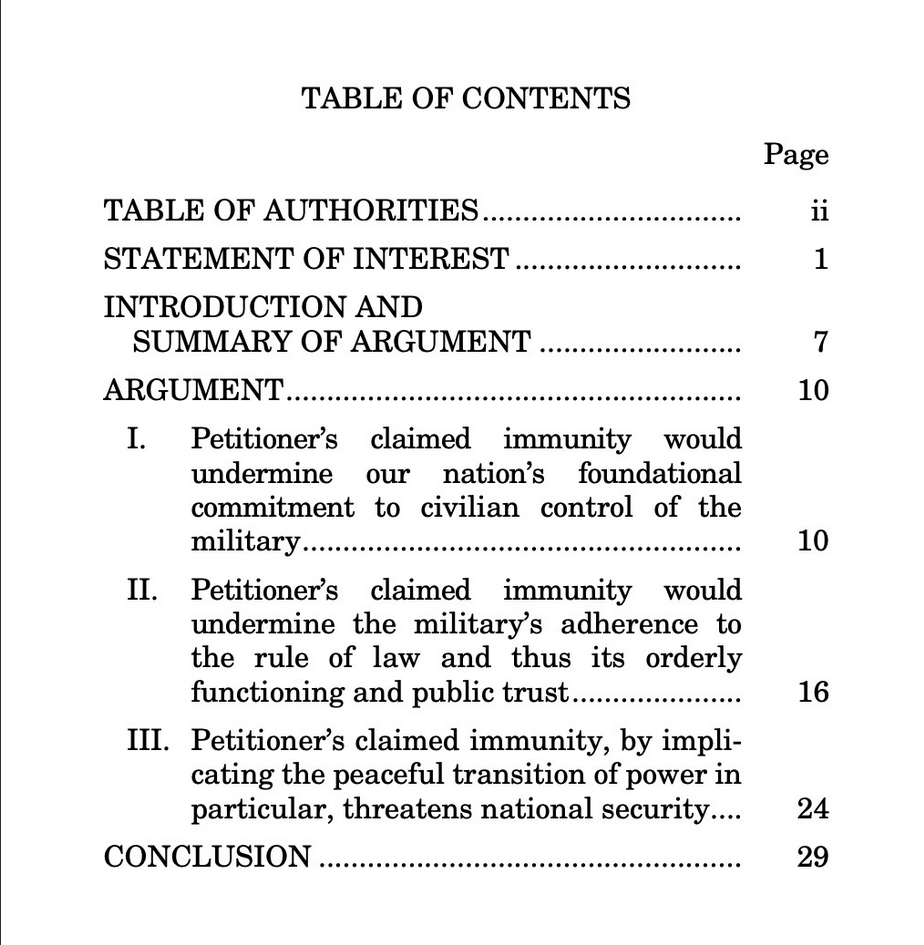
I have a mixed view of Donald Trump’s argument about presidential immunity, which you can read here. But an amicus brief filed with the Supreme Court today by retired flag officers and service secretaries is so bizarre that reading it may permanently alter the structure of my face.
You can read the whole amicus brief here, but treat it like a solar eclipse and don’t stare at it directly. As a first sign of how much good faith the thing contains, one of the amici is Michael Hayden.
The first argument is that Trump has to go to prison or else civilians won’t control the military anymore. You think I’m kidding.
“Amici are deeply interested in this case because presidential immunity from criminal prosecution would threaten the military’s role in American society, our nation’s constitutional order, and our national security.” See the connection? If Donald Trump doesn’t go to prison, “the military’s role in American society” will be damaged. He has to do at least ten years, or everybody will hate the navy.
The prevailing feature of the entire brief is an essence of flattening. Every issue is very simple. There are no competing examples. None of this has ever come up before: The brief deals with questions of presidential immunity around Obama drone-killing a 16 year-old US citizen, or Lincoln unilaterally suspending habeas corpus and using the military to arrest critics of the war, by not mentioning any of it, or any other historical example. Everything is a surface. I’ve graded undergraduate essays, so the tone and depth of the effort feels familiar.
Third argument: Donald Trump has to be prosecuted, because America promotes democracy all over the world, and Trump not being prosecuted is against democracy, so it will be harder for us to promote democracy if we don’t prosecute him. Authoritarian regimes say that American democracy doesn’t work, so: “Presidential immunity from criminal prosecution feeds those false and harmful narratives. Unless Petitioner’s theory is rejected, we risk jeopardizing America’s standing as a guardian of democracy in the world and further feeding the spread of authoritarianism, thereby threatening the national security of the United States and democracies around the world.”
We have to imprison the leader of the political opposition, or people won’t think we’re a democracy, and then there will be more authoritarianism, like when regimes imprison the political opposition.
April 8, 2024
“At the time of writing, the Scottish first minister Humza Yousaf edges J. K. Rowling in the battle for the inaugural title of Scotland’s Most Hateful Person”
At Oxford Sour, Christopher Gage updates us on the mental gymnastics required to navigate Scotland’s new hate crime law:

To the surprise of many terminally online folks, J.K. Rowling is not the top offender under Scotland’s new hate crime law. That “honour” goes to Scotland’s current first minister, Humza Yousaf for a speech delivered several years ago.
One-third of the Scottish police are yet to receive any training on this sweeping new law. Amongst the rank-and-file, the spectre of threatening and abusive material seeping out of public performances such as plays creeps like sarin gas. Such forbidden filth threatens to mutate ordinary Scots into far-right zombies, parroting Andrew Tate’s pitiful jock philosophy.
Police have absorbed over 4,000 reports of hate crimes in the first 48 hours. Mercifully, many Scots are still evidently well-versed in the timeless Scottish art of taking the piss. At the time of writing, the Scottish first minister Humza Yousaf edges J. K. Rowling in the battle for the inaugural title of Scotland’s Most Hateful Person. Second prize, I believe, is a set of steak knives.
Not to worry, those coppers recently announced a new “proportional response strategy”. Police will no longer investigate crimes such as smashed windows, or run-of-the-mill thefts. This “new approach” to policing, which contravenes the very definition of policing, saves the rozzers 24,000 fewer investigations and 130,000 man-hours per year. That leaves plenty of time to investigate those unenlightened beings poxed with the false belief that women don’t have cocks.
Nobody has any idea what is going on. On the first day of the Scottish Unenlightenment, a Scottish National Party minister said J. K. Rowling’s gender-critical tweets could bring the coppers to her door.
On Twitter, J. K. Rowling had reeled off a string of photographs of trans people. She then called those biological men “men”.
Siobhian Brown, the SNP’s community safety minister, had claimed referring to a trans woman as a “he” would not break the new law. Later on, she said the police would decide whether such misgendering would count as a hate crime.
“It could be reported, and it could be investigated. Whether or not the police would think it was criminal is up to Police Scotland for that”, said Brown.
You could taste the acrid, small-town glee steaming from the repressive and literal minded. Rajan Barot, a former fraud prosecutor for the Crown Prosecution Service, warned Rowling that her Twitter posts, many of which state that biological men are not and cannot become women, would most likely contravene the new law and advised her to delete them.
Police later confirmed the very rich and very visible author would not face prosecution for her stubborn grasp of biological reality — at least whilst the universe watched on in a state of unadulterated fremdschämen.
March 23, 2024
“At least they didn’t arrest the dog”
Andrew Doyle revisits the Nazi pug story as new Scottish blasphemy hate speech laws are about to come into force at the beginning of April:

If you’re deluded enough to suppose that human history works in a progressive linear fashion, the example of Scotland should swiftly change your mind. Once the home of the Enlightenment, the country has now veered into authoritarianism under the control of the SNP. The party’s new hate crime law will come into force on April Fools’ Day, and no-one in government is seemingly able to give examples of “crimes” that would be covered by this legislation that aren’t already criminal. When specifically asked on the BBC’s Newsnight whether “misgendering” would result in prosecution, SNP backbench Fulton MacGregor could only mutter: “Well, it depends on the circumstances”. How reassuring.
For all MacGregor’s “faith” that the law would be “properly” implemented, nonbelievers are right to be cautious. Vaguely worded legislation is bound to be exploited, and has been many times in the past. This is particularly the case when it comes to “hate speech”, a concept for which no adequate definition has ever been achieved. The best the Irish government could muster for their forthcoming hate crime bill is that hatred “means hatred”. In these times of slippery authoritarian wordplay, that’s about as specific as we can expect.
The Scottish police have claimed that they will not “target” comedians and actors under the new legislation, and yet at the same time have sworn to investigate every complaint. Thankfully, activists never make spurious complaints against their ideological opponents in the hope of seeing them silenced. Oh wait. They do. All the time.
[…]
So for all of the claims that our concerns about the new hate crime law are unfounded, and that the police would never prosecute anyone for a gag, we should remember that they already have. This legislation will simply make it easier for activists within and without the police force to weaponise the law against those deemed to be subversive. On the day of Meechan’s arrest, one police officer affirmed that he must be “an actual Nazi trying to inspire people to become Nazis”. The judge eventually agreed, in spite of the fact that after two years of investigation the police had uncovered no evidence of far-right sympathies.
Of course those who wish to criminalise dissent will not stop at comedians. They’ll also be keen to crack down on anyone who knows the difference between men and women and is willing to declare this esoteric knowledge out loud. Although it has become a cliché to cite George Orwell’s Nineteen Eighty-Four in such circumstances, that is only because it is so apposite: “The Party told you to reject the evidence of your eyes and ears. It was their final, most essential command”.
I do not sincerely believe that the police will turn up at our Comedy Unleashed show next Monday. It seems unfathomable that we might see a kind of re-enactment of the closing scenes of The Blues Brothers, with police officers standing in the shadows of the club to monitor the show for heterodox content. But then, I would never have anticipated that in a free country someone who made a video mocking Nazis would end up with a criminal record. Of course our show will be offensive to those who choose to be offended. Such is the nature of comedy. The only way to avoid such a situation would be for the acts to stand on stage in total silence. And even then, someone might find this offensive to mutes.
March 16, 2024
Canadian courts bracing for a “tsunami” of Pretendians
Tristin Hopper on the dawning realization among Canadian provincial courts that they are facing a huge increase in the number of offenders hoping to take advantage of the reduced sentences available to First Nations people:

“The Pretendians”, a CBC documentary – https://www.cbc.ca/passionateeye/episodes/the-pretendians
A B.C. judge has warned that a “tsunami” of fake Indigenous people are set to hit the Canadian court system as offenders increasingly claim Indigenous status in a bid to obtain lighter treatment.
“A Tsunami is coming; driven by the desire of non-Indigenous people to get what they perceive to be the benefits of identifying as Indigenous,” B.C. Provincial Court Judge David Patterson said in a decision published this week.
Patterson warned his fellow judges “to be alive to the issue of Indigenous identity fraud” and begin demanding “proof” that offenders are “entitled to be sentenced as an Indigenous person”.
The decision was in regards to a Prince George, B.C., pastor, Nathan Legault, who was convicted of several charges related to the sexual victimization of young girls under his supervision, including a conviction for the making of child pornography.
But before the sentencing, Legault told the court he now self-identified as Métis, and should thus be subject to Gladue Rights — a system wherein judges are required to consider lighter and “alternate” sentences for Indigenous offenders.
First written into the Criminal Code in 1995 and then encoded in the 1999 Supreme Court decision R v. Gladue, these principles were explicitly introduced to reduce rates of Indigenous incarceration by requiring judges to consider “the circumstances of Aboriginal offenders” before applying a legal sanction.
R v. Gladue states specifically that the principle is “not to be taken as a means of automatically reducing the prison sentence of aboriginal offenders”. The decision also says that it’s “unreasonable to assume that aboriginal peoples do not believe in the importance of traditional sentencing goals”.
Nevertheless, lighter sentences and more ready bail are often the effect — to the point where the Gladue process has been criticized by Indigenous women’s groups for favouring Indigenous male offenders at the expense of Indigenous female victims.
March 15, 2024
Toronto’s blue-uniformed surrender monkeys say … just make it easier for criminals and maybe they won’t hurt you
Crime has been increasing lately, and Toronto’s boys, girls, and all 57 other genderbeings in blue have their very best advice for you: surrender now.

… Toronto Police have reflected on the problem. They’ve mulled it over. Thought long and hard. And they’re advising people just give up. To stay safe.
This advice came out at a community safety meeting between Toronto Police officials and concerned citizens last month. (The meeting was covered by City News Toronto, but didn’t get widespread coverage until this week, when clips went viral online. Tell me that isn’t a microcosm of the 21 century.) In remarks to the citizens at the meeting, a Toronto police constable said this: “To prevent the possibility of being attacked in your home, leave your fobs by your front door. Because they’re breaking into your homes to steal your car. They don’t want anything else. A lot of them that [the police] are arresting have guns on them. And they’re not toy guns. They’re real guns. They’re loaded.”
Oh. Okay.
Look, it’s not bad advice, in any individual circumstance. There probably are a lot of people out there who’d be relieved if someone kicked in their door, grabbed the fob and took off. And it’s certainly not novel advice from a police service. We’ve all heard variations of this before, right? “Just give up your wallet” when you’re mugged. “Just get out of the car” during a carjacking. You can always replace things. Right?
The problem is that, in the other scenarios above, you’re out and about in public. There’s no guarantee of safety in public, as much as we all wish otherwise. The advice now being given by Toronto police isn’t what to do when someone jabs a gun into your ribs in a seedy back alley, but how to avoid being harmed by bad guys in your own home. And the police advice is “Make it so easy on them that they have no reason to hurt you”.
There’s no charitable read on this, and in this case, truth isn’t a defence. I accept that the police are giving their real, best, true advice. I accept that they are being sincere. That’s the problem: the police are sincerely surrendering. They’ve given up, and they think it would be best if you gave up, too. These violent robberies are just going to continue, and it’s on us — the public — to minimize the bloodshed and risk to ourselves by … submitting.
I try to avoid hyperbole in columns, with the odd exception for comic effect. But this isn’t funny at all, so I won’t make a joke of it. Let’s be extremely serious for a moment. If this is where the Toronto Police Service has landed in terms of their best advice for the public, as a member of that public and Toronto resident, I’d like to ask this: why stop with leaving my fob by the front door? I have a laptop computer. It’s a few years old now, but still in workable condition. It’s worth a few hundred bucks. Maybe I should leave that by the door, too? I don’t keep a lot of cash on hand — who the hell does, in 2024? — but there’s usually a few bucks in my wallet, or my wife’s. Should part of our nightly routine now just be emptying our wallets into a little bowl that we can leave on the radiator by the front door, and come morning, if the door hasn’t been kicked down and the cash grabbed, we can just put the money right back into our wallets as we get the day started? I’m not really a jewelry guy, but my wedding band is worth something, I guess. Pop that into the bowl with the cash?
After all, the bad guys have guns. Real guns. Loaded guns. And there is apparently nothing to be done about this except submit and co-operate. So say the police.
<sarc>No, that can’t be right. Justin Trudeau made guns illegal, so the bad guys just can’t have guns. It would be against the law, and they might get in trouble.</sarc> Oh, and should the propitiatory offerings be placed inside or outside the door? I guess outside, to make it even easier for them, but make sure everything is protected from rain or snow … it’d be risky if they had to pick everything up soaking wet and they might take it out on you and your family.
That’s Matt Gurney from The Line, so you really should read the whole thing.
QotD: The ever-growing state
That one phrase sums up all the problems we are having with government in this country. It justifies the humiliating personal searches at airports. It justifies the police state tactics of “sobriety checkpoints” or “identification stops”. It justifies the Patriot Act, and the new Intelligence Reform Act, with all their draconian intrusions on personal privacy, including the repulsive, illegal and un-Constitutional parts, such as no-warrant-required searches, a national ID card, federal snooping into our reading habits at libraries and book stores. It justifies any intrusion into private, personal, or intimate matters. After all, if someone has more than one wife (or husband), doesn’t your peace of mind require that that person be harassed, jailed, or otherwise punished for violation of your religious or moral code? It doesn’t matter that the people involved are adults who freely and willingly consent to live in that situation. For that matter, if two men or women live together, doesn’t your peace of mind require that their “immoral and ungodly” lifestyle be exposed, and the people involved publicly pilloried?
Ron Beatty, “Peace of Mind”, Libertarian Enterprise, 2005-03-06.
March 14, 2024
Oddly, Jen Gerson finds her fears about the Online Harms Act unassuaged
There was a point during the last Line podcast where Jen Gerson used the word “assuaged”, and then realized that although she knows what it means and when it’s appropriate to use it, she didn’t know how to say it out loud (a problem I’ve encountered many times in my life, having read widely but not listened to lectures on the various topics I’ve read about). I reference that in the headline, as she recounts going through a belated “technical briefing” on the already tabled bill:
Let’s start by noting that it’s a little bit odd for a government to hold a technical briefing for a bit of legislation more than a week after that legislation has been tabled. Usually presentations of this kind are held for media, MPs, and various stakeholders as or just before a complicated issue or bill is about to be announced to the public.
For the federal government to hold a briefing on the Online Harms Act on March 6 — as it did — raises questions. Questions like “Why?” Questions like “Is this really a ‘technical briefing’ or is this an attempt to assuage concerns about what is actually written in the bill?” And, most importantly, questions like “Am I so assuaged?”
I think, dear readers, that I am not.
Let me explain by appending a caveat about the Online Harms Act, or Bill C-63, which was tabled about two weeks ago. About 75 per cent of what’s in this bill is either good, or benign but potentially useless, and is genuinely focused on mitigating real online harms like child porn and revenge porn. I might nitpick some of those parts if it weren’t for the rest of it. The rest of it consists of “will result in the most significant expansion of Canada’s hate speech laws and create one of North America’s most rigid regulatory environments for media and social media companies”, as law firm Norton Rose Fulbright put it.
In C-63, and its attempts to explain this bill, this government has consistently muddied the waters that delineate between hate crimes and hate speech, and has demonstrated a deep unwillingness to deal with the philosophical problem of defining hate speech in a way that is clear, consistent, and fairly and evenly applied. More specifically, the bill’s attempts to increase the penalties for “advocating genocide” to life imprisonment; the use of peace bonds for pre-crime hate speech; and the re-introduction of Section 13, to be administered by the already questionable Human Rights Tribunal apparatus. All of these present such punitive measures that they would have a chilling effect on speech that is fundamentally incompatible with the freedoms we expect in a Western liberal democracy.
There’s no nice way to put this. These measures reveal deeply authoritarian instincts toward speech and regulation, all the more pernicious as they’re being introduced by people who are absolutely convinced of their own righteous good intentions.
And that brings us back to the aforementioned technical briefing, which attempted to address each of these concerns in turn. I should note that I don’t believe I was invited directly to this briefing — and as I’m not in the Parliamentary Press Gallery, this is not surprising or unusual. I was, however, provided a copy of the briefing in its entirety, and I was told that I was free to quote from it, provided I did not name the Department of Justice official speaking.
To that end, I’d like to provide some excerpts and paraphrases from this briefing, followed by my own observations on what was being presented to an audience of, broadly speaking, laymen. I’ve also run these observations by criminal lawyers to ensure my understanding of the law is sound. If I am in error in any point, I welcome any correction.
March 13, 2024
The true “Online Harms” are coming from inside the bill
Even the state media lapdog CBC admits that the Trudeau government’s proposed Online Harms Act is an incredibly authoritarian piece of legislation:
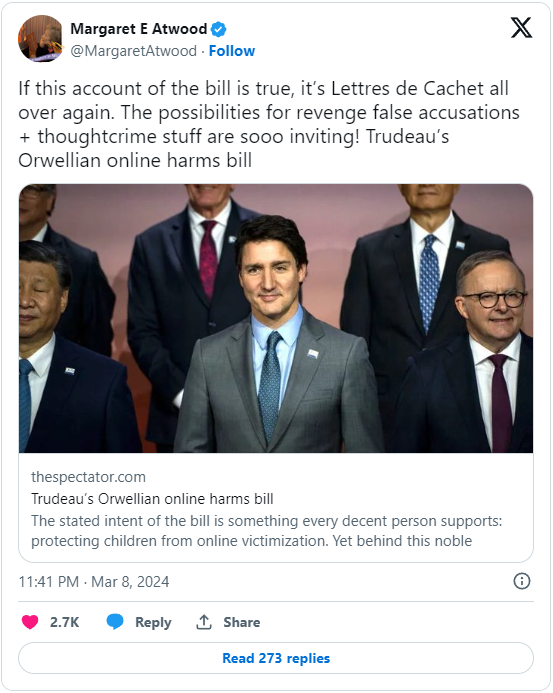
Justice Minister Arif Virani is defending his government’s Online Harms Bill after celebrated Canadian writer Margaret Atwood shared views comparing the new legislation to George Orwell’s dystopian novel Nineteen Eighty-Four.
The award-winning author took to social media late last week to share an article from the British magazine The Spectator titled, “Trudeau’s Orwellian online harms bill”.
“If this account of the bill is true, it’s Lettres de Cachet all over again,” Atwood wrote on X, referring to letters once sent out by the King of France authorizing imprisonment without trial.
The federal government introduced late last month its long-awaited Online Harms Bill, which proposes to police seven categories of harmful content online, including content used to bully a child, content that sexualizes children or victims of sexual violence, content that incites violence or terrorism, and hate speech.
As part of proposed amendments, “hate speech” would be defined based on Supreme Court of Canada decisions.
“The possibilities for revenge false accusations + thoughtcrime stuff are sooo inviting!” Atwood wrote.
In Orwell’s cautionary novel about a totalitarian society, thoughtcrime is the illegal act of disagreeing with the government’s political ideology in one’s unspoken thoughts.
Atwood famously tackled authoritarian regimes in her novel The Handmaid’s Tale, in which a religious patriarchal society forces women to bear children and those who speak freely are severely punished.