
TimeGhost History
Published on 21 Apr 2018The year 1919 was the year when the world took the first step into the age of mass communication. Wartime developments now create the aviation industry, mass produced cars, broadcast media and … more guns.
Join the TimeGhost Army at https://timeghost.tv
Or on Patreon: https://www.patreon.com/TimeGhostHistory
Hosted by: Indy Neidell
Written by: Spartacus Olsson and Indy Neidell
Directed by Spartacus Olsson
Produced by: Astrid Deinhard
Executive Producers: Bodo Rittenauer, Astrid Deinhard, Indy Neidell, Spartacus OlssonA TimeGhost chronological documentary produced by OnLion Entertainment GmbH
April 22, 2018
Planes, Guns and Automobiles I BETWEEN 2 WARS I 1919 Part 1 of 4
Comments Off on Planes, Guns and Automobiles I BETWEEN 2 WARS I 1919 Part 1 of 4
Hunting – Dreyfuss Affair – Equipment Modifications I OUT OF THE TRENCHES
The Great War
Published on 21 Apr 2018Chair of Wisdom Time!
Comments Off on Hunting – Dreyfuss Affair – Equipment Modifications I OUT OF THE TRENCHES
April 21, 2018
That time Mossad ran a resort to rescue Sudanese refugees
Join Israel’s secret spy agency! Learn all the tricks of espionage! Run an exotic beachside resort! Wait, what?
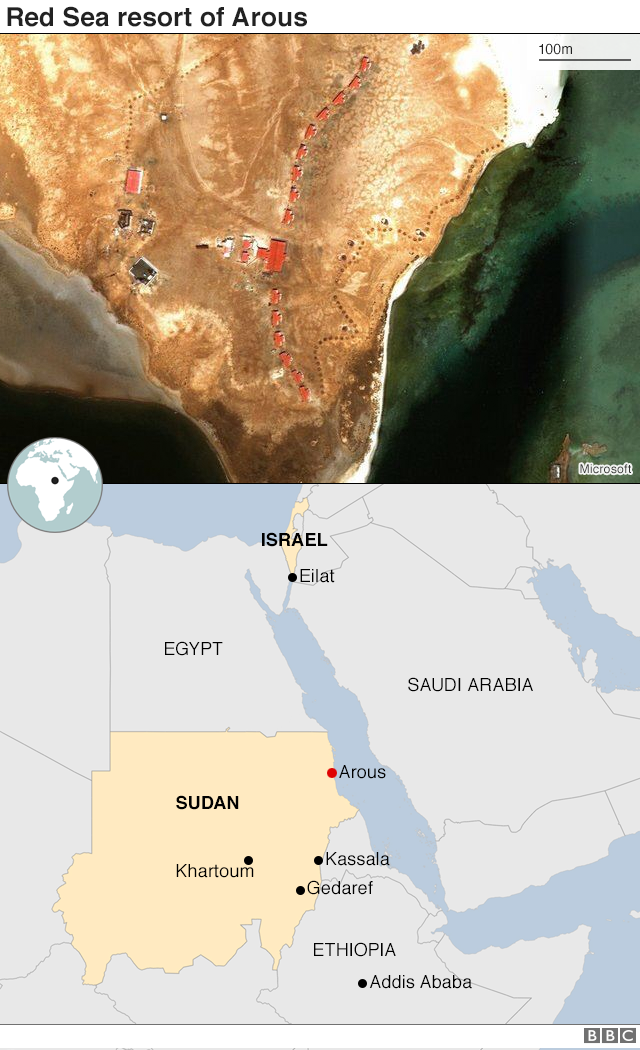
“Arous on the Red Sea, a wonderful world apart,” the glossy brochure says, pronouncing it “the diving and desert recreation centre of Sudan”
Illustrated with pictures of putty-coloured chalets on a sun-drenched beach, a smiling couple in scuba gear, and varieties of exotic fish, the advertisement boasts of “some of the best, clearest water in the world”. As night falls – “after the landscape colours have paled” – there are, it says, “breathtaking views of the heavens, aflame with millions of stars”.
Arous Village, on the fringe of spectacular coral reefs and the odd shipwreck, appears to be a diving enthusiast’s dream.
[…]
The only thing was, unbeknown to the guests or the authorities, the Red Sea diving resort was entirely fake.
It was a front, set up and run for more than four years in the early 1980s by operatives from the Mossad, Israel’s intelligence agency.
They used it as a cover for an extraordinary humanitarian mission – to rescue thousands of beleaguered Ethiopian Jews stranded in refugee camps in Sudan and evacuate them to Israel. Sudan was an enemy Arab country, and it had to be done without anyone finding out, either there or at home.
“It was a state secret, nobody talked about it,” says Gad Shimron, one of the agents who served at the village. “Even my family didn’t know.”
“For us it was a godsend. If we could get hold of this place and do it up, we could say we’re running a diving village, which would give us a reason for being in Sudan and furthermore for roaming around near the beach.”
What happened next is the subject of a soon-to be released Hollywood film called Red Sea Diving Resort. Filmed in Namibia and South Africa, it tells the story of the operation and the village. Though while it is based on true events, some of the scenes are fictitious.
[…]
While seeing to their guests by day, every so often at night a squad would leave under cover of darkness and head to a rendezvous point 10km (six miles) south of Gedaref.
“We’d tell the staff we’re going to Khartoum for a few days, or to meet some Swedish nurses from the hospital in Kassala,” says Gad.
They would pick up groups of Ethiopian Jews, smuggled out of the camps by so-called Committee Men – a handful of Beta Israelis recruited for the job.
“The Ethiopian Jews were given no notice, as we could not risk word getting out,” says Gad. “They did not even know we were Israelis. We told them we were mercenaries.”
From there, a convoy of lorries carrying dozens of bewildered refugees drove a two-day – 800km – journey, evading detection at numerous checkpoints along the way by a combination of guile, bribery and occasionally ramming their way through.
At breaks, they would try to pacify the frightened passengers.
“When we let them sit in the driver’s cabin and touch the wheel, they were in seventh heaven,” Gad says, in his book Mossad Exodus. “It was amazing to see how happy they were at sharing a piece of chewing gum among 20 children. They looked at us as though we were creatures from outer space.”
When they got to the beach, north of the holiday village, Israeli navy special forces would come ashore on Zodiac dinghies, collect the refugees and transport them a further hour and a half to a waiting naval vessel, the INS Bat Galim.
The ship then took them to Israel.
Comments Off on That time Mossad ran a resort to rescue Sudanese refugees
History Buffs: Rome Season One
History Buffs
Published on 18 Aug 2017Rome is a British-American-Italian historical drama television series created by John Milius, William J. MacDonald, and Bruno Heller. The show’s two seasons were broadcast on HBO, BBC Two, and RaiDue between 2005 and 2007. They were later released on DVD and Blu-ray. Rome is set in the 1st century BC, during Ancient Rome’s transition from Republic to Empire.
The series features a sprawling cast of characters, many of whom are based on real figures from historical records, but the lead protagonists are ultimately two soldiers named Lucius Vorenus and Titus Pullo, who find their lives intertwined with key historical events. Rome was a ratings success for HBO and the BBC. The series received much media attention from the start, and was honored with numerous awards and nominations in its two-series run. The series was filmed in various locations, but most notably in the Cinecittà studios in Italy.
Comments Off on History Buffs: Rome Season One
April 20, 2018
Disease, War and The Lost Generation I Between 2 Wars I 1918 Part 2 of 2
TimeGhost
Published on 19 Apr 2018As World War One ends the dying takes on new proportions when the Spanish Flu ravages the world. A whole generation of young people that should be starting their adult life is instead decimated at a devastating rate. The suffering at the end of 1918 will have consequences that last until this day.
Join us on https://timeghost.tv
or on Patreon: https://www.patreon.com/TimeGhostHistoryHosted by: Indy Neidell
Written by: Spartacus Olsson and Indy Neidell
Directed by: Spartacus Olsson
Produced by: Astrid Deinhard
Executive Producers: Bodo Rittenauer, Astrid Deinhard, Indy Neidell, Spartacus OlssonA TimeGhost chronological documentary produced by OnLion Entertainment GmbH
Additional information from TimeGhost:
In the new episode of Between 2 Wars we look at death and suffering in 1918 from another source than the World War: the Spanish Flu and its effects on the young adults of the time. This is the first, but not the last episode in the Between 2 Wars series that focuses on non-military and non-geopolitical events.
To understand these decades we will look occasionally at fashion, technology, design, arts, culture and civil life in general. After all the 1920s and the 1930s is very much the time period when the world became modern in the true sense of the word.
Much of what we still consider contemporary (both things and thoughts) was created in the 20s and 30s. Already the next episode will also focus on civil life as we look at the birth of civil aviation and the radio. After that we dive right back into war with the Russian Civil War!
Comments Off on Disease, War and The Lost Generation I Between 2 Wars I 1918 Part 2 of 2
Knocking Out The Hejaz Railway I THE GREAT WAR Week 195
The Great War
Published on 19 Apr 2018While the Germans are still advancing in Flanders (Operation Georgette), the other fronts are not always quiet. In Palestine, the British forces and the Arab Revolt are taking the initiative again. T.E. Lawrence (Lawrence of Arabia) and the Arab Revolt are attacking the vital Hejaz Railway, a major transport factor for the Ottoman Empire.
Comments Off on Knocking Out The Hejaz Railway I THE GREAT WAR Week 195
Great Blunders of WWII: The Pilot Who Bombed London 3
Anthony Coleman
Published on 4 Nov 2016From the History Channel DVD series Great Blunders of WWII
Comments Off on Great Blunders of WWII: The Pilot Who Bombed London 3
April 19, 2018
Lord Dunsany – The History of Sci Fi – Extra Sci Fi – #6
Extra Credits
Published on 17 Apr 2018Dunsany is arguably the “father of fantasy,” bringing to life the classic worldbuilding tropes that inspired so many authors, from H.P. Lovecraft to Ursula K. Le Guin. But his short stories and novels have sadly fallen out of memory…
Comments Off on Lord Dunsany – The History of Sci Fi – Extra Sci Fi – #6
“Blitzkrieg” – What most people get Wrong – Myth vs “Reality”
Military History Visualized
Published on 18 Aug 2017“Blitzkrieg” is probably the most wrongly used word when it comes to Military History. Its buzzword effect is widely known. The question is what was “Blitzkrieg” actually and is it used “correctly” at all? Additionally, the question if “Blitzkrieg” was something unique to the Wehrmacht will be answered?
Military History Visualized provides a series of short narrative and visual presentations like documentaries based on academic literature or sometimes primary sources. Videos are intended as introduction to military history, but also contain a lot of details for history buffs. Since the aim is to keep the episodes short and comprehensive some details are often cut.
» SOURCES «
Citino, Robert M.: The German Way of War
Hughes, Daniel J.: “Blitzkrieg”, in: Brassey’s Encyclopedia of Land Forces and Warfare, p. 155-162
Ong, Weichong: “Blitzkrieg: Revolution or Evolution?”, in: RUSI December 2017 – Vol. 152 No. 6, p. 82-87
Harris, J.P.: “The Myth of Blitzkrieg”, in War in History 1995 2 (3), p. 335-352
Frieser, Karl-Heinz: The Blitzkrieg Legend
Frieser, Karl-Heinz: “The war in the West, 1939-1940: an unplanned Blitzkrieg”. In: Cambridge History of the Second World War, Volume I: p. 287-314
Comments Off on “Blitzkrieg” – What most people get Wrong – Myth vs “Reality”
QotD: The Epicurean view of the soul
The purpose of the 37 volumes of his On Nature is to free us from the fear of death and therefore from the control of priests and from the internal fears of the religion that Plato and his followers had in mind. Epicurus says:
…[W]e must recognise generally that the soul is a corporeal thing, composed of fine particles, dispersed all over the frame….
…[T]he rest of the frame, whether the whole of it survives or only a part, no longer has sensation, when once those atoms have departed…. Moreover, once the whole frame is broken up, the soul is scattered and has no longer the same powers as before, nor the same notions; hence it does not possess sentience either.
The atoms that comprise the soul are immortal. They are passed on from being to being like the torch in one of the Athenian races. But the larger structure of atoms that is the soul of any one individual is itself mortal. Once we are dead, our atoms are recycled. Since there is nothing but atoms moving in the void, we as individuals are annihilated. After death, there is nothing; and because of that, death is nothing. Epicurus says:
Death is nothing to us; for that which has been dissolved into its elements experiences no sensations, and that which has no sensations is nothing to us.
After two thousand years of Christian spiritual hegemony, this may seem to many of us a gloomy doctrine. For Epicurus and his followers, however, it was a removal of the greatest barrier to happiness as they conceived it. That barrier was fear of endless punishment for the alleged sin of seeking their own happiness in life.
It may be, Lucretius says, that beating down religion is impious and the entry to a life of crime. Much rather, it is religion which has brought forth criminal and impious deeds. He lived before the most notable acts of religious mania. But he was poet enough to know the psychology of enthusiasm. In Book One of his poem, he produces one of the most striking of all denunciations of religion. He describes how, at the beginning of the Trojan War, the priests tell Agamemnon that a good passage across the Aegean required the sacrifice of his daughter. So a young girl was dragged to the altar for her throat to be cut by her own father.
Tantum religio potuit suadere malorum he concludes — “Such are the evils to which religion leads”
He says later, in Book Three:
Some wear out their lives for the sake of a statue or a name. Religion and its resulting fear of death can induce one man to violate honour, another to break the bonds of friendship, and to overthrow all natural feeling. It has induced men to betray their country or their parents for the sake of avoiding hellfire. For just as children tremble and fear all in the darkness, so we in the light of day often fear what is no more real. This terror must be dispersed, not by rays of sunshine nor by the bright shafts of daylight, but by the sight and understanding of nature.
It is Epicurus, he says, who brought us into this light of understanding. Do not fear the priests. Do not fear death. Pay no attention to dreams or omens. These latter have a natural explanation. The former have neither a divine nature nor a prophetic power, but they are the result of images that impact on us.
Follow the ethical teachings of Epicurus, and be happy.
None of this means, by the way, that Epicurus and his followers were atheists. They did accept the existence of gods, and were willing outwardly to conform to whatever cults were established. They only denied that the gods were immaterial, and that the gods had any interest in human affairs. Confronted with evidence for any supernatural event, they were content with insisting on a natural cause, whether or not they were able to think of one that convinced.
Sean Gabb, “Epicurus: Father of the Enlightenment”, speaking to the 6/20 Club in London, 2007-09-06.
Comments Off on QotD: The Epicurean view of the soul
April 18, 2018
Israel at 70
In the National Post, Barbara Kay explains why the world should (but largely will not) celebrate the 70th anniversary of the foundation of the state of Israel on Thursday:
Making the case for Israel’s territorial and political rights involves a deep knowledge of Jewish and Arab history, understanding of the complexities around the reconstruction of the modern Middle East from the ashes of the Ottoman empire, and a plod through a litany of declarations, mandates, commissions, conferences and international legal documents that most Israel defenders aren’t even aware of, let alone able to deploy in debate with rhetorical economy.
Moreover, since the 1967 war, which changed so much on the ground, even the Israeli government hasn’t pressed itself to defend Israel’s historic rights in any systematic way (apart from crises, as in 2016, when the Palestinians drafted a resolution for UNESCO, whose language deliberately detached Jewish ties from Judaism’s holiest sites). With the 1993 Oslo peace process, the issue of legal rights fell further off the communications radar.
When it became clear over the next tumultuous decade that terrorism could not destroy Israel, Israel’s enemies ramped up the campaign to undermine her legitimacy as a member state within the international community. Once the Palestinian strategy of revisionist history replaced organized physical violence — including outright lies as in the UNESCO fiasco — it became clear that a fact-based counteroffensive was needed.
For in the end, it will be international law and accords, not blood libels and emotional mantras, that will settle the matter of Israel’s literal legitimacy. Israel was created, like many other countries, after a successful war in which no other country came to its aid. Gaza, Judea and Samaria were conquered by Jordan and Egypt illegally, as they had no claim to them, while Israel did. The Palestinian territories are not in fact “occupied” in law; rather they are “disputed.” The word “settlements” imply Jews are foreigners in their own homeland, which they are not. Jews have built 140 communities in Judea and Samaria since 1967, which excites condemnation. The Arabs have built 260 communities in Judea and Samaria since 1967, which excites … silence.
Comments Off on Israel at 70
April 17, 2018
Storm of Steel – Author And Officer Ernst Jünger I WHO DID WHAT IN WW1?
The Great War
Published on 16 Apr 2018Storm of Steel (In Stahlgewittern) by Ernst Jünger is one of the most harrowing German accounts of World War 1. The author was an officer on the Western Front and fought with the assault troops and stormtroopers until summer 1918.
Comments Off on Storm of Steel – Author And Officer Ernst Jünger I WHO DID WHAT IN WW1?
The renewed controversy over Enoch Powell’s “Rivers of Blood” speech
In Spiked, Mick Hume discusses the resurgent controversy after a BBC re-broadcast of the original Powell speech this past weekend:
Here are the news headlines. There were no reports of race riots, pogroms or waves of hate crimes across Britain on Saturday night, as the BBC broadcast a radio show marking the 50th anniversary of Enoch Powell’s infamously anti-immigration ‘Rivers of Blood’ speech. In other news, the US, UK and France have bombed Syria…
Why all the overblown fuss about the BBC Radio 4 programme that broadcast the full text of Powell’s 1968 speech for the first time? To judge by the political denunciations and demands for a ban and the many ‘what next – Hitler’s Mein Kampf as Book at Bedtime?’-type tweets, one might imagine that the BBC had cleared the primetime schedules to give the late Powell the full Nuremburg Rally treatment.
In fact, the radio programme, ‘50 Years On: Rivers of Blood’, presented by BBC media editor Amol Rajan, was tucked away in the quiet Saturday evening Archive on 4 slot, where few might have noticed if not for all the calls for it to be taken off air. Far from giving us the full Enoch, the speech was cut up into chunks read by an actor and interspersed with critical commentary that went on rather longer than Powell.
But then, the ruckus over this programme really had little to do with Enoch and the anti-immigrant politics of 1968. The pre-emptive backlash was more about Brexit, and the anti-working-class politics of 2018. The essential message of the protests was that if the demos today heard Powell’s words from 50 years ago, they might go straight out to attack Britain’s immigrant or ethnic-minority communities and turn the Thames or the Tees into real-life rivers of blood. They think we are all Enochs now.
Ironically, it is these leading Remainers who sound more like modern-day Enochs, echoing a PC version of his warnings about a coming race war caused by anti-immigrant feeling. If Powell’s rhetoric was overdone back then, theirs is ridiculous today.
For us colonials who may not have been fully immersed in late-60s British politics, the Wikipedia page helps put it into some sort of perspective.
The “Rivers of Blood” speech is a speech given by British Member of Parliament Enoch Powell on 20 April 1968, addressing a meeting of the Conservative Political Centre in Birmingham in the United Kingdom. The speech strongly criticised mass immigration, especially Commonwealth immigration to the UK and the then-proposed Race Relations Bill.
Powell always referred to it as “the Birmingham speech” and the expression “rivers of blood” did not appear in the original speech. The phrase is an allusion to a line from Virgil’s Aeneid quoted by Powell (“As I look ahead, I am filled with foreboding; like the Roman, I seem to see the River Tiber foaming with much blood”).
The speech caused a political storm, making Powell one of the most talked about, and divisive, politicians in the country, and leading to his controversial dismissal from the Shadow Cabinet by Conservative Party leader Edward Heath. According to most accounts, the popularity of Powell’s perspective on immigration may have played a decisive contributory factor in the Conservatives’ surprise victory in the 1970 general election, and he became one of the most persistent rebels opposing the subsequent Heath government.
Comments Off on The renewed controversy over Enoch Powell’s “Rivers of Blood” speech
April 16, 2018
The Empire of Mali – The Twang of a Bow – Extra History – #1
Extra Credits
Published on 14 Apr 2018While the old Ghana Empire waxed wealthy due to taxes on trade passing through its lands, the new Empire of Mali born in its stead had expanded borders that included vast lands of gold…
Comments Off on The Empire of Mali – The Twang of a Bow – Extra History – #1
Tank Chats #27 Light Tank Mark IIA | The Tank Museum
The Tank Museum
Published on 17 Oct 2016A British two-man light tank from the early thirties.
The first British light tank, the Mark I, evolved from the Carden-Loyd Carrier. The Mark II was produced in larger numbers and issued for service. Light tanks were regarded as an alternative to armoured cars with a better cross-country performance.
http://tankmuseum.org/museum-online/vehicles/object-e1952-27
Comments Off on Tank Chats #27 Light Tank Mark IIA | The Tank Museum


