
The Tank Museum
Published on 13 Jan 2018The Second World War American T14 and British A33 (Excelsior) Assault tanks were made to the same specification as one another, neither ever went in to service and only one of each were made. They both survive at The Tank Museum.
Support the work of The Tank Museum on Patreon: ► https://www.patreon.com/tankmuseum
Or donate http://tankmuseum.org/support-us/donateVisit The Tank Museum SHOP: ►https://tankmuseumshop.org/
Twitter: ► https://twitter.com/TankMuseum
Tiger Tank Blog: ► http://blog.tiger-tank.com/
Tank 100 First World War Centenary Blog: ► http://tank100.com/ #tankmuseum #tanks
March 21, 2019
Tank Chats #44 T14 and A33 (Excelsior) Assault Tanks | The Tank Museum
Comments Off on Tank Chats #44 T14 and A33 (Excelsior) Assault Tanks | The Tank Museum
March 20, 2019
History Summarized: Medieval China (Ft Jack Rackam)
Overly Sarcastic Productions
Published on 15 Mar 2019Check out our website at http://www.OverlySarcasticProductions.com
Tale as old as time
Song as old as rhyme…
China broke agaiiinnnnnn — dammit china you only had one jobJack Rackam’s Channel: https://goo.gl/EgwpGu
PATREON: https://www.patreon.com/OSP
Comments Off on History Summarized: Medieval China (Ft Jack Rackam)
Over-Analyzing The Iconic Duel in The Princess Bride: How Accurate is It?
Skallagrim
Published on 16 Feb 2019Support My Channel! Download Free ⚔️ Vikings War Of Clans Here
➤ IOS: https://bit.ly/2TQVxjY
➤ Android: https://bit.ly/2TMlMbm
And Get 200 💰 Gold, And a ⛨ Protective Shield for FREEHave you ever wondered what Inigo Montoya and Westley chatter about while dueling with swords? What is Bonetti’s Defense? Does Thibault really cancel out Capo Ferro? And how realistic is the fighting overall?
You’ll find out in this video.
From the comments:
Skallagrim
2 days agoYes, you caught me… Should have said Thibault’s treatise was published in 1630. He did not write it after his death…
Although that would be pretty badass. Imagine you’re so dedicated to the art of fencing that you become a lich just to finish your work.
Comments Off on Over-Analyzing The Iconic Duel in The Princess Bride: How Accurate is It?
QotD: The Progressive view of American history
The debunking mind is typical of the American Left, which feels itself compelled to rewrite every episode in history in such a way as to put black hats on the heads of any and all American heroes: Jefferson? Slave-owning rapist. Lincoln? Not really all that enlightened on race. Saving the world from the Nazis? Sure, but what about the internment of the Japanese? Etc. […]
In high school, I had a very left-wing American history teacher who was a teachers’-union activist (a very lonely position in Lubbock, Texas, where the existence of such unions was hardly acknowledged) for whom the entirety of the great American story was slavery, the Triangle Shirtwaist fire, the Great Depression, and the momentary heroism of the New Deal (we were not far from New Deal, Texas), with the great arc of American history concluding on the steps of Central High School in Little Rock on September 23, 1957. It was, for reasons that remain mysterious to me, very important to her — plainly urgent to her — that the American story be one of disappointment, betrayal, and falling short of our founding ideals.
Kevin D. Williamson, “Bitter Laughter: Humor and the politics of hate”, National Review, 2016-08-11.
Comments Off on QotD: The Progressive view of American history
March 19, 2019
The Russian Civil War in Early 1919 I THE GREAT WAR
The Great War
Published on 18 Mar 2019Check out The Great War Miniatures Game: http://bit.ly/BattlefrontMiniatures
Use “greatwarchannel1” for 25% off of the Great War Game Book
Use “greatwarchannel2” for 10% off of any Army Deal plus free shipping worldwide.The biggest conflict, or rather series of conflicts, that had their roots in the First World War are today known as the Russian Civil War. After the October Revolution the Bolsheviks under Vladimir Lenin and Leon Trotsky fought all across the former Russian Empire to consolidate their power.
» SUPPORT THE CHANNEL
Patreon: https://www.patreon.com/thegreatwar
Merchandise: https://shop.spreadshirt.de/thegreatwar/» SOURCES
Figes, Orlando. A People’s Tragedy. The Russian Revolution (London: The Bodley Head, 2017 [1996]).Mawdsley, Evan. The Russian Civil War (New York: Pegasus Books, 2005).
Robert Gerwarth, The Vanquished. Why the First World War Failed to End, 1917-1923 (Penguin, 2017)
Gattrell, Peter. Russia’s First World War (Pearson, 2005).
Leonhard, Jörn. Der überforderte Frieden. Versailles und die Welt 1918-1923 (CH Beck, 2018).
Lloyd George, David. The Truth About the Peace Treaties, vol 1, (London: Victor Glocancz, 1938).
Mawdsley, Evan. “International Responses to the Russian Civil War,” in 1914-1918 online.
International Encyclopedia of the First World War. https://encyclopedia.1914-1918-online…Peeling, Siobhan. “War Communism,” in 1914-1918 online.
International Encyclopedia of the First World War. https://encyclopedia.1914-1918-online…Smele, Jonathan. The ‘Russian’ Civil Wars 1916-1926 (London: Hurst, 2015).
Sumpf, Alexandre. “Russian Civil War,” in 1914-1918 online.
International Encyclopedia of the First World War. https://encyclopedia.1914-1918-online…Volkov, Evgenii. “Czech Legions,” in 1914-1918 online.
International Encyclopedia of the First World War. https://encyclopedia.1914-1918-online…» SOCIAL MEDIA
Twitter: https://twitter.com/WW1_Series
Reddit: https://reddit.com/r/TheGreatWarChannel»CREDITS Presented by: Jesse Alexander
Written by: Jesse Alexander
Director: Toni Steller & Florian Wittig
Director of Photography: Toni Steller
Sound: Toni Steller
Editing: Toni Steller
Mixing, Mastering & Sound Design: http://above-zero.com
Motion Design: Christian Graef – GRAEFX
Maps: Daniel Kogosov (http://patreon.com/Zalesky)
Research by: Jesse Alexander
Fact checking: Florian Wittig
Channel Design: Alexander Clark Original Logo: David van StepholdA Mediakraft Networks Original Channel
Contains licenced material by getty images
All rights reserved – Real Time History GmbH i.Gr. 2019
Comments Off on The Russian Civil War in Early 1919 I THE GREAT WAR
Last German Panzer Battle – Six Day War 1967
Mark Felton Productions
Published on 9 Feb 2019WW2-era German Panzers last saw combat during the Six Day War in 1967, when Syria used them against Israel on the Golan Heights. Discover how Syria was able to acquire so many WW2 German vehicles and how they fared in combat against IDF Shermans and Centurions.
Credits: Bukvoed, Mark Felton Productions, YouTube Creative Commons, Google Commons, Panzers in the Golan Heights – wwiiafterwwii
Comments Off on Last German Panzer Battle – Six Day War 1967
March 18, 2019
The Phoney War: Actually Not Phoney
Historigraph
Published on 16 Mar 2019Join us in #WarThunder for free using this link and get a premium tank or aircraft and three days of premium time as a bonus: http://v2.xyz/WarThunderWithHistorigraph
If you enjoyed this video and want to see more made, consider supporting my efforts on Patreon: https://www.patreon.com/historigraph
Comments Off on The Phoney War: Actually Not Phoney
6 Worst British Rulers – Anglophenia Ep 8
Anglophenia
Published on 15 Jul 2014Britain has had a number of great kings and queens, but also some truly terrible ones. Siobhan Thompson looks at the worst of the worst.
Comments Off on 6 Worst British Rulers – Anglophenia Ep 8
QotD: The eternal bad bet that was feudalism
From time immemorial, the reigning myth of rule has been that the rulers provide a quid pro quo: in exchange for the people’s submission and payment of tribute, the rulers protect the people from the enemies who lurk “out there.” The promise was often unfulfilled, however. The lord of the manor might well flee into his castle, leaving the peasants outside the walls to suffer whatever outrages an invader chose to wreak on them. Or the lord might haul them off to a distant war in which they had no real interest, merely to satisfy the lord’s feudal obligation to the baron or duke just above him in the feudal pecking order.
Most important, however, is the sheer fact that the ordinary people’s most dangerous enemy, the one by far the most likely to plunder and abuse them, was their own impudent lord, the selfsame “nobleman” who forbade them to leave their place of birth or to engage in a variety of tasks and pleasures they might prefer — that is, the man who held and exploited them in a condition of serfdom.
Robert Higgs, “I Reject the Right of the Government to Choose My Friends and Enemies for Me”, The Beacon, 2017-04-03.
Comments Off on QotD: The eternal bad bet that was feudalism
March 17, 2019
Irish Potato Famine – The Young and the Old – Extra History – #5
Extra Credits
Published on 16 Mar 2019Irish leaders entered the picture when the 1847 Poor Laws backfired, leading landowners to mass-evict their starving tenants. Daniel O’Connell tried to maintain an alliance with the Whigs, and failed. The Young Irelanders split off from the Repeal Association, and as a result, both the rebellious and the moderate minds of the country lost significant traction, unable to fight the famine alone.
Comments Off on Irish Potato Famine – The Young and the Old – Extra History – #5
Apologizing for the Crusades
Perhaps our media-seeking politicians and activists are running out of other things to apologize for, so next on the apology tour may well be the Crusades:
Wherever one looks, the historic crusades against Islam are demonized and distorted in ways designed to exonerate jihadi terror. “Unless we get on our high horse,” Barack Obama once chided Americans who were overly critical of Islamic terror, “and think this [beheadings, sex-slavery, crucifixion, roasting humans] is unique to some other place, remember that during the Crusades and the Inquisition, people committed terrible deeds in the name of Christ.”
Others, primarily academics and self-professed “experts,” insist that the crusades are one of the main reasons modern day Muslims are still angry. According to Georgetown University’s John Esposito, “[f]ive centuries of peaceful coexistence [between Islam and Christendom] elapsed before political events and an imperial-papal power play led to [a] centuries-long series of so-called holy wars that pitted Christendom against Islam and left an enduring legacy of misunderstanding and distrust.”
Nor is this characterization limited to abstract theorizing; it continues to have a profound impact on the psyche of Westerners everywhere. Thus in 1999 and to mark the 900th anniversary of the crusader conquest of Jerusalem, hundreds of devout Protestants participated in a so-called “reconciliation walk” that began in Germany and ended in the holy city. Along the way, they wore T-shirts bearing the message “I apologize” in Arabic. Their official statement:
Nine hundred years ago, our forefathers carried the name of Jesus Christ in battle across the Middle East. Fueled by fear, greed and hatred … the Crusaders lifted the banner of the Cross above your people … On the anniversary of the first Crusade, we … wish to retrace the footsteps of the Crusaders in apology for their deeds … We deeply regret the atrocities committed in the name of Christ by our predecessors. We renounce greed, hatred and fear, and condemn all violence done in the name of Jesus Christ.
After outlining the Western concept of “Just War” in contrast to the Islamic concept of “Jihad”, Raymond Ibrahim puts the Crusades into historical context:
From the very start, at Clermont in 1095, Pope Urban never offered forgiveness of sins (but rather remission of the penances for sins to which crusaders had already confessed). Those who took the cross were required to be sincerely penitent.
This is a far cry from what Muslims were (and are) taught about fighting and dying in jihad: Every sin they ever committed is instantly forgiven, and the highest level of paradise is theirs. “Lining up for battle in the path of Allah,” Muhammad had decreed in a canonical hadith, “is worthier than 60 years of worship.” Muhammad also said, “I cannot find anything” as meritorious as jihad, which he further likened to “praying ceaselessly and fasting continuously.” As for the “martyr” — the shahid — he “is special to Allah,” announced the prophet. “He is forgiven from the first drop of blood [he sheds]. He sees his throne in paradise. … Fixed atop his head will be a crown of honor, a ruby that is greater than the world and all it contains. And he will copulate with seventy-two Houris.” (The houris are supernatural, celestial women — “wide-eyed” and “big-bosomed,” says the Koran — created by Allah for the express purpose of gratifying his favorites in perpetuity.)
Crusader motives also had to be sincere: “Whoever shall set forth to liberate the church of God at Jerusalem for the sake of devotion alone and not to obtain honor or money will be able to substitute that journey for all penance,” Urban had said. Similarly, Spanish Prince Juan Manuel (d. 1348) explained that “all those who go to war against the Moors in true repentance and with a right intention … and die are without any doubt holy and rightful martyrs, and they have no other punishment than the death they suffer.”
In this, Christian war significantly departed from Islamic jihad. Allah and his prophet never asked for or required sincere hearts from those flocking to the jihad; as long as they proclaimed the shahada — thereby pledging allegiance to Islam — and nominally fought for and obeyed the caliph or sultan, men could invade, plunder, rape and enslave infidels to their hearts’ content.
The cold, businesslike language of the Koran makes this clear. Whoever wages jihad makes a “fine loan to Allah,” which the latter guarantees to pay back “many times over” in booty and bliss either in the here or hereafter (e.g., Koran 2:245, 4:95, 9:111). “I guarantee him [the jihadi] either admission to Paradise,” said Muhammad, “or return to whence he set out with a reward or booty.”
In short, fighting in Islam’s service — with the risk of dying — is all the proof of piety needed. Indeed, sometimes fighting has precedence over piety: Many dispensations, including not upholding prayers and fasting, are granted those who participate in jihad. Ottoman sultans were actually forbidden from going on pilgrimage to Mecca — an otherwise individual obligation for Muslims, especially those who can afford it, such as the sultan — simply because doing so could jeopardize the prosecution of the jihad.
Little wonder that, whereas there was never a shortage of Muslims willing to participate in a jihad, “85-90 percent of the Frankish knights did not respond to the pope’s call to the Crusade,” explains Tony Stark, and “those [10-15 percent] who went were motivated primarily by pious idealism.”
Little wonder that there are still countless jihadis today but no crusaders.
Comments Off on Apologizing for the Crusades
The Soviets Finish a Costly Winter War – WW2 – 029 – March 16 1940
World War Two
Published on 16 Mar 2019The Winter War is over. The Allies tried to stall the Finns for as long as possible to justify their invasion of Norway, but the Finns have had it and don’t trust the British and French to come to their aid. This week, the Finns sign a peace agreement with the Soviet in Moscow.
Join us on Patreon: https://www.patreon.com/TimeGhostHistory
Or join The TimeGhost Army directly at: https://timeghost.tvFollow WW2 day by day on Instagram @World_war_two_realtime https://www.instagram.com/world_war_t…
Between 2 Wars: https://www.youtube.com/playlist?list…
Source list: http://bit.ly/WW2sourcesWritten and Hosted by: Indy Neidell
Produced and Directed by: Spartacus Olsson and Astrid Deinhard
Executive Producers: Bodo Rittenauer, Astrid Deinhard, Indy Neidell, Spartacus Olsson
Creative Producer: Joram Appel
Research by: Indy Neidell
Edited by: Iryna Dulka
Map animations: EastoryPhotos of the Winter War are mostly from the Finnish Wartime Photograph Archive (SA-Kuva).
Eastory’s channel: https://www.youtube.com/channel/UCEly…
Archive by Screenocean/Reuters https://www.screenocean.comA TimeGhost chronological documentary produced by OnLion Entertainment GmbH.
Comments Off on The Soviets Finish a Costly Winter War – WW2 – 029 – March 16 1940
Book Review: FN Browning Pistols by Anthony Vanderlinden
Forgotten Weapons
Published on 17 Feb 2019Get your copy here:
https://www.wetdogstore.com/NEW-FN-BR…Anthony Vanderlinden is a noted FN collector and author of a book on FN Mauser rifles as well as this volume on FN’s Browning pistols. Both are excellent reference works, with a remarkable amount of contextual information in addition to the very specific detail that appeal to the collector. This work begins with about 70 pages on the history of the FN company, detailing its work in firearms, automobiles, and other products through the Great War, the Great Depression, World War Two, and other events. It then spends a period discussing unique and interesting FN pistols, like the presentation guns made for FN’s celebration of producing a million Browning pistols and the guns used by Gavrilo Princip and his cohorts in the assassination of the Archduke Franz Ferdinand. There are then sections on FN’s association with John Browning and on Browning himself, and on the markings and proofs used by FN throughout its history.
The remaining bulk of the book is broken up into chapters covering the development, production, and use of each model of Browning pistol produced by FN (namely the 1899/1900, 1903, 1905, 1910, 1922, Baby Browning, and High Power). These chapters do an excellent job of providing information on the early development of the guns as well as the commercial and military production, often broken down by the different contracts for each model. For instance, the 1922 chapter includes sections on Yugoslav, Dutch, Mexican, Greek, Turkish, French, Romanian, Danish, Finnish, and German procurement of those pistols. For the historian, the context presented does an excellent job of explaining each gun’s significance in larger events. For the collector, the attention to the details of differences in marking and production between each different variant is thorough and very useful.
My only real complaint would be that the book is entirely in black and white. While that does not really hinder the purpose of the photographs in showing variations and such, color photographs would make it nicer to look at. The book was first printed in 2009, with a revised and expanded second edition printed in 2013. That second edition is available direct from Wet Dog Publications for $67.95 plus shipping, and also from Amazon.
http://www.patreon.com/ForgottenWeapons
Cool Forgotten Weapons merch! http://shop.bbtv.com/collections/forg…
Contact:
Forgotten Weapons
PO Box 87647
Tucson, AZ 85754
Comments Off on Book Review: FN Browning Pistols by Anthony Vanderlinden
March 15, 2019
Charles De Gaulle
Colby Cosh linked to an interesting Peter Hitchens review of a recent biography of Charles De Gaulle (De Gaulle by Julian Jackson):
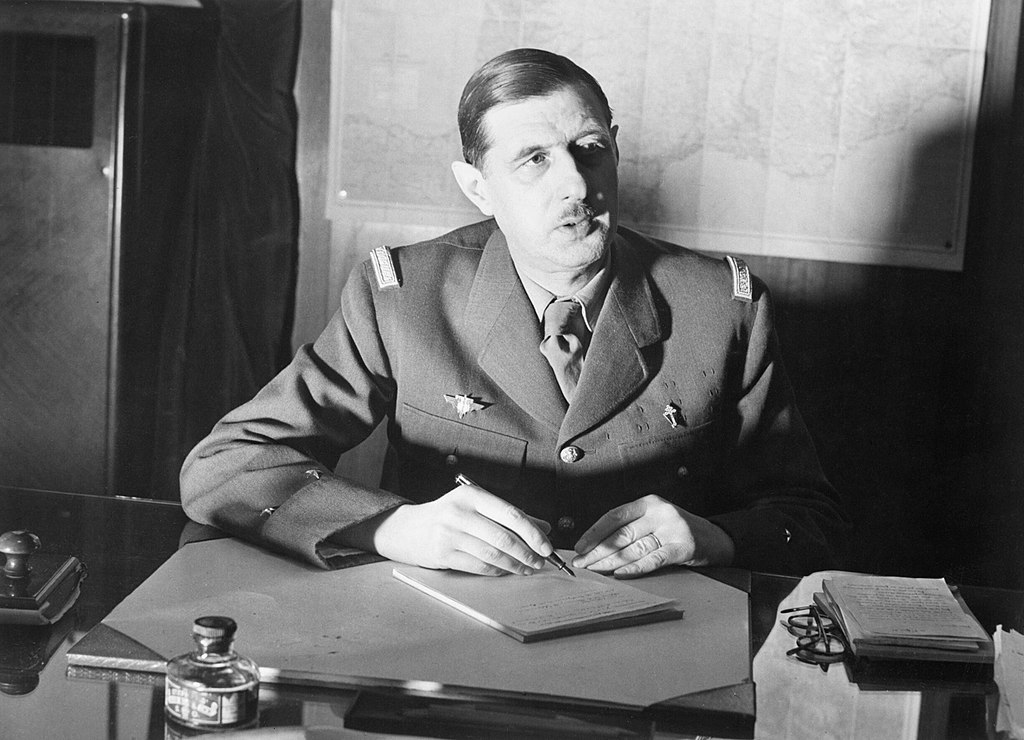
General Charles de Gaulle, Commander of Free French Forces, seated at his desk in London during the Second World War.
Photo via Wikimedia Commons.
When it came to what de Gaulle thought was the pivotal moment in his life, when he could become virtual monarch of France under conditions chosen wholly by himself, he was as ruthless as Lenin. He had, it is often said, a “certain idea of France.” But the ultra-conservative lawyer, Jacques Isorni, whose clients included the collaborationist Vichy leader Marshal Philippe Pétain and de Gaulle’s would-be assassin, Jean-Marie Bastien-Thiry, concluded that it was “an abstract idea of France, indifferent to the sufferings of the French people.” There is something to this. De Gaulle represented the steely warlike France, summoned up by Bonaparte and again a century later at Verdun, for which the French were required to die and mourn uncomplainingly. For him, Paris was well worth a lie or a betrayal, because his supremacy was so essential for the country he loved.
The costs of de Gaulle’s idea of France were high. As the general himself once mused, “There is no action in which the devil has no part.” The two massacres, and the charnel-house stench which clings to them, are evidence of the reliable rule that even — often especially — the greatest and best of men have terrible flaws and can do terrible things; and also of the other rule that power tends to corrupt. I have begun with them because they are a necessary antidote to the feelings of admiration and liking which any reader of this thrilling, witty, ceaselessly moving, beautifully written account of a truly great man is bound to feel.
Charles de Gaulle’s life would perhaps have been better lived in the seventeenth or eighteenth century, in times when personal courage, mystical imagination, chivalry, and religious fervor were more welcome than they are now. In this world of the United Nations, risk assessment, lawyers, Geneva Conventions, television and superpowers, there is not really enough room for such a man to swing his sword, just as there is no room for old-fashioned great powers in the shadow of superpowers. Had he not been so magnificent, he would have been ridiculous. He looked, more than anything else, like a camel, not least because of the superior expression on his face suggesting that he alone knew the secret One Hundredth Name of God, which camels are supposed to know.
He was filled with shining, old-fashioned beliefs about honor, courage, shame and humiliation, glory and infamy. And as those who conversed with him found, he was perhaps the last great man to make it his business to know those things that it is proper for a king to know. He could talk fluently with philosophers and literary novelists. He had a minute knowledge of history: not just that of France, but of Europe and the world. After many, many conversations with Winston Churchill, a large number of them furious quarrels, he concluded that England’s savior was not in fact very intelligent. He believed wartime, with its austerity and tests of manhood, was more virtuous than peacetime. He believed nothing important could be achieved without recklessness. He stood up to people with considerable courage, even when he was a powerless and lonely figure without soldiers, money, or supporters. He once justified his bloody-minded awkwardness by pointing out that if he were not so difficult, he would himself have been a collaborator. He said “If I were easy to work with, I would be on Marshal Petain’s staff.” He had no time for people like himself. He confessed, “I only esteem those who stand up to me but unfortunately I cannot stand them.”
De Gaulle possessed that great chivalrous virtue of being ready to walk unbowed and defiant in front of the powerful, while being gentle and even submissive to the defenseless and weak. He once became so angry with Churchill that he smashed a chair in his presence to emphasize his rage. Likewise, he defied Franklin Roosevelt over and over again. But he would go home after these battles to sing tender love songs to his daughter Anne, who suffered from Down syndrome. The tiny glimpses we have of this part of his life, obtained from the accidental observations of others, tear at the heart. His concern for Anne was entirely private and not at all feigned. After any long absence from home his first act was to rush up to her room. She died, aged twenty, in his arms. At her funeral, he comforted his wife Yvonne with the words, “Maintenant, elle est comme les autres” (“Now she is like the others”), which must be one of the most moving things said in the whole twentieth century.
Comments Off on Charles De Gaulle
“Talvisota” – The Winter War – Sabaton History 006
Sabaton History
Published on 14 Mar 2019This war is modern version of David versus Goliath. The Sabaton song “Talvisota” (from The Art of War album) is about the Winter War that took place in late 1939 till the early spring of 1940 between Finland and the Soviet union. Against all odds, and overwhelming numbers of Red Army soldiers, the Finnish army manage to hold off the Soviet advance for longer than anyone could have foreseen.
Support Sabaton History on Patreon: https://www.patreon.com/sabatonhistory
Hosted by: Indy Neidell
Written by: Markus Linke and Indy Neidell
Directed by: Astrid Deinhard and Wieke Kapteijns
Produced by: Pär Sundström, Astrid Deinhard and Spartacus Olsson
Creative Producer: Joram Appel
Executive Producers: Pär Sundström, Joakim Broden, Tomas Sunmo, Indy Neidell, Astrid Deinhard, and Spartacus Olsson
Maps by: Eastory
Edited by: Wieke Kapteijns
Sound Editing by: Marek KaminskiEastory YouTube Channel: https://www.youtube.com/channel/UCEly…
Archive by: Reuters/Screenocean https://www.screenocean.com
Music by Sabaton.An OnLion Entertainment GmbH and Raging Beaver Publishing AB co-Production.
© Raging Beaver Publishing AB, 2019 – all rights reserved.
Comments Off on “Talvisota” – The Winter War – Sabaton History 006


