
Quotulatiousness

March 27, 2019

Canada and the Battle of the Atlantic, part 1 by Alex Funk

Filed under: Cancon, History, Military, WW1, WW2 — Tags: , , , — Nicholas @ 05:00

Editor’s Note: This series was originally published by Alex Funk on the TimeGhostArmy forums (original URL – https://community.timeghost.tv/t/canada-and-the-battle-of-the-atlantic-part-1-edited/1433).

Sources:

  • The Far Distant Ships, Joseph Schull, ISBN 10 0773721606 (An official operational account published in 1950, somewhat sensationalist) [Schull’s book was published in part because the funding for the official history team had been cut and they did not feel that the RCN’s contribution to the Battle of the Atlantic should have no official recognition. It is very much an artifact of its era, and needs to be read that way. A more balanced (and weighty) history didn’t appear until the publication of No Higher Purpose and A Blue Water Navy in 2002, parts 1 and 2 of the Official Operational History of the RCN in WW2, covering 1939-1943 and 1943-1945 respectively.]
  • North Atlantic Run: the Royal Canadian Navy and the battle for the convoys, Marc Milner, ISBN 10 0802025447 (Written in an attempt to give a more strategic view of Canada’s contribution than Schull’s work, published 1985)
  • Reader’s Digest: The Canadians At War: Volumes 1 & 2 ISBN 10 0888501617 (A compilation of articles ranging from personal stories to overviews of Canadian involvement in a particular campaign. Contains excerpts from a number of more obscure Canadian books written after the war, published 1969)
  • All photos used exist in the Public Domain and are from the National Archives of Canada, unless otherwise noted in the caption.

I have inserted occasional comments in [square brackets] and links to other sources that do not appear in the original posts. A few minor edits have also been made for clarity.

Canada and the Battle of the Atlantic, part 1

Canada’s navy before WW2

This is my modest attempt to illustrate Canada’s contribution to the Battle of the Atlantic and the war at sea in general. In my honest opinion it was the most important thing we did as a nation aside from the BCATP (British Commonwealth Air Training Plan).

The Naval Service of Canada/Royal Canadian Navy before World War 2

The Royal Canadian Navy (RCN) was founded in 1910 under the Naval Service Bill re-introduced by Prime Minister Wilfrid Laurier (its first attempt at approval under George Foster in 1909 had failed), creating the Naval Service of Canada [Wikipedia – https://en.wikipedia.org/wiki/Origins_of_the_Royal_Canadian_Navy]. A distinct naval force for the Dominion of Canada to be maintained and manned by Canadians, which could be placed under British control if needs be. Two ex-Royal Navy vessels were obtained for the purposes of training [cruisers HMCS Niobe and HMCS Rainbow].

[There actually was an even earlier attempt to create a Canadian navy, as related by Joseph Schull:]

There had been one hint, in 1880, of an awareness of naval needs. A dispatch from the Governor General to the Colonial Secretary had suggested that Canada “would not be averse to instituting a ship for training purposes if the Imperial Government would provide the ship.” To the restrained enthusiasm of this proposal the Admiralty had responded with appropriate generosity. Charybdis, an ancient steam corvette, was at the time limping homeward from the China Station. The Canadian Government could have her.

When Charybdis arrived in the United Kingdom it was discovered that her boilers were worn out. Canada paid for their replacement. The ship was then coaxed and coddled across the Atlantic by a redoubtable Captain Scott, R.N., retired. Upon arrival in Saint John, Charybdis broke loose from her moorings in a gale and damaged much of the shipping in harbour. She had hardly been secured, and the clamour of aggrieved shipowners had not died down, when two Saint John citizens, attempting to come on board, fell through the rotting wood of her gangplank and were drowned. It was sufficient naval experience for the Canadian Government of that time. The wreck was towed from Saint John and turned over to the unwelcoming authorities of the Royal Navy. Charybdis became a gruesome memory, a political Flying Dutchman which heaved over the horizon when any naval proposal was advanced during the next thirty years.

The election of a new government (which had opposed the original bill) in 1911 left the new service in limbo. [Also in 1911, the Naval Service was given permission by King George V to rename itself the Royal Canadian Navy.] Nevertheless, between the two ex-Royal Navy vessels, two submarines purchased from the US [by the provincial government of British Columbia(!)], and two government patrol vessels pressed into military service the RCN spent the early years of World War 1 patrolling the east and west coasts of North America and sometimes as far south as Panama to deter the German naval threat. As that real or perceived threat slowly evaporated, the Canadian Navy’s patrols became less frequent.
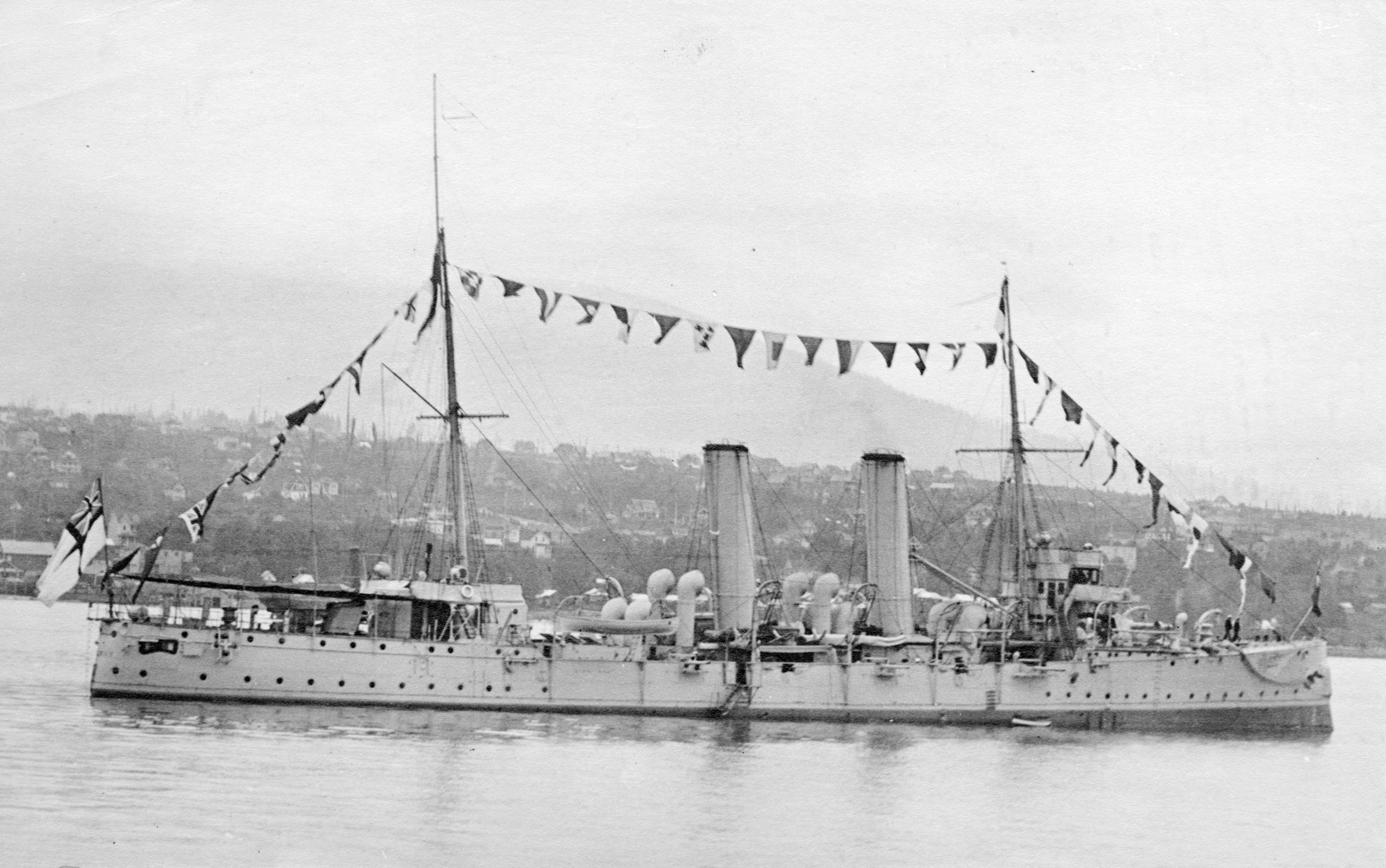
HMCS Rainbow at North Vancouver, 1910.

Photo from the City of Vancouver Library, the collection of Matthews, James Skitt, Major (1878-1970) via Wikimedia Commons.

The First World War saw the modest beginnings of the Canadian Navy, although it should be pointed out that many more Canadians chose to serve in the Royal Navy than the Canadian one, some as officers.

The inter-war years saw very little growth for the RCN. The post-war drawdown naturally occurred, and by 1922 the service had only 366 men and had paid off their only remaining cruiser. The Naval Volunteer Reserve was firmly established in Canadian cities across the country (and numbered around 1,000 men) but the Navy itself only kept two destroyers donated by the Royal Navy in service [HMCS Patriot and HMCS Patrician], until these were replaced by two more destroyers in the late 1920s (once again, ex-RN [ships renamed as HMCS Champlain and HMCS Vancouver]). 1931 saw a major facelift with the first ships built specifically for the RCN: HMCS Skeena and HMCS Saguenay.

The early 1930s saw the Navy along with the other Canadian service branches almost completely starved of funding, although by the late 30s, escalating world tension convinced the Canadian government to slowly begin rebuilding. Two more destroyers were purchased from the Royal Navy in 1937 (HMCS Fraser and HMCS St Laurent) and then two more in 1938 (HMCS Ottawa and HMCS Restigouche).

Marc Milner outlines the RCN’s original expansion plans in North Atlantic Run:

In January 1939 the government, reacting to the Munich crisis, announced its intentions to proceed with building a fleet capable defending Canada’s two coasts. The expansion plan, when completed, would give the RCN a strength of eighteen modern destroyers, sixteen minesweepers, and eight anti-submarine vessels, the numbers split evenly between Pacific and Atlantic commands, and a flotilla of eight motor torpedo boats for the east coast. Not surprisingly, little came of this plan before war broke out. In fact, by May the government had sharply cut the navy’s estimates. The 1939 building program (four anti-submarine vessels and two motor torpedo boats) was scrapped, and there was just enough money left to acquire the necessary plans. It is, however, significant that the RCN’s expansion plans were laid down in the last days of peace. Later developments would thrust a new form of expansion on the RCN, one more easily attainable in wartime than a fleet of destroyers, yet one which did not conform to the long-term goals of the professional navy.

Thus, by the outbreak of the Second World War in September 1939, the RCN consisted of six River-class destroyers, five minesweepers, and two small training vessels.
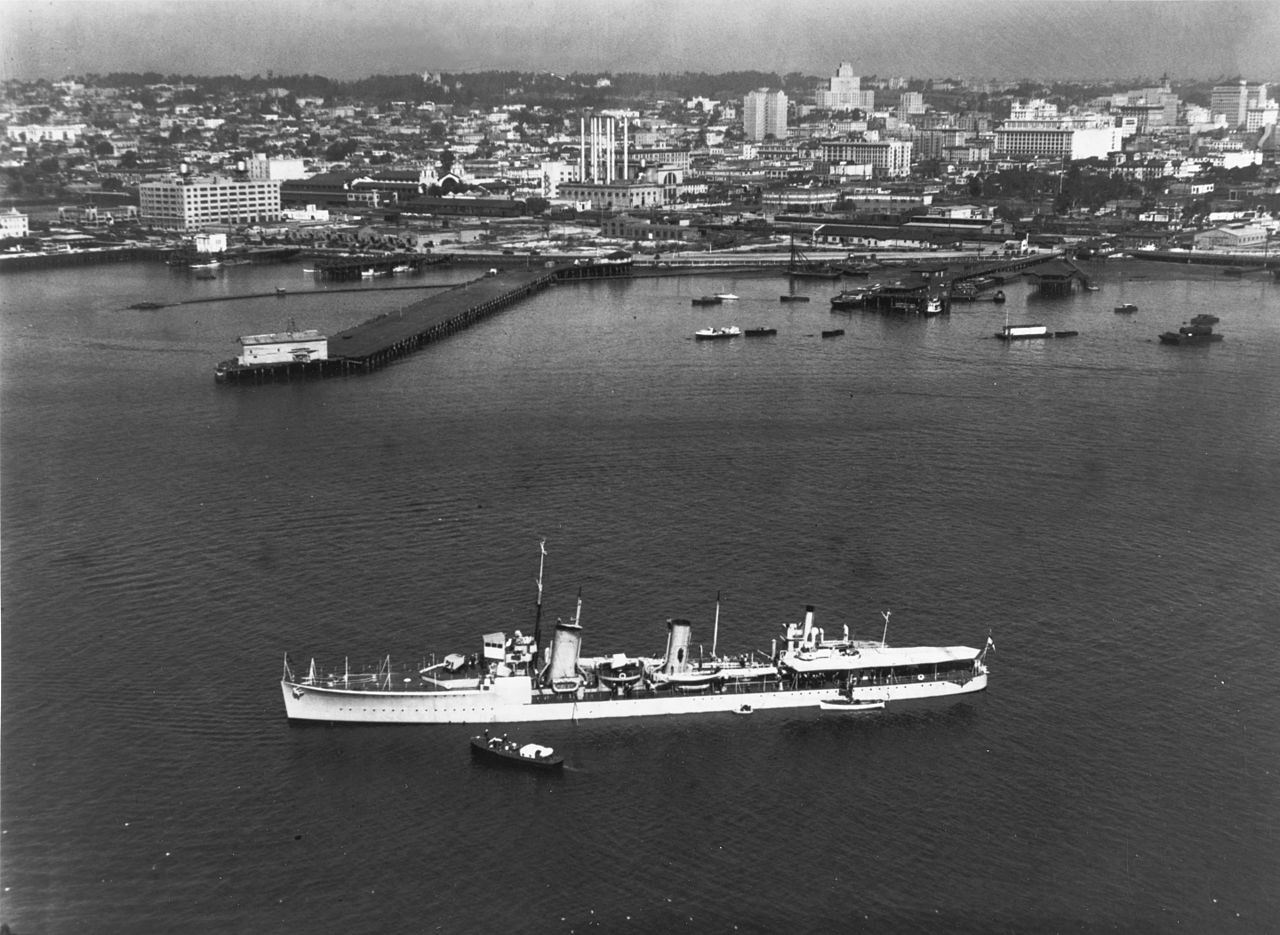
HMCS Vancouver (F6A) anchored off San Diego, California (USA), on 5 March 1929.
Official U.S. Navy photo 80-G-416377 from the U.S. Navy Naval History and Heritage Command, via Wikimedia Commons.

The January 1939 expansion plan belied the fact that the RCN was a traditional, gun-oriented navy. The experiences of the First World War and technological developments since had confirmed the sanctity of the gun as the pre-eminent naval weapon. Admittedly, the threat from Germany’s U-boats in 1917 had been grave. But her indiscriminate use of the submarine had brought the United States into the conflict on the Allied side and (or so it seemed) therefore cost Germany the war. It was felt that in future no nation would risk the sanction of a world coalition by resorting to “piracy” on the high seas. But even if Germany, or any other nation, turned once again to unrestricted submarine warfare on merchant shipping, the means of defeating the threat was already in service with Commonwealth navies — convoy and ASDIC.

During the First World War, before the adoption of the convoy system, German U-Boats preferred to use their deck guns to destroy lone merchant vessels, using their precious torpedoes sparingly. With the introduction of the convoy system, the days of easy targets vanished and the proximity of naval escort forced the U-Boat to either risk fighting an unequal surface battle against more heavily gunned escorts or to operate submerged. Convoys made the oceanic routes much safer, but this success was not unmixed. Cargo ships continued to sail independently and unescorted to and from convoy assembly ports in British coastal waters, and the U-boats resorted to submerged attack tactics inshore. Although Britain was never again threatened with defeat by starvation, losses to merchant shipping remained high for the rest of the war because of the virtual immunity of a submerged submarine to any threat of effective counter-attack by escort ships.

With the U-Boats relegated to nuisance status through the use of convoys, their final telling defeat simply awaited the perfection of a reliable underwater-detection device. The Allied Submarine Detection Investigation Committee was established in 1918 to resolve this problem, but it was not until the early twenties that an effective underwater sound locating and ranging set (now called sonar) was in use. ASDIC, as the British called the device, was to spell the doom of the submarine. As late as 1936 the First Sea Lord [the professional head of the Royal Navy], Admiral A.E.M. Chatfield, claimed that the RN’s anti-submarine measures were 80% effective. With location no longer a problem, it was believed that destruction of a submarine by a few well-placed depth charges would follow with equal certainty.

If anything, Canadian planners, like those elsewhere, were absorbed by the unknown dangers of air attack on trade (particularly on convoys) and by the very real threat of powerful enemy surface raiders. Both of these also presented Canada with the only real threat of direct enemy action. The RCN was therefore charged with defence against surface and air attacks on Canada and on trade in adjacent waters — the two were really inseparable. The “forms and scales of attack to which Canada would be subject,” as anticipated in 1939, reflected the preoccupation with surface and air threats. Bombardment by a single battleship and/or one or two large cruisers, by armed merchant cruisers (AMCs), or even by heavily gunned submarines was felt likely. Attacks could also be expected in the form of MTBs launched from larger ships, mines, small assault parties, or aircraft carrying torpedoes, bombs, or gas. Indeed, it was thought that aircraft launched from remote points along the Canadian coast might penetrate as far inland as Toronto. Certainly, the major coastal centres were in danger of quick and unexpected raids.

The expansion plan of January 1939 was naturally intended to counter these threats. To make good its intentions, the navy hoped to acquire the most powerful destroyers then in service, the Tribal-class. The Tribal’s high speed and heavy armament (eight 4.7-inch guns and four torpedo tubes) made it a veritable “pocket” cruiser, and several acting in concert posed a credible threat to a lone battleship. Not surprisingly, the RCN would pursue its intention to acquire Tribals throughout the entirety of the war, eventually absorbing dockyard space, resources, and trained manpower which could have been better used to maintain the escort fleet.

[Editor’s Note: On the other hand, had they not pursued a Tribal-class building program, the RCN might well have suffered a similar or even worse drawdown after the war as it did in 1919-22.]

On the eve of the Second World War the submarine was therefore considered by the RN to be a manageable problem. The same held true in the RCN. In a pre-war analysis of the threats to trade and possible countermeasures, Commodore Nelles summarized Canadian reaction to the submarine:

    If international law is complied with, Submarine attack should not prove serious. If unrestricted warfare is again resorted to, the means of combating Submarines are considered to have so advanced that by employing a system of of convoy and utilizing Air Forces, losses of Submarines would be very heavy and might compel the enemy to give up this form of attack.

Nelles went on to point out that the RCN would provide anti-submarine equipment and mines “for prosecution of offensive measures against submarine attack.” His choice of words illustrates clearly the thinking of naval contemporaries on how best to deal with submarines — offensive action. The countermeasures outlined by the CNS indicated that some lessons had been drawn from the previous war, and in the long term the combination of convoy, air power, and aggressive anti-submarine warfare proved more than a match for the U-boats. Unfortunately, Britain and her allies lacked the necessary means for a very long time, and the resilience of modern submarines proved a surprise to virtually everyone.
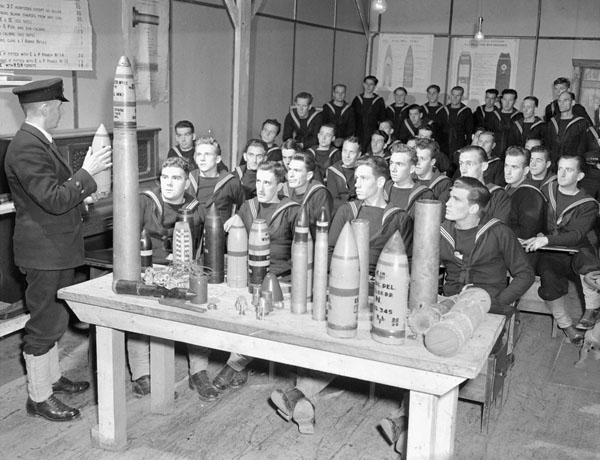
Chief Petty Officer Lowther delivering a lecture about various types of ammunition, Royal Canadian Navy Gunnery School, Halifax, Nova Scotia, Canada, 1940.
Credit: Canada. Dept. of National Defence / Library and Archives Canada / PA-104417


Gilgamesh vs. Humbaba – Bronze Age Myths – Extra Mythology – #2

Filed under: History, Humour, Middle East — Tags: , , — Nicholas @ 04:00

Extra Credits
Published on 25 Mar 2019

Join the Patreon community! http://bit.ly/EMPatreon

Gilgamesh and Enkidu set out to slay Humbaba. With the help of the goddess queen Ninsun in obtaining a blessing from the gods, these two men became brothers, who went on to have, like, totally epic dreams, bro, in the “House of the Dream God” which empowered them to take on the monstrous foe.

Someone had way too much fun doing the voices for this episode. Just sayin’

March 26, 2019

Food Rationing – How to Make Woolton Pie – WW2 Homefront 001 – April 1940

Filed under: Britain, Food, History, WW2 — Tags: , , , — Nicholas @ 04:00

World War Two
Published on 24 Mar 2019

Rationing of goods in Europe started immediately when the war broke out. Lord Woolton, British Minister of Food came up with one of the first substitute dishes… a vegetable pie that was promptly named after him. Our team chef Joram shows you how to do it. To find out how it tasted go here: https://youtu.be/quB0yH8Qhlo

Recipe can be found here: https://the1940sexperiment.com/2016/0…

Join us on Patreon: https://www.patreon.com/TimeGhostHistory
Or join The TimeGhost Army directly at: https://timeghost.tv

Hosted by Joram Appel and created by Wieke Kapteijns

Archive by Screenocean/Reuters https://www.screenocean.com

A TimeGhost chronological documentary produced by OnLion Entertainment GmbH

In about a month’s time (yes, I have my 1:00am and 2:00am posts lined up that far in advance), there’s an eight-part video series from Ian at InRangeTV on British rationing in WW2 that includes a slightly different Woolton Pie recipe.

Donning hoplite armour

Filed under: Europe, Greece, History, Military — Tags: , , , — Nicholas @ 02:00

Lindybeige
Published on 28 Sep 2016

How long does it take a hoplite to get ready for action? Watch one incompetent one time himself as he dons his panoply.

Support me on Patreon: https://www.patreon.com/Lindybeige

More weapons and armour videos here: https://www.youtube.com/playlist?list…

Some game systems have rules on how long it takes to put on armour. Here I give you some practical hints as to how long it actually takes. Yes, the sword and shield are just mock-ups, but the time it takes to take them up is probably about the same as the real thing.

Was this really shot in ancient Greece? No, it was a park in Gosforth, near a primary school and with aircraft flying overhead and a breeze just strong enough to create constant rustling of leaves and occasional wind noise on the microphones.

Buy the music – the music played at the end of my videos is now available here: https://lindybeige.bandcamp.com/track…
Lindybeige: a channel of archaeology, ancient and medieval warfare, rants, swing dance, travelogues, evolution, and whatever else occurs to me to make.

▼ Follow me…

Twitter: https://twitter.com/Lindybeige I may have some drivel to contribute to the Twittersphere, plus you get notice of uploads.

website: http://www.LloydianAspects.co.uk

March 25, 2019

The Boston Massacre – Snow and Gunpowder – Extra History

Filed under: Britain, History, Military, USA — Tags: , , , , , — Nicholas @ 04:00

Extra Credits
Published on 23 Mar 2019

Boston, 1770. A frigid winter night. A British sentry strikes a local citizen. Civilians begins to gather. Reinforcements arrive to back up the young sentry. Insults and snowballs escalate. Then out of the darkness comes a shout: “FIRE!”

The Boston Massacre didn’t come out of nowhere — resentment between the early US colonies and the British army had been brewing for some time over the Stamp Act. A propaganda war ensued between the loyalists and the radicals. John Adams would get his revolutionary start as he worked to resolve this injustice…

Join us on Patreon! http://bit.ly/EHPatreon

Battle of Ecnomus (256 BC) – Largest Naval Battle in History

Filed under: Africa, Europe, History, Military — Tags: , , , , , , — Nicholas @ 02:00

Invicta
Published on 12 Sep 2016

The Battle of Ecnomus in 256 BC is arguably the largest naval battle in history with 680 warships and an estimated 290,000 rowers and marines participating! This monumental clash was fought during the First Punic War between Rome and Carthage along the coast of Sicily.

Fleet Anatomy: https://www.youtube.com/watch?v=7PhRp…
Fleet Operation: https://www.youtube.com/watch?v=397-i…
Fleet Tactics: https://www.youtube.com/watch?v=VOc8m…

More Classical Antiquity Documentaries: https://www.youtube.com/playlist?list…

Literary Sources:
Uniforms of the Roman World by Kevin Kiley
Republican Roman Warships by Osprey Publishing
The Fall of Carthage by Adrian Goldsworthy
Augustus by Anthony Everitt

Game Engine:
Total War: Rome II

Game Mods:
Devide et Impera
Realistic Ship Colors
Ave_Gigas.pak

From the comments:

Invicta
2 years ago
It has been a real pleasure to research and produce the documentary series on the Roman Navy. This video is a culmination of that exploration into the little-covered world of ancient naval combat which I hope has been equally enlightening and entertaining. It is also worth mentioning that the battle maps I created for this video individually show the 680 vessels from both sides. Though this was painstaking to do, it was worth it to convey the insane scale of this encounter at sea.

I’d also like to point out that I tried using new effects in this video. I will continue to try new styles and adapt my presentations in the future and greatly appreciate any and all feedback. Thank you all for your support and help thus far. Its a true joy to have an audience for this passion of mine : )

March 24, 2019

Il Duce and der Führer Have a Date – WW2 – 030 – March 23 1940

Filed under: Europe, France, Germany, History, Military, Russia, WW2 — Tags: , , , , — Nicholas @ 06:00

World War Two
Published on 23 Mar 2019

French Prime Minister Daladier overplays his hand and is replaced after his vision regarding Scandinavia wasn’t widely shared in the French parliament. Meanwhile, the French and British in France are preparing for a German attack. If Hitler gets it his way, they will also have to prepare for an attack in the south as Hitler tries to persuade Mussolini to join his invasion.

Join us on Patreon: https://www.patreon.com/TimeGhostHistory
Or join The TimeGhost Army directly at: https://timeghost.tv

Follow WW2 day by day on Instagram @World_war_two_realtime https://www.instagram.com/world_war_t…
Between 2 Wars: https://www.youtube.com/playlist?list…
Source list: http://bit.ly/WW2sources

Written and Hosted by: Indy Neidell
Produced and Directed by: Spartacus Olsson and Astrid Deinhard
Executive Producers: Bodo Rittenauer, Astrid Deinhard, Indy Neidell, Spartacus Olsson
Creative Producer: Joram Appel
Research by: Indy Neidell
Edited by: Iryna Dulka
Map animations: Eastory

Photos of the Winter War are mostly from the Finnish Wartime Photograph Archive (SA-Kuva).
Colorisations by Norman Stewart

Eastory’s channel: https://www.youtube.com/channel/UCEly…
Archive by Screenocean/Reuters https://www.screenocean.com

A TimeGhost chronological documentary produced by OnLion Entertainment GmbH.

From the comments:

World War Two
25 minutes ago (edited)
The Wehrmacht is amassing at the German western borders. The Allies are ducked behind the Maginot Line and standing ready to advance into Belgium, are they in the right places? We want to go to France before the Germans do to give you guys some solid specials about the coming events there – you can help us by supporting the TimeGhost 1940 Road Trip to France here: https://timeghost.tv/support-the-1940-france-roadtrip/ more info here: https://www.youtube.com/watch?v=z3Mvd1VEFyw Thank you for your Support!!!!

Major Fosbery’s Automatic Revolver: History and Mechanics

Filed under: Britain, History, Military, Technology, Weapons — Tags: , , , , — Nicholas @ 02:00

Forgotten Weapons
Published on 9 Aug 2017

http://www.patreon.com/ForgottenWeapons

George Fosbery, V.C., was a decorated British officer with substantial combat experience in India when he decided to design a better sidearm in 1895. True semiautomatic handguns were in their very early stages of development at that time, and Fosbery thought that one could have a more durable, more powerful, and simpler weapon by using a revolver as a foundation. He began experimenting with a Colt SAA, but soon moved to using Webley revolvers when he found the Colt internals insufficiently durable for his conversion.

What Fosbery did was to relocate the barrel and cylinder into an upper assembly which could move independently of the grip and trigger of the gun. Upon firing, the energy of recoil would push the upper assembly rearwards, re-cocking the hammer and indexing the cylinder to the next chamber. This gave the shooter the rapid fire of a double action revolver with the excellent trigger pull of a single action revolver.

The gun was introduced at the Bisley shooting matches, where it proved quite popular as a target gun. By the time production began in the early years of the 20th century, however, semi-auto handguns had improved significantly, and the opportunity for the Webley-Fosbery to be a big seller had already passed. Still, British officers were required to provide sidearms chambered for the .455 service cartridge, and more than a few opted to purchase Webley-Fosberys.

Thanks to Mike Carrick of Arms Heritage magazine for providing this Webley-Fosbery for this video! See his regular column here: https://armsheritagemagazine.com

If you enjoy Forgotten Weapons, check out its sister channel, InRangeTV! http://www.youtube.com/InRangeTVShow

QotD: France and the Nazi Final Solution

Filed under: Europe, France, Germany, History, Quotations, WW2 — Tags: , , — Nicholas @ 01:00

Less happy is the story of France. The Germans realized that the Vichy French were attached to assimilated French Jews, so they started by demanding only those foreign Jews who had come to France as refugees. There were a hundred thousand of these, and Marshal Petain of France said that they had “always been a problem” and he was glad to have “an opportunity to get rid of them” (in his defense, he was under the impression that Jews sent to Germany would be “resettled in the East”). After this had been going on for a while, Eichmann figured that the French were on his side, and asked for permission to take the native French Jews as well. The French, having sent tens of thousands of stateless Jews to the concentration camps, were suddenly outraged that the Nazis would dare lift a finger against French Jews, and shut down the entire deportation program. I am sure the French count this as a moral victory nowadays, though it’s a very selective sort of morality.

Scott Alexander, “Book review: Eichmann in Jerusalem”, Slate Star Codex, 2017-01-30.

March 22, 2019

“Shiroyama” – The Satsuma Rebellion – Sabaton History 007

Filed under: History, Japan, Media, Military — Tags: , , , — Nicholas @ 06:00

Sabaton History
Published on 21 Mar 2019

What will you do when your traditional way of life is threatened by a powerful force in your native lands? The samurai didn’t hesitate to answer this question with: our swords. During the Satsuma Rebellion, the samurai and its leader Saigō Takamori fought the Japanese Imperial Government. Their rebellion ended with the Battle of Shiroyama, where in 1877 the samurai prepared for a last stand.

Support Sabaton History on Patreon: https://www.patreon.com/sabatonhistory

Watch the official music video for Shiroyama here: https://www.youtube.com/watch?v=oKW6g…

Listen to Sabaton on Spotify: http://smarturl.it/SabatonSpotify
Official Sabaton Merchandise Shop: http://bit.ly/SabatonOfficialShop

Hosted by: Indy Neidell
Written by: Markus Linke and Indy Neidell
Directed by: Astrid Deinhard and Wieke Kapteijns
Produced by: Pär Sundström, Astrid Deinhard and Spartacus Olsson
Creative Producer: Joram Appel
Executive Producers: Pär Sundström, Joakim Broden, Tomas Sunmo, Indy Neidell, Astrid Deinhard, and Spartacus Olsson
Maps by: Eastory
Edited by: Iryna Dulka
Sound Editing by: Marek Kaminski

Eastory YouTube Channel: https://www.youtube.com/channel/UCEly…
Archive by: Reuters/Screenocean https://www.screenocean.com
Music by Sabaton.

An OnLion Entertainment GmbH and Raging Beaver Publishing AB co-Production.

© Raging Beaver Publishing AB, 2019 – all rights reserved.

From the comments:

Sabaton History
2 days ago (edited)
In the 19th century, Japan transitioned from a feudal society to a modern constitutional monarchy shaped after its western counterparts. A constitution was introduced which made every Japanese man equal under the law. This effectively ended the privileged status of the samurai in Japan. However, many samurai didn’t take this kindly. A group of them rebelled against the Imperial government, which is what the Sabaton song “Shiroyama” is all about.

The fact that we can research, film and produce this with Indy and his team is only thanks to the people who support us on Patreon. If you don’t already, please do consider supporting us – which also gives you some cool rewards as well as early access to all our episodes!

The rise of the neo-barbarians and modern tribalism

Filed under: History, Politics, USA — Tags: , , — Nicholas @ 05:00

Sarah Hoyt isn’t a fan of civilization being replaced by the prehistoric landscape of tribe versus tribe, forever:

Tribalism seems to be the default setting of the human race.

Maybe it’s because we’re built on the frame of Great (or at least pretty good) Apes. Band seems to be the default unit of a Great Ape.

The people who do those cute and vapid studies on how your toddler is racist — by which they mean he prefers people who look like mommy and daddy, or their surrogates in his life — don’t seem to understand that. They don’t seem to understand that for most of human existence, (prehistory is much longer than history) for a toddler to stray outside his tribe meant at best he was raised as a slave, and at worst he became lunch.

I wonder if it’s this uncritical, sort of history-and-genetics free view of the world that causes the left to think that tribes are awesome.

Might just be their usual — and honestly, isn’t it tiresome by now? — view of the world which thinks everything “natural” by which they mean pre-civilized is better. This leads to nostalgie de la boue and therefore elevates primitive/non civilized cultures over western culture.

Or perhaps it is simply the fact that Marxism was “rescued” by Gramsci. Marxism was bad enough in its inability to see individuals, and ascribing everyone to economic tribes.

[…]

Anyway, back to our point: one of the great advances of humanity, possibly as momentous as the discovery of fire, was the overcoming of tribalism.

Forging tribe-like bonds based on “we share this land” and in fact, being able to tell ourselves stories about how “everyone in this land is one people” gave rise to the city state, the country, and eventually the “community of civilized men.”

Of course, yes, Christianity had a lot to do with this, but there was some of that going on already in the Roman Empire, where Persian and Greek could both declare (after the appropriate formalities and acculturation) “Civis Romanum sum.”

As bad as the super-states of the twentieth century got — because there’s nothing as a large nation with a good dose of crazy-making philosophical theory — it allowed commerce and industry, which are miles and miles better at creating and keeping wealth than hunting-gathering.

The problem is that the left, led by Gramsci, has re-invented tribalism. And no, I don’t just mean tribalism of place of origin or color — though they include that — I mean tribalism of EVERYTHING.

Being unable to see individuals (has anyone done studies of their brain? Maybe there’s something missing) they instead keep sorting people into increasingly smaller groups based on things that have bloody nothing to do with what the person IS capable of, or thinks or believes: Color, who people sleep with, what people have between their legs, who people like to sleep with, what people call their deity, etc. etc. ad very definitely nauseum.

[…]

The other side effect of this is that everyone who isn’t a member of the tribe is potentially the enemy. This is what leads to the internecine fights within the left, and why if they should win (forbid) we’ll be stuck in civil war after civil war forever. Adapting the Arab proverb: Me and my Marxist classmates against the world; Me and my black Marxist classmates against our white Marxist classmates; Me and my black Marxist female classmates against our black Marxist male classmates; Me and my black lesbian Marxist female classmates against our black straight Marxist female classmates… and so on ad infinitum, until the tribe of one is at war with everyone else, and worse stuck in a pit of anger and resentment because he/she isn’t given all the recognition and compensation he/she should have from the rest of the world at large.

At the same time anyone outside it is viewed as less than human. This is why they think they can tell everyone to shut up because “white privilege” or “male privilege” or whatever, and they honestly think there will be no resistance and no backlash.

Debunking Stephen Jay Gould

Filed under: Books, History, Science — Tags: , , , , , — Nicholas @ 03:00

Several years back, I linked to a David Friedman post on a study that contradicted a key argument in Stephen Jay Gould’s book The Mismeasure of Man. While I’ve read a few of his books, it’s been nearly 15 years since I last read anything by him … by now I only have a vague recollection of what he wrote, but his works were quite popular at the time. Much more recently Russell T. Warne looked at different problems in Gould’s work that are much more damaging to his reputation:

Stephen Jay Gould, the famous 20th century paleontologist, published his most celebrated work, The Mismeasure of Man, in 1981. Gould’s thesis is that throughout the history of science, prejudiced scientists studying human beings allowed their social beliefs to color their data collection and analysis. Gould believed that this confirmation bias was particularly powerful when a scientists’ beliefs were socially important to them. […] The Mismeasure of Man provides a great deal of evidence that scientists’ pre-existing beliefs color their judgment — but not in the way he intended. Rather, the book is a perfect example of the sin it purports to expose in others. Gould’s Marxist political beliefs made him attack intelligence research because he saw it as a threat to his egalitarian social goals. Ironically, it was this allegiance to ideology over data that made Gould himself a classic examplar of a biased scientist.

[…]

Most criticism of The Mismeasure of Man was confined to the recherché world of psychologists who study intelligence. However, a new debate opened up in 2011 when a team of anthropologists argued that Gould’s analysis of the data on cranium measurements from 19th century scientist Samuel George Morton was flawed. Gould cast Morton as a racist who fudged his data to match his beliefs about white racial superiority because of a supposed larger skull capacity. Instead, the anthropologists argued, it was Gould who manipulated the data to support his biases.

This ignited a series of follow-up articles in the scholarly literature by authors taking a variety of positions regarding Morton’s data and Gould’s interpretations. Weisberg believed that the re-analysis was flawed and Gould was mostly correct. Kaplan and his colleagues claimed that Morton’s interpretations were flawed, but that Gould was incorrect in believing that he could discern Morton’s actions and motivations. Finally, Mitchell believed that Morton’s data were accurate and that the interpretations were colored by the racism of the era, but the claim that Morton subtly manipulated the data was a fiction created by Gould.

Though still unresolved, the debate shows that a critical analysis of specific sections of The Mismeasure of Man is warranted. After writing an article about Lewis Terman, an important developer of early intelligence tests, I decided that a 23-page section of The Mismeasure of Man would be a valuable section of the book to analyze. This section is Gould’s description and analysis of the Army Beta test, one of the tests that Terman helped create. The Army Beta was used in World War I to screen illiterate recruits for military service.

Having read some of the primary scholarly work about the Army Beta, I knew that some of Gould’s claims were inaccurate. However, I was unprepared for the level of pervasive deception that I encountered when I carefully checked Gould’s claims against the historical record. Moreover, I discovered overwhelming evidence that any pretense of Gould being “objective” — even if defined as “fair treatment of data” — is a farce. In The Mismeasure of Man, Gould elevates his biases to the status of uncontestable facts and to great lengths to hide the truth from his readers.

Understanding the Great Depression

Marginal Revolution University
Published on 23 May 2017

In this video, we examine the causes behind the Great Depression with the help of the aggregate demand-aggregate supply model.

In 1929, the stock market crashed and an air of pessimism swept across America — making bank depositors nervous. What would you do if you thought your money might not be safe with the bank? You’d probably want it back in your own hands. What happened next? A run on the banks.

Along with the Stock Market Crash of 1929, it’s one of the iconic moments of the early days of Great Depression. However, the Great Depression was an incredibly complex downturn in which the economy experienced a series of aggregate demand shocks. By the end of this video, you’ll walk away with a better understanding of the many factors behind the Great Depression and how to apply the AD-AS model to a real-world scenario.

QotD: Millennial socialists

Filed under: Economics, Education, History, Politics, Quotations, USA — Tags: , — Nicholas @ 01:00

Those who cannot remember the past are doomed to repeat it, as George Santayana once said. Slightly before him, Karl Marx claimed that history repeats itself, the first time as a tragedy, the second time as a farce. Both of these Dead White Males are arguably right, if only the latter still continues to inspire people, though not with this particular quote.

Throughout the developed world – with the notable exception of Poland – Gen Ys or the Millennials veer strongly to the left. Young people have always done so, but the current crop would make even their proud Baby Boomer grandparents blush in their enthusiasm for collectivism. It’s not just that in countries like the United States or Australia two thirds of them vote for the parties of the left – after all, the left can be a broad church, from Tony Blair to Jeremy Corbyn – but they positively heart socialism: 63 per cent of Australian university graduates and over the half of the American cohort. Those who literally cannot remember the past are very keen to repeat it – let’s hope that this time only as a farce.

The Millennials can’t remember very much – and they don’t learn very much either. It’s easy being hot for socialism or communism when you actually have a very little idea of what it is and what it did throughout the 20th century. And the Ys have that ignorance in spades; one third of them think that George W Bush killed more people than Stalin and 42 per cent have never heard of Mao – but over 70 per cent agree with Bernie Sanders. Some research suggests that only 15 per cent actually have a correct understanding of socialism. It’s not just politics; the Millennials are the most woefully undereducated and miseducated generation in a very long time. To be fair, that’s not strictly their fault; that attaches itself again to their Boomer grandparents who have been in charge of our failing education systems during this time. Combine the modern indoctrination-cum-dumbification taking place in schools and universities with the attention span-killing impact of information technology and social media, and you have a barely literate cohort, which is simply not equipped with the necessary mental tools to learn about the real world even if they wanted to.

Any surprises that socialism is now nearly synonymous with Gen Y?

Arthur Chrenkoff, “Socialism as a Millennial religion”, The Daily Chrenk, 2019-02-19.

March 21, 2019

Remy: “Affluenflammation”

Filed under: Economics, History, Humour, Media, Politics, USA — Tags: , , — Nicholas @ 06:00

ReasonTV
Published on 20 Mar 2019

When quality of life improved, doctors discover a new affliction.

Reason is the planet’s leading source of news, politics, and culture from a libertarian perspective. Go to reason.com for a point of view you won’t get from legacy media and old left-right opinion magazines.

A parody of the Red Hot Chili Peppers’ “Californication” written by Remy.

Music tracks, mastering, and background vocals by Ben Karlstrom
Video produced by Austin Bragg.

LYRICS

There’s a non-foregone phenomenon in any prosperous nation
When primal fears all disappear the brain then gets a sensation
The medical name we gave this pain is affluenflammation

Ol’ Bill Tub is chugging a jug of cold bovine lactation
When his eyes then realize that carton side’s got information
And since his life contains no strife it’s affluenflammation

For the better part of history diseases all were raging
Measles, mumps up on your junk like they were Kevin Spacey
Then came Jonas Salk
Makes you wonder what all for…

Cuz we’ve got affluenflammation
We’ve got affluenflammation

Ol’ Chip Black is cracking the back of twelve live-steamed crustaceans
For the perks and glee of living free he starts to lose appreciation
And if you probe his frontal lobe — yep — affluenflammation

Through the course of human history each day we faced starvation
Rats and pox and chamber pots, streets filled with defecation
Free markets changed the norm
Makes you wonder what all for…

Cuz we’ve got affluenflammation
We’ve got affluenflammation

« Newer PostsOlder Posts »

Powered by WordPress
