In 1908, Rudyard Kipling published a short story called “The Mother Hive”. In this, the bees in a hive decide to drop all outmoded ideas of hierarchy and to make everyone equal. This includes the right of workers to eat royal jelly and to mate with the drones. In the spreading chaos that results, traditionalist dissidents are first shunned and then murdered. Eventually, the bee keeper looks into the hive, and sees the empty honeycombs and the horribly deformed offspring of the workers. His response is to poison all the bees.
Now, something like this has happened in England. In the past few generations, the whole of national life has been taken over by the cultural Marxists. They run government and the administration, and the law, and education and the media, and business too. They have imposed on us a nasty hegemonic discourse. Cultural Marxism is ultimately to be traced to European thinkers like Antonio Gramsci and Louis Althusser and the Frankfurt School. But this has come to England in American clothing. It has prestige because it was taken up by the American universities.
In America, however, the progress of cultural Marxism has been resisted, or slowed, by a strong religious right and by a written constitution that it is taking a long time to subvert. Here, we have no religious right, nor an entrenched constitutional law. In the past, freedom and common sense were safeguarded by an hereditary land-owing aristocracy and gentry. These ran the country, and did much to determine its moral tone. During the twentieth century, they were marginalised and then eliminated from government. They remain as a class — still very rich — but the tacit deal since at least the 1940s has been that they will be left alone, so long as they keep out of politics. Government has been left to middle class lefties. The effect followed the cause only after several generations. But here it is.
It may be interesting for you, as foreigners, to learn an answer to the implied question in the title of this speech. But it is essential for the English to think about the question and its answers. You see, like both the Germans and the Russians, we have had a revolution. Unlike them, we have had no obviously revolutionary event. The Russians had the storming of the Winter Palace and the murder of their Royal Family. The Germans were utterly defeated in 1945. Their cities were bombed flat. Their country was occupied and divided. Every German knows either that German history came to an end in 1945, or at least that a new chapter in German history had begun.
We do not have that awareness, and it would be useful for us to understand, even so, that we are living in a state of revolution. England has become the Mother Hive.
Sean Gabb, “A Nation of Sheep: Understanding England and the English”, Libertarian Enterprise, 2017-09-23.
October 18, 2019
QotD: England has become the Mother Hive
October 17, 2019
England in 1550 was a remarkably unpromising location for the later industrial revolution
Anton Howes, in his investigations on the Industrial Revolution looks back in time to see where or even if England deviated from the rest of Europe in ways that made the revolution possible, thinks he’s located the crucial time:
If a peaceful extraterrestrial visited the world in 1550, I often wonder where it would see as being the most likely site of the Industrial Revolution – an acceleration in the pace of innovation, resulting in sustained and continuous economic growth. So many theories about why it happened in Britain seem to have a sense of inevitability about them, but our extraterrestrial visitor would have found very few signs that it would soon occur there. There were many better candidates, on a multitude of metrics.
[…]
But England in 1550 was by global standards quite poor. Historical GDP per capita measures are notoriously difficult to obtain, even for some countries in the twentieth century let alone the sixteenth. The historical GDP per capita of England – by far the most studied region – is still hotly debated among economic historians. Nonetheless, according to the most recent collection of estimates – the Maddison project’s database of 2018 – in 1550 our extraterrestrial visitor would have been much more interested in Belgium. England at that stage lagged behind almost all of the areas for which we have estimates: Holland, Spain, Italy, Sweden, and France. In 1600, it was behind Portugal and India. Here are the figures in 2011 dollars; the colours are by row:
Such estimates should of course be taken with a hefty boulder of salt. (Note, also, that these particular figures, called “CGDPpc”, are something of an innovation by the team compiling the Maddison Project Database – they use multiple benchmarks to improve how we compare countries’ relative incomes in any particular year, which comes at the cost of not being able to compare their growth rates, for which there are separate figures. In other words, you should read the figures by row, not by column.) But it is worth noting that the more recent research on historical GDP per capita, finally filling in some details for regions other than England and Holland, often results in those other countries seeming richer in the sixteenth and seventeenth centuries. The more we know, the more the traces of an early English divergence seem to disappear.
Even without access to such statistics, however, our visitor would have noticed that in the mid-1550s England suffered severe food shortages. Indeed, the threat of famine would be present right up until the beginning of the eighteenth century: there was a major famine in the north of England in 1649, and even a famine in the 1690s that killed between five and fifteen percent of Scotland’s population. Britain would one day become perhaps the first famine-free region, but that did not occur until much later, when innovation had already begun to accelerate. It may even have been its result.
And England in 1550 was not just poor; it was also weak. If our visitor thought, as some historians do, that conquest and exploitation were essential for future growth, then it was Spain that had the major overseas empire, followed by Portugal. England in 1550 had no colonies in the New World, and its attempts to found them all failed until the seventeenth century, by which stage the Dutch and French had also begun to extend their own empires too. It was not until the eighteenth century that Britain began to exceed them.

American Eagle Lugers
Forgotten Weapons
Published on 1 Dec 2014
Dissent This
Sold for $14,950 (9mm fat barrel) and $9,775 (7.65mm test trials).Many people are aware of the .45 caliber Lugers made for US military field trials — but far fewer people realize that Lugers were both tested by the US military and sold commercially several years prior to the .45 tests.
In 1900, the US military put several hundred 7.65mm Luger pistols into field trials with both infantry and cavalry units. These pistols were marked with a large and elaborate American eagle crest, in an attempt by DWM to enhance the gun’s appeal to Americans. A similar tactic was used in production of Lugers for Swiss sale, with a large Swiss cross (and it worked well).
After complaints about the small caliber of the early 1900 Lugers, DWM developed the 9mm Parabellum cartridge, and attempted to sell them commercially in the US (and elsewhere). A small batch were also purchased for further military testing.
http://www.forgottenweapons.com
Theme music by Dylan Benson – http://dbproductioncompany.webs.com

October 16, 2019
M3 Halftrack: Strength & Weaknesses (featuring Chieftain)
Military History not Visualized
Published on 4 Sep 2019Sponsored by World of Tanks! Register here ► https://tanks.ly/2zrfzsF to receive a T-127 Premium Tank, 500 Gold and 7 days Premium access with the code
TANKTASTIC. Applicable to new users only.In this video Nicholas “The Chieftain” Moran and I talk about strength & weaknesses of the M3 Halftrack, we also compare it to the German Sdkfz 251 Halftrack.
Special thanks to WW2 Armor for helping with the interview and providing an excellent backdrop, be sure to check out their sites here:
WW2 Armor Channel: https://www.youtube.com/channel/UChM-…
WW2 Armor Homepage: http://ww2armor.org/Chieftain’s Channel: https://www.youtube.com/channel/UCp4j…
D-Day Ohio: https://www.ddayohio.us/
https://www.oorlogsmuseum.nl/en/home/
Thank you to vonKickass for helping with the thumbnail.
»» SUPPORT MHV ««
» paypal donation – https://paypal.me/mhvis
» patreon – https://www.patreon.com/mhv
» subscribe star – https://www.subscribestar.com/mhv» SOURCES «
von Senger und Etterlin, F. M.: Die Panzergrenadiere. Geschichte und Gestalt der mechanisierten Infanterie 1930-1960. J. F. Lehmans Verlag: 1961, München.
amazon.de (affiliate): https://amzn.to/2KNTB9JChamberlain, Peter; Doyle, Hilary: Encyclopedia of German Tanks of World War Two. Revised Edition. Arms & Armour: London, UK, 1999.
amazon.com (affiliate link): https://amzn.to/2Zz2ZlD
amazon.de (affiliate link): https://amzn.to/343naf5Spielberger, Walter; Doyle, Hilary Lous, Jentz, Thomas L.: Halbkettenfahrzeuge des deutschen Heeres
amazon.de (affiliate): https://amzn.to/2KDFrpP
Spielberger: Halftracked Vehicles of the German Army 1909-1945 (Spielberger German Armor and Military Vehicle)
amazon.com (affiliate): https://amzn.to/2IeHwdrDoyle, David: The Complete Guide to German Armored Vehicles. Skyhorse Publishing: New York, USA, 2019.
amazon.com (affiliate link): https://amzn.to/34dIEWS
amazon.de (affiliate link): https://amzn.to/2HvrytC» DISCLAIMER «
As an Amazon Associate I earn from qualifying purchases.Als Amazon-Partner verdiene ich an qualifizierten Käufen.
Come for the interesting profile of the M3, stay for the amusing asides on modelling trains and AFVs.

QotD: Childhood fears of nuclear armageddon
It was 1968. On the night before the last day of camp, a counselor named Charlie Brown interrupted our sunset meeting by the shores of White Bear Lake to tell us the news: Russia had launched their missiles and they would destroy America before the night was out. It was time to get right with God.
Silence; crickets; small sobs. I’m sure no one thought much about Jesus right then. We thought about Mom and Dad and Spot and our room, where we really, really wanted to be right now, with the familiar smell of the goldfish bowl, and —
Charlie Brown guided us through some prayers. We all said Amen, and I’m sure for some it was the least heartfelt Amen we’d ever said. Then Charlie Brown said he had made up the story. Russia hadn’t launched the missiles. But what if they had? Were we right with Jesus?
Back at the barracks we were quiet and unnerved. No one wanted to go to sleep. No one wanted to talk, either. Finally John Larson, the bunkhouse bully, broke the silence. He was the mean kid. He was the one who tormented me at home, and had bothered me at camp. Nelson Muntz without the charm. John Larson expressed his simple wish to stab Charlie Brown in the stomach.
A dozen little Lutheran campers nodded in the dark: ya sure, you betcha.
James Lileks, The Bleat, 2003-09-11.
October 15, 2019
The Tide Is Turning – Russian Civil War Fall 1919 I THE GREAT WAR 1919
The Great War
Published 14 Oct 2019Support 16 Days in Berlin: https://realtimehistory.net/indiegogo
The White Russian advance on Moscow comes to a crashing end as the Red Army manages to turn the tide of the Russian Civil War in Fall 1919.
» SUPPORT THE CHANNEL
Patreon: https://www.patreon.com/thegreatwar
Merchandise: https://shop.spreadshirt.de/thegreatwar/» SOURCES
Figes, Orlando. A People’s Tragedy. The Russian Revolution (London: The Bodley Head, 2017 [1996]).
Mawdsley, Evan. The Russian Civil War (New York: Pegasus Books, 2005).
Smele, Jonathan. The “Russian” Civil Wars 1916-1926 (London: Hurst, 2015).
Sumpf, Alexandre. “Russian Civil War,” in 1914-1918 online. International Encyclopedia of the First World War. https://encyclopedia.1914-1918-online.
Engelstein, Laura. Russia in Flames (Oxford University Press, 2017).»CREDITS
Presented by: Jesse Alexander
Written by: Jesse Alexander
Director: Toni Steller & Florian Wittig
Director of Photography: Toni Steller
Sound: Toni Steller
Editing: Toni Steller
Mixing, Mastering & Sound Design: http://above-zero.com
Maps: Daniel Kogosov (https://www.patreon.com/Zalezsky)
Research by: Jesse Alexander
Fact checking: Florian WittigChannel Design: Alexander Clark
Original Logo: David van StepholdA Mediakraft Networks Original Channel
Contains licensed material by getty images
All rights reserved – Real Time History GmbH 2019

October 14, 2019
Cavalry Combat & Tactics during the Napoleonic Era
Military History Visualized
Published 20 Jan 2018This video gives insights in cavalry combat and tactics during the era of Napoleon. This includes cavalry types, forms of combat, formations, organization, principles and many more.
Link to History Gaming Verified: https://www.youtube.com/channel/UCoeY…
»» SUPPORT MHV ««
» patreon – https://www.patreon.com/mhv
» paypal donation – https://www.paypal.com/cgi-bin/webscr…Military History Visualized provides a series of short narrative and visual presentations like documentaries based on academic literature or sometimes primary sources. Videos are intended as introduction to military history, but also contain a lot of details for history buffs. Since the aim is to keep the episodes short and comprehensive some details are often cut.
» SOURCES «
Rothenberg Gunther E.: The Art of Warfare in the Age of NapoleonNosworthy, Brent: Battle Tactics of Napoleon and his Enemies
Bruce, Robert B.; Dickie, Iain; Kiley, Kevin; Pavkovic, Michael F.; Schneid, Frederick C.: Fighting Techniques of the Napoleonic Age 1792 – 1815: Equipment, Combat Skills, and Tactics
Ortenburg, Georg: Waffen der Revolutionskriege 1792-1848
Planert, Ute: “Die Kriege der Französischen Revoluation und Napoleons. Beginn einer neuen Ära der europäischen Kriegsgeschichte oder Weiterwirken der Vergangenheit?” In: Beyrau, Dietrich; Hochgeschwender, Michael; Langewiesche, Dieter (Hrsg.): Formen des Krieges. Von der Antike bis zur Gegenwart, S. 149-162
Rogers, H.C.B.: Napoleon und seine Armee / Napoleon’s Army
Browing, Peter: The Changing Nature of Warfare. The Development of Land Warfare from 1792 to 1945
Citino, Robert M.: The German Way of War
Chandler, David: The Art of Warfare in the Age of Marlborough
Philip J. Haythornthwaite: Weapons & Equipment Of The Napoleonic Wars
Hughes, B. P.: Firepower – Weapon Effectiveness on the Battlefield, 1630-1850
Lind, William S.: “Maneuver”; in: Margiotta, Franklin (ed): Brassey’s Encyclopedia of Land Forces and Warfare, p. 661-667
AskHistorians: How does a commander screen his army?
https://www.reddit.com/r/AskHistorian…Russell, Jill R.: With rifle and bibliography: General Mattis on professional reading
http://www.strifeblog.org/2013/05/07/…» DISCLAIMER «
Amazon Associates Program: “Bernhard Kast is a participant in the Amazon Services LLC Associates Program, an affiliate advertising program designed to provide a means for sites to earn advertising fees by advertising and linking to amazon.com.”Bernhard Kast ist Teilnehmer des Partnerprogramms von Amazon Europe S.à.r.l. und Partner des Werbeprogramms, das zur Bereitstellung eines Mediums für Websites konzipiert wurde, mittels dessen durch die Platzierung von Werbeanzeigen und Links zu amazon.de Werbekostenerstattung verdient werden können.
» TOOL CHAIN «
PowerPoint 2016, Word, Excel, Tile Mill, QGIS, Processing 3, Adobe Illustrator, Adobe Premiere, Adobe Audition, Adobe Photoshop, Adobe After Effects, Adobe Animate.

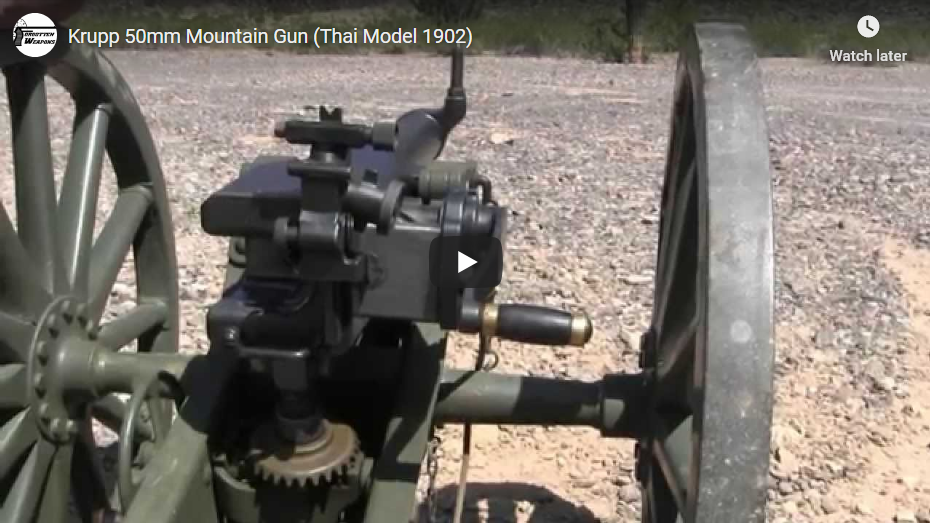
Krupp 50mm Mountain Gun (Thai Model 1902)
Forgotten Weapons
Published on 27 Jul 2014http://www.forgottenweapons.com
Theme music by Dylan Benson – http://dbproductioncompany.webs.com
Taking a look at another artillery piece today, a 50mm mountain gun made for Siam (now Thailand) by the German Krupp company. It is a relatively simple (and thus relatively inexpensive at the time) design, with no recoil mechanism or adjustable traverse.
QotD: Parliament and the Palace of Westminster
It is a real issue. For many years the experts have known that the Palace of Westminster, which looks so good in the background of TV news reports, is close to falling down. It was not very well built in the first place. It was quite severely bombed by Herr Hitler in 1941, and rebuilt on the cheap in the lean years after the war. A very expensive attempt to restore it in the 1980s has not held off the ravages of the years. A subway line which runs beneath it is suspected of making things worse. And now they are having to silence the great bell of Big Ben to allow unavoidable repairs to be done. Experts would like to shut the whole building down for several years and send both Houses of Parliament somewhere else. The members themselves don’t want to go. Who knows where they might end up? Worse, seen against a more ordinary background, would they look as dull and undistinguished as they truly are?
Peter Hitchens, “An Empty Parliament”, First Things, 2017-10-03.
October 13, 2019
Building Angkor – Monsoon Metropolis – Extra History – #1
Extra Credits
Published 12 Oct 2019Join us on Patreon! http://bit.ly/EHPatreon
Let’s lay down the foundations for one of the architectural marvels of the ancient world: At its height, the city of Angkor was, by several measures, the largest city of the medieval era. With a million people and a footprint larger than modern-day New York, it was arguably the world’s largest pre-industrial city. And at its center lay the magnificent Angkor Wat.

It’s raining bombs, keep calm and carry on… – WW2 – 059 – October 12 1940
World War Two
Published 12 Oct 2019The Blitz continues while Chinese Communists are fighting Chinese Nationalist in China. But the mass bombing of civilian targets does not really do what it is supposed to.
Join us on Patreon: https://www.patreon.com/TimeGhostHistory
Or join The TimeGhost Army directly at: https://timeghost.tvFollow WW2 day by day on Instagram @World_war_two_realtime https://www.instagram.com/world_war_two_realtime/
Join our Discord Server: https://discord.gg/D6D2aYN.
Between 2 Wars: https://www.youtube.com/playlist?list…
Source list: http://bit.ly/WW2sourcesWritten and Hosted by: Indy Neidell
Produced and Directed by: Spartacus Olsson and Astrid Deinhard
Executive Producers: Bodo Rittenauer, Astrid Deinhard, Indy Neidell, Spartacus Olsson
Creative Producer: Joram Appel
Post-Production Director: Wieke Kapteijns
Research by: Indy Neidell
Edited by: Iryna Dulka
Map animations: Eastory
Sound design: Marek KaminskiColorisations by Norman Stewart and Julius Jääskeläinen https://www.facebook.com/JJcolorization/
Eastory’s channel: https://www.youtube.com/channel/UCEly…
Archive by Screenocean/Reuters https://www.screenocean.com.A TimeGhost chronological documentary produced by OnLion Entertainment GmbH.
From the comments:
World War Two
2 days ago
Indy mentioned our Instagram page, where we make a daily post about what happened in the war on that day. This might be something completely different from what’s covered in these videos, or might add some more details. You can follow it by searching @world_war_two_realtime or by clicking here: https://www.instagram.com/world_war_two_realtime/. See you there!
Cheers,
Joram

Tank Chats #52 Sherman Crab Flail | The Funnies | The Tank Museum
The Tank Museum
Published on 15 Jun 2018Tank Chats playlist https://www.youtube.com/playlist?list…
Another episode in the Tank Chats Funnies Specials, looking at the weird and wonderful vehicles of 79th Armoured Division led by Major General Percy Hobart.
The Flail tank was designed to clear mines and flails were operated in the 79th Armoured Division after D-Day.
Support the work of The Tank Museum on Patreon: ► https://www.patreon.com/tankmuseum
Or donate http://tankmuseum.org/support-us/donateVisit The Tank Museum SHOP: ►https://tankmuseumshop.org/
Press the little bell above to enable NOTIFICATIONS so you don’t miss the latest Tank Museum videos.
Twitter: ► https://twitter.com/TankMuseum
Tiger Tank Blog: ► http://blog.tiger-tank.com/
Tank 100 First World War Centenary Blog: ► http://tank100.com/ #tankmuseum #tanks #tankchats

October 12, 2019
History Summarized: Ancient India
Overly Sarcastic Productions
Published 11 Oct 2019Go to http://www.audible.com/overlysarcastic or text
overlysarcasticto 500500 to get a free audiobook, 2 free Audible Originals, and 30-day free trial.In the first of what is sure to be a multi-part series, let’s take a look at the history of Ancient India, from the earliest civilization through the development of Sanskrit literature and all the way to the great Maurya Empire!
FURTHER READING: The Discovery of India, by Jawaharlal Nehru (https://en.wikipedia.org/wiki/The_Discovery_of_India)
PATREON: https://www.Patreon.com/OSP
DISCORD: https://discord.gg/sS5K4R3
MERCH LINKS: https://www.redbubble.com/people/OSPY…
OUR WEBSITE: https://www.OverlySarcasticProductions.com
Find us on Twitter https://www.Twitter.com/OSPYouTube
Find us on Reddit https://www.Reddit.com/r/OSP/

“Midway” – The Battle of Midway – Sabaton History 036 [Official]
Sabaton History
Published 11 Oct 2019The Battle of Midway in June 1942 was one of the decisive battles on the Pacific front during World War Two. The Sabaton song “Midway” is about that battle and the men who sailed, flew, fought and died there.
Support Sabaton History on Patreon: https://www.patreon.com/sabatonhistory
Listen to Coat of Arms (where “Midway” is featured):
CD: http://bit.ly/CoatOfArmsStore
Spotify: http://bit.ly/CoatOfArmsSpotify
Apple Music: http://bit.ly/CoatOfArmsAppleMusic
iTunes: http://bit.ly/CoatOfArmsiTunes
Amazon: http://bit.ly/CoatOfArmsAmzn
Google Play: http://bit.ly/CoatOfArmsGooglePlayWatch the Official Lyric Video of Midway here: https://www.youtube.com/watch?v=0WAfB…
Listen to Sabaton on Spotify: http://smarturl.it/SabatonSpotify
Official Sabaton Merchandise Shop: http://bit.ly/SabatonOfficialShopHosted by: Indy Neidell
Written by: Markus Linke and Indy Neidell
Directed by: Astrid Deinhard and Wieke Kapteijns
Produced by: Pär Sundström, Astrid Deinhard and Spartacus Olsson
Creative Producer: Joram Appel
Executive Producers: Pär Sundström, Joakim Broden, Tomas Sunmo, Indy Neidell, Astrid Deinhard, and Spartacus Olsson
Maps by: Eastory
Edited by: Iryna Dulka
Sound Editing by: Marek KaminskiEastory YouTube Channel: https://www.youtube.com/channel/UCEly…
Archive by: Reuters/Screenocean https://www.screenocean.com
Music by Sabaton.Sources:
National Security Agency
Letter icon by Mochammad Kafi from the Noun Project
Ship icon by Edward Boatman from the Noun ProjectAn OnLion Entertainment GmbH and Raging Beaver Publishing AB co-Production.
© Raging Beaver Publishing AB, 2019 – all rights reserved.

Göring, the Stoned Nazi Nut – Doped WW2 Leaders Part 1
World War Two
Published 10 Oct 2019Hermann Göring was one of the most powerful leaders of the Third Reich. He was also a drug addict with some serious problems and a remarkable lifestyle.
Join us on Patreon: https://www.patreon.com/TimeGhostHistory
Or join The TimeGhost Army directly at: https://timeghost.tvFollow WW2 day by day on Instagram @World_war_two_realtime https://www.instagram.com/world_war_t…
Join our Discord Server: https://discord.gg/D6D2aYN.
Between 2 Wars: https://www.youtube.com/playlist?list…
Source list: http://bit.ly/WW2sourcesHosted by: Indy Neidell
Written by: Joram Appel
Produced and Directed by: Spartacus Olsson and Astrid Deinhard
Executive Producers: Bodo Rittenauer, Astrid Deinhard, Indy Neidell, Spartacus Olsson
Creative Producer: Joram Appel
Research by: Joram Appel
Edited by: Iryna Dulka
Map animations: EastoryColorisations by Norman Stewart and Julius Jääskeläinen https://www.facebook.com/JJcolorization/
Eastory’s channel: https://www.youtube.com/channel/UCEly…
Archive by Screenocean/Reuters https://www.screenocean.com.Sources:
Klimbim Colorizations – https://klimbim2014.wordpress.com/A TimeGhost chronological documentary produced by OnLion Entertainment GmbH.
From the comments:
World War Two
31 minutes ago (edited)
Though this episode is mostly about the lifestyle of Hermann Göring, we will certainly get back to his more serious impact on the Nazi party, Germany and World War Two. For those of you who are new here, we are following World War Two Week by Week, in which we do pay a lot of attention to all those smaller but still significant events. If you would like to watch the series, make sure to subscribe and to click here to start watching from episode one: https://www.youtube.com/watch?v=3-A1gVm9T0A&list=PLsIk0qF0R1j4Y2QxGw33vYu3t70CAPV7XCheers,
The TimeGhost team.