The central problem of almost every society before about 1950 has been how to reconcile the great majority to distributions of property in which they are at a disadvantage. Only a minority has even been able to enjoy secure access to abundant food and good clothing and clean water and healthcare and education. Whether actually enslaved or formally free sellers of labour, the majority have always had to look up to a minority of the rich who are often legally privileged. How to keep them quiet?
Force can only ever be part of the answer. The poor have always been the majority, and sometimes the great majority. Armies of mercenaries to protect the rich have not always been available, and they have never by themselves been sufficient to compel obedience on all occasions in every respect.
Force, therefore, has always been joined by religious terrors. In Egypt, the king was a god, and the privileged system of which he was the head was part of a divine order that the common people were enjoined never to challenge. In the other monarchies of the near east, the king might not actually be a god. But all the priests taught that he was part of a divinely ordained order that it was blasphemy to challenge.
In the Greek city states until about a century before the birth of Epicurus, securing the obedience of the poor had not been a serious problem. There had been some class conflict, even in Athens. But most land was occupied by smallholders, and excess population could be decanted into the colonies of Italy and the western Mediterranean. There were rich citizens, but they were usually placed under heavy obligations to contribute to the defence and ornament of their cities.
Then a combination of commercial progress and the disruptions of the war between Athens and Sparta created a steadily widening gulf between rich and poor. There was also a growing problem of how to maintain large but unknown numbers of slaves in peaceful subjection.
The result was a class war that destabilised every Greek state. The sort of democracy seen in Athens could survive in a society where citizens were broadly equal. Once a small class of rich and a much larger class of the poor had emerged, there was a continual tendency for democratic assemblies to be led by demagogues into policies of levelling that could be ended only by the rise of a tyrant, who would secure the wealth of the majority — but who could secure it only so long as the poor could be terrified into submission. Once they could not be terrified by the threat of overwhelming force, they would rise up and dispossess the rich, until a new tyrant could emerge to subdue them again.
Unlike in the monarchies of the near east, no settled order could be maintained in Greece by religious terrors. During the sixth and fifth centuries, the Greek mind had experienced the first enlightenment of which we have record. There had been a growth of philosophy and science that revealed a world governed by laws that could be uncovered and understood by the unaided reason.
Now, enlightenments are always dangerous to an established religion. And the Greek religion was unusually weak as a counterweight to reason. The Greeks had no conception of a single, omnipotent God the Creator. Instead, they had a pantheon of supernatural beings who had not created the world, but were subject to many of its limitations. These were frequently at war with each other, and so they could be set against each other by their human worshippers with timely sacrifices and other bribes. They did not watch continually over human actions, and beyond the occasional punishment and reward to the living, they had no means of compelling observance of any code of human conduct.
And so, when the intellectual disturbance of philosophy and science spilled over into demands for a reconstruction of society in which property would be equalised, there was no religious establishment with the authority to stand by the side of the rich.
Sean Gabb, “Epicurus: Father of the Englightenment”, speaking to the 6/20 Club in London, 2007-09-06.
September 24, 2019
QotD: Conditions for the rise of tyrants in the Greek city states
September 23, 2019
M4 Sherman – The Workhorse of D-Day
Real Engineering
Published on 21 Sep 2019Watch over 2,400 documentaries for free for 30 days by signing up at http://www.CuriosityStream.com/realen… and using the code, “
realengineering”New streaming platform: https://watchnebula.com/
Patreon:
https://www.patreon.com/user?u=282505…
Twitter:
https://twitter.com/thebrianmcmanus
Discord:
https://discord.gg/s8BhkmNThank you to AP Archive for access to their archival footage
Virtual Tour: Newly Renovated Cody Firearms Museum
Forgotten Weapons
Published on 27 Jul 2019http://www.patreon.com/ForgottenWeapons
Cool Forgotten Weapons merch! http://shop.bbtv.com/collections/forg…
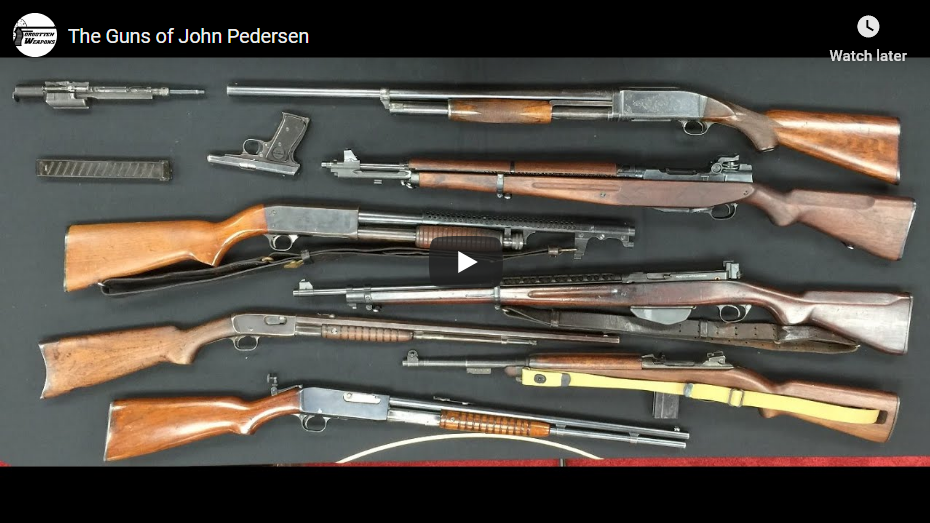
The Cody Firearms Museum has spent many months undergoing a complete renovation and rebuilding, and is now back fully open to the public. The new layout has not just improved visibility and put the guns in better display context, but it has actually increased the number of guns on display. When I last filmed at Cody, most of the really interesting unusual stuff was back in the vaults — but during filming this past week we had to take a remarkable number of guns out of displays to film. This is a great improvement — the Cody museum was always good, but this new design has made it the best firearms museum in the United States, in my opinion.
Visiting? The CFM is part of the 5-museum complex that is the Buffalo Bill Center of the West in beautiful Cody, Wyoming:
Contact:
Forgotten Weapons
PO Box 87647
Tucson, AZ 85754
QotD: Harry Truman’s second thoughts about the CIA
… it got out of hand. The fella … the one that was in the White House after me never paid any attention to it, and it got out of hand. Why, they’ve got an organization over there in Virginia now that is practically the equal of the Pentagon in many ways. And I think I’ve told you, one Pentagon is one too many.
Now, as nearly as I can make out, those fellows in the CIA don’t just report on wars and the like, they go out and make their own, and there’s nobody to keep track of what they’re up to. They spend billions of dollars on stirring up trouble so they’ll have something to report on. They’ve become … it’s become a government all of its own and all secret. They don’t have to account to anybody.
That’s a very dangerous thing in a democratic society, and it’s got to be put a stop to. The people have got a right to know what those birds are up to. And if I was back in the White House, people would know. You see, the way a free government works, there’s got to be a housecleaning every now and again, and I don’t care what branch of the government is involved. Somebody has to keep an eye on things.
And when you can’t do any housecleaning because everything that goes on is a damn secret, why, then we’re on our way to something the Founding Fathers didn’t have in mind. Secrecy and a free, democratic government don’t mix. And if what happened at the Bay of Pigs doesn’t prove that, I don’t know what does. You have got to keep an eye on the military at all times, and it doesn’t matter whether it’s the birds in the Pentagon or the birds in the CIA.
Harry S. Truman, quoted by Jeff Deist, “Truman Was Right About the CIA”, Mises Wire, 2017-03-08.
September 22, 2019
The Inca Empire – A God Taken Hostage – Extra History – #5
Extra Credits
Published on 21 Sep 2019Join us on Patreon! http://bit.ly/EHPatreon
Atahualpa vs. Francisco Pizarro. The Incas had never seen horses before, and it wasn’t long before the Spanish had captured Atahualpa as a hostage for gold and silver. But Atahualpa had a plan. He found a way to use this situation to his own political advantage — and Pizarro eventually destroyed himself through his greed and violent carelessness that appalled the Spanish government, eventually allowing the Incas to thrive again.
Follow us on Instagram: http://bit.ly/ECisonInstagram
The Brits teach the Germans to bugger off! – WW2 – 056 – September 21 1940
World War Two
Published on 21 Sep 2019The Battle of Britain continues as planes fight over the South-English shorelines and large parts of London are targeted during the Blitz. However, this week the ultimate goal of this air battle is postponed. The invasion of Britain, Operation Sea Lion, is called off. For now at least.
Join us on Patreon: https://www.patreon.com/TimeGhostHistory
Or join The TimeGhost Army directly at: https://timeghost.tvFollow WW2 day by day on Instagram @World_war_two_realtime https://www.instagram.com/world_war_t…
Join our Discord Server: https://discord.gg/D6D2aYN.
Between 2 Wars: https://www.youtube.com/playlist?list…
Source list: http://bit.ly/WW2sourcesWritten and Hosted by: Indy Neidell
Produced and Directed by: Spartacus Olsson and Astrid Deinhard
Executive Producers: Bodo Rittenauer, Astrid Deinhard, Indy Neidell, Spartacus Olsson
Creative Producer: Joram Appel
Post-Production Director: Wieke Kapteijns
Research by: Indy Neidell
Edited by: Iryna Dulka
Map animations: EastoryColorisations by Norman Stewart and Julius Jääskeläinen https://www.facebook.com/JJcolorization/
Eastory’s channel: https://www.youtube.com/channel/UCEly…
Archive by Screenocean/Reuters https://www.screenocean.com.Sources:
– Mussolini colorized by Olga Shirnina, aka Klimbim
– German barge by WerWil on Wikimedia Commons
– IWM: CM3513, MH 6657, ZZZ 2070B, MISC 51237A TimeGhost chronological documentary produced by OnLion Entertainment GmbH.
Gladius VS Spatha – Why Did The Empire Abandon The Gladius?
Metatron
Published on 11 Feb 2017If the famous Gladius/rectangular Scutum combo had proven to be so effective for so many centuries why did the Late Empire Romans choose to abandon it in favour of a spatha/round shield combination? Here is what I think.
Gladius was one Latin word for sword, and is used to represent the primary sword of Ancient Roman foot soldiers.
A fully equipped Roman legionary after the reforms of Gaius Marius was armed with a shield (scutum), one or two javelins (pila), a sword (gladius), often a dagger (pugio), and, perhaps in the later Empire period, darts (plumbatae). Conventionally, soldiers threw javelins to disable the enemy’s shields and disrupt enemy formations before engaging in close combat, for which they drew the gladius. A soldier generally led with the shield and thrust with the sword. All gladius types appear to have been suitable for cutting and chopping as well as thrusting.
Gladius is a Latin masculine second declension noun. Its (nominative and vocative) plural is gladiī. However, gladius in Latin refers to any sword, not specifically the modern definition of a gladius. The word appears in literature as early as the plays of Plautus (Casina, Rudens).
Modern English words derived from gladius include gladiator (“swordsman”) and gladiolus (“little sword”, from the diminutive form of gladius), a flowering plant with sword-shaped leaves.
Gladii were two-edged for cutting and had a tapered point for stabbing during thrusting. A solid grip was provided by a knobbed hilt added on, possibly with ridges for the fingers. Blade strength was achieved by welding together strips, in which case the sword had a channel down the center, or by fashioning a single piece of high-carbon steel, rhomboidal in cross-section. The owner’s name was often engraved or punched on the blade.
September 21, 2019
Sexton Tank Chat | Operation Market Garden 75 | The Tank Museum
The Tank Museum
Published on 20 Sep 2019Here we have a Tank Chat special from the commemorative XXX Corps convoy for Operation Market Garden 75. See David Willey discuss the a Sexton from the Historic Collection of the Royal Netherlands Army, on location in the Netherlands.
Support the work of The Tank Museum on Patreon: ► https://www.patreon.com/tankmuseum
Visit The Tank Museum SHOP: ► https://tankmuseumshop.org/
Twitter: ► https://twitter.com/TankMuseum
Instagram: ► https://www.instagram.com/tankmuseum/
Tiger Tank Blog: ► http://blog.tiger-tank.com/
Tank 100 First World War Centenary Blog: ► http://tank100.com/
September 20, 2019
Most Germans Reject Hitler | BETWEEN 2 WARS I 1932 Part 2 of 4
TimeGhost History
Published on 19 Sep 2019After Chancellor Brüning has run Germany’s economy into the ground, the country is once again going to the polls. It’s a wild brawl between reason and madness, populism and stability, and democracy and tyranny focused on who will unite Germany if Germany even can be united again …
Join us on Patreon: https://www.patreon.com/TimeGhostHistory
Subscribe to our World War Two series: https://www.youtube.com/c/worldwartwo…
Hosted by: Indy Neidell
Written by: Spartacus Olsson
Directed by: Spartacus Olsson and Astrid Deinhard
Executive Producers: Bodo Rittenauer, Astrid Deinhard, Indy Neidell, Spartacus Olsson
Creative Producer: Joram Appel
Post-Production Director: Wieke Kapteijns
Research by: Spartacus Olsson
Edited by: Wieke Kapteijns
Sound design: Marek KamińskiSources: Icon german parliament: Gerald Wildmoser. Graphic German Reichstag: Liambaker98. Images: Bundesarchiv.
A TimeGhost chronological documentary produced by OnLion Entertainment GmbH.
From the comments:
TimeGhost History
3 hours ago
This year it will be 85 years ago that Germany elected the Nazis to power, or will it? Well … as most events in history it isn’t quite that simple. There is no majority for anything in Germany at this point. You see, in 1932 Germany is still a diverse, democratic state. But it’s been under attack for many years now by populist, partisan interests tearing it apart into fractious, sometimes destructive opposite forces. In essence, they can be grouped into three camps:1. the mainstream centrist parties on the left and right that want a parliamentary, socially tolerant democracy.
2. the far left that wants to overthrow the parliamentary democracy and start a revolution to create an authoritarian, socially ultra-liberal, rule by the working class
3. the far right that wants to overthrow the parliamentary democracy to create a totalitarian, socially reactionary, rule by a strong man.Now, that is the left to right landscape and as you shall see that is also how the election results play out in alliances. So try your best to get rid of your prejudices and preconceived notions — because for many of you things are not the way that you have been told. And if for no other reason than saving us the trouble of having to police these comments too much — please, please try to remember our rules. They are not there to quash freedom of speech — they are there so that we can keep the comment sections turned on. When we don’t police them it never takes long for videos like this to descend into a hatefest full of death threats and calls for mass murder. You might think that’s cool, but we don’t and we know that most of the world doesn’t so respect that — for the sake of democracy if nothing else.
“Cliffs of Gallipoli” Part 2 – The Great War – Sabaton History 033 [Official]
Sabaton History
Published on 19 September 2019The second part of our coverage of the Sabaton song “Cliffs of Gallipoli” is about the brutal fighting that took place once the landings had come to a standstill. A stalemate similar to the Western Front caused thousands of Ottoman and Allied soldiers to have to endure endless charges, barrages, sniper fire in addition to the hot summer climate of South-Eastern Europe.
Support Sabaton History on Patreon: https://www.patreon.com/sabatonhistory
Watch Part 1 of Cliffs of Gallipoli here: https://youtu.be/oDac6Oswyns
Listen to The Art of War (where “Cliffs of Gallipoli” is featured):
CD: http://bit.ly/TheArtOfWarStore
Spotify: http://bit.ly/TheArtOfWarSpotify
Apple Music: http://bit.ly/TheArtOfWarAppleMusic
iTunes: http://bit.ly/TheArtOfWariTunes
Amazon: http://bit.ly/TheArtOfWarAmz
Google Play: http://bit.ly/TheArtOfWarGooglePlayWatch the Official Lyric Video of Cliffs of Gallipoli here: https://www.youtube.com/watch?v=oOCe2…
Hosted by: Indy Neidell
Written by: Markus Linke and Indy Neidell
Directed by: Astrid Deinhard and Wieke Kapteijns
Produced by: Pär Sundström, Astrid Deinhard and Spartacus Olsson
Creative Producer: Joram Appel
Executive Producers: Pär Sundström, Joakim Broden, Tomas Sunmo, Indy Neidell, Astrid Deinhard, and Spartacus Olsson
Maps by: Eastory
Edited by: Iryna Dulka
Sound Editing by: Marek KaminskiEastory YouTube Channel: https://www.youtube.com/channel/UCEly…
Archive by: Reuters/Screenocean https://www.screenocean.com
Music by Sabaton.Sourses:
– IWM: Q 13450, 2509-07, Q 13324, Q 13249, Q 13219, HU 57426, Q 13585, Q 13676, Q 13667, Q 13637, Q 13714, Q 13663, Q 13680, Q 13709, Q 13335, Q 13285, Q 13447, Q 56637, HU 105641, Q 13622, Q 13633, Q 13647, Q 13689, Q 13677, Q14394, Q 13625
– Australian War Memorial
– A soldier of the Indian Labour Corps courtesy of National Army Museum of New ZealandAn OnLion Entertainment GmbH and Raging Beaver Publishing AB co-Production.
© Raging Beaver Publishing AB, 2019 – all rights reserved.
Huot: Canada’s Ross-based Prototype Automatic Rifle from WW1
Bloke on the Range
Published on 18 Jul 2019Patreon: https://www.patreon.com/BlokeOnTheRange
Due to a shortage of Lewis guns and a glut of withdrawn Ross Mk.III rifles once the Canadian Expeditionary Force had been completely re-equipped with Lee-Enfield SMLE rifles, Monsieur Huot proposed to modify Ross rifles into an automatic rifle / light machine gun (LMG) configuration.
5 of these are known to exist, this is number 2, and is in the Seaforth Highlanders of Canada museum in Vancouver: https://www.seaforthhighlanders.ca/ho…
Many thanks to them for the opportunity to handle and film this exceptionally rare piece! Please give them a visit!
September 19, 2019
“[T]he Indian Act is a benign form of apartheid”
In the National Post, Barbara Kay discusses a recent book on the key legislation that regulates relations between the Canadian federal government and the various First Nations groups:
Few and far between are disinterested scholars of Canada’s Aboriginal history who have the tough hide and principled will to publicly depart from the approved Indigenous “nation-to-nation” narrative that keeps the guilt and money flowing, but perpetuates a dysfunctional status quo on many reserves. Most of the dissenters are university academics. But Best is simply an intelligent man with a passion for his subject, a deep impatience with political correctness, and unremitting determination to weather whatever storms afflict him as he shepherds his views to a public market.
I’ve written before in the National Post and elsewhere about Best’s lonely battles with our society’s forces of repression. There Is No Difference began its public life as a post on a dedicated online site in 2014, copied to his legal firm’s. Shortly afterward, complaints were filed against him with the Law Society of Upper Canada (now the Law Society of Ontario), asking that Best be “disbarred or suspended” and that he be forced to apologize for using his law practice “to disseminate racist materials.”
After two years of stressful limbo, the Law Society graciously allowed that the excerpts submitted by the (unnamed) complainant were “not enough to merit a finding of any form of professional misconduct on their face.” (The last three words telegraph the ardent wish that they had been; apart from a dissenting group of new benchers, the Law Society’s board has increasingly demonstrated worrying Thought Police tendencies.)
Best believes the Indian Act is a benign form of apartheid, and advocates for the integration model of equal citizenship for all, a model promoted, for example, by Pierre Elliott Trudeau (who called the system “apartheid”), and the late Aboriginal lawyer William Wuttunee, author of Ruffled Feathers, who was marginalized and discredited as an “apple,” red on the outside, white on the inside.
Best believes the federal government must be the ultimate master in its own house for Canada to function as a healthy nation. He is fiercely critical of the Supreme Court’s 2004 emphasis on the “honour of the Crown” concept in its Haida Nation vs. British Columbia ruling, with key words “to consult and where appropriate, accommodate the Aboriginal interest” virtually decreeing a devolution of Crown sovereignty to Aboriginals, and effectively turning Indigenous bands into a third order of government with the power arbitrarily to advance or restrict Canada’s economic fortunes.
It’s easy for Indigenous activists to bash a white historian, or even an Aboriginal dissident without special standing like Wuttunee. But it will be more difficult to dismiss the opinion of a former Supreme Court justice. Best just came in for an unexpected stroke of luck. Former Supreme Court justice Jack Major (1992-2005) has given the book his endorsement in a letter discussed in an article by the Frontier Centre for Public Policy (FCPP).
Ancient technology: Saxon glass-working experiment
Lindybeige
Published on 9 Aug 2019Many thanks to Victoria Lucas for inviting me along to see her experiments in medieval glass-working. Fire! Craft! Mud!
Support me on Patreon: https://www.patreon.com/LindybeigePicture credits:
Natron deposit image
By Stefan Thüngen – Own work, Public Domain, https://commons.wikimedia.org/w/index…Glass slab of BETH SHE’ARIM
Hanay [CC BY-SA 4.0 (https://creativecommons.org/licenses/…)]Palm cup
Reptonix free Creative Commons licensed photos [CC BY 3.0 (https://creativecommons.org/licenses/…)]Lindybeige: a channel of archaeology, ancient and medieval warfare, rants, swing dance, travelogues, evolution, and whatever else occurs to me to make.
▼ Follow me…
Twitter: https://twitter.com/Lindybeige I may have some drivel to contribute to the Twittersphere, plus you get notice of uploads.
websites:
http://www.Lindybeige.uk
http://www.LloydianAspects.co.uk
QotD: Parliament and democracy
In legal theory, the members of the Commons are representatives and they have the role that was enunciated in the famous letter to the electors of Bristol by Edmund Burke. “I owe you my discretion; I don’t merely owe you my vote.” That was nearly 250 years ago when there was no democracy and politics was run by a handful of families like the Marquess of Rockingham to whom he was the paid lackey (and by the way the electors of Bristol threw him out). There is a very vague relationship between Parliament and democracy. We have had Parliament for 800 years. We’ve had democracy for less than a century. And the great issue was: how do you reconcile the previous tradition of representative in a non-democratic Parliament with the position of delegate in a democratic Parliament. And the way it was dealt with — this is what all the fuss, all the things that we are talking about: Erskine May, A V Dicey, they all appear at a particular moment of time. They appear in the middle of the 1880s because it’s the 1884 reform act that introduces something like democracy.
But you see we’ve never worked out the relationship between the fact that we’ve got two sovereigns. There is the legal sovereign which is the Crown in Parliament and there is the real, political sovereign which is the sovereign people behind them. But what we did, and this is why Bercow’s behaviour is so disastrous; it’s why Theresa May’s behaviour has been so catastrophic: what we developed thanks to Erskine May and the Parliamentary Handbook and endorsed by Dicey, we developed a whole series of devices. They were conventions that turned MPs from more or less representatives into more or less delegates. And what are these things? They’re party affiliation. They are manifestos. They’re standing on a ticket and they’re being whipped when they’re in the house. That is the thing that binds them to the popular vote. No MP; Dominic Grieve was not elected in a personal capacity. He was elected because he stood as a Tory on a Tory manifesto which promised Brexit. That man did not dissent at the time. His claims to dignity, his claims to acting honourably, are totally false.
There are other rules in Erskine May about the procedures of Commons business which gives the government the basic control of the parliamentary timetable. Otherwise what happens is the house just dissolves into a talking shop. Becuase MPs have refused to vote for any deal: they’re strong in the negative but they’re hopelessly weak in the positive. They can’t agree on anything. We developed a series of conventions in the 1880s that turn MPs into something like the representatives of the people and what has systematically happened in this Parliament: we have broken those conventions.
Theresa May’s loss of the election and her absurd notion that you can keep people with completely contradictory opinions on a main platform of government policy in the same party broke down the whipping system. Bercow broke down the government’s control of legislation. And you’re left with this chaotic mess.
David Starkey talking to Brendan O’Neill on the Brendan O’Neill Show, 2019-09-15. (Transcription from The Great Realignment)
September 18, 2019
The invention of Writing, Paper and Print! l HISTORY OF CHINA
IT’S HISTORY
Published on 22 Jul 2015The invention of script, paper and printing can be credited to the Chinese. It was in China that Cai Lun, in his emperor’s service, made the production of paper suitable for the masses. Originally planned as a means to wrap things in, it soon became obvious that paper was more suitable for writing than the common bamboo stick. Guy explains how the Chinese printed written pages long before Gutenberg was born, how Chinese writing actually works and how emperor Qin tried to establish the standardized Chinese Han Characters, or Hanzi, attempting to unify the writing symbols for his country.
» SOURCES
Videos: British Pathé (https://www.youtube.com/user/britishp…)
Pictures: mainly Picture Alliance
Content:
Faulmann, Carl (1995): Schriftzeichen und Alphabete aller Zeiten und Völker. Augsburg. Reprint der Originalausabe von 1880 Wien.
Pan, Jixing (1998): “On the origin of movable metal-types”. In: Chinese Science Bulletin 43 (20).
Wai Wong (2005): “Typesetting Chinese. A personal perspective”. In: TUGboat 26 (2) 111-114.
https://www.tug.org/TUGboat/tb26-2/wo…
Yan, Yangtse (2006): “New Evidence suggests longer paper making history in China”. http://news.xinhuanet.com/english/200…» ABOUT US
IT’S HISTORY is a ride through history – Join us discovering the world’s most important eras in IN TIME, BIOGRAPHIES of the GREATEST MINDS and the most important INVENTIONS.» HOW CAN I SUPPORT YOUR CHANNEL?
You can support us by sharing our videos with your friends and spreading the word about our work.» CAN I EMBED YOUR VIDEOS ON MY WEBSITE?
Of course, you can embed our videos on your website. We are happy if you show our channel to your friends, fellow students, classmates, professors, teachers or neighbors. Or just share our videos on Facebook, Twitter, Reddit etc. Subscribe to our channel and like our videos with a thumbs up.» CAN I SHOW YOUR VIDEOS IN CLASS?
Of course! Tell your teachers or professors about our channel and our videos. We’re happy if we can contribute with our videos.» CREDITS
Presented by: Guy Kiddey
Script by: Martin Haldenmair
Translated by: Guy Kiddey
Directed by: Daniel Czepelczauer
Director of Photography: Markus Kretzschmar
Music: Markus Kretzschmar
Sound Design: Bojan Novic
Editing: Markus KretzschmarA Mediakraft Networks original channel
Based on a concept by Florian Wittig and Daniel Czepelczauer
Executive Producers: Astrid Deinhard-Olsson, Spartacus Olsson
Head of Production: Michael Wendt
Producer: Daniel Czepelczauer
Social Media Manager: Laura Pagan and Florian WittigContains material licensed from British Pathé
All rights reserved – © Mediakraft Networks GmbH, 2015