
Security empires come and go. While they serve a purpose, their citizens are willing to pay the cost. When they become too expensive to maintain, they simply fold, or get ground under. They work to purpose, or stop.
Conquest empires rarely outlive their founders, or only last a few generations. Alexander’s generals, or Charlemagne’s children and grandchildren, dividing and subdividing into smaller and smaller units, is the norm for such empires. (If not straight collapse when the dictator holding it all together vanishes.)
The only “conquest” empires that have held up are those that send settlers into the lands of hunter-gatherers or nomads. The United States, Russia and Australia being good examples. (But the only reason they can hold up is if the captured territory can be converted into a functional part of the state and society … something the US and Australia have largely managed … Russia’s attempts to enforce this unity by repression of its more developed conquered peoples have not been so successful over the last few centuries, and it is unlikely that China will do much better long-term no matter how much repression it introduces into its recent conquests of established societies like Tibet and the Uyghurs.)
Which leaves only trade empires as potentially successful long term options. And only because their success is not measured by sustaining the political unity of the “empire”, but by sustaining its economic goals.
The most successful empire in world history is the British empire, which could delightedly declare itself obsolete in the 1920s, and again (after having to work mostly co-operatively to fight World War Two) in the 1950s. Both times it encouraged the member states to go look after themselves (some successfully and some less so), and yet it still managed to leave an almost completely secure legacy for its existence … relatively safe international free trade routes. (The almost complete elimination of both piracy and slavery worldwide just being minor side benefits of the British Empire.)
For an empire developed “in a fit of absent mindedness”, and as a byproduct of trying to develop free trade around the world: the measure of success has to be the Commonwealth of Nations – comprising 54 nations with about 1/3 of the world’s population, getting together to play cricket every year and hold a Commonwealth Games every 4 years.
This is not an empire that copllapsed, or was destroyed. This is an empire that over a century or so (from granting independent Dominion status to Canada in 1886 [Canadians stoutly maintain it was 1867], Australia 1901, New Zealand and South Africa pre-Great War, Ireland and Egypt interwar, India and Pakistan post war, large parts of Asia and Africa in the 60s and 70s etc.); nonetheless developed and secured the international free trade system that the world has embraced. (Including a re-integration by an early exit-er from the empire … the 13 out of 35 British north American colonies that became the United States … and who finally inherited the title of world policeman when the rest of the Commonwealth nations had got sick of the whole thing.)
Nigel Davies, “Types of Empires: Security, Conquest, and Trade”, rethinking history, 2020-05-02.
August 8, 2020
QotD: The British Empire
August 7, 2020
A Career Anti-Fascist – George Orwell – WW2 Biography Special
World War Two
Published 6 Aug 2020George Orwell is one of the most famous English writers in the modern age. But how did he become the man who would coin so many of the words we still use in our political debates?
Join us on Patreon: https://www.patreon.com/TimeGhostHistory
Or join The TimeGhost Army directly at: https://timeghost.tvFollow WW2 day by day on Instagram @World_war_two_realtime https://www.instagram.com/world_war_two_realtime
Between 2 Wars: https://www.youtube.com/playlist?list…
Source list: http://bit.ly/WW2sourcesHosted by: Indy Neidell
Written by: Rune Væver Hartvig
Director: Astrid Deinhard
Producers: Astrid Deinhard and Spartacus Olsson
Executive Producers: Astrid Deinhard, Indy Neidell, Spartacus Olsson, Bodo Rittenauer
Creative Producer: Joram Appel
Post-Production Director: Wieke Kapteijns
Research by: Rune Væver Hartvig
Edited by: Mikołaj Cackowski
Sound design: Marek Kamiński
Map animations: Eastory (https://www.youtube.com/c/eastory)Colorizations by:
Cassowary https://www.flickr.com/photos/cassowa…
Klimbim https://www.flickr.com/photos/2215569…Sources:
Wellcome Images V0014461
Bundesarchiv
Narodowe Archiwum Cyfrowe
From the Noun Project: Pig by supalerk laipawat, Horse by supalerk laipawat, Goat by Laymik, Sheep by Laymik, Cow by supalerk laipawat, Chicken by supalerk laipawat, Farmer by Symbolon, Podium by Focus LabSoundtracks from the Epidemic Sound:
Howard Harper-Barnes – “London”
Johannes Bornlof – “Deviation In Time”
Johannes Bornlof – “The Inspector 4”
Skrya – “First Responders”
Jo Wandrini – “Puzzle Of Complexity”Archive by Screenocean/Reuters https://www.screenocean.com.
A TimeGhost chronological documentary produced by OnLion Entertainment GmbH.

From Medieval Letters Patent to our modern patents, by way of Venice
In the latest Age of Invention newsletter, Anton Howes traces the lines of descent from the Letters patent of the Middle Ages, through Venetian legal innovations, to what began to resemble our modern patent system:
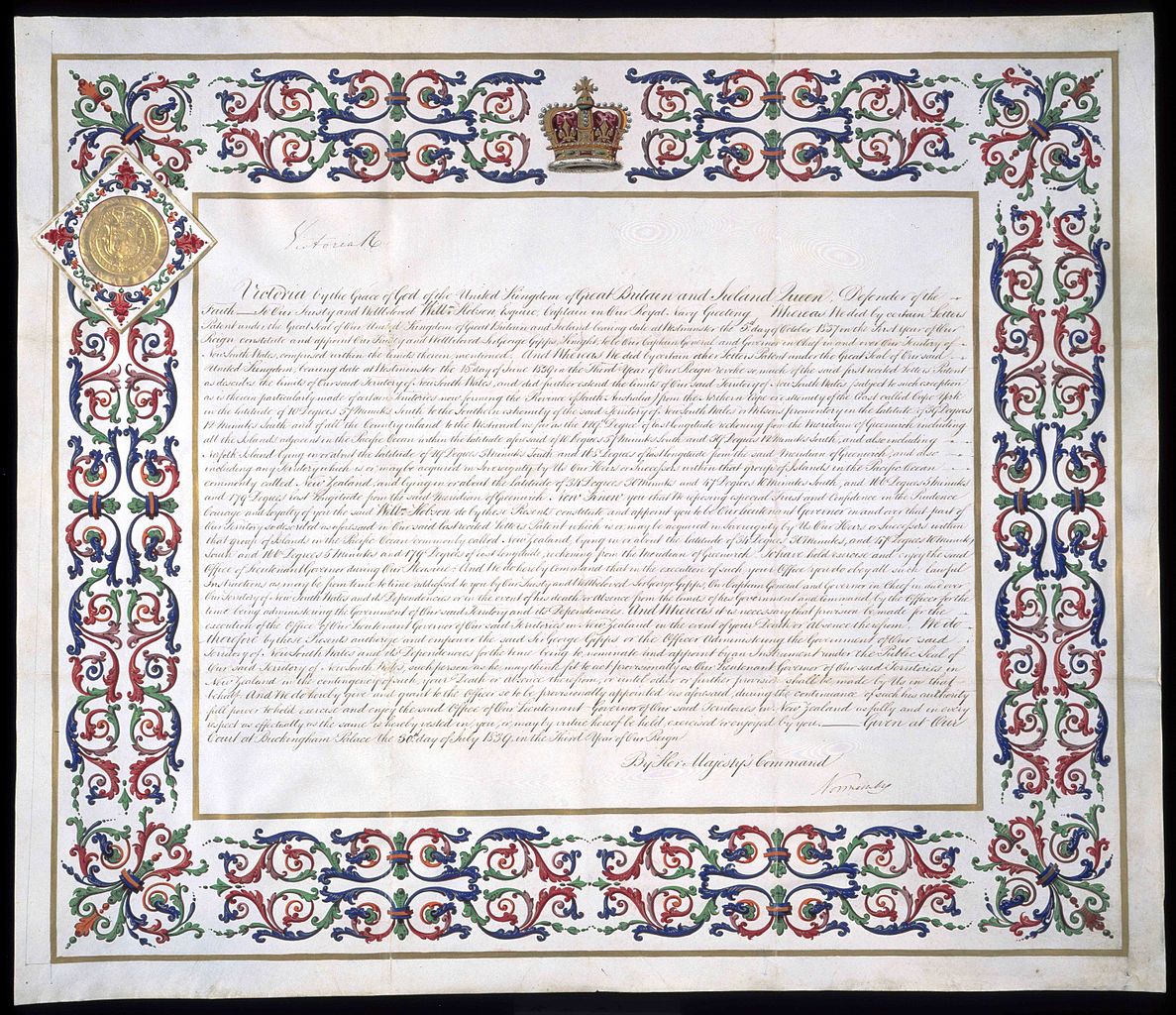
Letters Patent Issued by Queen Victoria, 1839
On 15 June 1839 Captain William Hobson was officially appointed by Queen Victoria to be Lieutenant Governor General of New Zealand. Hobson (1792 – 1842) was thus the first Governor of New Zealand. This position was renamed in 1907 as “Governor General”. Hobson arrived in New Zealand in late January 1840, and oversaw the signing of te Tiriti o Waitangi only a few days later. By the end of 1840, New Zealand became a colony in its own right and Hobson moved the capital of the colony from the Bay of Islands to Auckland. He served as Governor until his death in 1842 after he suffered a stroke at the age of 49.
Constitutional Records group of Archives NZ via Wikimedia Commons.
Patents for invention — temporary monopolies on the use of new technologies — are frequently cited as a key contributor to the British Industrial Revolution. But where did they come from? We typically talk about them as formal institutions, imposed from above by supposedly wise rulers. But their origins, or at least their introduction to England, tell a very different story.
England’s monarchs had long used their prerogative powers to grant special dispensations by letters patent — that is, orders from the monarch that were open for all the public to see (think of the word patently, from the same root, which means openly or clearly). For the most part, such public proclamations had been used to grant titles of nobility, or to appoint people to positions in various official hierarchies — legal, religious, and governmental. And, of course, letters patent could be used to promote the introduction of new technologies.
[…]
Monopolies in general, of course, over particular trades or industries had been granted for centuries, by rulers all across Europe. They granted such privileges to groups of merchants, artisans, and city-dwellers, giving them rights to organise and regulate their own activities as guilds or as city corporations. Inherent to all such charters was the ability of the in-group to restrict competition from outsiders, at least within the confines of their city. And the ruler, in exchange for granting such privileges, typically received a share of the guild’s or corporation’s revenues. But such monopolies were very rarely given to individuals. When they were, it was often so unpopular as to be almost immediately overturned. And they were rarely used to encourage innovation.
With one exception: Italy. Throughout the fifteenth century, some Italian city guilds had begun to forbid their members from copying newly-invented patterns for silk and woollen cloth, effectively granting a monopoly over those patterns to the individual inventors. In Venice, a 50-year monopoly was granted in 1416 to one Franciscus Petri, of Rhodes, to introduce superior fulling mills. In Florence, the famous architect and engineer Filippo Brunelleschi was granted a monopoly in 1421 for a vessel he designed for transporting heavy loads of marble, in exchange for revealing the secrets of his design. The printing press was also introduced to Venice using such a privilege, with a 5-year monopoly granted in 1469 to Johannes of Speyer, though he died only a few months after receiving it. And these ad hoc grants were made with increasing frequency, such that in 1474 Venice legislated to make them more systematic, declaring that 10-year monopolies could be obtained for all new technologies, either invented or imported (though it continued to also grant ad hoc patents, with the terms and durations decided on a case-by-case basis as before). Under the 1474 law, Venice was soon granting patent monopolies to the introducers of various mills, pumps, dredges, textile machines, printing techniques, and even special kinds of lasagna. It granted over a hundred patents in the first half of the sixteenth century, with many more thereafter.
From Venice, the use of patent monopolies as an instrument of policy spread abroad, with the initiative coming from the would-be introducers of novelties themselves. In the mid-fifteenth century, for example, a French inventor who had acquired patents in Venice was also successfully lobbying for similar privileges from the archbishop of Salzburg, the duke of Ferrara, and the Hapsburg Holy Roman Emperor. The use of patent monopolies thus soon diffused to the rest of Italy, to Germany, and to the various dominions of the Spanish emperor — including Spain itself, its American colonies, and the Low Countries.
And, eventually, to England. But not in the way we might expect. In 1496, the Venetian explorer Zuan Chabotto (aka John Cabot) acquired a patent monopoly from Henry VII over the trade and products of any lands he was to discover — a legal procedure unlike anything that earlier English explorers had attempted (they had merely been granted licenses). Cabot’s grant even differed from the agreements made by Christopher Columbus with the Spanish crown, or by earlier explorers for the Portuguese. Columbus, for example, was effectively granted a patent of nobility — the hereditary titles of viceroy, admiral, and governor. He and the Portuguese explorers were direct agents of the crown, with military and justice-dispensing responsibilities over any newly conquered lands — a model derived from the Christian conquests of Muslim Iberia. Columbus effectively became a marcher lord, a custodian and defender of Spain’s new borderlands.
“40:1” Pt. 2 – Another Polish Last Stand – Sabaton History 079 [Official]
Sabaton History
Published 6 Aug 2020At the end of September 1939, Poland was burning. Trapped in an ever shrinking corridor between the Wehrmacht and the Red Army, the last remaining Polish forces were still holding out. Isolated, short of ammunition and supplies, and without hope for relief. The last Polish Army, the SGO Polesie, was making its way towards the Vistula, as it was cut off by German motorcycle troops. Determined to sell their lives dearly, the SGO Polesie dug in and prepared for a last stand.
Support Sabaton History on Patreon: https://www.patreon.com/sabatonhistory
Listen to “40:1” from the album The Art Of War:
https://music.sabaton.net/TheArtOfWarWatch the Official Music Video of “40:1” here:
https://www.youtube.com/watch?v=epeQw…Listen to Sabaton on Spotify: http://smarturl.it/SabatonSpotify
Official Sabaton Merchandise Shop: http://bit.ly/SabatonOfficialShopHosted by: Indy Neidell
Written by: Markus Linke and Indy Neidell
Directed by: Astrid Deinhard and Wieke Kapteijns
Produced by: Pär Sundström, Astrid Deinhard and Spartacus Olsson
Creative Producer: Joram Appel
Community Manager: Maria Kyhle
Executive Producers: Pär Sundström, Joakim Broden, Tomas Sunmo, Indy Neidell, Astrid Deinhard, and Spartacus Olsson
Post-Production Director: Wieke Kapteijns
Edited by: Karolina Dołęga
Sound Editing by: Marek Kaminski
Maps by: Eastory – https://www.youtube.com/c/eastory
Archive by: Reuters/Screenocean https://www.screenocean.com
Music by Sabaton.Sources:
Paul Otto courtesy Glenn Jewison
University of Wisconsin-Milwaukee Libraries
Bundesarchiv
Imperial War Museums: HU106375
Museum of Warsaw
Narodowe Archiwum Cyfrowe
Centralne Archiwum WojskoweAn OnLion Entertainment GmbH and Raging Beaver Publishing AB co-Production.
© Raging Beaver Publishing AB, 2019 – all rights reserved.
From the comments:
Sabaton History
2 days ago (edited)
Once again the time has come for the Polish people to show what they’re made of.This time they’re facing a gargantuan two-headed monster of an enemy and are outnumbered many many times over.
They may not win, they may not even live to see another day — but The Polish will not give up without giving their all.
Spirit of Spartans
Death and glory
Soldiers of Poland
Second to noneSo come, bring on all that you’ve got
Come hell, come high water — never stop!With the help of Indy and the TimeGhost team you can learn more about the Soviet invasion of Poland and the last days of The Polish Defensive War in these two episodes of the “World War Two In Real Time” series:
“The Russians are Coming! – The Soviet Invasion of Poland” – WW2 – 004 – September 22, 1939
https://youtu.be/8vjBp-qyNVE“Poland is Crushed” – WW2 – 005 – 29 September, 1939
https://youtu.be/OOPiUaakSXM

Myth and Reality of the Ross MkIII Rifle
Forgotten Weapons
Published 16 Jun 2013There is a long-standing urban legend about the Canadian Ross rifle, a straight-pull bolt action that was used in lieu of the SMLE by Canadian troops early in World War One. The story is that the Ross would sometimes malfunction and blow the bolt back into its shooter’s face, with pretty horrible results. Well, I wanted to learn “the rest of the story” — could this actually happen? What caused it? How could it be prevented? In short, what would a Ross shooter need to know to remain safe? And if I could get some cool footage of a bolt blowing out of a Ross in the process, all the better.
Well, reader Andy very generously provided a sporterized Ross for the experiments, and I started reading into what the issue really was. Turns out that the legend was quite true — you can put a Ross MkIII bolt together the wrong way, and it will allow you to fire without the locking lugs engaged, thus throwing the bolt back out of the gun at high velocity. However, the issue was recognized fairly quickly, and the vast majority of Ross rifles were modified with a safety rivet to prevent this from happening. It is also quite easy to determine if a Ross is assembled correctly, once you know what to look for.

QotD: Celibacy and chastity
There has been some pretty elevated stuff written on that subject, and if you want to take that particular high road, then Professor Robert George of Princeton is your guy. But consider the low road, too. There’s another conclusion, maybe a little bit cynical, that could be drawn from this: If you are a sexually frustrated young man, the smart play would be to join a church.
Kevin D. Williamson, “Advice for Incels”, National Review, 2018-05-10.
August 6, 2020
Rhodes: A Short History
History Time
Published 2 Mar 2017*****This was one of the first videos I ever made.
******Subscribe for much better narration on the newer videos and tons more historical awesomeness*****Situated at a crossroads between East and West, in a strategic location between the Aegean and the Mediterranean, Rhodes has long been fought over by the surrounding powers. As a result, Rhodes is one of the most historic sites on Earth.
If you liked this video and have as little as a dollar to spare then please consider supporting me on Patreon for more and better content in the future:- http://www.patreon.com/historytimeUK
Are you a budding artist, illustrator, cartographer, or music producer? Send me a message! No matter how professional you are or even if you’re just starting out, I can always use new music and images in my videos. Get in touch! I’d love to hear from you.
I’ve also compiled a reading list of my favourite history books via the Amazon influencer program. If you do choose to purchase any of these incredible sources of information, many of which form the basis of my videos, then Amazon will send me a tiny fraction of the earnings (as long as you do it through the link) (this means more and better content in the future) I’ll keep adding to and updating the list as time goes on:-
https://www.amazon.com/shop/historytimeI try to use copyright free images at all times. However if I have used any of your artwork or maps then please don’t hesitate to contact me and I’ll be more than happy to give the appropriate credit.
—Join the History Time community on social media:-
Instagram:-
https://www.instagram.com/historytime…
Twitter:-
https://twitter.com/HistoryTimePete

Fallen flag — The Lehigh and Hudson River Railway
 This month’s Classic Trains featured fallen flag is a northeastern railway I didn’t know much about, the Lehigh and Hudson River. If you asked me to complete the phrase “Lehigh and …”, I’d most likely have said “New England”, which was a larger operation but is perhaps only remembered now as the second major American railway to file for abandonment after the New York, Ontario & Western. The L&HR earned its keep primarily as a bridge line, with additional revenues from online anthracite coal mines. From the original founding in 1881, it operated until it was incorporated into Conrail in 1976.
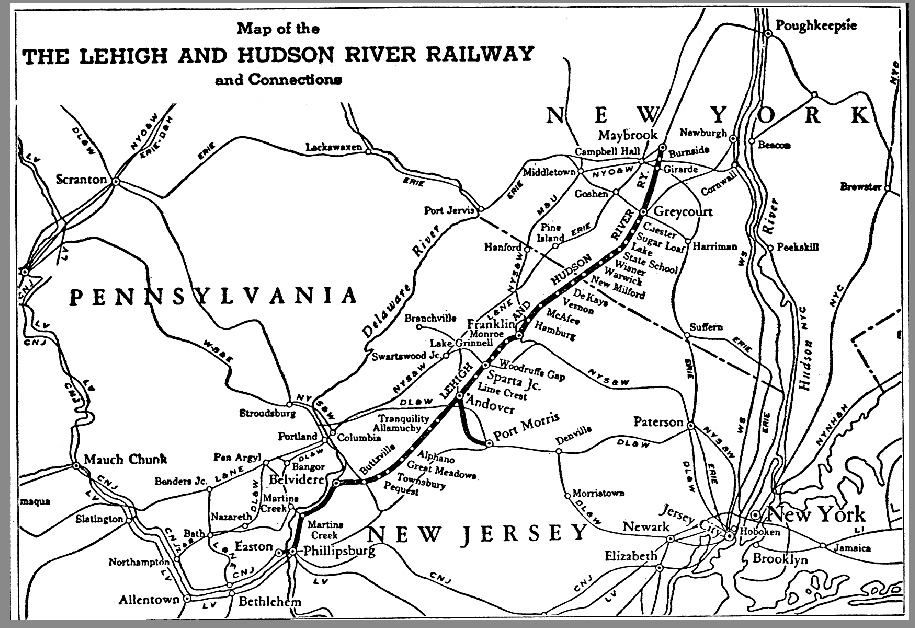
L&HR’s origins date to 1860, when arrival of the New York & Erie Railroad, at Greycourt, New York, 10 miles north of Warwick, prompted construction of the Warwick Valley Railroad under the leadership of Grinnell Burt. The Warwick Valley operated as a 6-foot-gauge feeder to the same-gauge NY&E, using the big road’s equipment for two decades. Around 1880, WV assumed its own operations, was standard-gauged, and built the 11-mile Wawayanda Railroad, which tapped agricultural and mineral sources at McAfee, New Jersey. Further extension southward soon followed.
Two projected competitive lines were combined as the Lehigh & Hudson River Railroad, extending from a Pennsylvania Railroad connection at Belvidere, New Jersey, on the Delaware River, to Hamburg, New Jersey, where three miles of isolated Sussex Railroad track linked it to the Warwick Valley. In 1882 the extensions were folded into the 61-mile Lehigh & Hudson River Railway.
In addition to the New York & Erie’s mainline business at Greycourt, its Newburgh Branch provided access to Hudson River carferries crossing to the New York & New England’s Fishkill Landing. Anthracite coal, particularly from mines of affiliate Lehigh Coal & Navigation, was a major eastbound commodity. Anticipating completion of the Poughkeepsie Bridge a few miles upstream, the Orange County Railroad built north of Greycourt to connect with the New York, Ontario & Western at Burnside in 1890. Via trackage rights, this provided a first connection with the Central New England & Western at Campbell Hall, New York. Within a year, the Orange County was extended from Burnside to CNE’s new Maybrook yard.
Simultaneously, trackage rights were obtained from the Pennsy over 13 miles of its Belvidere-Delaware Division (“Bel-Del”) to Phillipsburg, New Jersey. There, disconnected subsidiaries undertook bridging the Delaware to access Easton, Pennsylvania, and the Jersey Central and Lehigh Valley. The bridge also opened in 1890, creating a three-state route of about 85 miles. The L&HR thus fulfilled the prescient vision of the line’s 1861 directors, who reported, “It was well understood by those … promoting the construction of the Warwick Valley Railroad, that in all probability it would be but a link in a great chain destined to be one of the most important thoroughfares, and to effect an important influence upon the commerce and manufacturers of an extensive section of our country …” Additional links soon extended the chain of this “important thoroughfare.”

The Lehigh and Hudson River Railway bridge over the Delaware River between Easton, Pennsylvania and Phillipsburg, New Jersey. Easton, the Lehigh River Dam feeding the Delaware Canal, and the Northampton Street Bridge are in the background.
Photo by Zeete via Wikimedia Commons.
Post WWII United Kingdom – Cold War Documentary
The Cold War
Published 11 Apr 2020Our historical documentary series on the history of the Cold War continues with a video on the post-World War II situation in the United Kingdom
Support us on Patreon: https://www.patreon.com/thecoldwar or Paypal: http://paypal.me/TheColdWar
✔ Merch store ► https://teespring.com/stores/thecoldwar
✔ Instagram ► http://www.instagram.com/thecoldwartv#ColdWar #UK #WorldWar

August 5, 2020
Generalplan Ost, the Nazi plan to kill the Slavs – War Against Humanity 015 – July 1941, Part 02
World War Two
Published 4 Aug 2020In China, and the Soviet Union, all sides are causing widespread death to the local civilians. The defending forces are scorching the earth and plundering their own civilians, the attacking armed forces of Japan and Germany are executing planned genocide and mass destruction.
Join us on Patreon: https://www.patreon.com/TimeGhostHistory
Or join The TimeGhost Army directly at: https://timeghost.tvFollow WW2 day by day on Instagram @World_war_two_realtime https://www.instagram.com/world_war_two_realtime
Between 2 Wars: https://www.youtube.com/playlist?list…
Source list: http://bit.ly/WW2sourcesWritten and Hosted by: Spartacus Olsson
Director: Astrid Deinhard
Producers: Astrid Deinhard and Spartacus Olsson
Executive Producers: Astrid Deinhard, Indy Neidell, Spartacus Olsson, Bodo Rittenauer
Creative Producer: Joram Appel
Post-Production Director: Wieke Kapteijns
Research by: Spartacus Olsson and Joram Appel
Edited by: Mikołaj Cackowski
Sound design: Marek Kamiński
Map animations: Eastory (https://www.youtube.com/c/eastory)Colorizations by:
Dememorabilia – https://www.instagram.com/dememorabilia/
Jaris Almazani (Artistic Man) – https://instagram.com/artistic.man?ig…
Julius Jääskeläinen – https://www.facebook.com/JJcolorization/
Daniel Weiss
Spartacus Olsson
Klimbim – https://www.flickr.com/photos/2215569…
Mikolaj UchmanSources:
Eesti Kirjandusmuuseum KM EKLA, A-3:107
Yad Vashem 55AO6, 74FO7,
Consiliul National pentru Studierea Arhivelor Securitatii (CNSAS)
USHMM
IWM NA 15129, N 530
from the Noun Project: Skull by Muhamad Ulum
Picture of a victim of starvation during the siege of Leningrad, courtesy George Shuklin
Portrait of Nikolai Moskvin, courtesy goskatalog.ruSoundtracks from the Epidemic Sound:
Johan Hynynen – “Dark Beginning”
Yi Nantiro – “Watchmen”
Yi Nantiro – “A Single Grain Of Rice”
Farell Wooten – “Blunt Object”
Reynard Seidel – “Deflection”
Andreas Jamsheree – “Guilty Shadows 4”
Philip Ayers – “Trapped in a Maze”
Skrya – “First Responders”
Philip Ayers – “Under the Dome”Archive by Screenocean/Reuters https://www.screenocean.com.
A TimeGhost chronological documentary produced by OnLion Entertainment GmbH.
From the comments:
World War Two
3 hours ago (edited)
So here we are — it’s the end of July and the Nazi plan to ethnically cleanse Eastern Europe by genocide and forced migration is now in play, while the deliberate genocide of the Chinese has been in motion for more than three years. It’s easy to write off the massive death in both regions as collateral damage, the millions of PoWs that died as callous carelessness, the overall death toll as part of a desperate defense strategies. But that belies how planned, meticulous and specific both the genocides by Imperial Japan and by Nazi Germany were.The sources detailing the execution and opposition to these plans in the Soviet Union are relatively easy to access. Already during the war the Allied intelligence services were intercepting most of the communication that outlined death tolls, policies, and events. After the war the comprehensive documentation by the Germans themselves was captured and compiled for the Nuremberg Trials. Although Russia under the current regime choose to obfuscate, and distort their side of the story, the decade after the collapse of the Soviet Union saw the release of enough classified material for us to know the big picture.
The sources on what happened in China are, on the other hand, harder to come by. Unlike Germany, Japan has not been forced to, and has been unwilling to reconcile with what their forefathers did. Historians unearthing these stories face massive opposition by interests that still try to maintain Japanese exceptionalism. In China, the Communist regime never collapsed, and continues to promote a propagandist historiography that distorts the events within a narrative of unilateral heroic struggle by the People’s Red Army against Imperialism. Therefore it’s all the more important that we try to see these events for what they were: a massive tragedy of human suffering caused by ideological chauvinism – there is nothing heroic here, only the sad reality of war, and the terror of hatred to the level of mass murder.
Berserkers! The facts and the fictions
Lindybeige
Published 16 Jul 2015Support me on Patreon: https://www.patreon.com/Lindybeige
This one has been a long time coming, but now I’m glad that I’ve said it. It may disappoint many die-easy fans of unnecessary carnage, but the truth about berserkers is that they may have been a great deal more sensible and human than the rage-fuelled psychos so beloved by the world’s male teenagers.
Here’s a link to Roderick Dale’s new Viking book (although Amazon inaccurately describes it as an audiobook and abridged): http://www.amazon.co.uk/Viking-Experi…
For those wanting the full 100,000-word thesis, try here: http://eprints.nottingham.ac.uk/28819/
Lindybeige: a channel of archaeology, ancient and medieval warfare, rants, swing dance, travelogues, evolution, and whatever else occurs to me to make.
▼ Follow me…
Twitter: https://twitter.com/Lindybeige I may have some drivel to contribute to the Twittersphere, plus you get notice of uploads.

August 4, 2020
Nationalism DOESN’T explain WHY Austria-Hungary collapsed
TIK
Published 3 Aug 2020The go-to answer is that national or ethnic divisions caused the collapse of the Austro-Hungarian Empire. But is this really the case? Using multiple sources, it’s time to provide YouTube with a narrative which doesn’t confirm nationalist beliefs. The Habsburgs survived the collapse, with Emperor Karl / Charles trying to reclaim his throne later on before being exiled. However, by about mid-November 1918, he had lost all power. The fact that there is no specific date when Austria-Hungary collapsed, and the fact that the “national revolutions” were met with relatively little opposition, speaks volumes. As does the fact that the new states were all multinational, which undermines the narrative that nationalism was the reason why Austria-Hungary collapsed. Leave your thoughts in the comments below.
⏲️ Videos EVERY Monday at 5pm GMT (depending on season, check for British Summer Time).
– – – – –
📚 BIBLIOGRAPHY / SOURCES 📚
Judson, P. The Habsburg Empire: A New History. Belknap Press, Kindle 2016.
Kiste, J. The End of the Habsburgs: The Decline and Fall of the Austrian Monarchy. Kindle 2019.
Macgregor, J. & Docherty, G. Prolonging the Agony: How the Anglo-American Establishment Deliberately Extended WW1 by Three-and-a-Half Years. Trine Day LLC, 2018.
Marx, K. Capital: A Critique of Political Economy: Volume III. PDF, English edition, 2010. (Originally written 1894)
Mises, L. Socialism: An Economic and Sociological Analysis. Liberty Fund, 1981. 1969 edition (roots back to 1922).
Oxford Dictionary of English, Oxford University Press, Third Edition 2010.
Rady, M. The Habsburgs: The Rise and Fall of a World Power. Perseus Books, Kindle 2020.
Watson, A. Ring of Steel: Germany and Austria-Hungary at War, 1914-1918. Penguin Books, 2015.Cornwall, M. “Propaganda at Home (Austria-Hungary).” 1919. https://encyclopedia.1914-1918-online….
Online Latin-Dictionary http://www.latin-dictionary.net/defin…
Online Etymology Dictionary https://www.etymonline.com/word/publicFull list of all my sources – https://docs.google.com/spreadsheets/…
– – – – –
⭐ SUPPORT TIK ⭐
Want to ask a question? Please consider supporting me on either Patreon or SubscribeStar and help make more videos like this possible. For $5 or more you can ask questions which I will answer in future Q&A videos. Thank you to my current Patrons! You’re AWESOME! https://www.patreon.com/TIKhistory or https://www.subscribestar.com/tikhistory
– – – – –
ABOUT TIK 📝
History isn’t as boring as some people think, and my goal is to get people talking about it. I also want to dispel the myths and distortions that ruin our perception of the past by asking a simple question – “But is this really the case?” I have a 2:1 Degree in History and a passion for early 20th Century conflicts (mainly WW2). I’m therefore approaching this like I would an academic essay. Lots of sources, quotes, references and so on. Only the truth will do.
This video is discussing events or concepts that are academic, educational and historical in nature. This video is for informational purposes and was created so we may better understand the past and learn from the mistakes others have made.
Sturmtruppen Firepower: The Artillery Luger
Forgotten Weapons
Published 4 Apr 2020https://www.instagram.com/rockislanda…
https://www.youtube.com/user/RockIsla…
This is lot #3569 in the upcoming RIA Premier Auction. It was scheduled for April, but has been postponed — check their web site for upcoming Online Only auctions every month, though!
The lP08 (Lange pistole 08) was formally adopted in 1913 to replace the Reichsrevolver for the field artillery. These were the German light artillery troops, who were specifically given a pistol caliber carbine to provide maximum firepower in a very compact package. They were made by the Erfurt Arsenal in 1914, and by DWM throughout the war, with a total of about 180,000 made.
What is most interesting to me is the evolution of the use of the “artillery Luger” throughout the course of World War One. Starting as simply a compact weapon for artillery, it was quickly recognized by aviators as an ideal weapon for aircraft before the mass introduction of aerial machine guns. The stock allowed more accurate fire, and the semiautomatic operation minimized the handling movements required to fire. More substantially, it was adopted by the German Sturmtruppen for maximizing the striking power of small and flexible units. It is for these men that the 32-round drum magazine was developed in 1916. This represents one of the very few formal military uses of a pistol-caliber semiautomatic carbine, as it was superseded by the advent of the submachine gun in 1918.
A few small batches were made in the 1920s and 1930s, but it would not see significant use in World War Two – leaving it a weapon specifically iconic to the Great War.
http://www.patreon.com/ForgottenWeapons
https://www.floatplane.com/channel/Fo…
Cool Forgotten Weapons merch! http://shop.bbtv.com/collections/forg…
Contact:
Forgotten Weapons
6281 N. Oracle #36270
Tucson, AZ 85740

QotD: Epicureans are not hedonists
Many people consider that a fair summary of the Epicurean philosophy, named for its founder, the Athenian philosopher Epicurus who lived from 341-270 B.C., a few generations after Plato. It is a natural mistake. After all Epicurus did say that “Pleasure is the starting-point and goal of living blessedly.”
A common Greek word for pleasure is “hedone,” whence our word “hedonism.” A hedonist, we know, is someone who devotes himself to sensual pleasure. Add that to the fact that Epicureanism is a deeply materialistic philosophy — “all good and bad,” Epicurus says, “consists in sense experience” — and it is easy to see why people often conclude that Epicureanism advocates sensual abandon.
Easy, but mistaken.
For in fact, Epicureanism is a deeply ascetic philosophy. It preaches the gospel of pleasure. But it defines pleasure in such a way that no hedonist worth his salt would embrace it.
A hedonist is someone devoted to pleasure in the positive sense: he seeks to gratify his senses.
An Epicurean is devoted to pleasure in the negative sense: he seeks to avoid pain. “We do everything we can,” Epicurus wrote, “for the sake of being neither in pain nor terror.”
It is a melancholy fact that the human frame, while capable of great joy and pleasure, is susceptible to even greater pain and misery. The pleasures afforded us are delicate blossoms; the pains we are susceptible to are like a raging wildfire in comparison. Epicurus and his followers took note of this fact. Indeed, it was a fact that mesmerized their imaginations.
Epicurus says that pleasure is the goal of life. But what he taught was immunity to pain. “The removal of all feeling of pain,” he wrote, “is the limit of the magnitude of pleasures.” There was a core of common sense about the Epicurean approach to life. He advised his followers to live simple, healthy lives, to shun extravagances of all sorts. Of course, that is something many philosophers, indeed many friends and parents, would also advise. There is nothing distinctively Epicurean about the injunction to live simply and soberly.
There are three things distinctive about Epicureanism. One is its identification of pleasure with the absence of pain. Another is its emphasis on sense experience as the ultimate reality. The third is its identification of tranquillity as the aim or goal of life. (The Greek word is “ataraxia,” i.e., not troubled, not disturbed: note the privative character of the Epicurean ideal.)
If it is to succeed, Epicureanism must deliver us not only from physical pain but also from anxiety and mental anguish. The prospect of death, Epicurus knew, upset many people. Hence he and his followers expended a great deal of effort trying to remove the sting, the fear, from the prospect of death.
Epicurus offered two things to battle the fear of death: an attitude and an argument. The attitude was one of mild contempt: the right sort of people, he implies, do not get in a tizzy about things, not even about death. The argument is equally compelling. “Get used to believing,” he says, “that death is nothing to us.”
Roger Kimball, “Coronavirus, Flynn and Epicureanism”, American Greatness, 2020-05-02.
August 3, 2020
Romanticizing the past
Sarah Hoyt points out that the past really is a foreign country and they do things very differently there … and for good reasons:
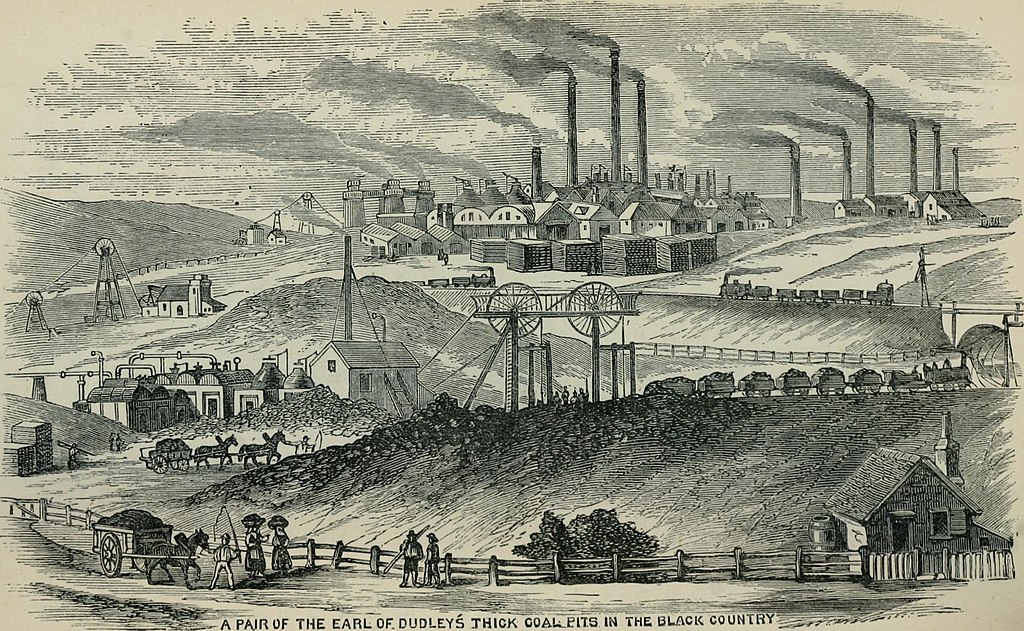
An image of coal pits in the Black Country from Griffiths’ Guide to the iron trade of Great Britain, 1873.
Image digitized by the Robarts Library of the University of Toronto via Wikimedia Commons.
So, quickly: The industrial revolution was not a disaster to your average peasant. It was a disaster for landowners.
Yes, yes, the conditions in the factories were terrible. By our standards. The lifespan was very short. By our standards. The anomie of the big cities, yadda yadda. When compared to what? Small villages? Ask those of us raised in them. Yes, there was child labor. As compared to what at that time? Other than the life of the upper classes?
Look, we don’t have to guess about this stuff. In India, in China, in other places that came to the industrial revolution very late, we’ve seen peasants leave the land where their ancestors had labored, to flock to the big cities, to take work we find horrible and exploitative at wages we find ridiculous.
And even if China has added “labor camp” and prisoner wrinkles to it, note that’s because China is a shitty communist country, not because the migration wasn’t there before. Also the labor camp aspects, as much as one can tell (and it’s hard to tell, due to the raging insanity of the regime) seem to have grown as the people grew more prosperous, as a result of the industrial revolution and thereby demanded higher wages, which positioned China more poorly as the “factory of the world.”
In fact, idealizing “living off the land” has been in place since at least the Roman empire, and probably before. It’s also been MISERABLE at least since then and probably before.
Because pre-industrial revolution farming sucked. It sucked horribly. And it kept you on the edge of subsistence. It double sucked when you were subjected to a Lord. Look, systems of serfdom, etc. didn’t come about because living in a Lord’s domain was so great, and everyone wove wreaths and danced around maypoles all the time, okay?
The bucolic paradise of a farmer’s life was mostly a creation of city dwellers, often noblemen, who saw it from the outside.
There are estimations that most people had trouble rearing even one child, and most of one generation’s peasants were people fallen from higher status. I don’t know. That might be exaggerated. Or it might not.
Even during the industrial revolution, it was normal for ladies bountiful to take baskets of food to tenant farmers because … they couldn’t make it on their own.
And btw, the more the industrial revolution pulled people to the cities, the more the Lords and “elites” talked about how great the countryside was and how terrible the factories/cities/new way of living were.
A lot of artists and pseudo bohemians jumped in on this bandwagon and so did Marx, who was both a pseudo bohemian, by birth “elite” (Well, his family had a virtual slave attached to him. He impregnated her too, as was his privilege), and by self-flattery intellectual.
Therefore the factories were the worst thing ever, the men who owned them, aka capitalists were terrible, terrible people — mostly because Marx wasn’t one, and probably because they laughed at him — and the proletariat they exploited horribly would rise up and —
All bullshit of course. Later on his fiction needed retconning by Anthony Gramsci who, having the sense to realize the “workers” weren’t rising up, just getting wealthier and escaping the clutches of the “elites” more made the “proletariat” a sort of “world proletariat” centered on poorer/more dysfunctional countries. This had the advantage of making the exploited masses always be elsewhere (or the supposed exploiters) and therefore made it easier to pitch group against group to the eternal profit of rather corrupt “elites.” Mostly political classes which are descended from “the best people.”


