Quotulatiousness

March 3, 2021

Geishas: World War Two Prostitutes or Entertainers? – WW2 – On the Homefront 007

Filed under: History, Japan, WW2 — Tags: , , , — Nicholas @ 04:00

World War Two
Published 2 Mar 2021

The geisha class has long been a feature of Japanese society. In the 1920s, they were caught between the struggle for women’s liberation and the rising sexual demand of powerful men. This crossfire only becomes more intense as war sweeps the Pacific.

Join us on Patreon: https://www.patreon.com/TimeGhostHistory
Or join The TimeGhost Army directly at: https://timeghost.tv

Follow WW2 day by day on Instagram @ww2_day_by_day – https://www.instagram.com/ww2_day_by_day
Between 2 Wars: https://www.youtube.com/playlist?list…
Source list: http://bit.ly/WW2sources

Hosted by: Anna Deinhard
Written by: Spartacus Olsson and Fiona Rachel
Director: Astrid Deinhard
Producers: Astrid Deinhard and Spartacus Olsson
Executive Producers: Astrid Deinhard, Indy Neidell, Spartacus Olsson, Bodo Rittenauer
Creative Producer: Maria Kyhle
Post-Production Director: Wieke Kapteijns
Research by: Fiona Rachel
Edited by: Karolina Dołęga
Sound design: Marek Kamiński

Portrait Colorizations by:
Mikołaj Uchmann

Sources:
– Metropolitan Museum of Art
– Rijksmuseum
– Narodowe Archiwum Cyfrowe
– Library of Congress
– National Archives NARA
– Nationaal Archief
– The Burns Archive
– Woman and Child in Kimono courtesy of Vintage Japan-esque from Flickr
– Five musicians courtesy of Adolfo Farsari

Soundtracks from Epidemic Sound:
– “Paths of a Samurai” – Mandala Dreams
– “Across the Sea of Japan” – Mandala Dreams
– “Secrets Of A Geisha” – Mandala Dreams
– “Watchman” – Yi Nantiro
– “The Unexplored” – Philip Ayers
– “Heavenly Feathers” – Deskant
– “Ode To The Moon” – Joseph Beg
– “Moving to Disturbia” – Experia

Archive by Screenocean/Reuters https://www.screenocean.com​.

A TimeGhost chronological documentary produced by OnLion Entertainment GmbH.

From the comments:

World War Two
17 hours ago (edited)
With this rather dramatic topic, we are happy to revive the On the Homefront series! Considering the popular opinion on geisha in America after the Second World War, it is not surprising at all, that the first association with the word is sex. But when we looked a little further into the topic, it got clearer and clearer that originally the job of a geisha meant no such thing. Still, with the social and political tension of the early 20th century, the job of the geisha evolved further and further to prostitution. This shows once again how the war influenced many different aspects of life and how important it is to shed light on these side stages of the war in order to understand its full impact. What would interest you to know about the different Homefronts of World War II?

Cheers, Fiona

March 2, 2021

The Evolution of Shock Cavalry – From Antiquity to the Middle Ages

Invicta
Published 1 Mar 2021

Learn about the evolution of shock cavalry from antiquity before the use of saddles and stirrups! Check out The Great Courses Plus to learn about shock cavalry in the campaigns of Alexander the Great: http://ow.ly/osex30rvhjf​

In this history documentary we explore the topic of ancient cavalry. The basic idea is that these units often get depicted in media as performing glorious massed charges headlong into the enemy ranks as seen in such scenes as the Charge of the Rohirrim from the Battle of Pelenor Fields. In reality this would have been a very dangerous situation for cavalrymen even under the best circumstances. But to make matters worse, riders from antiquity fought without the use of either saddles or stirrups. So how on earth did they manage to dominate the battlefield with these handicaps. Let’s find out.

We begin by covering the history of cavalry with the first domestication of the horse and its introduction to warfare first as member of the baggage train and soon after as a part of chariot crews rather than as actual mounted forces. This was in large part due to the lack of riding experience and technology on behalf of the rider. Soon after the Bronze Age Collapse however cavalry began to rise to prominence across the armies of the Mediterranean. We speak about the various forms of equine practices which ranged from riding bareback into combat as with the Numidian Cavalry to the use of simple bridles and cloth seats as with Greek Cavalry and Persian Cavalry.

We then cover the techniques used by these cavalrymen to mount, ride, and fight. As a part of this discussion, we rely heavily on Xenophon’s Manual on Horsemanship which provides excellent first hand details from the period. We also show how these techniques were successfully used by shock cavalry of antiquity such as the Macedonian Companion Cavalry, the Saka Steppe Lancers, and the Persian Cataphracts to great effect even without the use of saddles and stirrups.

Finally we do pose the question of why they didn’t use the saddle and stirrup given its seemingly obvious advantages. To answer this question we look at the history of its development from late antiquity to the early Middle Ages.

Bibliography and Suggested Reading
On Horsemanship, by Xenophon
Adrian Goldsworthy, The Complete Roman Army
Adrian Goldsworthy, Roman Warfare
J.C. Coulston, Cavalry Equipment of the Roman Army in the First Century A.D.
George T. Dennis, Maurice’s Strategikon, p. 38.
Julius Caesar, Commentarii de Bello Civili
Russel H. Beaty, Saddles

#History​
#Documentary​
#ShockCavalry

From the comments:

Invicta
13 hours ago
I was inspired by comments on our latest Units of History episode covering the Companion Cavalry which asked about how shock tactics worked in an age before the stirrup and saddle. I went down the rabbit hole finding answers and present to you my findings in this video! One awesome source we used was the Manual on Horsemanship by Xenophon which you can read for yourself here: http://www.gutenberg.org/files/1176/1176-h/1176-h.htm

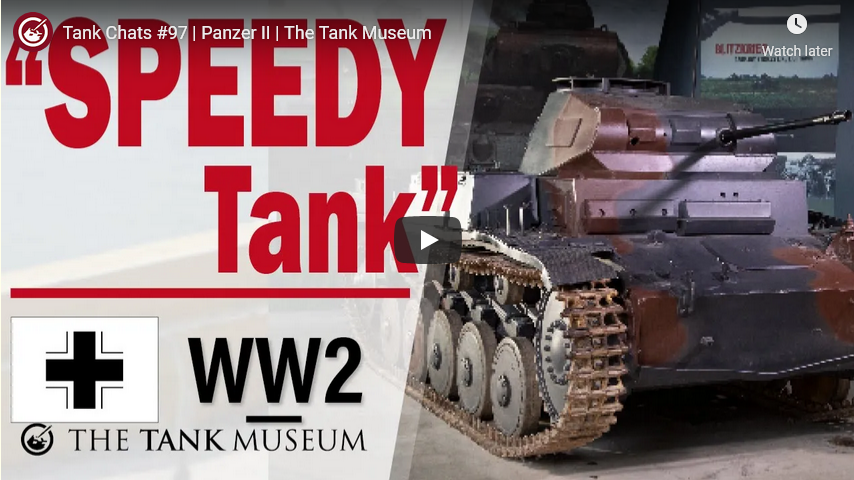
Tank Chats #97 | Panzer II | The Tank Museum

Filed under: Germany, History, Military, Weapons, WW2 — Tags: , , , — Nicholas @ 02:00

The Tank Museum
Published 20 Mar 2020

Here David Willey discusses the Panzer II, a German tank which was instrumental in the early days of the Second World War, especially during the Blitzkrieg.

Support the work of The Tank Museum on Patreon: ► https://www.patreon.com/tankmuseum

Visit The Tank Museum SHOP: ►tankmuseumshop.org

Twitter: ► https://twitter.com/TankMuseum
Instagram: ► https://www.instagram.com/tankmuseum/
Tiger Tank Blog: ► http://blog.tiger-tank.com/
Tank 100 First World War Centenary Blog: ► http://tank100.com/
#tankmuseum #tanks

March 1, 2021

Why the Bronze Age Collapse matters today. Dr. Eric Cline (If Civilization Collapsed Would We Know?)

Study of Antiquity and the Middle Ages
Published 13 Jun 2020

Ladies and Gentlemen we arrive finally to the part of our series that you have all been waiting for! And that is the Bronze Age Collapse and here to guide us through it is none other than Dr. Eric Cline, the rock star archaeologist, historian and author of none other than 1177 BC!

He will give us an overview history of the collapse along with sharing his own personal views on the subject! Guiding us briefly through archaeology, trade, national politics, and contact in the ancient Mediterranean we will get a nice picture of the Bronze Age and how it all came crashing down in a perfect storm of events. But what is ever more awesome is he even gives us the inside scoop on why he wrote 1177 BC? And how he did it!

But at the end of this episode we come to our modern world and Dr. Cline explains why the Bronze Age Collapse matters today. What we need to look at when comparing it to our modern world and the current events and impacts affecting our world. Did the peoples living through the Bronze Age Collapse know they were living in a collapse? And he asks a delicate and intense question and that is if civilization collapsed today would we know?

Check out our new store! teespring.com/stores/the-history-shop​

Support Dr. Eric Cline at the links below!

Personal web page: https://ehcline.com​

Get all of his books here at his Amazon Author page:
https://www.amazon.com/s?i=stripbooks…​

GW pages:
https://cnelc.columbian.gwu.edu/eric-…​

https://anthropology.columbian.gwu.ed…​

https://gwu.academia.edu/EricCline​

Image credits: Manna Nader, Gabana Studios Cairo

Hittite 3D City and intro footage credits: 3D reconstruction of Imperial Hittite Karkemish by Giampaolo Luglio, Turco-Italian Archaeological Expedition to Karkemish directed by Nicolò Marchetti (University of Boologna)

KARKEMISH (Carchemish) 1300 BC (3D) – The Southern Capital of the Empire Hittite

https://youtu.be/RsTdoY__F4U​

Music Attribution: Herknungr – Megaliths | Dark Neolithic Meditive Shamanic Ambient Music https://youtu.be/oc8FQwNjPu0

Solothurn S18-1000: The Pinnacle of Anti-Tank Rifles

Filed under: Europe, History, Military, Weapons, WW2 — Tags: , , , , , — Nicholas @ 02:00

Forgotten Weapons
Published 13 Oct 2017

Among all the antitank rifles developed between the World Wars, the highest quality and most sophisticated was the Solothurn S18-1000. It fires the 20x138B cartridge which was also used in the Finnish Lahti L-39 and the German 20mm Flak guns, and it does so using a semiautomatic action and an 8-round box magazine. It is a short-recoil system, with a rotating bolt rather similar to that of the MG-34 machine gun.

The recoil-operated action of the Solothurn helps dampen its recoil more than the Lahti, and is definitely a more comfortable gun to shoot. The Solothurn is equipped with both iron sights and an optical sight (we used the irons in this shooting, because the rubber eye cup on the scope is fairly hard and brittle on this example). Remarkably for its 100+ pound weight, the gun definitely jumps back a few inches when fired unless one has firmly sunk the bipod feet into the earth. However, the recoil force is really more of a push than a sharp impact, and combined with the large surface area of the shoulder pad it is not at all a bad experience.

A number of different countries bought the S18-1000 (and many others bought the smaller S18-100), including the Italians and Hungarians. The only combat account I was able to find was from a Dutch antitank gun team that used one to successfully engage several German armored cars during the invasion of the Netherlands in 1940.

http://www.patreon.com/ForgottenWeapons

Cool Forgotten Weapons merch! http://shop.bbtv.com/collections/forg…

If you enjoy Forgotten Weapons, check out its sister channel, InRangeTV! http://www.youtube.com/InRangeTVShow

QotD: Anti-semitism in Harold Lamb’s novels

Filed under: Asia, Books, History, Quotations, Religion — Tags: , , , , , , — Nicholas @ 01:00

The “brushes with anti-Semitism” lie in Lamb’s portrayal of the Jewish merchants of the time [Wikipedia]. They sell the Cossacks clothes, weapons, food, and gunpowder and turn the freebooters’ loot into cash. They are depicted as avaricious, cowardly, mean, and quite willing to toady to the warriors and princes they serve. How are we to interpret this in light of Lamb’s sympathetic portrayals of a dozen other races and cultures?

Of course it’s possible Lamb was simply replaying anti-Semitic attitudes he had absorbed somewhere. But in reading these stories I had another moment like the one in which I understood that [Edgar Rice] Burroughs [Wikipedia] was using “white” as culturist code for “civilized”. It was this: the behavior of Lamb’s Jewish merchants made adaptive sense. Maybe they were really like that!

Consider: The Jews of Lamb’s milieu lived under Christian and Islamic rulers who forbade them from carrying weapons, who despised them, who taxed and persecuted them with a heavy hand. If you were a Jew in that time and place, exhibiting courage and the warrior virtues that Lamb was so ready to recognize in a Mongol or an Afghani was likely to earn you a swift and ugly death.

Under those conditions, I’m thinking that being cowardly and avaricious and toadying would have been completely sensible; after all, what other options than flattering the authorities and getting rich enough to buy themselves out of trouble did Jews actually have?

Lamb seems to have have mined the historical sources pretty assiduously in his portrayals of other cultures and races. Rather than dismissing Lamb’s Jews as creatures of his prejudices, I think we need to at least consider the possibility that he was mostly replaying period beliefs about Jewish merchants, and that those beliefs were in fact fairly accurate. He certainly seems to have tried to do something similar with the other flavors of human being in his books.

Nowadays we tend to interpret Lamb’s Jewish merchants through assumptions that read something like this: (1) All racial labels are indications of racist thinking, and (2) all race-associated stereotypes are necessarily false, and (3) all racial labels and race-related stereotypes are malicious. But it seems to me that, at least as I read Burroughs and Lamb, all these assumptions are highly questionable. As long as you hold them, you can’t notice what “whiteness” in Burroughs really means, or account for the genuine multiculturalism of Lamb’s books.

Eric S. Raymond, “Reading racism into pulp fiction”, Armed and Dangerous, 2010-01-18.

February 28, 2021

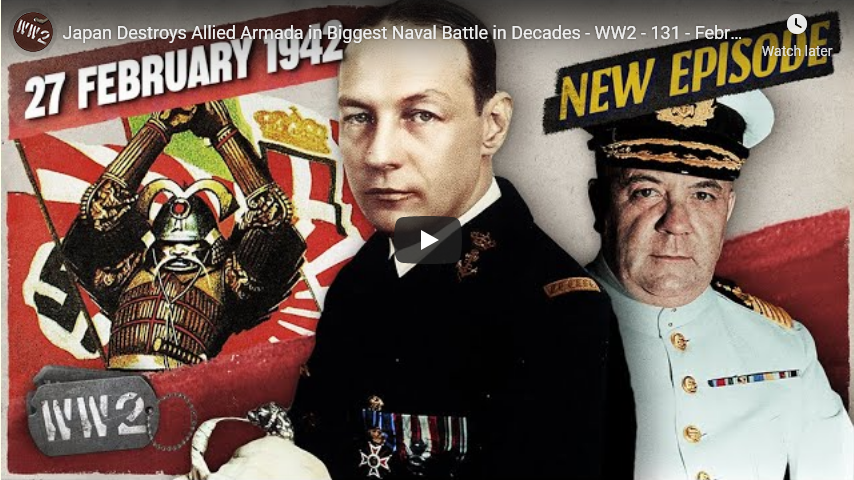
Japan Destroys Allied Armada in Biggest Naval Battle in Decades – WW2 – 131 – February 27, 1942

World War Two
Published 27 Feb 2021

The Japanese are advancing in the Dutch East Indies and Burma, brushing aside defenders, but their biggest victory this week is at sea, when they not only brush aside the ABDA Fleet, but literally wipe it out of existence. Meanwhile Italian and German submarines are patrolling the Caribbean, sinking any Allied merchant shipping they find. It is yet another week of Axis successes.

Join us on Patreon: https://www.patreon.com/TimeGhostHistory
Or join The TimeGhost Army directly at: https://timeghost.tv

Follow WW2 day by day on Instagram @ww2_day_by_day – https://www.instagram.com/ww2_day_by_day
Between 2 Wars: https://www.youtube.com/playlist?list…
Source list: http://bit.ly/WW2sources

Written and Hosted by: Indy Neidell
Director: Astrid Deinhard
Producers: Astrid Deinhard and Spartacus Olsson
Executive Producers: Astrid Deinhard, Indy Neidell, Spartacus Olsson, Bodo Rittenauer
Creative Producer: Maria Kyhle
Post-Production Director: Wieke Kapteijns
Research by: Indy Neidell
Edited by: Iryna Dulka
Sound design: Marek Kamiński
Map animations: Eastory (https://www.youtube.com/c/eastory​)

Colorizations by:
– Mikołaj Uchman
– Norman Stewart – https://oldtimesincolor.blogspot.com/​

Sources:
– National Portrait Gallery
– IWM: H 17365, A_238, CB(OPS) 5008

Soundtracks from the Epidemic Sound:
– Rannar Sillard – “Easy Target”
– Howard Harper-Barnes- “Underlying Truth”
– Jo Wandrini – “Dragon King”
– Fabien Tell – “Last Point of Safe Return”
– Wendel Scherer – “Out the Window”
– Reynard Seidel – “Rush of Blood”
– Brightarm Orchestra – “On the Edge of Change”
– Craft Case – “Secret Cargo”
– Phoenix Tail – “At the Front”
– Johan Hynynen – “Dark Beginning”
– Wendel Scherer – “Growing Doubt”

Archive by Screenocean/Reuters https://www.screenocean.com​.

A TimeGhost chronological documentary produced by OnLion Entertainment GmbH.

Cultural appropriation foods around the world

Filed under: Britain, Europe, Food, France, History, India, Italy, Japan, Pacific, USA — Tags: , , , , — Nicholas @ 02:00

J.J. McCullough
Published 14 Dec 2019

Baguettes in Vietnam! Curry in Japan! Tea in India! Let’s look at the practice of eating food from other countries, which is more widespread than you might think, thanks to imperialism and immigration.

FOLLOW ME:

🇨🇦Support me on Patreon! https://www.patreon.com/jjmccullough
🤖Join my Discord! https://discord.gg/3X64ww7
🇺🇸Follow me on Instagram! https://www.instagram.com/jjmccullough/
🇨🇦Read my latest Washington Post columns: https://www.washingtonpost.com/people…
🇨🇦Visit my Canada Website http://thecanadaguide.com

HASHTAGS:
#food #curry #empire

February 27, 2021

Q&A: Shooting the $ɦ!☦ with InRangeTV

Filed under: Food, History, USA — Tags: , , , , , — Nicholas @ 04:00

Atun-Shei Films
Published 26 Feb 2021

See the rest of our conversation over on Karl’s channel ► https://youtu.be/3sgc0BckrB8​

Atun-Shei and InRange finally got together for a chat! In this video we answer questions from our generous patrons, discussing New Orleans culture, Creole food, the gunfight at the OK Corral, urban life in the ancient world, Confederate monuments, historical justifications for slavery, Louisiana Voodoo, Cajun French, Ron Maxwell movies, and the importance of compassion and empathy.

Support Atun-Shei Films on Patreon ► https://www.patreon.com/atunsheifilms​
Leave a Tip via Paypal ► https://www.paypal.me/atunsheifilms​

Buy Merch ► teespring.com/stores/atun-shei-films​

#AtunSheiFilms​ #InRangeTV​ #History​

Original Music by Dillon DeRosa ► http://dillonderosa.com/​
Reddit ► https://www.reddit.com/r/atunsheifilms​
Twitter ► https://twitter.com/atun_shei

February 26, 2021

U.S. Detention, Nazi Deportation, and Death in the East – WAH 029 – February 1942, Pt. 2

Filed under: Germany, History, Italy, Japan, Military, USA, WW2 — Tags: , , , , , , — Nicholas @ 04:00

World War Two
Published 25 Feb 2021

Franklin D. Roosevelt signs an order to intern all Japanese-American citizens on the West Coast of the United States, while the Italians open up new concentration camps to deal with their ethnic enemies in the Balkans. At the same time, a large group of Jews attempts to escape Europe by boat, with disastrous consequences.

Join us on Patreon: https://www.patreon.com/TimeGhostHistory
Or join The TimeGhost Army directly at: https://timeghost.tv

Follow WW2 day by day on Instagram @ww2_day_by_day – https://www.instagram.com/ww2_day_by_day
Between 2 Wars: https://www.youtube.com/playlist?list…
Source list: http://bit.ly/WW2sources

Hosted by: Spartacus Olsson
Written by: Joram Appel and Spartacus Olsson
Director: Astrid Deinhard
Producers: Astrid Deinhard and Spartacus Olsson
Executive Producers: Astrid Deinhard, Indy Neidell, Spartacus Olsson, Bodo Rittenauer
Creative Producer: Maria Kyhle
Post-Production Director: Wieke Kapteijns
Research by: Joram Appel
Edited by: Miki Cackowski
Sound design: Marek Kamiński
Map animations: Eastory (https://www.youtube.com/c/eastory​), Miki Cackowski

Colorizations by:
Norman Stewart – https://oldtimesincolor.blogspot.com/​
Mikołaj Uchman

Sources:
Yad Vashem 143BO2, 5344/2, 6263, 9744/1, 15000/14187511, 15000/14258277, 15000/14088811
Martyr’s path to freedom (Mučeniška pot k svobodi), Ljubljana, 1946
USHMM
View of the Struma in the Istanbul harbor, February 1942, courtesy of USHMM, David Stoliar
From the Noun Project: Ship by kareemovic1000

Soundtracks from the Epidemic Sound:
Cobby Costa – “Flight Path”
Fabien Tell – “Break Free”
Philip Ayers – “It’s Not a Game”
Fabien Tell – “Last Point of Safe Return”
Fabien Tell – “Remembrance”
Rannar Sillard – “Split Decision”
Skrya – “First Responders”

Archive by Screenocean/Reuters https://www.screenocean.com​.

A TimeGhost chronological documentary produced by OnLion Entertainment GmbH.

Germany’s First Smokeless Carbines: the Kar 88 and Gewehr 91

Filed under: Germany, History, Military, Weapons — Tags: , , — Nicholas @ 02:00

Forgotten Weapons
Published 27 May 2018

http://www.forgottenweapons.com/germa…

http://www.patreon.com/ForgottenWeapons

Cool Forgotten Weapons merch! http://shop.bbtv.com/collections/forg…

With the development of the smokeless Gewehr 88 “Commission Rifle”, the German Army finally made a serious effort to bring their cavalry units up to a modern standard. There had never been a carbine variant of the Mauser 71/84 produced, and even by the late 1880s many German cavalrymen were still carrying single shot Mauser 71 carbines — or worse, converted captured Chassepots from the Franco-Prussian War. While the Karabiner 88 wasn’t in production quite as quickly as they would have liked, guns were coming off the factory line in quantity by the summer of 1890. The factories tasked with this production were not actually the major state arsenals, but rather two private companies in Suhl — CG Haenel and VC Schilling (although the Erfurt Arsenal would step in in 1891 to make a batch of 25,000 carbines).

The Kar 88 was remarkable light and handy, and designed for use in a cavalry scabbard, meaning that it had a nice slick profile. This became a problem when the Army wanted to issue the carbines for foot artillery crews as well, because it gave them no way to stack the rifles while tending to their artillery pieces. The result was the Gewehr 91, which was identical to the Kar 88 in every way except for the addition of a stacking rod under the muzzle.

Both the Kar 88 and Get 91 were already being slowly taken out of service before World War One, as the new Mauser 98 pattern carbines introduced in 1909 or 1910 were taking their place. This would change with the outbreak of war, of course, and every one of the 88 pattern carbines in German inventory would be issued out during the Great War. Their size and weight made them ideal for the troops who needed a personal weapon but were unlikely to actually have to fight with it (artillery crews, cyclists, supply drivers, balloon crews, etc). After the war, they all disappeared from military service, though. The arms limitations of the Treaty of Versailles gave Germany no reason to keep obsolescent arms, and they were discarded in favor of keeping Mauser 98 pattern rifles and carbines.

Contact:
Forgotten Weapons
6281 N Oracle #36270
Tucson, AZ 85704

QotD: “What have the Romans ever done for us?”

Filed under: History, Humour, Media, Middle East, Quotations — Tags: , , , , — Nicholas @ 01:00

REG: They’ve bled us white, the bastards. They’ve taken everything we had, and not just from us, from our fathers, and from our fathers’ fathers.

LORETTA: And from our fathers’ fathers’ fathers.

REG: Yeah.

LORETTA: And from our fathers’ fathers’ fathers’ fathers.

REG: Yeah. All right, Stan. Don’t labour the point. And what have they ever given us in return?!

XERXES: The aqueduct?

REG: What?

XERXES: The aqueduct.

REG: Oh. Yeah, yeah. They did give us that. Uh, that’s true. Yeah.

COMMANDO #3: And the sanitation.

LORETTA: Oh, yeah, the sanitation, Reg. Remember what the city used to be like?

REG: Yeah. All right. I’ll grant you the aqueduct and the sanitation are two things that the Romans have done.

MATTHIAS: And the roads.

REG: Well, yeah. Obviously the roads. I mean, the roads go without saying, don’t they? But apart from the sanitation, the aqueduct, and the roads–

COMMANDO: Irrigation.

XERXES: Medicine.

COMMANDOS: Huh? Heh? Huh…

COMMANDO #2: Education.

COMMANDOS: Ohh…

REG: Yeah, yeah. All right. Fair enough.

COMMANDO #1: And the wine.

COMMANDOS: Oh, yes. Yeah…

FRANCIS: Yeah. Yeah, that’s something we’d really miss, Reg, if the Romans left. Huh.

COMMANDO: Public baths.

LORETTA: And it’s safe to walk in the streets at night now, Reg.

FRANCIS: Yeah, they certainly know how to keep order. Let’s face it. They’re the only ones who could in a place like this.

COMMANDOS: Hehh, heh. Heh heh heh heh heh heh heh.

REG: All right, but apart from the sanitation, the medicine, education, wine, public order, irrigation, roads, a fresh water system, and public health, what have the Romans ever done for us?

XERXES: Brought peace.

REG: Oh. Peace? Shut up!

Monty Python’s Life of Brian, 1979.

February 25, 2021

Tank Chats #96 | D3E1 Wheel-cum-Track Machine | The Tank Museum

Filed under: Britain, History, Military, Weapons — Tags: , , , , — Nicholas @ 02:00

The Tank Museum
Published 28 Feb 2020

David Fletcher looks at the experimental inter-war Vickers D3E1, which was conceived to solve the problem of track wear, with wheels that could be used instead where the ground was suitable. In practice the concept proved too complicated.

Support the work of The Tank Museum on Patreon: ► https://www.patreon.com/tankmuseum

Visit The Tank Museum SHOP: ►tankmuseumshop.org

Twitter: ► https://twitter.com/TankMuseum
Instagram: ► https://www.instagram.com/tankmuseum/
Tiger Tank Blog: ► http://blog.tiger-tank.com/
Tank 100 First World War Centenary Blog: ► http://tank100.com/
#tankmuseum #tanks

QotD: Islam and the impact of the Enlightenment

Filed under: France, History, Middle East, Military, Quotations, Religion — Tags: , , , , — Nicholas @ 01:00

In private, however, or when addressing his soldiers, Napoleon was contemptuous of the Islamic word. “You have come to this country,” he told his army before the battle of the Pyramids, “to save the inhabitants from barbarism, and to bring civilisation to the Orient.” This was why, in addition to muskets, cannon and cavalry, he had brought with him to Egypt a printing press, a hot-air balloon and a small army of intellectuals.

The blaze of the Enlightenment, although it might seem to have been lit in Europe, was not just for Europeans. All the world had the potential to share in its radiance. Illumination was the same wherever it manifested itself, and this meant that in Peking as in Paris, in Baghdad as in Bordeaux, there were sages more than qualified to rank alongside Voltaire and Diderot.

The Enlightenment, far from ranking as something parochial and culturally contingent, was properly a global phenomenon. These various dogmas, which the philosophes had tended to take for granted, had then been given a new and militant edge by the French Revolution. That religion was superstition; that rights were universal; that equality, individual liberty and freedom of expression were simultaneously natural and sacred: these were the convictions that had inspired in the citizens of revolutionary France their continent-shaking sense of certitude. Thrones had been toppled; abbeys demolished; the detritus of a benighted past erased. And if in Europe, then why not further afield? The Rights of Man were for everyone, after all, or they were nothing. “Any law that violates them,” as Robespierre had put it, “is fundamentally unjust and tyrannical. Indeed, it is not law at all.”

This sense of missionary purpose, which inspired in those who felt it an ambition to bring the entire world from darkness into light, outlasted the execution of Robespierre, the defeat of Napoleon, the seeming triumph of reaction across post-revolutionary Europe. In 1854, when the Ottoman Empire was facing a critical threat from Russia, France joined Britain in insisting as a condition of its entry into the Crimean War that the slave trade across the Black Sea be abolished.

Also abolished was the jizya, a tax on Jews and Christians that reached back to the very beginnings of Islam, and was directly mandated by the Qur’an. Such measures, to the Ottomans, risked immense embarrassment. The effect, after all, was to reform Islamic jurisprudence according to the standards of non-believers. It was, for Muslim traditionalists, an ominous straw in the wind. Over the course of the century and more that followed, the weathering effects of Western hegemony on the practices that Muslims believed they had inherited from Muhammad — the Sunnah — became more and more pronounced.

Tom Holland, “The age-old tension between Islam and France”, UnHerd, 2020-11-02.

February 24, 2021

Solzhenitsyn was far from the first to warn about the evils of Soviet rule

Filed under: Books, Education, History, Politics, Russia — Tags: , , , , — Nicholas @ 05:00

Theodore Dalrymple had a discussion recently with a Marxist professor:

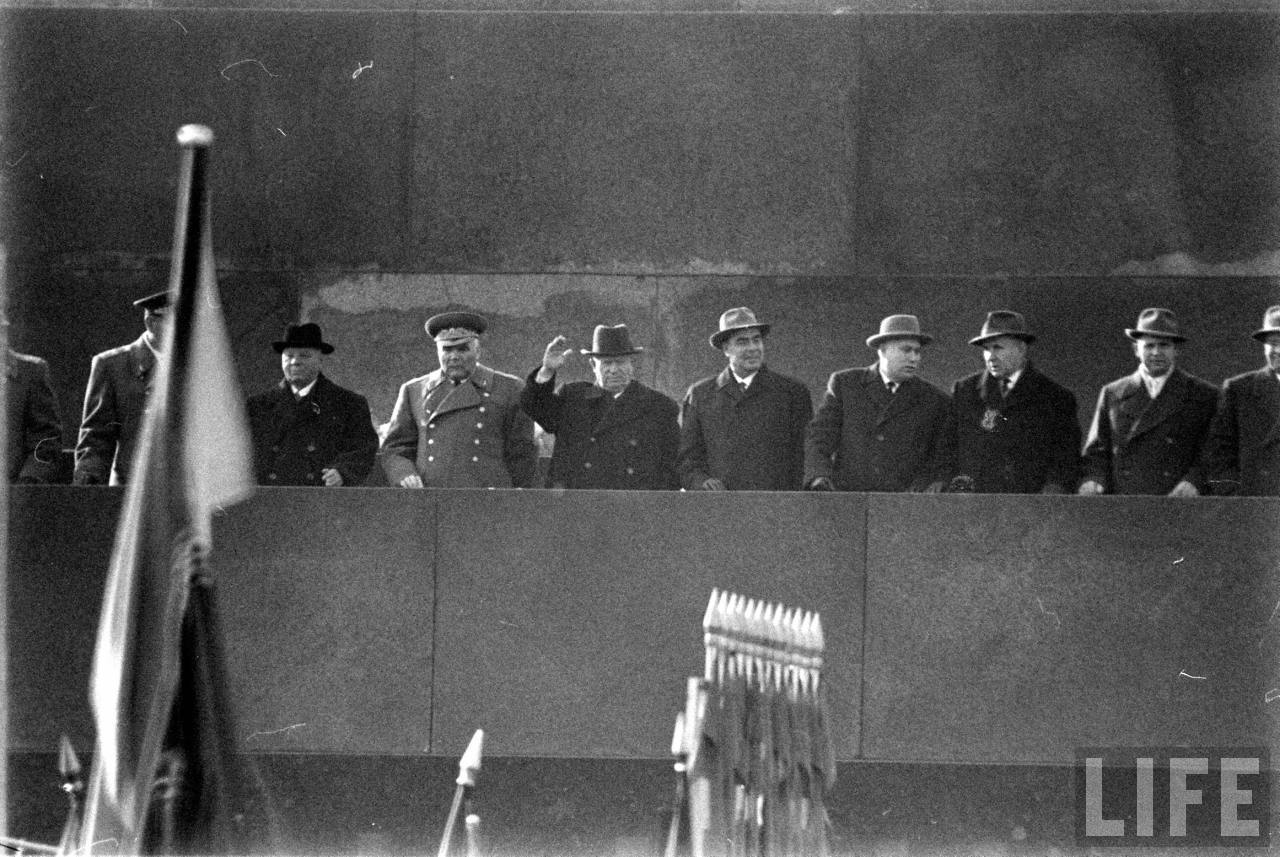
Krushchev, Brezhnev and other Soviet leaders review the Revolution parade in Red Square, 1962.
LIFE magazine photo by Stan Wayman.

The professor was an intelligent man, and probably cultivated too. How was it possible, in the Year of Our Lord 2021, for such a person still to believe that, until the advent of Stalin, the Russian revolution was a good thing, to be emulated or repeated elsewhere?

How could anyone of his intelligence fail to realise that, though as ever there was much wrong with the world, attempts to put everything right at once by the implementation of petty intellectual schemes are fraught with danger, and have a history of mass slaughter behind them?

I think the answer must lie in the psychology of religion: when religious faith is replaced by a philosophy that prides itself on its rationality, it soon turns religious in the worst possible sense. it becomes an atheist theocracy.

Everything was known about the Soviet Union from the first. It is simply not true that Solzhenitsyn revealed anything to the West that, in essence, was not, or could not have been, known before.

I have, in desultory fashion for a number of decades, been collecting books about Russia and the Soviet Union from just before the Revolution until the Second World War, and while it is true that many of them are laudatory, with titles that now seem hilarious to us such as The Soviet Union Fights Neurosis, a very large number books of various genres, from essays to histories to memoirs to novels and short stories, were published that exposed the viciousness of Bolshevism from the very first — a viciousness that anyone with any imagination could have anticipated from Lenin’s literary style alone.

Leninist viciousness was viciousness of a new and more thoroughgoing type that acted on the mind as a virus acts on a computer (viciousness, both actual and potential, is, alas, a constant of human history because of our flawed nature).

Solzhenitsyn was right about the difference between Macbeth, who from personal ambition killed people, but only a few, and the ideologically-motivated mass-killings of the Soviet Union and elsewhere — the difference being precisely in the effect of ideology.
But what was really different about Solzhenitsyn, apart from his literary talent, was that Western intellectuals were now prepared to believe what he said, whereas shortly before they had rejected as mere propaganda evidence of a very similar nature produced by others.

It was so startling to meet someone who still believed that a “pure” revolution could take place, and that such a person was teaching history of all things, in a reputable, or at any rate reputed, university, that, like Karl Kraus confronted by Hitler, I could think of nothing to say.

I had no idea whether he still taught undergraduates, or whether in doing so he suppressed at least some of his views (as a judge is supposed to suppress his own private opinions): but I confess that the charge against Socrates, that of corrupting youth, came into my mind.

« Newer Posts — Older Posts »

Powered by WordPress