Quotulatiousness

March 6, 2026

The “security clearance issue” demonstrated by, of all people, Mark Carney

Filed under: Cancon, Government, Media, Politics — Tags: , , , , — Nicholas @ 05:00

Melanie in Saskatchewan explains why the constant Liberal talking point that refusing to get a particular security clearance “proved” that Pierre Poilievre was next-door to a traitor will probably not be raised any more:

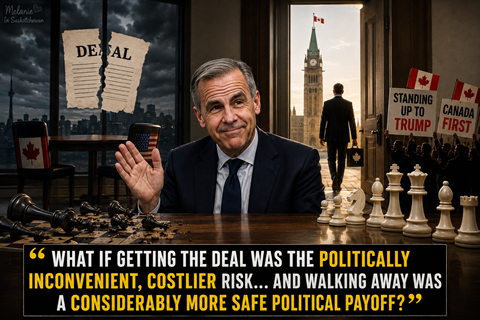
Image from Melanie in Saskatchewan

Open Letter to Canada’s Security Clearance Scolds: Carney Just Proved Pierre Right!

To every Liberal and NDP partisan who has spent the last year yelling “security clearance” like it is a magic spell that turns criticism into treason, congratulations. Mark Carney just demonstrated Pierre Poilievre’s point for him, on camera, in real time.

The moment came on March 3, 2026, during Prime Minister Mark Carney’s Indo-Pacific trip. After meetings in India with Prime Minister Narendra Modi, Carney held a press availability with Canadian media while travelling through the region. The topic journalists wanted clarified was not subtle. They asked about foreign interference linked to India and the 2023 assassination of Sikh activist Hardeep Singh Nijjar in Surrey, British Columbia, the allegation that detonated Canada’s diplomatic crisis with India.

The question came from Dylan Robertson of The Canadian Press during the media scrum. He asked directly whether Carney believed India continued to engage in foreign interference or transnational repression targeting Canadians.

Carney swerved. He was asked again. And again.

Eventually, after the careful circling that seasoned politicians deploy when a straight answer would be inconvenient, he landed on the tell. Not the kind you need a polygraph for. The kind you publish in a civics textbook.

Here is what he said, exactly:

    There will not be consequences for those officials … There are aspects of those briefings that I can’t share in public, and I’m not going to betray them. I will tell you that there is progress on these issues.

Read that again, slowly, with a spoon handy in case you choke on the irony. Because this is the whole debate in one neat little ribbon.

Pierre Poilievre’s argument, from the start, has been that the particular classified briefings being pushed would place him inside a legal box. Once inside it, the rules governing those briefings restrict what he can say publicly and how he can use the information while doing his job as Leader of the Opposition. Global News reported Poilievre’s office saying officials told them the briefing structure could leave him legally prevented from speaking publicly about certain information except in narrow ways, which they argued would “render him unable to effectively use any relevant information he received”.

Now watch what just happened.

Carney, the man with the clearance and the briefings, is asked direct questions about one of the most explosive foreign-interference files in modern Canadian politics.

And his answer, translated into plain English, is simple: I cannot share what I know.

March 5, 2026

“[I]nternational law is not law; it is a set of rules and claims that pretends to be law”

Filed under: Government, Law, Middle East, Military, USA — Tags: , , , — Nicholas @ 05:00

Lorenzo Warby discusses the charming illusion that “international law” is a real thing and must be treated as a real thing:

In domestic (“municipal”) law, questions of illegality arise. They arise because states have laws. They have laws because their laws come with remedies — consequences for breaking the law.

So, it is a genuine question whether President Trump is exceeding his constitutional authority in his attack on Iran. But that is a genuine question because the US has a Constitution that matters. The US is a rule-of-law state, no matter how much other common law jurisdictions may point and laugh at how politicised US law is.

Nimitz-class aircraft carrier USS Abraham Lincoln (CVN 72), Arleigh Burke-class guided-missile destroyers USS Michael Murphy (DDG 112) and USS Frank E. Petersen Jr. (DDG 121), Henry J. Kaiser-class fleet replenishment oiler USNS Henry J. Kaiser (T-AO-187), Lewis and Clark-class dry cargo ship USNS Carl Brashear (T-AKE 7) and U.S. Coast Guard Sentinel-class fast-response cutters USCG Robert Goldman (WPC-1142) and USCGC Clarence Sutphin. Jr. (WPC-1147) sail in formation in the Arabian Sea, Feb. 6, 2026. The Abraham Lincoln Carrier Strike Group is deployed to the U.S. 5th Fleet area of operations to support maritime security and stability in the Middle East.
U.S. Navy photo by Mass Communication Specialist 1st Class Jesse Monford via Wikimedia Commons.

In terms of the international order, however, there is no such thing as an illegal war, because (public) international law is not law. It is a set of rules and claims that pretends to be law. It only pretends to be law as it has no remedies — apart from declarative statements, which are not enough to make it law. (Private international law does have enforceable and enforced remedies, so is law.)

One of the consequences of this is that (public) international law, as an academic discipline, has no substantive reality-tests. There are no decisions by judges that are enforceable and enforced. This has led to academic international law being the vector by which the toxic ideas of the Critical Theory magisterium, that increasingly dominates Anglo-American universities, have infected Law Schools.

(Public) International law should not be taught at Law Schools, because it is not law. It should be taught in International Relations or Political Science Departments. A PhD in International Law should not qualify you to teach in Law Schools. Indeed, if you cannot tell the difference between actual law — with genuine remedies — and a simulacrum of law, you should not be teaching students at all.

Rules-based international order

When folk refer to the rules-based international order, they are not referring to nothing. There are various rules and conventions it is convenient for states, and other agents, to follow.

There is also a difference between the mercantile maritime order and continental anarchy. It is not an accident that the original international conventions pertained to sea travel and trade.

Within continental anarchy, it is relative power that matters. A war that depletes your resources and capacities, but depletes those of your neighbours more, is a winning proposition, within the state-geopolitics of continental anarchy. The geopolitics of continental anarchy leads states to seek weak or subordinate neighbours. The mercantile maritime order, on the other hand, is all about creating win-win interactions.

Russia, India and China are all continental Powers that live, at least to some extent, in a situation of continental anarchy. But they are also trading States that benefit from the mercantile maritime order maintained by the US-and-allies maritime hegemony. The tension between China as a trading nation becoming the biggest single beneficiary of the mercantile maritime order maintained by the US-and-allies maritime hegemony, and the interests of the CCP (the Chinese Communist Party), is the central strategic difficulty that CCP China faces.

Israel faces the strategic dilemma of operating in a region of continental anarchy but seeking support from states deeply embedded in the mercantile maritime order. Whether the Middle East has to be a region of continental anarchy, or can it become far more embedded in the mercantile maritime order, is precisely what is at stake in the latest conflict.

Any social order has to be enforced. This is even more true of international orders. As there is no such thing as international (public) law, enforcing an international order is not a matter of rules, it is a matter of those who actively support and enforce that order and those who seek to subvert it.

A vivid example of how central enforceability is to any international order is given by comparing the treatment of Germany after the two World Wars. Germany was treated far more harshly after the Second World War than after the First World War. The crucial difference was that the Versailles order was not enforceable by the victors and the Potsdam order was.

Update, 6 March: Welcome, Instapundit readers! Have a look around at some of my other posts you may find of interest. I send out a daily summary of posts here through my Substackhttps://substack.com/@nicholasrusson that you can subscribe to if you’d like to be informed of new posts in the future.

March 4, 2026

Epic bad takes – “Justin Trudeau wasn’t a bad prime minister”

Filed under: Cancon, Government, Media, Politics — Tags: , , , — Nicholas @ 03:00

On the social media site formerly known as Twitter, L. Wayne Mathison responds to someone who we shouldn’t mock, because perhaps he was dropped on his head too many times as a child or perhaps he’s a card-carrying member of the Liberal Party:

There’s a reflex in Canadian politics that drives me nuts. If you criticize a prime minister hard enough, someone eventually says, “You’re just emotional. History will fix it.”

No. History doesn’t fix weak math.

Let’s stop pretending this is about vibes. Under Justin Trudeau, federal spending didn’t just rise during COVID. It exploded before it. Deficits were normalized in good years. Productivity flatlined. GDP per capita drifted backward relative to the U.S. Housing costs detached from incomes. Regulatory layers multiplied while investment quietly left for friendlier jurisdictions.

That isn’t hysteria. That’s structural decline.

The “he governed for the times” excuse is soft thinking. Leaders are supposed to anticipate trade-offs, not amplify them. When you stack carbon taxes, capital constraints, pipeline cancellations, and endless approval timelines onto a resource economy, you don’t get moral progress. You get stalled growth and capital flight. Then you blame grocers and global headwinds.

And let’s be blunt. The brand was performance politics. Identity theatre. International applause. But governance is boring. It’s about compounding effects. Interest payments. Productivity curves. Regulatory drag. Trudeau governed like narratives create wealth.

They don’t.

Even his defenders quietly admit course corrections were needed. If policies now require rollback or “revision”, that’s not vindication. That’s damage control.

Time won’t turn fiscal drift into foresight. It won’t convert stagnant productivity into hidden genius. Mulroney is respected because NAFTA and fiscal reforms strengthened the country long term. Results earned that.

If in twenty years Canada’s energy capacity, housing stock, productivity, and fiscal health look stronger because of Trudeau’s foundations, fine. I’ll concede it.

But if the next generation is still digging out from regulatory paralysis and debt overhang, nostalgia won’t rewrite the ledger.

Simple standard. Did living standards rise sustainably?

If not, no amount of mood reframing saves the record.

March 3, 2026

New name for Vancouver incoming in 3 … 2 … 1…

Filed under: Cancon, Government, Liberty, Politics — Tags: , , , — Nicholas @ 03:00

The Canadian federal government is not eager to share the details of a new agreement they’ve signed with the Musqueam First Nation that apparently cedes most of the city of Vancouver to the band, casting the property rights of two million people into legal limbo:

The Liberal government is refusing to publicly release an agreement with the Musqueam Indian Band that recognizes Aboriginal title over a vast area of British Columbia, including Metro Vancouver and surrounding areas, potentially affecting nearly two million people.

Buried in a seemingly mundane fisheries announcement put out on February 20th, the acknowledgement could radically undermine property rights in one of Canada’s largest and most populated metropolitan regions.

On February 20, Crown-Indigenous Relations and Northern Affairs Canada issued a news release with little fanfare titled “Musqueam and Canada Sign Historic Agreements Recognizing Rights, Stewardship and Fisheries”.

The news release reads: Canada “recognizes that Musqueam has Aboriginal rights including title within their traditional territory and establishes a framework for incremental implementation of rights and nation-to-nation relations with Canada”.

That phrase “including title” refers to Aboriginal title. Under Canadian constitutional law, Aboriginal title is a contentious but increasingly recognized property interest, affirmed by recent court rulings, including the controversial Cowichan decision. Courts have recognized Aboriginal title as a prior and senior right to land that critics say threatens fee simple title or traditional private property ownership in Canada.

The Musqueam Indian Band’s traditional territory encompasses virtually all of Metro Vancouver, including Vancouver, West Vancouver, North Vancouver, Burnaby, Richmond, New Westminster, parts of Delta and Surrey and other regions.

Based on 2021 census and other data, that territory is home to an estimated 1.8 million British Columbians.

The federal government has now formally recognized in writing Musqueam Indian Band’s Aboriginal title over that territory, yet Crown-Indigenous Relations and Northern Affairs Canada refuses to make the agreement public.

The February 20 announcement specifically refers to the “šxʷq̓ʷal̕təl̕tən Rights Recognition Agreement”, described as recognizing Musqueam’s Aboriginal rights, “including title” and establishing a framework for implementation.

Musqueam Chief Wayne Sparrow emphasized the Aboriginal title component directly in the release:

    Our Musqueam community celebrates these historic agreements as a step forward in our path to Reconciliation. In signing these agreements, the Government of Canada is acknowledging Musqueam’s Aboriginal title and rights to our traditional territory and recognizing our expertise in both marine management and fisheries management.

But when Juno News requested a copy of the agreement from Crown-Indigenous Relations, the department’s media relations spokesperson Eric Head confirmed receipt of the request and then cut communication altogether, even when pressed to ask if the agreement would be made public.

March 2, 2026

Remember this when they tell you grocery prices are high because of greedy corporations

Filed under: Business, Cancon, Food, Government, Media — Tags: , , — Nicholas @ 03:00

On the social media site formerly known as Twitter, L. Wayne Mathison explains why the headline profits of grocery stores bear almost no relation to the far smaller actual profits in the grocery retail market:

“Leader IGA” by daryl_mitchell is licensed under CC BY-SA 2.0 .

The 32% Illusion: A Grocer’s View from Behind the Till

I used to own the IGA in Hamiota. Small town. Thin margins. Real bills. So when I hear that Loblaw Companies Limited is raking in “31–32% profit”, I don’t get angry. I get tired.

Here’s the move. Take a gross margin number. Call it profit. Add a dash of politics. Serve hot.

Gross margin is revenue minus cost of goods sold. That’s it. It doesn’t include payroll, hydro, insurance, property tax, refrigeration repairs at 2 a.m., shrink, theft, advertising, transport, interest, or the banker breathing down your neck. Net profit is what’s left after all of that. In grocery, that number floats around 2 to 3 percent in a good year. Some years less. Some years negative.

When I ran my store, payroll alone could swallow most of the gross margin. Then add freight. Then add utilities. Manitoba winters are not kind to freezers. Then add spoilage. Bananas do not care about your ideology. They rot on schedule.

People think grocers “set prices”. That’s half true at best. Suppliers raise costs. Fuel goes up. Wages rise. Carbon costs ripple through trucking and farming. You pass it on or you close. It’s arithmetic, not greed.

Now here’s the uncomfortable part. Food inflation hurts. It hurts seniors. It hurts young families. It hurts the clerk stocking shelves. But blaming a 30% “profit margin” is a shortcut. It feels good. It’s wrong.

Big chains make money on scale, pharmacy, cosmetics, financial services. Those categories carry higher margins than milk and bread. That lifts the consolidated gross margin number. It does not mean grocery aisles are printing cash.

We should argue about competition. We should argue about supply management. We should argue about taxes embedded at every step of the chain. Good. Let’s do that. But at least use the right numbers.

I spent years watching pennies. Grocers survive on volume and efficiency. A few cents per dollar is the game. Always has been.

If you want lower food prices, focus on input costs, transport, energy, regulation, and competition. Start there.

And before sharing the next viral graphic, ask one question: gross or net?

That single distinction separates outrage from reality.

March 1, 2026

The American Revolutionaries – when you don’t want a king, but you do want someone king-ish

Filed under: Britain, Government, History, USA — Tags: , , , , , — Nicholas @ 05:00

On Substack Notes, John Carter shared this post by Theophilus Chilton, saying:

Fascinating. The American founders were explicitly trying to revive a stronger form of monarchical executive authority with the presidency, as a deliberate corrective to the relatively powerless Crown of the British Constitution, which had been effectively neutered by the doctrine of parliamentary supremacy.

Along similar lines, the American Bill of Rights was in most ways simply a restatement of the ancient rights of Englishmen.

So, of course, I had to go read the post:

Too “kingly” but also not “kingly” enough for America’s Founding Fathers.
King George III in his Coronation robes.
Oil painting by Allan Ramsay (1713-1784) circa 1761-1762. From the Royal Collection (RCIN 405307) via Wikimedia Commons.

Recently, I’ve been reading an interesting book about 18th century political philosophy entitled The Royalist Revolution: Monarchy and the American Founding. In this work the author, Eric Nelson, guides the reader through the various aspects of the great inter-whiggish debates that roiled the American colonies prior to independence, and which then continued afterwards. One of the main premises is that a major faction within this debate — and indeed the one which ended up prevailing in the end — understood the relationship between colonies and mother country to be founded upon the king of Britain’s personal proprietorship over the colonies. This Patriot position was opposed by the Loyalist position which saw the colonies as existing under the laws and rule of Parliament.

Now this might seem strange to generations of Americans who grew up learning in school that the American revolutionaries fought against the great tyrant King George III who was set upon grinding the American colonies under his bootheel of oppression. That view would be quite surprising to many of the participants on the Patriot side, many of whom actually appealed to King George, both publicly and in private correspondence, to exercise kingly prerogative and overturn the various duties, laws, and taxes which Parliament had laid upon the colonies. This, indeed, was the crux of the Patriot argument, which is that because the colonies were originally founded under the personal demesne of the British King, they remained so even despite the temporary abolishment of the monarchy after the execution of Charles I in 1649. In the interregnum between that and the Glorious Revolution and restoration of a stable monarchy that was accepted by all classes as legitimate in 1688, Parliament had illegitimately usurped authority over the colonies. Because it was Parliament which was laying the Intolerable Acts and all the other complaints which the Americans had, it was Parliament against whom they wished to be protected.

But these Patriots were pining after a situation which no longer existed. In point of fact, the British kings since the Glorious Revolution had left whatever prerogative powers they might still have had unused. So it was with George III, who rejected the American colonists’ calls for him to intervene, knowing that doing so would have provoked a constitutional crisis in Britain which he would not have won. As a result, the American colonists chose to make their final break with the British monarchy and throw in their lot for independence, buttressed by Thomas Paine’s fleetingly persuasive but ultimately ineffectual pamphlet Common Sense.

However, after independence, the colonists were faced with providing their own governance. Initially, this was attempted under the Articles of Confederation, as well as their state constitutions, all of which were very whiggish in principle. They were also inadequate to the task. As every student who took high school civics knows, the solution to this was the Constitution of 1789.

Typically, students are taught that the new Constitution was designed to strengthen the ability of the federal government to handle the various issues that applied to the confederation of states as a whole. What we don’t generally hear, however, is that much of this included strengthening the roles and powers of the president to include several areas of prerogative powers which exceeded even the powers then available to the kings of Britain. The stock view of the Constitution is that it “was created to prevent anyone from getting too much power!” The actuality is that the Constitution was crafted, in part, to expand presidential power and create what was viewed at the time as a literally monarchical chief executive. Opponents of this described the proposed executive as “the foetus of monarchy”. Supporters often defended it on the basis that parliaments and congresses, if left unchecked by a strong executive whose interest was drawn from the body of the whole people, would themselves become the greatest threats to the liberties of the people.

The Founders who proposed this enhancement of the executive didn’t do this in a vacuum. Indeed, they had a century and a half of history about this very subject to draw from first-hand. Fresh in the collective mind of every Englishmen, both in the home country and in the colonies, were the English Civil Wars of the previous century. Beginning with the revolt of the parliamentarian army in 1642 through the regicide of Charles I in 1649, the protectorate of Oliver Cromwell, the attempted restoration of the House of Stuart under James II, until the final deposition of James and his replacement with William, Prince of Orange in the Glorious Revolution of 1688, Englishmen had a long series of examples from which to draw various conclusions.

So yes, they could see the parliamentarian excesses that took place during the Protectorate. Current in the collective national mind were the overreaches (whether real or imagined) of Parliament both during the interregnum and in the century since the acquisition of the throne by the House of Hanover. As noted above, among these overreaches, at least as viewed by many in the American colonies, was parliamentary interference in the affairs of the colonies, viewed as transgressions into the rightful domain of the king’s purview. Hence, by a strange twist, the Loyalists who opposed American independence before and during the Revolution were generally the more whiggish of the two sides, throwing in their lot with the parliamentary oligarchies. The Patriots, on the other hand, were desperately trying to get the king to reassert his royal prerogatives and intervene by reasserting his perceived rights to directly rule the colonies, something of a modified “high/low vs. the middle” type of scenario.

Demythologizing the Windrush story

Filed under: Britain, Government, History, Media — Tags: , , , , — Nicholas @ 03:00

The Empire Windrush was a British ship that brought the first batch of many, many Caribbean people to Britain in 1948. This has been hailed as the foundation of a modern, multicultural Britain by many pop historians and, weirdly, also the moral equivalent of the Jim Crow era of US racial relations. It’s a Two-fer, allowing progressives to celebrate the multicultural aspects and also to declaim and performatively protest against the racist aspects. Celina101 discusses the Windrush myths:

HMT Empire Windrush in harbour. Originally launched as the Hamburg Süd line’s Monte Rosa in 1930, seized for use as a British troopship in 1947 after WW2. She was lost after an engine room explosion and catastrophic fire in 1954 and sank in the Mediterranean.

In June 1948 the HMT Empire Windrush arrived at Tilbury carrying over 800 Caribbean passengers. Today this moment is often hailed beginning of modern multicultural Britain, the founding “origin story” of a tolerant, diverse cosmopolitan nation. Yet a deep dive into the archives shows a very different picture. The British Nationality Act of 1948 (passed just weeks after Windrush set sail) did create a universal status (“Citizen of the UK and Colonies”) that legally allowed colonial subjects to live in Britain. But as one colonial minister emphasised, this was meant to reaffirm an older imperial principle, that a subject could declare Civis Britannicus sum (“I am a British citizen”) regardless of colour and was not expected to trigger mass non-white immigration.1 In fact, Attlee’s government and senior civil servants were privately anxious about non-white migration, seeing Windrush as an “incursion” to be managed. Contemporary cabinet papers and correspondence reveal that Windrush was essentially an accident of imperial law and circumstance.

Imperial Citizenship and the 1948 Act

The post-war British state’s conception of citizenship was still shaped by empire. In theory, as Lord Palmerston had put it, every British subject “in whatever land he may be” could count on England’s protection.2 The 1948 British Nationality Act (BNA) codified this idea by creating two categories: Citizens of the UK & Colonies (CUKC) for the “non white” Commonwealth and Citizens of Independent Commonwealth Countries (CICC) for the white Dominions. As a Home Office historian notes, the Act was largely a reaction to Canada’s new Citizenship Act and was intended to preserve loyalty to the Crown and the Commonwealth.3 In practice, BNA 1948 did not fundamentally alter migration rules: colonial subjects remained British subjects with the right to enter the UK, as they had before. Critics at the time even pointed out that this laid the groundwork for subjects of a newly independent non-white India, Pakistan and African colonies to become CUKCs, but that eventuality was not central to the legislators’ intent.4 As David Olusoga and others have observed, no one in 1948 “imagined that black and brown people from Asia, Africa and the West Indies would use their rights under this act to come and settle in Britain”. The law was conceived primarily for white Commonwealth citizens like the populations of Canada and Australia, with the assumption that the British Empire’s non-white subjects, without the resources or need would not make the journey.5 In short, the legal framework of imperial citizenship was nominally open, but the political expectation was that few colonials would exercise the right to relocate.

[…]

Inventing the Myth: Windrush in National Memory

How, then, did Windrush attain the status of a proud national genesis myth? Over the ensuing decades the episode was reimagined and commemorated in ways that the original participants surely did not anticipate. As historian Simon Peplow notes, “the arrival of the Empire Windrush in 1948 has been cemented as a mythical central symbol for immigration in histories of modern Britain”.6 Newspaper narratives and politics in the 21st century cast the Windrush as the symbolic genesis of multicultural Britain. For example, literature and media (like Andrea Levy’s Small Island, 2004) linked the founding of a “shared history” to 1948, treating the Windrush landing as the first wave of a mass migration that made Britain what it is today.7 Over time this narrative was bolstered by public ceremonies: 50th- and 60th-anniversary events, the 1998 renaming of Brixton’s Windrush Square, and in 2018 the formal creation of a national Windrush Day (22 June) to “pay tribute” to the generation. Politicians and curriculum materials alike have repeated the line that Windrush marked the inception of modern Britain’s diversity.8

This retrospective framing treats the Windrush episode as a foundational myth, an origin story, and invoked to legitimise contemporary values of tolerance and diversity. In this constructed memory, loyal Caribbean war veterans returned to Mother Country to rebuild Britain, and British society (in hindsight) embraced them with open arms. Newsreel footage from 1948, often screened today, reinforces this sentimental image, the smiling Windrush passengers, calypso music, and patriotic commentary suggest an organised welcome.9 The reality was much, much more ambivalent.


  1. https://www.gov.uk/government/publications/the-historical-roots-of-the-windrush-scandal/the-historical-roots-of-the-windrush-scandal-independent-research-report-accessible#about-this-report
  2. Ibid
  3. Ibid
  4. Ibid
  5. https://www.theguardian.com/tv-and-radio/2019/jun/24/the-unwanted-the-secret-windrush-files-review-who-could-feel-proud-of-britain-after-this
  6. https://wrap.warwick.ac.uk/id/eprint/139720/1/WRAP-1997-Windrush-newspapers-Peplow-2020.pdf#:~:text=Abstract%3A%20The%20arrival%20of%20the,the%20manufactured%20centrality%20of%20this
  7. Ibid
  8. Ibid
  9. https://www.theguardian.com/commentisfree/2018/apr/22/windrush-story-not-a-rosy-one-even-before-ship-arrived

February 28, 2026

Corruption and red tape rise in lockstep

Filed under: Bureaucracy, Europe, Government, Law, Politics, USA — Tags: , , , , , — Nicholas @ 05:00

J.D. Tuccille notes that corruption — at least corruption being brought to our attention — is rising at the same rate as bureaucratic red tape. It’s almost as though there’s a correlation between making things harder to do and officials accepting “sweeteners” to make things easier to do …

At the moment, corruption investigations and trials of political figures are taking place in jurisdictions around the U.S. including Hawaii, Mississippi, and Washington, D.C. These aren’t isolated scandals; the latest edition of an international corruption index finds corruption worsening globally, with the United States earning its worst score to date. Given that corruption involves government officials peddling favors for compensation, it shouldn’t be surprising that evidence suggests the solution lies in reducing the power and role of the state.

[…]

Regulation Breeds Corruption

“EU regulation is not only becoming more cumbersome but it is also pilling in”, Oscar Guinea and Oscar du Roy of the European Centre for Political Economy wrote in 2024. “The amount of new regulation accumulated during the last years has been staggering.”

That matters. In its advice for reducing corruption, Transparency International emphasizes, “there is a broad consensus that unnecessary and excessive administrative requirements for complying with regulations create both incentives and opportunities for bribery and corruption”.

The means by which this occurs is logical enough. Government-imposed permitting and licensing requirements, administrative procedures, prolonged decision-making, and contract awards create a temptation to shorten delays and reduce costs by padding officials’ pockets. In many cases, selling exceptions becomes the real reason for red tape. That phenomenon applies to the entire world, including the United States.

In the U.S., the More Regulations, the More Bribery

In a paper published in the European Journal of Political Economy in 2020, Oguzhan Dincer of the Department of Economics at Illinois State University and Burak Gunalp of the Department of Economics at Turkey’s Cankaya University looked at the relative effects of federal regulations on the corruption levels in U.S. states.

“Power to enforce the regulations gives government officials power to extort bribes”, they wrote. “Government officials have an opportunity to extort bribes from the firms trying to enter an industry because they have the power to issue the industry licenses. They also have an opportunity to extort bribes from the incumbent firms by simply colluding with them and keeping the regulations unchanged and/or strengthening the regulations to increase the costs of entry for new firms. Finally, regulations and the discretionary power given to government officials to extract bribes create incentives for firms to operate in the unofficial economy.”

Specific to the U.S., they examined two decades of data to see how red tape affected the honesty of public officials.

What they found shouldn’t be surprising: “Using the U.S. Justice Department’s data on the number of federal convictions for the crimes related to corruption, and controlling for several economic and demographic variables, we find a positive and statistically significant relationship between federal regulations and corruption.”

February 27, 2026

Brookfield, Carney, Freeland, and Ukraine – cui bono?

Melanie in Saskatchewan goes digging in the less-publicly-visible parts of Canada’s massive support of Ukraine to see who is gaining the benefit from all that money and all those political and economic manoeuvres … and you probably won’t be surprised to hear that it’s not ordinary Ukrainians or their soldiers fighting on the front line against Russia:

Image from Melanie in Saskatchewan

I need you to stop for a moment and really sit with this. Ask yourself a question that should make your stomach drop. What if the billions of your tax dollars being sent to Ukraine are not just about solidarity, democracy, or defending freedom? What if they also intersect with private financial interests connected to the very people making those decisions?

Because that is the bombshell.

And once you see the connections, you cannot unsee them.

Canada has now committed more than $25.5 billion to Ukraine. Just days ago, Prime Minister Mark Carney announced another $2 billion in military aid. Armoured vehicles. Equipment. Sanctions. More money flowing outward while Canadians juggle mortgage renewals, grocery bills, and heating costs that feel like ransom demands.

[…]

And to the Ethics Commissioner, Canadians deserve clarity. The Conflict of Interest Act is widely described as a disclosure regime. It relies heavily on what office holders report and on screening mechanisms that operate within defined boundaries. Committee testimony has acknowledged that screen administrators do not know the specific underlying assets within the Brookfield Global Transition Fund and that a significant portion of Brookfield’s broader portfolio is outside those screens. Mark Carney is the architect of Brookfield’s Global Transition Fund. He KNOWS what the assets in that fund are. He also has carried interest structures in that fund. If Konrad von Finckenstein does not take note and act, then I cannot validate the need for his position. We might as well install a potted Boston Fern in his chair, we’d still get the same results.

So the question becomes simple. If an issue of this magnitude does not justify proactive scrutiny and clear public documentation, then what does? Canadians are not asking for drama. They are asking for written determinations, documented recusals, and visible oversight that goes beyond procedural minimums.

Were Canadian Ukraine policy decisions structured, timed, or insulated in a way that ensures there is absolutely no benefit, direct or indirect, to any financial exposure connected to Brookfield-related structures? Have recusals been documented? Has the Ethics Commissioner issued written determinations? Has conflict screening been publicly disclosed?

Where is the paperwork?

If everything is clean, then showing the documentation should be effortless. If everything is arms-length, then release the recusal letters. If there is nothing to hide, then open the books.

Canadians are not children. We understand complexity. What we resent is opacity.

To Moose on the Loose, credit where it is due. Independent researchers willing to comb through filings, contracts, and timelines are the reason these overlaps are being discussed at all. Without that digging, most Canadians would never see the full picture.

Now it is on us.

Share this. Ask your MP. Demand written answers. Demand documentation. Demand transparency from Mark Carney.

February 26, 2026

Abolish all Human Rights Tribunals in Canada

Canada’s Free Speech Union has launched a petition to get rid of all our anti-democratic Human Rights Tribunals in the wake of a BC man being penalized three-quarters of a million dollars for not bending the knee to the trans madness:

February 24, 2026

The political spectrum in Canadian media runs from the far left all the way to the left-of-centre

Filed under: Cancon, Government, Media, Politics — Tags: , , , , , , — Nicholas @ 05:00

The federal government isn’t noted for being good with money. Yes, I know, understatement of the century … But they did make one investment that has been fantastically beneficial. For the Liberal Party, if not for Canadians in general. That investment was buying the support of almost all of the surviving mainstream media outlets by directly subsidizing their payrolls. Most media folks lean left anyway, but once their paycheque literally depended on keeping the Liberals happy, they joyfully co-operated in ways that 1930s German newspapers would blush at. On her Substack, Melanie In Saskatchewan explains just how far away from representative the media political spectrum has drifted (leftwards, of course, always leftwards):

If you were to draw a Venn diagram of the real Canadian political landscape and the pundit ecosystem on legacy networks, you’d find they barely overlap.

Rosemary Barton is the undisputed matriarch of the CBC’s political brand. As host of At Issue and Rosemary Barton Live, she shapes the entire panel tone for CBC political discourse and anchors the network’s election coverage. She has been at the helm of federal election panels since 2016, interviewing party leaders and moderating debates from coast to coast.

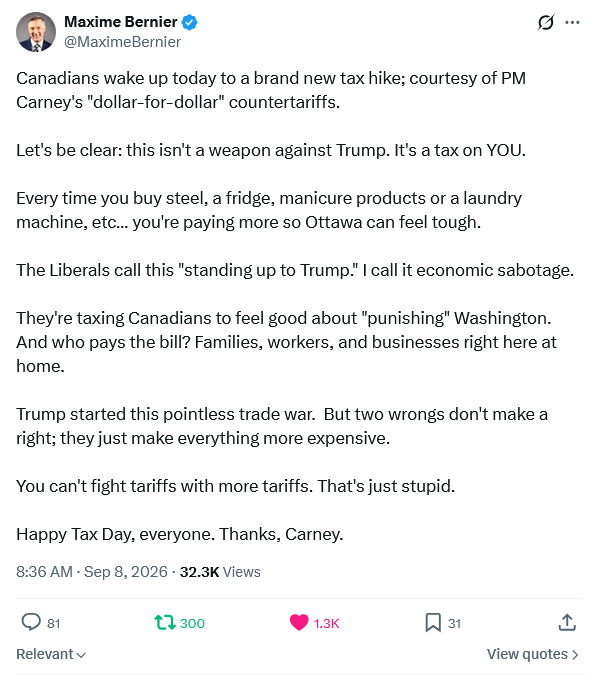
Canada’s mainstream media as Liberal Party propagandists.
Image from Melanie In Saskatchewan

Now ask yourself this: if half the population consistently feels unheard by these panels, is that a coincidence, or the predictable result of decades of the same ideological herd wandering through the same studios?

Here is the rub. The At Issue panel rarely rotates through voices that actually represent today’s conservative electorate. Instead, it routinely features professional journalists and political insiders who debate among themselves, talking about conservatives far more often than they engage with conservatives whose voters make up a massive share of the country. That is not centrism. It is an echo chamber assembled by committee.

Then there is Andrew Coyne. He is often presented as the token ideological counterweight on At Issue, the panel’s supposed nod to conservatism. After all, he has spent decades as a columnist and editorial thinker, comfortably critiquing governments from a well upholstered perch.

But let us be clear. Coyne is not remotely representative of today’s conservative electorate. He is not a reflection of the current Conservative Party base. He is not channeling the instincts of voters outside the Ottawa and Toronto corridor.

Positioning him as the conservative voice on a national panel is not balance. It is branding. It allows producers to claim ideological diversity without ever inviting someone who actually carries the convictions, tone, or priorities of the modern conservative movement. Coyne is not a grassroots conservative. He is a professional pundit whose worldview fits tidily within the Ottawa insider class. That is not ideological contrast. It is controlled opposition dressed up as pluralism.

Meanwhile, audiences have been increasingly vocal online about the sense that these panels sound like academic seminars, not reflections of the lived experience of Canadians who didn’t spend their twenties in Ottawa press galleries.

Canada’s climate follies, a brief update

On Substack, John Robson looks at the Canadian federal government’s lofty climate goals and their pathetic strategies to achieve those goals and the vast chasm between the two:

Chinese electric vehicles are likely coming to Canadian roads, like these BYD models.

Forgive us for being fixated on Canada’s climate follies just because we live here. But they are revealing, including the U-turn on EVs that we mentioned last week where the government yanked the steering wheel so hard they did a 360 from banning gasoline vehicles by law to banning them by regulation. Raising the question whether they actually know what they’re doing and, if so, whether they regard themselves as commendably devious or just way smarter than everyone else. We hope not the latter because the policy is going to fail big-time. As Randall Denley just warned in the National Post, “To summarize, the Carney plan relies on electric vehicles (EVs) that Ontario plants don’t produce, a sudden and dramatic new appetite for buying EVs and an imagined export market that doesn’t exist. To top it off, the federal government will provide $2.3 billion in EV rebates that will encourage Canadians to buy cars made elsewhere.” Apart from that, a stroke of genius of the sort that, through decades of diligent effort, has made the nation tragically poorer without hitting any of our targets including the one where they get more humble.

As a Globe & Mail news story blurted out:

    A new study published Friday by the Canadian Climate Institute says Canada is not on track to meet any of its climate targets – not the 2026 interim emissions reduction target, the 2030 Paris Agreement commitment, or even the long-term goal of reaching net-zero emissions by 2050.

Oh. Pretty hard to make that one sound like an achievement, isn’t it? Or to sound as if the people who pulled it off should be trusted with the next one.

Now as we’ve complained before, the “Canadian Climate Institute” bills itself as some sort of dispassionate neutral observer when in fact it’s a creature of the state. And, worse, one of those lavishly-funded outfits (we deniers may have all the money, but they got $30 million from the Canadian government and we did not … uh no, that was just one grant, the total’s higher) that exists to push the government to do things it wants to do anyway but needs the appearance of “civil society” support to pull off.

Thus, the Globe sonorously informs us, the problem isn’t that the targets were impractical or the politicians and bureaucrats inept. Heck no. As usual with Thomas Sowell’s “unconstrained vision” of public policy, all you need is love:

    The report suggests Canada has moved away from its climate goals thanks to “a slackening of policy effort over the past year, marked by the removal or weakening of climate policies across the country”.

Which gives the impression they had been on track to meet their goals up until some recent backsliding, whereas in reality they have never shown any sign of meeting them. After all, what policies have actually changed since Carney took over as Prime Minister in ways that could possibly affect long-term trends? And how close was Canada to meeting “its climate goals” before this disastrous swerve into the camp of the deniers?

It’s not even true that “Canada” as a collective has collective “climate goals”. The government has climate goals, and they come bundled with a host of other policies at election time, especially since even our “Conservative” party is terrified of challenging climate orthodoxy. Public support for those goals is weak, sporadic and prone to vanish when real costs hove into view. But ignoring that piece of typical collectivist prose, Mark Carney has spent most of his prime ministership flying around virtue-signaling in the presence of others doing the same. (No, really. It’s been less than a year and he’s taken almost three dozen flights.) He hasn’t been in the office shredding this and demolishing that.

February 21, 2026

QotD: Warren G. Harding’s successful depression-breaking policies

One is viewed as among America’s greatest presidents; the other perhaps the worst of all. One is hailed as a savior; the other as a failure. One is given memorials to enshrine his name for all time; the other is pushed into the sea of forgetfulness.

Driven by academia, this is where American history has placed Franklin Delano Roosevelt (in office 1933-1945) and Warren Gamaliel Harding (in office 1921-1923). It is impossible to see FDR absent a “great presidents” ranking; it is likewise impossible to see Harding absent the lowest rungs.

Both men came into office with an economy in tatters and both men instituted ambitious agendas to correct the respective downturns. Yet their policies were the polar opposite of one another and, as a result, had the opposite effect. In short, Harding used laissez faire-style capitalism and the economy boomed; FDR intervened and things went from bad to worse.

Despite these clear facts, in C-SPAN’s latest poll ranking US presidents, FDR finished third in the rankings, while Harding finished 37th. Surveying how both handled the economy, scholars ranked FDR third in that category, while Harding came in at 32. This is a tragedy of history.

America in 1920, the year Harding was elected, fell into a serious economic slide called by some “the forgotten depression“. Coming out of World War I and the upheavals of 1919, the economy struggled to adjust to peacetime realities, falling into a serious slump.

The depression lasted about 18 months, from January 1920 to July 1921. During that time, the conditions for average Americans steadily deteriorated. Industrial production fell by a third, stocks dropped nearly 50 percent, corporate profits were down more than 90 percent. Unemployment rose from 4 percent to 12, putting nearly 5 million Americans out of work. Small businesses were devastated, including a Kansas City haberdashery owned by Edward Jacobson and future president Harry S. Truman.

The nation’s finances were also in shambles. America had spent $50 billion on the Great War, more than half the nation’s GNP (gross national product). The national debt jumped from $1.2 billion in 1916 to $26 billion in 1919, while the Allied Powers owed the US Treasury $10 billion. Annual government spending soared more than twenty-five times, from around $700 million in 1916 to nearly $19 billion in 1919.

Harding campaigned on exactly what he wanted to do for the economy – retrenchment. He would slash taxes, cut government spending, and roll back the progressive tide. He would return the country to fiscal sanity and economic normalcy.

“We need a rigid and yet sane economy, combined with fiscal justice,” he said in his inaugural address, “and it must be attended by individual prudence and thrift, which are so essential to this trying hour and reassuring for our future”.

The business community expressed excitement about the new administration. The Wall Street Journal headlined on Election Day, “Wall Street sees better times after election”. The Los Angeles Times headlined the following day, “Eight years of Democratic incompetency and waste are drawing rapidly to a close”. Others read “Harding’s Advent Means New Prosperity” and “Inauguration ‘Let’s Go!’ Signal to Business”.

The day after Harding’s inauguration, the Times editors predicted “good times ahead”, writing, “The inauguration yesterday of President Harding and the advent of an era of Republicanism after years of business harassment and uncertainty under the Democratic regime were hailed” by the nation’s business leaders. I. H. Rice, the president of the Merchants and Manufacturers Association, told the press, “Good times are now ahead of us. Prosperity is at our door. We are headed toward pre-war conditions … Business men are well pleased with President Harding’s selections for his Cabinet and by the caliber of men he has chosen we know that he means business”.

Under Harding and his successor, Calvin Coolidge, and with the leadership of Andrew Mellon at Treasury, taxes were slashed from more than 70 percent to 25 percent. Government spending was cut in half. Regulations were reduced. The result was an economic boom. Growth averaged 7 percent per year, unemployment fell to less than 2 percent, and revenue to the government increased, generating a budget surplus every year, enough to reduce the national debt by a third. Wages rose for every class of American worker. It was unparalleled prosperity.

Ryan S. Walters, “The Two Presidents Whose Economic Policies Are Most Misunderstood by Historians”, Foundation for Economic Education, 2022-03-05.

February 18, 2026

It’s not just Britain that gives asylum-seekers better care than citizens – Canada does too

Filed under: Bureaucracy, Cancon, Government, Health — Tags: , , , — Nicholas @ 05:00

We had a look at how well the British government looks after asylum-seekers yesterday, but other nations are probably doing similarly inequitable things to give money and services to non-citizens than they ever would for the people who pay the taxes for these over-generous programs. In the National Post, Tristin Hopper outlines the findings of a recent analysis from the Parliamentary Budget Office on the costs of supporting huge numbers of foreign nationals in Canada:

An asylum seeker, crossing the US-Canadian border illegally from the end of Roxham Road in Champlain, NY, is directed to the nearby processing center by a Mountie on 14 August, 2017.
Photo by Daniel Case via Wikimedia Commons.

Paying the health-care premiums of refugee claimants will cost Canadians a record $1 billion this year, with some of the beneficiaries continuing to receive free health care despite their claims having already been rejected.

That’s according to a new analysis by the Office of the Parliamentary Budget Officer, and it’s just one of several ballooning costs wrought by the unprecedented number of foreign nationals currently living in Canada by virtue of a claim of refugee status.

The Interim Federal Health Program, which offers premium health benefits to asylum claimants, is soon set to hit $1 billion in annual costs for the first time, according to an analysis last Thursday by the Office of the Parliamentary Budget Officer.

This is a five-fold increase from just six years ago, when the program was costing $211 million per year. The analysis also projects that costs are expected to surge for the foreseeable future, with the annual budget likely to hit $1.5 billion as early as 2029.

All told, between now and 2030, Canadians are on track to spend $6.2 billion on health care for refugees or refugee claimants.

“The rising volume of asylum claims, along with the longer duration of eligibility caused by extended determination times, has been an important growth driver in recent years,” reads the PBO report.

The report was commissioned following a Conservative-led request made at the House of Commons standing committee on health. In a Thursday statement, the Conservative party noted that the Interim Federal Health Program can be accessed even by asylum claimants who have had their case rejected.

It also offers a higher level of care than that enjoyed by the average Canadian citizen. In addition to hospital care and surgical care, the IFHP also covers dental care, vision care, pharmacare and other services not typically covered by public health plans.

“Rejected asylum claimants are now receiving better health care than many Canadians who have paid into a system their entire life,” read a joint statement by Dan Mazier and Michelle Rempel Garner, the shadow ministers of health and immigration, respectively.

It added, “at a time when six million Canadians cannot find a family doctor and are waiting for care, it’s unacceptable that bogus asylum seekers are receiving better health benefits than Canadians”.

February 17, 2026

The ludicrous idea of an “unrealized gains tax”

Filed under: Bureaucracy, Business, Government, Media, Politics, USA — Tags: , , — Nicholas @ 03:00

Governments everywhere are always on the lookout for more ways to raise revenue, so any suggestion of an untapped resource they can tax will get their attention. Apparently the current hot idea is an unrealized gains tax, which @wokeandwoofing satirized thusly:

Also on the social media site formerly known as Twitter, @Yogi frames the proposed new tax for Gen Z readers:

Unrealized gains tax for Gen-Z:

You buy a Pokémon card for $50.

Someone offers you $500 for it. You say no. You love that card. You’re keeping it.

The government says: “Cool, but that card is worth $500 now. You owe us $100 in taxes.”
You: “… I didn’t sell it.”

Government: “Don’t care. Pay up.”

You don’t have $100 lying around. So you’re forced to sell the card you love just to pay a tax on money you never received.

Next month? That card drops back to $50.

Your card is gone. Your money is gone. And the government shrugs.

That’s a wealth tax on unrealized gains. They don’t pay you back the tax …

Now picture this.

Your mom calls you crying. She has to sell the house she raised you in. Not because she can’t afford it. She’s lived there 30 years. It’s paid off.

But some website says it’s worth more now and the government says she owes $15,000 she doesn’t have.

So she sells your childhood home. The kitchen where she made you breakfast. The doorframe where she marked your height every birthday.

Gone.

To pay a tax on money that was never real.

Now picture the opposite.

Your dad put everything into his small business. For 20 years he built it from nothing. One year the business is “valued” at $2 million on paper. He owes a massive tax bill. He empties his savings. Sells his truck. Borrows money. Pays it.

Next year the market crashes. His business is worth $200,000.

He lost everything to pay a tax on a number that doesn’t exist anymore.

Does the government give him his money back?
No.

Does the government give him his truck back?
No.

Does the government care?
No.

They sold this idea as “taxing billionaires”. But billionaires have armies of lawyers, offshore accounts, and trusts. They’ll be fine.

You know who won’t be fine? Your mom. Your dad. Your neighbor with a small business. The farmer down the road who’s had the same land for four generations and now has to sell it because dirt got expensive.

You’re not taxing wealth. You’re taxing people for owning things.

It’s like getting a parking ticket for a car you might drive somewhere someday.

They want you to own nothing and be happy. To fund the fraud, waste and abuse of the welfare state they created.

There is enough money. More tax isn’t needed. It’s all a lie. But you’ve been gaslit into believing this is a rich vs poor debate.

I hope you understand what’s at stake.

« Newer PostsOlder Posts »

Powered by WordPress