
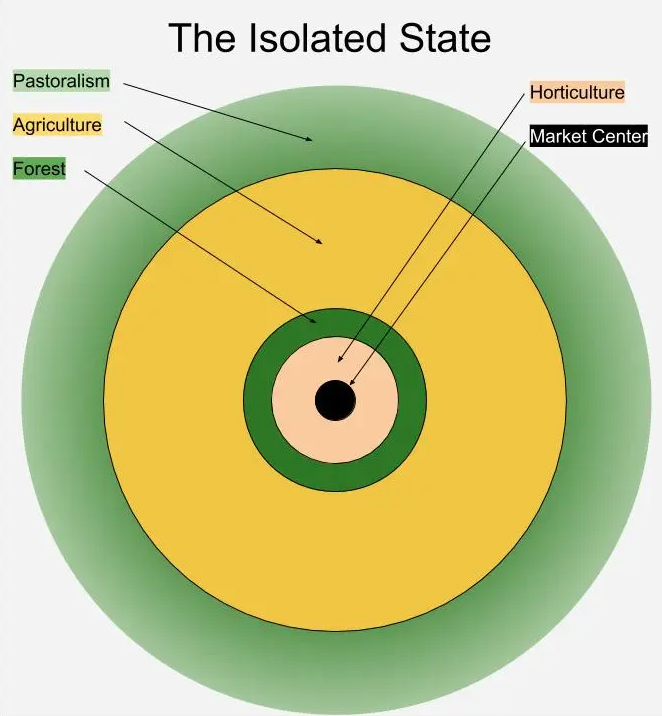
Diagram of von Thünen’s model from The Isolated State, after Morley (1996), 62. The agriculture ring is subdivided by intensity (intensive, long-lay and three-field), but here I have merged them for simplicity. The agriculture zone is wider because it did, in fact, tend to cover a larger area. The fade in the pastoralism zone is meant to indicate shifts from ranching to transhumance.
We’ll start at the inside, right next to the city and move outward. Imagine each “zone” as a wider concentric circle, moving outward from the city (see the image to the right). Because transportation costs (especially overland) are so high, distance from the city plays a dominant role in how the land is used and thus consequently what the countryside around the city looks like. As you move further and further away, transportation costs interact with the structure of agriculture to make different activities make more sense, creating somewhat predictable patterns.
Land very close to the city is valuable because its produce can reach the market with much lower transportation costs (and pretty much always in a single day’s walk). As a result, if the land can support any kind of productive use, it will not be left empty. Instead, the land is going to be put to the most productive use possible. Improvements that – because of cost or labor – might not be attempted on less valuable land further out will likely be done in close proximity to the city. Stepping out of our ideal model for a moment: this is especially true of irrigation, since cities tend to be on waterways (especially rivers) anyway, making irrigation both more valuable due to low transport costs and easier to accomplish.
Thus land in this innermost zone is likely to be heavily improved (irrigation, terracing to get maximum space out of hills, etc). Labor use will also be intensive, both because it is readily available (you are right next to the major population center) and because labor costs are small compared to the high value of the land. If you have managed to get some farmland right outside the city gates, it is very much worth your time to hire whatever labor you need to get the most out of it, so as to recoup the cost of buying or holding such valuable land.
The other improvement one is likely to do in this zone, at least for growing crops, is make extensive use of fertilizer, which in this case generally means manure. The good news is that this zone is directly next to the city, with its intense concentration of animals and people producing manure, making manure cheaper (yes, people did pay for it). Extensive use of manure lets the fields stay under cultivation more often – being fallowed less frequently. At greater distance, the cost of the manure for this begins to outweigh the value of the extra crops, but so close to the city, land this valuable ought to be kept producing as much as possible.
So what kinds of land use does this lead to? The two key activities that von Thünen identifies are horticulture and dairying, to which I’ll add trough-fed animals like pigs (not quite dairy, but as we’ll see, similar from an economic perspective). Why? Horticulture – the intensive growing of fruits and vegetables, often in small “market gardens” – is labor intensive and offers a high economic yield for the space. Land used for horticulture can be kept under almost continual cultivation (if manured, but see above), but gardens can be fussy and demand quite a lot of labor, compared to hardier plants (like maize corn or wheat). Likewise, dairy animals (which, up close to a large city, will be stall-fed rather than grazed or else transported in “on the hoof” and grazed much further out) and pigs (fed by trough) don’t require much space and offer a high economic yield. Both also produce manure which is in demand near the city for the reasons described above.
The other reason to keep these activities so close to the city is access to the market, for two related reasons. First, fresh dairy products, meats and vegetables spoil rapidly, so they must be gotten to market quickly. Remember that this is a world without refrigeration, so as soon as the plant is picked, the cow is milked or the pig is killed, the clock is ticking on spoilage (yes, there are ways to preserve meat, of course – but we’re talking fresh animal products). Precisely because these foods don’t travel or keep well, they tend to be luxury products as well – something produced for the market and bought by rich non-farmers who live in the city.
So what kind of terrain should we see here? Not open grassland or nice wide open fields. Instead, expect small plots, with clustered buildings, typically clinging to the roads leading into the city. Now – especially in the post-gunpowder age – there might be laws forbidding certain kinds of structures close to the city walls (if the city is walled), which might create some open space (but typically not vast). Likewise, when looking at historical city maps, also be wary: this innermost land-use zone was often contained within the city walls of smaller cities.
The next zone – also quite close to the city in von Thünen’s model is – perhaps somewhat surprisingly – a forest zone. That’s not to say that this is generally wild, uncontrolled forest. The reason for a forest zone at such close distance to the city is to provide wood, particularly firewood for heating. Trees might be arranged intentionally along field separations or on spots of agriculturally marginal land close to the city. Forests like these in the Middle Ages would often have been coppiced or pollarded – that is, the trees would have been intentionally cut to produce lots of long, thin straight branches which can be easily harvested to produce nice, evenly sized bits of wood.
Wood is obviously at no risk of spoiling, but it is heavy and bulky, making a close supply valuable. Moreover, the city will need quite a lot of it, for cooking and heating. That said, trees can often be grown either on very marginal (for agriculture) land or else between fields and farms outside of the city, so these patches of forest might often go on land that is a touch too rough or poor for intensive agriculture, or otherwise be squeezed in between land used for other purposes. Still, it is quite common to find spots of forest next to cities and villages alike.
(To answer a quibble in advance: of course this assumes wood is a key heating element. Societies in more arid climates often lack sufficient wood and might use dung, while wet enough areas may use peat. Historically, London shifted over to using mineral coal earlier than most places. All of these choices will impact the role and importance of forest near the city.)
Bret Devereaux, “Collections: The Lonely City, Part I: The Ideal City”, A Collection of Unmitigated Pedantry, 2019-07-12.
January 31, 2024
QotD: The inner-most “zones” outside a typical pre-modern city
January 29, 2024
Ancient Roman Garum Revisited
Tasting History with Max Miller
Published Nov 7, 2023
(more…)
January 28, 2024
Food That Time Forgot: Pemmican, The Ultimate Survival Food
Townsends
Published Oct 29, 2023Pemmican is and has always been the ultimate survival food. Pemmican revolutionized trade in the 18th century by giving travelers a new compact source for energy. Originally used as a food to help Native Americans make it though harsh winters, pemmican turned into an entire industry by the late 1700s.
(more…)
January 25, 2024
Finnish Jews, Polish Special Forces, and MREs – WW2 – OOTF 32
World War Two
Published 24 Jan 2024How did Finland treat its Jews, and what did Finnish people know about the Holocaust? Who were the mysterious Polish Silent Unseen? And, what sort of rations did soldiers carry? Find out in this episode of Out of the Foxholes.
(more…)
January 24, 2024
The father of the “Green Revolution”
In the latest review at Mr. and Mrs. Psmith’s Bookshelf, Jane Psmith reviews The Wizard and the Prophet by Charles C. Mann:
Norman Borlaug is generally estimated to have saved the lives of about a billion people who would otherwise have starved to death.
Yet despite all this — and Borlaug’s is a great story, which Charles Mann tells better and in far more detail than I do above — his book isn’t really a biography of Borlaug or of its other framing figure, early environmentalist William Vogt.1 Rather, it’s a compellingly-written and frankly fascinating overview of various environmental issues facing humanity, and of two different sorts of approaches one can take to addressing them. Mann opens by introducing the two men, but as soon as he’s done that they function mostly as symbols, examples and stand-ins, for these two schools of thought about the world and its problems.
Borlaug is the Wizard of the title, the avatar of techno-optimism: with hard work and clever application of scientific knowledge, we can innovate our way out of our problems. Vogt is the Prophet, the advocate of caution: he points to our limitations, all the things we don’t know and the complex systems we shouldn’t disturb, warning that our constraints are inescapable — but also, quietly, that they are in some sense good.
It’s not hard to identify the Wizards all around us. Inventors and innovators, transhumanists and e/acc, self-driving cars and self-healing concrete … every new device or technique for solving some human problem — insulin pumps! heck, synthetic insulin at all! — is a Wizardly project.
It’s a little more difficult to pin down what exactly the Prophets believe, in part because they spend so much time criticizing Wizardly schemes as dangerous or impractical that it’s easy to take them for small-souled enemies of human achievement.2 That isn’t fair, though — there’s a there there, a holistic vision of the world as an integral organic unity that we disturb at our peril, because the constraints are inextricably linked to the good stuff.
If that seems too abstract, here’s an example. Imagine for a moment (or maybe you don’t have to imagine) that you have a friend who subsists entirely on Soylent. It’s faster and easier than cooking, he says, and cheaper than eating out. He’s getting all his caloric needs met. And he’s freed up so much time for everything else! Now, anyone might express concern for his physical health: does Soylent actually have the right balance of macronutrients to nourish him? Is he missing some important vitamins or other micronutrients that a normal diet might provide? Is the lack of chewing going to make his jaw muscles atrophy? And those are all reasonable concerns about your friend’s plan, but they all have possible Wizardly solutions. (A multivitamin and some gum would be a start.)
If you’re a Prophet sort, on the other hand, you’re probably going to start talking about everything else your friend is missing out on. There’s the taste of food, for one, but also the pleasures of color and texture and scent, the connection to the natural world, the role of community and tradition in shared meals, the way cooking focuses thought and attention on incarnate reality. You might throw around words like “lame” and “artificial” and “sterile” and “inhuman”. Your friend’s Soylent-only plan assumes that the whole point of food is to consume an appropriate number of calories as quickly and easily as possible, hopefully in a way that doesn’t meaningfully degrade his health, but a Prophet rejects his premise entirely. Instead, a Prophet argues that your friend’s food “problem” is actually part of the richly textured beauty of Creation. Yes, feeding yourself and your loved ones delicious, healthful, and economical meals takes time and effort, but that’s simply part of being human.5 You should consider that a challenge to be met rather than a threat to be avoided.
Unfortunately, Mann does the Prophets a disservice by choosing William Vogt as their exemplar. Yes, he was an important figure in the history of the modern environmental movement. Yes, he wrote a very influential book.4 And yes, his careful attention to the integrity of the ecosystems he studied was quintessentially Prophet. But he saw human beings mostly as disruptions to the integrity of those ecosystems, and pretty much every one of his specific predictions — not to mention the predictions of his many followers, most famously Paul Erlich in The Population Bomb5 — have simply failed to come true. Compared to Borlaug’s obvious successes, Vogt’s dire warnings that humanity will soon exhaust the Earth’s capacity and doom ourselves to extinction (unless we abort and contracept our way there first; his second act was as director of Planned Parenthood) seem laughable. Reading about his life can leave you with the impression that Prophets are just people who are more worried about a spotted owl than a starving child, and frankly who cares what those people think?
1. They were roughly contemporaries, but this is emphatically not the story of a pair of rivals; they encountered each other in person only once, in passing, after which Vogt wrote an angry letter to the Rockefeller Foundation demanding they cease Borlaug’s Mexican project at once.
2. And, to be fair, a lot of the language and arguments pioneered by Prophets does get employed by a sclerotic managerial class opposed to anything they can’t fit neatly into their systems and processes and domain-agnostic expertise. But more on that later.
3. Incidentally, this is more or less the argument between the Wizards and the Prophets when it comes to soil. Wizards are delighted with the Haber-Bosch process and artificial fertilizers; Prophets decry the “NPK mentality” that sees the soil as a passive reservoir of chemicals and instead laud composting, manure, and other techniques that encourage the complex interactions between soil organisms, plant roots, and the physical characteristics of humus. This is the origin of the fad for “organic”, a label that doesn’t mean much when applied to industrial-scale food production and is often more trouble than it’s worth for small-time farmers and ranchers. Still, Mann’s story of the movement’s birth is interesting.
4. You’ve probably never heard of it, but it was influential!
5. Apparently out of print! Good.
January 19, 2024
Vienna’s Iconic Chocolate Cake
Tasting History with Max Miller
Published 17 Oct 2023
(more…)
January 16, 2024
Why Real Dijon Mustard Is So Expensive | So Expensive Food | Business Insider
Insider Business
Published 12 Jul 2022Dijon mustard has a tangier, sharper, and spicier flavor compared to other types of mustard. It takes its name from the town of Dijon in Burgundy, France, where it originated. But despite its name, the majority of Dijon mustard that is sold all over the world doesn’t come from France. The few jars that do will cost you up to six times more than regular Dijon mustard (or double if we want to compare it to Grey Poupon). So how is real Dijon mustard different? And why is it so expensive?
Editor’s Note: In this video, the translations at 2:10 and 3:16 are incorrect. The rind of the mustard seed is wrongly referred to as “sound of mustard”. The correct translation is mustard bran. Insider regrets the error.
(more…)
January 8, 2024
Crispy Hashbrowns – You Suck at Cooking (episode 161)
You Suck At Cooking
Published 7 Oct 2023Hashbrowns. Also known as fried potato shreds. Also known as 2D potatoes. Also known as even greasier potato chips. Also known as hashbrowns.
If you’ve never fried before or you want to brush up on the details, check this out
https://food52.com/blog/18669-the-do-…This deep fry safety page is also very good
https://www.bbcgoodfood.com/howto/gui…Basically hot oil can get out of control so you need to monitor your temperature and not let it get too hot. Electric stoves are deceptive in that they can get the oil very hot even at a lower settings, there’s just a longer delay.
RECIPE
Capture potatoes
Apologize to potatoes
Remove outer thermal membrane
Disintegrate potatoes
Rinse potato smithereens or soak them if you want them less starchy
Wrap them in some cheesecloth or a clean dish towel and squeeze the hell out of them (but mainly the water and leave some of the hell)
Cook them in a non stick pan with a tablespoon of oil for around ten minutes so they won’t be medium rare
Let them cool off a bit
Put them in a bowl
For each potato add
1 teaspoon corn starch
1 teaspoon garlic powder
1 teaspoon onion powder
some pepper pepper pepper
Wangjangle
Form into patties or triangles but NO OTHER SHAPES
Heat your oil in a cast iron skillet but not so hot that you burn your house down
Most recipes recommend around 350 degrees Fahrenheit but as long as you get a sizzle going when you put them in it’s hot enough
Fry until the first size is golden brown. Somewhere between 4-8 minutes
Fry the other side until golden brown which is gonna happen faster, probably 5 minutes max
Lay them down on a paper towel and tell them they did a good job
Let them cool or spray a heat resistant gel inside your mouth and eat immediately
(more…)
December 30, 2023
QotD: Post-Christmas dining
Refusing to do any shopping until the Christmas food is all gone so dinner tonight will be Pringles and sprouts topped with mince pies and, for dessert, Bounty Celebrations and Baileys with a stuffing jus.
Amanda (@Pandamoanimum), Twitter, 2021-12-29.
December 29, 2023
Rubaboo – Pemmican Stew of Canadian Mounties
Tasting History with Max Miller
Published 12 Sept 2023
(more…)
December 27, 2023
Eating like a Lighthouse Keeper from the 1800s
Tasting History with Max Miller
Published 19 Sep 2023
(more…)
QotD: “Healthy eating” after the holidays
So good to be eating healthily again. I feel fitter and better in myself alreadyDay 2 of healthy eating
I miss cheese so much I want to cry. I’ve forgotten the taste of chocolate. Vegetables taste of sadness and resentment. I’ve never known such miseryAmanda (Pandamoanimum), Twitter, 2022-01-04.
December 25, 2023
Homemade Eggnog Recipe – How to Make Classic Christmas Eggnog
Food Wishes
Published 22 Dec 2015Learn how to make Homemade Eggnog!
I’ve never been a big eggnog person, and that’s putting it kindly. It’s too thick, too sweet, and way too artificially nutmegy. I even did an anti-nog tweet recently, just for a few cheap, seasonal laughs, but then I realized I was being unfair to this iconic Christmas drink.
I was basing most of my hating on the stuff in the carton from the supermarket, which features no booze, and a nutrition label you seriously don’t want to read. The homemade stuff I’ve had was significantly better, and so I decided to film this rather easy process, since I get so many requests this time of year.
Go to http://foodwishes.blogspot.com/2015/1… for the ingredient amounts, more information, and many, many more video recipes! I hope you enjoy this easy Classic Christmas Eggnog recipe.
December 23, 2023
Ribbon Candy for Christmas at Lofty Pursuits
Lofty Pursuits
Published 19 Dec 2016Public displays of Confection use a very old ribbon candy machine to finally make some nice ribbon candy just before Christmas 2016. This batch was cherry, but we’ve made tutti frutti, and peppermint too. Lofty Pursuits makes candy on equipment made from the late 1800’s until the modern day. We concentrate on finding and restoring old candy equipment and re-learning the dying art of hard candy making.
http://www.pd.net to see the candy we sell.
December 22, 2023
Roast Smoked Goose – A Christmas Goose Special
Food Wishes
Published 8 Dec 2011Learn how to make a Roast Smoked Goose Recipe!
Visit http://foodwishes.blogspot.com/2011/1… for the ingredients, more recipe information, and over 650 additional original video recipes! I hope you enjoy this Christmas Roast Smoked Goose Recipe!


