
World War Two
Published 10 Dec 2022There are plans afoot to hit the enemy from behind in Italy. Allied leaders are meeting again in Cairo to go over other plans, notably what to do about China and Burma. There is active fighting on two fronts in Italy too, though this week it doesn’t go particularly well for the Allies. Attacks in the USSR are unsuccessful for the Soviets, but do go well for the Germans, and there are Allied attacks by air in the Marshall Islands and over France.
(more…)
December 11, 2022
An Amphibious Landing to take Rome? – 224 – December 10, 1943
Comments Off on An Amphibious Landing to take Rome? – 224 – December 10, 1943
Winter of Discontent 2, non-electric boogaloo?
Matt Goodwin sets the stage for Britain’s potential re-run of the “Winter of Discontent”. By chance, I happened to be in England for a few weeks smack-dab in the middle of the worst of that winter, so although I was not following the news at the time, the physical and emotional state of the country struck me very deeply. There certainly are strong similarities between late 1970s Britain and post-pandemic Britain:
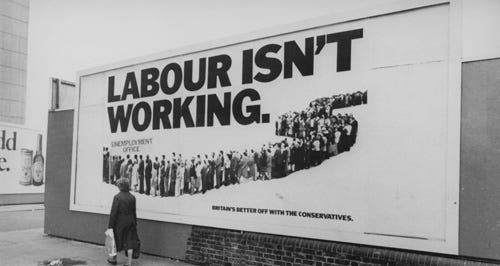
Conservative Party election poster, 1979.
Britain is entering a Winter of Discontent. If you are in the country and plan to take a train, a bus, a flight, a driving test, travel on the highway, send a letter, have a beer, go to school or university, need an ambulance to take you to hospital, need a nurse to look after you while you are in hospital or want to buy a coffin in case things do not go so well while you are in hospital then there is more than a good chance you will be caught up in a wave of strikes that are sweeping across the country.
More than one million working days are about to be lost due to strike action, the largest number since 1989. This is nowhere near the twelve million days that were lost in the original Winter of Discontent, in 1978-9, or the 126 million days lost during the general strike in 1926. But it is more than enough to cause yet another problem for Rishi Sunak and the faltering Conservative Party he is struggling to turn around.
As I pointed out in the Sunday Times last week, while Sunak has stabilised his party it remains deeply unpopular in the country. Even before this winter, voters blame the Tories far more than global events for Britain’s deteriorating economy. One legacy of Partygate and the disastrous experiment with Trussonomics is that Sunak has inherited a party that is now seen by much of the electorate as untrustworthy, serving its own interests, in the hands of a narrow elite and out of touch. Today, not even one in ten voters think the Conservatives “care about ordinary people”.
What options does Sunak have? While he and his team will be tempted to recycle the Thatcher playbook from the original Winter of Discontent, blaming the unions for the strikes and trying to appeal to national unity, this time things are more complicated. For a start, large numbers of voters actually support the strikes, which reduces Sunak’s room for manoeuvre. Second, this time it is the Conservatives not Labour who are in power, and are being blamed just as much as the unions for the unfolding chaos. Every train that is missed, every flight that is cancelled, every hospital patient that is not looked after will entrench the party’s negative image. And, third, as I said during an after dinner talk to clients of a major law firm this week, irrespective of what happens in the weeks ahead research on the impact of major strikes tells a consistent story: they hurt incumbent governments, lowering their support at the next election.
In fact, this might explain why the Rishi recovery already appears to be running out of steam. As I pointed out on Twitter this week, since taking over Sunak has certainly managed to increase his party’s average share of the vote from 23 to 27 per cent while Labour’s average lead in the polls has dropped from thirty to twenty points. And when voters are asked who would make the “best prime minister”, Sunak is much closer to Starmer, trailing him by only 5-points, than Liz Truss ever was, who trailed him by 29-points. But the Conservatives remain a long, long way behind. Just how far behind was underlined by a by-election in Chester this week which saw the party’s vote crash by sixteen points. The last time this happened at a by-election in a Labour-held seat was in the 1990s, shortly before the Blair asteroid almost rendered the Tories extinct.
At a deeper level, however, this winter also looks set to entrench a much deeper mood among the British people which will also undermine the government. The strikes, the chaos, the mounting sense of crisis are all feeding a palpable feeling among voters that nothing really works in Britain anymore, that contrary to the populist mantra of the last decade nobody is in control.
Comments Off on Winter of Discontent 2, non-electric boogaloo?
How to Make A Christmas Cake – The Victorian Way
English Heritage
Published 30 Nov 2017Christmas is approaching so Mrs Crocombe is making a cake for Lord and Lady Braybrooke at Audley End House.
This traditional plum cake is based on a recipe by Charles Francatelli, who was Queen Victoria’s chief cook from 1840 to 1841.
(more…)
Comments Off on How to Make A Christmas Cake – The Victorian Way
December 10, 2022
United States Empire – The Spanish-American War
The Great War
Published 9 Dec 2022The Spanish-American War (fought in Cuba and the Philippines) kickstarted US global ambitions and expanded their influence far beyond the borders of the United States. At the same time the war marked the endpoint of the decline of Spain as a global power.
(more…)
Comments Off on United States Empire – The Spanish-American War
Ed West finds nice-ish things to say about the French
It’s actually part two, which I’m sure would astonish many a Brit:
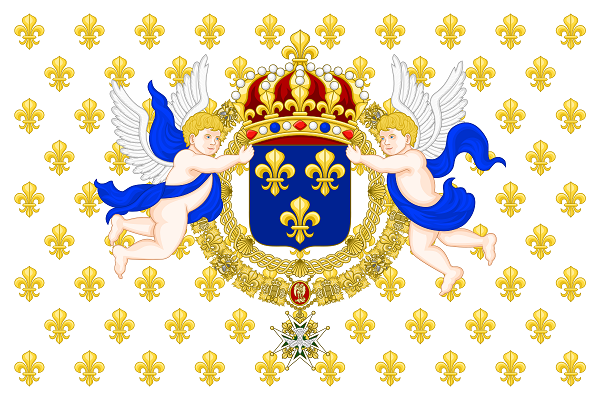
The Royal Standard of the King of France (and by default, the national flag), used between 1638 and 1790.
Wikimedia Commons.
“When, after their victory at Salamis, the generals of the various Greek states voted the prizes for distinguished individual merit, each assigned the first place of excellence to himself, but they all concurred in giving their second votes to Themistocles,” wrote the great 19th-century historian Edward Creasy. “This was looked on as a decisive proof that Themistocles ought to be ranked first of all. If we were to endeavour, by a similar test, to ascertain which European nation has contributed the most to the progress of European civilization, we should find Italy, Germany, England, and Spain, each claiming the first degree, but each also naming France as clearly next in merit. It is impossible to deny her paramount importance in history.”
France is central to the story of Europe, and indeed of Britain. It is almost impossible to understand England’s history without appreciating the relationship with its closest continental neighbour. It is a love-hate affair originating in a grand inferiority complex, a long rivalry that continues tomorrow [Saturday] when England meet France in the World Cup quarter-finals.
In a piece last year I cited some of the most endearing/maddening things about the French, all of which contributed to a sense of amused frustration on our part:
Only in France would football fans protest that a local restaurant had lost a Michelin Star, as happened in Lyon two years ago. Only in France would an expedition to the Himalayas — of huge national importance — fail because it was weighed down by eight tonnes of supplies, including 36 bottles of champagne and “countless” tins of foie gras. And only in France would you get actual wine terrorists, the Comité Régional d’Action Viticole, who have bombed shops, wineries and other things responsible for importing foreign produce. This is a country which only reluctantly in the 1950s stopped giving school children a nutritious drink for their health, by which the French meant not milk but cider.
This is a country where mistresses are so much part of life that they can legally inherit, and where murder doesn’t really count if it’s done for love. One of France’s most famous socialites, Henriette Caillaux, shot dead the editor of Le Figaro just before the First World War and received just four months in jail because it was a crime passionnel. So that’s all right then.
But there are so many other things to love about our strange neighbours …
The Anglo-French relationship is a difficult one, reflected in the troubled history of royal marriages. Charles I’s Catholic wife Henrietta Maria was a drag on his popularity among excitable Protestant radicals, and turned out to be the last French consort; in the 14th century Edward II’s wife Isabella overthrew him and, perhaps, conspired to have him killed, after a rocky marriage that began badly when he brought his lover to the coronation and acted inappropriately affectionate towards him. But then, as Edith Cresson pointed out, this is to be expected when you marry an Englishman.
In 1514 Louis XII married an English bride, Henry VIII’s sister Mary; she was 18, he was 53, and had syphilis, so she must have been delighted about the whole thing; however, within weeks she had “danced him to death”, the sex apparently proving too exciting for his nervous system. Francesco Vettori, Florence’s ambassador to Rome, wrote that King Louis had a lady “so young, so beautiful and so swift that she had ridden him right out of the world”.
***
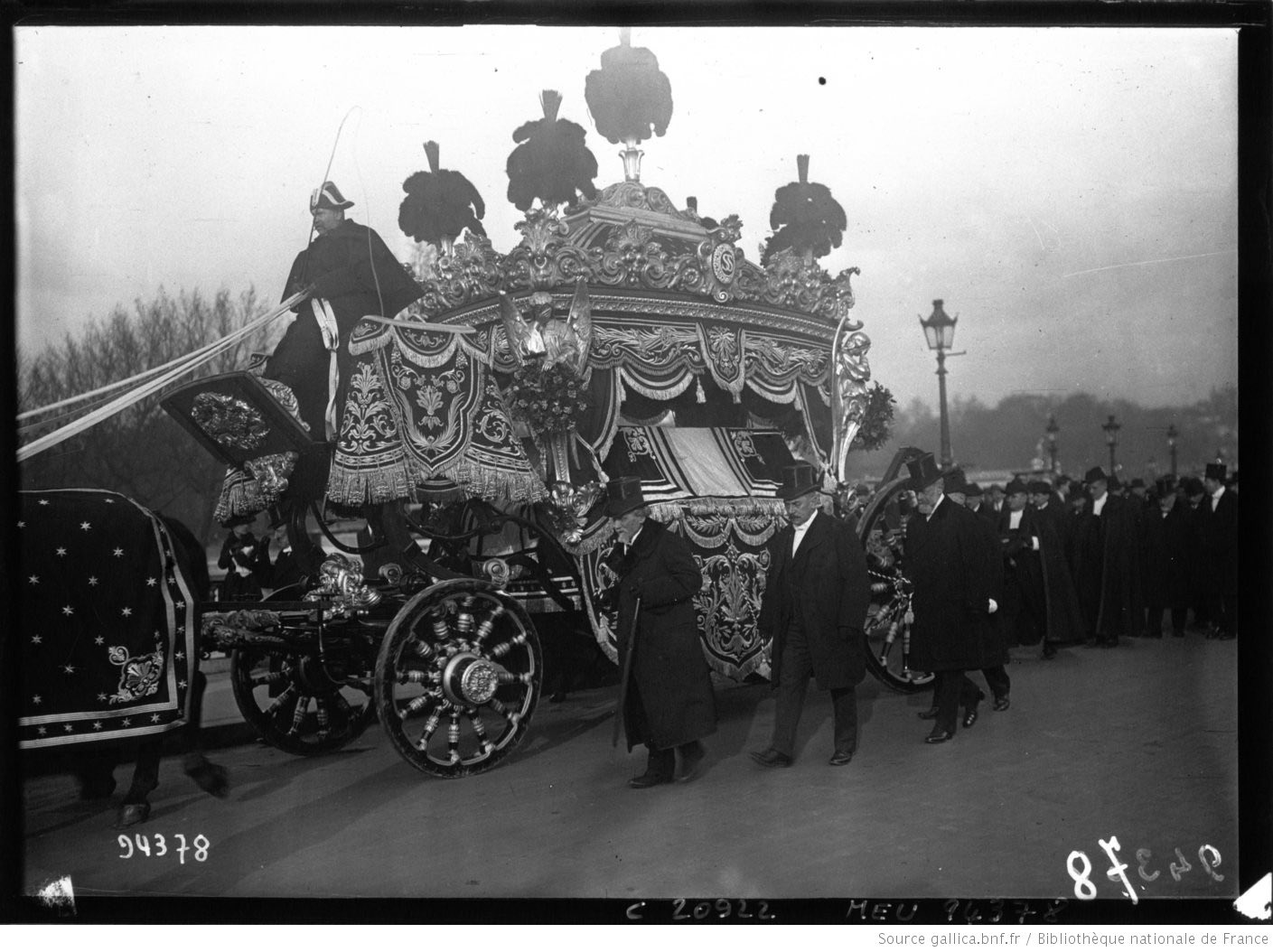
Perhaps not a terrible way for a Frenchman to go, and not the last French head of state to die in a similar manner. President Félix Faure expired in 1899 while with his mistress, after which his funeral featured this very understated carriage.
***
Numerous French presidents have had affairs, although Francois Mitterrand actually had a secret second family while in the Élysée Palace. Mitterrand’s last meal was also ultra-French: “He’d eaten oysters and foie gras and capon — all in copious quantities — the succulent, tender, sweet tastes flooding his parched mouth. And then there was the meal’s ultimate course: a small, yellow-throated songbird that was illegal to eat. Rare and seductive, the bird — ortolan — supposedly represented the French soul. And this old man, this ravenous president, had taken it whole — wings, feet, liver, heart. Swallowed it, bones and all. Consumed it beneath a white cloth so that God Himself couldn’t witness the barbaric act.”
***
The French are world outliers in their attitudes to adultery, the only country where a majority of people think it’s fine. Germany is number two in this index of permissiveness while the Americans, of course, are the most disapproving western nation.
Comments Off on Ed West finds nice-ish things to say about the French
The “Dark” Ages were fine, actually — History Hijinks
Overly Sarcastic Productions
Published 5 Aug 2022Curb your Crusading – the artwork, literature, and scholarship are far more interesting.
SOURCES & Further Reading: China: A History by John Keay, Byzantium & Sicily & Venice by John Julius Norwich, Great Courses Lecture series Foundations of Western Civilization by Thomas F. X. Noble lectures 27 through 38: “The Emergence of the Catholic Church”, “Christian Culture in Late Antiquity”, “Muhammad and Islam”, “The Birth of Byzantium”, “Barbarian Kingdoms in the West”, “The World of Charlemagne”, “The Carolingian Renaissance”, “The Expansion of Europe”, “The Chivalrous Society”, “Medieval Political Traditions I”, “Medieval Political Traditions II”, and “Scholastic Culture”.
(more…)
Comments Off on The “Dark” Ages were fine, actually — History Hijinks
QotD: The Western Roman Empire – “decline and fall” or “change and continuity”?
So who are our [academic] combatants? To understand this, we have to lay out a bit of the “history of the history” – what is called historiography in technical parlance. Here I am also going to note the rather artificial but importance field distinction here between ancient (Mediterranean) history and medieval European history. As we’ll see, viewing this as the end of the Roman period gives quite a different impression than viewing it as the beginning of a new European Middle Ages. The two fields “connect” in Late Antiquity (the term for this transitional period, broadly the 4th to 8th centuries), but most programs and publications are either ancient or medieval and where scholars hail from can lead to different (not bad, different) perspectives.
With that out of the way, the old view, that of Edward Gibbon (1737-1794) and indeed largely the view of the sources themselves, was that the disintegration of the western half of the Roman polity was an unmitigated catastrophe, a view that held largely unchallenged into the last century; Gibbon’s great work, The History of the Decline and Fall of the Roman Empire (1789) gives this school its name, “decline and fall“. While I am going at points to gesture to Gibbon’s thinking, we’re not going to debate him; he is the “old man” of our title. Gibbon himself largely exists only in historiographical footnotes and intellectual histories; he is not at this point seriously defended nor seriously attacked but discussed as the venerable, but now out of date, origin point for all of this bickering.
The real break with that view came with the work of Peter Brown, initially in his The World of Late Antiquity (1971) and more or less canonically in The Rise of Western Christendom (1st ed. 1996; 2nd ed. 2003, 3rd ed. 2013). The normal way to refer to the Peter Brown school of thought is “change and continuity” (in contrast to the traditional “decline and fall”), though I rather like James O’Donnell’s description of it as the Reformation in late antique studies.
Among medievalists this reformed view, which focuses on continuity of culture and institutions from late antiquity to the early Middle Ages, remains essentially the orthodoxy, to the point that, for instance, the very recent (and quite excellent) The Bright Ages: A New History of Medieval Europe (2021) can present this vision as an uncomplicated fact, describing the “so-called Fall of Rome” and noting that “there was never a moment in the next thousand years in which at least one European or Mediterranean ruler didn’t claim political legitimacy through a credible connection to the empire of the Romans” and that “the idea that Rome ‘fell’ on the other hand, relies upon a conception of homogeneity – of historical stasis … things changed. But things always change” (3-4, 12-3). As we’ll see, I don’t entirely disagree with those statements, but they are absolute to a degree that suggests there is no real challenge to the position. There have been a few cracks in this orthodoxy among medievalists, particularly the work of Robin Flemming (a revision, not a clear break, to be sure), to which we’ll return, but the cracks have been relatively few.
While some ancient historians also bought into this view, purchase there has always been uneven and seems, to me at least, now to be waning further. Instead, a process of what James O’Donnell describes as a “counter-reformation” (which he stoutly resists with his own The Ruin of the Roman Empire; O’Donnell is a declared reformer) is well underway, a response to the “change and continuity” narrative which seeks to update and defend the notion that there really was a fall of Rome and that it really was quite bad actually. This is not, I should note, an effort to revive Gibbon per se; it does not typically accept his understanding of the cause of this decline (and often characterizes exactly what is declining differently). Nevertheless, this position too is sometimes termed the “decline and fall” school. My own sense of the field is that while nearly all ancient historians will feel the need to concede at least some validity to the reformed “change and continuity” vision, that the counter-reformation school is the majority view among ancient historians at this point (in a way that is particularly evident in overview treatments like textbooks or the Cambridge Ancient History (second edition)). We’ll meet many of the core works of this revised “decline and fall” school as we go.
As O’Donnell noted in a 2005 review for the BMCR, the reformed school tends to be strongest in the study of the imperial east rather than the west (something that will make a lot of sense in a moment), and in religious and cultural history; the counter-reformation school is stronger in the west than the east and in military and political history, though as we’ll see, to that list must at this point now be added archaeology along with demographic and economic history, at which point the weight of fields tends to get more than a little lopsided.
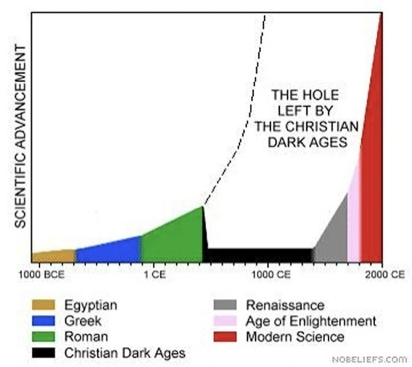
Those are our two knights – the “change and continuity” knight and the “decline and fall” knight (and our old man Gibbon, long out of his dueling days). To this we must add the nitwit: a popular vision, held by functionally no modern scholars, which represents the Middle Ages in their entirety as a retreat from a position of progress during the Roman period which was only regained during the “Renaissance” (generally represented as a distinct period from the Middle Ages) which then proceeded into the upward trajectory of the early modern period. Intellectually, this vision traces back to what Renaissance thinkers thought about themselves and their own disdain for “medieval” scholastic thinking (that is, to be clear, the thinking of their older teachers), a late Medieval version of “this ain’t your daddy’s rock and roll!”
But almost every intellectual movement represents itself as a radical break with the past (including, amusingly, many of the scholastics! Let me tell you about Peter Abelard sometime); as historians we do not generally accept such claims uncritically at face value. For a long time, well into the 19th century, the Renaissance’s cultural cachet in Europe (and the cachet of the classical period where it drew its inspiration) shielded that Renaissance claim from critique; that patina now having worn thin, most scholars now reject it, positioning the Renaissance as a continuation (with variations on the theme) of the Middle Ages, a smooth transition rather than a hard break. At the same time, knowledge of developments within the Middle Ages have made the image of one unbroken “Dark Age” untenable and made clear that the “upswing” of the early modern period was already well underway in the later Middle Ages and in turn had its roots stretching even deeper into the period. It is also worth noting here, that the term “Dark Age” has to do with the survival of evidence, not living conditions: the age was not dark because it was grim, it was dark because we cannot see it as clearly.
The popular version of this idea continues, however, to have a lot of sway in the popular conception of the Middle Ages, encouraged by popular culture that mistakes the excesses of the early modern period for “medieval” superstition and exaggerates the poverty of the medieval period (itself essentialized to its worst elements despite being approximately a millennia long), all summed up in this graph:
We are mostly going to just dunk relentlessly on this graph and yet we will not cover even half of the necessary dunking this graph demands. We may begin by noting that in its last century, the Roman Empire was Christian, a point apparently missed here.
While that sort of vision is not seriously debated by scholars, it needs to be addressed here too, in part because I suspect a lot of the energy behind the “change and continuity” position is in fact to counter some of the worst excesses of this thesis, which for simplicity, we’ll just refer to as “The Dung Ages” argument, but also because assessing how bad the fall of the Roman Empire in the West was demands that we consider how long-lasting any negative ramifications were.
Bret Devereaux, “Collections: Rome: Decline and Fall? Part I: Words”, A Collection of Unmitigated Pedantry, 2022-01-14.
Comments Off on QotD: The Western Roman Empire – “decline and fall” or “change and continuity”?
December 9, 2022
V-1: Hitler’s Deluded Revenge Plan – War Against Humanity 090
World War Two
Published 8 Dec 2022Japanese planes bomb Calcutta when it is still being crushed by the weight of the Bengali famine. Adolf Hitler and Albert Speer are obsessively trying to increase war production so Germany can begin launching its vengeance weapon against Britain. The wars of resistance continue across the Balkans with continued brutality and a new resistance force emerges in Italy.
(more…)
Comments Off on V-1: Hitler’s Deluded Revenge Plan – War Against Humanity 090
Caesar versus Cato
In The Critic, Daisy Dunn reviews Uncommon Wrath: How Caesar and Cato destroyed the Roman Republic by Josiah Osgood:
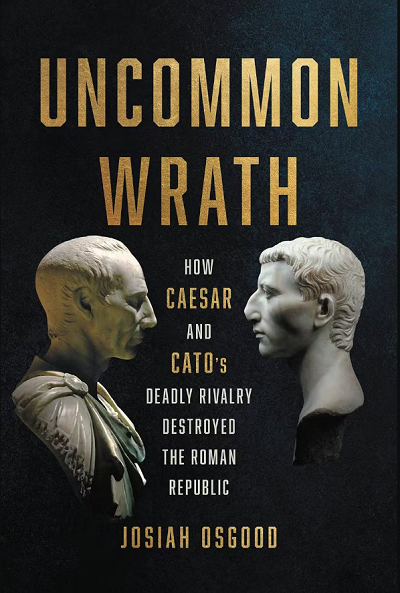
If there was one thing the Romans did well — aside from sanitation, irrigation and concrete — it was polemic. Cicero composed fourteen fiery Philippics against Mark Antony in the 40s BC, and Catullus jibed at Julius Caesar so profusely in his poems that he had to issue an apology. Less famous, but equally explosive, was Caesar’s own collection of vitriol. The Anticato survives today only in fragments, but according to an ancient satirist, it was originally so long that it took up two scrolls and almost outweighed the penis of Publius Clodius Pulcher, apparently among the best-endowed politicians in Rome.
Caesar wrote it shortly before he became dictator, with the intention of denigrating the memory of Marcus Porcius Cato, “Cato the Younger”. For years the two men had been locked in furious rivalry. Caesar blasted Cato as cold and miserly. Cato despaired at Caesar’s profligacy and tireless womanising. If Caesar was louche in his barely-belted toga and exotic unguents, Cato was positively austere — a prime hair-shirt candidate — with his bare feet, rustic diet, extreme exercise and strict sexual mores; it was most unusual for a Roman to make his wife the first woman he slept with.
Few would argue with Josiah Osgood, Professor of Classics at Georgetown, when he describes Caesar and Cato as opposites. Even Donald Trump and Joe Biden have more in common than they did. Caesar was the nephew of the wife of Gaius Marius, the populist enemy of Sulla, who as dictator had thousands of Italians proscribed and killed in his bid to restore the authority of the Senate. Cato could count Sulla as an old family friend. Caesar belonged to a well-established Roman family and claimed descent from Venus via her son Aeneas. Cato’s family was Sabine, and his most famous ancestor was a mere mortal in the shape of the plebeian writer and highly conservative statesman Cato the Elder.
The differences between Caesar’s and Cato’s personalities mattered because they reflected the differences in their visions for Rome. Osgood sums these up as “an empire wielding its power for the people” (Caesar) versus “a Senate protecting the people from the all-powerful empire builders” (Cato). It is little wonder they came to blows.
Osgood takes the tense relationship between Cato and Caesar as the central focus of his book. He argues that their feud has been overlooked as a contributing factor to the civil war that erupted in 49 BC and brought the Roman Republic crashing to the ground. Blame for this war has more usually been placed on the collapse of the First Triumvirate — an illegal alliance for power forged between Julius Caesar, Pompey the Great and Marcus Licinius Crassus in 60 BC — and the breakdown in relations between Caesar and Pompey in particular. But all wars have long-term and short-term causes. For Osgood, the dispute between Caesar and Cato was significant in at least the medium term.
Comments Off on Caesar versus Cato
Rod Bayonet Springfield 1903 (w/ Royalties and Heat Treat)
Forgotten Weapons
Published 20 Nov 2016(Note: I misspoke regarding Roosevelt’s letter; he was President at the time and writing to the Secretary of War)
The US military adopted the Model 1903 Springfield rifle in 1903, replacing the short-lived Krag-Jorgenson rifle. However, the 1903 would undergo some pretty substantial changes in 1905 and 1906 before becoming the rifle we recognize today. The piece in today’s video is an original Springfield produced in 1904, before any of these changes took place.
The most notable difference is the use of the rod bayonet. When the 1903 was in development, the Ordnance Department opined that the bayonet was largely obsolete, and that it was unnecessary to encumber soldiers with a long blade hanging from the belt. Instead, the new rifle would have a retractable spike bayonet that could double as cleaning rod and would be stored in the rifle stock, unobtrusive to the soldier. This ended in 1905 with a critical letter from Theodore Roosevelt (who was Secretary of War at the time). As the rod bayonet was replaced with a traditional blade bayonet, the cartridge would also be improved to a new style spitzer projectile at higher velocity, and the rifles’ stocks, hand guards, and sights were redesigned.
In this video I also discuss two often misunderstood elements of the Springfield’s history: heat treating and patent royalties. Are low serial number 1903 Springfields safe to shoot, and why or why not? And did the US government actually pay royalties to Germany for copying Mauser elements in the 1903?
(more…)
Comments Off on Rod Bayonet Springfield 1903 (w/ Royalties and Heat Treat)
December 8, 2022
Is the Luftwaffe Defeated in 1943? – WW2 Documentary Special
World War Two
Published 7 Dec 2022Outnumbered and outproduced, the once mighty Luftwaffe is battling to hold its own across three fronts. Every month brings new pain for the force. But the Luftwaffe still has a few tricks up its sleeves and can make the Allies bleed heavily. If only Hitler and the Nazi leadership weren’t sabotaging its chances …
(more…)
Comments Off on Is the Luftwaffe Defeated in 1943? – WW2 Documentary Special
Byzantine Honey Fritters
Tasting History with Max Miller
Published 26 Jul 2022
(more…)
Comments Off on Byzantine Honey Fritters
December 7, 2022
The Marie Antoinette Diet
Tasting History with Max Miller
Published 6 Dec 2022
(more…)
Comments Off on The Marie Antoinette Diet
December 6, 2022
The coming of the Korean War
In Quillette, Niranjan Shankar outlines the world situation that led to the outbreak of the Korean War in 1950:
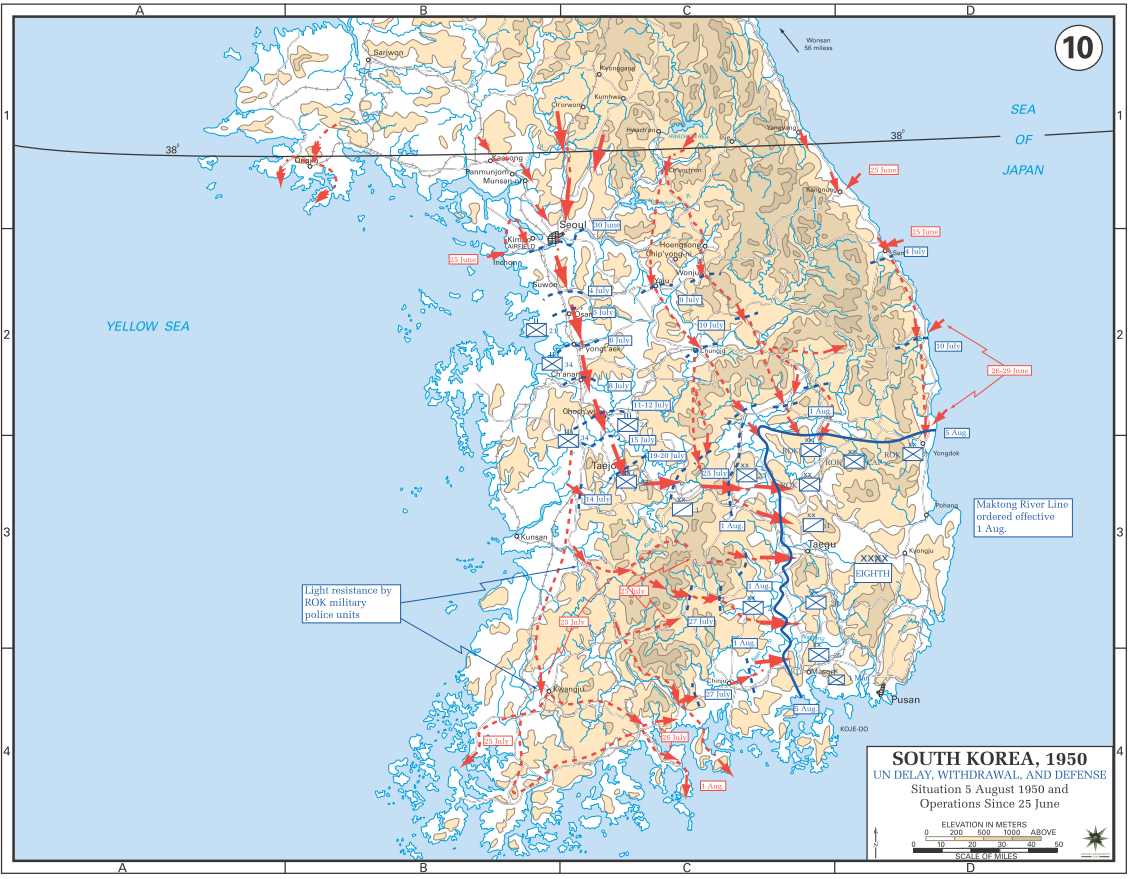
Initial phase of the Korean War, 25 June through 5 August, 1950.
Map from the West Point Military Atlas — https://www.westpoint.edu/academics/academic-departments/history/korean-war
The Korean War was among the deadliest of the Cold War’s battlegrounds. Yet despite yielding millions of civilian deaths, over 40,000 US casualties, and destruction that left scars which persist on the peninsula today, the conflict has never received the attention (aside from being featured in the sitcom M*A*S*H) devoted to World War II, Vietnam, and other 20th-century clashes.
But like other neglected Cold War front-lines, the “Forgotten War” has fallen victim to several politicized and one-sided “anti-imperialist” narratives that focus almost exclusively on the atrocities of the United States and its allies. The most recent example of this tendency was a Jacobin column by James Greig, who omits the brutal conduct of North Korean and Chinese forces, misrepresents the underlying cause of the war, justifies North Korea’s belligerence as an “anti-colonial” enterprise, and even praises the regime’s “revolutionary” initiatives. Greig’s article was preceded by several others, which also framed the war as an instance of US imperialism and North Korea’s anti-Americanism as a rational response to Washington’s prosecution of the war. Left-wing foreign-policy thinker Daniel Bessner also alluded to the Korean War as one of many “American-led fiascos” in his essay for Harper’s magazine earlier this summer. Even (somewhat) more balanced assessments of the war, such as those by Owen Miller, tend to overemphasize American and South Korean transgressions, and don’t do justice to the long-term consequences of Washington’s decision to send troops to the peninsula in the summer of 1950. By giving short shrift to — or simply failing to mention — the communist powers’ leading role in instigating the conflict, and the violence and suffering they unleashed throughout it, these depictions of the Korean tragedy distort its legacy and do a disservice to the millions who suffered, and continue to suffer, under the North Korean regime.
Determining “who started” a military confrontation, especially an “internal” conflict that became entangled in great-power politics, can be a herculean task. Nevertheless, post-revisionist scholarship (such as John Lewis Gaddis’s The Cold War: A New History) that draws upon Soviet archives declassified in 1991 has made it clear that the communist leaders, principally Joseph Stalin and North Korean leader Kim Il-Sung, were primarily to blame for the outbreak of the war.
After Korea, a Japanese imperial holding, was jointly occupied by the United States and the Soviet Union in 1945, Washington and Moscow agreed to divide the peninsula at the 38th parallel. In the North, the Soviets worked with the Korean communist and former Red Army officer Kim Il-Sung to form a provisional “People’s Committee”, while the Americans turned to the well-known Korean nationalist and independence activist Syngman Rhee to establish a military government in the South. Neither the US nor the USSR intended the division to be permanent, and until 1947, both experimented with proposals for a united Korean government under an international trusteeship. But Kim and Rhee’s mutual rejection of any plan that didn’t leave the entire peninsula under their control hindered these efforts. When Rhee declared the Republic of Korea (ROK) in 1948, and Kim declared the Democratic People’s Republic of Korea (DPRK) later that year, the division was cemented. Each nation threatened to invade the other and began preparing to do so.
What initially prevented a full-scale attack by either side was Washington’s and Moscow’s refusal to provide their respective partners with support for the military reunification of the peninsula. Both superpowers had withdrawn their troops by 1949 to avoid being dragged into an unnecessary war, and the Americans deliberately withheld weapons from the ROK that could be used to launch an invasion.
However, Stalin began to have other ideas. Emboldened by Mao Zedong’s victory in the Chinese Civil War and frustrated by strategic setbacks in Europe, the Soviet premier saw an opportunity to open a “second-front” for communist expansion in East Asia with Beijing’s help. Convinced that Washington was unlikely to respond, Stalin gave Kim Il-Sung his long-sought “green-light” to reunify the Korean peninsula under communist rule in April 1950, provided that Mao agreed to support the operation. After Mao convinced his advisers (despite some initial difficulty) of the need to back their Korean counterparts, Red Army military advisers began working extensively with the Korean People’s Army (KPA) to prepare for an attack on the South. When Kim’s forces invaded on June 25th, 1950, the US and the international community were caught completely off-guard.
Commentators like Greig, who contest the communists’ culpability in starting the war, often rely on the work of revisionist historian Bruce Cumings, who highlights the perpetual state of conflict between the two Korean states before 1950. It is certainly true that there were several border skirmishes over the 38th parallel after the Soviet and American occupation governments were established in 1945. But this in no way absolves Kim and his foreign patrons for their role in unleashing an all-out assault on the South. Firstly, despite Rhee’s threats and aggressive posturing, the North clearly had the upper hand militarily, and was much better positioned than the South to launch an invasion. Whereas Washington stripped Rhee’s forces of much of their offensive capabilities, Moscow was more than happy to arm its Korean partners with heavy tanks, artillery, and aircraft. Many KPA soldiers also had prior military experience from fighting alongside the Chinese communists during the Chinese Civil War.
Moreover, as scholar William Stueck eloquently maintains, the “civil” aspect of the Korean War fails to obviate the conflict’s underlying international dimensions. Of course, Rhee’s and Kim’s stubborn desire to see the country fully “liberated” thwarted numerous efforts to establish a unified Korean government, and played a role in prolonging the war after it started. It is unlikely that Stalin would have agreed to support Pyongyang’s campaign to reunify Korea had it not been for Kim’s persistent requests and repeated assurances that the war would be won quickly. Nevertheless, the extensive economic and military assistance provided to the North Koreans by the Soviets and Chinese (the latter of which later entered the war directly), the subsequent expansion of Sino-Soviet cooperation, the Stalinist nature of the regime in Pyongyang, Kim’s role in both the CCP and the Red Army, and the close relationship between the Chinese and Korean communists all strongly suggest that without the blessing of his ideological inspirators and military supporters, Kim could not have embarked on his crusade to “liberate” the South.
Likewise, Rhee’s education in the US and desire to emulate the American capitalist model in Korea were important international components of the conflict. More to the point, all the participants saw the war as a confrontation between communism and its opponents worldwide, which led to the intensification of the Cold War in other theaters as well. The broader, global context of the buildup to the war, along with the UN’s authorization for military action, legitimized America’s intervention as a struggle against international communist expansionism, rather than an unwelcome intrusion into a civil dispute among Koreans.
Comments Off on The coming of the Korean War
Tank Chat #160 | M18 Hellcat | The Tank Museum
The Tank Museum
Published 5 Aug 2022Hello Tank Nuts! M18 Hellcat perfectly fit the American Army’s Tank Destroyer doctrine during WW2. This particular M18 saw service during WW2 and conflict in former Yugoslavia. It is part of the Phelps private collection and recently took part in the celebrations for the 75th Anniversary of the liberation of the city of Mons, Belgium. Discover more on Hellcat and watch the latest Tank Chat with David Willey.
(more…)
Comments Off on Tank Chat #160 | M18 Hellcat | The Tank Museum


