
The Tank Museum
Published 31 Mar 2023Curator David Willey is back with another Tank Chat. This time, he will be discussing the Sonderkraftfahrzeug 251, which is more commonly referred to as the Sd.Kfz. 251.
(more…)
July 2, 2023
Tank Chats #170 | Sd. Kfz. 251 | The Tank Museum
Comments Off on Tank Chats #170 | Sd. Kfz. 251 | The Tank Museum
July 1, 2023
The Newfoundlanders at Beaumont-Hamel
Vlogging Through History
Published 12 Feb 2022Just after the explosion of the Hawthorn Ridge mine, the 29th Division assaulted German positions at Hawthorn Ridge and the Y Ravine outside the village of Beaumont-Hamel, suffering dreadful losses. No unit suffered more in that attack than the Newfoundland Regiment, part of the third wave that morning. Join me as we visit the Beaumont-Hamel Newfoundland Memorial.
(more…)
Comments Off on The Newfoundlanders at Beaumont-Hamel
QotD: The ever-increasing size and number of artillery pieces in WW1 trench battles
Because the generals on the attacking side – and it is worth remembering that Germany, Austria-Hungary, Britain, France and Italy all took their turns being the attacker on the narrower Western and Italian fronts defined by continuous unbroken trench-lines (the Eastern Front was somewhat more open) – were actively looking for ways out of the trench stalemate. We’ve already discussed one effort to get out, poison gas, and why it didn’t succeed. But there was a more immediate solution: after all, every field manual said the solution to weakening infantry positions on the field was artillery. Sure, trenches and dugouts made infantry resistant to artillery, but they didn’t make them immune to it. So what if we used more artillery?
So by the Second Battle of Artois (May, 1915), the barrage was four days long and included 293 heavy guns and 1,075 lighter pieces. At Verdun (February, 1916) the Germans brought in 1,201 guns, mostly heavy indirect fire artillery (of which the Germans had more than the French) with a shifting barrage that expected to fire 2 million shells in the first six days and 4 million during the first 18 days. At the Somme (1916) the British barrage lasted from the 24th of June to the attack on July 1 (so a seven-day barrage); a shorter barrage was proposed but could not be managed because the British didn’t have enough guns to throw enough shells in the shorter time frame. A longer barrage was also out: the British didn’t have the shells for it. By Passchendaele (1917) the British were deploying some 3,000 artillery pieces; one for every 15 yards of frontage they were attacking.
These efforts didn’t merely get to be more, but also more complex. It was recognized that if the infantry could start their advance while the shells were still falling, that would give them an advantage in the race to the parapet. The solution was the “creeping” barrage which slowly lifted, moving further towards the enemy’s rear. These could be run by carefully planned time-table (but disaster might strike if the infantry moved too slow or the barrage lifted too early) or, if you could guarantee observation by aircraft, be lifted based on your own movements (in as much as your aircraft pilots, with their MK1 eyeballs, could tell what was happening below them). […]
I find that most casual students of military history assume that these barrages generally failed. I suspect this has a lot to do with how certain attacks with ineffective barrages (e.g. the Somme generally, the ANZAC Corps’ attack at Passchendaele) have ended up as emblematic of the entire war (and in some cases, nationality-defining events) in the English-language discussion. And absolutely, sometimes the barrages just failed and attacks were stopped cold with terrible losses. But rather more frequently, the barrages worked: they inflicted tremendous casualties on defenders and allowed the attackers to win the race to the parapet which in turn meant the remaining defenders were likely to be swiftly grenaded or bayoneted. This is part of why WWI commanders continued to believe that they were “on the verge of a breakthrough”, that each attack had come so close, because initially there were often promising gains. They were wrong, of course, about being that close, but opening attacks regularly overran the initial enemy positions. Even the worst debacles of the war, like at the Somme, generally did so.
And at this point, you may be wondering if you’d been lied to, because you were always told this was a war where advances where measured in feet and meters instead of miles or kilometers and how can that be if initial attacks generally did, in fact, overrun the forward enemy positions? I’ll push this even further – typically, in the initial phases of these battles (the first few days) the casualty rates between attacker and defender were close to even, or favored the attacker. This is of course connected to the fact that the leading cause of battle deaths in the war was not rifle fire, machine guns, grenades, bayonets but in fact artillery fire and the attacker was the one blasting fixed positions with literal tons of artillery fire. So what is going on?
Because both sides quickly figured out that their forward positions were badly exposed to artillery barrages and began designing defenses in depth, with rear positions well out of the reach of all but the largest enemy artillery. For instance, most of the so-called “Hindenburg Line” (the Germans called it the Siegfriedstellung or “Siegfried Position”) was set in multiple lines […] The plan consisted of a thin initially defense which was assumed to fall in the event of an attack, but still featured channels made by heavy barbed wire and machine guns designed to inflict maximum casualties on an advancing force (and be dangerous enough to require the artillery barrage and planned assault). Then behind that was more open ground and then a second line of trenches, this time much more solid, with communications trenches cutting vertically and the battle positions horizontally, enabling reserves to be brought up through those trenches without being exposed to fire. Finally the reserves themselves were in a third line of trenches even further back, well outside of the enemy’s barrage (or indeed the range of all but their heaviest guns). Of course while your artillery is in the back, out of range of the enemy artillery, the enemy infantry is attacking into your artillery range. This keeps your artillery from being disabled into the initial barrage (you hope) so that it can be brought into action for the counter-attack.
And now the enemy of the attacker is friction (as we’ve discussed before with defense in depth). If everything possible goes right, you open with the barrage, your infantry sweeps forward, the creeping barrage lifts and you win the race to the parapet. The forward enemy defenders are either blasted apart by the barrage or butchered in their holes by your gas, grenades and bayonets. Great! Now you need to then attack again out of those enemy positions to get to the next line, but your forces are disorganized and disoriented, your troops are tired and your supplies, reinforcements and artillery (including many heavy guns that weigh many tons and shoot shells that also weigh 100+lbs a pop) have to get to you through the terrain the barrage created […]
So rapidly the power of your initial attack runs out. And then the counter-attacks, as inevitable as the rising sun, start. Your opponents can shell you from nice, prepared positions, while your artillery now has to move forward to support you. Their troops can ride railways to staging posts close to the front lines, advance through well-maintained communications trenches directly to you, while your troops have to advance over open group, under artillery fire, in order to support you. The brutal calculus begins to take its toll, you lose ground and the casualty ratios swings in favor of the “defender” (who to be clear, is now attacking positions he once held). Eventually your footholds are lost and both sides end up more or less where they started, minus a few hundreds or thousands of dead. This – not the popular image – this is the stalemate: the attacker frequently wins tactically, but operational conditions make it impossible to make victory stick.
The brutal irony of this “defensive” stalemate is that at any given moment in a battle that might last months and swing from offensive to defensive and back again that casualties typically favored the side which was attacking at any given moment. More ironic yet, the problem here is that the artillery itself is digging the hole you cannot climb out of, because it is the barrage that tears up the landscape, obliterating roads, making movement and communication nearly impossible for the attacker (but not for the defender). But without the barrage, there’s no way to suppress enemy artillery and machine guns to make it possible to cross no man’s land. Even with tanks, an attack without supporting artillery is suicide; enemy artillery will calmly knock out your tanks (which are quite slow; this is in 1918, not 1939).
The problem, for the attacker and the defender isn’t machine guns, it is artillery: the artillery that makes assaults possible in the first place makes actual victory – breaking through the enemy and restoring maneuver – impossible.
Bret Devereaux, “Collections: No Man’s Land, Part I: The Trench Stalemate”, A Collection of Unmitigated Pedantry, 2021-09-17.
Comments Off on QotD: The ever-increasing size and number of artillery pieces in WW1 trench battles
June 29, 2023
The End of Nazi Intelligence in 1944 – WW2 Documentary Special
World War Two
Published 27 Jun 2023After years of undermining the Nazi regime and aiding the resistance, Abwehr Chief Wilhelm Canaris finally loses his battle with Heinrich Himmler and the SS. The Abwehr Trojan Horse is no more, and German intelligence is at death’s door at the most crucial moment.
(more…)
Comments Off on The End of Nazi Intelligence in 1944 – WW2 Documentary Special
June 28, 2023
“I’ll forgive Dartnell for not writing ‘Lest Darkness Fall’ For Dummies“
Jane Psmith reviews The Knowledge by Lewis Dartnell, despite it not being quite what she was hoping it would be:

This is not the book I wanted to read.
The book I wanted to read was a detailed guide to bootstrapping your way to industrial civilization (or at least antibiotics) if you should happen to be dumped back in, say, the late Bronze Age.1 After all, there are plenty of technologies that didn’t make it big for centuries or millennia after their material preconditions were met, and with our 20/20 hindsight we could skip a lot of the dead ends that accompanied real-world technological progress.
Off the top of my head, for example, there’s no reason you couldn’t do double-entry bookkeeping with Arabic numerals as soon as you have something to write on, and it would probably have been useful at any point in history — just not useful enough that anyone got really motivated to invent it. Or, here, another one: the wheelbarrow is just two simple machines stuck together, is substantially more efficient than carrying things yourself, and yet somehow didn’t make it to Europe until the twelfth or thirteenth century AD. Or switching to women’s work, I’ve always taken comfort in the fact that with my arcane knowledge of purling I could revolutionize any medieval market.2 And while the full Green Revolution package depends on tremendous quantities of fertilizer to fuel the grains’ high yields, you could get some way along that path with just knowledge of plant genetics, painstaking record-keeping, and a lot of hand pollination. In fact, with a couple latifundia at your disposal in 100 BC, you could probably do it faster than Norman Borlaug did. But speaking of fertilizer, the Italian peninsula is full of niter deposits, and while your revolutio viridis is running through those you could be figuring out whether it’s faster to spin up a chemical industry to the point you could do the Haber-Bosch process at scale or to get to the Peruvian guano islands. (After about thirty seconds of consideration my money’s on Peru, though it’s a shame we’re trying to do this with the Romans since they were never a notably nautical bunch and 100 BC was a low point even for them; you’ll have to wipe out the Mediterranean pirates early and find Greek or Egyptian shipwrights.) And another question: can you go straight from the Antikythera mechanism to the Jacquard machine, and if not what do you need in between? Inquiring minds want to know.3
But I’ll forgive Dartnell for not writing “Lest Darkness Fall” For Dummies, which I’ll admit is a pretty niche pitch, because The Knowledge is doing something almost as cool.4 Like my imaginary book, it employs a familiar fictional conceit to explain how practical things work. Instead of time travel, though, Dartnell takes as his premise the sudden disappearance (probably plague, definitely not zombies) of almost all of humanity, leaving behind a few survivors but all the incredible complexity of our technological civilization. How would you survive? And more importantly, how would you rebuild?
1. I read the Nantucket Trilogy at an impressionable age.
2. Knitting came to Europe in the thirteenth century, but the complementary purl stitch, which is necessary to create stretchy ribbing, didn’t. If you’ve ever wondered why medieval hosen were made of woven fabric and fit the leg relatively poorly, that’s why. When purling came to England, Elizabeth I paid an exorbitant amount of money for her first pair of silk stockings and refused to go back to cloth.
3. Obviously you would also need to motivate people to actually do any of these things, which is its own set of complications — Jason Crawford at Roots of Progress has a great review of Robert Allen’s classic The British Industrial Revolution in Global Perspective that gets much deeper into why no one actually cared about automation and mechanization — but please allow me to imagine here.
4. Please do not recommend How To Invent Everything, which purports to do something like this. It doesn’t go nearly deep enough to be interesting, let alone useful. You know, in the hypothetical that I’m sent back in time.
How to Fund a War: Lend Lease, Billion Dollar Gift, and Aid to Britain
OTD Military History
Published 27 Jun 2023Programs like Lend Lease, Mutual Aid, and the Billion Dollar Gift were support from Canada and the United States that helped Britain with war supplies and material in the darkest days of World War 2.
(more…)
Comments Off on How to Fund a War: Lend Lease, Billion Dollar Gift, and Aid to Britain
The Treaty of Versailles: 100 Years Later
Gresham College
Published 4 Jun 2019The Treaty of Versailles was signed in June 1919. Did the treaty lead to the outbreak of World War II? Was the attempt to creat a new world order a failure?
A lecture by Margaret MacMillan, University of Toronto
04 June 2019 6pm (UK time)
https://www.gresham.ac.uk/lectures-an…A century has passed since the Treaty of Versailles was signed on 28 June 1919. After WWI the treaty imposed peace terms which have remained the subject of controversy ever since. It also attempted to set up a new international order to ensure that there would never again be such a destructive war as that of 1914-18. Professor MacMillan, a specialist in British imperial history and the international history of the 19th and 20th centuries, will consider if the treaty led to the outbreak of the Second World War and whether the attempt to create a new world order was a failure.
(more…)
Comments Off on The Treaty of Versailles: 100 Years Later
June 27, 2023
“People’s patience in the face of the daily elitist provocations of Just Stop Oil is nothing short of Herculean”
The virtue-signalling lunatics of the various Extinction Rebellion sub-groups depend far more than they realize on the patience and tolerance of ordinary Britons who are just trying to get on with their daily lives. Wealthy, highly educated, privileged scions of the well-connected may very quickly learn that the well of tolerance they’re drawing from can run dry extremely quickly. Brendan O’Neill says even some of the movers and shakers of the donor class are starting realize the dangers their protest foot soldiers are running:

“Just Stop Oil Courtauld Gallery 30062022” by Just Stop Oil is licensed under CC BY-SA 4.0 

 .
.
So even one of Just Stop Oil’s wealthy donors is tiring of its classist stunts. Trevor Neilson, a co-founder of the Climate Emergency Fund, which has pumped money into Just Stop Oil, says the eco-irritants’ funereal, road-blocking marches for Mother Earth increasingly come off as “disruption for the sake of disruption“. You have “working people that are trying to get to their job, get their kid dropped off at school [and] survive a brutal cost-of-living crisis”, he says, and then along comes a “pink-haired, tattooed and pierced protester standing in front of their car”. It pisses people off, he said.
He’s not wrong. Anyone with eyes in their head can see that Just Stop Oil, and its mother movement Extinction Rebellion, is riling the workers of Britain. Imagine you’re trying to get to work to earn a crust in tough times and up pops a privately educated, possibly non-binary loon with multi-coloured hair to tell you in a voice breaking with juvenile emotion that Judgement Day is coming. The fainthearts of the liberal media are always aghast when an angry scaffolder or stressed trucker drags one of the green hysterics off the road, but I’m blown away by the restraint of the British public. People’s patience in the face of the daily elitist provocations of Just Stop Oil is nothing short of Herculean.
It is “counterproductive”, says Mr Neilson, to have pink-haired sons and daughters of privilege inconveniencing workers during a “brutal” economic downturn. Again, he’s not wrong. The class-war streak in eco-activism is undeniable. Many Extinction Rebellion types are descendants of money. Writer Harry Mount calls them “Econians”, a green twist on “Etonians”. They’re the “public-school boys and girls who rule the wokerati world”. A survey of 6,000 XR activists who brought London to a halt in April 2019 found they were “overwhelmingly middle-class [and] highly educated”. Anyone who walked through London that month will have heard “Cut carbon emissions!” being cried in cut-glass tones and understood right away that our great city was under siege by vengeful aristocrats still smarting from the Industrial Revolution.
Comments Off on “People’s patience in the face of the daily elitist provocations of Just Stop Oil is nothing short of Herculean”
“No one seems to understand what the hell just happened in Russia”
Discussing anything to do with the Russo-Ukraine war is difficult enough due to the signal-to-noise ratio in the information we get from both sides and (theoretically) disinterested observers. Trying to read the tea leaves in the events over the weekend was just an utter waste of time, despite the potentially earth-shaking possibilities being thrown up. The weekend dispatch from The Line doesn’t pretend to have any deep analysis to offer, which I think is by far the wisest approach:
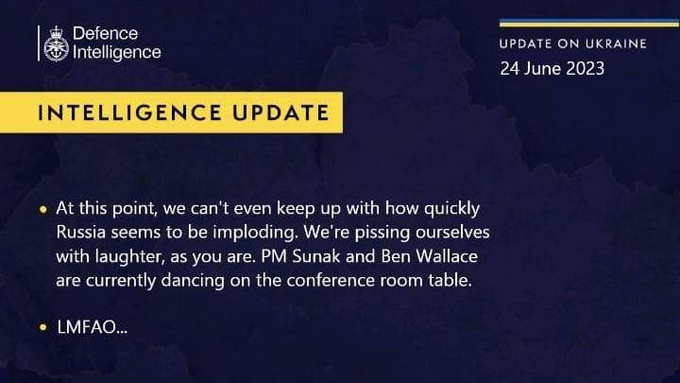
“Sir Humphrey Appleby” tweeted this, saying it was “the intelligence update slide every DI analyst secretly dreams of producing …
As we write this, roughly a day has passed since the sudden end of what briefly looked like a massive event with the potential to reshape global politics for a generation … before it fizzled. The rebellion of Russia’s Wagner mercenary group and its bolt toward Moscow was a stunning story, until it wasn’t. And that itself is a stunning story. Yevgeny Prigozhin, former chef and now Wagner leader, suddenly called off his mutiny, and it just … ended.
Really?
When the mutiny began on Friday, and especially when Wagner seized the southern city of Rostov, home to a major Russian military headquarters overseeing the invasion of Ukraine as well as a million other people, we were surprised, but the more we thought about it, we weren’t particularly shocked. There had been obvious signs of an imminent rupture of some kind in recent months; Line editor Gurney had wondered on Twitter how long it could last before something snapped. That was about three hours before the entire country seemed to snap and Prigozhin marched into Rostov and began moving north.
Events proceeded at a fairly frantic pace after that, with Wagner troops advancing almost all the way to Moscow while Russian security forces fortified the city and tore up roads along the route. It wasn’t clear to us that Wagner had enough men to actually take the city and potentially capture key members of the government. But it wasn’t clear that he didn’t: there are two sides of that equation — the troops Prigozhin had and the troops Putin could count on to oppose Wagner. It was the latter group that captured our interest.
Wagner encountered some resistance along the way, but not much. Most of Russia’s army is deployed in Ukraine, of course, and much of what’s left is now of famously poor quality and morale. But even those military and security forces that were able to block Wagner’s advance didn’t seem that interested in the job. There are reports that some units went over to Prigozhin’s side, but it seems that most of them just did … nothing in particular. And waited to see what happened. For a few hours, we wondered if Prigozhin’s small force would be just large enough in the face of a Russian military that seemed to have no appetite for battle on its own soil.
We can’t pretend to explain the bizarre conclusion to this chaotic day and a half, with an apparent deal brokered by Belarus seeing Wagner’s advance on Moscow called off, a broad amnesty granted to all participants and Prigozhin apparently set to continue to oversee Wagner’s global operations from Belarus in some kind of exile. This is all just wildly unrealistic. Prigozhin cannot be the last person around to realize that he’s put a target on his back and that he’ll soon experience some kind of fatal medical emergency or tragic tumble out of an open window. The moment his mercenaries took Rostov, he had only one path forward: all the way to the Kremlin. What the hell he’s thinking is frankly beyond our ability to guess, and we have fairly vivid imaginations. It’s baffling.
Nor will we try to guess what this will mean for Russia. In a situation like this, your Line editors would normally simply confess that we don’t have the deep knowledge of Russian domestic politics to turn ourselves into credible instant-experts on this. We’d seek out someone with that knowledge. We could interview them, solicit a column from them, or even — as we’ve done in the past — allow someone with deep expertise but who isn’t permitted to speak on the record in public to provide a blurb for one of these dispatches, to run under our shared byline. But in this case, we had to reject all those options, because at least for right now, all the experts seem as baffled as we are. No one seems to understand what the hell just happened in Russia.
We can say with at least reasonable confidence that if you happen to be named Vladimir Putin, it isn’t good. When Prigozhin announced that he was ending his mutiny and began withdrawing his forces from Rostov, the locals cheered them like some kind of conquering heroes. That’s gotta be on Putin’s mind. Also on his mind: the apparent, ahem, reluctance of much of his military and domestic security force to rally to his side during the crisis. This has wounded Putin. Time will tell how badly. Time will also tell how many other people in Russia today have carefully watched recent events, have adjusted their understanding of the facts on the ground there, and are now pondering a variety of intriguing options accordingly.
And the last thing time will tell is what Putin feels he must now do to assert his authority, such as it is. We must recall that whatever Putin’s domestic troubles, he has problems on the battlefield, too. While we haven’t yet seen major breakthroughs by Ukrainian forces, they are not yet fully committed, and their counteroffensive does seem to be making gradual progress in multiple sectors. Events of recent days can only hurt Russia’s combat performance and morale.
We wish we could offer you all a more firm and decisive statement to wrap all this up. But the best we can honestly promise you is that we’ll keep pondering this, trying to figure out what the hell happened, and we’ll certainly be watching this. It’s been a strange war. And we suspect it might get stranger still before it finally ends.
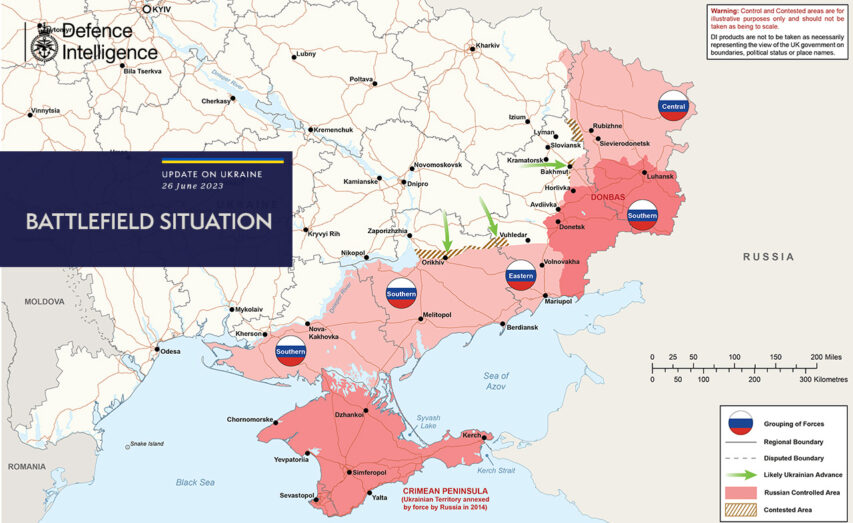
The most recent Defence Intelligence update map from the British Ministry of Defence shows what is thought to be a reasonably accurate representation of the battlefront in eastern Ukraine:
Comments Off on “No one seems to understand what the hell just happened in Russia”
Uncancelled History with Douglas Murray | EP. 05 Winston Churchill
Nebulous Media
Published 20 Dec 2022Andrew Roberts joins Douglas Murray on this episode to discuss Winston Churchill. The two discuss the soldier, writer and prime minister in detail, leaving nothing off limits. Should the British Bulldog stay cancelled?
(more…)
Comments Off on Uncancelled History with Douglas Murray | EP. 05 Winston Churchill
June 26, 2023
DShK-38: The Soviet Monster .50 Cal HMG
Forgotten Weapons
Published 10 Mar 2023In 1925 the USSR began a program to develop a heavy machine gun for antiaircraft use. After some initial experimentation with a converted Dreyse machine gun, they brought in Degtyarev to scale up his recently-adopted light machine gun to the task. Degtyarev’s first design was ready in 1930, and underwent testing until 1933. It was designated the DK, and used a 30-round drum magazine. This contributed to an unacceptably low rate of fire (~360 rpm), and the feed system was replaced by an ingenious development of Georgiy Shpagin to use belts instead.
Fitted with the Shpagin feed system, the DShK finished field testing in 1939 and was adopted as the model 1938. Production was slow, and the guns were not used on anything like the scale of American M2 use during World War Two. A total of about 9000 were in use at the end of the war, although the subsequent update to the DshKM (aka DShK 38/46) pattern would see it fitted to many armored vehicles, and total production eventually topped one million.
This example is a very early production 1939 example, most likely a Finnish capture piece from the Winter War or Continuation War.
(more…)
Comments Off on DShK-38: The Soviet Monster .50 Cal HMG
June 25, 2023
Workers will be forced to stop working to salve the consciences of university-educated elite wankers
Brendan O’Neill on the Climate Goblin’s latest stunt in Sweden:

Picture the daughter of an opera singer preventing working-class men from doing their jobs. A young woman so well-connected that she probably has presidents on speed-dial physically blocking truck drivers from doing what they do. A child of privilege gathering with her similarly comfortable pals to stop working people from working.
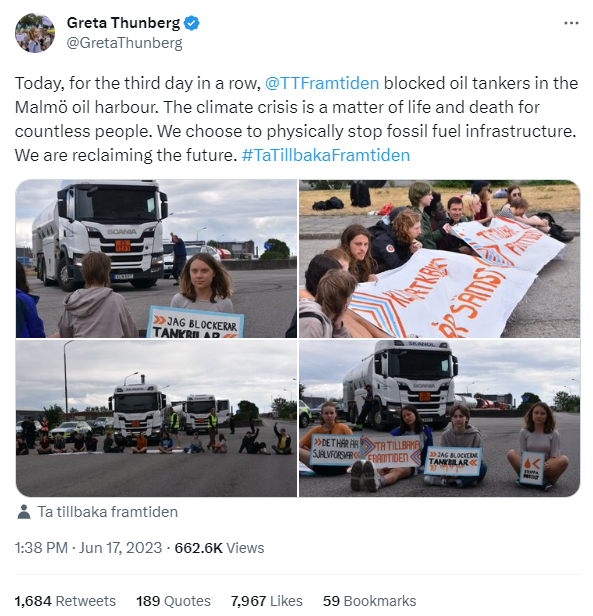
Well, shorn of all the fact-lite bluster about “saving the planet”, that’s exactly what Greta Thunberg’s latest eco-stunt adds up to. The pint-sized prophetess of doom is back in the headlines. This time for getting arrested in Malmo harbour in Sweden, where she and other members of the End is Nigh cult have been holding a sit-down protest to stop oil tankers from leaving and delivering their life-giving cargo to the good people of Sweden and beyond.
The photographs from this temper tantrum disguised as a political protest tell a fascinating tale of the classism and narcissism in green politics. In the middle of the road are the smug-looking youths. One has green hair. Others sport beanie hats. None has ever driven a truck, clearly. Their banners speak of defending Earth from man’s evil burning of the toxic sludge of oil. And in the background are the supposed agents of this evil – the truckers; working men idly standing by their tankers while the world’s media get shots of Greta looking sad for Gaia.
What an apt snapshot of the hierarchy of virtue in what passes for radical politics today. Working-class people reduced to background actors, non-player characters, in a drama feverishly focussed on the jumped-up angst of the privileged. Working men as mere backdrop to the eco-neuroses of the comfortably off. In the moral universe fashioned by eco-influencers and their legion fawners in the political and media elites, the irrational fears of the upper-middle class carry more weight than the living standards of the working class.
It’s a story we see repeated across every act of eco-agitation today. In the UK, the plummy activists of Just Stop Oil, all called Poppy or Edred, block roads and prevent builders, scaffolders, deliverymen, mums and others from carrying out their essential work. The fightback of working men against this imperious imposition on their right to earn a living – witness scaffolders pushing eco-irritants out of the road – has been heartening to see. As a worker at Smithfield meat market in London put it a few years back when Extinction Rebellion types stormed in to speak up for animal rights or something, why should I allow this “happy-clappy mob” to stop me from being “able to pay my bills”?
Comments Off on Workers will be forced to stop working to salve the consciences of university-educated elite wankers
British schoolchildren mock their oh-so-woke teachers
In Christopher Gage’s weekly round-up, I discovered that I shared a trait with Ted Kaczynski (“austere anarchist scholar” as US mainstream media might have described him). Not just any trait, but the one that ended up putting him in prison after nearly twenty years of sending bombs through the mail:

Elliot Rodger, Ed Kemper and Ted Kaczynski.
Photos from Quillette.
… Ted insisted on the proper use of the idiom, “You can’t eat your cake and have it, too”. Ted rejected the common and logically fraught version: “You can’t have your cake and eat it, too”. Indeed, you can. You must have your cake if you are to eat your cake. You cannot have your cake once you’ve eaten your cake.
That turn of phrase helped F.B.I agents snare Ted. His sister-in-law read his essay, recognised the writing style, and the peculiar diction, and then grassed him up to the rozzers.
For the record, this may be the only point of agreement I have with that noted austere scholar, although I’ve never read any of his writings to find out.
Another amusing incident involved children taking the Mickey out of ultra-progressive teachers in British schools:
Last week, schoolchildren in Sussex dropped themselves into the soup after suggesting that their fellow classmate is not actually a cat.
Two thirteen-year-old girls at Rye College were told they “should go to a different school” if they didn’t believe that a girl could identify as a cat.
During a “life education” class, the pair said there was “no such thing as agender” and: “If you have a vagina, you’re a girl, and if you have a penis, you’re a boy — that’s it.”
When they queried how someone could identify as a cat, the pair were blasted for questioning their classmate’s identity.
An investigation found children at schools across the land now identify as dinosaurs and horses. Another often dons a cape and demands to be acknowledged as a moon. Another identifies as Bambi.
After the hysteria simmered, it became obvious what was going on here. And it too became obvious that this is a good thing.
Reader, these children are taking the Mickey.
When confronted with obvious nonsense held by their preachy, supposedly superior teachers, these kids cannot resist mocking them to a nub.
After all, if one can identify as whatever one wants then that includes anything one wants. For teenagers primed with mischief, this is just too good a brew not to sup on a daily basis.
And it is a promising sign. Ridicule, the sharp-elbowed sister of truth, is essential to all progress. Clearly, these kids are unafraid to think for themselves and are determined to see that which is beyond their own nose.
Perhaps this is the beginning of the end of what almost everybody knows to be patent nonsense. As history assures us, once something becomes a laughingstock it soon dies of ridicule.
As James Thurber put it, that which cannot withstand laughter is not a good thing.
Comments Off on British schoolchildren mock their oh-so-woke teachers
The Greatest Pincer Movement in Military History – WW2 – Week 252 – June 24, 1944
World War Two
Published 24 Jun 2023The Red Army surges forward in Operation Bagration, a mighty new offensive to destroy German Army Group Centre. Fighting continues in Normandy, Italy, and Finland. The United States Navy tears the heart out of the Imperial Japanese Navy in the Philippine Sea even as the Imperial Japanese Army has success in China. The British and Indian armies lift the siege of Kohima.
(more…)
Comments Off on The Greatest Pincer Movement in Military History – WW2 – Week 252 – June 24, 1944
June 24, 2023
Official mythmaking about the Empire Windrush in 1948
The Armchair General unpacks some of the story-spinning being conducted by the British government and various charities to mark the 75th anniversary of the voyage of the Empire Windrush from Jamaica to Britain:
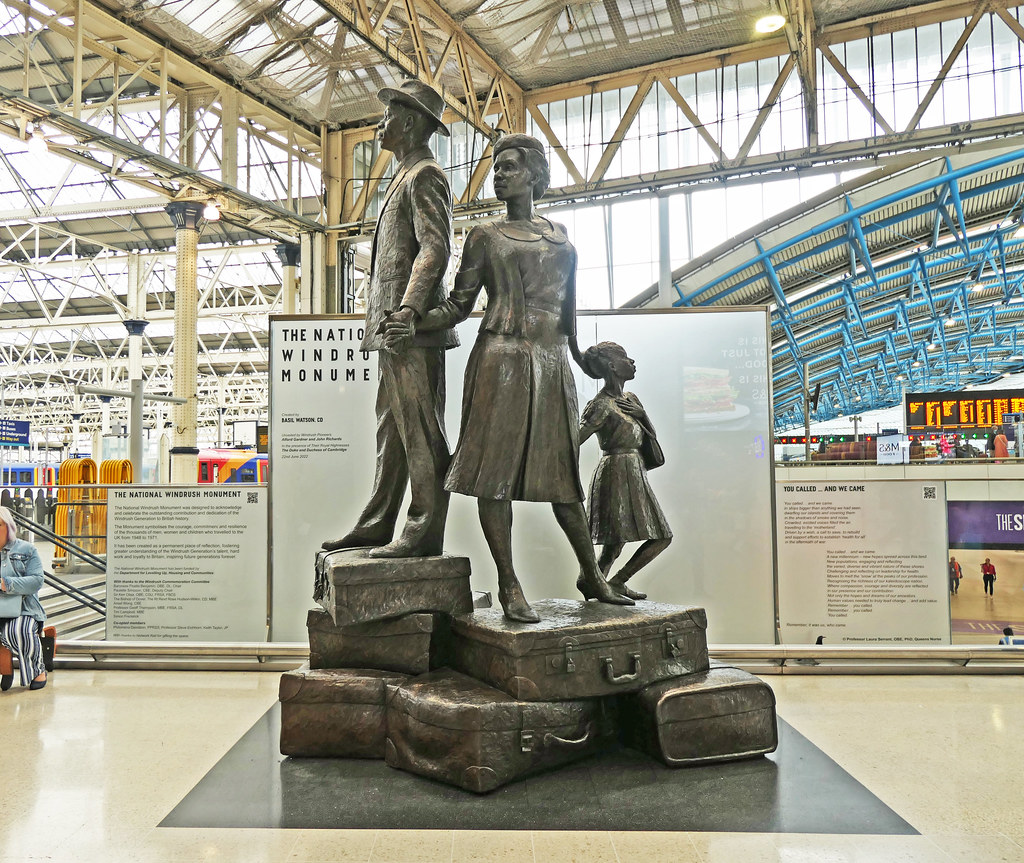
“The National Windrush Monument” by amandabhslater is licensed under CC BY-SA 2.0 .
The Armchair General notes that there is much excitement about the 75th anniversary of the arrival of the ship called the Empire Windrush — which arrived on 22 June 1948 — and the contribution of the so-called Windrush Generation.
The myth currently being constructed is that those coming from Jamaica on the ship were invited, in order to rebuild a Britain struggling to recover from Word War II; we are told that, with so many young men killed in the fighting, Britain needed menial workers to selflessly come and rebuild our economy. Indeed, this view of events has been cemented in a much-lauded poem by Professor Laura Serrant.
Remember … you called.
Remember … you called
YOU. Called.
Remember, it was us, who came.Like almost any story constructed by governments and charities over at least the last thirty years, this narrative is dodgy at best and downright dishonest at worst. The simple fact is that the ship’s operator had expected to leave Jamaica under capacity and so offered passage at half price: many local men (and it was all men) took the opportunity.
Writing in The Spectator, in an article well worth reading in full, Ed West points out that the British government certainly did not encourage these immigrants at all.
Far from calling them, the British government was alarmed by the news. A Privy Council memo sent to the Colonial Office on 15 June stated that the government should not help the migrants: “Otherwise there might be a real danger that successful efforts to secure adequate conditions of these men on arrival might actually encourage a further influx.”
Colonial Secretary Arthur Creech Jones replied: “These people have British passports and they must be allowed to land.” But, he added confidently: “They won’t last one winter in England.” Indeed, Britain had recently endured some very harsh winters.
The Ministry of Labour was also unhappy about the arrival of the Jamaican men, minister George Isaacs warning that if they attempted to find work in areas of serious unemployment “there will be trouble eventually”. He said: “The arrival of these substantial numbers of men under no organised arrangement is bound to result in considerable difficulty and disappointment. I hope no encouragement will be given to others to follow their example.”
Nor was it the solely the evil Tories who were concerned:
Soon afterwards, 11 concerned Labour MPs wrote to Prime Minister Clement Attlee stating that the government should “by legislation if necessary, control immigration in the political, social, economic and fiscal interests of our people … In our opinion such legislation or administration action would be almost universally approved by our people.” The letter was sent on 22 June; that same day the Windrush arrived at Tilbury.
One can hardly be surprised: after all, 75 years ago, the Labour Party at least strove to represent the working class of Britain and the simple fact is that there was, at the time, massive unemployment — so much so that the government was heavily subsidising tickets to Australia (at £10) in order to encourage British people to emigrate (over 2 million British people left between 1948 and 1960).
There is a certain amount of well-intentioned inclusive myth-making in this story, and from a historical point of view the idea that “diversity built Britain”, the birthplace of the Industrial Revolution, is bizarre. Until 1952 Britain was the richest country in Europe, after which we massively fell behind our continental rivals – so if diversity did “build” the country, it didn’t do a great job.
One can argue, I think, that the Windrush Generation made a great many contributions, in common with many immigrants; and if their contribution was not, in reality, as large as is claimed, then they share that with the EEC/EU’s Common Market which, again (and despite all the claims), brought no discernible benefit to the UK.
H/T to Tim Worstall for the link.
Comments Off on Official mythmaking about the Empire Windrush in 1948


