
The Tank Museum
Published 27 Aug 2021In this latest episode of Tank Chats, Curator David Willey details the German Marder. A post-war Infantry Fighting vehicle.
(more…)
December 9, 2021
Tank Chat #135 | Marder | The Tank Museum
Comments Off on Tank Chat #135 | Marder | The Tank Museum
December 5, 2021
Axis Armies Facing Starvation – WW2 – 171 – December 4, 1942
World War Two
Published 4 Dec 2021The Soviets have launched offensives on the entire eastern front and by now hundreds of thousands of men are surrounded at Stalingrad. The Japanese win a battle at sea, but are losing a war of attrition.
(more…)
Comments Off on Axis Armies Facing Starvation – WW2 – 171 – December 4, 1942
December 3, 2021
French Breakout Attempt During The Siege of Paris 1870 – Battle of Villiers-Champigny
Real Time History
Published 2 Dec 2021Sign up for Curiosity Stream and get Nebula bundled in and SAVE 26%: https://curiositystream.com/realtimeh…
The Siege of Paris has been going on for months in November 1870 and the population is starving. The French Army has previously tried and failed to break out but this week they are starting their biggest attempt yet — not knowing that it has been doomed from the start.
» THANK YOU TO OUR CO-PRODUCERS
John Ozment
James Darcangelo
Jacob Carter Landt
Thomas Brendan
James Giliberto
Kurt Gillies
Albert B. Knapp MD
Tobias Wildenblanck
Richard L Benkin
Scott Deederly
John Belland
Adam Smith
Taylor Allen
Jim F Barlow
Rustem Sharipov» OUR PODCAST
https://realtimehistory.net/podcast – interviews with historians and background info for the show.» LITERATURE
Arand, Tobias: 1870/71. Der Deutsch-Französische Krieg erzählt in Einzelschicksalen. Hamburg 2018Ders.: “Rogerowski oder Rasumowsky? Überlegungen zur nationalen ‘Meistererzählung’ in Fontanes ‘Kriegsgefangen’“, in: Fontane-Blätter 105 (2018). S. 61-86
Ders.: “‘… dazu find ich keine Worte’ – Der Blick auf den Krieg von 1870/71 in Erinnerungsbüchern deutscher Veteranen“, in: Nation im Siegesrausch. Württemberg und die Gründung des Deutschen Reichs 1870/71, hrsg. u. bearb. von W. Mährle. Stuttgart 2020. S. 85-98
Bourguinat, Nicolas and Gilles Vogt: La guerre franco-allemande de 1870. Une histoire globale. 2020
Gouttman, Alain: La grande défaite. 1870-1871. Paris 2015
Lecaillon, Jean-François: Les Femmes et la Guerre de 1870/71. Histoire d’un engagement occulté. Paris 2020
» SOURCES
Hérisson, Maurice d’: Journal d’un officier d’ordonnance. Paris 1885De Trailles, Paul et Henry: Les femmes de France pendant la guerre et les deux sièges de Paris. Paris 1872
Fontane, Theodor: Der Krieg gegen Frankreich. Bd. 3. Berlin 1874
Fontane, Theodor: Kriegsgefangen. Erlebtes 1870. Briefe 1870/71. Berlin (Ost) 1984
Kühnhauser, Florian: Kriegs-Erinnerungen eines Soldaten des königlich bayerischen Infanterie Leibregiments. Partenkirchen 1898
N. N. (Hrsg.): Bismarcks Briefe an seine Gattin aus dem Kriege 1870/71. Stuttgart, Berlin 1903
Schikorsky, Isa (Hrsg.): “Wenn doch dies Elend ein Ende hätte”, Ein Briefwechsel aus dem Deutsch-Französischen Krieg 1870/71. Köln, Weimar, Wien 1999
Wöllwarth, Julie von: Unter den Verwundeten von 1870/71. Aufzeichnungen aus einer großen Zeit. o.O, o.J. (1890)
Zola, Émile: La Débacle. Paris 1892
» OUR STORE
Website: https://realtimehistory.net»CREDITS
Presented by: Jesse Alexander
Written by: Cathérine Pfauth, Prof. Dr. Tobias Arand, Jesse Alexander
Director: Toni Steller & Florian Wittig
Director of Photography: Toni Steller
Sound: Above Zero
Editing: Toni Steller
Motion Design: Philipp Appelt
Mixing, Mastering & Sound Design: http://above-zero.com
Maps: Battlefield Design
Research by: Cathérine Pfauth, Prof. Dr. Tobias Arand
Fact checking: Cathérine Pfauth, Prof. Dr. Tobias ArandChannel Design: Battlefield Design
Contains licensed material by getty images
All rights reserved – Real Time History GmbH 2021
Comments Off on French Breakout Attempt During The Siege of Paris 1870 – Battle of Villiers-Champigny
November 28, 2021
Bigger Than Uranus? – Mars – WW2 – 170 – November 27 1942
World War Two
Published 27 Nov 2021Last week’s counterattack was just the beginning, for the Soviets launch another giant offensive this week. And things look bad for the Axis powers in the south of the USSR. Meanwhile in France, the French scuttle their navy rather than allow it to fall into German hands.
(more…)
Comments Off on Bigger Than Uranus? – Mars – WW2 – 170 – November 27 1942
November 26, 2021
The Battles of Amiens and Beaune-La-Rolande 1870 – Bismarck Wants His Kaiser
Real Time History
Published 25 Nov 2021Support us on Patreon: https://patreon.com/realtimehistory
After a brief break in the fighting, the Franco-Prussian War continues in late November with the Battles of Amiens and Beaune-La-Rolande. Both sides are exhausted and the casualties are mounting. In the meantime Bismarck is trying to convince the German states of a new German Emperor.
» THANK YOU TO OUR CO-PRODUCERS
John Ozment
James Darcangelo
Jacob Carter Landt
Thomas Brendan
James Giliberto
Kurt Gillies
Albert B. Knapp MD
Tobias Wildenblanck
Richard L Benkin
Scott Deederly
John Belland
Adam Smith
Taylor Allen
Jim F Barlow
Rustem Sharipov» OUR PODCAST
https://realtimehistory.net/podcast – interviews with historians and background info for the show.» LITERATURE
Arand, Tobias: 1870/71. Die Geschichte des Deutsch-Französischen Krieges erzählt in Einzelschicksalen. Hamburg 2018Arand, Tobias: Gestorben für “Vaterland” und “Patrie”. Die toten Krieger aus dem Feldzug von 1870/71 auf dem “Alten Friedhof” in Ludwigsburg. Ludwigsburg 2012
Barry, Quintin: The Franco-Prussian War 1870-71. Vol 2 After Sedan. Solihull, 2007
Gouttman, Alain: La grande défaite. 1870-1871. Paris 2015.
Howard, Michael: The Franco-Prussian War. London, 1961
» SOURCES
Braun, Lily (Hrsg.): Kriegsbriefe aus den Jahren 1870/71 von Hans von Kretschman. Berlin 1911Bundesgesetzblatt des Norddeutschen Bundes, Band 1867, Nr. 1, Seite 1–23
Fontane, Theodor: Kriegsgefangen. Erlebtes 1870. Briefe 1870/71. Berlin (Ost) 1984
Haus der Bayerischen Geschichte (Hrsg.): Gründung des Deutschen Kaiserreichs 1871. Unterrichtsmaterialien. o. O. 2011
Königliche Geheime Ober-Hof-Druckerei (Hrsg.): Verlust-Listen der Königlich-Preußischen Armee und der Großherzoglich Badischen Division aus dem Feldzuge 1870-1871. Berlin 1871
Kühnhauser, Florian: Kriegs-Erinnerungen eines Soldaten des königlich bayerischen Infanterie Leibregiments. Partenkirchen 1898
Kürschner, Joseph (Hrsg.): Der große Krieg in Zeitberichten. Leipzig o.J. (1895)
Moltke, Helmuth von: Geschichte des deutsch-französischen Krieges von 1870-71. Berlin 1891
Zeitz, Karl: Kriegserinnerungen eines Feldzugsfreiwilligen aus den Jahren 1870 und 1871. Altenburg 1905
» OUR STORE
Website: https://realtimehistory.net»CREDITS
Presented by: Jesse Alexander
Written by: Cathérine Pfauth, Prof. Dr. Tobias Arand, Jesse Alexander
Director: Toni Steller & Florian Wittig
Director of Photography: Toni Steller
Sound: Above Zero
Editing: Toni Steller
Motion Design: Philipp Appelt
Mixing, Mastering & Sound Design: http://above-zero.com
Maps: Battlefield Design
Research by: Cathérine Pfauth, Prof. Dr. Tobias Arand
Fact checking: Cathérine Pfauth, Prof. Dr. Tobias ArandChannel Design: Battlefield Design
Contains licensed material by getty images
All rights reserved – Real Time History GmbH 2021
Comments Off on The Battles of Amiens and Beaune-La-Rolande 1870 – Bismarck Wants His Kaiser
The Germans Learn to Love Their Slaves – WAH 047 – November 1942, Pt. 2
World War Two
Published 25 Nov 2021In November 1942 the resistance fight in many parts of Europe becomes a part of the regular military war. In Germany, the Germans discover humanity while the German mass murders see no end.
(more…)
Comments Off on The Germans Learn to Love Their Slaves – WAH 047 – November 1942, Pt. 2
Look at Life — Air Umbrella (1961)
PauliosVids
Published 20 Nov 2018A look at NATO’s international squadrons, with footage of the F104 Starfighter.

Comments Off on Look at Life — Air Umbrella (1961)
November 24, 2021
Tank Chats #133 | Renault UE Chenillette | The Tank Museum
The Tank Museum
Published 6 Aug 2021In this weeks Tank Chat, Curator David Willey talks about the Renault UE Chenillette. A light tracked armoured carrier produced by France between 1932 and 1940.
(more…)
Comments Off on Tank Chats #133 | Renault UE Chenillette | The Tank Museum
November 21, 2021
The Red Army Kicks Ass – Operation Uranus! – WW2 – 169 – November 20th, 1942
World War Two
Published 20 Nov 2021After months of stubborn defense the time has finally come for the Soviet counterstroke, but is it in time to save Stalingrad? And can the Allies reach Tunis and take all of North Africa before the Axis can reinforce?
(more…)
Comments Off on The Red Army Kicks Ass – Operation Uranus! – WW2 – 169 – November 20th, 1942
November 19, 2021
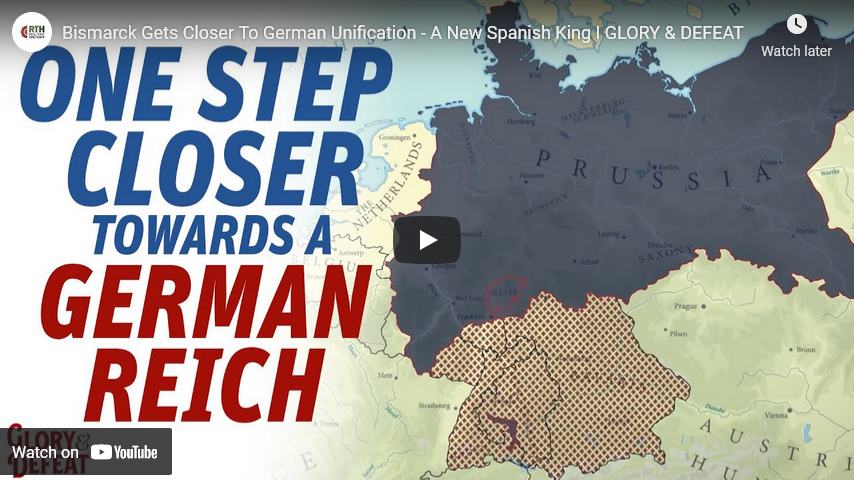
Bismarck Gets Closer To German Unification – A New Spanish King I GLORY & DEFEAT
Real Time History
Published 18 Nov 2021Sign up for Curiosity Stream and get Nebula bundled in and SAVE 26%: https://curiositystream.com/realtimeh…
While the Franco-Prussian War is continuing its messy guerilla phase, the German leaders are negotiating towards a united Germany. Hesse and Baden join the promptly renamed German Confederation — but Württemberg and Bavaria still want more concessions. Meanwhile the question of Spanish succession that started the war is solved in Madrid.
» THANK YOU TO OUR CO-PRODUCERS
John Ozment
James Darcangelo
Jacob Carter Landt
Thomas Brendan
James Giliberto
Kurt Gillies
Albert B. Knapp MD
Tobias Wildenblanck
Richard L Benkin
Scott Deederly
John Belland
Adam Smith
Taylor Allen
Jim F Barlow
Rustem Sharipov» OUR PODCAST
https://realtimehistory.net/podcast – interviews with historians and background info for the show.» LITERATURE
Arand, Tobias: 1870/71. Der Deutsch-Französische Krieg erzählt in Einzelschicksalen. Hamburg 2018Gouttman, Alain: La grande défaite. 1870-1871. Paris 2015
Koch, Roland : “Les canons à balles dans l’armée du Rhin en 1870” in Revue historique des armées, 255 (2009), p. 95-107.
» SOURCES
Braun, Lily (Hrsg): Kriegsbriefe aus den Jahren 1870/71 von Hans von Kretschman weiland General der Infanterie. Berlin 1911Carr, Raymond: Spain 1808–1939. Oxford: At the Clarendon Press, 1975
Deuerlein, Ernst: Die Gründung des Deutschen Reichs 1870/71 in Augenzeugenberichten. Düsseldorf 1970
Goncourt, Edmond de: Journal des Goncourts. II.1. 1870-1871. Paris 1890
Kühnhauser, Florian: Kriegs-Erinnerungen eines Soldaten des königlich bayerischen Infanterie Leibregiments. Partenkirchen 1898
Lowndes, Emma: Récits de femmes pendant la guerre franco-prussienne (1870-1871). Paris, 2013.
Meisner, Heinrich Otto (Hrsg.): Kaiser Friedrich III. Das Kriegstagebuch von 1870/71. Berlin, Leipzig 1926
N.N: + Amadeus von Savoyen in: Neue Presse v. 19. Januar 1890. S. 2
N. N. (Hrsg.): Bismarcks Briefe an seine Gattin aus dem Kriege 1870/71. Stuttgart, Berlin 1903
Schikorsky, Isa (Hrsg.). “Wenn doch dies Elend ein Ende hätte”. Ein Briefwechsel aus dem Deutsch-Französischen Krieg 1870/71. Köln, Weimar, Wien 1999
» OUR STORE
Website: https://realtimehistory.net»CREDITS
Presented by: Jesse Alexander
Written by: Cathérine Pfauth, Prof. Dr. Tobias Arand, Jesse Alexander
Director: Toni Steller & Florian Wittig
Director of Photography: Toni Steller
Sound: Above Zero
Editing: Toni Steller
Motion Design: Philipp Appelt
Mixing, Mastering & Sound Design: http://above-zero.com
Maps: Battlefield Design
Research by: Cathérine Pfauth, Prof. Dr. Tobias Arand
Fact checking: Cathérine Pfauth, Prof. Dr. Tobias ArandChannel Design: Battlefield Design
Contains licensed material by getty images
All rights reserved – Real Time History GmbH 2021
Comments Off on Bismarck Gets Closer To German Unification – A New Spanish King I GLORY & DEFEAT
November 17, 2021
The Real History Behind The Forgotten Battle | Battle of Walcheren 1944
History With Hilbert
Published 10 Nov 2021The Forgotten Battle is a Dutch/Belgian Netflix war film set during the Battle of Walcheren in 1944, part of the Liberation of the Netherlands from German control following the successful D-Day landings of the Allies. In this video I look at the history of the Battle of the Scheldt and in particular the assault on Walcheren, as well as some of the other historical aspects covered by the film such as Dutchmen who served in the Waffen SS on the Eastern Front and the Dutch Resistance (De Ondergrondse) who fought against the German occupiers and aided the Allies in their push into the Netherlands.
@History Hustle’s excellent videos on Dutch Waffen SS units:
https://www.youtube.com/watch?v=bQlF0…Go Fund My Windmills (Patreon):
https://www.patreon.com/HistorywithHi…Join in the Banter on Twitter:
https://twitter.com/HistorywHilbertIndulge in some Instagram..?(the alliteration needs to stop):
https://www.instagram.com/historywith…0:00 – Intro
3:00 – Walcheren Remains In German Hands
4:14 – The Battle of Walcheren Causeway
6:18 – Operation Infatuate I & II
8:00 – Walcheren Is Captured
8:47 – Dutchmen Serving in the SS
10:18 – The Dutch Resistance In World War 2
13:04 – OutroSend me an email if you’d be interested in doing a collaboration! historywithhilbert@gmail.com
#WW2 #Netherlands #Netflix
Comments Off on The Real History Behind The Forgotten Battle | Battle of Walcheren 1944
Child Soldier Camps, Captured Crewmen, and Chaotic Air Forces – WW2 – OOTF 025
World War Two
Published 16 Nov 2021How did the “Nazi pirates” treat their captured crewmen? Why didn’t the Soviets just bomb the motionless German armies stuck in a traffic jam? And how did the Nazi government convince parents to allow their children to go to “evacuation” camps? Find out the answers in this latest edition of Out of the Foxholes!
(more…)
Comments Off on Child Soldier Camps, Captured Crewmen, and Chaotic Air Forces – WW2 – OOTF 025
QotD: From Theda Bara to Lady Gaga
… despite showing acres of pallid flesh in the fetish-bondage garb of urban prostitution, Lady Gaga is far less sexy than Stefani Germanotta used to be. In fact, Gaga isn’t sexy at all — she’s like a gangly marionette or plasticised android. How could a figure so calculated and artificial, so clinical and strangely antiseptic, so stripped of genuine eroticism have become the icon of her generation? Can it be that Gaga represents the exhausted end of the sexual revolution? In Gaga’s manic miming of persona after persona, over-conceptualised and claustrophobic, we may have reached the limit of an era.
In 1933, the critic I.A. Richards, writing about “The Waste Land”, spoke of T.S. Eliot’s “persistent concern with sex, the problem of our generation, as religion was a problem of the last.” After the first world war, sexual experimentation and titillating smart talk became the hallmark of the emancipated new woman, who smoked, drank, bobbed her hair and danced the antic Charleston. Hollywood discovered that sex was great box office — leading to pressure from civic and religious groups for a production code, which movie-makers found ingenious ways to evade.
We are approaching the 100-year anniversary of Hollywood sex: Theda Bara’s incarnation as The Vamp in A Fool There Was (1915), a lurid femme fatale who slew overnight the lingering Victorian ideal of the pure, saintly woman-child, portrayed on screen by Mary Pickford and Dorothy and Lilian Gish. Theda Bara, like Lady Gaga, was a manufactured personality; although the studio publicity department claimed she was born in the Sahara to a French artist and Arabian princess, she was actually Theodosia Goodman, the daughter of a Jewish tailor in Cincinnati.
The sexual icon of 1920s Hollywood was Clara Bow, a madcap flapper who was probably falsely rumoured to have bedded the entire University of Southern California football team. Lithe Louise Brooks, with her signature bobbed hair, made landmark films of decadent eroticism in Germany. Wicked Mae West and lushly buxom Jean Harlow began the tradition of the sex bomb, which continued through Hedy Lamarr to Jane Russell and Marilyn Monroe, whose influence endures around the globe. But the cardinal sexual pioneer was Marlene Dietrich, who exploded on the international scene in 1930 as the heartless cabaret singer of The Blue Angel. In her subsequent films with the director Josef von Sternberg, Marlene toyed with transvestism (based on the drag balls of Weimar Berlin) and created the sophisticated look of hard glamour that remains a staple of fashion magazines.
Marlene was Madonna Louise Ciccione’s idol; the seductive, commanding Marlene permeates Madonna’s brilliant videos of the 1980s and the early ’90s, with their dominatrix, transvestite and bisexual motifs. Madonna wanted to play Marlene on film, but the idea was overruled by Marlene herself, who (as the proud daughter of a Prussian officer) decreed Madonna “too vulgar”.
Weimar cabaret was recreated in the 1972 film Cabaret, based on Christopher Isherwood’s Berlin stories. Bob Fosse’s dazzlingly aggressive choreography in that blockbuster film was adopted by Madonna for her videos and stage shows — all of which have been doggedly imitated by Lady Gaga. Gaga has borrowed so heavily from Madonna (as in her latest “Alejandro” video) that it must be asked, at what point does homage become theft? But the main point is that the young Madonna was on fire. She was indeed the imperious Marlene Dietrich’s true heir. Madonna’s incandescence is still on view in videos like “Open Your Heart”, “Vogue” and “Express Yourself”. However, for Gaga, sex is mainly decor and surface; she’s like a laminated piece of ersatz rococo furniture. Alarmingly, Generation Gaga can’t tell the difference. Is it the death of sex? Perhaps the symbolic status that sex had for a century has gone kaput; that blazing trajectory is over.
Camille Paglia, “Lady Gaga: The Death of Sex”, Sunday Times, 2010-09-12.
Comments Off on QotD: From Theda Bara to Lady Gaga
November 15, 2021
Fighting Nazis with Radios and Funerals – WAH 046 – November 1942, Pt. 1
World War Two
Published 14 Nov 2021As the Winter of 1942/43 is beginning, the German Nazis are under more and more pressure, both on the frontlines and in the occupation zones.
(more…)
Comments Off on Fighting Nazis with Radios and Funerals – WAH 046 – November 1942, Pt. 1
November 14, 2021
Axis and Allies Both Invade France – WW2 – 168 – November 13, 1942
World War Two
Published 13 Nov 2021Operation Torch goes off this week, the Allied invasion of French Northwest Africa, but this prompts the Germans to invade Vichy France. This is the Allies’ first combined major offensive in the Western Hemisphere. The Germans launch another offensive of their own this week, though — Operation Hubertus in Stalingrad. And in the South Pacific, a major naval battle begins off Guadalcanal.
(more…)
Comments Off on Axis and Allies Both Invade France – WW2 – 168 – November 13, 1942


