
Forces TV
Published on 30 Aug 2018Upper Heyford was one of the largest US Air Force bases in Europe, housing bombers that carried NATO’s intermediate-range nuclear weapons… now it’s attracting Hollywood A-listers…
Read more: https://www.forces.net/news/declassif…
September 21, 2018
Declassified: The Old RAF Base Bringing Hollywood To Upper Heyford | Forces TV
Comments Off on Declassified: The Old RAF Base Bringing Hollywood To Upper Heyford | Forces TV
September 20, 2018
The Last Lee Enfield: the L42A1 Sniper
Forgotten Weapons
Published on 31 Aug 2018More info: https://www.forgottenweapons.com/the-…
http://www.patreon.com/ForgottenWeapons
When the British military adopted the FAL (L1A1 SLR) in 1960, they adopted the 7.62x51mm NATO cartridge along with it. While the Bren guns were converted to the new cartridge, efforts at converting the Lee Enfield into a precision rifle were not successful at the time. However, civilian target shooters and the British NRA would work on perfecting that conversion for use in competition, and would ultimately produce very accurate 7.62mm rifles built on Lee Enfield actions – accurate enough that the military took notice. Copying the competition rifles, the British military would adopt the L42A1 in 1970, an Enfield action converted to 7.62mm NATO with a shortened and free-floated stock and hand guard and a heavy profile barrel. A total of 1,080 L42A1 rifles would be converted from existing No4 MkI(T) sniper rifles, and they would serve in the front lines of the British military until 1992, when they were replaced by the Accuracy International L96A1.
If you enjoy Forgotten Weapons, check out its sister channel, InRangeTV! http://www.youtube.com/InRangeTVShow
Comments Off on The Last Lee Enfield: the L42A1 Sniper
September 18, 2018
A case to keep Theresa May in power … at least until March, 2019
Sean Gabb offers about the only possible justification for the British Tories to keep Theresa May on as Prime Minister:

Let us imagine that there is a vote of no-confidence in Mrs May as Leader of the Conservative Party. Let us imagine what is not certain — that someone more committed to leaving then becomes the Prime Minister. We can suppose that Anna Soubry and Damian Green will resign the Conservative whip — they and perhaps several dozen others of their kind. They are held from doing this at the moment because the ghostly electoral mandate Mrs May has gives them no excuse for splitting. A new Prime Minister without any mandate would give them their excuse. This would leave the Government with no majority. But there is worse.
Between a third and half the Parliamentary Labour Party would like an excuse to peel away and form a new party. So far, they have not found this excuse. A Conservative split would be their excuse. I can imagine a “centrist” block of 150 Members in the House of Commons. Add the Scottish Nationalists and the Liberal Democrats — that would be enough to form a new coalition government. Whether this new government then called a second referendum or found some less honest method, there would be no departure of any kind from the European Union. And, thanks to the Fixed Term Parliaments Act, they would keep their seats until 2022. After that, they could look forward to a shower of corporate sinecures.
Bearing this in mind, I call on the Conservative leavers not to allow a vote of no-confidence in Mrs May. Instead, let them focus on making it impossible for the Government we have to offer new concessions to the European negotiators. I call on the relevant Jewish organisations to keep up their pressure on the Labour leadership — but not to try for any killing blow. They can have Mr Corbyn’s head on a plate after next March. In short, I pray for no change in any direction in British politics until after we have left the European Union. Then, we can have blood on the moon — the more, the better. Until then, let the May Government continue shuffling towards departure on whatever terms they can get or want to get.
Comments Off on A case to keep Theresa May in power … at least until March, 2019
September 15, 2018
QotD: Churchill on brevity
To do our work, we all have to read a mass of papers. Nearly all of them are far too long. This wastes time, while energy has to be spent in looking for the essential points.
I ask my colleagues and their staffs to see to it that their Reports are shorter.
- The aim should be Reports which set out the main points in a series of short, crisp paragraphs.
- If a Report relies on detailed analysis of some complicated factors, or on statistics, these should be set out in an Appendix.
- Often the occasion is best met by submitting not a full-dress Report, but an Aide-mémoire consisting of headings only, which can be expanded orally if needed.
- Let us have an end of such phrases as these: “It is also of importance to bear in mind the following considerations…”, or “Consideration should be given to the possibility of carrying into effect…”. Most of there woolly phrases are mere padding, which can be left out altogether, or replaced by a single word. Let us not shrink from using the short expressive phrase, even if it is conversational.
Reports drawn up on the lines I propose may at first seem rough as compared with the flat surface of officialese jargon. But the saving in time will be great, while the discipline of setting out the real points concisely will prove an aid to clearer thinking.
Winston Churchill, memorandum to the War Cabinet, 1940-08-09.
Comments Off on QotD: Churchill on brevity
September 14, 2018
A sensible post-Brexit farming policy
Tim Worstall linked to his 2016 post at the Adam Smith Institute that nicely summarizes the best post-Brexit farm policy for Britain:
We have an alternative policy framework to suggest. Let’s just not have a policy. No subsidies, no payments, no department, no Minister, nothing, nowt, zippedy dooh dah. The New Zealand option. You’ve had it good for a century or more now there’s yer bike and have a nice ride.
We would not swear that this is true but we have heard that it is so — British farming has long passed Parkinson’s Event Horizon. There are now more bureaucrats “managing” farming than there are farmers farming. Let’s not pay the farmers anything and thus we don’t need the bureaucrats paying it — a double saving. Instead of £2 to £3 billion a year in taxes going to the farmers, plus whatever the amount again to pay it to them, we could just keep that what, £5 billion? And go and buy food from whomever.
Sounds like a plan really and we recommend it to all. Let’s use Brexit to right some of the wrongs of our current system. One of those wrongs being the incessant whining and demands for bribery from the farming sector.
The correct design of the new domestic agriculture policy is that there isn’t one. And nor is there any funding for either it or its absence. In short Meurig, go away.
Comments Off on A sensible post-Brexit farming policy
September 13, 2018
Broadsword and targe – how Highlanders fought
Lindybeige
Published on 22 Aug 2018A quick introduction to the use of this weapon combination, shot very quickly at Fight Camp 2018. Sorry about the background noise.
Support me on Patreon: https://www.patreon.com/LindybeigeThis was shot at the end of the last day, and I was a bit hoarse from shouting, camping, and beer. When the aircraft overhead gets very loud, I have added subtitles.
The targes we are using are the correct diameter, but the real things were a fair bit heavier, and offered some protection against even musketballs.
Lindybeige: a channel of archaeology, ancient and medieval warfare, rants, swing dance, travelogues, evolution, and whatever else occurs to me to make.
Comments Off on Broadsword and targe – how Highlanders fought
September 11, 2018
Unleashing The Tank’s Full Potential – 1918/1919 Tank Tactics I THE GREAT WAR On The Road
The Great War
Published on 10 Sep 2018Support The Tank Museum: https://www.patreon.com/tankmuseum
Indy and David Willy from the Tank Museum sit inside a Mark V tank to talk about the evolution of tank tactics and how the Allies started to properly use tanks during and after the battle of Amiens.
Comments Off on Unleashing The Tank’s Full Potential – 1918/1919 Tank Tactics I THE GREAT WAR On The Road
How the Media and Literati Class Determines the Politics of a Nation
rubatirabbit
Published on 15 Oct 2016From Yes Prime Minister S02E05 Power To The People
The prime minister intends to introduce a professor’s scheme for enacting bottom-up government. The civil service and reformists reacts to this scheme.
Comments Off on How the Media and Literati Class Determines the Politics of a Nation
September 10, 2018
HMS Victorious Receives New Strike Force (1966)
British Pathé
Published on 13 Apr 2014Full title reads: “Moray Firth. ‘Victorious’ Receives New Strike Force”.
Moray Firth, Scotland.
Air view Royal Navy warship, the aircraft carrier HMS Victorious at sea refuelling from tanker. Air view ditto. Angle shot as Buccaneer fighter jets flies overhead. LV Interior of bridge. SV The Captain DL Davenport talking to Senior Officer. CU The Captain.
LV As Buccaneer comes in and lands on Victorious. LV As wings fold up. GV As it moves to side of ship. Air view as another plane comes in and lands. LV As it misses the arrester wire and overshoots. SV Men watching. Air view as the plane comes in again. CU As it hooks the arrester wire. LV As the plane comes to a halt. CU The arrester wire comes back for next plane. LV Next plane coming in. CU As it hooks wire. LV As it comes to halt.
LV The FDO (Flight Deck Officer) signalling for catapult mechanism to be fixed to aircraft. LV The aircraft preparing for take off. SV As the plane is hooked up. LV Firemen standing ready. Steam is rising from catapult mechanism. CU Firemen. CU FDO signals for take off. LV As the aircraft takes off. SV Buccaneer with wings folded on deck. GV The deck packed with Buccaneers.
(Original Neg.)
FILM ID:1795.16A VIDEO FROM BRITISH PATHÉ. EXPLORE OUR ONLINE CHANNEL, BRITISH PATHÉ TV. IT’S FULL OF GREAT DOCUMENTARIES, FASCINATING INTERVIEWS, AND CLASSIC MOVIES. http://www.britishpathe.tv/
Comments Off on HMS Victorious Receives New Strike Force (1966)
September 9, 2018
QotD: Minimum wages hurt the very poorest workers
The theory that minimum wages discharged the least productive workers had been a constant of Anglophone political economy, dating to John Stuart Mill’s (1848) Principles of Political Economy. When England established a minimum wage with the Trades Board Act in 1909, it did so notwithstanding the objections of a generation of England’s most eminent economists – Henry Sidgwick, Alfred Marshall, Philip Wicksteed, and A.C. Pigou – all of whom observed that while the law could make it criminal to pay a worker less than the minimum, it could not compel firms to hire someone at that rate. Even the intellectual champions of the English minimum wage conceded the point.
Thomas Leonard, Illiberal Reformers, 2016.
Comments Off on QotD: Minimum wages hurt the very poorest workers
September 8, 2018
British tabloids try to stir up trouble with Argentina … again
Sir Humphrey tries to talk the tabloid press in off the ledge over some terrible reporting from the Falkland Islands:
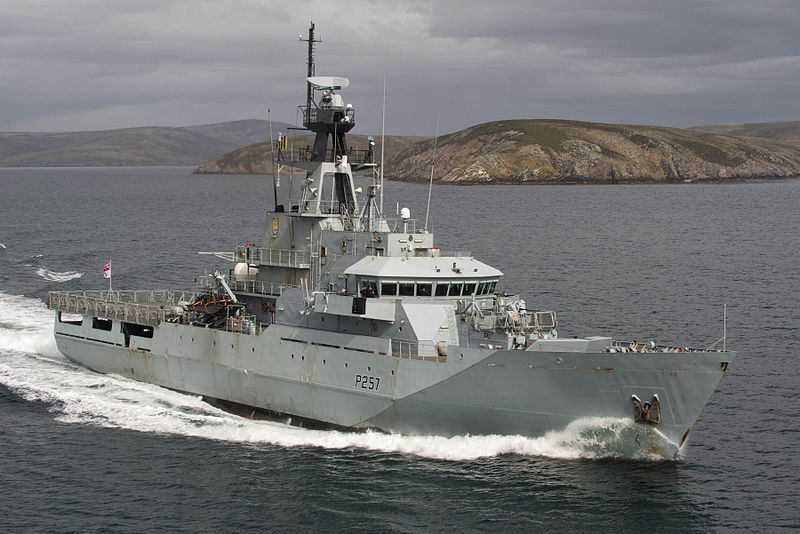
River Class Patrol Vessel HMS Clyde is pictured exercising at sea. HMS Clyde patrols the territorial seas and monitors the airspace around the Falkland Islands whilst conducting routine visits and reassurance to the many small settlements found throughout the islands.
Photo via Wikimedia Commons.
This week it was revealed that an Argentine survey vessel had been reported near the Falkland Islands, and that the local patrol ship HMS Clyde had reportedly been sent to investigate. This simple story led to a barrage of negative news suggesting that the RN had ‘confronted’ the vessel which was apparently looking for oil.
One of the greatest success stories in the last few years for British foreign policy has been the way a formerly tense and difficult relationship with Argentina has so rapidly been reset to become a genuinely productive one. Under the Kirchner regime, which used foreign policy gripes as a means of distracting attention from domestic woes, the relationship between Argentina and the UK was far less productive and strong than it could, or should, have been.
[…]
It is therefore immensely depressing to see some utter rubbish being spouted in the newspapers about what may or may not have happened off the Falkland Islands. The reality is far more simple than is being reported – the vessel in question was a scientific research ship conducting operations near the Burwood bank. Extremely bad weather forced a course change, which brought the vessel closer than planned to the Falkland Islands. (Full source can be found HERE).
The UK and Argentina operate a sensible arrangement to notify each other of movements in certain areas to reduce concerns and maintain effective communications. This agreement means that both nations provide 48hrs notice when a naval vessel will be within 15nm of the others coast line (noting territorial waters usually extend out to 12nm). Usually vessel movements and operational plans are known well in advance, and it is possible to communicate this in a timely fashion. Sometimes though, this doesn’t always go to plan – for instance when a vessel is changing course unexpectedly due to the weather.
On this occasion, it appears to have been the case that the Argentine authorities notified the UK of the vessels course and presence as soon as they were aware of its situation. The vessel herself is not one that is normally covered by these notification arrangements anyway (being a civilian research vessel).
What may have happened is that the UK may have identified an unknown vessel in the local area that they were not expecting to see (noting these waters are reasonably quiet) and began the process of sending HMS Clyde to investigate. As soon as it was clear that in fact this was an entirely legitimate presence, she returned to her normal duties. It is not even clear that HMS Clyde sailed, let alone went close to the Argentine vessel. As the Argentines themselves made clear, no overflight or challenge was made, and normal business continued as the weather improved.
Comments Off on British tabloids try to stir up trouble with Argentina … again
September 4, 2018
WW1 Trucks and Logistics I THE GREAT WAR On The Road
The Great War
Published on 3 Sep 2018Indy and David Willey of the Tank Museum talk a bit about trucks and logistics during WW1 while sitting in some sweet vintage World War 1 trucks.
Comments Off on WW1 Trucks and Logistics I THE GREAT WAR On The Road
September 2, 2018
Adrian Carton de Wiart – WW1 Paratroopers? I OUT OF THE TRENCHES
The Great War
Published on 1 Sep 2018Chair of Wisdom Time!
Comments Off on Adrian Carton de Wiart – WW1 Paratroopers? I OUT OF THE TRENCHES
World of Warships – Public Test 0.7.9 – The Queen, God Bless Her!
The Mighty Jingles
Published on 31 Aug 2018The Public Test Server is currently experiencing large doses of tea, Union Jacks and digestive biscuits that don’t look like much but are in fact strangely tasty. I hear the song of my people, I came as fast as I could.
Comments Off on World of Warships – Public Test 0.7.9 – The Queen, God Bless Her!
HMS Eagle: Royal Aircraft Carrier (1969) | Extra! | British Pathé
British Pathé
Published on 13 Apr 2014This Pathé ‘Extra!’ segment depicts the carrier HMS Eagle in 1969, which was the 15th in a long line of Royal Navy ships to carry that name. This particular ship was an Audacious-class aircraft carrier that hosted all manner of planes from the de Havilland Sea Vixen to the McDonnell Douglas Phantom.
#BritishPathé #RoyalNavy #RAF #Ships #Navy #Military
(FILM ID:2221.15)
Extra ! HMS Eagle.Aerial shot of the aircraft carrier HMS Eagle of the Royal Navy. M/S of radar tower. Several shots of jet aircraft on the deck of the ship including Sea Vixens, Gannets and Phantoms. Shots of jet plane taxiing on runway. M/S to L/S of Sea Vixen taking off from the deck. M/Ss of three men working in the control tower. M/Ss of pilot sitting in cockpit of jet on the deck. Good shot of deck crew at work preparing jet plane for takeoff. L/Ss of Phantom aircraft taking-off. L/S and M/S of the aircraft in-flight. L/S of deck of ship. An aircraft lands on the deck of the ship. M/S of arrester wire. Another shot of plane landing. M/S of Westland Wessex helicopter hovering nearby. Air to air shot of phantom in-flight. M/S shots of plane landing. L/Ss of the aircraft carrier.
Comments Off on HMS Eagle: Royal Aircraft Carrier (1969) | Extra! | British Pathé


