
Jabzy
Published on 22 Jun 2017
September 1, 2018
The Tartan Myth | Stuff That I Find Interesting
Comments Off on The Tartan Myth | Stuff That I Find Interesting
August 31, 2018
Experimental strip farm demonstrates why strip farming was eventually abandoned
Tim Worstall uses an article in the Guardian about a National Trust experimental replication of medieval farming patterns to point out exactly why modern farms do not use them:
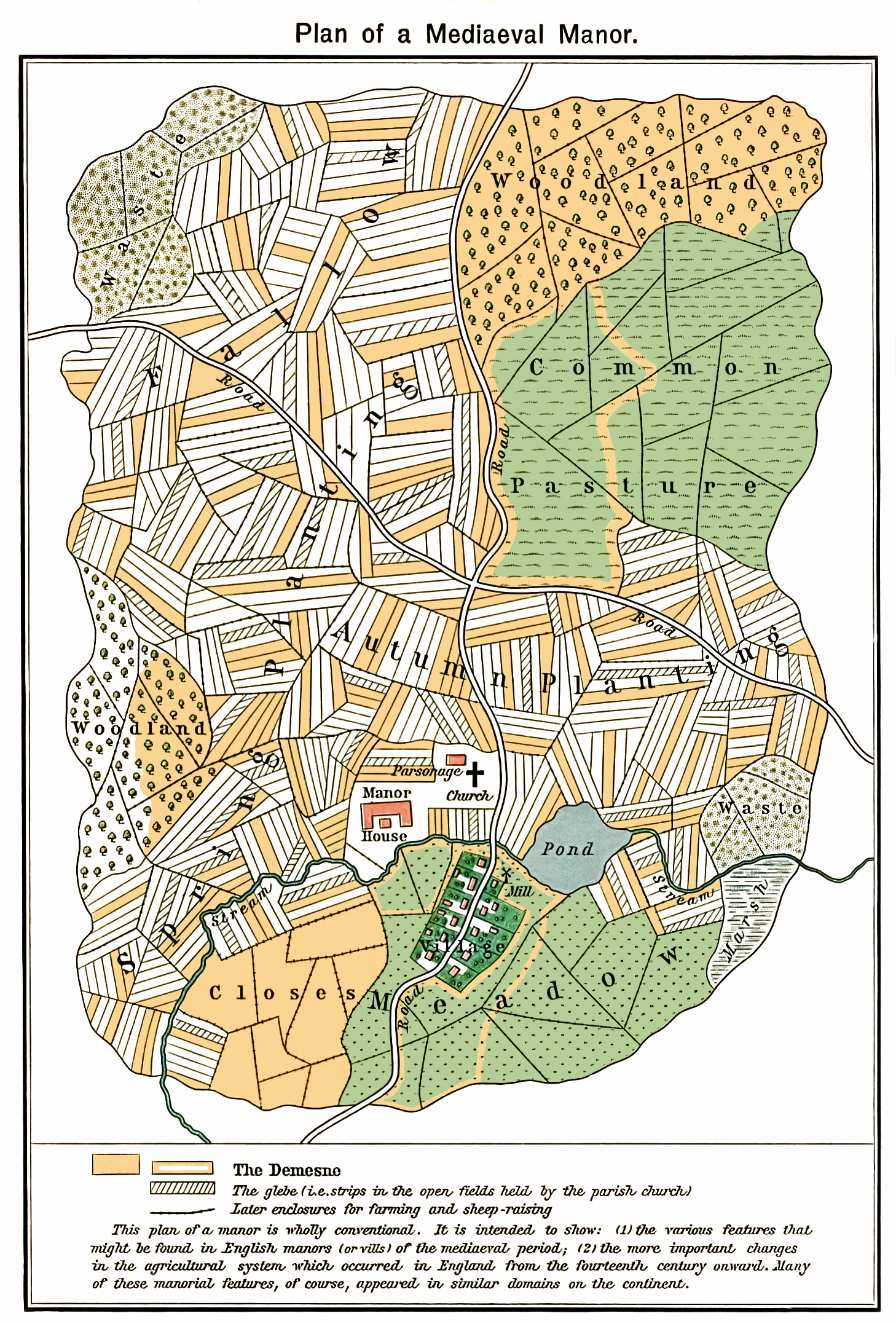
Plan of a fictional medieval manor. The mustard-coloured areas are part of the demesne (owned by the lord), the hatched areas part of the glebe (reserved to support the parish priest).
Illustration from William R. Shepherd’s Historical Atlas, 1923 via Wikimedia Commons.
The proof of the inefficiency is in the presence of that lots more wildlife. We’re trying to grow food for humans to eat recall. So, more wildlife eating off the same earth is less food for humans. We have more butterflies around? That’s nice, but that does mean more caterpillars munching on those now not for humans crops. Hen harriers? Great, but they’re eating the mice and the voles living off those crops. Land that’s growing wildflowers isn’t growing grain or veggies for us, is it?
Sure, it’s nice to have hen harriers, great to have wildflowers. But their very existence on this land shows that this method of farming is less efficient at doing the job of farming – growing food for us. Which is why we abandoned this method of farming of course. Under the simple and basic pressures of trying to gain more output from our inputs. And yes, land is, obviously enough, an input into farming.
And if we’d like to have flowers and harriers? Then we should be using the most efficient farming methods on those areas we do farm so as to leave more space, more land, for the pretty things we’d also like to have. That is, prairies of glycophosphate drenched wheat for us, the other 30 or 50 or 70% of the land left alone for them. And the more chemicals we use on our bit the smaller that bit devoted to us is going to be.
The very fact that we’ve more wildlife as a result of this inefficient farming method shows us that we must be using the more efficient industrial methods. You know, to save the wildlife?
Comments Off on Experimental strip farm demonstrates why strip farming was eventually abandoned
The American First Army Gears Up – Germany Retreats I THE GREAT WAR – Week 214
The Great War
Published on 30 Aug 2018As the German Army withdraws along the Western Front, the Entente prepares for ever more offensives. This includes the newly founded American First Army which will have the task to attack the Germans in the Meuse-Argonnes area.
Comments Off on The American First Army Gears Up – Germany Retreats I THE GREAT WAR – Week 214
How did Britain Conquer India? | Animated History
The Armchair Historian
Published on 10 Aug 2018Check out History With Hilbert: https://www.youtube.com/watch?v=Hs1sw…
Our Patreon: https://www.patreon.com/armchairhistory
Our Twitter: https://twitter.com/ArmchairHist
Sources:
https://dailyhistory.org/Why_was_Brit…
1857 Indian War of Independence: 1857 Indian Sepoys’ Mutiny, Shahid Hussain Raja
The East India Company, Brian Gardner
The Corporation that Changed the World: How the East India Company Shaped the Modern Multinational, Nick Robins
A History of India, Peter Robb
Comments Off on How did Britain Conquer India? | Animated History
August 30, 2018
Britain “forgets” to regulate e-cigarettes, youth smoking drops substantially
Last month, Matt Ridley sang the praises of the regulators who didn’t regulate:

A selection of e-cigarettes
Photo by Ecig Click via Wikimedia Commons.
Britain is the world leader in vaping. More people use ecigarettes in the UK than in any other European country. It’s more officially encouraged than in the United States and more socially acceptable than in Australia, where it’s still banned. There is a thriving sector here of vape manufacturers, retailers, exporters, even researchers; there are 1,700 independent vape shops on Britain’s streets. It’s an entrepreneurial phenomenon and a billion-pound industry.
The British vaping revolution dismays some people, who see it as a return to social acceptability for something that looks like smoking with unknown risks. Yet here, more than anywhere in the world, the government disagrees. Public Health England says that vaping is 95% safer than smoking and the vast majority of people who vape are smokers who are partly or wholly quitting cigarettes. The Royal College of Physicians agrees: “The public can be reassured that ecigarettes are much safer than smoking.”
Lots of doctors are now recommending vaping as a way of quitting smoking. It is because of vaping that Britain now has the second lowest percentage of people who smoke in the European Union. The youth smoking rate in the UK has fallen from 26% to 19% in only six years.
How did this happen here? It’s partly the fault of the advertising executive Rory Sutherland; he is the Walter Raleigh of this revolution. In 2010, he walked into an office in Admiralty Arch to see an old friend, David Halpern, head of David Cameron’s new “nudge unit”, formally known as the Behavioural Insights Team. Sutherland pulled out an electronic cigarette he had bought online, and inhaled. By then, several countries including Australia, Brazil and Saudi Arabia had already banned the sale of electronic cigarettes — usually at the behest of tobacco interests or public-health pressure groups. California had passed a bill banning them, though Arnold Schwarzenegger, then the governor, had vetoed it. It looked inevitable that Britain would follow suit.
“I was a very early convert,” Sutherland tells me now. “Partly because I was a longtime ex-smoker myself who found them much better than constant relapses; I was also interested in the placebo effect they offered by mimicking the act of smoking. But I was almost equally fascinated by the psychology of the people who instinctively wanted to ban them.”
Halpern took notice. He knew the theory of “harm reduction” — that it is more effective to give somebody the lesser of two evils than insist unrealistically on immediate abstinence. So he asked his nudge team to get digging. Over coffee at No 10, he was surprised to learn that even the anti-smoking group Ash was leaning in favour of ecigarettes. So when public-health nannies started calling for them to be banned, Halpern made sure the government resisted.
In his book Inside the Nudge Unit, Halpern wrote: “We looked hard at the evidence and made a call: we minuted the PM and urged that the UK should move against banning e-cigs. Indeed, we went further. We argued we should deliberately seek to make e-cigs widely available, and to use regulation not to ban them but to improve their quality and reliability.”
H/T to Rafe Champion for the link.
Comments Off on Britain “forgets” to regulate e-cigarettes, youth smoking drops substantially
August 29, 2018
Out of Context: How to Make Bad History Worse | World War 2
Knowing Better
Published on 5 Mar 2018Churchill was a genocidal maniac. The Japanese were rounded up into concentration camps. FDR let Pearl Harbor happen. When you take history out of context, you can make it say whatever you want – including making bad things worse.
A long list of links to sources is included, but I’m too lazy to re-link ’em all, just go to YouTube to see them. Back in 2009, I did a short fisking of Pat Buchanan’s hit-piece on Churchill’s “reponsibility” for the outbreak of WW2.
Comments Off on Out of Context: How to Make Bad History Worse | World War 2
August 27, 2018
Feature History – Peninsular War
Feature History
Published on 20 Aug 2017Hello and welcome to Feature History, featuring the Peninsular War and not much else. It’s not called Peninsular War and other stuff, just Peninsular War so really you can’t complain.
Help me defeat Napoleon (or not)
https://www.paypal.me/FeatureHistory
Patreon
https://www.patreon.com/FeatureHistory
https://twitter.com/Feature_History
Discord
https://discord.gg/Zbk4CvR
———————————————————————————————————–
I do the research, writing, narration, art, and animation. Yes, it is very lonely
Comments Off on Feature History – Peninsular War
August 24, 2018
Over By Christmas? – Growing Allied Confidence I THE GREAT WAR Week 213
The Great War
Published on 23 Aug 2018Get David Zabecki’s Book about the German 1918 Offensives: http://bit.ly/Zabecki1918
With the recent “Black Day of the German Army” and the success of the new strategy of Allied attacks along the Western Front and with the renewed offensives in Palestine, British Commander Sir Douglas Haig is confident the war can be won by the end of the year. Entente Generalissimo Ferdinand Foch is a bit more cautious but also thinks the war can be won by 1919.
Comments Off on Over By Christmas? – Growing Allied Confidence I THE GREAT WAR Week 213
Tank Chats #35 Centurion | The Tank Museum
The Tank Museum
Published on 14 Apr 2017The thirty-fifth Tank Chat, presented David Fletcher MBE, is the first of the videos on the Centurion series of tanks.
The Centurion is one of the most important tanks in the history of the British AFV and is one of the most significant post-war Western tanks. Introduced in the spring of 1945, a small number of the Beach Armoured Recovery Version (BARV) served with the British forces during the Iraq war of 2003, 58 years later.
To find out more, buy the Haynes Centurion tank manual. https://www.myonlinebooking.co.uk/tan…
Support the work of The Tank Museum on Patreon: ► https://www.patreon.com/tankmuseum
Or donate http://tankmuseum.org/support-us/donate
Comments Off on Tank Chats #35 Centurion | The Tank Museum
August 22, 2018
The 10 Worst British Military Aircraft
Hush Kit
Published on 5 Feb 2018Patreon – https://www.patreon.com/hush_kit
PayPal – https://www.paypal.me/HushKit
Blog – https://hushkit.net/
If you want something done slowly, expensively and possibly very well, you go to the British. While Britain created the immortal Spitfire, Lancaster and Edgley Optica, it also created a wealth of dangerous, disgraceful and diabolical designs. These are just ten plucked from a shortlist of thirty. In defining ‘worst’- we’ve looked for one, or a combination, of the following: design flaws, conceptual mistakes, being extremely dangerous, being unpleasant to fly, or obsolete at the point of service entry (and the type must have entered service). Grab a cup of tea, and prepare for ire as you read about ten machines they wanted your dad, grandad or great grandad to fly to war. I’d love to hear your opinions below. The original article can be found here: https://hushkit.net/2016/03/02/the-te…
Comments Off on The 10 Worst British Military Aircraft
August 21, 2018
Celebrity chef accused of cultural appropriation
Tim Worstall explains why, despite jerk chicken being something like the national dish of Jamaica, accusing Jamie Oliver of culturally appropriating it makes no sense whatsoever:
Well, here’s a recipe for that jerk chicken which does seem to be close to being the Jamaican national dish.
Ingredients
8 -10 pieces of legs and thighs
1 lemon/lime
Salt and pepper to season
½ tablespoon cinnamon powder
1 sprig of fresh thyme
3 medium scallions (green onions) chopped
1 medium onion coarsely chopped
2-4 habanero pepper chopped
1 1/2 tablespoon Maggi or soy sauce
1 tablespoon bouillon powder optional
3 tablespoons dark brown sugar
6 garlic cloves chopped
1 teaspoon freshly grated nutmeg
1 tablespoon allspice coarsely ground
1 1/2 tablespoon fresh ginger chopped
1 tablespoon coarsely ground pepperAs far as I can tell those ingredients coming from, in order – the chicken, SE Asia via land cultural exchange to Europe and then the Americas by the Portuguese and Spanish. Sure, some evidence of Polynesian delivery but on West Coast only. The lemon, SE Asia, salt everywhere, pepper India or perhaps Indonesia. Cinnamon, SE Asia but introduction to European thus Caribbean cuisines through Ancient Egypt and thus into Greece. Thyme, the Levant and Ancient Egypt, scallions at least as far back as Ashkelon and further east than that. Onions, definitely Eurasian, habaneros definitively Latin American. Soy sauce, think we’ll allow Nippon to claim that, maybe China. Bouillon powder, industrial civilisation somewhere. Sugar, Indian subcontinent, garlic central Asia we think. Nutmeg and allspice the Spice Islands, now Indonesia. Ginger, South and SE Asia.
So, someone who makes this is accusing us of cultural appropriation if we make it?
Oh Aye?
All of which is, of course, to misunderstand the basic point about human beings. We’re apes, ones with a special and remarkable talent. We’ve this readin’ an’ writin’ stuff meaning that when we spot something that works we’re able to tell other people about it. In a manner rather more efficient than just teaching junior to do what we’ve learned to do. This is the secret of our success. That things once learned can be passed onto millions, billions, of other people. If we had to go reinvent the wheel each generation then we’d not all be rolling around in cars now, would we?
The very essence of our being the successful tool using species we are is that we copy. Appropriate that is. So insistences that we don’t “culturally” appropriate are demands that we stop being us, stop being human. Well, you know, good luck with that, however delightful the concept of cultural appropriation is as a method of having something else to shout about.
Comments Off on Celebrity chef accused of cultural appropriation
August 20, 2018
The Opium War
In Quillette, Jeffrey Chen reviews Song-Chuan Chen’s Merchants of War and Peace: British Knowledge of China in the Making of the Opium War:
The war had a name even before its first shot. The first recorded use of the moniker, the ‘Opium War,’ was in an 1839 piece in the London Morning Herald; within months it would be echoed across the benches of Parliament and across the carronades of the fleet sent to punish the Chinese crackdown on British trade.
The war’s nomenclature revealed from the beginning the multivalent views the British public held towards the war: it was at once the “unjust and iniquitous” Opium War — to use Gladstone’s well-known phrase — as well as the patriotic ‘China War,’ as its proponents wanted it to be called. The historiography of the war is similarly divided among varied lines. Some see the war as reflective of China’s failure to catch up to Western technologies; others emphasize the British desire to avenge their slighted national honour as the prime motive for the conflict. A wide array of scholars have placed a central focus on the role of opium, while some prefer to see the war in the context of imperial and economic expansion. Song-Chuan Chen’s Merchants of War and Peace: British Knowledge of China in the Making of the Opium War is a worthy addition to these voices.
Chen’s portrait of the Opium War places the role of British traders and their lobbying efforts in the foreground by arguing that it was British knowledge of China, as transmitted via the merchant class, that contributed to the ‘making’ (in the sense of both manufacture and execution) of the war. Chen asserts that it was the decade-long campaign of bellicose editorials and pamphlets on the part of the Canton merchant intelligentsia, as well as an accumulation of knowledge on the details of China’s coastal defences and overall military strength, that made it possible for Britain to both conceive of and win the war. The book casts, as its main actors, the ‘Warlike Party,’ a group of British merchants in Canton who lobbied for military intervention to expand the Canton System of trade, and the ‘Pacific Party,’ who opposed the war and criticised the diffusion of opium as an illicit and immoral drug. By narrowing his focus towards the production of knowledge, Chen also elevates the importance of language. A chapter of the book is devoted to a summary of the ‘Barbarian’ controversy – the disagreements and narratives spun around the British choice in translating the Chinese character 夷 (Yí) as ‘Barbarian,’ rather than ‘Foreigner.’
Chen’s account is thus of a battle as much between China and Britain as an internal conflict within the British public sphere. Though Chen is careful to nuance his depiction of the war by overlaying the many causal factors detailed by existing scholarship, his book makes two main arguments, which, in the words of the author, are new to the field: firstly, that the decisive factor in the war’s escalation was due to the machinations of the Warlike Party; and secondly, that the Canton System represented a ‘soft border’ through which the British were able to secure intelligence on the Qing state, without a reciprocal exchange of knowledge.
Written in engaging, lucid prose that presents its ideas clearly, if repetitively, Chen’s monograph is studded with riveting selections of his primary source research, drawn from the National Archives, UK, the First Historical Archives of China, the National Palace Museum, the British Library, SOAS Library, and Cambridge’s Jardine & Matheson archive. These quotations are often reproduced at generous length from the Warlike Party’s Canton Register and the Pacific Party’s Canton Press, and they provide a revealing account of the vigorous rhetorical strategies employed by the two camps.
Comments Off on The Opium War
August 17, 2018
Thomas Clarkson: The First Abolitionist
Foundation for Economic Education
Published on 26 Jul 2018The brutal and cruel transatlantic slave trade lasted for more than 300 hundred years. In 1785, Thomas Clarkson, a man you’ve probably never heard of, firmly held to his belief that no man can rightly claim ownership over another. That year he vowed to end the transatlantic slave trade. This is his story.
Comments Off on Thomas Clarkson: The First Abolitionist


