
OverSimplified
Published on 22 Oct 2017“HEY OVERSIMPLIFIED, WHERE’S WW2?!”
Don’t worry, WW2 is still coming! Here’s a little something in the meantime!If you would like to see more OverSimplified on a more regular basis, please consider supporting me on Patreon (Patreon rewards coming soon):
https://www.patreon.com/OverSimple
October 9, 2018
The Falklands – MiniWars #1
Comments Off on The Falklands – MiniWars #1
October 5, 2018
Know Your Ship #50 – C and D Class Destroyers – HMS Crescent & Diana, HMCS Fraser & Margaree
iChaseGaming
Published on 10 Sep 2018A Know Your Ship episode talking about C & D class destroyers, in particular HMS Crescent and Diana and their later service as part of the Royal Canadian Navy HMCS Fraser and Margaree. Enjoy!
Comments Off on Know Your Ship #50 – C and D Class Destroyers – HMS Crescent & Diana, HMCS Fraser & Margaree
October 4, 2018
Prairie Gun Works Timberwolf: British Trials Sniper Rifle
Forgotten Weapons
Published on 26 Sep 2017Armament Research Services (ARES) is a specialist technical intelligence consultancy, offering expertise and analysis to a range of government and non-government entities in the arms and munitions field. For detailed photos of the guns in this video, don’t miss the ARES companion blog post:
http://armamentresearch.com/north-ame…
The Timberwolf is a bolt action precision rifle made by Prairie Gun Works of Manitoba, Canada. It was initially made as a commercial rifle in a number of different calibers, and in 2001 it won Canadian trials to become the C14 Timberwolf Medium Range Sniper Weapon System (replacing the C3A1 Parker-Hale 7.62 NATO rifle previously used in that role).
The Timberwolf was also tested by the British military, and the one we have in today’s video (courtesy of the Shrivenham Defense Academy) is serial number UK001; the British trials rifle. It was not adopted, and the British opted to continue using Accuracy International bolt action rifles for its snipers.
In both the Canadian issue configuration and the British trials version, the rifle is chambered for the .338 Lapua Magnum cartridge, allowing a longer supersonic range than 7.62mm NATO.
http://www.patreon.com/ForgottenWeapons
If you enjoy Forgotten Weapons, check out its sister channel, InRangeTV! http://www.youtube.com/InRangeTVShow
Comments Off on Prairie Gun Works Timberwolf: British Trials Sniper Rifle
QotD: Gandhi in World War One
We are therefore presented with the seeming anomaly of a Gandhi who, in Britain when war broke out in August 1914, instantly contacted the War Office, swore that he would stand by England in its hour of need, and created the Indian Volunteer Corps, which he might have commanded if he hadn’t fallen ill with pleurisy. In 1915, back in India, he made a memorable speech in Madras in which he proclaimed, “I discovered that the British empire had certain ideals with which I have fallen in love …” In early 1918, as the war in Europe entered its final crisis, he wrote to the Viceroy of India, “I have an idea that if I become your recruiting agent-in-chief, I might rain men upon you,” and he proclaimed in a speech in Kheda that the British “love justice; they have shielded men against oppression.” Again, he wrote to the Viceroy, “I would make India offer all her able-bodied sons as a sacrifice to the empire at this critical moment …” To some of his pacifist friends, who were horrified, Gandhi replied by appealing to the Bhagavad Gita and to the endless wars recounted in the Hindu epics, the Ramayana and the Mahabharata, adding further to the pacifists’ horror by declaring that Indians “have always been warlike, and the finest hymn composed by Tulsidas in praise of Rama gives the first place to his ability to strike down the enemy.”
This was in contradiction to the interpretation of sacred Hindu scriptures Gandhi had offered on earlier occasions (and would offer later), which was that they did not recount military struggles but spiritual struggles; but, unusual for him, he strove to find some kind of synthesis. “I do not say, ‘Let us go and kill the Germans,’” Gandhi explained. “I say, ‘Let us go and die for the sake of India and the empire.’” And yet within two years, the time having come for swaraj (home rule), Gandhi’s inner voice spoke again, and, the leader having found his cause, Gandhi proclaimed resoundingly: “The British empire today represents Satanism, and they who love God can afford to have no love for Satan.”
The idea of swaraj, originated by others, crept into Gandhi’s mind gradually. With a fair amount of winding about, Gandhi, roughly, passed through three phases. First, he was entirely pro-British, and merely wanted for Indians the rights of Englishmen (as he understood them). Second, he was still pro-British, but with the belief that, having proved their loyalty to the empire, Indians would be granted some degree of swaraj. Third, as the home-rule movement gathered momentum, it was the swaraj, the whole swaraj, and nothing but the swaraj, and he turned relentlessly against the crown. The movie to the contrary, he caused the British no end of trouble in their struggles during World War II.
Richard Grenier, “The Gandhi Nobody Knows”, Commentary, 1983-03-01.
Comments Off on QotD: Gandhi in World War One
October 1, 2018
Britain’s Labour Party under Jeremy Corbyn has become a “force for antisemitism”
Hugh Fitzgerald on the British Labour Party’s slide into open anti-semitic actions under Jeremy Corbyn:

Jeremy Corbyn, Leader of the Labour Party speaking at a Rally in Hayfield, Peak District, UK on 25th July 2018 in support of Ruth George MP.
Photo by Sophie Brown via Wikimedia Commons.
In Great Britain, Jeremy Corbyn and his willing collaborators in the Labour Party continue their ferocious attacks on anyone in the party who still supports Israel. In the first week of September, a vote of no-confidence against Joan Ryan, the head of Labour Friends of Israel, passed 94-92 among local party members. Frank Field, another long-serving MP and prominent supporter of Israel, resigned as whip to protest the Labour Party becoming a “force for antisemitism” and for allowing a “culture of nastiness, bullying and intimidation” to develop; he was informed that as result he was no longer a member of the Party.
As is well known, Jeremy Corbyn intensely dislikes Israel. He refers to members of Hamas and Hezbollah, on the other hand, as “friends.” They feel the same about him. In a Twitter post, Hamas wrote: “We salute Jeremy Corbyn’s supportive positions to the Palestinians.”
When first accused of having honored dead terrorists at a graveside ceremony in Tunisia in October 2014, Corbyn denied that he had been anywhere near the graves of any terrorists, and he certainly had “no memory” of any wreath laying. Then some photographs surfaced. One of them shows Corbyn holding — with others — a large wreath. And the grave they are standing over turns out to have been that of one of those who planned the murder of the Israeli athletes at the Munich Olympics in 1972.
Another photo of Jeremy Corbyn shows him posing in the same graveyard next to a convicted terrorist, Fatima Bernawi, who was given a life sentence for trying to blow up a Israeli cinema in 1967. While the attempted terror attack did not come off, Bernawi boasted that it was successful because it “generated fear.” Bernawi was later freed in a prisoner swap, and was thus able to attend the same terrorist-honoring graveside ceremony as Jeremy Corbyn.
Asked to explain what he was doing next to a convicted terrorist, Mr Corbyn’s spokesman said: “Jeremy has a long and principled record of solidarity with the Palestinian people and engaging with actors in the conflict to support peace and justice in the Middle East.”
Comments Off on Britain’s Labour Party under Jeremy Corbyn has become a “force for antisemitism”
September 29, 2018
QotD: Alanbrooke and Churchill
This was indeed a typical Churchillian soirée. Like most of those around the table, [Major-General Sir John] Kennedy too kept a diary. His account is graphic and chagrined. He noted at the time that AB [Alanbrooke] did not intervene on his behalf, “although I knew I had said nothing with which he did not agree.” His coda is equally pointed. “Later, I realized the wisdom of the technique which Brooke acquired after many stormy passages with the Prime Minister. Brooke found it an invaluable rule never to tell Churchill more than was absolutely necessary. I remember him once scoring out nine-tenths of the draft of a minute to the Prime Minister, remarking as he did so, ‘The more you tell that man about the war, the more you hinder the winning of it.'”
Footnote to Field Marshal Lord Alanbrooke, War Diaries, 1939-1945, 1957.
Comments Off on QotD: Alanbrooke and Churchill
September 28, 2018
The Meuse-Argonne Offensive – Bulgarian Collapse I THE GREAT WAR Week 218
The Great War
Published on 27 Sep 2018This week, the biggest American military operation in history kicks off with 1.2 million American soldiers trying to take the Krimhilde Stellung. At the same time the Army of the Orient advances into Bulgaria and the Ottoman 7th and 8th armies collapse in Palestine.
Comments Off on The Meuse-Argonne Offensive – Bulgarian Collapse I THE GREAT WAR Week 218
Arthur C. Clarke – Beyond Human – Extra Sci Fi – #2
Extra Credits
Published on 25 Sep 2018Arthur C. Clarke’s novel Childhood’s End explores his self-described “crypto-Buddhist” philosophy and the question of: are higher powers inherently, morally good, or is that something we decide as humans?
Comments Off on Arthur C. Clarke – Beyond Human – Extra Sci Fi – #2
September 27, 2018
QotD: Gandhi’s views on Britain
… as almost always with historical films, even those more honest than Gandhi, the historical personage on which the movie is based is not only more complex but more interesting than the character shown on the screen. During his entire South African period, and for some time after, until he was about fifty, Gandhi was nothing more or less than an imperial loyalist, claiming for Indians the rights of Englishmen but unshakably loyal to the crown. He supported the empire ardently in no fewer than three wars: the Boer War, the “Kaffir War,” and, with the most extreme zeal, World War I. If Gandhi’s mind were of the modern European sort, this would seem to suggest that his later attitude toward Britain was the product of unrequited love: he had wanted to be an Englishman; Britain had rejected him and his people; very well then, they would have their own country. But this would imply a point of “agonizing reappraisal,” a moment when Gandhi’s most fundamental political beliefs were reexamined and, after the most bitter soul-searching, repudiated. But I have studied the literature and cannot find this moment of bitter soul-searching. Instead, listening to his “inner voice” (which in the case of divines of all countries often speaks in the tones of holy opportunism), Gandhi simply, tranquilly, without announcing any sharp break, set off in a new direction.
It should be understood that it is unlikely Gandhi ever truly conceived of “becoming” an Englishman, first, because he was a Hindu to the marrow of his bones, and also, perhaps, because his democratic instincts were really quite weak. He was a man of the most extreme, autocratic temperament, tyrannical, unyielding even regarding things he knew nothing about, totally intolerant of all opinions but his own. He was, furthermore, in the highest degree reactionary, permitting in India no change in the relationship between the feudal lord and his peasants or servants, the rich and the poor. In his The Life and Death of Mahatma Gandhi, the best and least hagiographic of the full-length studies, Robert Payne, although admiring Gandhi greatly, explains Gandhi’s “new direction” on his return to India from South Africa as follows:
He spoke in generalities, but he was searching for a single cause, a single hard-edged task to which he would devote the remaining years of his life. He wanted to repeat his triumph in South Africa on Indian soil. He dreamed of assembling a small army of dedicated men around him, issuing stern commands and leading them to some almost unobtainable goal.
Gandhi, in short, was a leader looking for a cause. He found it, of course, in home rule for India and, ultimately, in independence.
Richard Grenier, “The Gandhi Nobody Knows”, Commentary, 1983-03-01.
Comments Off on QotD: Gandhi’s views on Britain
September 26, 2018
The last British carriers before the Queen Elizabeth class
This is a long, long thread from @EngageStrategy, so I’m putting it below the fold for those who aren’t interested and don’t want to scroll down for hours…
It covers the near-death experience of British carriers in the 1960s (the cancellation of the last fleet carriers), the odd evolution of the “through deck command cruisers” (Invincible, Illustrious, and Ark Royal), the development of the Harrier, and the very near-run thing that was the carriers’ share of combat duty during the Falklands War.
Comments Off on The last British carriers before the Queen Elizabeth class
September 25, 2018
Is the UK military situation really as dire as this new book portrays?
In the Daily Mail, there’s an excerpt from a new book on the British military by Michael Ashcroft and Isabel Oakeshott, White Flag? An Examination Of The UK’s Defence Capability:
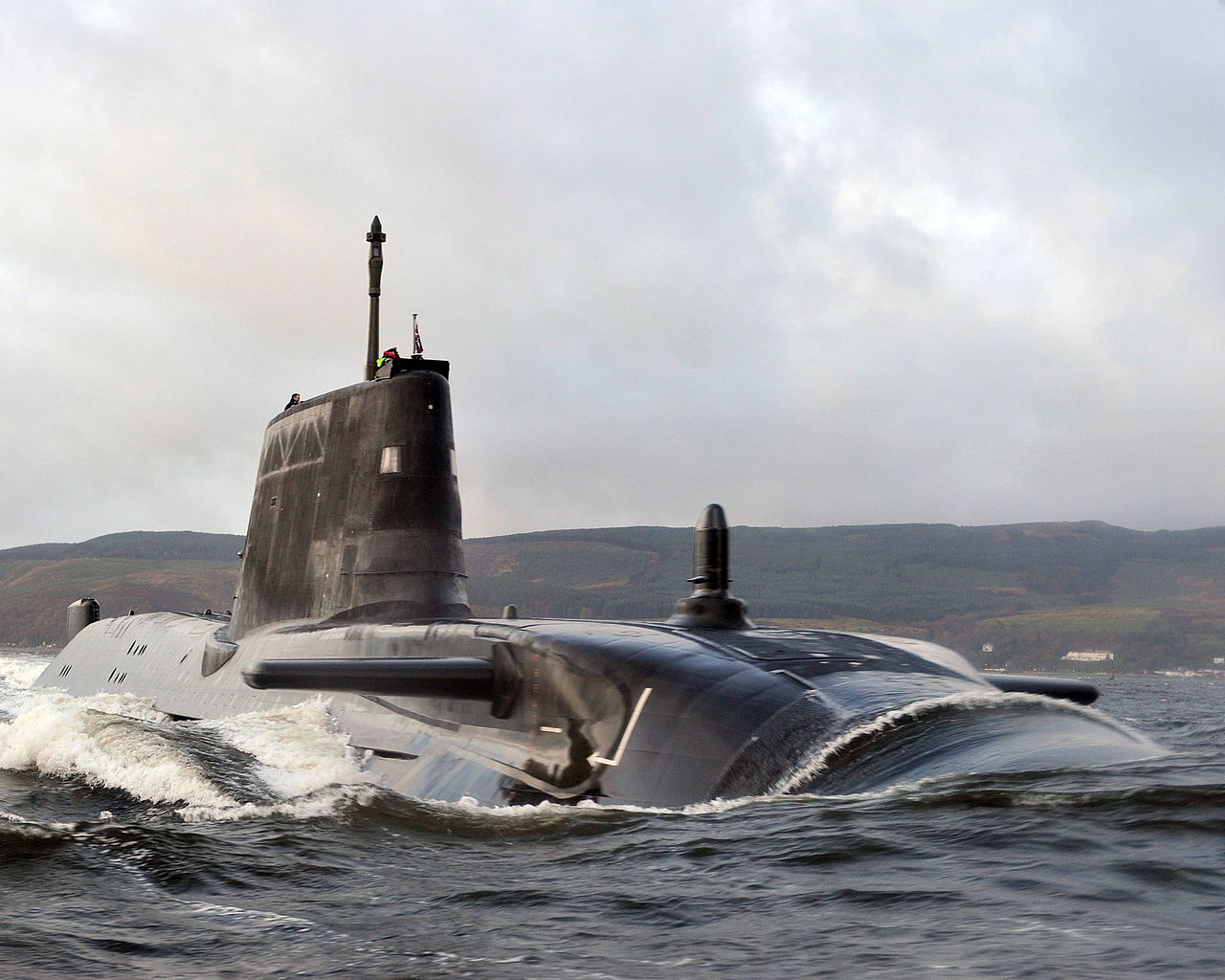
HMS Astute (S119), lead ship of her class, sails up the Clyde estuary into her home port of Faslane, Scotland.
MOD photo, via Wikimedia Commons.
Bluntly, at a time of international crisis, when the prime minister wanted to take a stand against the illegal use of chemical weapons, our Armed Forces did not have what was needed for a full-throttle response.
Naturally, ministers preferred voters to imagine that submarines were on their way to the action. The truth about our limited capability might have fuelled creeping fears that the UK has run up the white flag.
This was one of the many shocks we had during our wide-ranging investigation into the state of this country’s defence capabilities. Thanks to remorseless cuts imposed by successive governments, the Army, Navy and RAF all struggle to meet day-to-day commitments to protect this country and play their part in collective security through Nato and other defence alliances — let alone prepare for serious potential new threats.
The particular problem this time was probably down to maintenance issues.
Hulls need cleaning to stop them rusting, engines need overhauling and nuclear reactors need to be flushed.
When you don’t have very many ships, taking one or two out of circulation leaves quite a gap — in this case, one that could not be filled.
And the fact is that we don’t have enough ships any more. Or aircraft. Or tanks. Or military personnel. Not since Defence became a soft target for governments looking to cut spending.
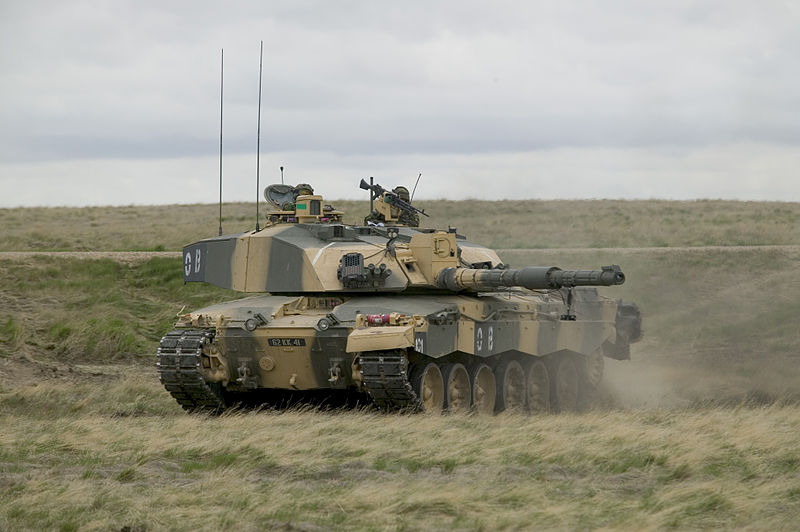
A British army Challenger 2 Main Battle Tank, of 1 Royal Regiment of Fusiliers (1RRF), is shown returning to base after completing a firing mission as part of Exercise MedMan.
1RRF Battle group were based at the British Army Training Unit Suffield (BATUS) in Canada.
MOD photo by Mike Weston via Wikimedia Commons.
What this means on the front line is illustrated by the small but fierce battalion of 800 UK troops stationed at a remote base in the Baltic state of Estonia as a crucial part of Nato’s defences against a Russian attack. They are on their guard at all times, scouring the bleak horizon for anything suspicious.
Inside a vast metal hangar is a fleet of Challenger tanks. The Army wanted to send 18 but the MoD cut this back to ten, of which only eight can be operational because two will always be in for repairs.
Asked if this would be enough if the Russians came over the border, the men we met there shrugged and laughed. They know full well that the Russians could throw as many as 22 tank battalions — that’s more than 650 tanks — at them.
A war-gaming exercise concluded that Nato forces would be ‘woefully inadequate’ in the event of an invasion: the Russians would be in Tallinn, the Estonian capital, within 60 hours.
No wonder the men themselves refer to their assignment as ‘Operation Tethered Goat’. Hopelessly outnumbered, they would be brushed aside, sacrificed to the predatory Putin, like the goat swallowed by the T. rex in Jurassic Park.
QotD: The Laffer Curve
Around a certain sort of leftist mention of the Laffer Curve just brings a derisive snort. The sadness of that reaction being that it’s just an obvious mathematical truth. Tax rates of 0 % and 100 % bring in no revenue. Somewhere in between maximises the moolah. Note what isn’t being said, that all tax cuts always pay for themselves, nor even that lower tax rates are necessarily a good thing. Only that there’s some optimal level with regard to revenue collection.
All the arguments about the optimal level of government are over in the Wagner Curve and such others.
The Laffer Curve is also made up of two components, the income and substitution. Some people will work just to make their nut. Observational studies have shown that many taxi drivers do. So, increase their tax rates and they’ll work more. The substitution effect is, well, what’s that net wage worth to me? What’s the value of not working? When going fishing is worth more than working then people will go fishing. The curve as a whole is the interplay of these two effects.
Each tax in each society has its own such curve. A transactions tax of 0.01% can reduce revenue collection, as the EU’s study of a financial transactions tax shows us. Taxes upon income of 20% are below that Laffer Curve peak.
But where, exactly, is that peak for taxes upon income? The best study we’ve got, Saez and Diamond, says between 54% and 80% dependent upon other structures in the tax system. The Tory part of the UK Treasury says around 40 to 45% for income tax, plus national insurance, so at the bottom end of that S&D range. Many lefties want to say it’s higher so we can tax “the rich” more.
Tim Worstall, “How Lovely To Spot The Laffer Curve In The Wild – Doctors’ Pensions Edition”, Continental Telegraph, 2018-09-05.
Comments Off on QotD: The Laffer Curve
September 23, 2018
The Nimrod MRA4 – the world’s most expensive bad aircraft
Back in 2011, I posted an article about the retirement of the Hawker Siddeley Nimrod from the Royal Air Force inventory. I referred to the Nimrod as
… expensive to buy, eye-wateringly expensive to upgrade, but it must be cheap to operate, right? No:
[…] our new fleet of refurbished De Havilland Comet subhunters (sorry, “Nimrod MRA4s”) will cost at least £700m a year to operate. If we put the whole Nimrod force on the scrapheap for which they are so long overdue right now, by the year 2019 we will have saved […] £7bn
The Register certainly got in the right ballpark with this helpful graphic:

Earlier this month, the Nimrod saga was detailed at Naval Gazing, if only as a way to show that someone can have worse procurement experiences than the United States military. Despite being a military development of a passenger jet famous for crashes, the initial marks of the Nimrod were able to meet the RAF’s needs. The problems began when a requirement was generated for a British AWACS aircraft and the Nimrod was deemed to be the best candidate for conversion (“best” probably meaning “only British competitor”):
Things began to go wrong in the mid-70s, when the British decided to introduce an AWACS aircraft to support their air defense efforts. They had several options. The E-2 Hawkeye and E-3 Sentry were both about to enter service, and were rapidly proving themselves to have excellent radar systems during trials. The British could have had either aircraft, or bought their radar systems to integrate into an aircraft of their own. Or they could have only bought a few subcomponents, like the antenna or the radar transmitter itself, and built the rest domestically.
They decided to take none of these options. Instead, they would produce an entirely new radar system. Instead of an American-style radome, separate antennas would be installed in the nose and tail, and the system would sweep through one, and then the other. This was far more expensive and much riskier than buying from the Americans, but it did produce a lot more jobs in the British defense industry, which was apparently the government’s prime concern. In 1977, a contract was placed, making BAE and GEC-Marconi co-leads on the project to convert 11 surplus Nimrod MR1 airframes to the new configuration.
As might be expected based on that kind of decision-making, the resulting airplane had problems. The computer system chosen wasn’t powerful enough to integrate all of the data, particularly the area where the nose and tail radars overlapped. It was also horribly unreliable, with a mean time between failures of only two hours, in a system which took 2.5 hours to load the mission data from the tape. The Nimrod, considerably smaller than the American Sentry, was unable to carry more equipment to solve this problem. Different electronics racks were earthed to different points in the airframe, and the resulting potential differences caused false tracks to appear, overloading the computer even more. To make matters worse, most of the electronics units weren’t interchangeable for reasons that were never entirely clear. If one unit failed, several spares had to be tried before one that worked was found. The only system that functioned reliably was the IFF system, which could only track friendly aircraft and airliners. This was a major handicap in an aircraft intended to detect incoming Soviet bombers.
It probably isn’t a surprise to hear that the planes were delayed. A lot. And delaying military projects tends to drive the overall price higher. What was anticipated to be a £200-300 million project was over £1 billion before the government of the day came to their fiscal senses and pulled the plug (they ended up buying Boeing E-3 Sentry aircraft instead).
A few years later, the RAF ran a competition to replace the Nimrod MR2 maritime patrol aircraft. Lockheed, Dassault and Airbus entered the competition, but somehow, the RAF ended up selecting BAE’s bid which involved rebuilding 30-year-old Nimrod frames with new electronics and all the modern conveniences.
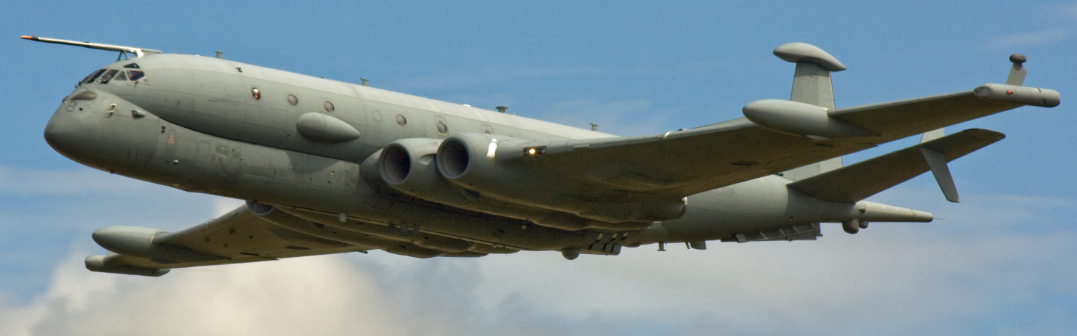
RAF Nimrod MRA4 on 18 July 2009.
Detail of original photo by Ronnie Macdonald, via Wikimedia Commons.
In 1996, a contract was issued for the new aircraft, designated Nimrod MRA4. 21 aircraft were to be produced at a cost of £2.8 billion, and they would be essentially new airplanes, with only the fuselage structure being retained. The antique Spey engines would be replaced with modern BR700s. These engines were significantly larger, and required much more air, forcing BAE to design a new, larger wing. The combined effect of these two changes was to double the Nimrod’s range and improve performance. Inside, the flight deck was replaced with one derived from the A340 airliner, and the mission systems were to be all-new.
A fuselage was sent to be reverse-engineered for the design of the new wing, and BAE designed and built it, then pulled in another aircraft to make the modification. And discovered that the wing didn’t fit. Apparently, the problem dated back to the initial construction of the aircraft. When positioning the frames, Hawker Siddeley had not done what all sensible manufacturers did, and measured from a common baseline. Instead, they had positioned each frame with a tolerance relative to the previous one, which meant that the position of the wings varied by as much as a foot across the fleet. Worse, the aircraft they had designed the wings for was one of the most extreme in wing position, so the new wings didn’t fit most of the other aircraft. This forced a redesign of the wings, further delaying the program.
Spoiler: they missed their delivery deadline. By nearly a decade. And the original plan to build 21 aircraft shrank to only 4 … but the budget continued to grow, from the original £2.8 billion to over £4.1 billion at cancellation. Each of the surviving airframes had literally cost more than £1 billion. That’s why Bean gave the Nimrod his “Naval Gazing Worst Procurement Ever” trophy, and I think it was very well-deserved.
Comments Off on The Nimrod MRA4 – the world’s most expensive bad aircraft
September 22, 2018
Arthur C. Clarke – Master of Science Fiction – Extra Sci Fi – #1
Extra Credits
Published on 18 Sep 2018Arthur C. Clarke is well known for his work on 2001: A Space Odyssey, but even more importantly he ventured into writing novels instead of just magazine serializations. Works like The City and the Stars asked big philosophical questions in science fiction.
Comments Off on Arthur C. Clarke – Master of Science Fiction – Extra Sci Fi – #1
September 21, 2018
Allied Breakthroughs In Palestine And Macedonia I THE GREAT WAR Week 217
The Great War
Published on 20 Sep 2018In a turbulent week of the First World War, the Allies break through at the Macedonian Front during the Battle of Vadar and in Palestine during the Battle for Palestine. At the same time, the Ottoman defeats the last defenders of Baku.
Comments Off on Allied Breakthroughs In Palestine And Macedonia I THE GREAT WAR Week 217


