
The Great War
Published on 29 Oct 2018Check out War2Glory: http://bit.ly/TheGreatWar_W2G
Great Britain was the center of a vast colonial empire and a rapidly changing world during the 19th and early 20th century. But what happened in the country in the years leading up to World War 1?
October 31, 2018
Great Britain Before World War 1 I THE GREAT WAR Special
Comments Off on Great Britain Before World War 1 I THE GREAT WAR Special
Some Criticism of The Infographics Show – Best World War 2 Battleships and Battlecruisers
iChaseGaming
Published on 10 Oct 2018There is something called Wikipedia. You can find it here: https://en.wikipedia.org/wiki/Main_Page
Comments Off on Some Criticism of The Infographics Show – Best World War 2 Battleships and Battlecruisers
October 30, 2018
RE: Bren vs Spandau – which was better? @Lindybeige
Military History Visualized
Published on 17 May 2016Patreon: https://www.patreon.com/mhv
Response video, it was necessary, I like Lindybeige, but his latest video “Bren vs Spandau – which was better?” had too many errors. So here is my response to his video.
Comments Off on RE: Bren vs Spandau – which was better? @Lindybeige
October 28, 2018
The actual science behind the “leaves on the line” excuse for late trains
While it doesn’t explain the “wrong type of snow” excuse also deployed by announcers when Britain’s trains run inexplicably slow in winter, here’s the scientific facts about the “leaves on the line” excuse:
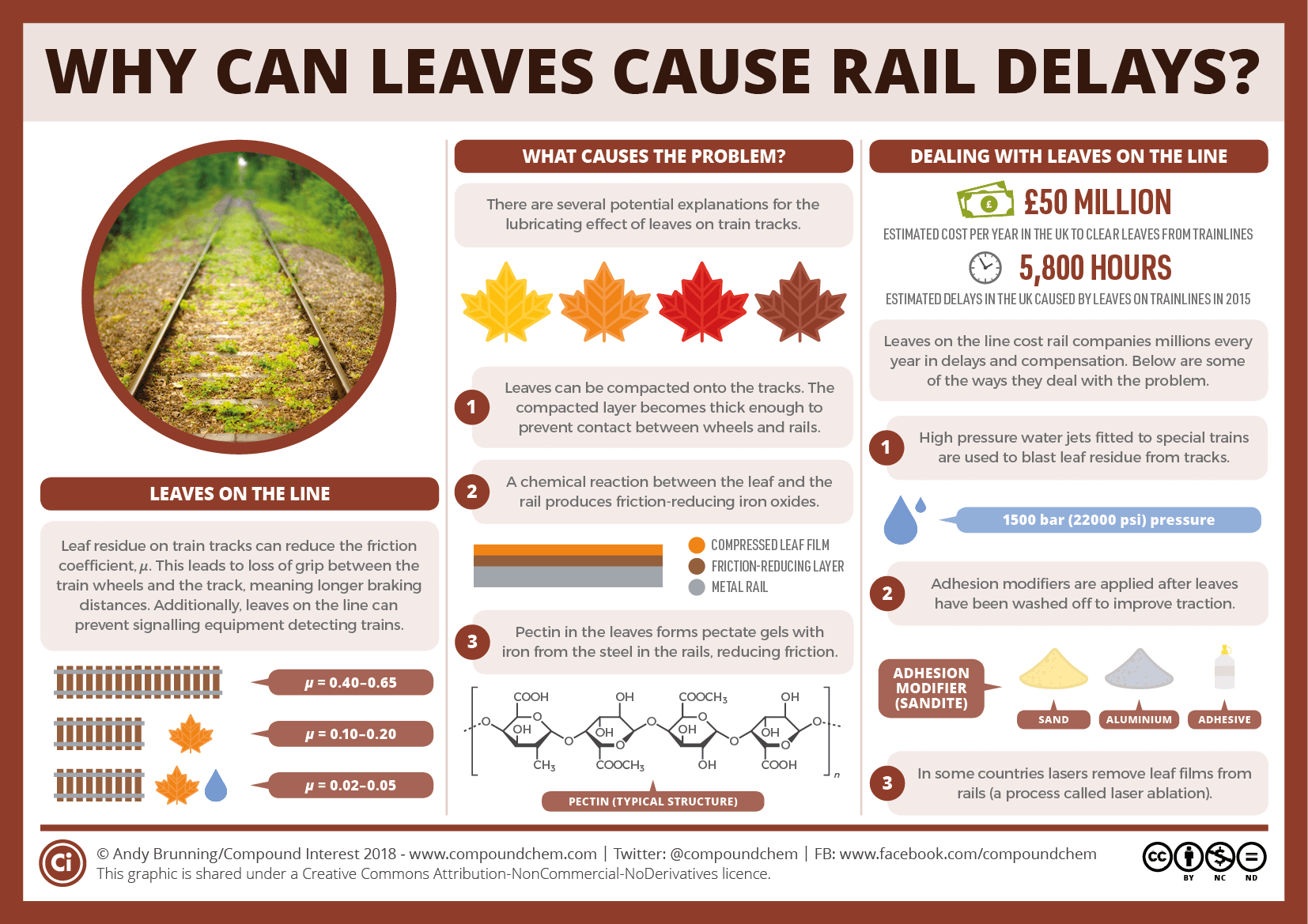
Autumn is here, and for most of us, it’s a time of beauty as the leaves cascade through an array of hues before pirouetting down from the trees. If you have to travel by train, however, you might tire of ‘leaves on the line’ being the supposed cause of train delays. It turns out to be more than just a flimsy excuse – and particular chemical reactions are partly to blame.
We’ve previously looked at the chemical cause of the colours of autumn leaves. By the time they make their descent from trees to the ground, most of these colours have passed. What remains is a brown husk, mainly made up of cellulose. Cellulose is the biological polymer that is the main component of plant cell walls.
Once leaves have fallen from trees, they simply decompose over time. Their presence isn’t usually a problem until it comes to the train network. When leaves fall on train lines, they can reduce the grip between the train wheels and the track. This, in turn, can lead to longer braking distances for trains. By disrupting the contact between the train wheels and the track, the leaves also prevent signalling equipment detecting trains. This can then cause train delays.
What makes leaves affect train tracks in this way? Scientists have a few suggestions, and it’s likely that they all contribute to the problem to some extent.
Comments Off on The actual science behind the “leaves on the line” excuse for late trains
October 27, 2018
HMS Queen Elizabeth to depend on Shock! Horror! Dutch escort!
At the Thin Pinstriped Line, Sir Humphrey explains to “Disgusted of Tunbridge Wells” and all the other would-be Admirals of the Fleet why having a non-RN escort for Britain’s newest aircraft carrier is hardly a bad thing:
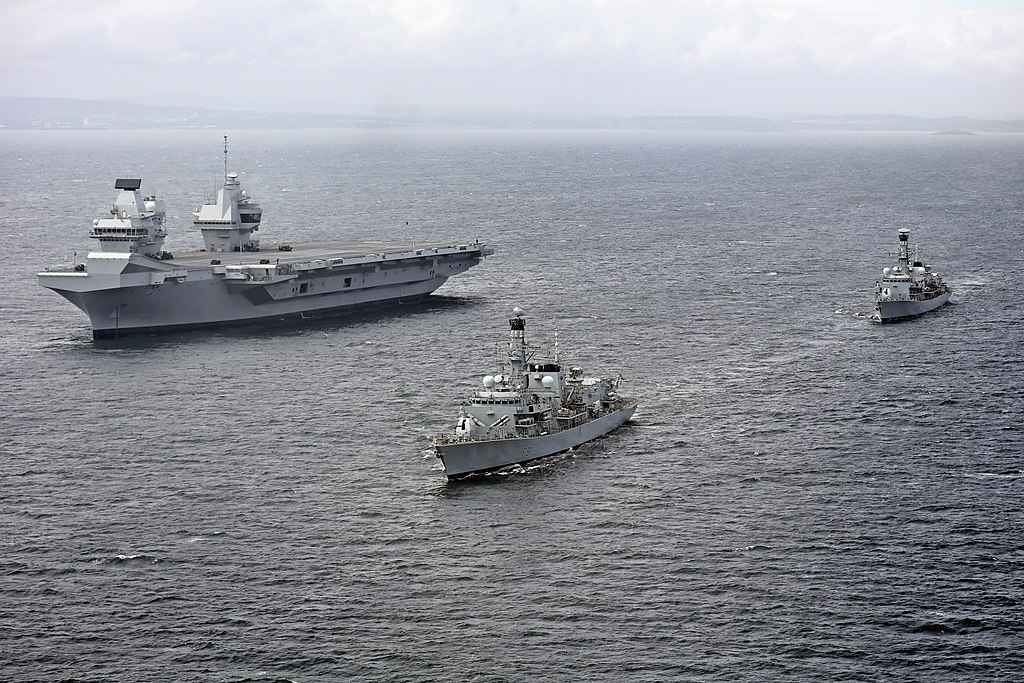
Aerial view of HMS Queen Elizabeth with Type 23 frigates HMS Iron Duke (centre) and HMS Sutherland (right) in June 2017 off the coast of Scotland.
Photo by MOD via Wikimedia Commons.
The United Kingdom has few allies closer than the Netherlands. Both nations are modern, outward looking and instinctively maritime in their view of the world. Long standing NATO partners and with significant experience of working together across the globe, the Netherlands Armed Forces are highly respected as being capable, well equipped and staffed with first rate personnel.
The relationship between the RN and the Royal Netherlands Navy is extremely close, particularly between the Marine Corps and the Submarine Services. It is therefore extremely pleasing to hear that the Netherlands will be deploying a warship to form part of the inaugural ‘Carrier Strike Group’ (CSG) deployments for HMS Queen Elizabeth in 2021 HERE. This is a significant announcement and it has several ramifications that are good news for the Royal Navy.
[…]
There seems to be an exceptionally British trait of moaning at good news. Some people felt that it wasn’t good enough for the RN to be ‘reliant’ on a foreign warship operating as part of the CSG, and that the UK should be going it alone. What utter rot.
It does not mean, despite what some naysayers were desperate to bleat about on social media without any evidence to the contrary, that defence cuts mean the UK is reliant on the Dutch to protect the carrier. The RN has spent a lot of time working out what escorts are needed and ensuring they will be available when necessary as part of the CSG to properly protect the carrier. Any foreign participation is a nice bonus capability to have, not a tacit hint that the RN is short of ships.
The reality of future operations is that the UK is going to operate as part of an international coalition with our friends and allies. Despite the fantasies of some, desperate to see a huge purely British task force sailing around the world looking for a fight and a free trade deal, the fact is that any future military operation is going to be international by design.
Working with allies is critically important but isn’t something you can just do at the drop of a hat. One of the reasons why NATO works so well is because it has spent 70 years investing in common processes, tactics and procedures and exercising them regularly to ensure everyone can work together coherently.
Integrating a Dutch vessel now is vital because it helps build and cement an understanding at operational level of how to work with each other, to learn the capabilities of each other’s ships and how to work them to best effect together. It can also spot unintended issues or problems and help work out how to fix them quickly. This takes time to do, so it is likely that any Dutch vessel assigned in 2021 will have spent a considerable period working up in advance before beginning the deployment proper.
For those who complain that the Royal Navy hasn’t got enough ships to escort the carrier, it is worth reflecting that the Netherlands have a total of 6 frigates. Assuming the normal serviceability rates for escorts apply, then two are likely to be in refit and another in maintenance or training. This leaves just three active vessels at any one time – so in reality, the Netherlands commitment to support the Carrier Strike Group represents them committing a third of their available escort force for a significant amount of time.
Comments Off on HMS Queen Elizabeth to depend on Shock! Horror! Dutch escort!
October 25, 2018
The History of Australia
History With Hilbert
Published on 23 Aug 2017The entire history of Australia from the earliest humans until somewhere after World War II where I lost interest.
Comments Off on The History of Australia
October 24, 2018
Temporal privilege
In the latest issue of Libertarian Enterprise, Sarah Hoyt discusses reading a recent historical novel that she nearly threw at the wall:
What brought about this rant is that I just read a Pride and Prejudice Variation written by someone who swallowed Dickens hook line and barbed socialist sinker.
Dickens was an amazing writer. What he was not was an historian or an impartial observer. What he put in his books has tainted people’s perception of the past and encouraged the cardinal “socialist virtue” of envy. It causes people to think those richer than themselves are callous bastards. It teaches people to see the past through that lens.
This book was almost walled when the woman assured us that the middle and upper classes did not care about the disappearance of a serving-woman.
It wasn’t many years after that the murder of a series of prostitutes set Victorian England aflutter, and yes, that included the upper and middle classes.
In the same way she waxes pathetic about how death was common among the poor in the Regency. B*tch, death was common in the Regency, period. If your entitled, propagandized ass were plopped down in a society with no antibiotics and uncertain house-heating, you’d learn really quickly how common. Young ladies in the upper reaches of society routinely made two baby shrouds as part of their trousseau. They were expected to lose at least that many children. And while we’re talking of children, yeah, death in child birth was really common too. As was death in any of the male occupations which, as is true throughout history, took them outside the house. Even noblemen were around horses a lot, and spent quite a bit of time — if they were worth their salt — managing their own lands, fraught occupations in a time when any wound could turn “septic” and any cold could turn “putrid” and carry you off.
Yeah. The people in these close-to-the-bone societies didn’t give money to people who’d waste it. They sometimes set conditions on distributing largesse. And they had definite opinions on what behaviors were “good” and which “bad.”
They weren’t tight-ass moralists, as the left imagines. They were following precepts and behaviors proven to lead to success. Mostly success in staying alive.
They were poorer than us and in that measure they were a lot more realistic.
They had to be. The other way lay death.
Spitting on our ancestors for not obsessing about gender-fluid trilobites is in fact the ultimate expression of “temporal privilege.” The left is yelling at people poorer, unhealthier and less able than themselves.
And they’re proud of it.
Comments Off on Temporal privilege
October 23, 2018
QotD: The boomers
How did my generation do? Well, we get blamed for being selfish and self-obsessed and soft and pushing up house prices and saddling the next generation with hideous debts and nowhere to live and I suppose that’s not entirely unfair.
We are ridiculously obsessed with food, buy too many things and have too many clothes. But we didn’t start a war. Well, not a big one. And we didn’t nuke anyone. We defused the Cold War. We believed in the collective good. Although we came to confuse gestures with actions and we think going on a march and writing a letter are the same as doing something, making the world better.
We were the generation that were relentlessly for civil rights, human rights, gay rights, disability rights, equality, fairness. We were implacably against racism and censorship. We defended freedom of speech, religion and expression. We will leave the world better fed and better off than when we arrived in it.
Britain is a far happier, richer and fairer place than it was 60 years ago. And if you think that’s wishful self-promotion, you have no idea how grim and threadbare Britain in the Fifties was. You weren’t there, you don’t remember.
A.A. Gill, “Life at 60”, Sunday Times, 2014-06-29.
Comments Off on QotD: The boomers
October 22, 2018
The Last German E-Boat
Mark Felton Productions
Published on 24 Sep 2018S-130 is the very last of Germany’s sleek S-Boats, the fast motor torpedo boats known to the British as E-boats, that ravaged shipping around the shores of the UK. Now being restored in Britain, this boat is a rare wartime survivor with an equally fascinating postwar story to match.
Photo credits: British Power Boat Trust, Exercise Tiger Memorial, Barry Lewis, Jim Linwood.
Comments Off on The Last German E-Boat
October 19, 2018
Webley Model 1911 Stocked .22 Single-Shot Target Pistol
Forgotten Weapons
Published on 29 Sep 2018http://www.patreon.com/ForgottenWeapons
The Webley Model 1911 is a single-shot, self-ejecting target pistol made only for a few years. It was fitted with a long barrel to increase sight radius and also a detachable shoulder stock for those who wanted a bit more stability when shooting. Mechanically, the piece must be loaded manually, and it will then open the slide and eject the empty case automatically when fired, leaving the slide open for the shooter to load the next round. These were manufactured until 1914, with the final batch of pistols sold in 1919 from remaining parts stocks.
I am at the range with this example on Malta, thanks to the Association of Maltese Arms Collectors and Shooters. I thought it would be interesting to compare shooting with and without the stock, although my biggest takeaway was that I need more practice time on the range!
If you enjoy Forgotten Weapons, check out its sister channel, InRangeTV! http://www.youtube.com/InRangeTVShow
Contact:
Forgotten Weapons
PO Box 87647
Tucson, AZ 85754
Comments Off on Webley Model 1911 Stocked .22 Single-Shot Target Pistol
October 17, 2018
How Toronto got its name
Colby Cosh on the origins of the name of Canada’s largest city (which, surprisingly, isn’t the Mississauga name for “big stink on the water”):
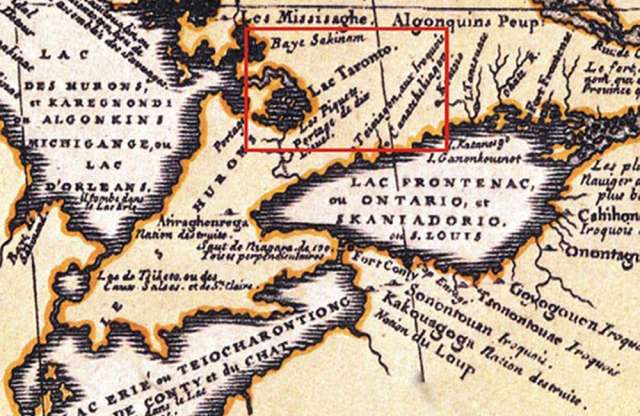
Detail from a 1688 map of western New France by Vincenzo Coronelli that locates “Lac Taronto” at Lake Simcoe.
City of Toronto Culture Division/Library and Archives Canada via the National Post
By the time of Franquelin, “Tkaronto” had already become “Taronto,” a generic name for the highway between Lake Simcoe and Lake Ontario. The Humber River was called the Toronto River by the French before Gen. John Graves Simcoe and the British got hold of everything. The word, in turn, became attached to a trading settlement at the southern end of the trail — a pretty crummy place, by all accounts, but one destined for bigger things as part of a global seafaring empire.
The miracle is that it held on to the name. Simcoe insisted that “Toronto,” on being anointed as the site of the new capital of Upper Canada in 1793, be dubbed “York” in honour of Prince Frederick (1763-1827), Duke of York and second son of George III. This Duke of York is the “Grand Old Duke of York” from the satirical verse about military futility. He was also commander-in-chief of the British armies that helped to chase Napoleon out of Europe twice, and is thought to deserve genuine credit for this, so be careful who you write insulting rhymes about.
Simcoe dubbed Toronto “York” just because he was sucking up to a very identifiable future boss, and for no other reason. The people of Toronto seem to have understood this and resented it. In the decades to come, it was occasionally observed that there were something like a dozen other places in Upper Canada called “York.” Moreover, Simcoe’s “Little York,” as it was often called, seems to have presented an increasingly embarrassing parallel with the Americans’ bustling New York.
In 1834, when the Legislative Council of Upper Canada decided that the capital needed to be formally incorporated as a city, the citizenry remembered that they belonged to “Toronto” and appealed to the council to have the more musical old name restored. Over four decades their annoyance had not receded. Diehards who wanted York to remain York for imperial-grandeur reasons were outvoted, and Toronto’s formal Act of Incorporation observes that “it is desirable, for avoiding inconvenience and confusion, to designate the Capital of the Province by a name which will better distinguish it.” The appellation “Toronto,” of course, had actually been nicked from a spot some way off, but the white settlers had mislaid that information, and didn’t check with anyone who would know better.
Comments Off on How Toronto got its name
Bren vs Spandau part two
Lindybeige
Published on 31 May 2016The WW2 German fanboys didn’t like my first video on this topic, some were quite hostile. Here I explain myself even more fully.
Support me on Patreon: https://www.patreon.com/Lindybeige
Many people didn’t read the description on my last video, and so missed my dealing with most of the objections. People don’t read descriptions, so here I come back at my critics in video form. So terrified were some people to think that someone out there might be suggesting that German WW2 equipment wasn’t superb in every way, or that British equipment might have been as good as adequate, that they were very quick to misinterpret me, and to jump to wild and erroneous conclusions. Most people were not like this, and I was blessed as ever by many pleasant comments, but when a YouTuber concludes that a piece of WW2 German or medieval Japanese kit was sub-perfect, then he will face the wrath and wails of the fan-boys.
Musical stings kindly contributed by David Bevan.
Lindybeige: a channel of archaeology, ancient and medieval warfare, rants, swing dance, travelogues, evolution, and whatever else occurs to me to make.
Follow me…
Twitter: https://twitter.com/Lindybeige I may have some drivel to contribute to the Twittersphere, plus you get notice of uploads.
website: www.LloydianAspects.co.uk
Comments Off on Bren vs Spandau part two
October 16, 2018
Bren vs Spandau – which was better?
Lindybeige
Published on 15 May 2016The Bren gun and the Spandau were rather different, and each the prime infantry weapon of its army. Was one better?
Support me on Patreon: https://www.patreon.com/Lindybeige
After reading the comments, I shall respond with the following, because the same few points were coming up again and again:
1. The two weapons were both section MGs. This makes them comparable. The standard infantry section of a British Commonwealth infantry unit had one Bren per section, and the standard German equivalent had one Spandau. Yes, they were in other ways different weapons. That is largely my point. If they were almost identical in performance and use, then there would be no video to make. The comparison is only interesting because they were different.
2. Yes, I am well aware that there are descendants of the Spandau still around today, notably the MG 74 and MG 3. I never said otherwise. I was talking about the Bren and the Spandau in the context of WW2, when they went up against each other.
3. I say things in praise of both weapons in this video, and point out short-comings of both, and conclude that they were both fit for purpose. I reject, therefore, accusations of bias one way or the other. The usual thing one hears/reads is that the Bren was rubbish and the Spandau excellent, and the reality was more complicated than that.
4. I concede that when I mention some of the good things about one gun, it may imply to some that these things were lacking in the other. For example, I mention that it was easy to change the barrel on a Bren, which some people have mistakenly interpreted as my saying that it was awkward to change the barrel on an MG 42, which it wasn’t.
5. Yes, very obviously there were more factors than Bren guns that explain the advance of the Allies in in 1944/5 in the west. However, the point I make is that the front advanced towards Berlin every day, and this can only happen if infantry are moving forward, and taking and holding that ground. Artillery and air support cannot do this. It is also a way of countering the too-often-repeated notion that the Germans were better troops with better equipment. Yes, the best German troops were excellent, but let us not forget that they lost. If they were consistently better troops with better equipment, then they would not so consistently have lost.
6. Yes, there were differences between the MG34 and the MG42 more than simplicity of manufacture. The MG42 had a higher rate of fire, for example. I lumped them together at the start of the video for convenience. They served the same battlefield role, and were used with the same doctrine. After-action reports written at the time, and memoirs written afterwards almost never differentiate between them. Everything I say about the relative merits of Bren and Spandau are true for both MG34 and MG42, which both fired substantially faster than a Bren, and were both belt-fed.
7. The name ‘Spandau’ originally referred to the MG 08 used in World War One. It was made at the factory in Spandau, a borough of Berlin. The nick-name then got transferred to the machine guns used by the Germans in WW2. It was a misnomer in that the MG 34 and MG 42 were not made in Spandau, as I say in the video, but it is still a good word to refer to the two weapons since it is quick, clear, and was the term used at the time.
8. Yes, the MG 34 was accurate enough for purpose. Had it not been, I would have been sure to mention that. With a new and cool barrel, fired single shot, the MG34, with its double-crescent trigger, lacking in the MG42, could indeed be decently accurate. However, the barrel quickly got hot and worn, and more importantly, that was not the doctrine of use. The gun was designed to put plenty of rounds down against the enemy. Also — psychology. Give a man a gun that can spray bullets really effectively, suppressing his foes and thus keeping him safe, while making a really impressive noise, and he will use it this way, but accuracy will suffer. Give a man a slow-firing MG with a magazine of 28 rounds, and he will take careful aim and fire far fewer bullets, but with greater accuracy.
Musical stings kindly contributed by David Bevan.
Lindybeige: a channel of archaeology, ancient and medieval warfare, rants, swing dance, travelogues, evolution, and whatever else occurs to me to make.
Follow me…
Twitter: https://twitter.com/Lindybeige I may have some drivel to contribute to the Twittersphere, plus you get notice of uploads.
website: www.LloydianAspects.co.uk
Comments Off on Bren vs Spandau – which was better?
QotD: I’m All Right Jack
I’m All Right Jack is a film delicately poised between two very different cultural moments. The opening scene looks back to the war, the heyday of collective endeavour and national solidarity, but the song — both in content and style — seems to look forward to a new era of aggressive hedonism and unashamed self-interest.
At the time, though, what attracted most attention was Peter Sellers’s hilarious performance as the obstreperous trade unionist Fred Kite (“We do not and cannot accept the principle that incompetence justifies dismissal”), which delighted many cinemagoers and won him a BAFTA. Not surprisingly, it went down very badly with union leaders and left-wing reviewers, but the Boultings were unrepentant. In an article for the Daily Express, they explained their reasoning:
As individuals we believe in Britain because Britain has always stood for the individual.
Nowadays there seem to be two sacred cows — Big Business and Organized Labour. Both are deep in a conspiracy against the individual — to force us to accept certain things for what in fact they are not. Both are busy feathering their nests most of the time. And to hell with the rest of us…
AFter all, who is King in the Welfare State? That humourless, faceless monster — the official, the bureaucrat, the combine executive.
Certainly a great deal has changed since we used to be Angry Men before the war … But at the end of this huge revolution we are not so sure that the losses have not been as great as the gains.
For example, the tendency to think of people not as human beings but as part of a group, a bloc, a class.
The Boultings knew, of course, that this would annoy some poeple. But the great strength of the “average Briton”, they insisted, lay in “laughing at his leaders and institutions. We believe our films reflect the popular attitude and mood. Their success seems to prove our point.”
Since I’m All Right Jack is in black and white, it is easy to forget how bracingly modern it must have seemed, not just to the Queen and Harold Macmillan, but to the large audiences who flocked to see it in the autumn of 1959. It was released only ten years after Passport to Pimlico, but the difference in mood and tone can hardly be exaggerated. It is not just a question of colletivism versus individualism, but the social context that those two ideas reflected. The Ealing film was made against a background of austerity; the Boultings’ film is drenched in consumerism. In the early scenes of Passport to Pimlico, we find ourselves in a world of rationing and restrictions, bomb damage and dereliction. What kicks off the action, in fact, is the accidental detonation of an unexploded German bomb. But I’m All Right Jack is set in the late 1950s, a world awash with appliances and advertising, in which wartime austerity is merely a fading memory. The narrator tells us that at long last “industry, spurred by the march of science in all directions, was working at high pressure to supply those viatl needs for which the people had hungered for so long”. But when Ian Carmichael’s blundering hero gets a job in industrial management, he soon finds out what these “vital needs” are: Num-Yum chocolate bars and Detto washing powder, each with its own irritatingly catchy jingle.
Dominic Sandbrook, The Great British Dream Factory: The Strange History of our National Imagination, 2015.
Comments Off on QotD: I’m All Right Jack
October 10, 2018
Why do we have accents? | James May’s Q&A (Ep 31) | Head Squeeze
BBC Earth Lab
Published on 26 Jul 2013We asked Cheltenham Science Festival goers what burning science question they wanted answered and YOU voted for your favourite one!
Comments Off on Why do we have accents? | James May’s Q&A (Ep 31) | Head Squeeze


