
T.V Allsorts
Published on 13 Apr 2016
November 14, 2018
Ronnie Barker – British Rail
Comments Off on Ronnie Barker – British Rail
November 13, 2018
General Sir Charles Napier lived in vain
Douglas Murray on the Asia Bibi case:
All of this is to say that the latest news from the U.K. is both thoroughly predictable and deeply disturbing. Readers of National Review will be familiar with the case of Asia Bibi. She is the Christian woman from Pakistan who has been in prison on death row for the last eight years. Her “crime” is that a neighbor accused her of “blasphemy.” […]
Her case has had ramifications throughout Pakistani society in the years since. For instance, it provoked the statement by the brave governor of Punjab, Salman Taseer, which led to his own murder by one of his own bodyguards. In the days since her release from jail, there have been mass protests in Pakistan where thousands of enraged fanatics have called, literally, for Asia Bibi’s head. The case has amply demonstrated the type of country that Pakistan is these days. But who would have guessed that her case would also throw so much light on the type of country Britain now is?
There are clearly international efforts underway to get Bibi out of Pakistan. If anybody in the world deserves asylum it is her. And any civilized country should be queuing up to give asylum to her and her family. Among those reported to have done so is the Netherlands.
But today there are reports that the British government has said that it will not offer asylum to Asia Bibi. The reason being “security concerns” — that weasel term now used by all officialdom whenever it needs one last reason to avoid doing the right thing. According to this report, the government is concerned that if the U.K. offered asylum to Bibi it could cause “unrest among certain sections of the community.” And which sections would that be? Would it be Anglicans or atheists who would be furious that an impoverished and severely traumatized woman should be given shelter in their country? Of course not. The “community” that the British government will be scared of is the community that comes from the same country that has tortured Asia Bibi for the last eight years.
So what’s the tie-in with General Sir Charles Napier? He was the governor of Sindh from 1843 to 1847. During his time in that office, he had opportunity to challenge certain long-established barbaric cultural practices:
Napier opposed suttee, or sati. This was the custom of burning a widow alive on the funeral pyre of her husband. Sati was rare in Sindh during the time Napier stayed in this region. Napier judged that the immolation was motivated by profits for the priests, and when told of an actual Sati about to take place, he informed those involved that he would stop the sacrifice. The priests complained to him that this was a customary religious rite, and that customs of a nation should be respected. As recounted by his brother William, he replied:
“Be it so. This burning of widows is your custom; prepare the funeral pile. But my nation has also a custom. When men burn women alive we hang them, and confiscate all their property. My carpenters shall therefore erect gibbets on which to hang all concerned when the widow is consumed. Let us all act according to national customs.”
Britain could use another General Napier.
Comments Off on General Sir Charles Napier lived in vain
QotD: Julius Caesar’s invasion of Britain
The first date in English History is 55 B.C., in which year Julius Caesar (the memorable Roman Emperor) landed, like all other successful invaders of these islands, at Thanet. This was in the Olden Days, when the Romans were top nation on account of their classical education, etc.
Julius Caesar advanced very energetically, throwing his cavalry several thousands of paces over the River Flumen; but the Ancient Britons, though all well over military age, painted themselves true blue, or woad, and fought as heroically under their dashing queen, Woadicea, as they did later in thin red lines under their good queen, Victoria.
Julius Caesar was therefore compelled to invade Britain again the following year (54 B.C., not 56, owing to the peculiar Roman method of counting), and having defeated the Ancient Britons by unfair means, such as battering-rams, tortoises, hippocausts, centipedes, axes, and bundles, set the memorable Latin sentence, “Veni, Vidi, Vici“, which the Romans, who were all very well educated, construed correctly.
The Britons, however, who of course still used the old pronunciation, understanding him to have called them “Weeny, Weedy, and Weaky”, lost heart and gave up the struggle, thinking that he had already divided them All into Three Parts.
W.C. Sellar & R.J. Yeatman, 1066 And All That, 1930.
Comments Off on QotD: Julius Caesar’s invasion of Britain
November 11, 2018
Mark Knopfler – “Remembrance Day”
Bob Oldfield
Published on 3 Nov 2011A Remembrance Day slideshow using Mark Knopfler’s wonderful “Remembrance Day” song from the album Get Lucky (2009). The early part of the song conveys many British images, but I have added some very Canadian images also which fit with many of the lyrics. The theme and message is universal… ‘we will remember them’.
Comments Off on Mark Knopfler – “Remembrance Day”
In memoriam
A simple recognition of some of our family members who served in the First and Second World Wars:
The Great War
 Private William Penman, Scots Guards, died 16 May, 1915 at Le Touret, age 25
(Elizabeth’s great uncle)- Private Archibald Turner Mulholland, Argyll & Sutherland Highlanders, mortally wounded 25 September, 1915 at Loos, age 27
(Elizabeth’s great uncle) - Private David Buller, Highland Light Infantry, died 21 October, 1915 at Loos, age 35
(Elizabeth’s great grandfather) - Private Harold Edgar Brand, East Yorkshire Regiment. died 4 June, 1917 at Tournai.
(My first cousin, three times removed) - Private Walter Porteous, Durham Light Infantry, died 4 October, 1917 at Passchendaele, age 18
(my great uncle) - Corporal John Mulholland, Argyll & Sutherland Highlanders, wounded 2 September, 1914 (shortly before the First Battle of the Aisne), wounded again 29 June, 1918, lived through the war.
(Elizabeth’s great uncle)
The Second World War
- Flying Officer Richard Porteous, RAF, survived the defeat in Malaya and lived through the war
(my great uncle) - Able Seaman John Penman, RN, served in the Defensively Equipped Merchant fleet on the Murmansk Run (and other convoy routes), lived through the war
(Elizabeth’s father) - Private Archie Black (commissioned after the war and retired as a Major), Gordon Highlanders, captured at Singapore (aged 15) and survived a Japanese POW camp
(Elizabeth’s uncle) - Elizabeth Buller, “Lumberjill” in the Women’s Land Army in Scotland through the war.
(Elizabeth’s mother) - Trooper Leslie Taplan Russon, 3rd Royal Tank Regiment, died at Tobruk, 19 December, 1942 (aged 23).
A recently discovered relative. Leslie was my father’s first cousin, once removed (and therefore my first cousin, twice removed).
For the curious, the Commonwealth War Graves Commission the Royal British Legion, and the Library and Archives Canada WW1 and WW2 records site provide search engines you can use to look up your family name. The RBL’s Every One Remembered site shows you everyone who died in the Great War in British or Empire service (Canadians, Australians, New Zealanders, South Africans and other Imperial countries). The CWGC site also includes those who died in the Second World War.
In Flanders fields the poppies blow
Between the crosses row on row,
That mark our place; and in the sky
The larks, still bravely singing, fly
Scarce heard amid the guns below.We are the Dead. Short days ago
We lived, felt dawn, saw sunset glow,
Loved and were loved, and now we lie
In Flanders fields.Take up our quarrel with the foe:
To you from failing hands we throw
The torch; be yours to hold it high.
If ye break faith with us who die
We shall not sleep, though poppies grow
In Flanders fields.Lieutenant Colonel John McCrae, MD Canadian Army Medical Corps (1872-1918)
Comments Off on In memoriam
How Peter Jackson ‘Brought To Life’ WW1 Footage In His New Film | RATED
Forces TV
Published on 10 Oct 2018Lord Of the Rings director Peter Jackson has seen footage of a mine explosion that his own grandfather was only a hundred yards away from on the Western Front at the time. He saw the footage while making his new film They Shall Not Grow Old.
Comments Off on How Peter Jackson ‘Brought To Life’ WW1 Footage In His New Film | RATED
November 10, 2018
Emperor Karl’s last attempt for peace, 1917
Part of a post at Essays in Idleness from last month by David Warren:
As we approach the centenary of the Great Armistice, I see the plastic poppies circulating from the little boxes in the liquor stores. My thoughts turn to war qua war. Though sometimes necessary, it is not a good thing (“bad for children and animals” as the peaceniks say); and given the ambiance of our high-tech weaponry, little heroism is left to raise the tone. Contemporary battles are not confined to the soldiers, as once they could be. The devastation of cities and towns, the routine destruction of infrastructure, the civilian suffering that follows from that, must match or quite exceed ancient incidents of rapine.
While I’ve never thought war should be avoided at all costs, I recognize that the cost is very high. Opportunities for peace should not be overlooked, even while the carnage is in progress.
When, for instance, the newly-enthroned Emperor Karl of Austria-Hungary — “fanatic” Catholic Christian — discreetly proposed a separate peace to the allies in the spring of 1917, his agents were rebuffed, outed, and mocked. The Americans were coming to tilt our fortunes, the Germans were distracted overrunning the Russians, and while the Western Front was in catastrophic stasis, our nationalist politicians could now hope to utterly crush the foe. They would demand unconditional surrender.
The incident haunts my historical imagination. This was a serious opportunity to restore something close to the status quo ante, while resolving casus belli (very much plural) from Belgium and Alsace to Serbia and Constantinople on the principle of sweet reason. Drowned in the gunfire was this Blessed Karl’s expressly Christian plea. In an instant the decision was made, in the West, to persist till millions more were slain, and the conditions were assembled for international violence and totalitarianism through the next seventy years.
The gentlemen I call “the three stooges of the apocalypse” — Wilson, Lloyd George, Clemenceau — were all modern politicians, whose nationalist ideals were now buttressed by the vast democratic constituencies of countries at war, goaded on by the screaming headlines of a paper mass media. They wanted a New Europe, a New World Order, in which antiquated empires and all the sleepy old aristocratic polities would be smashed and replaced — with modern, ethically homogenous, democratic States. The consequences were unforeseeable to them, wrapped in their flags and the rhetoric of liberté, égalité, fraternité.
It was a war to end all wars! … Both the malice and the naivety were astounding.
Comments Off on Emperor Karl’s last attempt for peace, 1917
War Graves: Honouring the Fallen of the First World War | The Tank Museum
The Tank Museum
Published on 2 Nov 2018On a visit to the Cambrai Memorial to the Missing at Louverval, Curator David Willey took the opportunity to explore the Allied First World War graves. In this video he explains how they were set up by the Commonwealth War Graves Commission during WW1 and why they look the way they do.
SUBSCRIBE to The Tank Museum YouTube channel: ► http://www.youtube.com/channel/UChl-X…
Support the work of The Tank Museum on Patreon: ► https://www.patreon.com/tankmuseumVisit The Tank Museum SHOP: ►https://tankmuseumshop.org/
Press the little bell above to enable NOTIFICATIONS so you don’t miss the latest Tank Museum videos.
Twitter: ► https://twitter.com/TankMuseum
Tiger Tank Blog: ► http://blog.tiger-tank.com/
Tank 100 First World War Centenary Blog: ► http://tank100.com/ #tankmuseum #tanks
Comments Off on War Graves: Honouring the Fallen of the First World War | The Tank Museum
November 9, 2018
Tank Chats #37 Daimler Armoured Car | The Tank Museum
The Tank Museum
Published on 12 May 2017Historian David Fletcher MBE, in the 37th Tank Chat discussing the Daimler Armoured Car.
The Daimler Armoured Car proved to be a versatile and successful vehicle, serving with the British Army in all theatres of war from 1941 and remaining in service for some years after the Second World War.
Support the work of The Tank Museum on Patreon: ► https://www.patreon.com/tankmuseum
Or donate http://tankmuseum.org/support-us/donate
Comments Off on Tank Chats #37 Daimler Armoured Car | The Tank Museum
November 8, 2018
What do you do with decommissioned Royal Navy nuclear submarines?
Apparently, based on current MoD practice, you leave them sitting around for decades, until you have more decommissioned boats in storage than the RN has in commission:
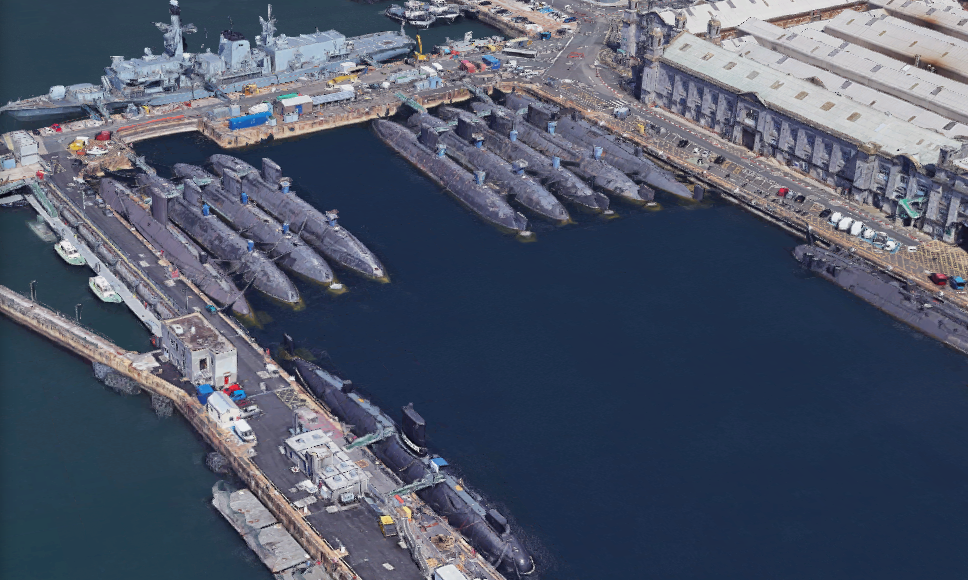
Decommissioned Royal Navy nuclear submarines at Devonport.
Screen capture from Google Maps.
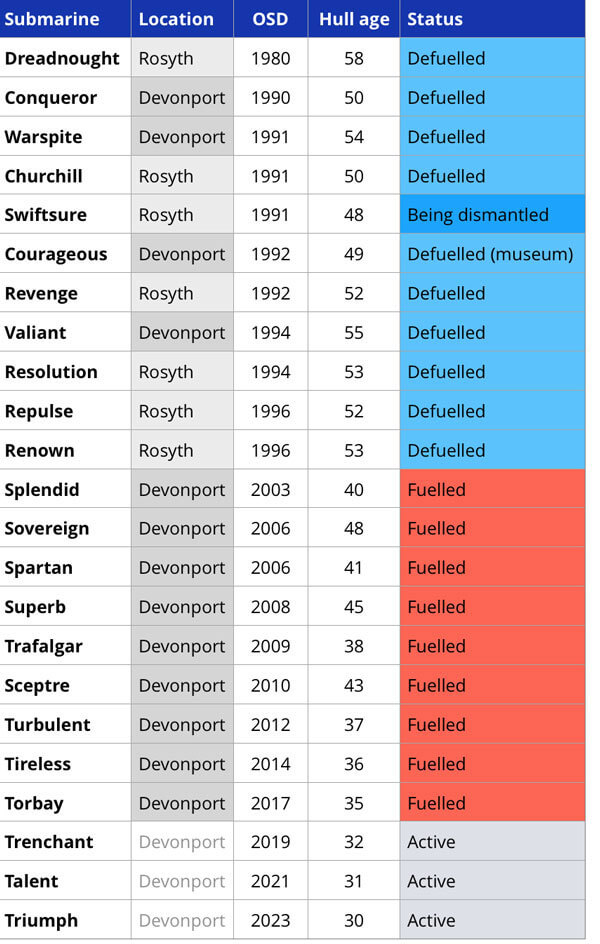
There are currently 20 former Royal Navy nuclear submarines awaiting disposal in Rosyth and Devonport. They do not represent a great hazard but maintaining them safely while they await dismantling is a growing drain on the defence budget. Nuclear submarines are arguably Britain’s most important defence assets but the failure to promptly deal with their legacy has been a national scandal. Although there has been discussion and consultation going back years, only recently has there been action to actually start the disposal process.
Status of Royal Navy submarine disposal in early 2018.
OSD – Out of Service Date. Hull age – years since hull laid down.
Plans for the safe and timely disposal of nuclear submarines should have been drawn up as far back as the 1970s but successive governments have avoided difficult decisions and handed the problem on to their successors. RN submarines were designed so the Reactor Pressure Vessel could be removed from the hull. Other nations cut the entire reactor compartment out of the submarine and transport it to land storage facilities. The US has successfully disposed of over 130 nuclear ships and submarines since the 1980s. The Russians have disposed of over 190 Soviet-era boats (with some international assistance) since the 1990s while France has already disposed of 3 boats from their much smaller numbers.The first Royal Navy nuclear submarine, HMS Dreadnought decommissioned in 1980, has now been tied up in Rosyth awaiting disposal longer than she was in active service.
As any householder knows, It is sensible practice to dispose of your worn out items before you replace them with new ones.
The capacity to store more boats at Devonport is limited, every further delay adds to cost that will have to come from a defence budget that is much smaller in real terms than when the boats were conceived at the height of the Cold War. Apart from the attraction of deferring costs in the short-term, a major cause of delay has been the selection of a land storage site for the radioactive waste. It has also taken time to develop a method and ready the facilities needed to undertake the dismantling project.
Afloat storage
While awaiting dismantling, decommissioned submarines are stored afloat in a non-tidal basin in the dockyard [as seen in the image at the top of this post]. Classified equipment, stores and flammable materials are removed together with rudders, hydroplanes and propellers while the hull is given treatments to help preserve its life. The 7 submarines in Rosyth have all had their nuclear fuel rods removed but of the 13 in Devonport, 9 are still fuelled. This is because in 2003 the facilities for de-fuelling were deemed no longer safe enough to meet modern regulation standards and the process was halted. Submarines that have not had their fuel rods removed have the reactor primary circuit chemically treated to guarantee it remains inert and additional radiation monitoring equipment is fitted.
More than £16m was spent between 2010-15 just to maintain these old hulks alongside, and costs are rising. Apart from regular monitoring, the hulks need to be hauled out of the basin for occasional dry docking for inspection and repainting to protect the hull from corrosion. All this effort and expense is a drain on precious resources for no direct gain. Responsible care of the growing number of hulls means they pose little risk to the local population, but a tiny risk does remain. This makes some people living nearby uneasy and provides another grievance for those ideologically opposed to nuclear submarines and Trident.
November 7, 2018
Bonfire Night hate “crime”
I have to say that I agree with Brendan O’Neill here … it was an offensive, idiotic, and totally tasteless act: but it was not — or at least should not be — a crime:
I cannot be the only person who finds the Metropolitan Police’s promise to investigate the Grenfell Tower bonfire video more chilling than the video itself. Yes, the video is repulsive. But what crime has been committed here? Being a wanker? Being a scumbag? Saying disgusting things in your own back garden? Those are criminal offences now? If they are, then Britain has far greater things to worry about than the fact that a handful of dreadful people decided to burn an effigy of Grenfell Tower for Bonfire Night.
First things first: the video is horrible. I am going to make a wild guess that the people featured in it, laughing and cheering as their cardboard Grenfell Tower goes up in flames, are not very nice. Some of them are probably racist. In the windows of their Grenfell effigy, there are notably non-white paper figures, waving for help. The effigy-burners say ‘This is what you get for not paying your rent!’ as the paper figures are consumed by the bonfire flames. Gross.
But criminal? That would be even more gross. Living in a society that criminalises people for what they say in their own back gardens would be worse, infinitely worse, than living in a society that has small numbers of prejudiced twats who think mocking the Grenfell calamity is funny.
And yet it looks like we live in that society. The commander of Scotland Yard, no less, issued a plea for information about the video, declaring himself ‘appalled by the callous nature’ of the people in it and by their ‘vile’ comments. I’m sorry, but I don’t want the police investigating videos in which no crime has been committed. In which no one’s property has been damaged or stolen and no person has been harmed. In which there is merely an act of expression. That way the police state lies. If we allow speech in one’s own home to become a police matter, we will regret it. Profoundly. What next: telescreens?
The police are upping the ante. This morning it is reported that five men have ‘surrendered’ to the cops and have duly been arrested. Some are saying they committed a public-order offence. In their own private residence? That’s a fascinating, and disturbing, definition of public disorder. Others are saying they committed a hate crime. Even though there were no victims? Even though they did not utter their words to anyone but themselves? Even though – once again for the people at the back – they were speaking among themselves in their own private space?
Comments Off on Bonfire Night hate “crime”
When A British Army Officer Tries A US Ration Pack… | Forces TV
Forces TV
Published on 16 Oct 2018They say an Army marches on its stomach, but who gets the best deal out of British and US troops? One British Army Major has been taste-testing an American ration pack to find out…
Subscribe to Forces TV: http://bit.ly/1OraazC
Check out our website: http://forces.net
Twitter: https://twitter.com/ForcesNews
Comments Off on When A British Army Officer Tries A US Ration Pack… | Forces TV
November 6, 2018
An alternative explanation for the population explosion of the “land whales”
Tim Worstall suggests that the real reason for our collective expanding waistlines isn’t evil capitalist exploiters pushing us to eat unhealthy fast food:
We don’t, for example, eat more than our forefathers did. Sure, we can all play games with how much people lie on those self-reported surveys about calorie intake. True, to make sense of it being lies we’d have to assume that people lie more now than they used to. So, instead, let’s look at official guidance. In WW1 the aim was, for the Army, to stuff some 4,300 calories a day into each frontline soldier out there in the trenches. Something they largely achieved too. In WWII rationing peeps started to worry that diets of less than 2,900 calories a day would lead to weight loss. Today official guidance is that 2,500 a day for men, 2,000 for women. Well, that’s the last one I recall at least.
I suspect that people actually do lie more on self-reporting surveys of that kind than they once did, if only because we’ve had several decades of prissy lecturing about what we should consume … the temptation to shade the answers in the “right” direction I’m sure plays some part, but not enough to explain the obesity crisis. If you doubt that this happens, remember that a significant number of people vote for the party they expect to win rather than the party that best represents their interests or desires. Sucking up to teacher is a very common psychological trait.
However, back to the swelling obesity numbers:
Actually, 40 years ago is about when central heating became a commonplace in Britain. Anyone of my maturity in years – which includes G. Monbiot – and even those from thoroughly upper middle class backgrounds – both me and G. Monbiot – will recall ice on the inside of bedroom windows in winter. Houses simply were not fully heated throughout. Actually, pretty much the entire country was in what we’d now call fuel poverty. That fuel poverty that we have standards for these days, you should be able to heat the entire house to such and such a temperature on less than 10% of income. A standard which just about no one pre-1950 reached, few pre-1970 did.
America had that heating rather earlier than we did. Americans also became land whales that little bit earlier than we did. Anecdata I know but a move to the US in 1981 was marked with an observation of how warm Americans kept their houses in winter.
We do actually spend quite a lot on all this public health stuff these days. It might be worth someone doing a little study of correlations. Different nations became lardbuckets at different times. Different nations adopted central heating as a commonplace at different times. Why don’t we go see what the correlation between those two is?
After all, the idea that mammals use some significant portion of their energy intake for body temperature regulation isn’t exactly fringe science, is it?
Comments Off on An alternative explanation for the population explosion of the “land whales”
November 5, 2018
Who Was Guy Fawkes? – Anglophenia Ep 18
Anglophenia
Published on 5 Nov 2014Remember, remember the 5th of November: Guy Fawkes is one of Britain’s most infamous figures. Who’s the man behind the mask made famous by V For Vendetta and the protest group Anonymous? Siobhan Thompson explains.
Comments Off on Who Was Guy Fawkes? – Anglophenia Ep 18
November 4, 2018
Molotov’s Heel on Finland and Nobody to Fight in the West – WW2 – 010 3 November 1939
World War Two
Published on 3 Nov 2018Ten weeks into World War Two, and the Allied ground forces are bored in France. In North-Eastern Europe, Poland’s suffering has no end and Finland is in the crosshairs of the USSR.
WW2 day by day, every day is now live on our Instagram account @World_war_two_realtime https://www.instagram.com/world_war_t…
Between 2 Wars: https://www.youtube.com/playlist?list…
Join us on Patreon: https://www.patreon.com/TimeGhostHistory
Or join The TimeGhost Army directly at: https://timeghost.tvWritten and Hosted by: Indy Neidell
Produced and Directed by: Spartacus Olsson and Astrid Deinhard
Executive Producers: Bodo Rittenauer, Astrid Deinhard, Indy Neidell, Spartacus Olsson
Research by: Indy Neidell
Edited by: Wieke Kapteijns and Spartacus OlssonColoring by Spartacus Olsson and Sarvesh
Archive by Screenocean/Reuters https://www.screenocean.com
A TimeGhost chronological documentary produced by OnLion Entertainment GmbH
Comments Off on Molotov’s Heel on Finland and Nobody to Fight in the West – WW2 – 010 3 November 1939


