
HenryvKeiper
Published on 28 May 2009My favorite scene from one of my favorite TV shows of all time.
December 5, 2018
Yes, Minister – The Six Diplomatic Options
Comments Off on Yes, Minister – The Six Diplomatic Options
December 4, 2018
Sex, Drugs, and the Right to Vote I BETWEEN 2 WARS I 1920 Part 4 of 4
TimeGhost History
Published on 2 Dec 2018When many of the fighting men of The Great War return home addicted to drugs and infected with venereal disease, their sweethearts have decided that it’s time for some serious changes! It’s time for women’s liberation!
Join us on Patreon: https://www.patreon.com/TimeGhostHistory
Hosted by: Indy Neidell
Written and directed by: Spartacus Olsson
Produced by: Astrid Deinhard
Executive Producers: Bodo Rittenauer, Astrid Deinhard, Indy Neidell, Spartacus Olsson
Edited by Wieke Kapteijns and Spartacus OlssonColorized picture of Greta Garbo in the thumbnail courtesy of Olga Shirnina aka Klimbim
Images of Canadian WWI troops courtesy of the Canadian War Museum.
Video Archive by Screenocean/Reuters http://www.screenocean.com
A TimeGhost chronological documentary produced by OnLion Entertainment GmbH
Comments Off on Sex, Drugs, and the Right to Vote I BETWEEN 2 WARS I 1920 Part 4 of 4
QotD: B.H. Liddell Hart and J.F.C. Fuller
The military commentators of the popular press can mostly be classified as pro-Russian or anti-Russian pro-blimp or anti-blimp. Such errors as believing the Maginot Line impregnable, or predicting that Russia would conquer Germany in three months, have failed to shake their reputation, because they were always saying what their own particular audience wanted to hear. The two military critics most favoured by the intelligentsia are Captain Liddell Hart and Major-General Fuller, the first of whom teaches that the defence is stronger that the attack, and the second that the attack is stronger that the defence. This contradiction has not prevented both of them from being accepted as authorities by the same public. The secret reason for their vogue in left-wing circles is that both of them are at odds with the War Office.
George Orwell, footnote to “Notes on Nationalism”, Polemic, 1945-05.
Comments Off on QotD: B.H. Liddell Hart and J.F.C. Fuller
December 3, 2018
QotD: Scottish dietary preferences
The Scots have a fondness for deep-fried foods. Everything from fish n’ chips to Mars bars. A survey of shops said customers also request deep fried sweets, pineapple rings, and even ice cream. The health authorities are naturally somewhat concerned about this diet, but Dr. David Morrison of the Greater Glasgow Health Service Board is encouraged by “evidence of the penetrance of the Mediterranean diet into Scotland, albeit in the form of deep-fried pizza.”
Billy Munnelly, “Journal”, Billy’s Best Bottles Volume 21, No. 4, Spring 2005.
Comments Off on QotD: Scottish dietary preferences
November 30, 2018
England: South Sea Bubble – Lies – Extra History
Extra Credits
Published on 9 May 2015Support us on Patreon! http://bit.ly/EHPatreon
____________No historian is perfect, so it’s important we acknowledge our mistakes where we find them (with the help of our viewers, no less)! After we clear up some discrepancies that emerged during the South Sea Bubble series, we turn to answering some common questions that came up during this series on economic history. In a period where financial masterminds like John Blunt engaged in trickery meant to confuse other people and hide his real activities, it’s no wonder that many viewers had questions about what insider trading is and how Blunt could endlessly inflate stock prices for his unprofitable company. This is a history show, but we do our best to explain! As a bonus, James also reads Robert Knight’s letter to Parliament on the eve of his illegal flight and tells some cool stories about Robert “It was Me” Walpole.
Comments Off on England: South Sea Bubble – Lies – Extra History
November 29, 2018
The Royal Navy’s “Nelsol” and “Rodnol” – a battleship design driven by lessons from Jutland
One of my favourite quirky ship designs is profiled at Naval Gazing: HMS Nelson and HMS Rodney. These two ships, known derisively by the names “Nelsol” and “Rodnol” (because of their odd profile resemblance to a class of RN oilers, whose names all ended in “-ol”), were the first post-WW1 British battleships designed to incorporate the bitter lessons learned at the battle of Jutland in 1916. Their construction was also influenced by the round of naval treaty talks that aimed to stop a renewed naval arms race and limit the major navies in both number and size of ships.
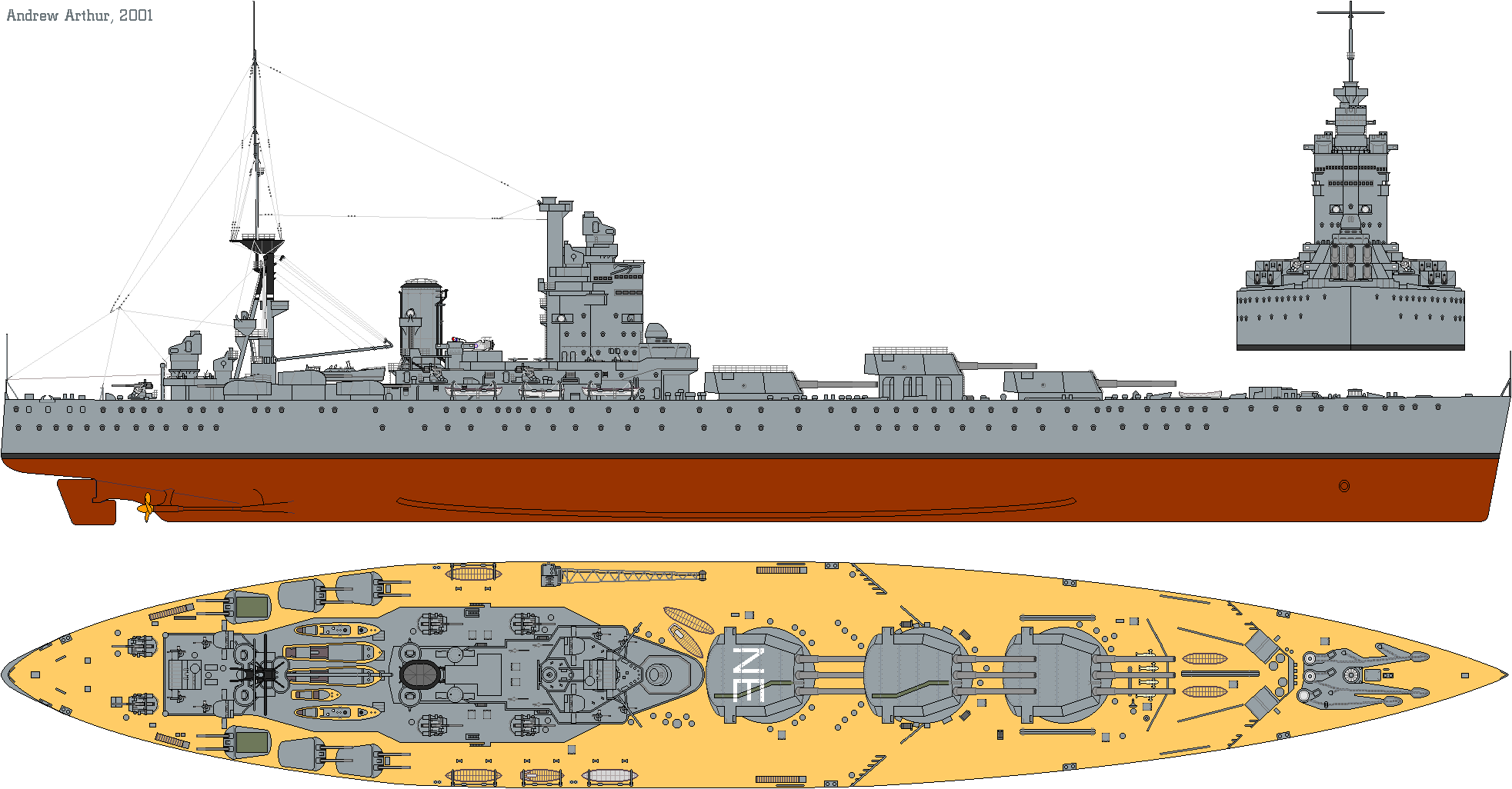
HMS Nelson profile drawing as she appeared circa 1931.
Image by Emoscopes via Wikimedia Commons.
At the end of WWI, the Royal Navy faced a crisis. During the war, it had suspended new capital ship construction except for a handful of battlecruisers, while the American and Japanese building programs had continued to churn out ships that were more modern than the bulk of the British fleet. Worse, the British battlefleet had seen hard war service, and many of the early dreadnoughts were in bad shape and essentially unfit for further service. New battleships would be needed, ships that fully reflected the lessons of the war.
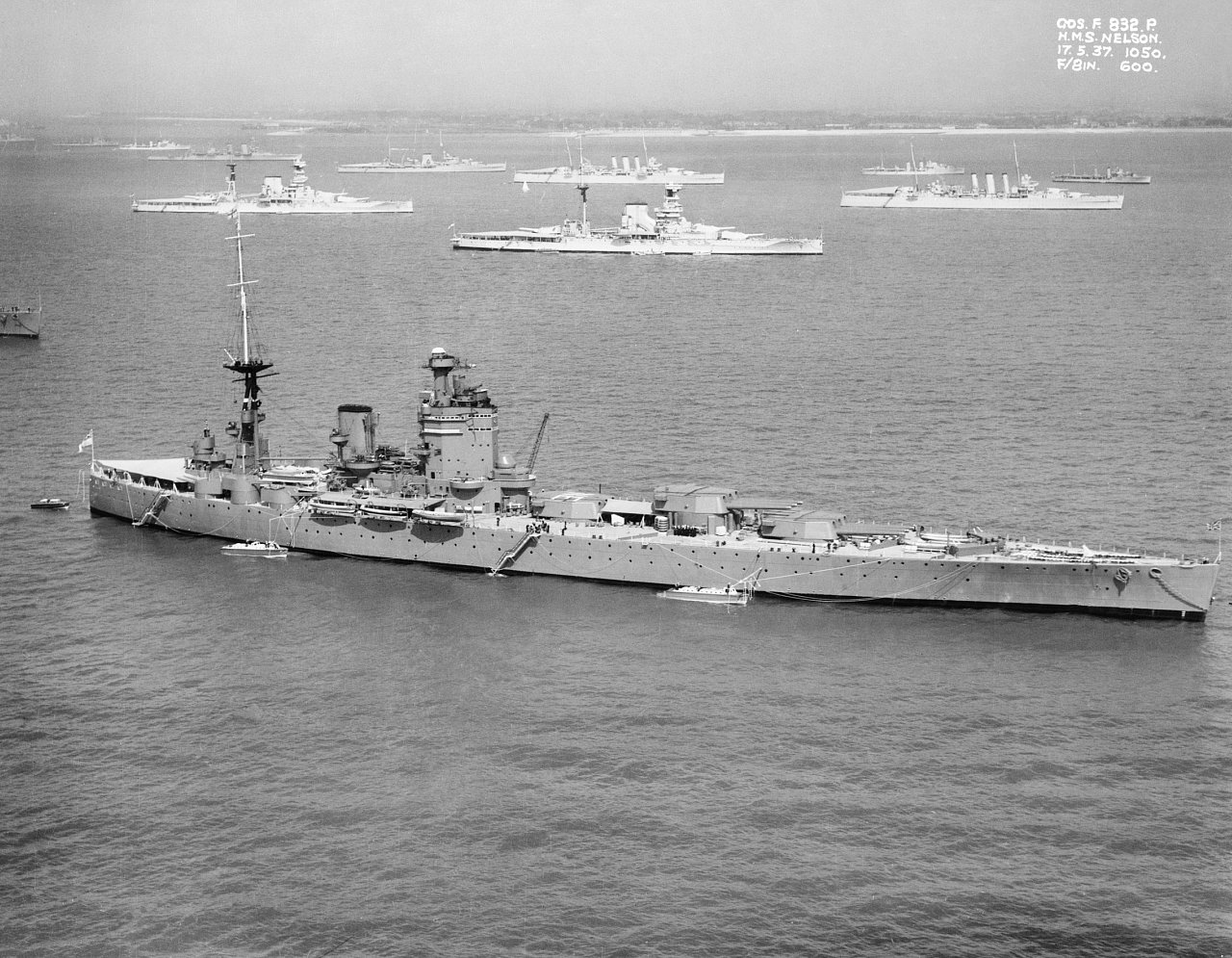
HMS Nelson off Spithead for the 1937 Fleet Review. Anchored in the background are two Queen Elizabeth-class battleships and two cruisers of the London class.
Photo via Wikimedia Commons.The most important of these was the need for an all-or-nothing armor scheme, as developed in the US. The war had seen major improvements in armor-piercing shells, and they required significantly more armor than previous vessels. However, the increased range gave designers a way out. Previously, the size of citadels had been set by the need to preserve stability and buoyancy if the ends were riddled. At long range, the many hits necessary to riddle the ends would not happen, and the citadel could be shrunk to thicken the armor. The British also looked to improve on the 15″ gun due to the proliferation of 16″ weapons in the American and Japanese navies. They investigated the triple turret, abandoned a decade earlier amid fears of increased mechanical complexity, and the 18″ gun under the cover name of 15″/B.
Two parallel design series were started, one for battleships, the other for battlecruisers. As this series was developed, the designers saw a serious problem with the battlecruisers. The boiler uptakes would leave large holes in the armored deck, and if the ship was headed towards the enemy, shells might be able to pass through the holes and into the aft magazines. The solution was to move all three turrets forward of the engines, on the basis of war experience showing that ships rarely if ever engaged targets directly aft.
Comments Off on The Royal Navy’s “Nelsol” and “Rodnol” – a battleship design driven by lessons from Jutland
England: South Sea Bubble – It Was Walpole – Extra History – #5
Extra Credits
Published on 25 Apr 2015Support us on Patreon! http://bit.ly/EHPatreon
____________Robert Walpole’s attempts to use the South Sea Company scandal to enhance his own ambitions are threatened by the appearance of Robert Knight, a former South Sea employee whose records of corporate bribery implicate Walpole and his friends in Parliament. But faced with threats of retribution if he ever shares these records, Knight flees the country rather than face a public inquiry. Although he gets caught and sent to prison in Antwerp, Walpole deftly engineers his release and escape. With Knight finally gone, Walpole teams up with John Blunt to pin the blame for the South Sea stock bubble on his political opponents, conveniently clearing the way for himself to become essentially the first Prime Minister of England. He also makes sure that all of his own supporters get off easy (if not scot free) for their involvement, and even Blunt walks away from the South Sea Bubble with more money than he started with.
Comments Off on England: South Sea Bubble – It Was Walpole – Extra History – #5
November 28, 2018
The Difficult Road To Peace 1919 I THE GREAT WAR Epilogue 2
The Great War
Published on 26 Nov 2018After 4 1/2 years of war and millions of dead and wounded any kind of peace would be difficult. The peace process in 1919 was even more difficult because it happened in turbulent times with a rapidly changing landscape and new ideas about a future world order that should prevent this level of bloodshed in the future.
Comments Off on The Difficult Road To Peace 1919 I THE GREAT WAR Epilogue 2
England: South Sea Bubble – The Bubble Pops – Extra History – #4
Extra Credits
Published on 11 Apr 2015Support us on Patreon! http://bit.ly/EHPatreon
____________With the South Sea Company’s value dangerously inflated, Blunt drives one more scheme to raise stock prices – and it finally backfires on him. Early investors (including the famous politician Robert Walpole) seize the opportunity to sell their stock while the value is high, and the general public finally realizes that the South Sea Company has no actual worth. Everyone who didn’t sell their stock in the first round finds themselves suddenly bankrupt as the stock value plummets. Even King George, on vacation when disaster strikes, loses a large amount of the royal fortune. Robert Walpole, however, sees this as an opportunity to make himself a hero of the public. Hiding his own involvement in the South Sea Swindle, he cancels all debts owed for the company’s stock to help put its public investors back on their feet. Despite this, the public demands an inquiry and Walpole must walk a thin line between his facade as defender of the people and the reality of his, his party, and the King’s blatant corruption.
Comments Off on England: South Sea Bubble – The Bubble Pops – Extra History – #4
November 27, 2018
England: South Sea Bubble – Buying Out Britain – Extra History – #3
Extra Credits
Published on 28 Mar 2015Support us on Patreon! http://bit.ly/EHPatreon
____________The time has come for Blunt to enact the final act of his scheme: taking on the 31 million pound British debt. When Parliament initially balks at transferring responsibility for that much money to Blunt’s insolvent South Sea Company, he bribes them with special deals on his own stock. Despite a legal clause that should have locked the stock price until the company began paying off the debt, Blunt keeps introducing new plans to inflate the stock price and pocket the money for himself. He does everything from selling stocks on layaway to loaning people money so they could buy more stocks from him, creating an artificial demand for South Sea Company stock that drives the company’s worth up to 300 million pounds: a staggering ten times the initial value of the already stunning debt it had assumed. His success, founded entirely on speculation with no actual revenue from trade, not only starves out other businesses across Britain but exceeds the total amount of money in the country’s entire economy. This bubble can not last.
Comments Off on England: South Sea Bubble – Buying Out Britain – Extra History – #3
November 26, 2018
England: South Sea Bubble – Too Big to Fail – Extra History – #2
Extra Credits
Published on 14 Mar 2015Support us on Patreon! http://bit.ly/EHPatreon
____________Frustrated at every turn by the Whig-controlled Bank of England, Harley and Blunt decide to start their own institution: a trading company that will exchange government debt for stock shares. This new South Sea Company will have a monopoly on trade in the rich new lands of South America, but all the ports there are controlled by Spain, with whom Britain is at war. So Blunt pushes the country into a premature and unfavorable peace with Spain, enlisting famous authors to write his propaganda and convincing Queen Anne herself to tip the balance of Parliament in his favor. After the queen dies and the government changes hands, Blunt kicks Harley and his Tory leaders out of the company. He manages to bring King George I himself on board as a ceremonial leader, linking the success of the South Sea Company with the reputation of the monarchy. But while his maneuvering inflates the value of his company’s stock, it’s never produced anything close to the amount of money he’s convinced people to invest in it.
Comments Off on England: South Sea Bubble – Too Big to Fail – Extra History – #2
November 25, 2018
England: South Sea Bubble – The Sharp Mind of John Blunt – Extra History – #1
Extra Credits
Published on 28 Feb 2015Support us on Patreon! http://bit.ly/EHPatreon
____________When Robert Harley steps in as England’s new Chancellor of the Exchequer, he discovers that not only is the government deeply in debt, but no one knows quite how much debt it owes. Because vicious political infighting between the Tory and Whig politic parties made it difficult to pass new tax laws, Harley turned to a private financier named John Blunt to help find enough money for England to keep up with its expenses for the year. Using Harley’s government resources, Blunt instigated a series of get-rich schemes that drove artificial demand for unsustainable land and lottery investments with tremendous short term gains. Before the year was done, Blunt had successfully covered the shortfall for the government that year – albeit at the cost of driving England’s already outrageous debt even higher.
Comments Off on England: South Sea Bubble – The Sharp Mind of John Blunt – Extra History – #1
November 24, 2018
QotD: The Anglo-Saxon invasion
The withdrawal of the Roman legions to take part in Gibbon’s Decline and Fall of the Roman Empire (due to a clamour among the Romans for pompous amusements such as bread and circumstances) left Britain defenceless and subjected Europe to that long succession of Waves of which History is chiefly composed. While the Roman Empire was overrun by waves not only of Ostrogoths, Vizigoths, and even Goths, but also of Vandals (who destroyed works of art) and Huns (who destroyed everything and everybody, including Goths, Ostrogoths, Vizigoths, and even Vandals), Britain was attacked by waves of Picts (and, of course, Scots) who had recently learnt how to climb the wall, and of Angles, Saxons, and Jutes who, landing at Thanet, soon overran the country with fire (and, of course, the sword).
Important Note
The Scots (originally Irish, but by now Scotch) were at this time inhabiting Ireland, having driven the Irish (Picts) out of Scotland; while the Picts (originally Scots) were now Irish (living in brackets) and vice versa. It is essential to keep these distinctions clearly in mind (and verce visa).
The brutal Saxon invaders drove the Britons westward into Wales and compelled them to become Welsh; it is now considered doubtful whether this was a Good Thing. Memorable among the Saxon warriors were Hengist and his wife (? or horse), Horsa. Hengist made himself King in the South. Thus Hengist was the first English King and his wife (or horse), Horsa, the first English Queen (or horse). The country was now almost entirely inhabited by Saxons and was therefore renamed England, and thus (naturally) soon became C. of E. This was a Good Thing, because previously the Saxons had worshipped some dreadful gods of their own called Monday, Tuesday, Wednesday, Thursday, Friday, and Saturday.
W.C. Sellar & R.J. Yeatman, 1066 And All That, 1930.
Comments Off on QotD: The Anglo-Saxon invasion
November 21, 2018
Allied War Economy During World War 1 I THE GREAT WAR Special
The Great War
Published on 19 Nov 2018Check Out Supremacy 1914: https://www.supremacy1914.com/index.p…
Financing and supplying the First World War was a huge economic undertaking that influenced the British, French, American and Italian economies profoundly and shaped the global balance of power.
Comments Off on Allied War Economy During World War 1 I THE GREAT WAR Special
November 16, 2018
QotD: Defining hate speech
Then, of course, there is the question of where hate-speech ends and legitimate commentary starts. It is generally easy to recognise the vilest abuse that is intended only to inflame and not to argue, just as it is easy to recognise pure pornography (I use the word ‘pure’ in its chemical, not its moral sense, of course). But often matters are much more complex than this.
For example, I recently saw the following statistic in a serious article on the internet: that Nigerian immigrants to Switzerland are seven times as likely to be convicted for a crime as Swiss citizens. Surely no one who wrote such a thing could think that it was calculated to create warm feelings in the hearts of the Swiss towards Nigerian immigrants, except those very few of Fabian mentality, who see in serial killers a cry for help (from the killers, of course, not from their victims).
The statistic – let us assume – is true. But then let us ask whether it has been corrected for the different sex and age structures of the two populations, that of the Nigerian immigrants and that of the Swiss population.
If it has not (and the article does not say), it is easily conceivable that a better, or at least different, statistic would be that Nigerian immigrants are only twice or three times as likely to be convicted for a crime as Swiss citizens. And if this were in fact the case, would the man who published the article be guilty of hate-speech, or merely of intellectual error? Is the test of hate-speech to be whether something does in fact bring a group into hatred, ridicule and contempt, or whether it is intended to do so?
It is easy to multiply examples. In this country, young Moslem men far out-fill their quota in prison, while young Hindu and Sikh far underperform where criminal conviction is concerned. Is this an interesting and important sociological fact, or an incitement to hatred, ridicule and contempt, or perhaps both?
A further problem is that of judging how sensitive people actually are or should be to perceived slights and insults. Just as the expression of hatred can be self-reinforcing, so can the sensitivity to slight and injury. The more you are protected from it, the more of it you perceive, until you end up being a psychological egg-shell. The demand for protection becomes self-reinforcing, until a state is reached in which nobody says what he means, and everybody infers what is not meant. Temperatures, or tempers, are raised, not lowered. The disgracefully pusillanimous (and incompetent) Macpherson report into the killing of Stephen Lawrence demonstrated the risks we run: it suggested that a racial incident should be defined as an incident which any witness to it believed to be racial, without there being any need for objective evidence that it was. Where a British judge can be so pusillanimously unattached to the rule of law, we can be sure that one day hate-speech will be defined as any speech that anyone finds hateful.
Theodore Dalrymple, “Hating the Truth”, Salisbury Review, 2011-06.
Comments Off on QotD: Defining hate speech


