
Historigraph
Published on 1 Dec 2018Join us in #WarThunder for free using this link and get a premium tank or aircraft and three days of premium time as a bonus: http://v2.xyz/WarThunderWithHistorigraph
If you enjoyed this video and want to see more made, consider supporting my efforts on Patreon: https://www.patreon.com/historigraph
#OperationSealion #Historigraph
►Twitter: https://twitter.com/historigraph
►Instagram: https://www.instagram.com/historigraph
►Patreon: https://www.patreon.com/historigraph
►Discord: https://discord.gg/f8JZw93
►My Gaming Channel: https://www.youtube.com/c/Addaway
►My Twitch: https://www.twitch.tv/addawaySources:
Philips Payson O’Brien, How the War was Won
Stephen Bungay, The Most Dangerous Enemy
Leo McKinstry, Operation Sealion: How Britain Crushed the German War Machine
https://www.naval-history.net for factual information on locations of RN ships
December 26, 2018
Operation Sealion: Actually a Bad Idea
December 25, 2018
QotD repost: Sir Humphrey’s bureaucratic holiday wishes
Sir Humphrey: I wonder if I might crave your momentary indulgence in order to discharge a by no means disagreeable obligation which has, over the years, become more or less established practice in government service as we approach the terminal period of the year — calendar, of course, not financial — in fact, not to put too fine a point on it, Week Fifty-One — and submit to you, with all appropriate deference, for your consideration at a convenient juncture, a sincere and sanguine expectation — indeed confidence — indeed one might go so far as to say hope — that the aforementioned period may be, at the end of the day, when all relevant factors have been taken into consideration, susceptible to being deemed to be such as to merit a final verdict of having been by no means unsatisfactory in its overall outcome and, in the final analysis, to give grounds for being judged, on mature reflection, to have been conducive to generating a degree of gratification which will be seen in retrospect to have been significantly higher than the general average.
Jim Hacker: Are you trying to say “Happy Christmas,” Humphrey?
Sir Humphrey: Yes, Minister.
December 24, 2018
Bottom 5 British Tanks – David Fletcher | The Tank Museum
The Tank Museum
Published on 6 Oct 2018Tank Museum legend and Tank Chat superstar David Fletcher couldn’t possibly decide on a Top Five Tanks – so we asked him to pick the five worst!
Feel free to agree in the comments below, as we present David Fletcher’s Bottom Five Tanks
Visit The Tank Museum SHOP: ►https://tankmuseumshop.org/
Support the work of The Tank Museum on Patreon: ► https://www.patreon.com/tankmuseum Or donate http://tankmuseum.org/support-us/donateTwitter: ► https://twitter.com/TankMuseum
Tiger Tank Blog: ► http://blog.tiger-tank.com/
Tank 100 First World War Centenary Blog: ► http://tank100.com/ #tankmuseum #tanks
QotD: “Working over Christmas”
“Are you working over Christmas?” I asked the waitress at my local diner in New Hampshire last Thursday – December 23rd.
Erica looked bewildered. “No,” she said. “We’re closed Christmas Day.”
My mistake. I’d just been on the phone to an editor in London who’d wanted early copy for the late January issue because no-one was going to be in the office “over Christmas”. I’d forgotten that, in New Hampshire, “over Christmas” means December 25th. In London and much of the rest of Europe, it’s a term of art stretching as far into mid-January as you can get away with.
In America, the Christmas holiday is what it says: a holiday to observe Christmas. If it happens to fall on a Saturday or Sunday, tough. See you at work Monday morning. But across the Atlantic, if Christmas and New Year fall on the weekend, the ensuing weeks are eaten up by so many holidays they can’t even come up with names for them. I see from the well-named “Beautiful Ireland” calendar this newspaper sent me in lieu of a handsome bonus for calling the US elections correctly that January 3rd 2005 is a holiday in Ireland and Britain – the Morning After The Morning After Hogmanay – and the lucky Scots get January 4th off too – the First Hogtuesday After Hogmonday? Eventually, the entire Scottish economy will achieve the happy state of their enchanted village of Brigadoon and show up for one day every hundred years.
Mark Steyn, “Happy Christmas Bank Holiday Thursday”, The Irish Times, 2004-12.
December 23, 2018
Repost – Kate Bush – Christmas Special 1979 (Private Remaster)
Published on 5 Oct 2013
I know there’s a good few copies of this out on YouTube, but here it is, again! The other copies were either split up into individual tracks, the best complete one (from BBC Four’s rebroadcast in 2009) had the wrong aspect ratio, which annoyed the hell out of me! So, here this is…
Video and audio have been tidied up very slightly, not much was needed!
Kate Bush – Christmas Special
Tracklist:
(Intro) 00:00
Violin 00:29
(Gymnopédie No.1 – composed by Erik Satie) 03:44
Symphony In Blue 04:44
Them Heavy People 08:20
(Intro for Peter Gabriel) 12:52
Here Comes The Flood (Peter Gabriel) 13:22
Ran Tan Waltz 17:02
December Will Be Magic Again 19:43
The Wedding List 23:35
Another Day (with Peter Gabriel) 28:05
Egypt 31:41
The Man With The Child In His Eyes 36:21
Don’t Push Your Foot On The Heartbreak 39:24“I was recently asked about this BBC TV special and I thought I’d share my comments here. Kate: Kate Bush Christmas Special is a stage performance by Kate Bush with her special guest Peter Gabriel. Though most of the songs are not holiday ones, they come from Bush’s first three albums (Never for Ever her third album would be released in 1980 after this 1979 TV special was taped). The performances include costumes, choreographed dances and a wind machine, creating an eclectic music TV special to say the least.
This is one of the programs that makes my research quite difficult — because it calls itself a Christmas Special yet it contains only one performance of a Christmas song “December Will Be Magic Again” (a song that wouldn’t be released as a single by Bush until the following year, in 1980). TV programming that calls itself a Christmas Special and yet contains little to no Christmas entertainment is actually quite common — especially on the BBC.
Between the end of November and the end of December each year, there is quite a bit of special programming on television. Remember Elvis’ 1968 Comeback Special — it aired in December that year and includes only one holiday song, a performance of “Blue Christmas.” Is it considered a Christmas special? No, not really. And so, despite its title, the lack of holiday programming in Kate Bush’s 1979 TV special means it shouldn’t be considered a Christmas special either. But the Kate Bush Christmas Special is certainly worth watching!”
H/T to Ghost of a Flea for the link.
December 22, 2018
Christmas Dishes From Around the World – Anglophenia Ep 44
Anglophenia
Published on 16 Dec 2015Join us for an international holiday feast, as Anglophenia’s Kate Arnell takes a look at several traditional Christmas dishes from around the world. Starting with the U.K., of course…
5 British Christmas Phrases Not Used in America
Lost in the Pond
Published on 13 Dec 2016It’s that time of year again, folks: the decorations are up, the tree is down (I have cats), and Michael Bublé has emerged from his chrysalis. And so, what better time to give you a run down of all the British Christmas phrases not in wide use in America?
December 16, 2018
The Last British Battleship?
Mark Felton Productions
Published on 13 Nov 2018Does a British battleship still exist? Yes, but not in Britain. Find out the full fascinating story of the last of her kind.
Support my channel by becoming a Patron: https://www.patreon.com/markfeltonpro…
Photos: Nesmad, Ningyou, nattou, Mikasa Historic Memorial Warship
Video: YouTube Creative Commons
December 15, 2018
Season 3 of The Grand Tour to be the final one
The TV trio of James May, Richard Hammond and Jeremy Clarkson are giving up the show after the third season, due to begin in January, and will instead move on to “Hollywood budget” specials on Amazon Prime:

An emotional Jeremy Clarkson has revealed he will walk away from the studio car shows that helped turn him into a household name following the third series of The Grand Tour.
The outspoken presenter, 58, will give up on the traditional format employed by the hugely popular Amazon show and long-running BBC flagship Top Gear after more than 17 years.
However, fans needn’t be alarmed since Clarkson – joined by co-hosts Richard Hammond and James May – has inked a new deal with Amazon Prime for a fourth series of the show in a brand new format.
[…]
‘It’s a really sad day,’ Clarkson later told The Sun. ‘I will miss the banter with each other and with the audience. But we’ve been doing that show for effectively 17 years — sitting around in studios, watching cars race around the track.’
He added: ‘We all agreed that we’ve been doing it a long time and everything eventually runs its course. Besides, I’m 58 and I’m too fat to be climbing on to the stage.’
Clarkson, Hammond and May will now focus on a series of extravagant, big-budget specials over the next two years that will take them away from their usual studio environment.
I’m far from a petrol-head, but I’ve been a fan of Clarkson/Hammond/May for several years, and I still barely know anything about cars…
December 14, 2018
“Bohemian Rhapsody”
Colby Cosh on the media phenomenon of “Bohemian Rhapsody” … which, in his opinion, isn’t all that good as a song:
… Queen wasn’t really a four-piece; it was a pansexual mutant alien athlete-hero plus three ugly, highly talented Englishmen. And “Bohemian Rhapsody” almost isn’t a song so much as a captured moment. Considered as a song, there isn’t much to it except as a showcase for virtuosity: it’s not among Queen’s 20 best. And ordinary people can’t take a crack at “Bohemian Rhapsody” expecting to do it nicely and competently, in the way they might do “Blackbird” or “Wonderwall.” To be used for performance by the general public, “Bohemian Rhapsody” basically requires a roomful of drunks united in the ironic, non-judgmental spirit of karaoke.
Perhaps there is not much more to be said of “Bohemian Rhapsody” by way of explanation. Queen enjoyed trying on American hats from time to time (ah, if only Elvis had stayed around to receive the gift of “Crazy Little Thing Called Love”). But an American group could never have made anything that was weird in this particular way — wallowing in the pathos of a French gangster movie, then diving into a cryptic Dantean nightmare, piling up gestures and word-sounds into a unabashedly hokey panorama. There is no content at all to the thing, per se, except what the band members put into it as performers. In no way, I promise, will knowledge of Scaramouche’s place in the commedia dell’arte or the life of Galileo Galilei unlock some hidden layer of understanding.
“Bohemian Rhapsody” is an exquisitely made thing whose intricacy and beauty everybody can appreciate on more or less the same level. That is the special formula for mass popularity in all of the arts. They will tell you the Mona Lisa has a zillion layers of biographical or political meaning, but the painting really is what it is for everybody, and in roughly the same way. Every ordinary grownup can participate in the intimacy and the mystery of it, and it is not really a superior experience, as many great paintings might be, for somebody with a bundle of university degrees. As often happens I am reminded of Andy Warhol’s praise for Coca-Cola. “A Coke is a Coke and no amount of money can get you a better Coke than the one the bum on the corner is drinking. All the Cokes are the same and all the Cokes are good.”
Dreadnought: The Battleship that Changed Everything
Historigraph
Published on 24 Nov 2018So it’s probably worth noting here that when Dreadnought made all other battleships irrelevant, it didn’t do so equally. For example, Japan had constructed two ‘semi-dreadnoughts’ a couple of years earlier, with more 10-inch guns than was standard at the time. The Americans too were moving towards building an ‘all-big-gun’ battleship, but they were much slower at getting them built than the British.
If you enjoyed this video and want to see more made, consider supporting my efforts on Patreon: https://www.patreon.com/historigraph
Sources:
Robert K. Massie, Dreadnought: Britain, Germany and the Coming of the Great War
Ben Wilson, Empire of the Deep: The Rise and Fall of the British Navy
December 13, 2018
QotD: The Cabinet
[T]here is a clear similarity between the Prime Minister’s cabinet and the wardrobe/closet from the Narnia Chronicles: neither has any back to it and people who spend an excessive amount of time in either find themselves in a fantasy land.
Eric Kirkland, 2005-03-24.
December 11, 2018
Criticizing the left, from the left
In Quillette, Matt Johnson discusses the phenomenon of devoted leftists being willing to criticize their own “side”, and includes a section on George Orwell’s willingness to critique leftists while still being a fully dedicated leftist himself:
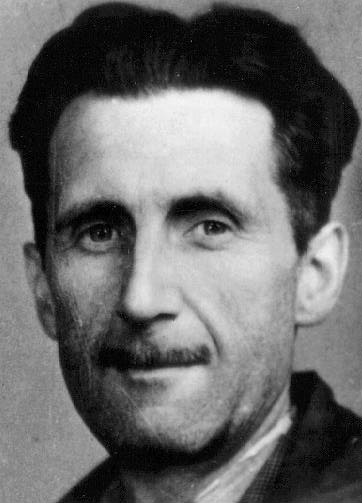
Orwell’s press card portrait, 1943
Bruckner’s remark about “Stalinist blackmail” calls to mind a writer whose commitment to both left-wing politics and anti-totalitarianism never wavered in the face of threats and coercion from the Left.
In the summer of 2003, the BBC aired George Orwell: A Life in Pictures. About halfway through the documentary, Orwell (played by Chris Langham) says, “Every line of serious work that I have written since 1936 has been written, directly or indirectly, against totalitarianism.” This is a line from one of Orwell’s best-known essays, published in 1946, “Why I Write.” But astute viewers may have noticed that something was missing from the reference — eight words that the producers decided to leave out.
Here’s the original sentence: “Every line of serious work that I have written since 1936 has been written, directly or indirectly, against totalitarianism and for democratic socialism, as I understand it.” After the sentence abruptly ends with the word “totalitarianism” in the documentary, Langham takes a long drag on his cigarette before jumping to a different passage of the essay. It was almost as if the producers wanted to accentuate the omission, taunting viewers with their own version of Orwell — one who didn’t have the courage to disclose his true beliefs.
There’s something simultaneously fitting and perverse about the manipulation of Orwell’s words more than half a century after his death (by the BBC, no less). Orwell’s anxiety about the falsification of history is one of the major themes of Nineteen Eighty-Four — as well as much of his other writing and later correspondence — and this is what the producers of the documentary were guilty of doing when they amputated one of his firmest ideological declarations and turned it into a much more palatable and anodyne comment on totalitarianism. No matter how badly some people want Orwell to be a polished and uncontroversial product for mass consumption, he was still the man who wrote these words as he speculated about the possibility of violent revolution in England: “I dare say the London gutters will have to run with blood. All right, let them, if it is necessary.”
Even when Orwell wasn’t in a mood that had him impatiently looking forward to the day “when the red militias are billeted in the Ritz,” he was always honest about his political beliefs. On November 13, 1945, Katharine Stewart-Murray, the Duchess of Atholl, wrote to Orwell asking if he would speak on behalf of an anti-communist organization called the League for European Freedom. This was a month after the publication of Animal Farm — a time when Orwell was worried that the book would be misinterpreted as a broadside against socialism instead of a narrower attack on Stalinism.
Given this context, it isn’t surprising that Orwell declined the duchess’s offer: “Certainly what is said on your platforms is more truthful than the lying propaganda to be found in most of the press, but I cannot associate myself with an essentially Conservative body which claims to defend democracy in Europe but has nothing to say about British imperialism.” Even though Orwell was a staunch anti-communist, his essential political convictions remained immovable: “I belong to the Left and must work inside it, much as I hate Russian totalitarianism and its poisonous influence in this country.”
Orwell was a socialist until the end of his life. For many people, this complicates his legacy and detracts from his pristine image as the twentieth century’s foremost foe of totalitarianism — an image that has been appropriated again and again over the past 70 years.
[…]
But as Orwell was at pains to demonstrate (especially after the publication of Animal Farm), he would have firmly rejected the Right’s attempts to appropriate his legacy. While Orwell is rightly celebrated for his refusal to accept the dogmas of the Left when he was under tremendous pressure to do so, his independence of mind is only one of the reasons why he remains so relevant today. His ability to maintain that independence without sacrificing his most fundamental principles may be even more important.
December 10, 2018
Tank Chats #38 Churchill | The Tank Museum
The Tank Museum
Published on 3 Jun 2017Historian David Fletcher MBE, in the 38th Tank Chat discussing the well-loved Churchill tank. The Churchill in this video resides at The Tank Museum, Bovington and was the last Churchill VII of the production line.
The Churchill tank was rushed in to production during the early years of the Second World War. The Churchill tank was one of the most successful British tank designs of the Second World War. They saw service from the 1942 Dieppe raid, through to North Africa, Italy and Europe.
Support the work of The Tank Museum on Patreon: ► https://www.patreon.com/tankmuseum
Or donate http://tankmuseum.org/support-us/donateTwitter: ► https://twitter.com/TankMuseum
Tiger Tank Blog: ► http://blog.tiger-tank.com/
Tank 100 First World War Centenary Blog: ► http://tank100.com/ #tankmuseum #tanks
December 6, 2018
QotD: The best “industrial policy” is not to have one at all
Which brings us to nub of the matter: how do we increase trade and productivity, given that productivity is the thing they claim the whole schemozzle is about. There is one simple and single policy which will do both. One policy which will increase British productivity simply by allowing more trade.
This policy is so simple that even the Treasury (yes, that’s our Treasury, the one in London) was able to get right, even when being run by George Osborne. As they set out in their analysis of Brexit repercussions:
“The benefits of trade in terms of increasing productivity are well understood… greater openness to trade creates a larger market which the most productive firms expand to serve. Openness also increases competition between firms, enhancing the incentives for domestic firms to innovate or adopt new technology… It increases returns on investment, and encourages UK firms to make greater use of new technologies, either by improving the quality of inputs, or through the more effective adoption of technological innovations. Greater openness to trade also increases consumer choice and reduces prices. Lower trade costs give consumers access to cheaper imported goods and competition reduces the price of domestically-produced goods.”
In plain English, it is the competition from imports which forces British firms to buck up their act and become more productive. So here is how we improve British productivity: we move to unilateral free trade. No barriers to imports, no tariffs, just the same regulation as domestically produced items.
British industry, facing the stiffest competition from the best in the world, would be forced to meet global standards of productivity. So the best industrial policy would be to stop trying to have an industrial policy about what we can and can’t buy from beyond Britain’s borders – and the rest should take care of itself.
Tim Worstall, “The best industrial strategy for Britain is not to have one”, CapX, 2017-01-23.


