
Within the intelligentsia, a derisive and mildly hostile attitude towards Britain is more or less compulsory, but it is an unfaked emotion in many cases. During the war it was manifested in the defeatism of the intelligentsia, which persisted long after it had become clear that the Axis powers could not win. Many people were undisguisedly pleased when Singapore fell or when the British were driven out of Greece, and there was a remarkable unwillingness to believe in good news, e.g. el Alamein, or the number of German planes shot down in the Battle of Britain. English left-wing intellectuals did not, of course, actually want the Germans or Japanese to win the war, but many of them could not help getting a certain kick out of seeing their own country humiliated, and wanted to feel that the final victory would be due to Russia, or perhaps America, and not to Britain. In foreign politics many intellectuals follow the principle that any faction backed by Britain must be in the wrong. As a result, ‘enlightened’ opinion is quite largely a mirror-image of Conservative policy. Anglophobia is always liable to reversal, hence that fairly common spectacle, the pacifist of one war who is a bellicist in the next.
George Orwell, “Notes on Nationalism”, Polemic, 1945-05.
January 15, 2019
QotD: Masochistic anglophobia
January 13, 2019
The Chainsmokers – Closer | Scotland the Brave | Bagpipe Cover
TheSnakeCharmer
Published on 18 Jan 2017The Chainsmokers’ “Closer” meets traditional Scottish tune “Scotland the Brave”. Watch how magical it sounds together when played on Bagpipes. Don’t miss the dance action in between the video!
Please SHARE the video if you enjoyed watching 🙂Special thanks to Wenom (Dance Crew) for being a part of my video
Check them out here – https://www.youtube.com/channel/UCZoA…Support me here on Patreon – https://www.patreon.com/thesnakecharmer
Track Produced by Karan Katiyar
Check out his awesome metal parody channel here – www.youtube.com/bloodywoodVideo Editing – Karan Katiyar
Video Shoot – Aditi Verma
TGKI Productions
January 10, 2019
QotD: Pacifism
The majority of pacifists either belong to obscure religious sects or are simply humanitarians who object to the taking of life and prefer not to follow their thoughts beyond that point. But there is a minority of intellectual pacifists whose real though unadmitted motive appears to be hatred of western democracy and admiration of totalitarianism. Pacifist propaganda usually boils down to saying that one side is as bad as the other, but if one looks closely at the writings of younger intellectual pacifists, one finds that they do not by any means express impartial disapproval but are directed almost entirely against Britain and the United States. Moreover they do not as a rule condemn violence as such, but only violence used in defence of western countries. The Russians, unlike the British, are not blamed for defending themselves by warlike means, and indeed all pacifist propaganda of this type avoids mention of Russia or China. It is not claimed, again, that the Indians should abjure violence in their struggle against the British. Pacifist literature abounds with equivocal remarks which, if they mean anything, appear to mean that statesmen of the type of Hitler are preferable to those of the type of Churchill, and that violence is perhaps excusable if it is violent enough. After the fall of France, the French pacifists, faced by a real choice which their English colleagues have not had to make, mostly went over to the Nazis, and in England there appears to have been some small overlap of membership between the Peace Pledge Union and the Blackshirts. Pacifist writers have written in praise of Carlyle, one of the intellectual fathers of Fascism. All in all it is difficult not to feel that pacifism, as it appears among a section of the intelligentsia, is secretly inspired by an admiration for power and successful cruelty. The mistake was made of pinning this emotion to Hitler, but it could easily be retransfered.
George Orwell, “Notes on Nationalism”, Polemic, 1945-05.
January 8, 2019
Tank Chats #40 Crusader | The Tank Museum
The Tank Museum
Published on 30 Jun 2017In the 40th Tank Chat, David Fletcher looks at the Second World War Crusader tank.
The first Crusader III was delivered in May 1942. Crusader IIIs were landed first in Algeria on 13 November 1942, but removed from service upon conclusion of the campaign in Tunisia in May 1943. This vehicle probably never left England, as it was held by the School of Tank Technology, before transfer to the Tank Museum in 1949. This vehicle is painted to represent a tank serving in Tunisia.
Support the work of The Tank Museum on Patreon: ► https://www.patreon.com/tankmuseum
Or donate http://tankmuseum.org/support-us/donateTwitter: ► https://twitter.com/TankMuseum
Tiger Tank Blog: ► http://blog.tiger-tank.com/
Tank 100 First World War Centenary Blog: ► http://tank100.com/ #tankmuseum #tanks
January 7, 2019
People tend to become more conservative as they age … let’s just lower the voting age to “fix” that “problem”
It is a truth universally acknowledged that as people age they tend to develop more conservative or even reactionary views. This can, in extreme cases, lead to deplorable results — as our American and British friends discovered in 2016 (fortunately, we Canadians were lucky enough to avoid such unpleasantness by having our election in 2015). Some advanced forward-thinking on how to best address this problem was reported in the Guardian on suggestions by Cambridge professor David Runciman, who advocated lowering the voting age to six, as younger voters are generally much more open to progressive ideas.
This extension of the franchise was not proposed by an inmate of an asylum for the criminally insane but by a professor, David Runciman, of the University of Cambridge, supposedly one of the best three or four such institutions in the world. But no mere criminal lunatic could have dreamt up such an idea. Is it any wonder that many people feel the world has gone mad?
Sure enough, Runciman’s idea was given serious consideration by a writer in The Guardian. Admittedly, the writer came down against the proposal, but only after giving it credence. Nevertheless, it gave an insight into the mindset of those whose political ideas are to themselves so self-evidently virtuous that the only possible explanation for the fact others do not share them is stupidity in the case of the poor and wickedness in the case of the rich.
At the head of the article were the words: “Allow six-year-olds to vote? No, but it’s not as crazy as it sounds. Children tend to be more progressive and idealistic than their parents.”
I think it’s safe to say that if the US election and the Brexit referendum had included all those woke six-year-olds, the results would have been much more amenable to our moral and intellectual superiors in the media. However, I suspect that Professor Runciman’s proposal is only half of the necessary solution. In addition to lowering the minimum voting age, we should give careful consideration to lowering the maximum voting age as well. I’m sure that a properly funded study would find that not only do older voters tend to become more conservative as they begin to fall apart physically, but it also tracks directly with mental incapacity. Our study — perhaps a pan-national group drawn from Harvard, Berkeley, Cambridge and the London School of Economics — would almost certainly conclude that a pattern of voting for more conservative options is a clear indication of enfeeblement of judgement and society would be doing a kindness to remove the franchise from those who can no longer responsibly exercise it.
Perhaps, rather than directly revoking oldsters’ voting rights, we could offer a more gentle option of designating a responsible young voter (ideally between the ages of six and eighteen) to exercise the franchise on their behalf. This way, they are still fully represented, but the vote will be directed by someone with a direct stake in the outcome, as the young will have to live for far longer with the result of any election (and the oldsters are all going to die soon, anyway).
It might also make sense to revise the voting system so that the votes of younger people carry more weight than those of older folks. Perhaps double the weight of their parents’ votes and quadruple the weight of their grandparents’? We can’t be short-changing the people who matter the most, after all … that would hardly be progressive, would it?
The use of the word progressive is telling. It implies not only that there is a clear path in humanity’s moral ascent to perfection but also that its route map has been vouchsafed to certain adults. For self-proclaimed progressives, there are no complexities or unintended consequences, let alone ironies: there is only progress and its opposite, reaction.
For the writer of the article, children are born with a knowledge of the route map of the ascent to perfection, as salmon, cuckoos and swallows are born with a knowledge of where to migrate to. Only the corruption of age causes them to forget: “Children do tend towards the progressive, having a natural sense of justice … and an underdeveloped sense of self-interest.” But what has caused the realisation that children may be suitable for enfranchisement? Our author cannot be clearer: “Most of the arguments against giving six-year-olds a vote have been capsized by the (Brexit) referendum.”
In other words, because the electorate got the answer wrong, it is necessary to change the electorate. If only it had answered the question correctly, it is a fair guess no one would have thought of lowering the voting age to six.
Why, then, does our author finally reject the vote for six year-olds? “If parents could be trusted to use their influence wisely and inculcate children with the politics it will take to assure a better future, then I wouldn’t necessarily have a problem with that, apart from, obviously, that culture is already wildly skewed towards parents … But that’s moot anyway, because parents can’t be trusted, otherwise we’d all already vote Green.”
The Private Army of the British East India Company
Brandon F.
Published on 15 Dec 2018Before the days of the Raj, British India was ruled by a private corporation: The Honourable East India Company. The Company, which began in India as a purely mercantile institution, eventually came to control vast territories across the subcontinent. These wild frontiers and busy cities required garrisons to defend them, and the expansion of Company interests demanded the ability to wage war. To do this, the Company commanded a massive private army. Made up of both European and Indian soldiers, and working in close — if not always frictionless — tandem with H.M.’s regiments, it was a fascinating institution that only came to an end with the massive Sepoy Mutiny of 1857 and the dissolution of Company rule.
In this video, I discuss the organization of this army, and the way in which it related to government forces.
If you would like to support the Channel on Patreon:
https://www.patreon.com/BrandonF
January 6, 2019
The demands to re-nationalize British passenger railways
In the Continental Telegraph, Tim Worstall points out the mutually exclusive claims about the state of British passenger rail services and the counter-productive demand to shuffle it all back into the state’s tender mercies:
Wikimedia caption – “This is the Bring Back British Rail, a reverse image of the old BR logo, (now used by the TOC’s) to show we are heading the wrong way with Rail in the UK”
A standard whinge in Britain today is that rail privatisation has failed – just look, the trains are so crowded! The thought that people flocking to use something proves failure being a most odd one of course. That more people use the train sets to travel longer distances more often should be seen as a triumph of privatisation, not a proof of its failure. And we should note that the last few decades of British Rail did show – population adjusted – falling ridership.
There’s also a certain puzzlement at the next cry of outrage – that ticket prices are too high. If people are flocking to use something etc then it’s difficult to insist that prices are too high. […] Popularity both proves that the basic system is wrong and also that prices are too high. Tough this economics stuff, isn’t it?
As to the congestion part, well, on those popular lines and routes the route itself is running at capacity. It’s just not possible to squeeze more trains onto the tracks without them running into each other. Ah, but goes the cry, government should do something! But the tracks are already run by government, that we’re not getting more track capacity is government’s fault. Giving us a good guide to how it would be if government ran it all – as history tells it was like when government did.
As to the prices, well, that overcrowding shows us that prices are too low. We need some method of rationing that access to something being over-used. Price is always the best method of rationing. Thus prices should be higher to relieve that over-crowding – while we wait a few decades for government to pull thumb out and provide more track capacity.
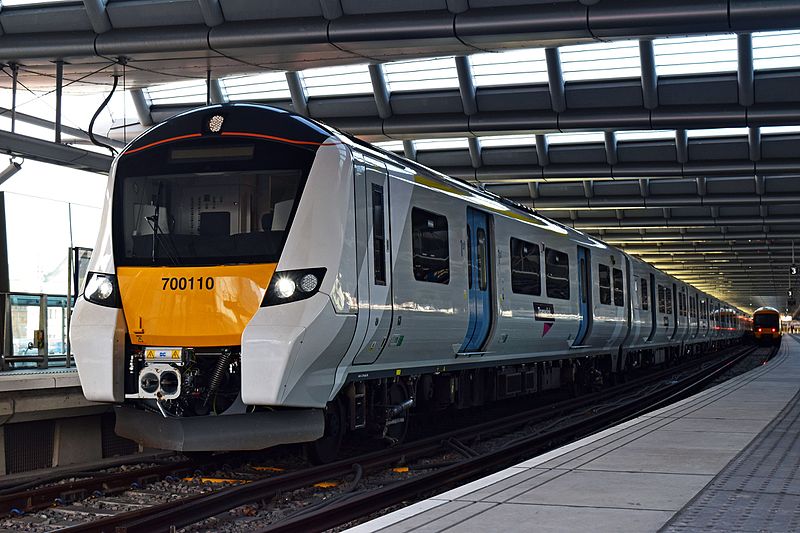
Thameslink Class 700 Desiro City at London Blackfriars in 2016.
Photo by Alex Nevin-Tylee via Wikimedia Commons.
QotD: English racism
The old-style contemptuous attitude towards ‘natives’ has been much weakened in England, and various pseudo-scientific theories emphasising the superiority of the white race have been abandoned. Among the intelligentsia, colour feeling only occurs in the transposed form, that is, as a belief in the innate superiority of the coloured races. This is now increasingly common among English intellectuals, probably resulting more often from masochism and sexual frustration than from contact with the Oriental and Negro nationalist movements. Even among those who do not feel strongly on the colour question, snobbery and imitation have a powerful influence. Almost any English intellectual would be scandalised by the claim that the white races are superior to the coloured, whereas the opposite claim would seem to him unexceptionable even if he disagreed with it. Nationalistic attachment to the coloured races is usually mixed up with the belief that their sex lives are superior, and there is a large underground mythology about the sexual prowess of Negroes.
George Orwell, “Notes on Nationalism”, Polemic, 1945-05.
January 3, 2019
The “Full English Breakfast”
My friend Liam emailed me to ask whether I had strong opinions on this serious debate despite having been raised in Canada. This was my response:

Yes, of course. I have a pulse, you know.
A proper Full English Breakfast is actually composed of eggs, bacon (English bacon, not side, back, or peameal), beans, and black pudding. Sausage is for wimps who can’t handle black pudding. Optional, but completely acceptable additions include fried mushrooms, fried onions, fried tomatoes, potato fry-up, and toast.
Anything else is an Abomination in the sight of the Lord. ESPECIALLY chips.
As to the positioning on the plate … these must also be people who colour-code their sock drawers and have secret notebooks filled with locomotive spotting numbers. You know, “anoraks”.
Bloody wankers.
The ship that revolutionised naval warfare
Lindybeige
Published on 13 Dec 2018Thanks to World of Warships for sponsoring this video. Follow the link https://wo.ws/2Pp7LgQ and use the code “LINDYBEIGE” to receive the Premium Soviet Ship ‘Diana’, 500 Doubloons, and 7 Premium days of game time. For new accounts only.
Support me on Patreon: https://www.patreon.com/Lindybeige
Many thanks to the helpful staff at the Discovery Museum in Newcastle upon Tyne. Here is the museum’s website:
https://discoverymuseum.org.uk/Lindybeige: a channel of archaeology, ancient and medieval warfare, rants, swing dance, travelogues, evolution, and whatever else occurs to me to make.
▼ Follow me…
Twitter: https://twitter.com/Lindybeige I may have some drivel to contribute to the Twittersphere, plus you get notice of uploads.
website: http://www.LloydianAspects.co.uk
January 2, 2019
In non-breaking, non-news … politicians lie
Hector Dummond explains why what might seem like a shocking revelation from a former Thatcher MP isn’t even getting a raised eyebrow from the British media:
In a highly revealing article former MP Matthew Parris admits that the Conservative Party would often lie so that it could do what it wanted. And when it didn’t lie it fudged and avoided issues in order to prevent the ‘people’ having any say in the country’s governance:
our challenge was to find ways of ducking the issue. Once I became an MP, I did so by voting for the principle and against the practice. This subversion of democracy (in Theresa May’s phrase) caused me embarrassment, but not a second’s guilt. Sod democracy: hanging was wrong …
Among ourselves we talked cheerfully about subterfuge. The Britain of 1979 and 1983 most emphatically did not vote for a massive confrontation with the coal miners. We made sure the electorate was never asked.
These candid admissions have been completely ignored by the media. One reason they’ve been ignored is, of course, that most people have come to work this out for themselves, so Parris isn’t telling us anything we don’t already know. But surely hearing it from the horse’s mouth has great value? Why hasn’t the media splashed on this? Why haven’t Parris’s old enemies in the Labour party made hay with it?
The main reason is that most of the media, and virtually all the Labour party, is on his side over this. Even newspapers like the Guardian. You might think the Guardian would be the natural enemy of a former Tory MP, especially one who worked with Thatcher, and certainly on some issues they will regard Parris as an enemy, but the fact is that the Guardian wants government to be free of restraint by the people, because its vision of the state involves a leftist government getting into power, imposing its own ideology onto society and removing the power for the people to have a democratic say from most areas of life. So it can hardly criticise Parris for having done what it longs to do. It doesn’t want to bring about anything that might lessen the freedom government currently has to ignore the voter.
December 29, 2018
English public health officials angling to ban most restaurant meals due to excess calorie counts
The bureaucrats at Public Health England (PHE) apparently want the English to go back to those gloriously hungry days of rationing during and after the Second World War, at least based on their diktats on the allowable limits for calories in purchased meals:
The idea of the government controlling the number of calories in meals is so outlandish that few people have taken it seriously, despite PHE explicitly stating that this is what they are working on. They have been busy setting calorie limits for almost every food product available in shops, cafés, pubs and restaurants. The plan was to publish them in the spring but Laura Donnelly at the Telegraph has got hold of them and has leaked them today.
They are astonishing, not only because they are so low but because they are so comically precise. Sandwiches and main meal salads will be capped at 550 calories, ready meals will be capped at 544 calories and main courses in restaurants will be capped at 951 calories. Vol-au-vents or onion bhajis will be capped at 134 calories and salad dressing capped at 145 calories. The spurious precision of these numbers is presumably meant to imply that they have been worked out scientifically. They haven’t, of course (why is OK to have a 900 calorie lunch in a restaurant but not OK to have a 600 calorie microwave dinner?). There is no way of working out how much energy a single meal should contain. The concept is ludicrous.
But the detailed proposals have infuriated manufacturers – who say they are far too complex and confusing to be workable.
No kidding.
These are not legal limits. Not yet. The plan is for the bureaucrats at PHE to ‘work with’ the food industry to magically remove calories from their products without destroying flavour. PHE have no knowledge to bring to the table so their part in the ‘partnership’ amounts to setting targets, issuing threats and naming and shaming businesses.
Some of the companies will attempt to play along, mainly by reducing portion sizes, but it is a doomed enterprise. The government initially planed to use the threat of advertising restrictions to make the companies play ball, but it has already capitulated to the ‘public health’ lobby on this, so the only thing left is to threaten them with mandatory calorie limits.
If that happens, it will mean an effective prohibition on many of Britain’s best loved dishes. Steak and kidney pudding far exceeds the 951 calorie limit for out-of-home food, as does ham, egg and chips, the all day breakfast, fish and chips, and beer and ale pie (based on Wetherspoons’ nutritional information). So does a normal Christmas dinner.
As for foreign cuisine, you can kiss goodbye to kebabs, curries, pizzas and Chinese food. But it’s a treat, you say! Tough luck. No exceptions.
December 28, 2018
Who are the best jungle troops?
Lindybeige
Published on 5 Dec 2018The answer may seem weird at first, but there is an historical reason for it.
Support me on Patreon: https://www.patreon.com/Lindybeige
Shot on location in the Petén rainforest, Guatemala.
Cameraman: Jeremy Lawrence.
Lindybeige: a channel of archaeology, ancient and medieval warfare, rants, swing dance, travelogues, evolution, and whatever else occurs to me to make.
▼ Follow me…
Twitter: https://twitter.com/Lindybeige I may have some drivel to contribute to the Twittersphere, plus you get notice of uploads.
website: http://www.LloydianAspects.co.uk
QotD: Celtic nationalism
Welsh, Irish and Scottish nationalism have points of difference but are alike in their anti-English orientation. Members of all three movements have opposed the war while continuing to describe themselves as pro-Russian, and the lunatic fringe has even contrived to be simultaneously pro-Russian and pro-Nazi. But Celtic nationalism is not the same thing as anglophobia. Its motive force is a belief in the past and future greatness of the Celtic peoples, and it has a strong tinge of racialism. The Celt is supposed to be spiritually superior to the Saxon — simpler, more creative, less vulgar, less snobbish, etc. — but the usual power hunger is there under the surface. One symptom of it is the delusion that Eire, Scotland or even Wales could preserve its independence unaided and owes nothing to British protection.
George Orwell, “Notes on Nationalism”, Polemic, 1945-05.
December 27, 2018
The 1914 Christmas Truce
Mark Felton Productions
Published on 25 Dec 2018As we celebrate Christmas today, perhaps its worth recalling the Christmas Truce of 1914, when, for a few days 104 years ago, the terrible slaughter of World War I stopped and the ordinary officers and men of both sides met in No Man’s Land to sing carols, exchange gifts and play soccer.
Support Mark’s work on Patreon or PayPal – see below:


