Quotulatiousness

February 21, 2020

QotD: Thought experiment

Filed under: Britain, Cancon, Quotations, USA — Tags: , , , , — Nicholas @ 01:00

If you were hovering above Earth looking to be born randomly into any time period in human history, you’d pick now if you had any brains. And if you could pick a place, you’d pick a Western liberal democracy, and probably the United States of America (though as much as it pains me to say it, you wouldn’t be crazy to pick Canada or the U.K. or Holland). Sure, if you could pick being rich, white, and male — and didn’t really care too much about the plight of others — you might take the 1950s. But even then, your choices for food, entertainment, etc. would be terribly curtailed compared to today. If you chose to be a billionaire in 1917, you could still die from a minor infection, and good Thai food would be entirely unknown to you. You’d certainly never enjoy watching a Star Wars movie on an IMAX screen in air conditioning. In other words, while your homes would be bigger and cooler if you were a billionaire in 1917, a typical orthodontist in Peoria in 2017 is in many respects much richer than a billionaire a century earlier.

Still, that’s not the deal on offer. You have to buy an incarnation lottery ticket, and the results would be random.

I’m not big on dividing people up by abstract categories, and I certainly don’t mean them to be pejorative. But as a historical matter, being born poor, gay, black, Jewish, ugly, weird, handicapped, etc. today may certainly come with some problems or challenges, but on the whole those traits are less of a shackle or barrier than at any time in the past. The only trait where I think it might be a closer call is dumbness. All other things being equal, a not-terribly-intelligent person with a good work ethic and some decent values might have had more opportunities before machines replaced strong backs. But even here, I can think of lots of exceptions.

Jonah Goldberg, “America and the ‘Original Position'”, National Review, 2017-12-22.

February 20, 2020

So that’s why John Cabot got hired!

Filed under: Britain, History, Technology — Tags: , , , , — Nicholas @ 05:00

Anton Howes explains something that I’d wondered about in the latest edition of his Age of Invention newsletter:

Route of John Cabot’s 1497 voyage on the Matthew of Bristol posited by Jones and Condon: Evan T. Jones and Margaret M. Condon, Cabot and Bristol’s Age of Discovery: The Bristol Discovery Voyages 1480-1508 (University of Bristol, Nov. 2016), fig. 8, p. 43.
Wikimedia Commons.

… in 1550 the English were still struggling with latitude. Their inability to find it, unlike their Spanish and Portuguese rivals, was one of the main things holding them back from voyages of exploration.

The replica of John Cabot’s ship Matthew in Bristol harbour, adjacent to the SS Great Britain.
Photo by Chris McKenna via Wikimedia Commons.

The traditional method of navigation for English pilots was to simply learn the age-old routes. They were trained through repetition and accrued experience, learning to recognise particular landmarks and using a lead and line – just a thin rope weighted with some lead – to determine their location from the depth of the water. Cover the lead with something sticky, and you might bring up some sediment from the sea floor to double-check: a pilot would learn the kinds of sand and pebbles from to expect from different areas. And when they travelled out to sea, away from the coastline, they used a basic system of dead reckoning, taking their compass bearings from a known location, estimating their speed, and keeping in a particular direction for long enough. Or at least hoping to. They might keep track of their progress on a wooden traverse table, inserting pegs to indicate how far they had sailed, but it was ultimately a matter of rough estimation. Should they make any mistake — in terms of their speed, heading, or point of departure — they might easily get lost. But it was still a matter of trying to follow an already-known route. And English mariners of the 1550s did not even know that many routes.

For a voyage of exploration, by contrast, landmarks and sediment from the sea floor would be seen for the first time rather than recalled. By definition, there was no route to follow. So to launch their own voyages of discovery, the English needed to learn a new skill. They needed to look to the heavens.

Celestial navigation — measuring the altitude of heavenly bodies and then using geometry to determine one’s latitude on the earth’s surface — was by the 1550s already hundreds of years old. It had primarily been used to cross the deserts of North Africa and the Middle East — seas of sand, in which there might also be no landmarks from which to take bearings — and to navigate the Indian Ocean. Thus, while pilots in the Atlantic and the Mediterranean stuck to dead reckoning and soundings, Islamic navigators had for centuries used quadrants and astrolabes to take their bearings at sea. By the mid-fifteenth century, these instruments and techniques had found their way to Europe, where they were put to use especially by Portuguese, Spanish, and Italian explorers, along with additional instruments such as the cross-staff.

[…]

So for decades, English explorations relied on foreigners who either knew the routes that the English pilots didn’t, or who at least possessed the skill of mathematical, celestial navigation. The Italian explorer John Cabot (Zuan Chabotto), when he sailed to Newfoundland from Bristol in the late 1490s, was able to take latitude readings (he may even have been familiar with the older Islamic navigational practices, as he claimed to have visited Mecca). When Cabot died, the English expeditions that set out from Bristol in 1501-3 relied on Portuguese pilots from the mid-Atlantic islands of the Azores. And John Cabot’s son, Sebastian Cabot, who was involved in a few English expeditions, was so expert in mathematical navigation that he was eventually appointed pilot major for the entire Spanish Empire, making him responsible for the training and licensing of all its pilots — a position he held for three decades. When he led a voyage of exploration on behalf of Spain in 1526-30, a few English merchants became investors so that they could justify sending with him an English mariner, Roger Barlow, to secretly learn the Spanish routes across the Atlantic and have immediate knowledge if an onward route to Asia was discovered (as it turned out, South America got in the way).

February 19, 2020

Great Blunders of WWII: The Scattering of Convoy PQ17

Filed under: Britain, Germany, History, Military, Russia, WW2 — Tags: , , , , , — Nicholas @ 06:00

Anthony Coleman
Published 4 Nov 2016

From the History Channel DVD series Great Blunders of WWII.

This is of interest for many reasons, but particularly because my late father-in-law served in the Royal Navy on the Arctic convoys and spent a full winter in the Soviet Union when his convoy couldn’t return before the ice closed the convoy route.

Enoch Powell

Filed under: Books, Britain, History, Politics — Tags: , , , , , — Nicholas @ 05:00

Theodore Dalrymple reviews a recent book by Paul Corthorn on Powell’s career and the concerns that animated him:

Enoch Powell in a 1987 portrait by Allan Warren.
Wikimedia Commons.

It does not pretend to be a biography, or even an intellectual biography. Rather, it chronicles, scrupulously but somewhat drily, Powell’s varying attitudes toward the main subjects of his political concerns: international relations, economics, immigration, Britain’s relations with Europe, and the status of Northern Ireland in the United Kingdom. Powell’s wider intellectual interests and religious views are scarcely touched upon, though it is mentioned that he went from being a believer to being (under the influence of Nietzsche) an atheist, to then returning to Christian belief. There is no description of his character in this book, not even by implication, and with this book as a guide, one would not recognise him if one met him. It is not possible to tell whether the author admires or detests his subject. This neutrality creates confidence in the accuracy of his scholarship, but also makes his book less than a pleasurable or exciting read. Perhaps it is the sign of a frivolous mind, but I prefer even histories of ideas to be spiced with a little biography (or, more truthfully, gossip).

The author does, however, offer a unifying interpretation of Powell’s various political concerns, namely that they were all responses to Britain’s precipitous national decline, the steepest part of which occurred in his lifetime, but which is continuing apace to the extent that Britain might even cease to be a nation at all. Powell was born in a great power and died in an enfeebled country with no industrial or military might, with precious little patriotism, and with no sense either of grandeur or collective purpose.

That this decline – relative rather than absolute, except in such fields as the maintenance of law and order — was inevitable given the conjunctures of the age, was evident to Powell (though not at first). This relative decline was already implicit in Disraeli’s dictum that “the Continent [of Europe] will not suffer England to be the workshop of the world.”

Powell’s concerns, then, were how to manage Britain’s decline and how to find it a new place in the world. He had not always been perceptive about the scale of its decline. He clung, for example, to the illusion that the Empire might still count for something even after the Second World War. Thereafter, however, he became a devotee of a kind of Realpolitik, to the extent of wanting a rapprochement or even alliance with the Soviet Union to balance the power of the United States, whose aims he had long distrusted. He discounted ideology, including communism, as a force in international politics, which is odd in a man who was by far the most intellectual and intellectually accomplished of all British politicians of the 20th century, being both a classical scholar and a brilliant linguist. He seemed to think that Soviet ambition was merely that of any large power in the great game. Those countries that fell into its grip knew otherwise.

On economics, Powell was an early devotee of the superiority of the market over state planning at a time when the intellectual tide was running the other way. There was one important subject, however, on which he was a confirmed statist, namely that of health care. He was for a time Minister of Health in the British government, during which he fiercely defended the NHS. He believed that the government had an ethical duty to provide health care for its citizenry, and it never seemed to occur to him that the centralised NHS was not the only possible way of doing so. He was often highly suspicious of international comparison, but it is difficult to see how judgment of the merits of a system could be made without it. It was clear, moreover, that in this, as in other fields, Britain was at best very mediocre. Perhaps Powell was blind to the NHS’s mediocre performance because of the benevolence of its stated intentions (an occupational hazard among intellectuals, even — or perhaps especially — among brilliant ones). At any rate, he never satisfactorily explained why health care should be different from other spheres of service provision in the superiority of private over public organization.

Christopher Hitchens – Why Orwell Matters

Filed under: Books, Britain, History, Liberty, Politics — Tags: , , , , — Nicholas @ 04:00

TheHitchensArchive
Published 24 Apr 2013

October 21, 2002. Christopher Hitchens giving a speech based on his book about George Orwell at The Commonwealth Club.

February 18, 2020

Viking Invasion of England | 3 Minute History

Filed under: Britain, Europe, History, Military — Tags: , , — Nicholas @ 02:00

Jabzy
Published 18 Oct 2016

https://www.patreon.com/Jabzy

Thanks to Xios, Alan Haskayne, Lachlan Lindenmayer, Victor Yau, William Crabb, Derpvic, Seth Reeves and all my other Patrons.

February 17, 2020

Sieges and Siege-craft

Lindybeige
Published 2 Jun 2016

Sieges in the ancient and medieval worlds were on quite different scales. 10,000 men can do things differently from 500.

Support me on Patreon: https://www.patreon.com/Lindybeige

This video’s subject was chosen by Jack Sargeant, the winner of the DeepArt art competition a couple of weeks ago. The topic is a large one, but I hope I gave it a decent enough shot.

Castle illustration by Mathew Nielsen.

Buy the music – the music played at the end of my videos is now available here: https://lindybeige.bandcamp.com/track…

Lindybeige: a channel of archaeology, ancient and medieval warfare, rants, swing dance, travelogues, evolution, and whatever else occurs to me to make.

▼ Follow me…

Twitter: https://twitter.com/Lindybeige I may have some drivel to contribute to the Twittersphere, plus you get notice of uploads.

website: http://www.LloydianAspects.co.uk

February 16, 2020

Diamonds vs. Self Determination – South West Africa and the League of Nations I THE GREAT WAR 1920

The Great War
Published 15 Feb 2020

Sign up for Curiosity Stream and Nebula: https://curiositystream.com/thegreatwar

Woodrow Wilson’s 14 Points and their idea of self-determination didn’t go unnoticed in the former German colonies like German Southwest Africa. But especially South Africa had other ideas at the Paris Peace Conference and lobbied to take control over future Namibia and its lucrative diamond mines.

» SUPPORT THE CHANNEL
Patreon: https://www.patreon.com/thegreatwar
Merchandise: https://shop.spreadshirt.de/thegreatwar/

» SOURCES

Emmett, Tony. 1999. Popular Resistance and the Roots of Nationalism in Namibia, 1915-1966. Basel, Switzerland: P. Schlettwein Publishing.
Olusoga, David, and Casper W. Erichsen. 2011. The Kaiser’s Holocaust: Germany’s Forgotten Genocide and the Colonial Roots of Nazism. London, UK: Faber and Faber.
Onselen, Charles van. 1980. Chibaro: African mine labour in Southern Rhodesia 1900-1933. London, UK: Pluto Pr.
Pirio, Gregory. 1988. “The Role of Garveyism in the Making of Namibian Nationalism.” In Namibia 1884-1984: Readings on Namibia’s History and Society: Selected Papers and Proceedings of the International Conference on “Namibia 1884-1984: 100 Years of Foreign Occupation; 100 Years of Struggle”, London 10-13 September, 1984, Organised by the Namibia Support Committee in Co-Operation with the SWAPO Department of Information and Publicity, edited by International Conference on “Namibia 1884-1984: 100 Years of Foreign Occupation; 100 Years of Struggle,” Brian Wood, Namibia Support Committee, United Nations Institute for Namibia, SWAPO, and Department of Information and Publicity. London: The Committee in cooperation with United Nations Institute for Namibia.
“Report on the Natives of South-West Africa and Their Treatment by Germany.” 1918. 1918. https://ufdc.ufl.edu/UF00072665/00001/1j.
Silvester, Jeremy, and Jan-Bart Gewald, eds. 2003. Words Cannot Be Found: German Colonial Rule in Namibia: An Annotated Reprint of the 1918 Blue Book. Sources for African History, v. 1. Leiden, NL ; Boston, USA: Brill.
Smith, Iain R. 1999. “Jan Smuts and the South African War.” South African Historical Journal 41 (1): 172–95. https://doi.org/10.1080/0258247990867….
Vinson, Robert Trent. 2012. Americans Are Coming! Dreams of African American Liberation in Segregationist South Africa. Athens: Ohio University Press. http://public.eblib.com/choice/public….
Wallace, Marion, and John Kinahan. 2013. A History of Namibia from the Beginning to 1990. Oxford, UK: Oxford University Press.
William Blakemore Lyon. 2015. “The South West Africa Company and Anglo-German Relations, 1892-1914.” Master’s thesis, Cambridge University.
Zimmerer, Jürgen, and Joachim Zeller. 2008. Genocide in German South-West Africa. Monmouth, UK: Merlin Press.
Michell, Lewis (1910). The Life and Times of the Right Honourable Cecil John Rhodes 1853-1902, Volume 2. New York and London: Mitchell Kennerly
Rhodes, Cecil, (1902) “The Last Will and Testament of Cecil John Rhodes: With Elucidatory Notes to Which Are Added Some Chapters Describing the Political and Religious Ideas of the Testator”, London: “Review of Reviews” Office
Cecil Rhodes, “Confession of Faith”, 1877 https://pages.uoregon.edu/kimball/Rho…

» SOCIAL MEDIA
Instagram: https://instagram.com/the_great_war
Twitter: https://twitter.com/WW1_Series
Reddit: https://reddit.com/r/TheGreatWarChannel

»CREDITS
Presented by: Jesse Alexander
Written by: Jesse Alexander
Director: Toni Steller & Florian Wittig
Director of Photography: Toni Steller
Sound: Toni Steller
Editing: Toni Steller
Mixing, Mastering & Sound Design: http://above-zero.com
Maps: Daniel Kogosov (https://www.patreon.com/Zalezsky)
Research by: Jesse Alexander
Fact checking: Florian Wittig

Channel Design: Alexander Clark
Original Logo: David van Stephold

A Mediakraft Networks Original Channel

Contains licensed material by getty images
All rights reserved – Real Time History GmbH 2020

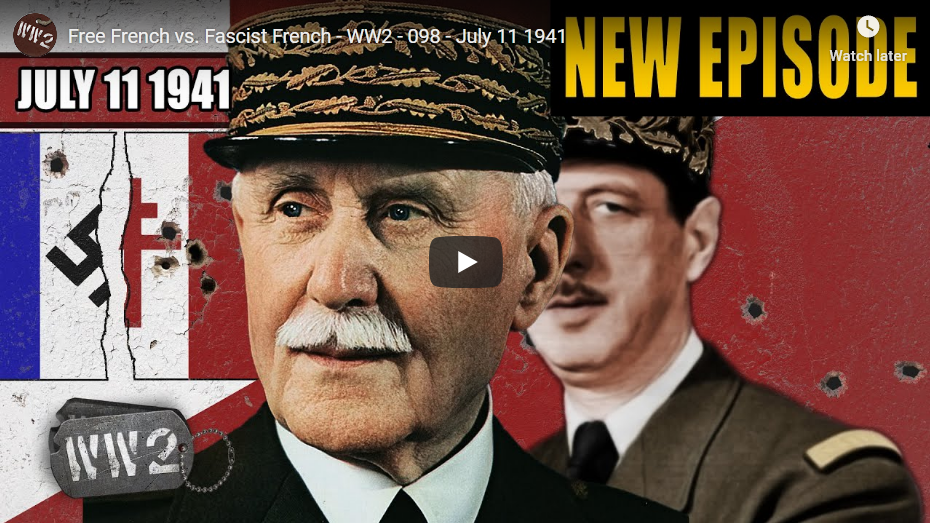
Enter Erwin Rommel – The British Advance in Africa – WW2 – 077 – February 15 1941

World War Two
Published 15 Feb 2020

While the Germans send one of their best generals to North Africa to bail out the Italians, Great Britain switches focus from Libya to Greece, but make symbolically important gains in East Africa.

Join us on Patreon: https://www.patreon.com/TimeGhostHistory
Or join The TimeGhost Army directly at: https://timeghost.tv

Follow WW2 day by day on Instagram @World_war_two_realtime https://www.instagram.com/world_war_t…
Join our Discord Server: https://discord.gg/D6D2aYN
Between 2 Wars: https://www.youtube.com/playlist?list…
Source list: http://bit.ly/WW2sources

Written and Hosted by: Indy Neidell
Produced and Directed by: Spartacus Olsson and Astrid Deinhard
Executive Producers: Bodo Rittenauer, Astrid Deinhard, Indy Neidell, Spartacus Olsson
Creative Producer: Joram Appel
Post-Production Director: Wieke Kapteijns
Research by: Indy Neidell
Edited by: Iryna Dulka
Map animations: Eastory (https://www.youtube.com/c/eastory)

Colorizations by:
– Julius Jääskeläinen – https://www.facebook.com/JJcolorization/
– Norman Stewart – https://oldtimesincolor.blogspot.com/

Sources:
– Bundesarchiv
– A German soldier poses atop a tank, photo credit: United States Holocaust Memorial Museum, courtesy of Perquimans County Library
– US National Archive
– IWM: A 4035, HU 39482

Archive by Screenocean/Reuters https://www.screenocean.com.

A TimeGhost chronological documentary produced by OnLion Entertainment GmbH.

From the comments:

World War Two
2 days ago
When you know the story going forward it’s fascinating to see how the decisions unfold this week — the reshuffling of command both on the Axis and Allied side might seem like innocuous administrative decisions when you don’t know the future. But if you have a crystal ball, you’ll know that not just Rommel arriving in North Africa, but also the decisions on the British side this week will have momentous impact on the war in total. That’s one of the things we discovered early-on with a chronological narrative, it suddenly puts things in a new perspective. The relationship between events changes, and things that might seem too boring, or undramatic to include in a “great story” take on a whole new meaning, increasing our understanding of cause and effect of the “greater” events that will come. On a different note, we just finished shooting a new batch of videos today and we’ll be announcing some fascinating developments on our program in the coming weeks. Stay tuned, and stay awesome, you all are by far the best community on YouTube!

February 15, 2020

Theodore Dalrymple on the death penalty

Filed under: Books, Britain, Law — Tags: , , , — Nicholas @ 03:00

From the New English Review:

“Tombstone Courthouse State Historic Park” by August Rode is licensed under CC BY-NC-SA 2.0

I happened to read a book published in 1965, the year Britain legislated to end the death penalty, titled Murder Followed by Suicide, by the distinguished criminologist, D.J. West. For forty years up to that date, about a third of homicides had been followed by the suicide of those who committed them.

Most people who committed homicide followed by suicide were highly disturbed psychologically, if not outright mad. For example, in killing their families they imagined that they were saving them from a worse fate. They were not the kind of people who would be deterred by anything, including the death penalty.

Here was a natural experiment. I hypothesized that if the death penalty acted as a deterrent, the homicide rate would increase but the proportion of homicide followed by suicide, which in absolute numbers would remain more or less the same, would decrease. My friend, the criminologist David Fraser, looked at the actual figures and found that this was indeed the case. Some sane people who might otherwise be inclined to kill managed to control themselves knowing that they might be executed if they did.

For the death penalty to deter, it was not necessary for it to be applied in every case. Although the death penalty for murder was mandatory in Britain, it was commuted in nine cases out of ten. All that was necessary for it to deter was that execution was a real possibility. We shall never know whether the death penalty would have deterred even more if it had been applied more rigorously.

Does its deterrent effect, then, establish the case for the death penalty, at least in Britain? No, for two reasons. First, effectiveness of a punishment is not a sufficient justification for it. For example, it might well be that the death penalty would deter people from parking in the wrong place, but we would not therefore advocate it. Second, the fact is that in all jurisdictions, no matter how scrupulously fair they try to be, errors are sometime made, and innocent people have been put to death. This seems to me the strongest, and perhaps decisive, argument against the death penalty.

Against this might be urged the undoubted fact that some convicted murderers who have been spared death have gone on to kill again, and this will continue to be so. Victims of those who murder a second time are probably more numerous than those executed in error. Therefore, utilitarians might argue, even if mistakes are sometimes made, that the death penalty overall would save lives. (Let us disregard the fact that those murderers who go on to murder a second time would not necessarily have been executed after their first murder, for nowhere are all murderers executed.)

The argument holds only if utilitarianism is accepted as a true ground of ethics. But few of us would accept that it is. It might be that hanging the wrong person after the commission of a terrible crime would have a better social outcome than hanging no one at all, provided only that it was never publicly known that the wrong person had been hanged: but we would still be horrified at the prospect. Moreover, in practice, the execution of the innocent, once it is known, serves disproportionately to undermine faith in the justice system. And surely it is true that for the state to kill an innocent man is peculiarly horrific.

February 14, 2020

Innovation and the “low-hanging fruit”

Filed under: Britain, History, Technology — Tags: , , — Nicholas @ 05:00

In the latest Age of Invention newsletter, Anton Howes wonders about the “low-hanging fruit” theories on innovation and why some things that seem obvious in hindsight took so long to be noticed:

A flying shuttle with bobbin.
Photo by Audrius Meskauskas via Wikimedia Commons.

A theme I keep coming back to is that a lot of inventions could have been invented centuries, if not millennia, before they actually were. My favourite example is John Kay’s flying shuttle, one of the most famous inventions of the British Industrial Revolution. It radically increased the productivity of weaving in the 1730s, but involved simply attaching a little extra wood and string. It involved no new materials, was applied to the weaving of wool — England’s age-old industry — and required no special skill or science. Weaving had been “performed for upwards of five thousand years, by millions of skilled workmen, without any improvement being made to expedite the operation, until the year 1733”, was how Bennet Woodcroft — one of the nineteenth century’s most important historians of technology — put it. (Lest you doubt that description of Woodcroft, he was, in addition to being an inventor himself, the man who compiled and categorised England’s entire patent record up to 1852, and who collected the inventions that would later form the basis of London’s Science Museum, particularly some of the earliest steam engines — among the most important machines in human history — that grace its engine hall today. My hero!) Weavers had been around for millennia, as had shuttles: one is even mentioned in the Old Testament (“My days are swifter than a weaver’s shuttle, And are spent without hope”). As a labour-saving invention, Kay’s flying shuttle was even technically illegal.

I keep coming back to this example, because it goes against so many common notions about the causes of innovation. When it comes to skill, materials, science, institutions, or incentives, none of them quite seem to fit. But I keep seeing more and more such cases. There’s the classic example, of course, of suitcases with wheels — why so late? Was the bicycle another candidate?

It strikes me as odd, too, that there was an explosion of signalling systems like semaphore only towards the end of the eighteenth century. Although there were some seventeenth-century precursors, the main telegraphing systems in Europe seem to have been as crude as Gondor’s lighting of the beacons, capable only of communicating a single pre-agreed message. Ancient China at least had its smoke signals, as did many indigenous American societies, and apparently the ancient Greeks too. So what took semaphore so long to take off? Many of the eighteenth-century systems did not even need multicoloured flags, my favourite being Lieutenant James Spratt’s “homograph”, subtitled “every man a signal tower”, which involved just a long white handkerchief.

The economist Alex Tabarrok calls these cases “ideas behind their time“. I tend to just call them low-hanging fruit. Hanging so low, and for so long, that the fruit are fermenting on the ground. I now see them everywhere, not just in history, but today — probably at least one per week.

Silent But Deadly: Welrod Mk IIA

Filed under: Britain, History, Military, Weapons, WW2 — Tags: , , , — Nicholas @ 02:00

Forgotten Weapons
Published 27 Dec 2016

http://www.patreon.com/ForgottenWeapons

Cool Forgotten Weapons merch! http://shop.bbtv.com/collections/forg…

If you enjoy Forgotten Weapons, check out its sister channel, InRangeTV! http://www.youtube.com/InRangeTVShow

The Welrod is a nearly completely silent bolt action pistol designed by SOE Section 9 for covert operation and assassination use during WW2. Chambered for the .32ACP cartridge (which is subsonic to begin with), the Welrod uses a ventilated barrel and large-volume suppressor with several solid rubber wipes to bring its firing report down to the minimum possible level. This noise reduction only lasts for about a dozen shots, after which time the rubber wipes have more or less bore-sized permanent holes in them, reducing the suppressor’s effectiveness to pretty much on par with other typical designs.

The Welrod is a manually operated pistol, to avoid action noise. It feeds from a Colt 1903 Pocket Hammerless magazine, which also serves as its grip. A grip safety is the only safety device, and it fires using a striker mechanism. The Welrod was first introduced in 1943, with a larger 9x19mm version added later in the war. They appear to have been manufactured by BSA, with a total of about 14,000 made. Welrods were in service as recently as Desert Storm, and are most likely still in use for those times when a very efficient silent pistol is necessary.

Thanks to the Institute of Military Technology for allowing me to have access to this very cool pistol and bring it to you! Check them out at:

http://www.instmiltech.com

February 13, 2020

“Titania McGrath thinks you’re scum. That is because of how tolerant she is.”

Spencer Klavan interviews the mind behind the Twitter legend that is Titania McGrath:

In April 2018, Oxford-educated comedian and journalist Andrew Doyle created a satirical Twitter persona, an “activist,” “healer,” and “radical intersectionalist poet” who self-identifies as “selfless and brave.” Titania, an imaginary amalgam of all the worst excesses in the modern social justice movement, fancies herself a voice for minorities of all kinds (whether they know they agree with her or not). What she lacks in self-awareness, she makes up for in conviction.

There are other parody accounts in a vein similar to Titania’s: Jarvis Dupont of the Spectator USA, for example, or Wrightly Willowleaf (who moved to Williamsburg before it was cool). But none of them has achieved Titania’s notoriety, or her reach (418.4K followers). Doyle attributes some of this success to a much-publicized Twitter ban. But that’s perhaps too modest: Titania is a note-perfect creation, as frighteningly accurate as she is screamingly funny. “[Y]ou need to understand that which you are critiquing,” Doyle told me: more than anything, his tweets as Titania demonstrate an incisive grasp of how radical progressivism functions and why woke politics commands such hypnotic power over the 21st-century Western psyche.

Doyle is among a growing number of classical liberals who have simply had enough: witty, thoughtful, and profoundly humane, he is the kind of eloquent sophisticate who would have been quite uncontroversial as a cultural critic and public intellectual in a less turbulent era. But that wasn’t his fate. Comedy and culture have been so strangled by political correctness that he is “at that point where I feel that it would be morally wrong to be silent” about the crisis of free public discourse in the West. Still, there is much more to Doyle than politics and polemic. I spoke to him at some length about his philosophical outlook, his academic interests, and his career beyond Titania.

[…]

S.K. Yes, something you capture really well with Titania is the complete lack of self-awareness, the oblivion of people to their own racism even as they criticize racism in others.

Let’s talk about that moment when Titania got banned: you’ve written elsewhere that “those in power cannot tolerate being ridiculed.” That was a theme when we interviewed Kyle Mann of the Babylon Bee as well: why do you think ridicule gets woke people so angry?

A.D. Because it’s an effective way to expose their folly. There’s something very instinctive that we all have as human beings: we don’t like being laughed at. And that makes sense: it feels like a form of humiliation. But I also think that’s why it’s a good way to puncture and deflate those kinds of pretensions. And they absolutely don’t like it — I mean, tyrants throughout history have locked up and killed satirists. We had the Bishop’s Ban on any satirical work in Great Britain, and that was in 1599. You’ve got president Erdogan in Turkey who will lock up satirists and call for their arrest — so it’s a pretty standard feature of history.

Of course, with Titania, the misinterpretation of what she’s doing is that she’s punching down, she’s attacking minorities. That’s not the point at all: it’s attacking the social justice movement, which is very very powerful but doesn’t perceive itself to be powerful. That’s why they claim victimhood: so that they can say mocking social justice is mocking the weak. It’s not, of course. It’s mocking those who are in power.

S.K. You’re absolutely right that persecution of satire by the powerful is as old as satire itself — goes back to the court of Ptolemy II, probably further. So let’s talk about power.

Based on what you’ve written it seems as if you feel that wokeness wields a kind of soft power — a cultural power more than a legal or a political power. I’m reminded a bit of Shelley’s argument that poets are the “unacknowledged legislators of the world.” How is it that you think the woke and the social justice movement came to acquire the overwhelming degree of cultural power they now have?

A.D. I think it’s because the woke movement is largely driven by people who are independently wealthy and privately educated. Just to give you an example from the U.K.: 7% of our country is educated privately. So those are the richest people, but those 7% dominate the arts, and the media, and journalism, and the law, and education, and the government. So what you have is a very small coterie of very powerful people who disproportionately control the direction of culture.

The BBC is a good example of an institution that is overly dominated by privately educated people, and it’s very very woke. So there seems to be a correlation. And similarly, the universities where they have the most woke students, and the most people wanting to de-platform and censor — which comes hand-in-hand, obviously, with woke culture — there is a clear correlation between the economic privilege of students and how woke they are. So the worst examples you’ll find are in places like Oxford University, Cambridge University, Yale, and Harvard. Those will be the ones where you get the most egregious examples of censorial wokeness. And of course those are the kids who come from the most privileged backgrounds.

It is no surprise to me that those with the most would like to claim to have the least and to be the most oppressed. There was a survey in the Atlantic about political correctness, and by a long way, the people who resent political correctness the most are the ones whom it purports to defend: the ethnic minorities and the sexual minorities and so on. And the people who support political correctness the most tend to be rich white liberals, by a long way. I think there’s something quite strategic about holding on to power by claiming to be oppressed or claiming to stand up for the oppressed. It’s something which I think is unprecedented in history: those who claim to be the victims also seize the power. It’s very unusual.

February 12, 2020

Jeeves & Windsor (Prince Andrew Edition) – Will Franken

Filed under: Britain, Humour, Politics — Tags: , , , — Nicholas @ 04:00

Comedy Unleashed
Published 8 Feb 2020

An imagined Prince Andrew receives advice from Jeeves about Jeffrey Epstein.

Live at London’s little home of free-thinking comedy.
Gigs every month https://comedyunleashed.co.uk/whatson

H/T to Hector Drummond for the link.

February 10, 2020

The coup that toppled Margaret Thatcher

Filed under: Books, Britain, Europe, History, Politics — Tags: , , , , — Nicholas @ 03:00

Charles Moore published the third volume of his Thatcher biography last year (I’ve read the first two volumes, but not the final one). In Quillette, Johan Wennström reviews the book:

This November will mark 30 years since former British Prime Minister Margaret Thatcher left office. After she had narrowly failed to secure an outright win in a 1990 leadership contest triggered by a challenge from Michael Heseltine, her former defense secretary, the majority of Thatcher’s Conservative cabinet colleagues withdrew their support and forced her departure following what she described as “eleven-and-a-half wonderful years.”

For Thatcher, the “coup,” as she referred to the events of 1990, had been unexpected. But as journalist Charles Moore explains in the third and final volume of his authorized Thatcher biography, Herself Alone (2019), the writing had been on the wall for some time. Thatcher’s style, which some considered abrasive, had turned senior figures against her. And many younger party members believed that if the party were to win a fourth consecutive election victory, in 1991 or 1992, it should be under a new standard-bearer (who turned out to be John Major).

An important underlying factor was the long-standing policy conflict regarding the European Community (or the EC as the European Union was then known), which pitted Thatcher against many in her own government, as well as against continental European leaders and George H. W. Bush’s White House. She was perceived as a “Cold Warrior” who was overly cautious in regard to the future of Europe, especially the project of European political and economic integration.

To some modern observers, that criticism of Thatcher remains apt. In a recently published book on international relations authored by former Swedish Prime Minister Carl Bildt, The Age of Disorder (Den nya oredans tid, 2019), Thatcher’s reluctance to endorse a speedy German reunification is attributed to her obsolete anxieties regarding “the dangers of a strong Germany.”

Moore’s latest volume, which focuses extensively on Thatcher’s views about Europe, shows her in a more nuanced light. In some ways, in fact, she was actually ahead of her time. And some of the current problems facing Europe, and the West more generally, might have been mitigated had her opinions been given a more generous audience.

Unfortunately, I don’t have the money for new hardcover books these days so I’ll have to wait until this volume gets a paperback edition or [shudder] get a library card and wait for it to show up at the local library.

« Newer PostsOlder Posts »

Powered by WordPress