… every time I buy “organic”, I feel like I’m sending a reinforcement to several different forms of vicious stupidity, beginning with the term “organic” itself. Duh! Actually, all food is “organic”; the term just means “chemistry based on carbon chains”.
Take “no GMOs” for starters. That’s nonsense; it’s barely even possible. Humans have been genetically modifying since the invention of stockbreeding and agriculture; it’s what we do, and hatred of the accelerated version done in a genomics lab is pure Luddism. It’s vicious nonsense, too; poor third-worlders have already starved because their governments refused food aid that might contain GMOs. And without GMOs it’s more than possible that the new wave of wheat rust, once it really gets going, might condemn billions to death.
Vegan? I’ve long since had it up to here with the tissue of ignorance and sanctimony that is evangelical veganism. Comparing our dentition and digestive tracts with those of cows, chimps, gorillas, and bears tells the story: humans are designed to be unspecialized omnivores, and the whole notion that vegetarianism is “natural” is so much piffle. It’s not even possible except at the near end of 4000 years of GMOing staple crops for higher calorie density, and even now you can’t be a vegan in a really cold climate (like, say, Tibet) because it’ll kill you. In warmer ones, you better be taking carnitine and half a dozen vitamins or you’re going to have micronutrient issues sneak up on you over a period of years.
OK, I give on gluten-free. Some people do have celiac disease; that’s a real need. But “no trans fat”? Pure faddery, or the next thing to it. The evidence indicting trans fats is extremely slim and surrounded by a cloud of food-nannyist hype. I hate helping to keep that sort of balloon inflated with my dollars.
Who could be against “fair trade”? Well, me … because the “fair trade” crowd pressures individual growers to join collectives with “managed” pricing. If you’re betting that this means lazy but politically adept growers with poor resource management and productivity prosper at the expense of more efficient and harder-working ones, you’ve broken the code.
Finally, “pesticide-free”. Do I like toxic chemicals on my food? No … but I also don’t fool myself about what happens when you don’t use them. This ties straight back to the general cluster of issues around factory farming. Without the productivity advantages of pesticides, synthetic fertilizer, and other non-“organic” methods, farm productivity would plummet. Relatively wealthy people like me would cope with reduced availability by paying higher prices, but huge numbers of the world’s poor would starve.
I buy “organic” food because it tastes better and I can, but I feel guilty about reinforcing all the kinds of delusion and superstition and viciousness that are tied up in that label. We simply cannot feed a world population of 6.6 billion without pesticides and factory farming and GMOs and preservatives in most bread; now, and probably forever, “organic” food will remain a luxury good.
Try telling its political partisans that, though. Hyped on their belief in their own virtue, and blissfully ignorant about scale problems, they have already engineered policies that have cost thousands of lives during spot famines. The potential death toll from (especially) anti-GMO policies is three orders of magnitude higher.
And my problem reduces to this: how can I buy the kind of food I want without supporting dangerous delusions?
Eric S. Raymond, “Organic guilt”, Armed and Dangerous, 2010-08-23.
January 1, 2021
QotD: Buying “organic” food
December 31, 2020
Louis Armstrong and the Beginning of the Jazz Age | BETWEEN 2 WARS: ZEITGEIST! I E.08 – Summer 1920
TimeGhost History
Published 30 Dec 2020Louis Armstrong will be one of the greats of the American Century. But before that, others have to blaze a trail for him. No mean feat in a land of racial tension…
Join us on Patreon: https://www.patreon.com/TimeGhostHistory
Hosted by: Indy Neidell
Written by: Indy Neidell and Francis van Berkel
Director: Astrid Deinhard
Producers: Astrid Deinhard and Spartacus Olsson
Executive Producers: Astrid Deinhard, Indy Neidell, Spartacus Olsson, Bodo Rittenauer
Creative Producer: Maria Kyhle
Post-Production Director: Wieke Kapteijns
Research by: Indy Neidell and Francis van Berkel
Edited by: Michał Zbojna
Sound design: Marek Kamiński
Colorizations: Mikołaj Uchman and Spartacus OlssonSources:
Some images from the Library of CongressFrom the Noun Project:
world by Arafat Uddin
Stamp by Made
questions by Gregor Cresnar
Money by DARAYANI
Money Bag by HAMEL KHALED
people by Florent LenormandSoundtracks from Epidemic Sound:
“Epic Adventure Theme 3” – Håkan Eriksson
“You’re Trouble” – Rich in Rags
“1920s Chicago 2” – Magnus Ringblom
“It’s Not a Game” – Philip Ayers
“Weapon of Choice” – Fabien Tell
“On the Edge of Change” – Brightarm Orchestra
“For the Many STEMS INSTRUMENTS” – Jon Bjork
“Easy Target” – Rannar Sillard
“Step on It” – Golden Age RadioArchive by Screenocean/Reuters https://www.screenocean.com.
A TimeGhost chronological documentary produced by OnLion Entertainment GmbH.

The limiting factor that holds back the green dream of electric cars everywhere
I’m not actually against the spread of electric vehicles — where appropriate — but we’re a long way technically speaking from an all-electric future on the roads. Alongside the vast increase in our electric generation and distribution infrastructure such a change would require, there’s also the practical limitation of what is currently possible in battery technology, and hoped-for improvements will require significant breakthroughs which seem more than just a step beyond our current capabilities:

Nissan Leaf electric vehicle charging.
Photo by Nissan UK
“There are liars, damned liars, and battery guys” – or some variation thereof – is an aphorism commonly attributed to US electro-whizz Thomas Edison.
Edison’s anecdotal frustrations remain valid today because scarcely a month goes by without a promised battery revolution, and scarcely a month goes by without that revolution arriving.
In October, for example, The Register encountered Jagdeep Singh, CEO of QuantumScape, a battery startup that boasted a new type of battery that could double the range of electric vehicles, charge in 15 minutes, and is safer than the lithium-ion that dominates the rechargeable market.
“Ten years ago, we embarked on an ambitious goal that most thought was impossible,” Singh said in a canned statement. “Through tireless work, we have developed a new battery technology that is unlike anything else in the world.”
Singh might disprove Edison’s aphorism and deliver the better batteries the world will so clearly appreciate. But to do so he’ll have to buck a 30-year trend that has seen lithium-ion reign supreme.
Why has the industry stalled? The short answer is that chemistry hasn’t found a way to build a better battery.
“The basic concept of what a battery is hasn’t shifted since the 18th century,” says Professor Thomas Maschmeyer, a chemist at the University of Sydney and founding chairman of Gelion Technology, a battery developer. All batteries, Maschmeyer explains, consist of three main building blocks: a positive electrode, called a cathode; a negative electrode, called an anode; and an electrolyte that acts as a catalyst between the two sides. “These three elements cannot change. So, if you want a breakthrough, it must come from a fundamental change in the chemistry,” Maschmeyer says.
Better living through chemistry
Battery boffins have proposed a periodic table’s worth of alternative compounds that could surpass lithium-ion batteries.These largely fall into two categories. First, batteries that are trying to surpass the energy densities that lithium offers, such as solid-state batteries, lithium-sulphur, and lithium-air. The other is batteries comprised of more abundant materials such as sodium-ion batteries, aluminium-ion, and magnesium-ion batteries.
But changing the chemistry of batteries is easier said than done, says Professor Jacek Jasieniak, a professor of material sciences and engineering at Monash University. He compares changing one element in a battery to changing a chemical in a pharmaceutical. “Often solving one problem exacerbates another,” he says.
December 29, 2020
The Economics of Wine (Orley Ashenfelter, Princeton)
Marginal Revolution University
Published 30 Sep 2020What does an economist know about wine? Given that many wines need years to mature, how can one predict which ones will be great or not?
Princeton’s Orley Ashenfelter explains how he used economic principles and regression analysis to predict wine quality (and score great deals!). His research helped spawn an entire field dedicated to the economics of wine.
This video is based on the following paper:
Predicting the Quality and Prices of Bordeaux Wines By Orley Ashenfelter
https://www.researchgate.net/publicat…More of Orley Ashenfelter’s work: https://irs.princeton.edu/people/orle…
Orley Ashenfelter’s vineyard: https://cedarrosevineyards.com/
Want to see more Economists in the Wild? Check out our series: https://mru.io/economists-wild-67905

December 26, 2020
Repost – The market failure of Christmas
Not to encourage miserliness and general miserability at Christmastime, but here’s a realistic take on the deadweight loss of Christmas gift-giving:

Christmas gifts under the tree.
Photo by Kelvin Kay via Wikimedia Commons.
In strict economic terms, the most efficient gift is cold, hard cash, but exchanging equivalent sums of money lacks festive spirit and so people take their chance on the high street. This is where the market fails. Buyers have sub-optimal information about your wants and less incentive than you to maximise utility. They cannot always be sure that you do not already have the gift they have in mind, nor do they know if someone else is planning to give you the same thing. And since the joy is in the giving, they might be more interested in eliciting a fleeting sense of amusement when the present is opened than in providing lasting satisfaction. This is where Billy Bass comes in.
But note the reason for this inefficient spending. Resources are misallocated because one person has to decide what someone else wants without having the knowledge or incentive to spend as carefully as they would if buying for themselves. The market failure of Christmas is therefore an example of what happens when other people spend money on our behalf. The best person to buy things for you is you. Your friends and family might make a decent stab at it. Distant bureaucrats who have never met us — and who are spending other people’s money — perhaps can’t.
So when you open your presents next week and find yourself with another garish tie or an awful bottle of perfume, consider this: If your loved ones don’t know you well enough to make spending choices for you, what chance does the government have?
December 24, 2020
Repost — The lousy economics of gift-giving
Tim Worstall explains why gift-giving at Christmas is so economically inefficient:
Christmas gifts under the tree.
Photo by Kelvin Kay via Wikimedia Commons.
The point being made is dual, that individuals have agency and that utility is entirely personal.
To unravel that jargon.
Individuals, peeps, are able to make choices. We delight in making choices in fact, “agency” is the opposite of “anomie”, that feeling that society determines what we may or can do that so depresses the human spirits. We get to choose to get up at 6 am or 8. Have coffee or tea when we do. Go buy the latest platters from the newly popular beat combo, pay the ‘leccie bill or have the coffee out at an emporium.
Having choices, making them, makes people happier.
Secondly, utility. The result of those choices, which of them will maximise happiness, is different for each and every individual. Sure, we can aggregate some of them – food is usually pretty high up everyones’ list, that first litre of water a day tops most. But the higher up Maslow’s Pyramid we go the more tastes – and thus happiness devoured – differ.
So, we make humans happier by their having the choice to do what they want, not what others think they should want or have.
Thus, give people cash at Christmas not socks.
Balancing that is the obvious point that the care and attention with which a present is considered is part of that consumption of happiness. The boyfriend who actually listens to the type of clothing desired and goes gets it provides that joy that a bloke has, for once, been listening. Or the book that would never have been individually considered but was chosen because it might – and does.
Sure.
But the point isn’t about Christmas at all. That’s a way of wrapping the point so it can be left underneath the tree of knowledge.
December 23, 2020
Our “systemically racist and patriarchal society” which oppresses “people of color, women, and LGBT”
To hear some people (especially on social media in these locked-down pandemic days), there has never been a human society that more greatly benefits white heterosexual men and oppresses everyone else like the modern west. Here are some stats from Rav Arora to challenge that claim:
We are frequently told by commentators and theorists on the progressive and liberal Left that we live in a systemically racist and patriarchal society. The belief that Western societies privilege white men and oppress people of color, women, and LGBT citizens is especially popular within academic institutions, legacy media, the entertainment industry, and even sports. However, newly released statistics from the US Department of Labor for the third quarter of 2020 undermine this narrative. Asian women have now surpassed white men in weekly earnings. That trend has been consistent throughout this past year — an unprecedented outcome. Full-time working Asian women earned $1,224 in median weekly earnings in the third quarter of this year compared to $1,122 earned by their white male counterparts. Furthermore, the income gap between both black and Latino men and Asian women is wider than it has ever been. The income gap between white and black women, meanwhile, is much narrower than the gap between their male counterparts.
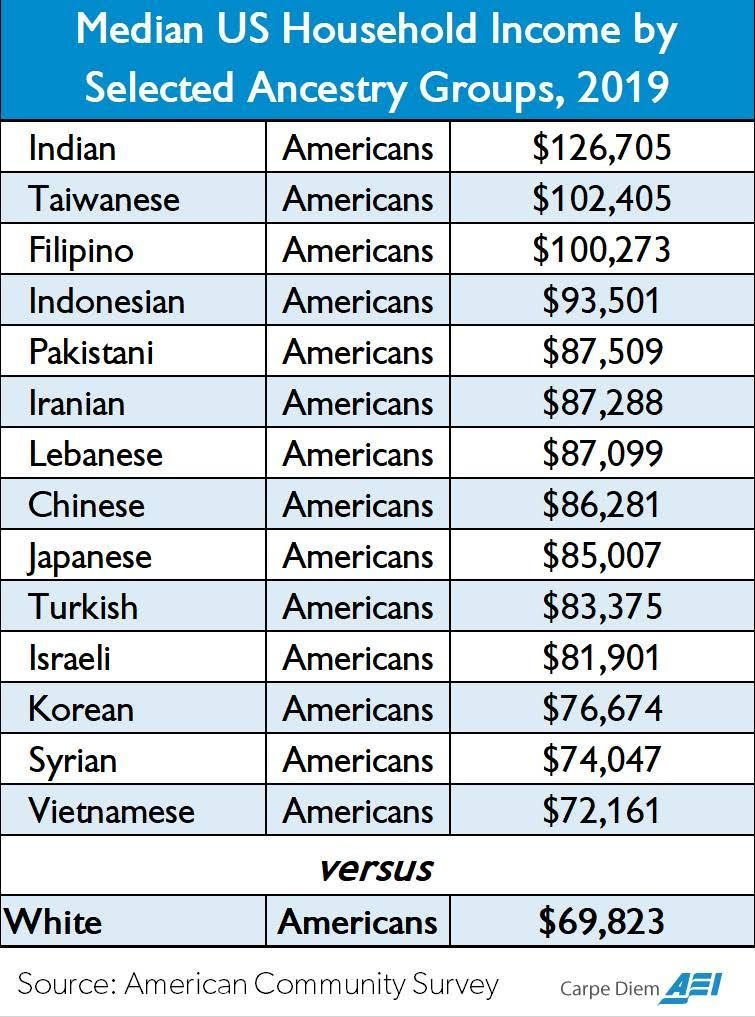
These outcomes cannot exist in a society suffused with misogyny and racism. As confounding to conventional progressive wisdom as these new figures appear to be, copious research finds that ethnic minorities and women frequently eclipse their white and male counterparts, even when these identities intersect. Several ethnic minority groups consistently out-perform whites in a variety of categories — higher test scores, lower incarceration rates, and longer life expectancies. According to the latest data from the US Census Bureau, over the 12 months covered by the survey, the median household incomes of Syrian Americans ($74,047), Korean Americans ($76,674), Indonesian Americans ($93,501), Taiwanese Americans ($102,405), and Filipino Americans ($100,273) are all significantly higher than that of whites ($69,823). The report also finds substantial economic gains among minority groups. Valerie Wilson at the Economic Policy Institute reports that from 2018 to 2019, Asian and black households had the highest rate of median income growth (10.6 percent and 8.5 percent, respectively) of all main racial groups (although she cautions that overall disparities remain “largely unchanged”). On a longitudinal scale, Hispanics, not whites, had the highest income growth in 2019 relative to the start of the Great Recession in 2007 (although many of these gains have been reversed by the pandemic).
Rapidly rising female economic success is partly a product of higher academic representation. 2019 was the 11th consecutive year in which women earned the majority of doctoral degrees. Women accounted for 57 percent of all students across American colleges in 2018 according to the latest US Department of Education figures and earned the majority of associate’s, bachelor’s, and master’s degrees. According to University of Michigan economist Mark J. Perry, “By overall enrollment in higher education men have been an under-represented minority for the last 40 years.” Sex differences in cognition can help to explain differential performance along gender lines — although men typically perform better on quantitative and visuospatial tasks, several studies have found that on average women perform better in verbal and memory tasks and on reading and writing tests.
No, Console Scalpers Aren’t Ruining Christmas
Foundation for Economic Education
Published 22 Dec 2020Support Out of Frame on Patreon: https://www.patreon.com/OutofFrameShow
Check out our podcast, Out of Frame: Behind the Scenes: https://www.youtube.com/channel/UCiS5…
As we enter peak holiday season, most people have their shopping done by now, but as always, many are scrambling last-minute for their purchases. And if you aren’t one of those early-birds fortunate enough to procure a PS5 or Xbox Series X, you can guarantee that you won’t be able to find one unless you’re willing to pay $1,200 to a scalper.
Many are understandably frustrated. How is it fair for people to buy up the consoles at $500 and sell for nearly double or triple the cost? “There ought to be a law” against that kind of thing — right?
Well, in short, there’s nothing wrong with scalping — and a few economic lessons will help explain why.
Scarcity is real and so is time-preference. Scalpers (and even bots) show that demand for some goods is so high that people are willing to pay several times the list price — which could provide a lot of information to Sony and Microsoft on how many consoles to produce and in what parts of the world. They could factor that information into the future, so there would be less problems with availability, but most retailers make this information exchange impossible.
______________________________
CREDITS:Produced by Sean W. Malone
Written by Jen Maffessanti & Sean W. Malone
Edited by Paul Nelson
Asst. Edited by Jason Reinhardt

December 17, 2020
QotD: Light rail systems are almost always an upper middle class boondoggle
[…]
The problem with light rail (and the reason it is popular with government officials) is that it is an upper middle class boondoggle. There can be no higher use of transit than to provide mobility to poorer people who can’t afford reliable automobiles. Buses fulfill this goal better than any mode of transit. They are flexible and can reach into many corners of the city. The problem with buses, from the perspective of government officials, is that upper middle class people don’t like to ride on them. They like trains. So the government builds hugely expensive trains for these influential, wealthier voters. Since the trains are so expensive, the government can only build a few routes, so those routes end up being down upper middle class commuting corridors. As the costs mount for the trains, the bus routes that serve the poor and their dispersed commuting destinations are steadily cut.
Warren Meyer, “Phoenix Light Rail Fail, 2019 Update”, Coyote Blog, 2019-11-13.
December 16, 2020
QotD: Distorting the history of America’s “Gilded Age”
To some extent, during the late 1800s — a period historians call the “Gilded Age” — American politicians learned from the past. They had dabbled in federal subsidies from steamships to transcontinental railroads, and those experiments dismally failed. Politicians then turned to free markets as a better strategy for economic development. The world-dominating achievements of Cornelius Vanderbilt, James J. Hill, John D. Rockefeller, and Charles Schwab validated America’s unprecedented limited government. And when politicians sometimes veered off course later with government interventions for tariffs, high income taxes, anti-trust laws, and an effort to run a steel plant to make armor for war — the results again often hindered American economic progress. Free markets worked well; government intervention usually failed.
Why is it, then, that for so many years, most historians have been teaching the opposite lesson? They have made no distinction between political entrepreneurs, who tried to succeed through federal aid, and market entrepreneurs, who avoided subsidies and sought to create better products at lower prices. Instead, most historians have preached that many, if not all, entrepreneurs were “robber barons”. They did not enrich the U.S. with their investments; instead, they bilked the public and corrupted political and economic life in America. Therefore, government intervention in the economy was needed to save the country from these greedy businessmen.
Burton W. Folsum, “How the Myth of the ‘Robber Barons’ Began — and Why It Persists”, Foundation for Economic Education, 2018-09-21.
December 14, 2020
QotD: Goodhart’s law
Any observed statistical regularity will tend to collapse once pressure is placed upon it for control purposes.
Or as it has been reformulated:
Goodhart’s law is an adage named after economist Charles Goodhart, which has been phrased by Marilyn Strathern as: “When a measure becomes a target, it ceases to be a good measure.” One way in which this can occur is individuals trying to anticipate the effect of a policy and then taking actions which alter its outcome.
Set a target for tonnes of shoes and you get one tonne shoes. Set a target for 100 shoes and you get 100 left feet. Set a target for being on time and people fiddle their definition of time.
It is, by the way, entirely fine to insist that airlines play fair with telling us how long a flight will take. You said it will take 4 hours, then 4 hours should be about the time it takes. Yes, sure, we understand, airports, crowded places. Idiot passengers forget to board, luggage must be taken off. Winds vary, thunderstorms happen, French air traffic controllers actually turn up to work today, their one day in seven. Sure, there’re lots of variables. But if you say it’s about four hours then it should be about four hours. Great.
But to complain that they pad their number a bit is ludicrous. We’re holding their feet to the fire, insisting that an underestimate will lead to financial costs. Thus, obviously, they will overestimate. That’s not really even Goodhart’s Law, that’s just human beings. But then, as we know, those who would plan everything don’t deal well with the existence of people, do they?
Tim Worstall, “Goodhart’s Law Applies To Economies, To Everything – Why Not Scheduled Airline Flight Times?”, Continental Telegraph, 2018-08-27.
December 13, 2020
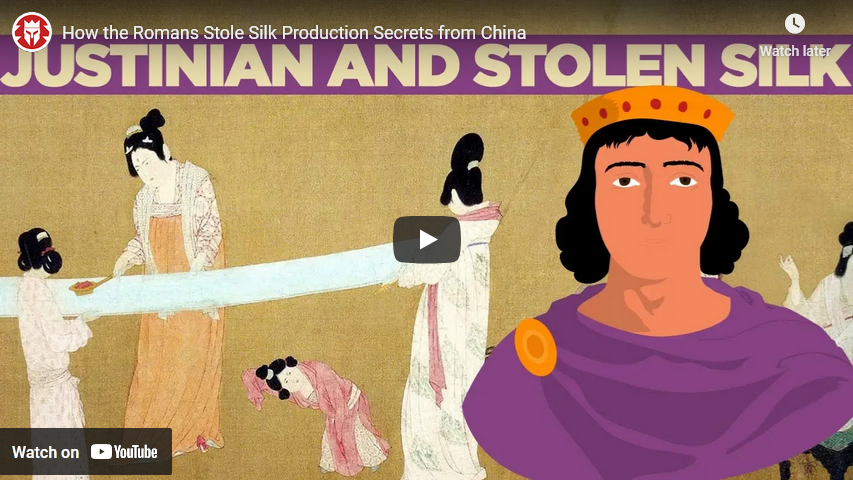
How the Romans Stole Silk Production Secrets from China
Kings and Generals
Published 31 Jan 2019Go to https://www.wix.com/KingsAndGenerals to get started on your website today!
Check out our new website at http://kingsandgenerals.orgSilk production was one of the biggest secrets of China and one of the most lucrative industries of the age. So it is not a surprise that the Roman emperor Justinian was eager to learn this secret. In this video we will discuss the start of the silk production, its importance and the story of how Justinian managed one of the first industrial thefts in history
Support us on Patreon: http://www.patreon.com/KingsandGenerals or Paypal: http://paypal.me/kingsandgenerals
Check out our Merch Store: teespring.com/stores/kingsandgenerals
We are grateful to our patrons and youtube members, who made this video possible: https://drive.google.com/open?id=1Xa-…
The video was made by our friend Cogito
This video was narrated by Officially Devin (https://www.youtube.com/user/Official…)
✔ Merch store ► teespring.com/stores/kingsandgenerals
✔ Podcast ► Google Play: http://bit.ly/2QDF7y0 iTunes: https://apple.co/2QTuMNG
✔ Twitter ► https://twitter.com/KingsGenerals
✔ Instagram ► http://www.instagram.com/Kings_GeneralsProduction Music courtesy of Epidemic Sound: http://www.epidemicsound.com
#Documentary #Justinian #Silk
December 12, 2020
Trains and Oil | California History [ep.8]
The Cynical Historian
Published 4 Jul 2019After a long hiatus, here is the return of the History of California series. For those who haven’t seen the previous episodes, here’s the playlist: https://www.youtube.com/playlist?list…
Today we’re going over the history of transcontinental railroads, monopolistic practices, and crude oil production in California.
————————————————————
references:
eds. Richard Francaviglia and David Narrett, Essays on the Changing Images of the Southwest (Arlington: University of Texas at Arlington, 1994). https://amzn.to/2JwNiHkWilliam H. Goetzmann, Army Exploration in the American West, 1803-1863, new ed. (1959; Lincoln: University of Nebraska, 1979). https://amzn.to/2K8tslY
Paul Sabin, Crude Politics: The California Oil Market, 1900-1940 (Berkeley: University of California Press, 2005). https://amzn.to/2W16gtt
Jules Tygiel, The Great Los Angeles Swindle: Oil, Stocks, and Scandal During the Roaring Twenties (Berkeley: University of California Press, 1996). https://amzn.to/2ASH7Z0
Richard White, Railroaded: The Transcontinentals and the Making of Modern America (New York: W.W. Norton, 2011). https://amzn.to/2zkURO3
————————————————————
Support the channel through PATREON:
https://www.patreon.com/CynicalHistorianLET’S CONNECT:
Discord: https://discord.gg/Ukthk4U
Twitter: https://twitter.com/Cynical_History
————————————————————
Wiki: The history of the Southern Pacific stretches from 1865 to 1998. For the main page, see Southern Pacific Transportation Company; for the former holding company, see Southern Pacific Rail Corporation. The Southern Pacific was represented by three railroads. The original company was called Southern Pacific Railroad, the second was called Southern Pacific Company and the third was called Southern Pacific Transportation Company. The third Southern Pacific railroad, the Southern Pacific Transportation Company, is now operating as the current incarnation of the Union Pacific Railroad.The story of oil production in California began in the late 19th century. In 1903, California became the leading oil-producing state in the US, and traded the number one position back-and forth with Oklahoma through the year 1930. As of 2012, California was the nation’s third most prolific oil-producing state, behind only Texas and North Dakota. In the past century, California’s oil industry grew to become the state’s number one GDP export and one of the most profitable industries in the region. The history of oil in the state of California, however, dates back much earlier than the 19th century. For thousands of years prior to European settlement in America, Native Americans in the California territory excavated oil seeps. By the mid-19th century, American geologists discovered the vast oil reserves in California and began mass drilling in the Western Territory. While California’s production of excavated oil increased significantly during the early 20th century, the accelerated drilling resulted in an overproduction of the commodity, and the federal government unsuccessfully made several attempts to regulate the oil market.
————————————————————
Hashtags: #history #California #trains #oil

November 29, 2020
QotD: The succession problem of totalitarian leadership
There were two main reasons for the decline, both structural. The first, of course, is Communism itself. A totally ideologized society is a society totally committed to make-believe. You could fill a good-sized book listing the catastrophes make-believe caused the USSR. Just to take the most obvious: Hitler did everything but send the Goodyear Blimp over Moscow, towing a banner announcing his invasion plans. But since everyone who accurately reported the goings-on in Poland ended up in the Gulag, the Wehrmacht walked right on in.
The second has to do with the nature of totalitarian leadership. Obviously sharing power is out of the question, so every Boss who finally claws his way to the top ruthlessly purges everyone who could conceivably challenge him. The purged are replaced by yes-men and toadies, who immediately enact mini-purges of their own inside their new departments. It doesn’t take more than a few rounds of this for smarter functionaries to learn to dig themselves in very, very deep, disguising themselves in a kind of protective stupidity. A few more rounds, and “protective stupidity” drops the modifier, as anyone with anything on the ball has decamped for the safer — and, not coincidentally, very soon much more profitable — havens of technical management.
It doesn’t take long before your “leadership” is nothing but ideology-addled dimbulbs. Sound familiar?
Severian, “How Dumb Are Liberals?”, Rotten Chestnuts, 2020-07-31.
November 24, 2020
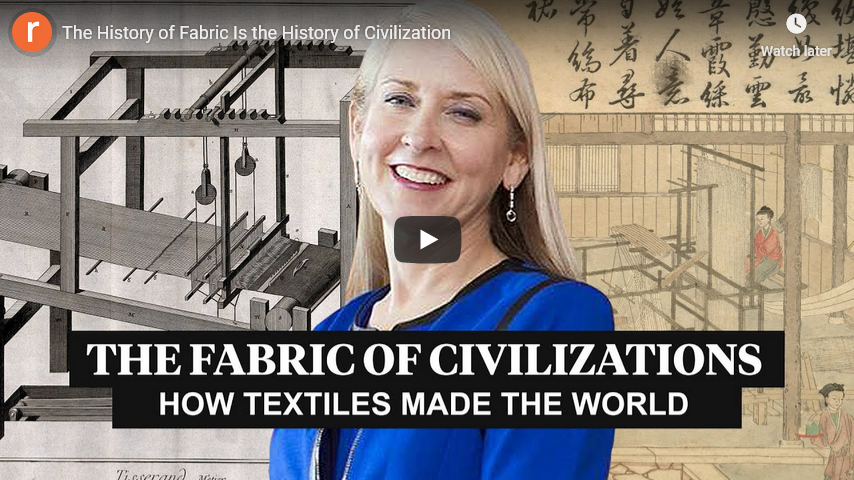
The History of Fabric Is the History of Civilization
ReasonTV
Published 23 Nov 2020Virginia Postrel’s new book explores economics, politics, and technology through textiles.
——————
Full text and links: https://reason.com/video/2020/11/23/t…Follow us on Twitter: https://twitter.com/reason
Reason is the planet’s leading source of news, politics, and culture from a libertarian perspective. Go to reason.com for a point of view you won’t get from legacy media and old left-right opinion magazines.
—————-The Fabric of Civilization: How Textiles Made the World, a new book by former Reason editor in chief Virginia Postrel, is a rich, endlessly fascinating history of the remarkable luck, invention, and innovation that made our fabric-rich world possible.
The book aims to make the mundane miraculous. Consider cotton. Most of the cotton we grow today is descended in part from a plant species that evolved in Africa and somehow got over to what is now Peru, where it mixed with New World strains.
“The fact that we have cotton at all, that it exists anywhere, is amazing,” says Postrel. “It happened long before there were human beings, but much more recently than when the continents were together. So we don’t know. It could have gotten caught up in a hurricane. It could have floated on a piece of pumice. So it’s this random, very unlikely happening that had tremendous world-changing consequences.”
The story of textiles is rife with attempts at protectionism and prohibition. In 17th and 18th century Europe, countries banned the importation of super-soft, super-colorful cotton prints from India known as calicos because they threatened domestic producers of everything from lower-quality cotton fabric to luxury silks. “For 73 years, France treated calico the way the U.S. treats cocaine,” Postrel says. “There was this huge amount of smuggling, and they were constantly ratcheting up the penalties [so] that they got quite grotesque, at least for the major traffic.” Some of “the earliest writings of classical liberalism are in this context, people saying not only is this not working, but … it is unjust to be sentencing people to the galleys in order to protect silk makers’ profits.”
Postrel also documents how the Luddites, the 19th century English textile workers famous for smashing the power looms threatening to put them out of work, owed their jobs to an earlier technological breakthrough: the spinning machines that emerged in the late 1700s.
“If you go back to that earlier period, when spinning machines were introduced, the same thing happened,” she says. “They had their own period of rebelling against the new technologies and saying they’re putting people out of work.”
The book also upends some contemporary myths, such as the claim that commercial production of hemp for clothing was a casualty of the war on drugs. “Hemp historically was a very coarse kind of fabric for poor people who didn’t have an alternative,” says Postrel. “It was replaced by cotton for good reasons. Cotton was also affordable, but it was soft and washable and just a much better fabric.”
“Human beings live in history and we inherit the legacies, positive and negative, of that history,” says Postrel, whose previous books include The Power of Glamour, The Substance of Style, and The Future and Its Enemies. Discussing the large themes of her work she says, “All you can do is start from where you are and try to do better from where you are.”
Narrated by Nick Gillespie. Edited by Isaac Reese.
Music: “Thoughts,” by ANBR
Photos: World History Archive/Newscom; The Print Collector Heritage Images/Newsroom; The “Réale” returning to port, Med/CC BY-SA 3.0; Smithsonian National Museum of African American History and Culture/CC0; Battle of Grand Port, Rama/Wikimedia Commons/CC BY-SA 2.0 FR; Fine Art Images Heritage Images/Newscom; Seton, M., Müller, R., Zahirovic, S., Gaina, C., Torsvik, T., Shephard, G., Talsma, A., Gurnis, M., Turner, M., Maus, S., and Chandler, M., 2012, Global continental and ocean basin reconstructions since 200 Ma: Earth-Science Reviews, v. 113, no. 3-4, p. 212-270