
PC-brigadiers behave exactly like owners of a positional good who panic because wider availability of that good threatens their social status. The PC brigade has been highly successful in creating new social taboos, but their success is their very problem. Moral superiority is a prime example of a positional good, because we cannot all be morally superior to each other. Once you have successfully exorcised a word or an opinion, how do you differentiate yourself from others now? You need new things to be outraged about, new ways of asserting your imagined moral superiority.
You can do that by insisting that the no real progress has been made, that your issue is as real as ever, and just manifests itself in more subtle ways. Many people may imitate your rhetoric, but they do not really mean it, they are faking it, they are poseurs … You can also hugely inflate the definition of an existing offense … Or you can move on to discover new things to label “offensive”, new victim groups, new patterns of dominance and oppression.
If I am right, then Political Correctness is really just a special form of conspicuous consumption, leading to a zero-sum status race. The fact that PC fans are still constantly outraged, despite the fact that PC has never been so pervasive, would then just be a special form of the Easterlin Paradox.
Kristian Niemietz, “The economics of political correctness”, Institute of Economic Affairs, 2014-04-30.
January 30, 2021
QotD: Positional goods and social signalling
January 29, 2021
Costs of keeping Biden’s promise to forgive student debt
Antony Davies and James R. Harrigan consider the frequently issued campaign promise by Joe Biden and what it will cost to implement:
Given the results of the recent election, it should come as no surprise that we’re poised for the next big expansion: student debt forgiveness, a promise Joe Biden made frequently as he campaigned for the presidency. Like the big ideas that came before it, this idea will cost us more than we can afford from day one, and far more than its proponents will admit. Biden’s plan as currently envisioned would cost over $300 billion. But that’s just this year. The plan will set in motion unintended consequences that will doubtlessly persist for generations.
First, next year’s crop of new students will — understandably — demand that their loans be forgiven too. And so will those of the year after that, and so on. This program will quickly become a sort of college UBI, where the government just hands out $10,000 to every college student. Some argue that if this results in a better educated populace, then it’s worth the cost. But it won’t result in a better educated populace; it will result in a whole bunch of students majoring in things the market doesn’t value, and another batch simply taking a four-year vacation on the taxpayer’s dime. Heretofore, graduates knew they needed marketable skills in order to repay their college loans. But when student loans are forgiven as a matter of course, graduates bear no cost for wasting our collective resources by studying things the market doesn’t value, or by not studying at all.
Data sources: Federal Reserve Bank of St. Louis, National Center for Education Statistics.
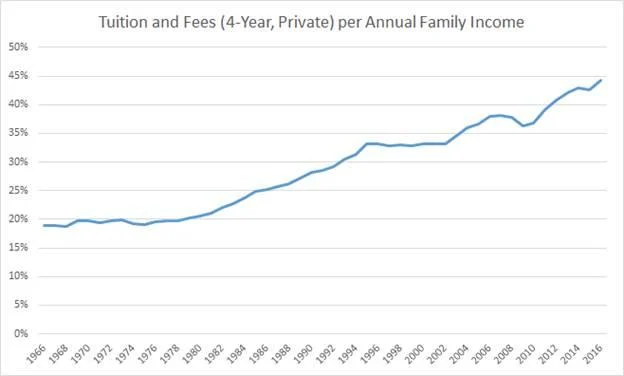
Second, colleges and universities will respond to this new reality by raising tuition commensurately. Tuition and fees were a pretty constant 18 to 19 percent of family income from the 1960s until 1978. In 1965, the federal government started guaranteeing student loans. In 1973, Congress established Sallie Mae and charged it with providing subsidized students loans. And by 1978, tuition and fees had started a steady march to 45 percent of family income today. When the government makes it less painful for students to borrow, whether by guaranteeing, subsidizing, or forgiving loans, it takes away some of the pain of student borrowing, which makes it easier for colleges and universities to raise tuition.
Third, expect many taxpayers to cry foul. Homeowners will quite sensibly wonder why the government is not forgiving their mortgages. After all, student loans add up to about $1.4 trillion, while American mortgages total more than $16 trillion. If relieving students from the burden of their debts is a good idea, it should be an even better idea to relieve homeowners of theirs.
What about students who worked multiple jobs or attended less prestigious schools so they could avoid going into debt? Why aren’t they being rewarded? What about students who diligently paid off their debt and are now debt free? Will they receive nothing? What about, fantastically, people in the trades? Is it reasonable to charge people — via the higher taxes loan forgiveness will bring — who did not go to college to subsidize those who do? Regardless of the answers to these questions, implementing this plan will be fraught with difficulty.
January 28, 2021
Japan’s Big Asian Gamble – WW2 Special
World War Two
Published 27 Jan 2021Access to scarce natural resources and labor was a big reason for the Japanese to invade numerous South-East asian countries. But was that necessary? And did the benefits outweigh the risk? Let’s find out!
Join us on Patreon: https://www.patreon.com/TimeGhostHistory
Hosted by: Indy Neidell
Written by: Joram Appel
Director: Astrid Deinhard
Producers: Astrid Deinhard and Spartacus Olsson
Executive Producers: Astrid Deinhard, Indy Neidell, Spartacus Olsson, Bodo Rittenauer
Creative Producer: Maria Kyhle
Post-Production Director: Wieke Kapteijns
Research by: Joram Appel
Image Research by: Michał Zbojna
Edited by: Michał Zbojna
Sound design: Marek KamińskiColorizations:
Julius Jääskeläinen – https://www.facebook.com/JJcolorization/Icons from The Noun Project:
asia by Ted Grajeda
clothing by Adnen Kadri
Coal by Eucalyp
Wire by Arthur Shlain
noun_Wool_2842881
noun_rock_12609
noun_rock_481051
noun_hemp_2183488
Iron Ingot by Jetro Cabau Quirós
rock by Bakunetsu Kaito
Medicine by Ladalle CS
noun_rock_481016
noun_silk_3492403
noun_Oil_3319962
Paper by Sergey Demushkin
rock by Aline Escobar
tire by Juan León
soap by Roman
noun_Wood_2177037
noun_Metal_3369307
rock by Bakunetsu Kaito
noun_Mineral_3517065Soundtracks from Epidemic Sound:
“Sights of the Tokyo Tower” – Sight of Wonders
“Paths of a Samurai” – Mandala Dreams
“Pacific Shores” – Mandala Dreams
“Sights of the Tokyo Tower” – Sight of Wonders
“Save Her” – Jon BjorkSources:
Archive by Screenocean/Reuters https://www.screenocean.com.
A TimeGhost chronological documentary produced by OnLion Entertainment GmbH.
From the comments:
World War Two
4 hours ago
Japan wasn’t the only nation that went to war over Asia’s natural resources. Indonesia was a big source of wealth for the Dutch ever since it became a colony, so The Netherlands went to war after World War Two, when the Indonesians declared their independence. We have made a whole series about the Indonesian War of Independence, including a prologue covering the colonial context (including WW2 occupation) of Indonesia. You can watch that prologue right here: https://youtu.be/IkKJSRaeOik

The economic impact of a US national minimum wage of $15 per hour
I missed this post by Warren Meyer last week, but it’s still very topical:

I have talked a lot about the negative effects of higher minimum wages on low-skill workers. Two good example background posts are here and here. I covered how a broad range of labor regulation hurts unskilled workers in a cover story for Regulation magazine a few years back. Unfortunately, in a country where the average American buys about $1000 in lottery tickets each year, the willingness to believe we can get something for nothing is strong.
But I want to talk specifically about a Federal minimum wage increase, where one other problem emerges. The best way to state this is — how can one possibly set the same minimum wage for San Francisco at the same rate as one does for rural Mississippi? Here is one source for comparative state cost of living. Doing this by county would make the curve even wider.
Cost of living in Hawaii is more than 2x that of Mississippi. CA and NY are not far behind. A minimum wage that might comfortably be accommodated in San Francisco (and note even there the rise to $15 was ending service jobs in that city long before COVID), would be an economic disaster for rural Alabama. I don’t tend to think primarily along racial lines as seems to be the case on the Left today, but basically this is a policy driven by rich white tech guys in San Francisco that is going to devastate the employment prospects of rural blacks.
Whatever one’s misgivings about minimum wages, it is certainly true that allowing states to take the lead on setting minimum wages (counties would make even more sense) makes a lot more sense that trying to take action at the national level. Even with state action there are disparities.
QotD: Art for art’s sake
Severian, “The Entertainer”, Rotten Chestnuts, 2020-10-08.
January 26, 2021
The brief and inglorious life of Penn Central
In City Journal, Nicole Gelinas recounts the tale of the fateful merger of two great American railroad systems that lasted just long enough to support massive financial chicanery before descending into inevitable bankruptcy:

More than 50 years on now, the spectacular collapse of the Penn Central railroad in 1970 is little remembered today, but its legacy is still with us — not so much as a warning, but as a prelude: to New York City’s own near-bankruptcy in the 1970s; to four decades of financial engineering, beginning in the 1980s; to the 2001 Enron downfall; to the 2008 financial crisis and its “too big to fail” bailouts — and yes, even to the public discontent that elected President Donald Trump.
As America emerged from World War II, most people would have laughed at the idea of the nation’s two premier freight and passenger railroads, the Pennsylvania and the New York Central, going broke in a quarter-century’s time. By design, the Pennsy and the Central were not fierce competitors but complementary “frenemies” that had long agreed not to undercut one another’s monopoly profits. From Massachusetts to Missouri, the two railroads dominated freight and passenger travel in the northeast quarter of the United States, with nearly 21,000 miles of track between them.
Yet even as America built its powerhouse postwar economy, the railroads struggled. As Joseph R. Daughen and Peter Binzen write in The Wreck of the Penn Central, their cult-classic chronicle of the Penn Central’s demise, during the war the then-separate railroads had been running their equipment 24 hours a day to transport troops and supplies, leaving them with “worn-out” equipment.
In the fifties and sixties, moreover, new competitive pressures prevented them from catching their breath. Trucks competed with the railroads for freight hauling via the new, free highways the nation was building. Commuter-rail passengers moved to the highways as well, while long-haul rail passengers took to the skies. The railroads’ decline accelerated in the sixties, partly because of the collapse of northeast manufacturing.
In 1962, the two companies decided to merge. But railroading was one of the most heavily regulated industries in the United States, so the merger took six years, as it wound its way through multiple levels of public approval for the creation of the 100,000-worker, 100,000-shareholder, 100,000-creditor behemoth. Meantime, government-set rates already fell short of the railroads’ long-term costs.
The combined entity that would become the Penn Central made significant concessions to win political support for the merger, including no-layoff pledges that would hamper its ability to cut spending and a promise to take on the independent (and chronically insolvent) New York, New Haven, and Hartford passenger railroad.
After the merger, the railroads discovered that they had incompatible computer systems, which threw railyards into chaos and angered customers. The Penn Central’s three top officials, too, were incompatible. They “scarcely spoke to one another,” write Daughen and Binzen. Stuart Saunders, the board chairman, was a political guy. Alfred Perlman, the president, was a trains guy. These different outlooks could have complemented each other, but personalities got in the way. Rounding out this dysfunctional triumvirate was Penn vet David Bevan, the top financial official, perpetually “angry and humiliated” at not being picked for the top job.

Penn Central route map from us.leforum.eu
http://us.leforum.eu/t1355-Photos-du-Penn-Central-PC.htm
H/T to Ed Driscoll at Instapundit, who also posted this video the combined entity put together to celebrate the merger:
£760m to connect Bicester and Bletchley? That’s … very spendy
At the Continental Telegraph, Tim Worstall looks at the economic case for building the East-West railway line — in “reverse Beeching” style — to connect Oxford and Cambridge:
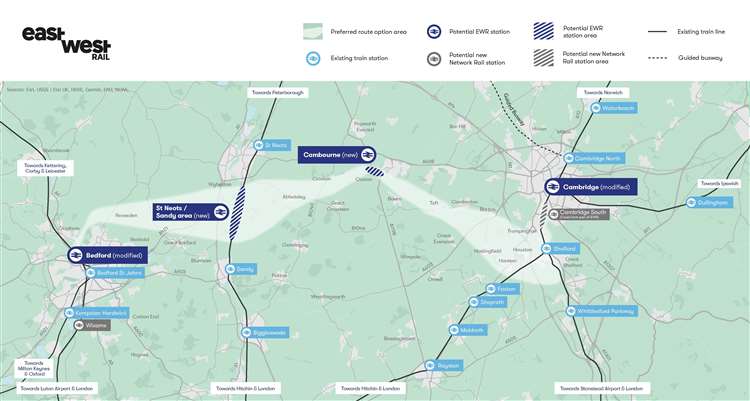
The cash from the Department of Transport will be used to lay track along a disused railway line between Bicester and Bletchley, in Buckinghamshire, with services beginning in 2025.
Excuse me? £760m to link Bicester and Bletchley? Other than the fact that that is £50m/mile, which should be the cost of rail lines made from crushed Faberge eggs and unicorn hair, how many people want to travel between Bicester and Bletchley by train? That’s roughly £10K/person in those small towns. OK,that then extends to Oxford, but that allows around 30,000 more people to go by train to Oxford. Which is not a particularly busy commuter metropolis anyway.
The aim is to complete the whole project by the end of the decade, according to the government minister overseeing it.
2 miles per year? Are they going to use canals and horses like Brunel?
[…]
Elsewhere, the new railway will shorten journey times between routes outside of London. Travellers from Oxford for example, will no longer have take a train into the capital and back out again to reach Milton Keynes, but could travel there via Bicester.
Again, what’s the demand for this? How many people want to do this, and would it be cheaper to just hire some chauffeurs to drive each passenger in a Ferrari from Bicester to where they want in Milton Keynes? I doubt it will be any quicker than a car because this only gets you to Bletchley, and then you have to get off a train to get to Milton Keynes, and then get where you want in Milton Keynes.
This used to be an active railway corridor before the Beeching cuts in the 1960s, which slashed a lot of uneconomic branch lines from British Rail’s network. If the land wasn’t sold off, then it’s just a matter of re-laying the track and ensuring that any existing bridges, embankments and drainage culverts are still capable of handling the renewed rail traffic. It seems unlikely that the mere engineering aspects of the project would require several hundred million pounds to complete, so perhaps there are some land issues that need to be re-acquired to allow the railway to become active again.
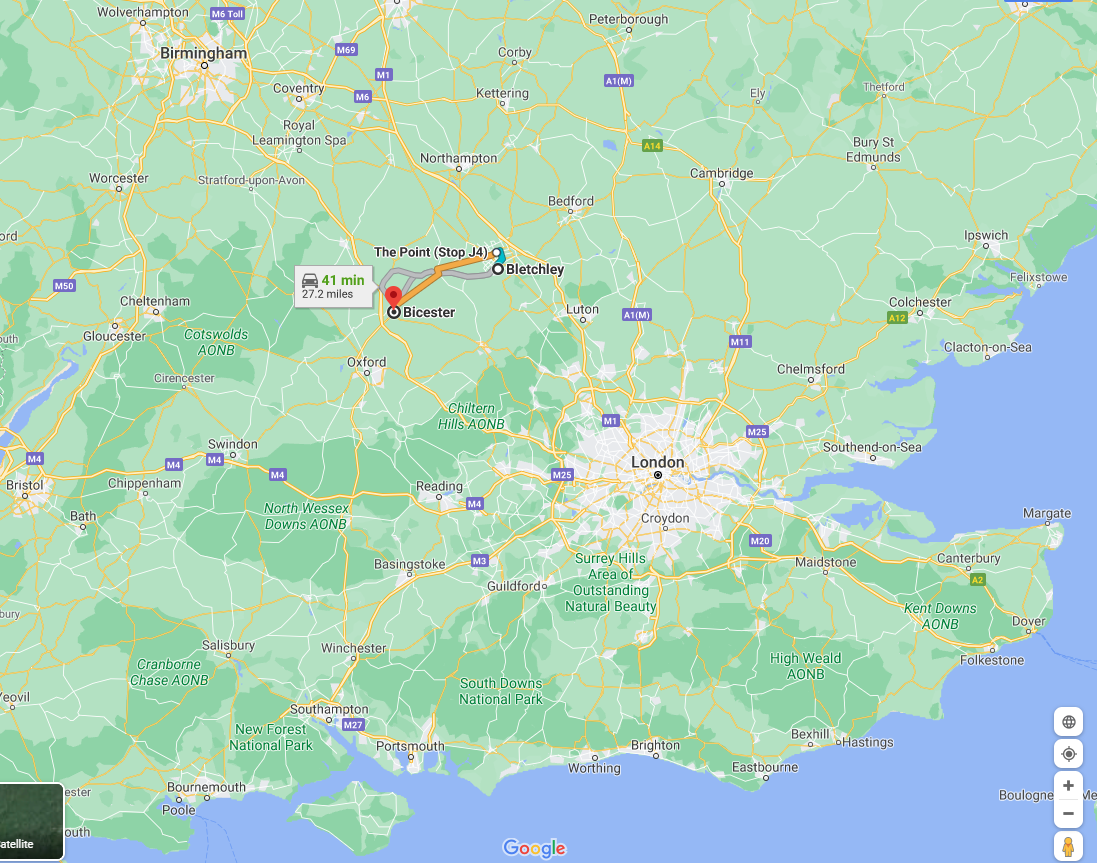
Here’s the route in question on Google Maps.
QotD: “A world organized around institutional mass slavery”
New hypothesis: It’s a category error, all right, but not because they didn’t think in terms of labor costs. It’s because they couldn’t think in terms of labor costs.
A world organized around institutional mass slavery is, in a very real sense, a timeless world. Herodotus (I think) actually says somewhere that nothing worth mentioning happened before him, and you can see echoes of this attitude even as late as the Antebellum South. You see their attitude described as “conservative,” but since that’s egghead shorthand for “evil” you can ignore it. They weren’t consciously backward-looking; rather, they were deeply rooted to their place and station. To the outsider, it looked like they were trying to hold time back, but to the insider, time — clock time, industrial time, the time of the Protestant work ethic — barely existed at all.
So with the Classical World. The Romans, for instance, are endlessly frustrating to their admirers (of which I am an ardent one). Their only economic fix, for instance, was debasing the currency, i.e. a primitive form of inflation. You guys could figure out how to hew an artificial harbor out of some desert rocks — a trick we’d have a hard time pulling off today — but you couldn’t figure out fiat currency? Or a better political system than the tetrarchy? Or that the forts-and-legions paradigm just isn’t cutting it? Or … etc.
Stuff like that is why Spengler said classical, Apollonian culture was fundamentally different from, and incompatible with, our Faustian culture. According to Spengler, the master metaphor for the Apollonian is the human body, which is beautiful but changeless (emphasis mine, not Spengler’s). You can improve your body somewhat, but only within certain tight limits, and the body’s fundamental form is always the same (we could time warp Julius Caesar into the Current Year and still recognize him as a fellow homo sap., no matter how different his mind might be).
The Faustian, though — that would be us — organizes his worldview around space, infinite space. Practically speaking, this results in our attitude of innovation-for-innovation’s sake. We send a man to the moon because we can, but such an idea would never occur to the Romans, for the same reason they didn’t apply all their awesome engineering knowledge to the problems of governance. Hacking a harbor out of the desert is a tremendous feat, but it’s a local feat — a one-shot deal, a very specific response to a very specific local problem, with no broader applications.
This, I suggest, is because the timeless world of institutional mass slavery naturally selects for the kind of man who is at home in the world of institutional mass slavery. It’s a world of very low future time orientation, because “time” hardly exists at all. Forget machinery for a sec; the Roman world was full of enormous problems that had teeny-tiny, head-slappingly obvious fixes. Julius Caesar, for instance, was considered some kind of prodigy because he could sight-read books. Which really was a noteworthy feat, because Romans didn’t even put spaces between their words, much less use any sort of punctuation marks. And they were radical innovators compared to the Ancient Egyptians, since at least Roman writing all ran left-to-right; hieroglyphics can be read in any direction, including vertically, and I’m pretty sure there are examples of them changing text orientations in the middle of the same inscription. It’s not hard to imagine some legion commander actually losing a battle because he had to stop and sound out an important communique from a subordinate …
… and yet the Romans, for all their technical skill, never even figured that tiny change out. See also: The Chinese doing fuck-all with movable type, vs. (Faustian) Europeans using it to conquer the world. China, too, was a timeless society. As Derb says somewhere, Classical Chinese isn’t even really writing; it’s more of an aide-memoire — designed to remind readers of stuff they already know, not to communicate new information.
Your post-Roman European, by contrast, lived in a world where high future time orientation was an absolute must. You don’t need hypotheses like the famous “lead in the drinking water pipes” to explain the seemingly bizarre things the Romans did, or didn’t do; all you need is time orientation, a fundamental attitude of “this is a variation on an old problem” vs. “this is an entirely new situation that requires a new response.” Life in the post-Roman world was solitary, poor, nasty, brutish, and short — every man for himself; think through the consequences of your actions very carefully before you do them, or die horribly. Those who failed to do so died. Bake that into the genetic cake for a few generations, and you get Renaissance Man, who’d see a million possible applications for the aeolipile.
Severian, “Bio-Marxism”, Rotten Chestnuts, 2020-09-24.
January 22, 2021
QotD: The enclosure movement, in historical fact and in Marxist imagining
How this process played out all depended on extremely specific, local conditions. But on the whole it was slow — piecemeal enclosure had been happening to varying degrees since at least the fourteenth century. It’s hard to see how such a sporadic and piecemeal process could have led to such consistently and increasingly massive numbers flocking specifically to London. Indeed, the fact that they singled out London as their target suggests that this narrative might have it back-to-front. Some economic historians argue that it was the prospect of higher wages in the ever-growing metropolis that induced farmers to leave the countryside in the first place, selling up or abandoning their plots to those they left behind. Rather than enclosure pushing peasants off the land and into the city, London’s specific pull may instead have thus created the vacuum that allowed the remaining farmers to bring about enclosure. Otherwise, why didn’t the peasants simply flock to any old urban centre? The second-tier cities like Norwich or Bristol or Exeter or Coventry or York would all have been far less dangerous.
Anton Howes, “London the Great”, Age of Invention, 2020-10-20.
January 19, 2021
Milton Friedman’s “Shareholder Doctrine” is alive and well
Satish Bapanapalli on why Friedman’s doctrine helps to explain why auto manufacturers spend so much money to crash-test their vehicles:

Ford Focus versus Ford Explorer crash test IIHS by Brady Holt is licensed under CC BY 3.0

Of all of Friedman’s great ideas, the Shareholder Doctrine is perhaps the most misunderstood by academics, in large part because many left-leaning intellectuals use the good old straw man argument to misleadingly caricature the doctrine as a “profit-at-all-cost system regardless of human toll.”
Case in point, the latest sermon by some reputed academics published in Fortune magazine: “50 years later, Milton Friedman’s shareholder doctrine is dead.”
This one has all the usual tropes, including the claim that “Friedman … urged business to use its muscle to reduce the effectiveness of unions, blunt environmental and consumer protection measures, and defang antitrust law. He sought to reduce consideration of human concerns [such as] treat[ing] workers, consumers, and society fairly.”
Friedman said no such things. Read it for yourselves. Friedman’s primary argument was that it is not the job of the officers of a corporation (corporate executives) to fight for social causes. The officers must only act in accordance with the shareholder’s wishes, “which generally will be to make as much money as possible while conforming to the basic rules of the society, both those embodied in law and those embodied in ethical custom.”
Of course, in some cases, the shareholders may themselves encourage charitable spending and other corporate policies and activities deemed “socially responsible.” In which case, executives are tasked with finding the best ways to fulfill those objectives. In his article, Friedman clearly demonstrates why this is a logically precise position.
The scolds, who authored the Fortune article, put forth an alternative. Their “three pillars” proposal advocates for laws to be imposed on corporations with vague and fuzzy objectives (note the italicized words) such as “responsible corporate citizen[ship]”, “treating workers … fairly“, “avoiding externalities, such as carbon emissions, that cause unreasonable or disproportionate harm to others”, and corporations should make profits by “benefiting others.” To rub foolishness on the vagueness, the proposal calls for putting the onus on the corporations to measure and demonstrate progress on these fuzzy objectives! To put it in Friedman’s own words, such proposals “are notable for their analytical looseness and lack of rigor.”
January 15, 2021
QotD: Capitalism and socialism, viewed from Harvard in 1942
The idea that socialism would ultimately prevail over capitalism was quite a widespread view — especially in Cambridge, Massachusetts. It persisted throughout the Cold War. “The Soviet economy is proof that, contrary to what many skeptics had earlier believed, a socialist command economy can function and even thrive,” wrote Paul Samuelson, Schumpeter’s pupil, in the 1961 edition of his economics textbook — a sentence that still appeared in the 1989 edition. In successive editions, Samuelson’s hugely influential book carried a chart projecting that the gross national product of the Soviet Union would exceed that of the United States at some point between 1984 and 1997. The 1967 edition suggested that the great overtaking could happen as early as 1977. By the 1980 edition, the timeframe for this great overtaking had been moved forward to 2002–12. The graph was quietly dropped after the 1980 edition.
Niall Ferguson, “Capitalism, Socialism and Nationalism: Lessons from History”, 2020-02.
January 13, 2021
Waking the Sleeping Giant – America Prepares for War – WW2 Special
World War Two
Published 12 Jan 2021As the United States enters World War Two, a huge industrial giant awakens from hibernation. This episode covers industrial mobilization plans, their execution, and their potential.
Join us on Patreon: https://www.patreon.com/TimeGhostHistory
Or join The TimeGhost Army directly at: https://timeghost.tvFollow WW2 day by day on Instagram @ww2_day_by_day – https://www.instagram.com/ww2_day_by_day
Between 2 Wars: https://www.youtube.com/playlist?list…
Source list: http://bit.ly/WW2sourcesHosted by: Indy Neidell
Written by: Joram Appel
Director: Astrid Deinhard
Producers: Astrid Deinhard and Spartacus Olsson
Executive Producers: Astrid Deinhard, Indy Neidell, Spartacus Olsson, Bodo Rittenauer
Creative Producer: Maria Kyhle
Post-Production Director: Wieke Kapteijns
Research by: Joram Appel
Edited by: Karolina Dołęga
Sound design: Marek Kamiński
Map animations: Eastory (https://www.youtube.com/c/eastory)Colorizations by:
Dememorabilia – https://www.instagram.com/dememorabilia/
Norman Stewart – https://oldtimesincolor.blogspot.com/Sources:
– Library of Congress
– National Archives NARA
– Picture of the first class of the Army Industrial College from National Defense University
– FDR Presidential Library & Museum
– Icons from the Noun Project: Artillery by Creative Mania, Douglas SBD Dauntless by Lluisa Iborra, Man by Milinda Courey, Factory Workers by Gan Khoon Lay, Soldier by Wonmo Kang, Old Car by Andri Graphic, progress 20% & 40% by Roberto Chiaveri.Soundtracks from Epidemic Sound:
– “The Inspector 4” – Johannes Bornlöf
– “London” – Howard Harper-Barnes
– “Break Free” – Fabien Tell
– “Last Point of Safe Return” – Fabien Tell
– “Force Matrix” – Jon BjorkArchive by Screenocean/Reuters https://www.screenocean.com.
A TimeGhost chronological documentary produced by OnLion Entertainment GmbH.

QotD: Bureaucracy as a filter
But imagine it takes the doctor an hour of painful phone calls to even get the right person from the insurance company on the line. Now there’s a cost involved. If your patient is going to die without the medication, you’ll probably groan and start making the phone calls. But if your patient doesn’t really need it, and you just wanted to approve it in order to be nice, now you might start having a heartfelt talk with your patient about the importance of trying less expensive medications before jumping right to the $10,000 one.
Organizations have a legal incentive not to deny people things, because the people involved can sue them. But they have an economic incentive not to say yes to every request they get. Seeing how much time and exasperation people are willing to put up with in order to get what they want is an elegant way of separating out the needy from the greedy if every other option is closed to you.
This story makes sense and would help explain why bureaucracy gets so bad, but I’m not sure it really fits the evidence. People complain a lot about bureaucracy in places like the Department of Motor Vehicles, but the DMV doesn’t lose anything by giving you a drivers license and isn’t interested in separating out people who really want licenses from people who only want them a little. If the DMV can be as bureaucratic as it is without any conspiratorial explanation, maybe everything is as bureaucratic as it is without any conspiratorial explanation.
Scott Alexander, “Bureaucracy as Active Ingredient”, Slate Star Codex, 2018-08-31.
January 7, 2021
QotD: Sneering at “the throwaway society”
These are not new truths, even if it took the Covid-19 pandemic to reveal them again. The throwaway age began because of public-health campaigns a century ago to control the spread of pathogens. Disposable products were celebrated for decades for promoting hygiene and saving everyone time and money. It wasn’t until the 1970s that they became symbols of decadent excess, and then only because of economic and ecological fallacies repeated so often that they became conventional wisdom.
In a strange turn of events, the most affluent society in history suddenly turned into a mass of neurotic hoarders. Sifting through garbage for valuables, an activity formerly associated with the most destitute inhabitants of Third World shantytowns, became a moral duty in American suburbs. Greens campaigned for “zero waste” and a “circular economy” in which disposable products would be outlawed. They confidently predicted that the throwaway society was doomed, but if they’d known anything about its history, they would have realized that it was created for very good reasons — and that it will endure long after their lamentations are forgotten.
John Tierney, “Let’s Hold On to the Throwaway Society”, City Journal, 2020-09-13.
January 1, 2021
The paradox of innovation – the more you have, the less impact each individual innovation has
In the latest Age of Invention newsletter, Anton Howes considers the oddity that as the British economy expanded during the early Industrial Revolution, each new discovery had less and less direct impact on the economy as a whole:

What this means is that when there were even some slight improvements in agriculture alone, the effects on living standards could be dramatic. But absent such improvements, a rich culture of innovation affecting everything from clothes to watches to books, wine, glassware, metals, and pottery would have been almost entirely masked from the figures. Importantly, the same applies not only to the composition of average notional consumption baskets, but to the contributions of different sectors to the economy as a whole. While the total amount of food has increased dramatically for the past few hundred years, for example, agriculture’s share of the economy steadily fell (from over 40% of the English economy in 1600, and an even greater share of total employment, to less than 1% today, with a similar trend repeated worldwide). So the relative importance of your typical agricultural innovation for overall growth rates has fallen dramatically. Perhaps it’s no wonder that twentieth-century agricultural pioneers like Norman Borlaug still don’t really get their due.
The same goes, more recently, for manufacturing. The reason the textbooks always name Kay, Hargreaves, Crompton, Cartwright and Arkwright, is because they made improvements to what was already one of the most important sectors of the economy: textiles. In the eighteenth century, textiles as a whole accounted for a whopping 16-17% of the British economy. So any growth in the value of wool, linen, and increasingly cotton goods, had an appreciable impact on overall economic growth. Today, by contrast, you’d be hard pressed to find many sectors that account for even 5% of the country’s economy (except construction, and possibly financial services, depending on how broadly you define them). And while Britain may have long lost its role as the workshop of the world, textile production in China today still only accounts for about 7% of the country’s economy. To put it another way, the modern Arkwrights and Cartwrights and Cromptons of China, to have any comparable effect on national statistics, would have to make productivity improvements to their industry that are at least three times as impressive.
And impressive they are, though you won’t have heard of them. Arkwright and Crompton multiplied the number of threads that a single machine could spin, from one to dozens. Today, thread is spun by the thousands, at speeds they could have scarcely comprehended, and with entire factories hardly needing a single pair of human hands. Automatic sensors monitor the yarn’s tension and detect any defects while it is being spun, with robots even whizzing along to repair any snaps, able to find a loose end and piece the yarn together again — a task that once required the nimble fingers of small children. From an eighteenth-century perspective, our textile machines routinely now do magic, and are getting ever more fantastical every day. Imagine showing Arkwright the use of lasers in fading and cutting jeans.
But by replacing human labour, innovation has become ever more hidden. Many people don’t realise that British manufacturing is actually larger and more valuable than ever. It’s just that it employs fewer people than ever, so hardly anybody gets to witness its great strides forwards (to witness a flavour of manufacturing’s modern marvels, I recommend checking out MachinePix).
And more importantly, the overall effect of each innovation has also been steadily diluted — itself the result of growth. Innovation has, in a sense, been the victim of its own success. By creating ever more products, sprouting new industries, and diversifying them into myriad specialisms, we have shrunk the impact that any single improvement can have. When cotton was king, a handful of inventors might hope to affect the entire national textile industry in some way. Nowadays, there’s not a chance. Doubling the productivity of cotton spinning is all well and good, but what about nylon, polyester, rayon, and the host of other fibres we have since invented? And which kind of spinning machine would you improve? An old-fashioned ring-spinner, a newer rotor spinner, or perhaps even one of the brand new air-jet types?
If you make an improvement, it’s not going to be to the industry as a whole — it’ll be specific. And actually improvements have always been specific; it’s just that the industries have since multiplied and narrowed. Inventors once made drops into a puddle, but the puddle then expanded into an ocean. It doesn’t make the drops any less innovative. This paradox of progress affects all innovation, such that it is no wonder that the number of researchers has been increasing while national-level productivity growth has appeared fairly stagnant. Even general-purpose technologies, like the recent dramatic improvements to telecommunications, computing, and software, have had a muted effect, being applied more slowly than we’d have liked. I expect that all future general-purpose technologies will fare even worse, for it takes still further effort and innovation to apply a technology to a given industry, and those industries will continue to multiply. All future general-purpose technologies, that is, except improvements to energy.


