
For someone who remembers the old days, the food is the most startling thing about modern England. English food used to be deservedly famous for its awfulness — greasy fish and chips, gelatinous pork pies, and dishwater coffee. Now it is not only easy to do much better, but traditionally terrible English meals have even become hard to find. What happened?
Maybe the first question is how English cooking got to be so bad in the first place. A good guess is that the country’s early industrialization and urbanization was the culprit. Millions of people moved rapidly off the land and away from access to traditional ingredients. Worse, they did so at a time when the technology of urban food supply was still primitive: Victorian London already had well over a million people, but most of its food came in by horse-drawn barge. And so ordinary people, and even the middle classes, were forced into a cuisine based on canned goods (mushy peas!), preserved meats (hence those pies), and root vegetables that didn’t need refrigeration (e.g. potatoes, which explain the chips).
But why did the food stay so bad after refrigerated railroad cars and ships, frozen foods (better than canned, anyway), and eventually air-freight deliveries of fresh fish and vegetables had become available? Now we’re talking about economics — and about the limits of conventional economic theory. For the answer is surely that by the time it became possible for urban Britons to eat decently, they no longer knew the difference. The appreciation of good food is, quite literally, an acquired taste — but because your typical Englishman, circa, say, 1975, had never had a really good meal, he didn’t demand one. And because consumers didn’t demand good food, they didn’t get it. Even then there were surely some people who would have liked better, just not enough to provide a critical mass.
And then things changed. Partly this may have been the result of immigration. (Although earlier waves of immigrants simply adapted to English standards — I remember visiting one fairly expensive London Italian restaurant in 1983 that advised diners to call in advance if they wanted their pasta freshly cooked.) Growing affluence and the overseas vacations it made possible may have been more important — how can you keep them eating bangers once they’ve had foie gras? But at a certain point the process became self-reinforcing: Enough people knew what good food tasted like that stores and restaurants began providing it — and that allowed even more people to acquire civilized taste buds.
Paul Krugman, “Supply, Demand, and English Food”, https://web.mit.edu/krugman/www/mushy.html.
March 19, 2021
QotD: English food
March 17, 2021
QotD: Technocracy’s failure mode
That engineering mindset is one of order, of processes, of structures. Free form and flowing is not generally described as desirable among engineers.
To change examples, Major Douglas came up with the idea of Social Credit. Calculate the profits in an economy and then distribute them to the people. This makes sense to an engineer. The shoot down that we never can calculate such profits in anything like real time just does not compute.
To engineers, if we’ve a process, a structure, then we can handle these things. Yet human life and society is simply too complex to be handled in such a manner. Sure, Hayek never was talking about sexual harassment but the point does still stand.
No, this is not really specifically about Google nor sexual harassment. Rather, it’s about technocracy and the undesirability of it as a ruling method. Here we’ve got just great engineers stepping off their comfort zone and into social relationships. The nerds that is, the very ones we’ve been deriding for centuries as not quite getting it about those social relationships, trying to define and encode those things we’re suspicious they don’t quite understand in the first place.
That is, rule by experts doesn’t work simply because experts always do try to step out of their areas of expertise. Where they’re just as bad and dumb as the rest of us. Possibly, even worse, given the attributes that led them to their areas of expertise in the first place.
Tim Worstall, “Google’s Sexual Harassment Policies – Why We Don’t Let The Technocrats Run The World”, Continental Telegraph, 2018-11-08.
March 16, 2021
The horrors of British & US Logistics in WW2
TIK
Published 15 Mar 2021The Allies may have had a lot of resources, manpower and industry, but that didn’t mean that their logistics weren’t inefficient or a disorganized mess. Today, we’re going to look at how the British railways were disaster during WW2, how the Americans ran out of fuel on the way to Germany, and why Montgomery called the planning for the invasion of Sicily a “dog’s breakfast”.
⏲️ Videos EVERY Monday at 5pm GMT (depending on season, check for British Summer Time).
The thumbnail for this video was created by Terri Young. Need graphics? Check out her website here https://www.terriyoungdesigns.co.uk/
– – – – –
📚 BIBLIOGRAPHY / SOURCES 📚
Dunn, W. The Soviet Economy and the Red Army, 1930-1945. Praeger Publishers, 1995.
Garvey, J. Operation Husky: The Untold Story of the logistics of the Sicily Invasion. Farm Publications, Kindle 2019.
Hazlitt, H. Economics in One Lesson: The Shortest & Surest Way to Understand Basic Economics. Three Rivers Press, 1979.
MacDonald, J. Supplying the British Army in the Second World War. Pen & Sword Military, Kindle 2020.
Molony, C. The Mediterranean and Middle East, Volume V, The Campaign in Sicily 1943 and The Campaign in Italy 3rd September 1943 to 31st March 1944. The Naval & Military Press LTD 2004, first published in 1973.
Wolmar, C. Fire & Steam: How the Railways Transformed Britain. Atlantic Books, Kindle 2007.British Government, Railways Act 1921, https://www.legislation.gov.uk/ukpga/…
Full list of all my sources https://docs.google.com/spreadsheets/…
– – – – –
⭐ SUPPORT TIK ⭐
This video isn’t sponsored. My income comes purely from my Patreons and SubscribeStars, and from YouTube ad revenue. So, if you’d like to support this channel and make these videos possible, please consider becoming a Patreon or SubscribeStar. All supporters who pledge $1 or more will have their names listed in the videos. For $5 or more you can ask questions which I will answer in future Q&A videos (note: I’m behind with the Q&A’s right now, and have a lot of research to do to catch up, so there will be a delay in answering questions). There are higher tiers too with additional perks, so check out the links below for more details.
https://www.patreon.com/TIKhistory
https://www.subscribestar.com/tikhistoryThank you to my current supporters! You’re AWESOME!
– – – – –
ABOUT TIK 📝
History isn’t as boring as some people think, and my goal is to get people talking about it. I also want to dispel the myths and distortions that ruin our perception of the past by asking a simple question – “But is this really the case?”. I have a 2:1 Degree in History and a passion for early 20th Century conflicts (mainly WW2). I’m therefore approaching this like I would an academic essay. Lots of sources, quotes, references and so on. Only the truth will do.
This video is discussing events or concepts that are academic, educational and historical in nature. This video is for informational purposes and was created so we may better understand the past and learn from the mistakes others have made.

March 15, 2021
Target is careful to only cite economic reasons for abandoning their downtown Minneapolis headquarters
Jon Miltimore explains why the Target corporate headquarters in Minneapolis will be given up — for reasons that go beyond the claimed success of the telecommuting encouraged by the 2020 pandemic lockdowns:

A building burning in Minneapolis following the death of George Floyd.
Photo by Hungryogrephotos via Wikipedia.
Target Corporation, the eighth largest retailer in the United States, announced in an email to employees on Thursday that it will be leaving the City Center, its primary downtown Minneapolis location.
Company officials cited improved remote work opportunities and less need for space as the drivers for the decision.
“In just one year we’ve proven that we can drive incredible results, together, from our kitchens and basements and living rooms,” said Melissa Kremer, executive vice president and leader of Target’s human resources operations.
Target, the largest employer in Minneapolis with some 8,500 corporate workers, says the 3,500 employees who work at the City Center will still have a “home base,” but it will be at another Minneapolis location or in the nearby suburb of Brooklyn Park.
A Story of Capital Flight?
On one hand, there is little reason to doubt Target’s explanation for abandoning its headquarters. Many anticipated that the pandemic would lead to a normalization of remote work.
“The future of work will be distributed,” Erica Brescia, the chief operating officer of Github, told the BBC last fall. “We’re going to see a big shift from office by default to remote by default.”
Part of that shift, it’s reasonable to assume, would be corporations moving away from high-end corporate real estate. Yet it also shouldn’t be forgotten (or ignored) that Target’s decision comes less than a year after Minneapolis suffered some of the worst riots in US history, prompted by the May 25 death of George Floyd.
The riots — which broke out after a video went viral showing police pinning Floyd, a 46-year-old black man, to the ground for nearly nine minutes before he died — caused an estimated $2 billion in damage.
Though Target made no mention of the riots in its announcement, last summer I noted that an abundance of evidence suggested that the economic damage of the riots would persist long after the wreckage had cleared.
March 6, 2021
QotD: Why “the rich” benefit more from tax cuts
There is that objectionable idea that not taxing something is a giveaway. The root presumption there is that everything belongs to the State and we’re lucky it allows us to keep anything to deploy as we desire and not as those who stay awake in committee do. This is not an assumption that leads to a free country nor populace, nor a liberal society.
But it’s also to miss that logical point, that if income tax is to be reduced then it must be those currently paying income tax who benefit from not doing so in the future under the new rates. […] The low paid cough up hardly anything in income tax. Therefore the low paid gain hardly anything from income tax being reduced. This should be obvious.
Tim Worstall, “Budget Revelation – Those Who Pay Income Tax Benefit From Income Tax Cuts”, Continental Telegraph, 2018-10-30.
March 2, 2021
Warship purchasing is not for the faint-of-heart
Ted Campbell talks about the way the Royal Canadian Navy plans for warship purchases … and how the best-laid plans can be derailed by ignorant political advisors:

An artist’s rendition of BAE’s Type 26 Global Combat Ship, which was selected as the Canadian Surface Combatant design in 2019, the most recent “largest single expenditure in Canadian government history” (until the RCAF gets their replacement for the CF-18 Hornet).
(BAE Systems, via Flickr)
Once upon time,* about 25 to 30 years ago, in the mid 1990s, when I was the director of a small, very specialized team in National Defence Headquarters (NDHQ) in Ottawa, something like this happened: One of my colleague, who had a title like Director of Maritime Requirements or something similar said to one of his principle subordinates, “Look, now that the 280s (Canada had four Tribal Class destroyers with pennant numbers starting at 280, they were often just called ‘280s’) are finished their mid-life refit and now that the new frigates are entering service it is time to put a ‘placeholder’ in the DSP for their eventual replacements.” The DSP was (still is?) the Defence Services Programme, it is the internal document which sets out the long range spending plans (maybe hopes is a better word) for the Canadian Armed Forces.
Anyway, the Navy commander (the officer assigned to write the document, not the Commander of the Royal Canadian Navy who is nicknamed the Kraken (CRCN)) sat at his desk and consulted the most recently approved planning document which, as far as I can remember, called for a surface fleet of 25 combat vessels and four large support ships plus numerous minor war vessels (like minesweepers) and training vessels. The officer then prepared a memorandum for the joint planning staff which said that the Navy would need 25 new combat ships, to be procured between about 2015 and 2035, in five “batches” of five ships each** at a total cost of about $100 Billion, in 2025 dollars. He didn’t say much beyond that, actually, he was just intending to “reserve” some money a generation or so in the future. His memorandum sailed, smoothly, past his boss and the commodore but questions came from a very senior Air Force general: Where he asked, did the $100 Billion come from? That was an outrageous number, he said.
A meeting ensure where the Navy engineering people came and said, “$100 Billion is a very reasonable guesstimate. Our brand new frigate are costing $1 Billion each when they come down the slipway. They will each have cost the taxpayers two to three times that by the time we send them to be broken up thirty or forty years from now. Adding in the inevitable costs of new technology and inflation, which we know is higher for things like military ships and aircraft than it is for consumer goods, then a life-cycle cost of $4 Billion for each ship is very conservative. The admirals and generals huffed and puffed but they didn’t argue ~ they knew that the engineering branch insisted on using life cycle costing, even though no-one but them understood it, and they also knew that arguing with engineers is like mud-wrestling with pigs: everyone gets dirty but the pigs love it.
A decade later, when a new government was planning the National Shipbuilding Procurement Strategy, which was all about making the Canadian shipbuilding industry competitive and had very little to do with ships ~ except they would be the “product” for which the Government of Canada would pay top-dollar, the Navy was told it could have fewer ships, in two classes, and someone ~ NOT the military’s engineering branch ~ assigned a cost figure to the project which was, to be charitable, pulled out of some political/public relations staffer’s arse.
[…]
* The story is true, in general, but I was not directly involved in any of it. I learned about what happened from three main sources: 1. routine briefings that my bosses (directors-general and branch chiefs) gave, regularly, to we directors, dealing with what was going on in the HQ and in the big wide world; 2. periodic chats with my colleagues, after work on Friday afternoons, in the bar of the Officers’ Mess ~ many of us regarded 2. as a more reliable source of information than 1.; and 3. in the case of the story about the Navy engineers and the Air Force general, by a friend and colleague who was in the room.
** The idea, long before the National Shipbuilding Strategy, was to keep shipyards moderately busy on a continuous basis. The 25 ships would all be similar: the first “batch” of five would be identical, one to the other; the second “batch” would be very similar but with some improvements; the five ships of batch 3 would be similar to the ships from the second batch and those from batch 4 would be rather like their batch 3 sisters. Finally, the batch 5 ships would be product improved versions of batch 4 ~ they would still be “sisters” of the batch 1 ships, but not, in any way, twins. The idea was that about the time that the batch 5 ships were being delivered the first of the batch 1 ships would be getting ready for a mid-life refit (after 15 to 20 years of service) which would result in it being much more like the batch 5 ships … and so on.
February 25, 2021
Malthusian cheerleaders
Barry Brownstein looks at some of the claims from Malthus onward about the imminent demise of humanity due to overpopulation and how that same concern keeps popping up again and again:

Thomas Malthus.
Portrait by John Linnell, 1834, via Wikimedia Commons
… James Lovelock advanced the Gaia hypothesis that Earth is one “self-regulating organism.” Lovelock forecasts the population of the Earth will fall to one billion from its current total of over seven billion people. Given Lovelock’s cheerfulness about such carnage, it is easy to see why Alan Hall, a senior analyst at The Socionomist, wonders whether “today’s drives to limit consumption and population” are ideologically related to the eugenics movement from the past century. In his essay “A Socionomic Study of Eugenics,” Hall writes in The Socionomist:
Circa 1900, influential intellectuals in Europe and the U.S. voiced concerns about uncontrolled procreation causing a supposed decline in the quality of human beings. Today, similar groups voice concerns about uncontrolled population growth and resource consumption causing a decline in the quality of the environment … Today’s green advocates brandish images of an overrun, dying planet.
Today, the Bill and Melinda Gates Foundation is working to aid the lives of children living “in extreme poverty.” In his book, Factfulness, the late professor of international health Hans Rosling, reports on critics of the Gates Foundation who reject such efforts. “The argument goes like this,” Rosling writes. “If you keep saving poor children, you’ll kill the planet by causing overpopulation.”
In the face of advocates for such beliefs, no wonder Hall asks us to reflect on whether we “will make the cut” if those seeking to cull humanity are successful.
Malthusian Doom
We’ve all heard the SparkNotes version of Malthusian predictions of doom caused by overpopulation. Malthus thought food production could not keep pace with population growth. In his 1798 “Essay on the Principle of Population,” Malthus anticipated the suffering that awaited humanity.
The power of population is so superior to the power in the earth to produce subsistence for man, that premature death must in some shape or other visit the human race. The vices of mankind are active and able ministers of depopulation. They are the precursors in the great army of destruction; and often finish the dreadful work themselves. But should they fail in this war of extermination, sickly seasons, epidemics, pestilence, and plague, advance in terrific array, and sweep off their thousands and ten thousands. Should success be still incomplete, gigantic inevitable famine stalks in the rear, and with one mighty blow levels the population with the food of the world.
Unlike Ehrlich and others, Malthus had reason to be a pessimist in his lifetime. If Malthus had been writing history or predicting the near future, he would not have been far from the mark.
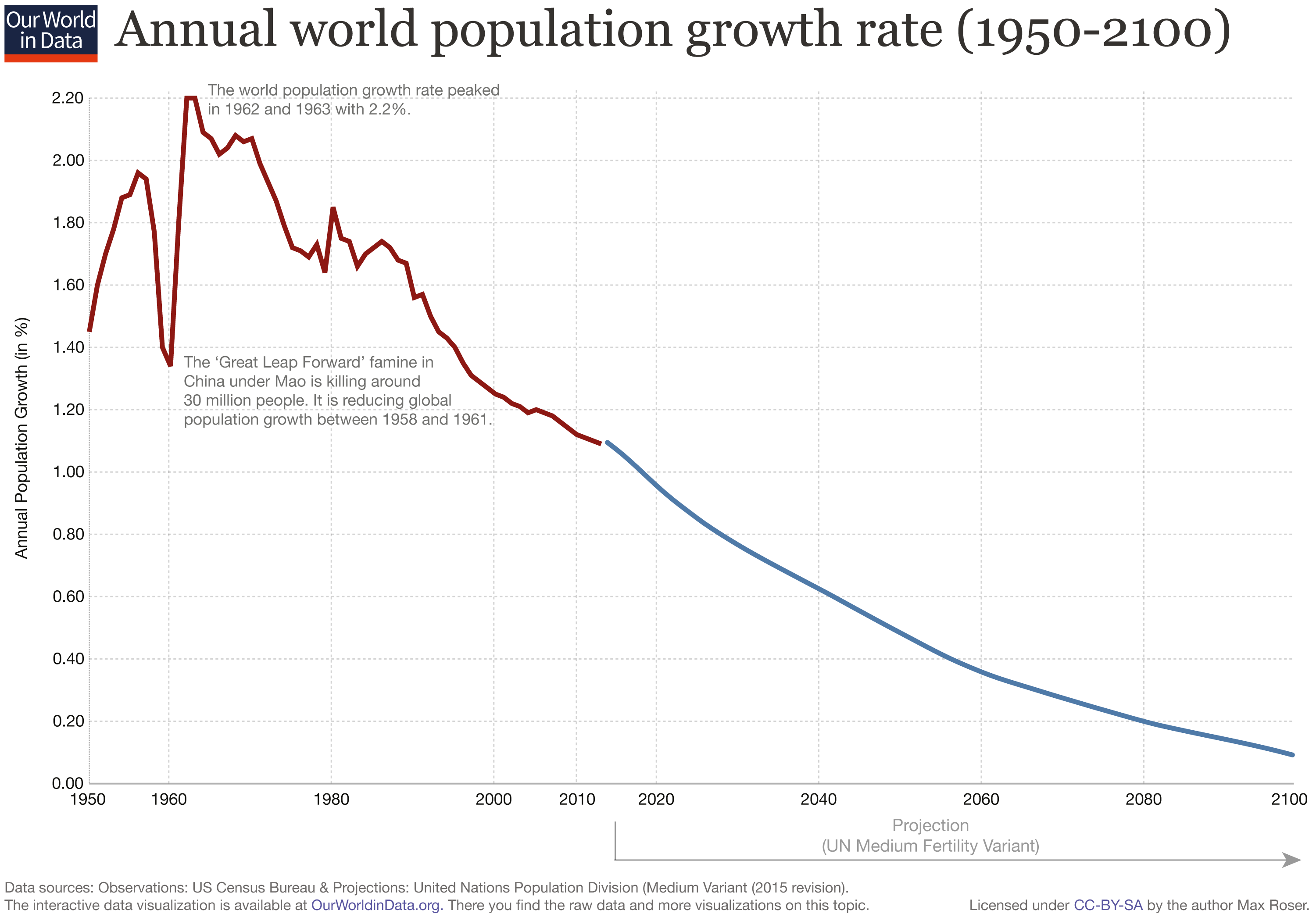
Many of the predictions of overpopulation were based on estimates of population growth (especially in sub-Saharan Africa) which were far from accurate, and in every case we know of, increased economic well-being directly impacts population growth so as a country begins to get richer its population growth begins to slow down significantly (most first-world nations are already at or below population-replacement birthrates).
In their book, Empty Planet: The Shock of Global Population Decline, Darrell Bricker and John Ibbitson have startling facts for those who believe the population will continue to explode.
No, we are not going to keep adding bodies until the world is groaning at the weight of eleven billion of us and more; nine billion is probably closer to the truth, before the population starts to decline. No, fertility rates are not astronomically high in developing countries; many of them are at or below replacement rate. No, Africa is not a chronically impoverished continent doomed to forever grow its population while lacking the resources to sustain it; the continent is dynamic, its economies are in flux, and birth rates are falling rapidly. No, African Americans and Latino Americans are not overwhelming white America with their higher fertility rates. The fertility rates of all three groups have essentially converged.
Looking at current trends and expecting them to continue is what Hans Rosling calls “the straight line instinct.” That instinct often leads to false conclusions.
February 17, 2021
QotD: Protectionists, left and right
“Progressives” who embrace protectionism share conservatives’ low opinion of their country’s businesses, entrepreneurs, and workers, but also mistakenly believe that protectionism “sticks it to” corporate oligarchs when, in fact, it creates corporate oligarchs.
Don Boudreaux, “Quotation of the Day…”, Café Hayek, 2018-09-10.
February 16, 2021
Reduce, re-use, recycle … reject
John Miltimore rounds up several recent stories about American cities backing away from their elaborate, expensive, and wasteful recycling programs. We’ve had three generations of kids brought up indoctrinated into the belief that recycling was not only a good idea, but that it had almost mystical qualities and that it was essential to “saving the world”. The economic facts strongly contradict that, and have always revealed the inefficiencies and outright waste produced by even the best-run municipal recycling programs.

China, perhaps the largest buyer of US recyclables, stopped accepting them in 2018. Other countries, such as Thailand and India, have increased imports, but not in sufficient tonnage to alleviate the mounting costs cities are facing.
“We are in a crisis moment in the recycling movement right now,” Fiona Ma, the treasurer of California, told the Times.
Cost is the key word. Like any activity or service, recycling is an economic activity. The dirty little secret is that the benefits of recycling have been dubious for some time.
“Recycling has been dysfunctional for a long time,” Mitch Hedlund, executive director of Recycle Across America, told The Times.
[…]
And then there are the energy and resources that go into recycling. How much water do Americans spend annually rinsing items that end up in a landfill? How much fuel is spent deploying fleets of barges and trucks across highways and oceans, carrying tons of garbage to be processed at facilities that belch their own emissions?
The data on this front is thin, and results on the environmental effectiveness of recycling vary based on the material being recycled. Yet all of this presumes the recyclables are not being cleaned and shipped only to be buried in a landfill, like so much of it is today. This, Mises would say, is planned chaos, the inevitable result of central planners making decisions instead of consumers through free markets.
Most market economists, Reed points out, “by nature, philosophy, and experience” a bunch skeptical of centrally planned schemes that supplant choice, were wise to the dynamics of recycling from the beginning.
In a 2004 episode of Penn & Teller’s Bullshit, they discussed recycling:
February 11, 2021
Tom Brady’s Super Bowl success has outlasted many titans of corporate America
Despite the headline, this isn’t really about the NFL, Tom Brady or the S*per B*wl, it’s about a key factor in free market economies: creative destruction.
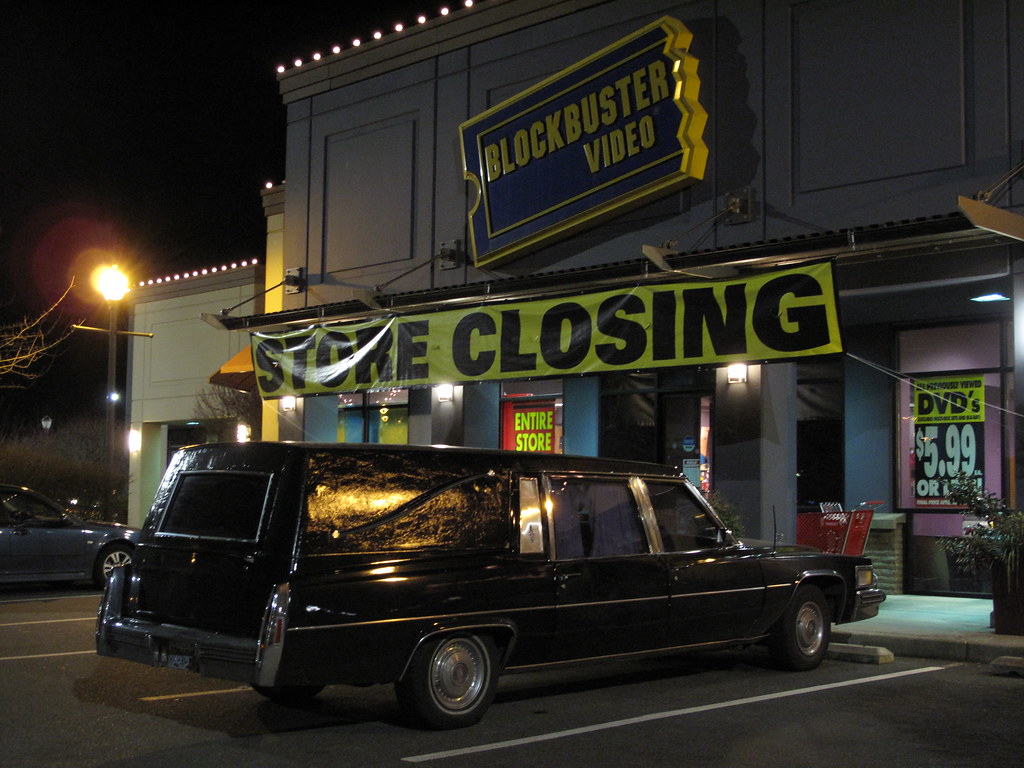
“Blockbuster store closing sale” by Consumerist Dot Com is licensed under CC BY 2.0

Consider some of the names that bought Super Bowl airtime during Brady’s first rodeo in January 2002: AOL, Blockbuster, Radio Shack, Circuit City, CompUSA, Sears, Yahoo, VoiceStream Wireless, and Gateway Computers.
The Titans of Yesterday
Notice a theme? That list features some companies we saw in Captain Marvel, the 2019 hit movie that nailed 90s nostalgia and reminded us how fast the world had changed. Like when Blockbuster Video stores were still a thing.
For those who may not recall, when Brady was winning his first Super Bowl, Blockbuster was approaching its peak. In 2004, it operated 9,094 stores and employed some 84,300 people. The company was pulling in $6 billion in revenue annually and looked invincible. Today, a single Blockbuster store remains open — in the world.
Remember RadioShack? Once upon a time, it seemed as if you could find one of their brick-and-mortar stores in every corner of the USA. Not anymore. In 2015, RadioShack filed for Chapter 11 bankruptcy, in large part because of those many store locations, which cannibalized revenues.
Sears, one of the historic giants of retail, managed to make it to 2018 before announcing its bankruptcy. Its stores continue to close so fast, it’s hard to tell how many remain in operation. (The best guess is about 60.)
It’s sometimes difficult to remember that the titans of industry aren’t always the same companies from year to year, and the sector-dominating company today might well be begging for a bailout (or demanding protection from uppity new competitors) only a few years down the way.
Some might see the collapse of Blockbuster, Sears and company as a sign of something terribly wrong with our economic system. After all, Blockbuster alone paid rent at tens of thousands of properties and employed tens of thousands of workers. Sears was the largest American retailer (by far) for decades.
Watching the companies we once shopped at flounder and fail can be surprising, jarring even. But a closer look shows this cycle is not unusual and is actually the sign of a healthy market economy, not a dysfunctional one. What may seem like pure destruction actually clears the way for economic innovation and renewal. “Creative destruction” is how the economist Joseph Schumpeter (1880-1950) characterized business failure in a free market.
As economist Mark Perry points out, companies on top have a very hard time staying on top. Perry, a scholar at the American Enterprise institute and a professor of economics at the University of Michigan’s Flint campus, compared the 1955 Fortune 500 companies to the 2019 Fortune 500. He found that just 52 were still on the list six decades later.
I spent most of my working career in the software business, and many of the companies I’ve worked for over the years aren’t in business any more (my first job out of school was with Northern Telecom … remember them?). Software is a particularly fast-cycling industry, but it’s true of the economy as a whole at a slightly more sedate pace.
QotD: Progressive credentials as positional goods
But if PC was not really about protecting anyone, and really all about expressing one’s own moral superiority, PC credentials would be akin to what economists call a “positional good”.
A positional good is a good that people acquire to signalise where they stand in a social hierarchy; it is acquired in order to set oneself apart from others. Positional goods therefore have a peculiar property: the utility their consumers derive from them is inversely related to the number of people who can access them.
Positionality is not a property of the good itself, it is a matter of the consumer’s motivations. I may buy an exquisite variety of wine because I genuinely enjoy the taste, or acquire a degree from a reputable university because I genuinely appreciate what that university has to offer. But my motivation could also be to set myself apart from others, to present myself as more sophisticated or smarter. From merely observing that I consume the product, you could not tell my motivation. But you could tell it by observing how I respond once other people start drinking the same wine, or attending the same university.
If I value those goods for their intrinsic qualities, their increasing popularity will not trouble me at all. After all, the enjoyment derived from wine or learning is not fixed, so your enjoyment does not subtract from my enjoyment. I may even invite others to join me – we can all have more of it.
But if you see me moaning that the winemakers/the university have “sold out”, if you see me whinging about those ignoramuses who do not deserve the product because they (unlike me, of course) do not really appreciate it, you can safely conclude that for me, this good is a positional good. (Or was, before everybody else discovered it.) We can all become more sophisticated wine consumers, and we can all become better educated. But we can never all be above the national average, or in the top group, in terms of wine-connoisseurship, education, income, or anything else. We can all improve in absolute terms, but we cannot all simultaneously improve in relative terms. And that is what positional goods are all about – signalising a high position in a ranking, that is, a relation to others. This leads to a problem. Positional goods are used to signalise something that is by definition scarce, and yet the product which does the signalling is not scarce, or at least not inherently. You can increase the number of goods which signal a position in the Top 20 (of whatever), but the number of places in that Top 20 will only ever be, er, twenty. Increasing the number of signalling products will simply destroy their signalling function. Which is why the early owners of such a signalling product can get really mad at you if you acquire one too.
Kristian Niemietz, “The economics of political correctness”, Institute of Economic Affairs, 2014-04-30.
February 5, 2021
QotD: Misunderstanding the threat/promise of robotics and AI
OK, so, now we use machines to do some jobs that were previously done by humans. Imagine that this new technology actually required more human labour – that it created new jobs in greater volume than those it destroys. Say, the tractor and combine harvester industry needs more people in it than we used to use to cut the crops by hand. We’ve just made ourselves poorer. We used to have some amount of grain through the labour of some number of people. We’ve now got that grain but by using the labour of more people. We’ve used more of our scarce resource and we’re now poorer by the loss of what they used to make when not hand cutting grain but now no longer are by making tractors.
What makes us richer is if the tractor industry has record production statistics while using less labour than the hammer and sickle. That means that some human labour is now free to go off and try to sate a human desire or want for something other than grain. Ballet dancing for example. We’re now richer – tractors and combine harvesters have made us richer – by whatever value we put on more ballet dancing.
The entire point of any form of automation is to destroy jobs so as to free up that labour to do something else. The new technology doesn’t create jobs, it allows other jobs to be done.
The only point at which this fails is if human needs and desires aren’t unlimited. Which means that we might be able to provide everything that everyone wants without us all working. Which doesn’t really sound like much of a problem really.
Tim Worstall, “As Usual, World Economic Forum Gets Robots And AI Wrong Over Jobs”, Continental Telegraph, 2018-09-18.
February 3, 2021
QotD: The “Parkerization” of wine
The world of wine had never seen anything like it. Parker was on a mission to demythologise all the snobby and obscure terminology under which fine wine was clouded and developed a simple 100 point scale on which wines could be judged.
As his influence grew, a Parker wine score in the 90s would pretty much guarantee considerable financial success to a vineyard. Inevitably, so the argument goes, those who made wine started to adjust the taste of their product so that it would suit the arbiter’s palate.
Parker generally likes big, dark, gutsy, jammy, tannic wines that can, his critics say, be engineered to taste that way in post-production, often by use of imported yeasts or through the use of young oak barrels. It’s more about clever chemistry than the particular charisma of the local terroir. Parker’s taste favours the muscular Californian Cabernet wines and the great Château wines of Bordeaux, yet has little appreciation for the lighter, less tannic, more subtle Pinot Noirs from Burgundy or Gamays from the Loire Valley. “Bad critics look at Pinot through Cabernet-tinted spectacles and so criticise it for being something it never set out to be,” writes Clive Coates, in a not so subtle dig at Parker, in his encyclopaedic The Wines of Burgundy.
Those who bewail Parker’s phenomenal influence speak of “parkerisation” as the wine equivalent of globalisation. The New York Times wine critic Alice Feiring writes that this is how “Rioja loses its Spanish accent”: parkerisation leads to an increasingly homogenised style of wine in which the diversity of grapes and wine tastes come to be submerged under the over powerful influence of Parker’s very particular palate. Those, like her, who prefer subtlety in their wine speak dismissively of Parker’s love for “jam bombs”.
Those who defend Parker, argue that his 100 point scale works as a kind of bullshit detector. It’s cutting through all the fancy talk and obscure (often) French classifications, to focus on the taste and the taste alone.
Giles Fraser, “Is wine starting to taste the same?”, UnHerd, 2020-10-14.
February 2, 2021
When the self-defined elites achieved class consciousness
At Rotten Chestnuts Severian adds to his ongoing series of posts identifying areas where Marx was right:
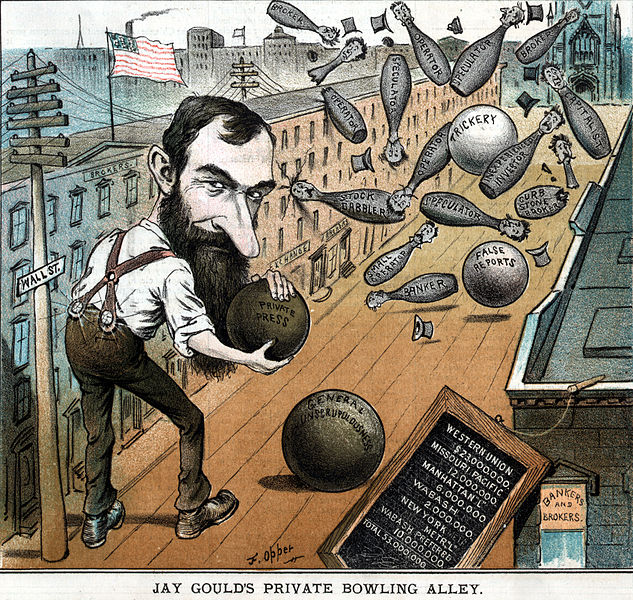
“Jay Gould’s Private Bowling Alley.” Financier and stock speculator Jay Gould is depicted on Wall Street, using bowling balls titled “trickery,” “false reports,” “private press” and “general unscrupulousness” to knock down bowling pins labeled as “operator,” “broker,” “banker,” “inexperienced investor,” etc. A slate shows Gould’s controlling holdings in various corporations, including Western Union, Missouri Pacific Railroad, and the Wabash Railroad.
From the cover of Puck magazine Vol. XI, No 264 via Wikimedia Commons.
… I liken Karl Marx to one of those bird-masked medieval Plague doctors — he sees the pathology clearly, indeed far faster and better than anyone else, but his proposed “cure” is far likelier to kill you than the actual disease. Worse, what makes Marx’s cure especially lethal is what ends up making his diagnosis essentially right: It’s a self-fulfilling prophecy.
The proletariat is achieving class consciousness, all right — look no further than the GameStop “short squeeze” for proof. But the only reason the proles are achieving class consciousness is because the “capitalists” forced them to, just like Marx said they would. The Elite and the Bureaucracy (usually, but not always, a distinction without a difference) finally achieved class consciousness through the combination of NAFTA and the Louvre Accords. Starting around 1990, then, the Elite self-consciously embraced their role as rootless, stateless, jet-setting parasites (with the wannabe-Elites in the Media, academia, and the bureaucracies signing up for tours of duty as fart-catchers, both to bask in reflected glory and in hopes of being promoted).
In short, our “Capitalists” — really, “financial-ists” or “spreadsheet gangsters,” since they don’t actually make anything, they just bust out existing firms via debt manipulation — behave exactly as Marx described factory owners behaving all the way back in the First Industrial Revolution.In my naivete, I used to think Marx’s ranting was hyperbole. I cited the example of Andrew Carnegie — a real bastard in his youth, who went on to be one of the world’s great philanthropists. That’s human behavior, I said, as opposed to the bloodthirsty caricature of Marx’s fantasies … but I was wrong, comrades. Carnegie happily would’ve sold his fellow Americans down the river, just as Bezos, Gates, and the rest of the pirates-in-neckties are happily selling us down the river now. Only two things prevented it back then: one structural, one cultural.
The structural one is simply technology, and therefore uninteresting. Britain’s “free traders” — you know, the Jardine-Matheson types who started the Opium Wars for fun and profit — would’ve happily outsourced Britain’s entire industrial base to China if they hadn’t been hampered by wind speed. By the time this was technically feasible — which is about 1860, if you’re keeping score — simple inertia had taken over. They didn’t retool until they had to, at which point instant communications and modern ships … well, you know the rest. Like I said, it’s vital, but boring.
The cultural one is much more interesting. You might be tempted to say, as I did, that Jardine and Matheson were always on the lookout for #1, of course, but were sincere British patriots for all that, just as Carnegie for all his faults was an authentic American. I doubt it, comrades. I sincerely doubt it. What kept these guys in check wasn’t patriotism, or even culture. Rather, it was fear.
January 30, 2021
“The only thing ‘dangerous’ about a gang of Reddit investors blowing up hedge funds is that some of us reading about it might die of laughter”
Matt Taibbi says “Suck it, Wall Street!”
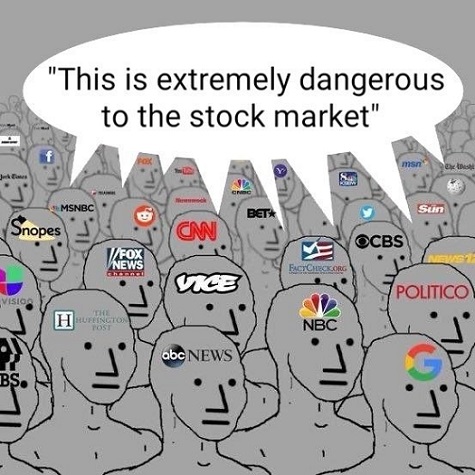
Meme stolen from Ace of Spades H.Q.
The press conveyed panic and moral disgust. “I didn’t realize it was this cultlike,” said short-seller Andrew Left of Citron Research, without irony denouncing the campaign against firms like his as “just a get rich quick scheme.” Massachusetts Secretary of State Bill Galvin said the Redditor campaign had “no basis in reality,” while Dr. Michael Burry, the hedge funder whose bets against subprime mortgages were lionized in The Big Short, called the amateur squeeze “unnatural, insane, and dangerous.”
The episode prompted calls to regulate Reddit and, finally, halt action on the disputed stocks. As I write this, word has come out that platforms like Robinhood and TD Ameritrade are curbing trading in GameStop and several other companies, including Nokia and AMC Entertainment holdings.
Meaning: just like 2008, trading was shut down to save the hides of erstwhile high priests of “creative destruction.” Also just like 2008, there are calls for the government to investigate the people deemed responsible for unapproved market losses.
The acting head of the SEC said the agency was “monitoring” the situation, while the former head of its office of Internet enforcement, John Stark, said, “I can’t imagine there isn’t an open investigation and probably a formal order to find out who’s on these message boards.” Georgetown finance professor James Angel lamented, “it’s going to be hard for the SEC to find blatant manipulation,” but they “owe it to look.” The Washington Post elaborated:
To establish manipulation that runs afoul of securities laws, Angel said regulators would need to prove traders engaged in “an intentional act to push a price away from its fundamental value to seek a profit.” In market parlance, this is typically known as a pump-and-dump scheme …
Even Nancy Pelosi, when asked about “manipulation” and “what’s going on on Wall Street right now,” said “we’ll all be reviewing it,” as if it were the business of congress to worry about a bunch of day traders cashing in for once.
The only thing “dangerous” about a gang of Reddit investors blowing up hedge funds is that some of us reading about it might die of laughter. That bit about investigating this as a “pump and dump scheme” to push prices away from their “fundamental value” is particularly hilarious. What does the Washington Post think the entire stock market is, in the bailout age?
H/T to Larry Correia for the link.


