
As for conditions on the eve of coal’s rapid rise in the late sixteenth century, they were actually even less intense. Following the Black Death, London’s population took centuries to recover, and by 1550 was still below its estimated medieval peak. Having once had over 70-80,000 souls, by 1550 it had only recovered to about 50,000. And the woodlands fuelling London were clearly still intact. Foreign visitors in the 1550s, who mostly stayed close to the city, described the English countryside as “all enclosed with hedges, oaks, and many other sorts of trees, so that in travelling you seem to be in one continued wood”, and remarked that the country had “an abundance of firewood”.1 Even in the 1570s, when London’s population had likely begun to finally push past its medieval peak, the city seems to have drawn its wood from a much smaller radius than before. Whereas in the crunch of the 1300s it seemingly needed to draw firewood from as far as 17 miles away over land, in the 1570s even a London MP, with every interest in exaggerating the city’s demands, complained that it only sometimes had to source wood from as far away as just 12 miles.2
And not far along the coast from the city were also the huge woodlands of the Weald, which stretched across the southeastern counties of Sussex, Surrey and Kent, and which did not even send much of their wood to London at all. Firewood from the Weald was not only exported to the Low Countries and the northern coast of France, but those exports more than tripled between 1490 and the early 1530s, from some 1.5 million billets per year to over 4.7 million. That level was still being reached in 1550, when not interrupted by on-and-off war with France, but by then the Weald was also meeting yet another new demand, for making iron.3
Ironmaking was extremely wood-hungry. In the 1550s Weald, making just a single ton of “pig” or cast iron, fit only for cannon or cooking pots, required almost 4 tons of charcoal, which in turn required roughly another 28 tons or so of seasoned wood. England in the early sixteenth century had imported the vast majority of its iron from Spain, but between 1530 and 1550 Wealden pig iron production increased eightfold. The expansion would have demanded, on a very conservative estimate, the sustained annual output of at least 50,000 acres of woodland — an area over sixty times the size of New York’s Central Park. Yet even this hugely understates the true scale of the expansion, as pig iron needed to be refined into bar or wrought iron in order to be fit for most uses, which required twice as much charcoal again — or in other words, a total of 86 tons of seasoned wood had to be first baked and then burned, just to make one ton of bar iron from the ore. And all this was just the beginning. By the 1590s the output of the Wealden ironworks had more than tripled again, for pig iron alone (though the efficiency of charcoal usage had also halved — a story for another time, perhaps).4
Given the rapidity of these changes, it will come as no surprise that there were complaints from the locals about how much the ironworks had increased the price of fuel for their homes. No doubt the wood being exported was having a similar effect as well. But the 1540s and 50s were also time of rapid general inflation, because of a dramatic debasement of the currency initiated by Henry VIII to pay for his wars. This not only made imports significantly more expensive, and so likely spurred much of the activity in the Weald to replace increasingly unaffordable iron from Spain, but they also made exports significantly cheaper for buyers abroad — and thus unaffordable for the English themselves.
In 1548-9, in a desperate bid to keep prices down, royal proclamations repeatedly and futilely banned the export of English wheat, malt, oats, barley, butter, cheese, bacon, beef, tallow, hides, and leather, to which the following year were added — like a game of inflation whack-a-mole — rye, peas, beans, bread, biscuits, mutton, veal, lamb, pork, ale, beer, wool, and candles. And of course charcoal and wood.5 For us to have records of the Weald exporting large quantities of wood in 1550 then, they must either have been sold through special royal licence, or have all been shipped out before the ban came in force just halfway through the year in May. Presumably a great deal more than recorded was also smuggled out. In 1555, parliament saw the need to put the ban on exporting victuals and wood into law, adding severe penalties. Transgressing merchants would lose their ship and have to pay a fine worth double the value of the contraband goods, while the ship’s mariners would see all their worldly possessions seized, and be imprisoned for at least a year without bail.6
It’s perhaps no wonder that the Weald’s ironworks continued to expand at such a rapid pace: the export ban would have freed up a great deal of woodland for their use. And ironmaking soon spread to other parts of England too, to where it did not have to compete for fuel with people’s homes. Given iron was significantly more valuable by both weight and volume than wood, it could easily bear the cost of transporting it from further away, and so could be made much further inland, away from the coasts and rivers whose woodlands served cities. In the early seventeenth century, iron ore and pig iron from the southwest of England was sometimes shipped all the way to well-wooded Ireland for smelting or refining into bar.7 In the early eighteenth century scrap iron from as far away as even the Netherlands was being recycled in the forested valleys of southwestern Scotland.8
Whenever ironmaking hit the limits of what could be sustainably grown in an area, it simply expanded into the next place where wood was cheap. And there was almost always another place. England, having had to import some three quarters of its iron from Spain in the 1530s, by the 1580s was almost entirely self-sufficient, after which the total amount of iron it produced using charcoal continued to grow, reaching its peak another two hundred years later in the 1750s.9 Had iron-making not been able to find sustainable supplies of fuel within England, it would have disappeared within just a few years rather than experiencing almost two centuries of expansion.10
And that’s just iron. The late sixteenth century also saw the rapid rise in England of a charcoal-hungry glass-making industry too. Green glass for small bottles had long been made in some of England’s forests in small quantities, but large quantities of glass for windows had had to be imported from the Low Countries and France. Just as with iron, however, the effect of debasement was to make the imports unaffordable for the English, and so French workers were enticed over in the 1550s and 60s to make window glass in the Weald. Soon afterwards, Venetian-style crystal-clear drinking glasses were being made there too.
What makes glass even more interesting than iron, however, is that its breakability meant it could not be made too far away from the cities in which it would be sold, and so had to compete directly with people’s homes for its fuel. Yet by the 1570s crystal glass was even being made even within London itself. Despite charcoal supplies being by far the largest cost of production, over the course of the late sixteenth century the price of glass in England remained stable, making it increasingly common and affordable while the price of pretty much everything else rose.11
What we have then is not evidence of a mid-sixteenth-century shortage of wood for fuel, and certainly not of those demands causing deforestation. It is instead evidence of truly unprecedented demands being generally and sustainably met.
And despite these unprecedented demands, the intensity with which under-woods were exploited for fuel seems to have actually decreased. During the medieval population peaks, the woods and hedges that supplied London had been squeezed for more fuel by simply cropping the trunks and branches more often, cutting them away every six or seven years rather than waiting for them to grow into larger poles or logs. After the Black Death killed off half the population, the cropping cycle could again lengthen to about eleven. But under-woods in the mid-sixteenth century were being cropped on average only twelve or so years — about twice as long a cycle as before the Black Death — which by the nineteenth century had lengthened still further to fourteen or fifteen.12
The lengthening of the cropping cycle can imply a number of things, and we’ll get to them all. But one possibility is that in order to meet unprecedented demands, more firewood was being collected at the expense of the other major use of trees: for timber.
Anton Howes, “The Coal Conquest”, Age of Invention, 2024-10-04.
1. Estienne Perlin, “A description of England and Scotland” [1558], in The Antiquarian Repertory, vol.1 (1775), p.231. Perlin must have visited Britain in early 1553, as he mentions the arrival of a new French ambassador, which occurred in April 1553, as well as the wedding of Lady Jane Grey, which occurred in May of that year. Also Danielo Barbaro, “Report (May 1551)” in Calendar of State Papers Relating to English Affairs in the Archives of Venice, Vol 5: 1534-1554 (Her Majesty’s Stationery Office, 1873). And: Paul Warde and Tom Williamson, “Fuel Supply and Agriculture in Post-Medieval England”, The Agricultural History Review 62, no. 1 (2014), p.71
2. Galloway et al., p.457 for the estimate of 17.4 miles overland as the outer limit of London’s firewood supply; Proceedings in the Parliaments of Elizabeth I, Vol I: 1558-1581, ed. T.E. Hartley (Leicester University Press, 1981), p.370: specifically, the London MP Rowland Hayward complained of the cost of firewood billets and charcoal having increased in price over the previous 30 years (which would encompass the period of debasement-induced inflation), before noting that “Sometimes the want of wood has driven the City to make provision in such places as they have been driven to carry it 12 miles by land”.
3. Mavis E. Mate, Trade and Economic Developments, 1450-1550: The Experience of Kent, Surrey and Sussex (Boydell Press, 2006), pp.83, 92, 101.
4. These statistics are derived from a combination of Peter King, “The Production and Consumption of Bar Iron in Early Modern England and Wales”, The Economic History Review 58, no. 1 (1 February 2005), pp.1–33 for the iron production estimates, and G. Hammersley, “The Charcoal Iron Industry and Its Fuel, 1540-1750”, The Economic History Review 26, no. 4 (1973), pp.593–613 for the estimates of how much charcoal, wood, and land was required at a given date to produce a given quantity of pig or bar iron.
5. Paul L. Hughes and James F. Larkin, eds., Tudor Royal Proclamations., Vol. I: The Early Tudors (1485-1553) (Yale University Press, 1964), proclamations nos. 304, 310, 318, 319, 345, 357, 361, 365, 366.
6. 1 & 2 Philip & Mary, c.5 (1555)
7. William Brereton, Travels in Holland, the United Provinces, England, Scotland and Ireland 1634-1635, ed. Edward Hawkins (The Chetham Society, 1844), p.147
8. T. C. Smout, ed., “Journal of Henry Kalmeter’s Travels in Scotland, 1719-20”, in Scottish Industrial History: A Miscellany, vol. 14, 4 (Scottish History Society, 1978), p.19
9. See King. Note that there was an interruption to this growth in the mid-seventeenth century, for reasons I mention later on.
10. There was a period in the early-to-mid seventeenth century when English ironmaking stagnated, but this was due to the growth of a competitive ironmaking industry in Sweden.
11. D. W. Crossley, “The Performance of the Glass Industry in Sixteenth-Century England”, The Economic History Review 25, no. 3 (1972), pp.421–33
12. Galloway et al. On cropping cycles in particular, see pp.454-5: they note how the average cropping of wood in their sample c.1300 was about every seven years, but by 1375-1400 — once population pressures had receded due to the Black Death — the average had increased to every eleven. See also Rackham, pp.140-1. John Worlidge, Systema agriculturæ (1675), p.96 mentions that coppice “of twelve or fifteen years are esteemed fit for the axe. But those of twenty years’ standing are better, and far advance the price. Seventeen years’ growth affords a tolerable fell”.
January 13, 2025
January 10, 2025
Javier Milei’s “devastation” and “social chaos” report card
In the Washington Examiner, David Harsanyi checks the current state of Argentina against the doom-and-gloom predictions from the start of Javier Milei’s term:
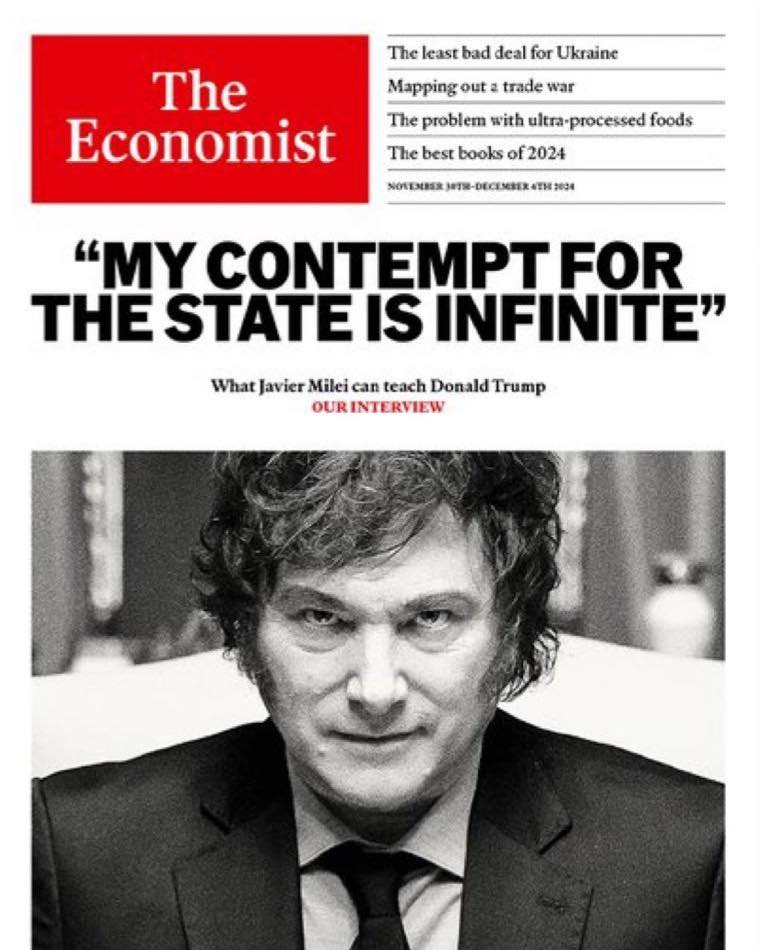
In the days leading up to the August 2023 presidential election in Argentina, a hundred “leading” economists from around the world, including progressive favorite Thomas Piketty, published an open letter warning that “radical right-wing economist” Javier Milei would inflict “devastation” and social chaos on his country.
However, they said it like it was a bad thing.
By the time Milei unexpectedly won the presidency, Argentina, once one of the wealthiest nations in the world, had a poverty rate of over 40% and the third-highest inflation rate in the world. After decades of Peronism, a toxic melding of fascism, socialism, and unionism, the nation bankrupted its central bank, and the peso was depreciating at warp speed. Do you think your mortgage rate is bad? Interest rates hit 118% in Argentina weeks before the election. The country was on its way to becoming another Venezuela. Milei wanted to blow it up.
After Milei’s unlikely victory, political scientist Ian Bremmer warned, “Economic collapse is coming imminently”. Felix Salmon, the chief financial correspondent at Axios, argued that Milei’s policies would plunge Argentina into “a deep recession”.
Seven months later, Argentina was out of a recession that had set in before Milei’s victory. The chainsaw-wielding economist, “el Loco” to friends, followed through on his promise of “shock therapy”, prioritizing taming inflation by cutting spending and deregulating the economy.
Almost all problems in modern Keynesian fixes are prominent features of governance in the modern West. Governments are always bragging about spending their way out of economic tribulations (tribulations they usually instigate). If a person suggests that free-market economic policy would have been more beneficial in the long term, they are forced to rely on a counterhistory. This is one reason why lots of elites are rooting against Milei, who argues that most of the West’s economic ills lie in Keynesian economics. They want him to fail.
As we all know, most panic-inducing cases of “austerity” are just minuscule reductions in the trajectory of spending growth. Not Milei’s plan, which entailed shutting down 13 government agencies and firing over 30,000 public workers — around 10% of the federal workforce. That is an unrivaled political revolution. Argentina’s federal budget was reduced by 30%. Even if the Department of Government Efficiency accomplished everything Elon Musk and Vivek Ramaswamy are talking about doing, they wouldn’t come close to 3%, much less 30%, in spending cuts. There has likely been no comparable austerity program in any Western economy.
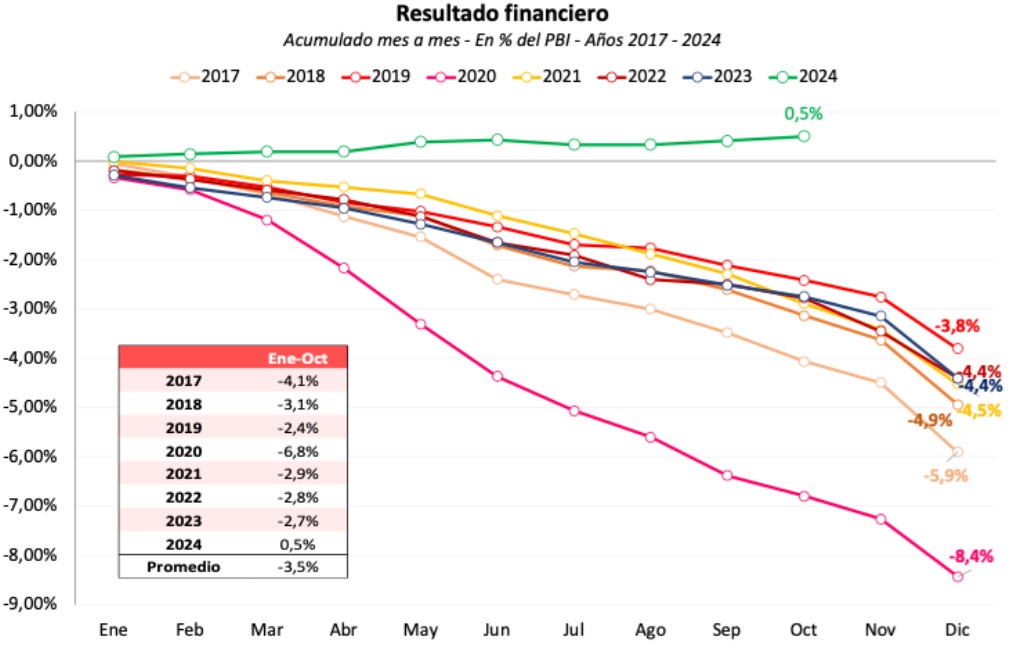
By May 2024, Argentina recorded its first quarterly budget surplus since 2008. Inflation, still high, dropped from a debilitating 25% at the end of 2023 to 2.4% by the end of 2024. Per capita salary, having plunged, is now also recovering.
Dan Mitchell agrees that it’s easy to mock economists for their hair-on-fire reaction to Milei’s election:
Consider the supposedly prestigious left-leaning academics who asserted in 2021 that Biden’s agenda was not inflationary. At the risk of understatement, they wound up with egg on their faces.1
Today, we’re going to look at another example of leftist economists making fools of themselves.
It involves Argentina, where President Javier Milei’s libertarian agenda has yielded amazingly positive results in just one year.
- Dramatic lowering of inflation.
- Big reductions in the burden of government spending.
- Rapidly achieving a balanced budget.
- Reductions in poverty.
- Rising levels of household income.
Some of us knew that good policy would lead to good results.
Others, like the editors at Bloomberg, perhaps did not expect such a quick turnaround. But, to their credit, they just acknowledged the amazing progress in an editorial.
The U.K.-based Telegraph leans to the right, so this headline can probably be interpreted as a victory dance.
1. The bad monetary policy that led to rapidly rising prices actually began under Trump in 2020 and was continued by Biden in 2021.


QotD: The “bottle service” model as a “douchebag Potlatch”
As to whether I’ve gotten a grant to pay for bottle service, mercifully no. I have had dinner with a (former) model, but it was Ashley herself at the kind of restaurant that occasionally has a hedge fund Powerpoint deck critiquing its management go viral. It was a decent hour, both of us were completely sober, there was no party promoter arranging the meeting, and there was no EDM played at OSHA-violation decibel levels. My idea of a good time is a lucid conversation with a smart friend, such as both that occasion and this email exchange, whereas I’d pay a good amount of money to avoid getting extremely drunk and staying out until dawn in an environment too loud for conversation.1 However I salute Ashley for doing so and thereby providing us with this book. The most I’ve had to suffer for my scholarship is writing response memos to annoying reviewer questions, or struggling with merge errors whilst munging data files.
And yet, contrary to my own taste, the people at the night clubs are paying a lot of money and/or waiting in line to get in, so obviously they seem to think it is appealing. I don’t think we can call this false consciousness either. Ashley is very clear that part of the reasons the models go to the clubs is as a favor to the promoters (much more on that later), but part of it is that a lot of models think going to a famous night club is really glamorous and cool. I’m tempted to say this is just de gustibus non disputandum, but just shrugging at taste is kind of a cop out for a sociologist since one of our mandates is to explain socially patterned taste.
I think a key explanation for what’s going on is Girard’s mimetic desire. The club is glamorous because there’s a long line of people outside waiting to get past the velvet rope. The women are beautiful because everyone agrees that tall skinny women are beautiful, even though in other contexts a lot of men (including the promoters) are more attracted to the kind of shorter curvier women who are barred entry to the club as “midgets”. Everyone and everything in the world of models and bottles that is desirable is desirable primarily because they or it are desired by others.
John: I’ve never read a fashion magazine or watched a runway show, so I just naively assumed that models were stunningly attractive and feminine. But as Mears points out, the models are not actually to most men’s tastes. They tend to have boyish figures and to be unusually tall.2 Is this because the fashion industry is dominated by gay men, who gravitate towards women who look like teen boys? Whatever the origins of it, there is a model “look”, and the industry has slowly optimized for a more and more extreme version of it, like a runaway neural network, or like those tribes with the rings that stretch their necks or the boards that flatten their skulls. There’s actually a somewhat uncanny or even posthuman look to many of the models. The club promoters denigrate women who lack the model look as “civilians”, but freely admit that they’d rather sleep with a “good civilian” than with a model. The model’s function, as you say, is as a locus of mimetic desire. They’re wanted because they’re wanted, in a perfectly tautological self-bootstrapping cycle; and because, in the words of one promoter: “They really pop in da club because they seven feet tall”.
The men don’t want to sleep with the models, and by and large they don’t. This leads directly to one of the most jaw-dropping insights in the entire book: the models are a potlatch of sorts too. The men are buying thousand dollar bottles of champagne and dumping them out on the floor, destroying economic value just to show that they can. And likewise, they’re surrounding themselves with dozens of beautiful women and then not sleeping with them. A potlatch of female beauty, sexuality, and reproductive potential — flaunting their wealth by hoarding women and conspicuously declining to enjoy their company, but at the same time denying them to every other man. An anti-harem.
Actually, you know what else the models remind me of? Medieval jesters. There was a point in the 15th century when every ruler in Europe had to have a dwarf in his entourage — not because there was anything intrinsic or valuable about very short men, but just because it was rare. The first guy did it to show that he was a big enough deal to have something expensive and hard to find, and then everybody else started doing it because it was the thing to do. (When dwarfs became too commonplace, the status symbols got weirder.) I think model phenotype is a little bit like that — desirable because it is rare, and because gathering and showcasing all these rare objects is a way to demonstrate your wealth and power.
John Psmith and Gabriel Rossman, “GUEST JOINT REVIEW: Very Important People, by Ashley Mears”, Mr. and Mrs. Psmith’s Bookshelf, 2024-03-04.
1. Another interesting work of scholarship on partying is Minjae Kim’s work on Korean work team binge drinking. Minjae shows that people go binge drinking because most of them hate it and thus it serves as a costly signal of loyalty.
2. In fact, an unusually high proportion of models are intersex individuals with a Y-chromosome and androgen insensitivity syndrome.
January 9, 2025
Trump plays fast and loose with numbers over US/Canadian trade
On her Substack, Tasha Kheiriddin refutes some of the big numbers US President-elect Donald Trump has been using in his “make Canada the 51st state” campaign:

US President-elect Donald Trump successfully trolled Justin Trudeau about Canada becoming the 51st state of the union.
“We don’t need their cars. … We don’t need their lumber”, Trump said. “We have massive fields of lumber … We don’t need their dairy products. We have more than they have.”
This is, of course, a giant lie. Canada has plenty of things America needs, including raw materials like oil and food that it refines and transforms. That transformation generates millions of well-paying US industrial and manufacturing jobs. The US also imports nearly $5 billion in fertilizer to boost agricultural production.
And if we don’t have anything America needs, why would Trump want to annex us? Because, he claims, the US trade deficit with Canada is a “subsidy.” Trump asks, “Why are we losing $200 billion dollars a year and more to protect Canada?”
This is a second lie. First of all, trade deficits are not subsidies. A trade deficit represents the difference in the value of imports and exports. Second, the US trade deficit with Canada isn’t $200 billion, or even the $100 billion figure Trump has previously used. In 2023, according to the US Bureau of Economic Analysis, it was $USD 41 billion. And if you remove energy exports, the US actually runs a surplus with us, not a deficit. Energy exports accounted for over $177 billion of Canada’s exports south of the border. Twenty-eight per cent of what we export is energy, namely, over four million barrels per day of oil, the largest amount from any country in the world.
Trump is correct that Canada has benefitted from the American military’s umbrella. We benefit by proximity, because we happen to be next to the US – just like Americans benefit from buying our discounted crude oil, because they happen to be next to us. The US would maintain their military whether we were neighbours or not. They wouldn’t have a smaller military if they annexed Canada; if anything, they’d spend more, because they would be actively engaged across our entire landmass, directly defending our borders. We have also been a steadfast ally in times of war, a fact Trump handily omits.
So Trump’s argument is a lie, but a clever lie. It’s something that will resonate with his voters, with the average American struggling to pay their bills. It’s purportedly about fairness, doing what’s right. Not taking over a sovereign nation, but returning to Americans what’s rightfully theirs.
It’s like Putin saying that the Donbas is full of Russians, so it really should be part of Russia. Or Xi Jinping saying that Taiwan is really part of China, so the two countries should be “reunified”.
It’s also cover for the real reason Trump would like to take over Canada: because we do have a lot of what the US needs, namely oil, water, and critical minerals. He would love to take control of the Arctic, ostensibly for security reasons, but really for the resources that lie beneath. Drill, baby, drill. But Trump can’t say that part out loud, because then he sounds like a communist dictator, not the leader of the free world.
Trump wants to use tariffs to break Canada. Our GDP could drop by two to four per cent and put us in an official recession. Two and half million jobs would be at risk. People would get poorer at a time when two million of us are already using food banks. Throw in a simultaneous diet of pro-annexation propaganda pumped out by Trump’s friends on social media, and the blathering of front groups funded by vested interests, and the 13% of Canadians who favour joining the US could swell to the point where they put political pressure on Ottawa to cave to Trump’s demands.
And then, all bets are off. Trump figures Canadians will beg to join the US, and he may not be wrong. Manifest destiny, achieved — and a YUGE legacy for him.
In the National Post, Carson Jerema wishes the Canadian media would calm the hell down and recognize that Trump is still trolling the heck out of them:
So it turns out Donald Trump doesn’t really want to annex Canada. Seriously. Anyone who watched his news conference Tuesday, and not just the short clip shared on social media, should come away assured, as much as one can be with Trump anyway, that his comments about this country becoming the 51st state really are little more than trolling. Certainly, the U.S. president-elect repeatedly musing about absorbing Canada has never been funny, and the words themselves undermine Canadian sovereignty, but nothing Trump said Tuesday was much different than what he’s been saying for weeks.
Yes, I’m aware that we are supposed to be in crisis mode at Trump’s latest musings, which the Toronto Star called “explosive”, and the Globe and Mail referred to as an “escalation”. Even the National Post’s Wednesday front page played up the president-elect’s comments. A similar response came from Prime Minister Justin Trudeau, who posted on social media that “There isn’t a snowball’s chance in hell” that Canada would merge with the U.S., and Conservative Leader Pierre Poilievre, who posted that “Canada will never be the 51st state. Period”.
As is so often the case, what Trump actually said is less exciting than the reaction it generated.
When asked by a reporter if he was “considering military force to annex and acquire Canada?” Trump responded, “No. Economic force because Canada and the United States, that would really be something. You get rid of that artificially drawn line and you take a look at what that looks like and it would also be much better for national security.”
That response is the sum total of the so-called “escalation”.
It is, at a brief glance, easy to see why so many felt compelled to react the way they did to the president-elect’s comments, but it was the reporter, not Trump, who used the word “force” first, and getting “rid” of the border could mean any number of arrangements, short of a merger. Beyond that, however, there isn’t much in the way of a new development in the supposed annexation crisis of 2025.
January 5, 2025
“Everything humans build starts with human and social capital. This includes everything economic.”
Lorenzo Warby explains why he has always disagreed with the “standard model” of economic growth, as it fails to include the biggest cultural variables that matter enormously for economic development:

“Hyderabad bazaar” by ruffin_ready is licensed under CC BY 2.0 
 .
.
The seminal theory of economic growth is the Solow Growth Model (technically, the Solow-Swan model). The model can be easily expressed mathematically.
I have never liked the model, nor its later variations.1 The intuition behind my dislike was that societies — and indeed different ethnic groups within societies — obviously varied enormously in their capacity to use, to “put together”, the factors of production. They also vary enormously in their capacity to generate factors of production: specifically capital, the produced means of production. The model implies that there will be a general convergence between economies that has not happened.
Updating the model by including human capital was a gesture in that direction but did not fix the problem with the model, which is much more basic. The update attempted to grapple with the failure of investment to flow to poorer countries and, by implication, the long-term, systematic failures of foreign aid. The failures of foreign [aid] also supported my intuition.
The most recent (2024) Nobel memorial was for work that also directly supports my intuition — how much institutions matter for economic growth. The long-term economic growth literature — identifying culture as very much mattering for economic growth — also supports my intuition.
Skills and knowledge (human capital) are basic
To explain why the entire approach — basically, fiddling with some version of the Cobb-Douglas production function — is fundamentally mistaken, we need to go back to the origins of human economic growth. I mean, right back — all the way to foragers.
What are the original forms of capital? Well, there are tools, which are the original form of physical capital. But without the skills to make and use the tools, they either do not exist, or they are useless.
So, we start with skills and knowledge, with human capital. It takes almost 20 years to train a young human forager to be a subsistence adult — that is, to forage as much nutrition as they consume. The need to stuff the human brain with skills and knowledge — and the need to grow a brain that can be so stuffed — is why we have the most biologically expensive children in the biosphere. The need to impart skills to biologically expensive children is fundamental to the dynamics of all human societies.
Human capital — skills and knowledge — is not an “add on”. It is basic.
So are social connections (social capital)
Foragers do not live as atomistic individuals. They live in families and (fluid) foraging bands. Families and foraging bands are vehicles for our highly cooperative subsistence and reproduction strategies.
That we are the tool-making and tool-using species lacking tearing teeth and claws with the most biologically expensive offspring is why we have highly cooperative subsistence and reproduction strategies. It is also why we are so much the normative species — enabling robust cooperation based on convergent expectations — and why we have prestige and propriety as forms of status.
Both these forms of status represent currencies of cooperation. Prestige grants people status for doing things which are risky, clever, hard, entertaining. It is status by conspicuous competence. It provides a way to reward people for engaging in activities which generate wider social benefits — what economists call positive externalities. It also encourages people to want to associate with you.2
The other form of status — propriety — grants status to those who uphold the norms of the group. In particular, it wields stigma against those deemed to have violated those norms. It provides a way to punish people for engaging in activities which generate wider social costs — what economists call negative externalities. It helps solve the free-rider problem regarding the effort to enforce norms.
Reversing (i.e. perverting) status patterns so that people get prestige from victimhood — extending to various forms of failures of competence or even wildly anti-social behaviour — while stigmatising people who conspicuously successful (as oppressors or exploiters) is deeply destructive of human flourishing.3 We can see this pattern currently operating in “progressive” US states, and especially cities, but murderous versions of it operated in various Communist states. These things affect economic activity, but cannot be discerned by a Cobb-Douglas production function.
It is not true that scientists have never discovered Homo economicus. Unfortunately, Homo economicus is not a member of genus Homo. It is Pan troglodytes (chimpanzees) playing strategy games in a lab. It is precisely because we Homo sapiens are more normative, allowing us to encapsulate the social conquest of the Earth, that there are billions of us and only a few thousand of them.
We — as a highly social, indeed ultra-social, species — engage in both individual and social calculations. Different cultures notoriously generate different patterns for, and balances between, such calculations.
1. The model has some utility for short-term calculations of growth.
2. As with any social benefit, the knock-on dynamics of prestige can be complex, but status from conspicuous competence is at the heart of it.
3. The November 2014 Shirtgate controversy — where a rocket scientist who had led the technically incredibly difficult task of landing a probe on a comet was publicly humiliated over the shirt he wore (a gift from a female friend it turned out) — represented conspicuous achievement (prestige) being trumped by feminist stigmatisation (propriety).
January 4, 2025
January 2, 2025
DOGE has a lot of low-hanging fruit to pick
Patrick Carroll selects some of the least-defendable ways the US government has been spending taxpayer money from Senator Rand Paul’s 2024 Festivus Report, including pickleball courts, $10B in unused office space, DEI initiatives for birdwatchers, crop fertilizer in foreign countries, and literal circus performances:

Rand Paul by Gage Skidmore is licensed under CC BY-SA 2.0  .
.
Why does such government waste persist year after year? A significant part of the explanation traces back to the concept of concentrated benefits and dispersed costs. Essentially, the beneficiaries tend to be a small, concentrated group, so they lobby hard for these outlays because they stand to gain a lot from them. Taxpayers, on the other hand, tend to be dispersed and only minimally affected by any single expense, so it’s not usually worth it for them to lobby against the spending, or even learn about it in the first place.
Economist Gordon Tullock famously illustrated this concept with his fictional Tullock Economic Development Plan. The plan “involves placing a dollar of additional tax on each income tax form in the United States and paying the resulting funds to Tullock, whose economy would develop rapidly”.
Think about the incentive Tullock would have to advocate for this plan, compared to the incentive that an ordinary taxpayer would have to look into it and voice their objections. With campaign contributions and votes to be gained from the special interest beneficiaries, is it any wonder politicians often go for these kinds of wealth transfers?
The ubiquity and stubborn persistence — year after year — of all this waste, combined with the economic theory that explains why it happens, suggests that there is a fundamental problem with the process of government as we know it. This is not, as many are itching to believe, a “Democrat” problem or a “Republican” problem. The degree of government waste changes very little with changing administrations. No, this is a problem with the government as such.
To solve this problem, we need to ask not just who should run the government, but what the government should be allowed to spend money on in the first place, given what we know about its entirely predictable and repeatedly demonstrated propensity for waste and dysfunction.
Milei has already started that conversation in Argentina. Let’s hope that with the new Trump administration and DOGE, that’s a conversation we can have here as well.
December 30, 2024
RIP Jimmy Carter, “The Great Deregulator”, 1924-2024
ReasonTV
Published 29 Dec 2024Nobel-Winning Economist Vernon Smith says the 39th president radically improved air travel, freight rail, and trucking in ways that still benefit us immensely.
______Jimmy Carter was perhaps the most successful ex-president in American history, winning the Nobel Peace Prize in 2002 for his work promoting human rights and economic and social development.
But his single term as president (1977–1981) is largely remembered as a series of failures and missteps, sometimes literally. Gas lines, a record-high combination of unemployment and inflation on the “misery index”, and Americans being held hostage by Iranian revolutionaries for over a year all fueled the perception that Carter was a weak and ineffective leader. When he collapsed during a six-mile run, it personified for many the exhaustion of the country under his leadership.
But there was at least one way in which Carter excelled as president. He was, in the words of 2002 Nobel–winning economist Vernon Smith, the great deregulator. Carter forced the airline industry, along with interstate trucking and freight rail, to compete for business, with powerful and positive effects that continue to this day.
I talked to Smith about Carter, whom he met at a White House event for American Nobel Prize winners, and what it was like to fly in the days when the government controlled air travel.
December 28, 2024
How the H1B visa argument follows an earlier political struggle
On the social media platform formerly known as Twitter, ESR points out that the arguments over US work permits for foreigners might well have been prefigured by the now-receding tide of attempts to gut the second amendment:
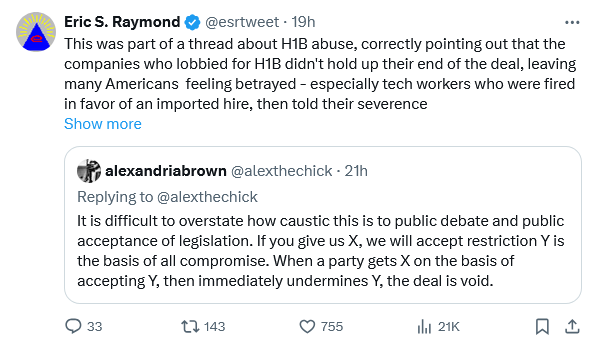
alexandriabrown @alexthechick
It is difficult to overstate how caustic this is to public debate and public acceptance of legislation. If you give us X, we will accept restriction Y is the basis of all compromise. When a party gets X on the basis of accepting Y, then immediately undermines Y, the deal is void.This was part of a thread about H1B abuse, correctly pointing out that the companies who lobbied for H1B didn’t hold up their end of the deal, leaving many Americans feeling betrayed — especially tech workers who were fired in favor of an imported hire, then told their severance pay would be denied if they didn’t train their replacements.
I am, however, irresistibly reminded of another betrayal. One I’ve written about before — but maybe at least part of this story needs to be told again.
Today in the 21st century most of the American gun culture is bitterly, even fanatically opposed to more “gun control” laws, and howling for all of them clear back to the National Firearms Act of 1934 to be repealed. Donald Trump earned huge support with his promise to get national concealed-carry reciprocity pushed through Congress.
We weren’t always like that. Long ago, before 1990, many of us were less resistant to new gun control measures. Sometimes major gun-rights organizations would even help lawmakers draft legislative language.
(Yes, I was a gun owner then. So I’m not going by legends, but by lived experience.)
What changed?
The quid-quo-pros we were offered were many variations of “If you will accept this specific restriction X, we will stop pushing. We will stop trying to undermine your Second Amendment rights in general. Help us save the chilllldren!”
That promise was never kept. Gradually, we noticed this. It always turned out that the minority of angry suspicious people who said “This won’t be enough, they’ll come back for another bite!” were right.
Eventually, some documents leaked out of one of the major graboid organizations that revealed a conscious strategy of salami-slicing — instead of challenging gun rights directly, they intended to gradually make owning personal weapons less useful and more onerous until the culture around them collapsed.
So nowadays we’re pretty much all angry and suspicious. Even restrictions that do little harm and might be objectively reasonable (bump stocks, anyone?) touch off tsunamis of protest.
People offering us more “deals” (just give up this one little thing, mmmkay?) now have negative credibility.
Are you paying attention, Big Tech? (Particularly you, @elonmusk, and you, @VivekGRamaswamy.) Because you’re almost there, now. Too many people see that H1B has become an indentured-servitude fraud that victimizes both the workers it imports and the Americans it displaces.
You credibility isn’t as shot as the gun-banners’ yet. You still have some room for recovery on “high-skilled immigation” in general, but it’s decreasing.
Your smart move would be to sacrifice H1B so you can keep the O-1 “genius” visas. I advise you to take it, because if you dig in your heels I think you are likely to lose both.
And on the reason so many Americans have become angry about blatant and exploitive H1B visa abuse:
Today’s big beef is between tech-success maximizers like @elonmusk and MAGA nationalists who think the US job market is being flooded by low-skill immigrants because employers don’t want to pay competitive wages to Americans.
To be honest, I think both sides are making some sound points. But I’d rather focus on a different aspect of the problem.
When I entered the job market as a fledgling programmer back in the early 1980s, I didn’t have to worry that some purple-haired harpy in HR was going to throw my resume in the circular file because I’m a straight white male.
I also didn’t have to worry that a hiring manager from a subcontinent that shall not be named would laugh at my qualifications because in-group loyalty tells him to hire his fourth cousin from a city where they still shit on the streets.
It’s a bit much to complain that today’s American students won’t grind as hard as East Asians when we abandoned meritocracy more than 30 years ago. Nothing disincentivizes working your ass off to excel more than a justified belief that it’s futile.
Right now we’re in and everybody-loses situation. Employers aren’t getting the talent they desperately need, and talent is being wasted. That mismatch is the first problem that needs solving.
You want excellence? Fire the goddamn HR drones and the nepotists. Scrap DEI. Find all the underemployed white male STEM majors out there who gave up on what they really wanted to do because the hiring system repeatedly punched them in the face, and bring them in.
Don’t forget the part about paying competitive wages. This whole H-1B indentured-servitude thing? It stinks, and the stench pollutes your entire case for “high-skill” immigration. You might actually have a case, but until you clean up that mess Americans will be justified in dismissing it.
These measures should get you through the next five years or so, while the signal that straight white men are allowed to be in the game again propagates.
I’m not going to overclaim here. This will probably solve your need for top 10% coders and engineers, but not your need for the top 0.1%. For those you probably do have to recruit worldwide.
But if you stop overtly discriminating against the Americans who could fill your top 10% jobs, your talent problem will greatly ease. And you’ll no longer get huge political pushback from aggrieved MAGA types against measures that could solve the rest of it.
Doesn’t that seem like it’s worth a try?
December 27, 2024
QotD: Adapting to “permanent” food surpluses
More to the point, this is a testable hypothesis. I’m a history guy, obviously, not a biologist, but you don’t need to be a STEM PhD to see it. All our physical structures still look the same in 2021 as they did in 1901, but our biochemistry is far different. Just to take two obvious — and obviously detrimental — examples, we are awash in insulin and estrogen. Time warp in a laboring man from 1901 and feed him a modern “diet” for a week; the insulinemic effects of all that corn syrup etc. would put him in a coma. Even if he didn’t, the knock-on effect of all that insulin — greatly ramped-up estrogen — would deprive him of a lot of his physical strength, not to mention radically alter his mood, etc.
Severian, “The Experiment”, Founding Questions, 2021-09-25.
December 24, 2024
David Friedman on elegant solutions to problems
Sometimes the solution to a problem is obvious … at least once someone else has pointed it out:
Recently, when writing a check, it occurred to me that requiring the amount to be given separately in both words and number was a simple and ingenious solution to the problem of reducing error. It is possible, if your handwriting is as sloppy as mine, to write a letter or number that can be misread as a different letter or number. If redundancy consisted of writing the amount of the check twice as numbers or twice as words the same error could appear in both versions. It is a great deal less likely to make two errors, one in letters and one in numbers, that happen to produce the same mistaken result. It reduces the risk of fraud as well, for a similar reason.
That is one example of a simple and elegant solution to a problem, so simple that until today it had never occurred to me to wonder why checks were written that way. Another example of the same pattern is a nurse or pharmacist checking both your name and date of birth to confirm your identity.1
That started me thinking about other examples:
The design of rubber spatulas, one bottom corner a right angle, the other a quarter circle. One of the uses of the device is to scrape up the contents of containers, jars and bowls and such. Some containers have curved bottoms, some flat bottoms at a right angle to the wall. The standard design fits both.
Manhole covers are round because it is the one simple shape such that there is no way of turning it that lets it fall through the hole it fits over.
Consider an analog meter with a needle and a scale behind it. If you read it at a slight angle you get the reading a little high or low. Add a section of mirror behind the needle and line up the image behind the needle. Problem solved.
If you try to turn a small screw with a large screwdriver it doesn’t fit into the slot. Turning a large screw with a small screwdriver isn’t always impossible but if the screw is at all tight you are likely to damage the screwdriver doing it. The solution is the Phillips screwdriver. The tip of a large Phillips screwdriver is identical to a smaller one so can be used on a range of screw sizes.2
Ziplock bags have been around since the sixties. Inventing them was not simple but a new application is: packaging that consists of a sealed plastic bag with a Ziplock below the seal. After you cut open the bag you can use the ziplock to keep the contents from spilling or drying. I do not know how recent an innovation it is but I cannot recall an example from more than a decade ago.
1. This one and some of the others were suggested by posters on the web forum Data Secrets Lox.
2. I am told that the solution is not perfect, doesn’t work for very small screws, which require a smaller size of driver.

December 18, 2024
Justin Trudeau at bay
However much you may dislike the man — and there’s just so much to dislike — it’s impossible to write him off no matter how bad the situation may look. In The Free Press, Rupa Subramanya explains to non-Canadian audiences what has been going on in the Deranged Dominion lately:
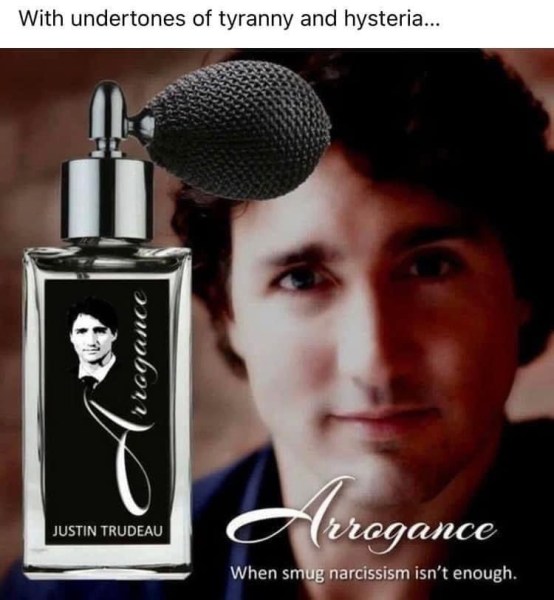
Justin Trudeau’s government could be at the point of collapse. And a social media post from Donald Trump about tariffs may have set off the latest in a chain of dominoes for Canada’s prime minister.
On November 25, Trump posted on his platform Truth Social that, as one of his first executive orders, he would “sign all necessary documents to charge Mexico and Canada a 25% Tariff on ALL products coming into the United States, and its ridiculous Open Borders”. Four days later, Trudeau flew to Mar-a-Lago to meet Trump for dinner. Although the content of their discussion has not been made public, Trump’s tariff threat may have landed a death blow to Trudeau’s cabinet.
On Monday morning, Trudeau’s most important ally — his number two, finance minister Chrystia Freeland — resigned in a fiery letter directed at her boss, which she posted on X.
“Our country today faces a grave challenge,” she wrote. “The incoming administration in the United States is pursuing a policy of aggressive economic nationalism, including a threat of 25 percent tariffs. We need to take that threat extremely seriously.” She continued: “That means pushing back against ‘America First’ economic nationalism with a determined effort to fight for capital and investment and the jobs they bring”.
The same morning, Trudeau’s housing minister Sean Fraser also announced his departure, saying he wanted to spend more time with his family. This brings the total number of cabinet members who’ve resigned under Trudeau in 2024 to nine. But a walkout from Freeland, his most trusted lieutenant, who was expected to release her fall economic statement Monday, is by far the biggest. That such a loyal servant who has worked for Trudeau since 2015 would resign so publicly shows just how deep the rot is these days. Freeland stood by the prime minister as his popularity began to tank in February 2022 when Canadian truckers protested his harsh Covid vaccine mandates. She even authorized the debanking of those protesters, freezing their bank accounts as a means of punishment [NR: with no legal authority, it must be noted].
Now, her resignation is feeding feverish speculation that the longtime progressive darling could finally be on his way out, amid his sinking popularity and the country’s economic slump. By Monday night, a prominent member of Trudeau’s Liberal Party, Anthony Housefather, went on TV to say the prime minister is “past his shelf life“.
QotD: Western shaming – the grass is always greener overseas
Once Japan’s economy ossified, the new utopia of the 1990s was supposedly the emerging European Union. Americans were supposed to be awed that the euro gained ground on the dollar. Europe’s borderless democratic socialism and its “soft power” were declared preferable to the reactionary U.S.
By 2015, the EU was a mess, so China was preordained as the inevitable global superpower. American intellectuals pointed to its high-speed rail transportation, solar industries and gleaming airports, in contrast to the hollowed-out and grubby American heartland.
Now the curtain has been pulled back on the interior rot of the Chinese Communist Party, its gulag-like re-education camps, its systematic mercantile cheating, its Orwellian surveillance apparatus, its serial public health crises and its primitive hinterland infrastructure.
After the calcification of the Soviet Union, Japan Inc., the EU and the Chinese superpower, no one quite knows which alternative will next supposedly bury America.
Victor Davis Hanson, “The Cult of Western Shaming”, Townhall.com, 2020-01-29.
December 17, 2024
Canada’s deputy prime minister heads for the exits
After being informed by Justin Trudeau that he no longer wanted her to be the finance minister on Friday, but still apparently expecting her to present the fall economic statement on Monday, Chrystia Freeland instead submitted her resignation from cabinet:

In the National Post, John Ivison calls it her “gangster move” against Trudeau:
Who saw Chrystia Freeland pulling a gun, after Justin Trudeau unsheathed a knife?
The finance minister is an unlikely champion of the Chicago Way, but she has just pulled off a coup that may end up toppling this government.
Just hours before she was due to give her fall economic statement, she quit.
Despite the widespread media speculation about a falling out between Freeland and Trudeau, it’s a good bet that no one was more surprised at the finance minister’s gangster move than the prime minister.
Her resignation letter was savage. She said that on Friday, Trudeau had told her he no longer wanted her as finance minister and offered her another job in cabinet.
She said that she concluded she had no option but to resign because she had lost the prime minister’s confidence.
The casus belli was the multi-billion-dollar affordability package that included a two-month GST holiday and mailing $250 cheques to nearly 19 million working Canadians.
As the National Post reported late Sunday, Freeland had already reversed the government’s position on the rebate cheques that would have cost an estimated $4.68 billion. One person with knowledge of the plans said that the measure will not be in the fiscal update but the government hopes to take another look in the new year, if it can find another party to support it.
Oh, and the financial update Freeland was still expected to deliver after being underbussed by Trudeau? It apparently did get released:

You can always count on the Babylon Bee to find the most accurate and tasteful way to present the news:

QotD: Capitalism is a combination of laziness, stupidity, and greed
Tim Worstall, “Folks Are Copying SpaceX – That’s How Capitalism Works”, It’s all obvious or trivial except …, 2024-09-16.


