
Forgotten Weapons
Published May 29, 2024The Sten MkI had barely been approved for production when the Sten MkII was born. Initially requested to produce a version of the gun suitable for paratroopers, in March 1941 Harold Turpin redesigned the front end of the Sten to have a quickly detachable barrel and a rotating magazine well (for compact storage). This new model was tests in late June and early July, approved for use, and contracts for it were issued in August 1941.
Named the MkII, this model of the Sten would quickly become the standard, and it was ultimately produced by six major factories (with the assistance of hundreds of subcontractors) on three continents to the tune of 2.6 million examples made. In addition to the barrel removal, the new model has a simpler front sight, simpler stock, and a revised bolt locking notch (upward, instead of downward like on the MkI).
(more…)
September 3, 2024
Sten MkII: Just When You Thought It Couldn’t Get Simpler
September 2, 2024
There’s no limit to how progressive politicians want to control your life
In the National Post a couple of days ago, Carson Jerema provided many examples of how the Canadian federal government — despite failing and fumbling so many of its existing responsibilities — still wants to increase control over the daily lives of Canadians:
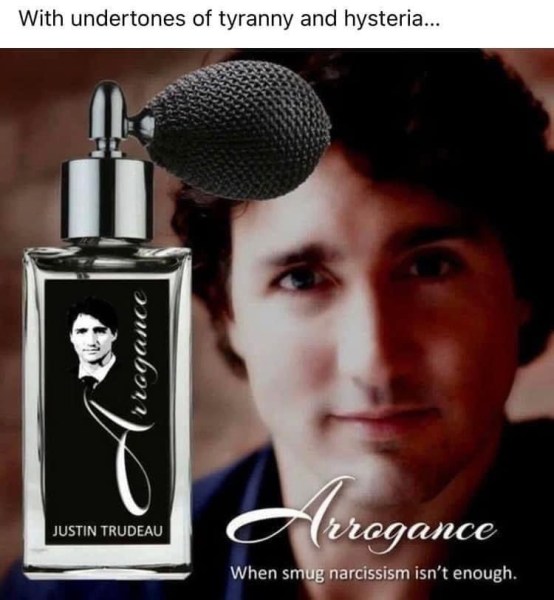
After a decade or so, progressives are on the defensive in Canada and elsewhere because regular people, as in those who are not activist weirdos, are tired of the agenda to control every aspect of our lives. Point this out to a progressive, and they will deny that anyone’s life is being interfered with and claim only some far-right monster would think otherwise. They can’t believe there are people out there who share a different view. They don’t understand how this could be.
But progressive governments are trying to control our lives in ways big and small, and in ways that range from subtle to a punch in the face.
In Canada, the federal government’s environmental policies are the most obvious example of this interference. The Liberals have banned plastic straws and plastic bags; even compostable bags are banned in grocery stores because they resemble plastic. Such bans are pointless irritants that make shopping more expensive, and life slightly less enjoyable as paper straws dissolve in one’s drink. People might dismiss these concerns as simply minor inconveniences, but this is how most people experience government policy, by being forced to replace their bag of plastic bags that they were already reusing, with more expensive, less useful options.
Next up, the Liberals are exploring options to bring in environmental regulations for clothing. The cost of clothes has actually gone down in recent years, so leave it to Ottawa to look for ways to bring the cost back up and to limit options.
There is also the plan to essentially force Canadians to purchase electric vehicles, that nobody would otherwise want, through government mandates to phase out the sale of gas-powered cars and trucks.
On a larger scale, the government is attempting to restrict the kind of work people do, specifically work in the oil and gas industry, through steep emissions targets, which will close off lucrative job opportunities in western oilfields. It will also limit the kinds of fuels people will be able to use to heat their homes.
There are also policies that the Canadian government hasn’t implemented, but which green activists have endorsed, such as the banning of gas stoves and the ludicrous suggestion from some academics that “climate lockdowns” be implemented to help cut emissions.
It is possible to be supportive of all these policies, despite their paternalistic and job-killing nature, but pretending that no one is trying to, or that no one wants to, interfere with our liberty is not a credible position to take.
September 1, 2024
Explaining everything on Canadian money
J.J. McCullough
Published May 19, 2024Who’s on it? What’s the history? How is it going to change?
(more…)
August 30, 2024
Experts are concerned that criticism of experts will weaken their role in our political system
In the National Post, Geoff Russ dares to imply that the experts are not the divinely inspired superior beings with unfailing wisdom about any and all issues:

So-called “experts” have weakened Canada’s political discourse far more than Pierre Poilievre ever has. Journalist and author Stephen Maher recently penned a column in the Globe & Mail titled, “By slamming experts, Pierre Poilievre and his staff are degrading political debate”.
Maher is an even-handed journalist, and his column should not be written off as the scribblings of a Liberal partisan. What his column misses is how the term “expert” has been abused, and the degree to which “experts” have thoroughly discredited themselves in recent years.
Poilievre’s criticisms of the “experts” would not resonate if they lived up to the title bestowed upon them.
For example, the Doug Ford government’s decision to close 10 safe injection sites after implementing a ban on such facilities located near schools and child-care centres. The closures were lamented by “experts” trotted out by the CBC as putting peoples’ lives at risk.
The safe injection sites slated to be shut down are near schools and daycares, and there is demonstrable proof that crime rises near these sites wherever they are located.
Derek Finkle recently wrote that the critiques of the closures levelled by selected “experts” failed to note how community members had been threatened with rape, arson, and murder since the injection site in his Toronto neighbourhood had been opened.
These are reasonable grounds for a government to reconsider whether they should allow drug-use, supervised or not, to proliferate in neighbourhoods where families reside.
For all their alleged expertise, many “experts” seem unwilling to actually investigate what is happening on the ground, and often give plainly bad advice altogether, and this goes back decades.
The “experts” failed to predict the 2008 financial crisis, they said the risk to Canadians from the coronavirus was low in early 2020, and they failed to prevent runaway inflation after the worst of it had subsided.
Was it not the “experts” who asserted that arming and funding of Ukraine prior to Vladimir Putin’s invasion in 2022 was a bad idea? After the invasion began, was it not the “experts” who confidently predicted Putin’s army would conquer the whole of Ukraine in a matter of days, and not be bogged down in a years-long conflict that would reshape global trade?
The truth is that we live in a worse-off world because of the advice and predictions of “experts”.
August 22, 2024
“Say my pronouns, peasant!”
Andrew Doyle doubts that the push for bespoke personal pronouns will have any lasting impact on the language and how it is used despite all the political capital invested to coerce people to adopt them:
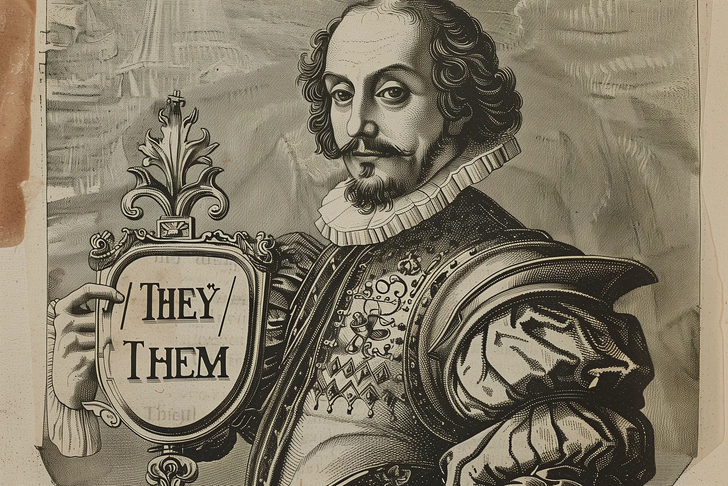
For all the demands of activists that “they” and “them” should be normalised as singular pronouns, very few members of the public have adapted their speech patterns accordingly. Even when the print media started following this odd new craze after Sam Smith declared himself to be “non-binary” in September 2019, the trend simply didn’t catch on.
This is hardly surprising. For one thing, most of the articles that adhere to this creed end up being both syntactically and stylistically incoherent. Take the following excerpt from a review of Judith Butler’s latest book in The Atlantic:
In essence, Butler accuses gender-crits of “phantasmatic” anxieties. They dismiss, with that invocation of a “phantasm”, apprehension about the presence of trans women in women’s single-sex spaces…
At first glance, “they” could appear to be referring to the “gender-crits”, but in this case it refers to Butler. A reader unfamiliar with the subject will inevitably find this confusing. Throughout the article, one is forced to reset one’s reading instincts – cultivated through a lifetime of universally-shared linguistic conventions – and even though the meaning eventually becomes clear, the prose is irredeemably maladroit. In other words, those who accept these new rules must first surrender their capacity to write well.
Of course, we all know that “they” is commonly used in the singular sense in cases of unknown identity. So we might say “Someone has left their car keys here” because we cannot be sure of the sex of the stranger in question. This causes no confusion at all because the sentence automatically conveys the uncertainty. Such colloquial exceptions aside, “they” is simply not used as a singular pronoun among the general population.
While identitarian activists love to dismiss Shakespeare as an irrelevant dead white male, they are happy to invoke him to support their attempts to impose their own modifications to the English language. In almost all articles on the singular “they”, one will find a reference somewhere to Shakespeare. “For decades, transgender rights advocates have noted that literary giants Emily Dickinson, William Shakespeare, William Wordsworth, and Geoffrey Chaucer all used singular they in their writing”, states one writer. “Shakespeare used the singular they, and so should you”, claims another. In the Washington Post, a professor of English writes that “Shakespeare and Austen both used singular “they” … just as many English speakers do now”.
It’s difficult to see how this argument is in any way compelling. Nobody is claiming that language does not evolve. The point is rather that the singular “they” has not caught on in modern usage, in spite of activists’ demands that it should. Are gender identity ideologues really urging us to adopt sixteenth-century language in the name of progress? I have yet to see any of them favouring “thou” as a familiar form of address. They tend to prefer “y’all”, and if this was ever used by Shakespeare I must have missed it.
Abandoned Manitoba 2: Port Nelson, Manitoba’s Forgotten Seaport on Hudson Bay
Manitoba Historical Society
Published May 6, 2024The Abandoned Manitoba 2 video series by Graham Street, Shaun Cameron, and Gordon Goldsborough visits ghost towns, vacant buildings, and other historic sites from Manitoba’s past. Join us as we explore back roads to places that tell great stories about how things used to be, and how we have ended up where we are today.
In this video, we tour an abandoned seaport at the mouth of the Nelson River on Hudson Bay. Construction started in 1912 and stopped before the work was completed. It never resumed. Instead, all attention moved to Churchill where, in 1929, a deep water seaport opened. We explore the crumbling remains at Port Nelson, including an artificial island a half mile offshore, a rotting 17-span railway bridge, and a broken dredge.
August 14, 2024
Premier Doug Ford’s weird plan to hold the justice system to account
The problem with Premier Ford’s as-yet-unelaborated plan to collect formal statistics on the products of the criminal justice system is that it’s weird. And Canadians don’t like weird things because something something Donald Trump something something Hitler. Despite that, Colby Cosh thinks it’s a good idea:
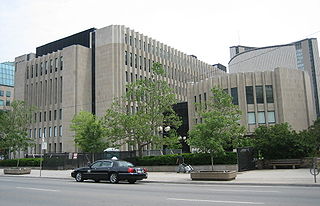
Superior Court of Justice building on University Avenue in Toronto (formerly the York County Court House).
… the very idea of addressing a social problem by gathering quantitative information is so un-Canadian as to seem radical and startling. It certainly seemed that way to the lawyers and civil libertarians who freaked out at Ford’s mention of “accountability” for judges who fail to protect the public from criminal predators.
Judicial independence is an axiom of our constitution — but to the degree that judges become policymakers, which is perpetually increasing as they discover creative new applications of the Charter, their lack of oversight by elected legislators and by the voting public is also a serious and obvious problem, purely in principle. It is no wonder the legal guild takes fright at the notion of “accountability” if it is interpreted to mean that judges might be subject to enforceable performance measures or firing by a minister.
But, of course, the word “account” is visible in there, and measurement of a social crisis is necessary to establish that one exists, even if almost everybody believes it to exist. Our courts are the first to castigate a government that makes some legislative change affecting individual rights without an attempt at inquiry into its reasonability and urgency. Ford, in proposing to establish the dimensions of preventable re-offending, is doing exactly what a legislator hoping to reduce crime ought to do: gather numbers. Collect and publish information. And let us specify that we mean publish publish, in an open, dependable, accessible way, with maximum detail.
Frankly, Ford’s announcement seems as much as anything like a reaction to being backed into a corner by an unresponsive Liberal government, which controls bail policy and the content of the Criminal Code, and by judges, whose irrational bail and sentencing decisions flood what’s left of our news media. Provincial politicians are bound to be judged by voters on the perceived prevalence of crime, but about all they can actually do about it is to, well, buy more choppers for the coppers and start collecting local data about revolving-door justice.
Update: Fixed broken link.
August 12, 2024
“Premier Doug Ford’s plans for the demon liquor will lead us all to untold poverty and perdition”
In the National Post, Chris Selley points and laughs at the classist viewing-with-alarm and frenzied pearl-clutching over the impending rule change that will allow wine and beer to be sold (and even served) in convenience stores like the 7-Eleven chain:
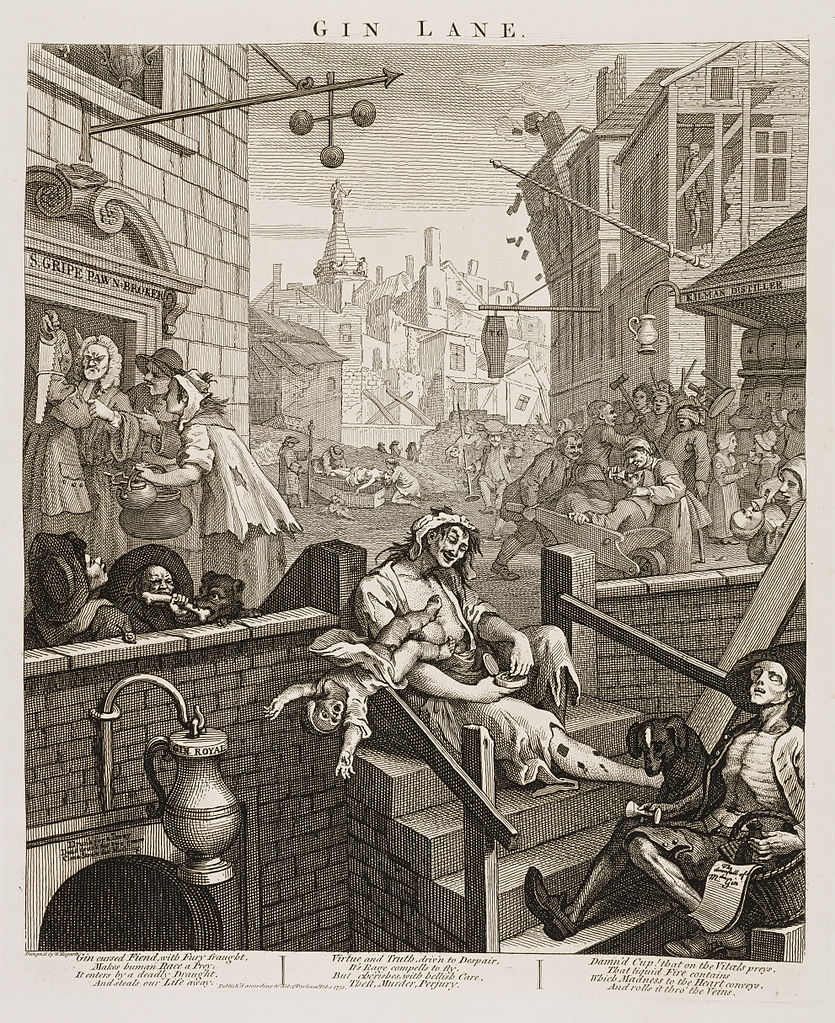
The plight of poverty-stricken Ontarians, forced to get drunk at their local 7-Eleven dive bar.
Gin Lane, from Beer Street and Gin Lane via Wikimedia Commons.
Ontario politics in recent weeks has played out as something like a real-time satire of itself, with the Latent Methodist Brigade still insisting Premier Doug Ford’s plans for the demon liquor will lead us all to untold poverty and perdition. The news this week has only made them more upset: Japanese convenience store empire 7-Eleven will open licensed areas in 58 of its 59 stores in Ontario, in which you can enjoy an alcoholic drink with your hot dog, nachos or chicken nuggets. The company says it’ll add 60 jobs.
Fifty-eight is not a large number, you will agree, in a province with many thousands of licensed premises, any of which might get you drunk and send you back out to your car or boat (though of course they shouldn’t). Some of those thousands of licensed premises are even attached to gas stations, I can report. And many gas-station convenience stores in Ontario sell beer, wine and liquor as independently run “LCBO agency stores”.
For the record, 7-Eleven announced they were doing this way back in December 2022. Pro-forma neo-puritan controversy ensued, and quickly died down. Two 7-Elevens already operate as licensed restaurants in Ontario, apparently without incident, along with 19 in Alberta. (Unfortunately, bien-pensant Ontarians are trained from birth to believe Alberta’s liquor-retail reforms in the 1990s were a grotesque misadventure that everyone there regrets.)
Nevertheless, the same pro-forma neo-puritan freakout is playing out again.
“Let me get this straight. 7-Eleven locations where people fuel up their cars will now allow folks to drink on the premises? What could possibly go wrong?” sneered JP Hornick, president of the Ontario Public Service Employees’ Union (OPSEU), who was last seen dragging LCBO employees into a disastrous tantrum-cum-strike over expanding retail access.
“We need a government that will focus on real things including bringing down hospital wait times, fixing schools and tackling the housing crisis as their signature achievements, amongst many more,” Toronto Coun. Josh Matlow correctly averred on Twitter … and then, as is the fashion here, went full non-sequitur: “Doug Ford made sure we could drink coolers inside a 7-Eleven.” As if the government decided it could only pick one.
(And can I just say here, any Toronto city councillor complaining about another politician’s lack of “signature achievements” is on bloody thin ice.)
Every fully paid-up member of the Laurentian Elite [Spit!] believes with all their flinty hearts that Alberta is a barren wasteland of ruined lives thanks to the demon liquor being sold in corner stores. Initial issues from a generation ago are firmly ensconced as “the way it is” with liberalized booze access out there in the wild west.
August 11, 2024
Canada’s long-standing issues with national defence won’t be fixed by merely spending more money
In The Line, Greg Quinn explains why meeting the 2% of GDP NATO target for military spending isn’t going to solve Canada’s problems with the military:
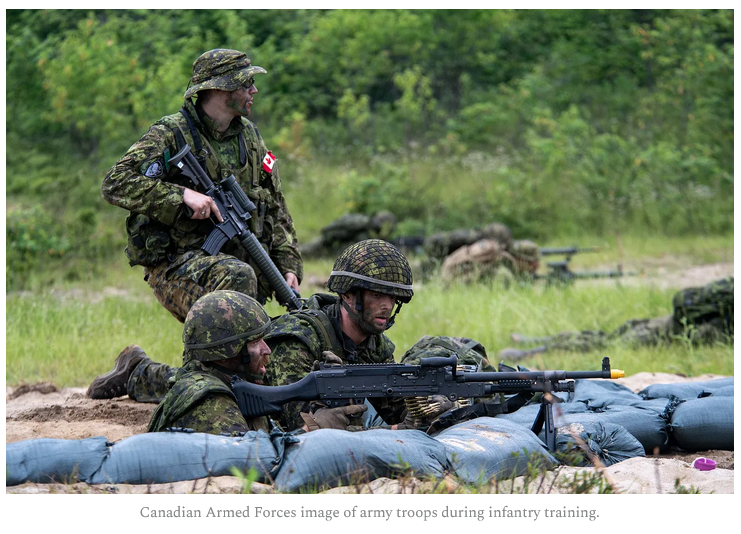
Canada isn’t pulling its weight on defence. Is that what Canadians want? Because it isn’t what its allies want. And the allies are more and more willing to say so.
Canada, and Prime Minister Justin Trudeau, likes to talk about how the country punches above its weight in NATO and global affairs more generally. It’s a cliché many countries have resorted to when put under pressure on one issue or another. (And I’ll confess that this includes my own United Kingdom, which I served as a diplomat for decades before my recent retirement.)
It’s also smoke and mirrors, which in Canada’s case on defence, hides an unhappy truth — Canada doesn’t pay its way.
Trudeau says Canada will meet the target of spending two per cent of GDP on defence in 2032. Some 18 years after NATO committed to it. At the moment Canada spends a paltry 1.37 per cent, or some $33.8 billion a year, on defence, damn near the bottom among the allies, in percentage terms. Ottawa claims this will increase to 1.76 per cent, or $49.5 billion, by 2030. If so, that will move Canada up a whopping two places to 25th.
Mind you, the Parliamentary Budget Office disputes even this, stating that Canada’s defence spending will peak at 1.49 per cent of GDP in 2025-26 before dropping (yes, dropping) to 1.42 per cent in 2029-30. Somebody is being economical with the truth.
[…]
The bottom line is simple — what does Canada (and the Canadian people) want its role in the world to be? Words are easy but they need to be backed by action. One of the most obvious demonstrations of action is spending on a defence force that is capable of deploying and acting on the global stage. More bluntly, of fighting and defeating a near-peer enemy as part of a coalition of allies.
If Canada doesn’t want to do that and prefers a defence force that is essentially a glorified local militia that focuses on domestic issues, well, fine. But let’s not pretend it is anything else. Let’s not talk about how much of a force for good Canada is in the world and let’s not try and fool Canada’s allies. They’re not as stupid as Canadian politicians want them to be.
And let’s not expect those allies to happily accept the situation and continue on as if nothing has changed. Canada already complains about being left out of AUKUS. Is it any wonder? More of that should be expected. If you don’t play the game and don’t pull your weight, then sadly, you don’t get the benefits of being in the grown-ups’ club.
Canadians owe themselves, and frankly owe their allies, an honest discussion about kind of role Canada actually wants to play in the world … and whether they’re willing to actually pay the bills required to play that role. Only after such an honest chat can Canadians, and their allies, calibrate their expectations accordingly.
August 10, 2024
The GTA job situation is dire, yet the government keeps allowing special permits to bring in foreign workers
I try not to moan about my work situation here on the blog … nobody comes here for that … but despite my decades of experience in my technical field, it’s been a very long time since I had an interview (I’m ashamed to admit how long), despite all the jobs I’ve applied for. I have several strikes against me, of course, in that I’m an older slightly disabled white male, but it’s not just about me: Canadian employers in the Greater Toronto Area are still getting special permits to bring in foreign workers despite the huge numbers of un- and under-employed Canadian citizens and permanent residents in the GTA:
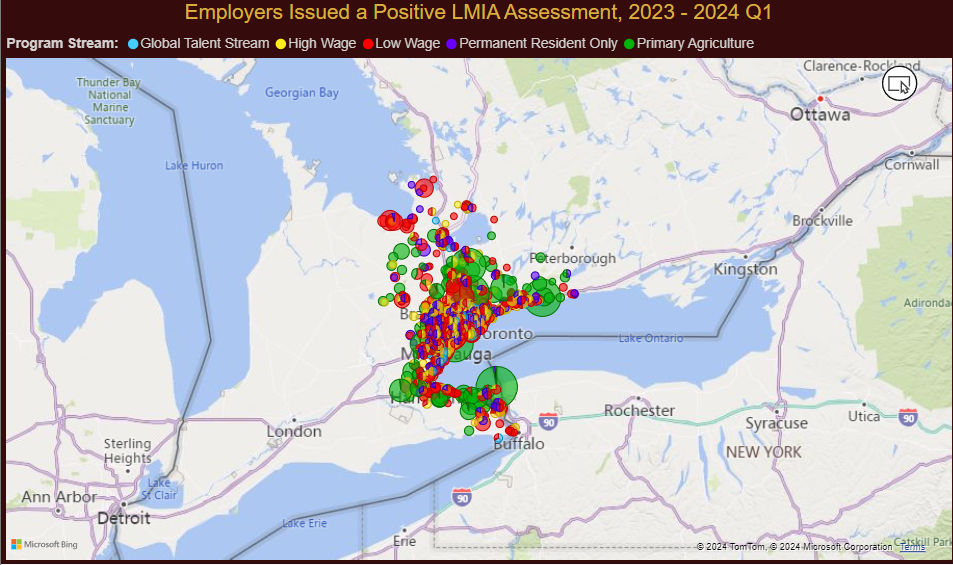
With job fair lineups regularly snaking around blocks and experienced professionals unable to secure roles despite applying to hundreds of them, it’s safe to say the job market is pretty terrifying right now for anyone looking for any type of work in the Toronto area.
Population growth has been outpacing employment gains, pushing the city’s unemployment rate to a dismal 7.4 per cent earlier this year (compared to Canada’s 5.8 per cent). So, it’s no wonder that residents are concerned to find how many local businesses are outsourcing labour to foreign workers.
A user-created map shared to Reddit last week shows which employers in the GTA have applied to hire overseas personnel via Labour Market Impact Assessments from 2023 on, which are supposed to be used only when there is “a need for a foreign worker to fill the job [because] no Canadian worker or permanent resident is available to do the job.”
While it seems like the above would be a rare exception given the current work crisis, the map shows quite the opposite: a shocking number of firms trying to use LMIAs to hire thousands of staffers, from food service and retail workers to engineering technicians and administrative assistants.
The data used is from Canada’s Open Government Portal, the page explains, adding that “there have also been instances where employers have illegally sold their approved LMIA positions to workers.”
The post has tacked up thousands of upvotes and a robust discussion of hundreds of comments, almost all from people who are angry and confused about why so many places are actively trying to recruit — and in many cases, successfully recruiting — people from outside of the country when so many here are desperately seeking jobs.
August 9, 2024
Domicidal maniacs in charge
Lorenzo Warby provides an oh-so-useful word to accurately capture what the diversity-at-all-costs elites running most western countries these days are actually up to:
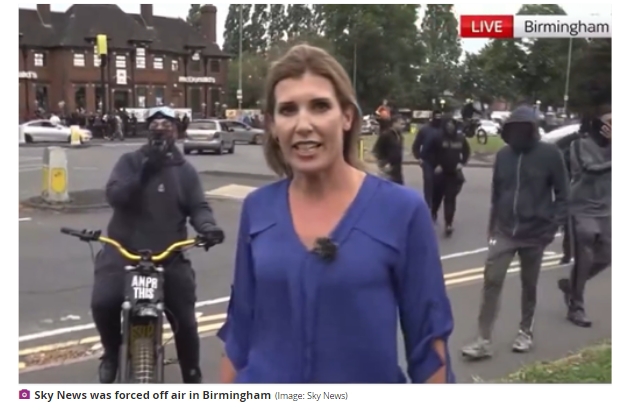
Domicide is the destruction of home. It comes in the “hard” version — the physical destruction of houses and infrastructure.
Domicide also comes in a “soft” version — flooding localities with new people, separating people from, and otherwise degrading, their heritage. When folk say Britain is becoming “unrecognisable”, it is the domicidal effect of mass migration they are referring to.
The UK is suffering from a domicidal elite, one that uses mass migration to break up working-class communities; asymmetric multiculturalism to elevate incoming cultures over those of native English (the Celtic fringe get minority brownie points); favours non-“white” faces in advertising; asymmetric race-swapping in entertainment against the native English; denigration of British history as racist, white supremacist, imperialist, colonialist, etc.
Much of this is insulting virtue-signalling allied to, or presenting, cartoonish (simplified) and caricature (distorted) history. It all undermines social cohesion. But it is the use of migration policy as a systematic weapon against the resident working class which does the most damage. Though two-tier policing — obviously treating Muslims in particular with a deference not shown to the natives, especially when it comes to policing speech — is also highly corrosive of social cohesion.
Many working-class communities in Britain were already fairly dysfunctional — though the British state is not innocent in those dysfunctions1 — and sections of the British working class are very far from admirable. None of this justifies the use of mass migration to make things worse for such folk, however much it may help to explain the moralised class contempt that underlies so much of modern progressivism and modern managerialism.
To improve such things, to “level up”, requires a strong sense of how to create and maintain social order. Modern progressivism is strongly antipathetic to such understanding. To “level up” also requires a strong sense of custodianship, which managerialism typically lacks: particularly progressivist managerialism.
Indeed, modern feminist, progressivist, managerialism—in its lack of custodianship; lack of social solidarity;2 in its antipathy to taking the problems of social order seriously — is running the British state into the ground. The post-medieval British aristocratic and mercantile elite did a much better job of state management. But those elites had mechanisms — such as duelling, that forced men to defend their reputation at the risk of their life, and grand country houses, that turned into expensive investments in social isolation if you behaved badly — that selected for character.
Nowadays, the British elite only selects for capacity and even that is being degraded by DEI undermining the signals of competence. It turns out, over the longer term, character matters more than capacity. For capacity without character selects for manipulative, anti-social personalities that degrade institutions over time.
1. For a particularly brutal depiction in fiction of the dysfunctional British welfare state — especially its school system — see Christopher Nuttall’s Mystic Albion series, especially the first book.
2. Feminisation of institutions and discourse has tended to degrade social solidarity, see Benenson et al, 2009. The most conspicuous example of this in the UK is how uncouth it is in elite circles to mention the systematic rape and sexual exploitation of underage working class girls by overwhelmingly Muslim gangs.
August 4, 2024
QotD: Canada’s “middle class”
Class is everywhere in this election, invoked seemingly every time someone wants to put a sympathetic face on a policy proposal or make a point about being in touch with ordinary Canadians.
There’s the “middle class” that’s constantly prioritized, flattered and fetishized by every campaign and candidate; critiques of people who come from such a privileged class they can’t possibly understand the concerns of normal people; sometimes bizarre pitches aimed at those who want a better future for their kids and just need a boost (camping, anyone?); and leaders who come from hardscrabble backgrounds — except that maybe they don’t quite.
But if class is an ever-present anthem running through campaign 2019, it’s a tune no one seems to know the proper words to, or they’re deliberately mumbling nonsense lyrics and assuming no one else will notice.
[…]
Then there is the electorally beloved — and conveniently poorly defined — “middle class”. Given all the campaign trail hot air devoted to lauding the values and hard work of this population and lionizing their noble struggles, you would think that at some point, other corners of the electorate would get ticked off about being ignored by politicians in favour of these golden children.
But they don’t, because pretty much everyone thinks that’s them.
Shannon Proudfoot, “The ‘family shame’ of Canadian politics: class struggle”, Maclean’s, 2019-10-04.
August 2, 2024
Trudeau won’t – can’t – go voluntarily
In The Line, Michael Den Tandt explains why the Biden option isn’t a viable one for Justin Trudeau at this stage of the Canadian electoral cycle:
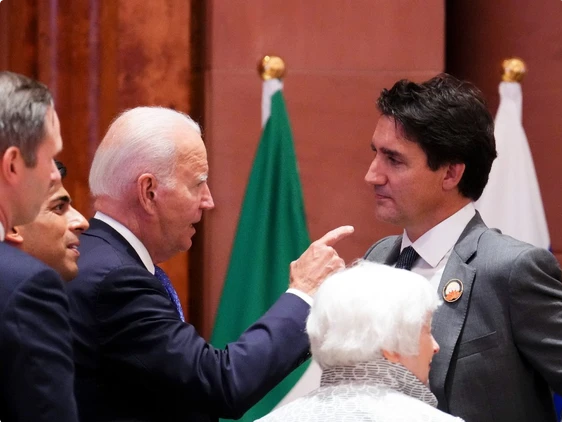
US President Joe Biden talks to Canadian Prime Minister Justin Trudeau, March 2023.
It’s a tough time to be a backbench Liberal MP in Canada, yes? The tone, emerging in anonymous leaks to reporters, is grumpy, surly, unhappy. This is unsurprising. We’re in year ten of a ten-year political cycle that feels stretched and road-beaten, by any standard.
Plus, to our south, there’s this shining model now of the transformative power of change. One day President Joe Biden is clinging by his fingernails to his party’s nomination, with the convicted felon Donald Trump seemingly headed for a big win in November. The next, Biden’s out, new hope Kamala Harris is raising tens of millions in campaign donations, and reporters are lasering in on Trump’s highly quotable running mate, J.D. Vance.
All in a week. So, couldn’t something similar happen in Ottawa? Couldn’t Prime Minister Justin Trudeau take a step back, hit the beach or the lecture circuit, make way for fresh blood, and at least give the Liberals a shot at survival in 2025? What’s he waiting for?
Anything is possible. But this scenario is unlikely. That’s because Justin Trudeau isn’t Joe Biden; Chrystia Freeland isn’t Kamala Harris, and Canada isn’t the United States.
Most obviously, the cycle: The cycle is everything. Individuals are all but powerless in its clutches. As it nears a decade it adds lead weights, like those a deep-sea diver might wear, to the feet of Canadian incumbents. Even the most promising of change agents — former prime minister and justice minister Kim Campbell is Exhibit A — will be brought low by its power.
The argument can be made made that the Progressive Conservative party’s obliteration in 1993 (reduced from majority status to two seats) was not just due to late-cycle fatigue, that Campbell herself had run a wobbly campaign. Some will note the deep weariness with the constitutional wrangling that dominated Canadian discourse during the Brian Mulroney years, or the hangover of Mulroney’s, at the time, keen personal unpopularity. Fair points.
But underlying those events was still the implacable cycle — as in 2006, when prime minister Paul Martin, having seen that Liberal government reduced to a minority in 2004 (despite his personal popularity at the time), lost power to a rising Stephen Harper. In the throes of the federal sponsorship scandal (I will spare you the details, but you can find them here if you’re interested in the arcana), Martin was described by gifted wordsmith Scott Reid, then his communications director, as “the wire brush” who would scrape away the stain of sponsorship. It was a bold attempt to rhetorically seize the change wave. But the wave was strong and Martin lost.
August 1, 2024
The Rarest 1911: North American Arms Co
Forgotten Weapons
Published Apr 22, 2024In the summer of 1918, the US government wanted to increase production of M1911 pistols, but all current manufacturers were working at capacity. So they looked to issue new contracts, and someone realized that the Ross rifle factory was a potential option. Now, the Ross Rifle Company was bankrupt by this time, and its factory lay essentially abandoned. So in June of 1918, two Canadian lawyers by the names of James Denison and Edmond Ryckman incorporated the North American Arms Company Ltd in Quebec, signed a contract to manufacture 500,000 1911 pistols for the US, and then leased the Ross factory for a term of 18 months. Whether they would have been successful in producing pistols at scale is unknown, because their contract was cancelled on December 4, 1918 before any deliveries were made. With the end of the war, arms requirements plummeted, and pretty much all ongoing weapons contracts were cancelled, not just this one. However, parts for 100 pistols had been produced, and these were assembled and sold commercially after the contract was cancelled.
(more…)
July 31, 2024
The Jasper wildfire – climate change or blatant government incompetence and neglect?
In The Line, Jen Gerson points out that the federal government had been given plenty of warning — literally years — about potentially serious problems near Jasper and had done nothing about them:

When Ken Hodges heard about the devastating wildfire that took out part of the historic mountain town of Jasper this week, he said he was “frustrated”.
“All I could say is that we tried to warn them that it was coming. We told them constantly. It’s not a matter of if, it’s a matter of when.”
The retired forester, along with his colleague Emile Begin, spent years repeatedly warning the parks service, the federal and provincial government, city council, and residents, that mis-management of the forests around Jasper had created a tinderbox that would inevitably spark a massive wildfire.
“I just feel so badly for the people who have lost their homes and their businesses. Could it have been prevented? I don’t know. If they had done everything they could have? Maybe. Something was going to happen over time, so it’s so frustrating and devastating.”
Hodges first spotted the problem almost a decade ago while skiing near Marmot Basin. From his years working in forestry in B.C. — a province that had previously been devastated by both wildfires and infestations of the Mountain Pine Beetle — Hodges was able to identify similar patterns of decay in the forests in Alberta.
“It was a hillside on the way up to Marmot that I looked up and thought ‘holy crap. The Mountain Pine Beetle is here.'” His experience told him exactly what would follow — fire.
Not just any fire. “It’s the intensity and the ferocity of the fire that can cause the problem. With climate change, that exacerbates the situation as well.”
Eventually Hodges connected with Begin. The two men between them had 40 years of experience in forestry in B.C. and Alberta, respectively. They feared the Parks service was not prepared for what the men had seen in B.C. — and told them so. Repeatedly. Vociferously. They also sent letters of warning to several ministers; they met with the local municipality. They were interviewed by the CBC for a story that was headlined “Jasper National Park not prepared for potential forest fire ‘catastrophe’, researchers say“.
That was in 2018.
Also in 2018, the pair issued an open letter that read: “The potential for a huge fire or mega fire is real. Fires of this type and magnitude generally occur in mid August to early September. With climate change it may occur earlier.”
The response?
“They just wrote us off,” Hodges told The Line this week.


