
The skepticism I’m now developing about ascriptions of racism in pulp fiction really began, I think, when I learned that it had become fashionable to denigrate Rudyard Kipling’s Kim and other India stories as racist. This is clearly sloppy thinking at work. Kim was deeply respectful of its non-European characters, especially the Pathan swashbuckler Mahbub Ali and Teshoo Lama. Indeed, the wisdom and compassion of Kipling’s lama impressed me so greatly as a child that I think it founded my lifelong interest in and sympathy with Buddhism.
But I didn’t begin thinking really critically about race in pulp fiction until I read Tarzan and the Castaways a few years ago and noticed something curious about the way Burroughs and his characters used the adjective “white” (applied to people). That is: while it appeared on the surface to be a racial distinction, it was actually a culturist one. In Burroughs’s terms of reference (at least as of 1939), “white” is actually code for “civilized”; the distinction between “civilized” and “savage” is actually more important than white/nonwhite, and non-Europeans can become constructively “white” by exhibiting civilized virtues.
Realizing this caused me to review my assumptions about racial attitudes in Burroughs’s time. I found myself asking whether the use of “white” as code for “civilized” was prejudice or pragmatism. Because there was this about Burrough’s European characters: (1) in their normal environments, the correlation between “civilized” and “white” would have been pretty strong, and (2) none of them seemed to have any trouble treating nonwhite but civilized characters with respect. In fact, in Burroughs’s fiction, fair dealing with characters who are black, brown, green, red, or gorilla-furred is the most consistent virtue of the white gentleman.
I concluded that, given the information available to a typical European in 1939, it might very well be that using “white” as code for “civilized” was pragmatically reasonable, and that the reflex we have today of ascribing all racially-correlated labels to actually racist beliefs is actually unfair to Burroughs and his characters!
Eric S. Raymond, “Reading racism into pulp fiction”, Armed and Dangerous, 2010-01-18.
April 9, 2017
QotD: Re-assessing the pulp era’s racism
April 6, 2017
American “isolationism” between the wars
Reason‘s Jesse Walker linked to this article by Andrew Bacevich which helps to debunk the routine description of US foreign policy between the first and second world wars as “isolationism”:
… McCain is worried about the direction of world events, with Russian provocations offering but one concern among many. Patterson shares McCain’s apprehensions, compounded by what he sees as a revival of “the isolationism in Europe and America that precipitated World War II.”
Now as an explanation for the origins of the war of 1939-1945, American “isolationism” is as familiar as the sweet-and-sour pork featured at your local Chinese takeout joint. Its authenticity is equally dubious. Yet Patterson’s assertion has this virtue: It captures in less than a sentence a prime obstacle to instituting a realistic, fact-based approach to foreign policy.
In truth, isolationism is to history what fake news is to journalism. The oft-repeated claim that in the 1920s and 1930s the United States raised the drawbridges, stuck its head in the sand, and turned its back on the world is not only misleading, but also unhelpful. Citing a penchant for isolationism as a defect afflicting the American character is like suggesting that members of Congress suffer from a lack of self-esteem. The charge just doesn’t square with the facts, no matter how often repeated.
Here, by way of illustrating some of those relevant facts, is a partial list of places beyond the boundaries of North America, where the United States stationed military forces during the interval between the two world wars: China, the Philippines, Guam, Hawaii, Panama, Cuba, and Puerto Rico. That’s not counting the U.S. Marine occupations of Nicaragua, Haiti, and the Dominican Republic during a portion of this period. Choose whatever term you like to describe the U.S military posture during this era — incoherent comes to mind — but isolationism doesn’t fill the bill.
As for Patterson’s suggestion that the behavior of the United States “precipitated” World War II, the claim is simply laughable. World War I precipitated World War II, or more specifically the European malaise resulting from the bloodletting of 1914-1918, compounded by the Bolshevik Revolution and the spread of fascism, and further exacerbated by profoundly shortsighted policies pursued by Great Britain and France. Throw into the mix the Great Depression, Japanese imperial ambitions, and the diabolical plotting of Adolf Hitler and his henchmen, and you have the makings of a catastrophe. Some few observers foresaw that catastrophe, but preventing it lay well beyond the ability of the United States, even if U.S. leaders had been clairvoyant.
April 1, 2017
South Korean Thunder for Finland
Last month, Strategy Page reported on a recent deal for Finland to purchase a number of K-9 “Thunder” 155mm self-propelled guns from South Korea:

South Korean K-9 Thunder 155mm self-propelled gun (via Wikimedia)
Finland has ordered 48 South Korean K-9 “Thunder” 155 mm self-propelled howitzers for about $3.3 million each. This price includes training, spare parts, maintenance and howitzer modernization to Finland standards (installation of Finnish made communication equipment and battle management system). The contract also includes an option for additional K-9s. Deliveries begin by the end of 2017 and all 48 vehicles should arrive to Finland till 2024. Nearby Estonia will now be able to get valuable advice from Finland to determine if Estonia should go forward with a similar purchase of twelve K-9s.
In 2016 the Finns began negotiating the K-9 purchase terms with South Korea because the Finns had determined that the K-9 was the least expensive option to obtain modern self-propelled howitzers that could be easily handled by the conscripts Finland still depends on for most of their military manpower. By the end of 2016 the Finns had confirmed this with field trials of the K-9 which as expected, performed better than competitors.
K-9 is a South Korean designed and manufactured self-propelled howitzer which was developed as a replacement for the K55 (license variant of M109). K-9 is a 48 ton self-propelled howitzer operated by a crew of five and using a NATO standard 155mm gun which can take out targets 40 kilometers away. Development of the K-9 began in 1989 and mass production began in 1999.
March 30, 2017
Another Japanese “destroyer” joins the fleet
Due to a long-standing aversion to calling certain kinds of vessels by their most appropriate name, the Japanese Maritime Self-Defence Force (because Japan’s constitution prohibits the country having a “navy”, post-1945) commissioned their latest “destroyer” last week:
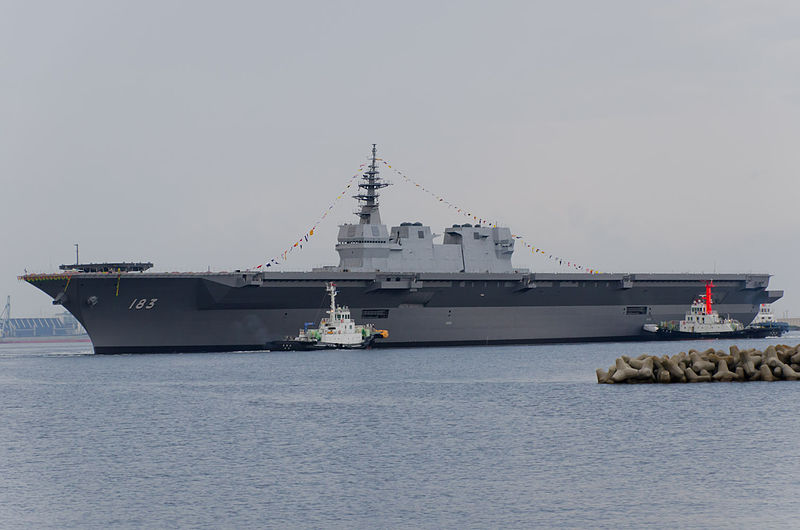
JS Izumo DDH-183, sister-ship of the just-commisioned JS Kaga DDH-184, both helicopter-equipped destroyers, officially.
I know what you’re thinking … “That doesn’t look like a destroyer to me” … but that’s what Japan officially designates ships like this to be, so that’s what they’re called. Strategy Page has more:
On March 22nd Japan put into service a second 27,000 ton “destroyer” (the Kaga, DDH 184) that looks exactly like an aircraft carrier. Actually it looks like an LPH (Landing Platform Helicopter) an amphibious ship type that first appeared in the 1950s. This was noted when Izumo, the first Japanese LPH was launched in 2012 (it entered service in 2015). The Izumos can carry up to 28 aircraft and are armed only with two 20mm Phalanx anti-missile cannon and launcher with sixteen ESSM missiles for anti-missile defense.
LPHs had no (or relatively few) landing craft but did carry a thousand or more troops who were moved ashore using the dozen or more helicopters carried. The first American LPH (the USS Iwo Jima) was an 18,400 ton ship that entered service in 1961, and carried 2,000 troops and twenty-five helicopters. Until Izumo showed up, several nations operated LPHs, and Britain and South Korea still do. The U.S. retired its last LPHs in the 1990s, but still have a dozen similar ships that include landing craft (and a well deck in the rear to float them out of) as well as helicopters. A few other nations have small carriers that mostly operate helicopters but carry few, if any troops.
The Izumos are the largest LPHs to ever to enter service. It differs from previous LPHs in not having accommodations for lots of troops and having more powerful engines (capable of destroyer-like speeds of over fifty-four kilometers an hour). Izumo does have considerable cargo capacity, which is intended for moving disaster relief supplies quickly to where they are needed. Apparently some of these cargo spaces can be converted to berthing spaces for troops, disaster relief personnel, or people rescued from disasters. There are also more medical facilities than one would expect for a ship of this size. More worrisome (to the Chinese) is the fact that the Izumo could carry and operate the vertical take-off F-35B stealth fighter, although Japan has made no mention of buying that aircraft or modifying the LPH flight decks to handle the very high temperatures generated by the F-35B when taking off or landing vertically. The Chinese are also upset with the name of this new destroyer. Izumo was the name of a Japanese cruiser that was a third the size of the new “destroyer” and led the naval portion of a 1937 operation against Shanghai that left over two-hundred-thousand Chinese dead. The Chinese remember all this, especially the war with Japan that began unofficially in 1931 and officially in 1937.
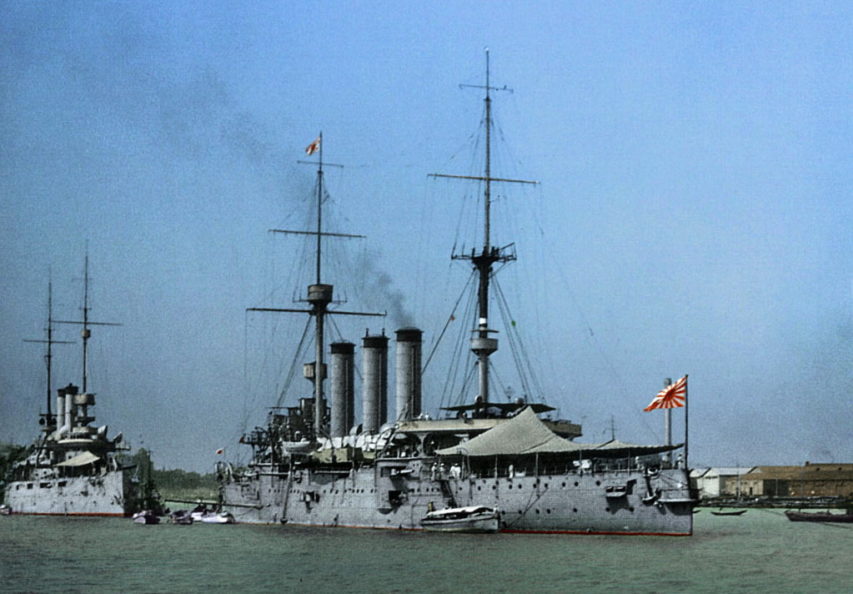
IJNS Izumo at anchor 1932 (Colourized), via Wikimedia
How Germany’s Victories weakened the Japanese in World War 2
Published on 24 Mar 2017
This video gives you a short glimpse on how the war in Europe had a detrimental effect on the Japanese Economy.
Military History Visualized provides a series of short narrative and visual presentations like documentaries based on academic literature or sometimes primary sources. Videos are intended as introduction to military history, but also contain a lot of details for history buffs. Since the aim is to keep the episodes short and comprehensive some details are often cut.
March 29, 2017
You can’t really understand history without considering the geography
At Samizdata, Brian Micklethwait discusses Tim Marshall’s book, Prisoners of Geography:
Britain and Western Europe, and then the other parts of the world where English is the dominant language, have mostly been blessed with a degree of geographically conferred freedom of manoeuvre that is denied to the inhabitants of pretty much all other nations. That is why these places got rich first. And it also now means that we Euros and Anglos are able to believe, as a matter of practical political policy rather than merely as privately pious aspiration, in a wide range of idealistic things of very variable value – things like freedom, democracy, equality, human rights, freedom for women, “social justice”. and so on and so forth – things that geographically more constrained people can only, as yet, dream of, and which they often regard as more as a threat to their own ways of doing things than as any kind of promise.
[…]
The word “maps” being in its subtitle, along with the bombastic claim that these maps tell you all you need to know about the world, these maps ought to be really, really well done, from the graphic point of view. But to my admittedly fading eye, they seemed to be not that good. On their own, they tell you nothing like everything about the world, which is why you actually need to read the book to get the points of all the maps. I was particularly disappointed by how the mountains look in these maps. Along with rivers, mountains are a big deal in this book, as you would expect them to be. But, in these maps, the mountains often scarcely register. It doesn’t help that the maps are done only with black ink on white paper. Colour would have helped. But even black ink could have been used, I feel, with somewhat greater clarity. I had to look quite hard to work out where these various mountains were. But, as I say, maybe that’s just me. My eyesight is definitely not what it was.
The mountainous insight I recall with particular pleasure is Marshall’s observation that the hostility between India and China would have been and would now be far greater, were it not for the most impenetrably formidable mountains on earth being at the boundary between these two civilisations. Contrast those impenetrable Asian mountains with that famous gap in the mountains in northern Europe, which results in a gigantic military parade ground with no natural barriers stretching from the Pyrenees to the Urals.
In addition to knowing better about Europe’s mountains, I now sort of know a whole lot more than I did about the mountains of South America. South America is, for me, one of the less fascinating places in the world, because, being so geographically cut off from the rest of the world and being of significance mostly only to their northern neighbours, South American mistakes count for a lot less than mistakes can elsewhere, especially mistakes made by the USA and Europe of course. South America, you might say, is basically just a big clutch of European mistakes.
Speaking of European mistakes, Marshall is very good on the habit of late nineteenth century Europeans of drawing straight lines upon maps of foreign parts, in defiance of geographical and consequent social and cultural and now “national” realities on the ground. The USA gets along fine despite all the straight lines that it contains dividing its states, because these states are, fundamentally, still very united, at least in the sense that everyone in them is quarrelling about the same things within the same political institutions. But the Middle East is still trying to shake free of its baleful legacy of fake states, which Europeans and now also Americans, all motivated by the need for oil, have expended so much of their own treasure and so much Middle Eastern blood trying to keep in being.
March 21, 2017
The “happiest” country in the world?
Julie Burchill on the topic of happiness:
When we are stroppy teens, we often declare mulishly that we’d rather have an interesting life than a happy one, seeing cheeriness as something suspiciously shallow. Each time we hear the vulgar street exhortation “Cheer up, it might never happen!” we dig our dismayed heels in further. But before we know it, we’ve gone from exquisitely doomed youth to grumbling old git. Look at poor Morrissey! Like Maoism and love bites, miserabilism only looks good on the young.
The country with the best “happiness equality” in the world is Bhutan, the United Nations tells us. I’m not sure how happy I’d be in a country where homosexuality is illegal, where abortions are so hard to get that many women have to cross into India to find even a backstreet termination and where citizens married to foreigners are not permitted to hold civil service positions. Is it just because Bhutan is so cut off that no one knows any better?
The position of those on the left when it comes to immigration is strangely inconsistent. On the one hand, they like to present England as a joyless hellhole (which I always think says far more about them and their joyless mates than the country I’ve had such a smashing time in during my long, lush life): on the other hand, they want everyone to come here. Is this what the young people call “humblebrag”, perchance?
March 16, 2017
Origins of the Silk Road
I’ve been quietly fascinated by the ancient Silk Road trading route spanning from the Middle East to China since I first heard about it as a kid. (The most recent book I read on the topic, Foreign Devils on the Silk Road, blended bits of the history of the route with the activities of European spies in the area preceding the start of the First World War.) At Ars Technica, Annalee Newitz summarizes some recent work in Nature that pushes back the origins of the Silk Road more than two millennia:
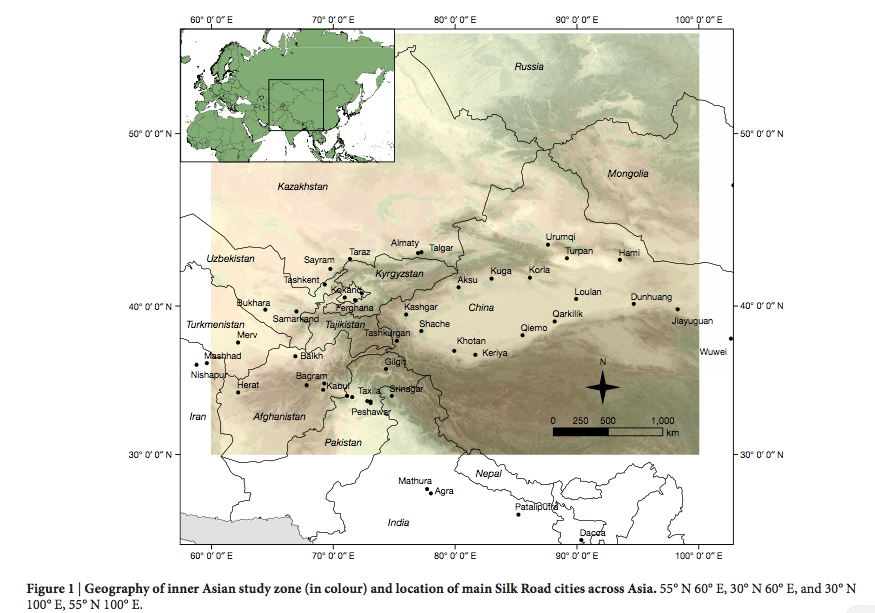
The Silk Road was a series of ancient trading routes that spanned Asia, reaching as far as the Middle East and Europe. Self-organizing and vast, it fell under the control of various empires — but never for long. The polyglot civilizations of traders who lived along its routes are the subject of legends, and more recently the Silk Road lent its name to an infamous darknet market. Historians usually date the Silk Road from roughly the 200s to the 1400s. But a new study in Nature suggests the trade routes may be 2,500 years older than previously believed and its origins much humbler than the rich cities it spawned.
Historical accounts of the Silk Road begin in China in the 100s, when the Han Dynasty used its many routes to trade with the peoples of Central and South Asia. Han soldiers protected the roads and maintained regular outposts on them, allowing wealth and knowledge to flow across the continent. Monks wandering the Silk Road brought Buddhism from India to China, while merchants brought spices, gems, textiles, books, horses, and other valuables from one part of the continent to the other. Great Silk Road cities such as Chang’an (today called Xi’an) and Samarkand grew fat on wealth from the routes that passed outside their walls.
But Washington University in St. Louis anthropologist Michael Frachetti and his colleagues wondered how people traversed the many difficult stretches of the Silk Road that switchbacked through the mountains of Central Asia. Even though these routes weren’t urban or under the protection of soldiers, people used them all the time to pass between Asia and the Middle East. We can see where these travelers camped at over 600 archaeological sites in the mountains. Writing in Nature, Frachetti and his colleagues describe how they had to devise a new approach to track the routes people took between these camps.
The problem was that previous scholars assumed people took routes that resembled what a “least cost” algorithm would draw — essentially the easiest path. This is “largely effective in lowland zones where economic networks and mobility between urban centers are consistent with ease of travel,” the researchers write in their paper. But those algorithms won’t work in the mountains, on uneven terrain that was often barren.
NHK and CCTV did a 12-part documentary on the Silk Road, with beautiful theme music by Kitaro:
Published on 18 Sep 2013
Camels plodding across the desert, and a sense of timelessness evoked by Kitaro’s theme music… NHK devoted 17 years to the planning, shooting and production of The Silk Road, which unearthed trade routes linking long-lost civilizations of East and West. A landmark in broadcasting history, this series told the story of the rise and fall of ancient civilizations.
The NHK Tokushu and China’s CCTV documentary series The Silk Road began on April 7, 1980. The program started with the memorable scene of a camel caravan crossing the desert against the setting sun, with Kitaro’s music and a sense of timelessness. It was the start of an epic televisual poem.The first journey described in the series began in Chang’an (now Xi’an), at the eastern end of the ancient route. On 450,000 feet of film, the NHK crew recorded the path westward to the Pamir Heights at the Pakistan border and this material was edited to make 12 monthly broadcasts. In response to viewers’ requests that the series be extended to cover the Silk Road all the way to Rome, sequels were made over the next 10 years. Seventeen years after the program was conceived, the project was completed.
1) The Glories of Ancient Chang-An
Chang-An – China’s old center. The journey begins from Chang-An, current Xi-an that was more than 1,000 years a capital in China, and the melting pot of international influences.
March 14, 2017
British India During World War 1 I THE GREAT WAR Special
Published on 13 Mar 2017
India was part of the British Empire during World War 1 and it was of vital importance to the war effort. Resources, manufacturing power and over 1.3 million men that served in the Army meant a great price for India to pay during the war. But even before the conflict, the call for independence grew louder and louder.
March 1, 2017
The different “flavours” of propaganda
Cory Doctorow on the various types of propaganda in use around the world:
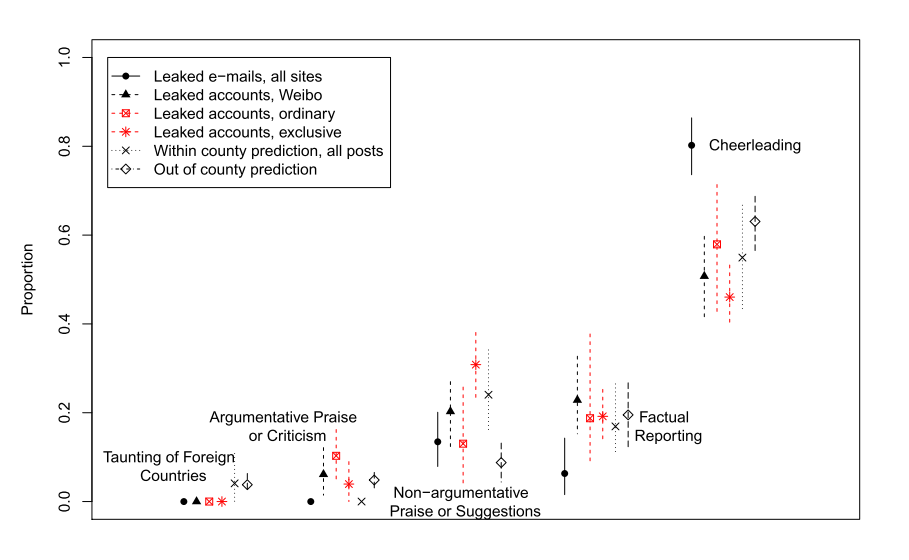
Jonathan Stray summarizes three different strains of propaganda, analyzing why they work, and suggesting counter-tactics: in Russia, it’s about flooding the channel with a mix of lies and truth, crowding out other stories; in China, it’s about suffocating arguments with happy-talk distractions, and for trolls like Milo Yiannopoulos, it’s weaponizing hate, outraging people so they spread your message to the small, diffused minority of broken people who welcome your message and would otherwise be uneconomical to reach.
Stray cites some of the same sources I’ve written about here: Tucker Max’s analysis of Yiannopoulos’s weaponized hate and The Harvard Institute for Quantitative Science team’s first-of-its kind analysis of leaked messages directing the activities of the “50-cent army, which overwhelms online Chinese conversation with upbeat cheerleading (think of Animal Farm‘s sheep-bleating, or Nineteen Eighty-Four‘s quackspeak).
But I’d never encountered the work he references on Russian propaganda, by RAND scholar Christopher Paul, who calls Russian disinformation a “firehose of falsehood.” This tactic involves having huge numbers of channels at your disposal: fake and real social media accounts, tactical leaks to journalists, state media channels like RT, which are able to convey narrative at higher volume than the counternarrative, which becomes compelling just by dint of being everywhere (“quantity does indeed have a quality all its own”).
Mixing outright lies with a large dollop of truth is key to this tactic, as it surrounds the lies with a penumbra of truthfulness. This is a time-honored tactic, of course: think of the Christian Science Monitor‘s history of outstanding international coverage, accompanied by editorials about God’s ability to heal through prayer; or Voice of America‘s mixture of excellent reporting on (again) international politics and glaring silence on US crises (see also: Al Jazeera as a reliable source on everything except corruption in the UAE; the BBC World Service‘s top-notch journalism on everything except UK complicity in disasters like the Gulf War, etc).
In addition to this excellent taxonomy of propaganda, Stray proposes countermeasures for each strain: for Russia-style “firehoses of falsehood,” you have to reach the audience first with an alternative narrative; once the firehose is on, it’s too late. For Chinese quackspeak floods, you need “organized, visible resistance” in the streets. For pathetic attention-whores like Yiannopoulos, Stray says Tucker Max is right: you have to ignore him.
February 26, 2017
British History’s Biggest Fibs with Lucy Worsley Episode 3: The Jewel in the Crown
Published on 10 Feb 2017
In the final episode, Lucy debunks the fibs that surround the ‘jewel in the crown’ of the British Empire – India. Travelling to Kolkata, she investigates how the Raj was created following a British government coup in 1858. After snatching control from the discredited East India Company, the new regime presented itself as a new kind of caring, sharing imperialism with Queen Victoria as its maternal Empress.
Tyranny, greed and exploitation were to be things of the past. From the ‘black hole of Calcutta’ to the Indian ‘mutiny’, from East India Company governance to crown rule, and from Queen Victoria to Empress of India, Lucy reveals how this chapter of British history is another carefully edited narrative that’s full of fibs.
QotD: Tibetan cuisine
… even in Parkdale we have good restaurants. There are now seven Tibetan chop shops (yak stops?) along Queen Street. I think this qualifies us to be called “Little Tibet,” and get special street signs from the the municipal multicultural patronizing bureaucracy. Though when I accompanied an excessively white friend into one such establishment, he was filled with anxiety. “I sure hope the food isn’t authentic,” he commented.
It was, earlier today, starting with the salted butter tea. Or rather, it wasn’t. Everything tastes different, this close to sea level.
The same remark can be made for chillies, as can be made for wine. Except, chillies often grow well in the mountains. But this depends on the mountain face, in relation to the sun’s course; on the soils, and temperatures; on the rains in their seasons; on luck, and the art of the chilli farmer. Gentle reader will guess I am about to pump Tibetan Tiger Chillies.
Now, Tibet is no country to grow chillies, overall. Some katabasis is usually required. Go south, down the mountains, perhaps to Bengal; then east, to the hills behind Chittagong; or into the lower hills of Assam; and there, I solemnly believe, you will find the finest chillies in the world. The Naga Morich, grown there, have been attempted elsewhere, always with dispiriting results. The conditions can be reproduced artificially, and hybridizations can be tried to square the circle, as it were. Some gentleman in England topped the Scoville table, a few years ago, by triangulating from the Naga Morich, the Bhut Jolokia (or, “ghost pepper,” closely related), and the Trinidad Moruga (or, “butch scorpion,” with linguistic variants). But the hybrid was unstable and he lost the competition the next year.
I love very hot chillies, and those above 1,000,000 Scoville units are much appreciated. (The hottest Habaneros get only half way there.) But I also love chillies, in themselves, and this includes quite mild ones. You see, as chilli-haters refuse to be taught, there is more to them than capsaicin. Even the heat is produced by compounds: the scientists, always counting, don’t know where to start. The customer who wants only pain can hit 16,000,000 with the synthetic chemical in its wax form. … Go ahead. … I’ll watch.
A Canadian (white) may say, “How can you taste your food with all those chillies?” There is no polite answer to this. It’s a typically Canadian passive-aggressive stance: to ask the unanswerable question. You just have to shoot them.
David Warren, “Elevated Discourse”, Essays in Idleness, 2015-06-11.
February 13, 2017
“[M]ost of what journalists know about radioactivity came from watching Godzilla“
Charlie Martin explains why the “news” out of Fukushima lately has been mostly unscientific hyperventilation and bloviation:
On February 8, Adam Housley of Fox News reported a story with a terrifying headline: “Radiation at Japan’s Fukushima Reactor Is Now at ‘Unimaginable’ Levels.” Let’s just pick up the most exciting paragraphs:
The radiation levels at Japan’s crippled Fukushima nuclear power plant are now at “unimaginable” levels.
[Housley] said the radiation levels — as high as 530 sieverts per hour — are now the highest they’ve been since 2011 when a tsunami hit the coastal reactor.
“To put this in very simple terms. Four sieverts can kill a handful of people,” he explained.
The degree to which this story is misleading is amazing, but to explain it, we need a little bit of a tutorial.
The Touhoku earthquake and tsunami on March 11, 2011, along with all the other damage they caused, knocked out the TEPCO Fukushima Daiichi (“plant #1”) and Daini (“plant #2”) reactors. Basically, the two reactors were hit with a 1000-year earthquake and a 1000-year tsunami, and the plants as built weren’t able to handle it.
Both reactors failed, and after a sequence of unfortunate events, melted down. I wrote quite a lot about it at the time; bearing in mind this was early in the story, my article from then has a lot of useful information.
[…]
So what have we learned today?
We learned that inside the reactor containment at Fukushima Daini, site of the post-tsunami reactor accident, it’s very very radioactive. How radioactive? We don’t know, because the dose rate has been reported in inappropriate units — Sieverts are only meaningful if someone is inside the reactor to get dosed.
Then we learned that the Fukushima accident is leaking 300 tons of radioactive water — but until we dig into primary sources, we didn’t learn the radioactive water is very nearly clean enough to be drinking water. So what effect does this have on the ocean, as Housley asks? None.
The third thing we learned — and I think probably the most important thing — is to never trust a journalist writing about anything involving radiation, the metric system, or any arithmetic more challenging than long division.
January 26, 2017
Autarky is not the answer
Warren Meyer on the idiocy of Trump’s economic nationalist notions:
Think about the corollary of Trump’s economic nationalism, particularly if everyone followed this same approach. If one skews all the rules and taxes and prohibitions so everything must be sourced domestically, then if a country does not have some particular resource or skill domestically, it is out of luck. No domestic rare earth metals? Sorry.
But governments and powerful people seldom calmly accept that something they critically need is not available. They will be tempted to go and take it. The worst, most violent empire building of the last 100-150 years has occurred when countries have pursued economic nationalism. Think of the colonialism of the late 19th century. Today we happily trade with South Africa and other countries for valuable resources, but in that time of economic nationalism, if a country wanted access to these resources, it felt it had to control the land and the people. Hitler in the 1930’s wanted to make Germany self-sufficient in agricultural goods and certain other resources, and the only way to do that was to go and grab other people’s land and resources.
The best example of all of this phenomenon is, I think, Japan in the 1930’s. Japan felt that it was resource poor and under Trump’s theory of economic nationalism, it felt it had to control oil and other resources it did not have domestically. So it plotted to go take it. When the US instituted a trade embargo in these very goods to punish Japan’s aggressiveness in China, it just accelerated Japan’s thinking in this area, convincing it for good it had to control these resources, and it was soon invading the oil-rich islands of what is now Indonesia. This example is all the more telling because Japan actually found true prosperity after the war when it traded peacefully for these resources. Unfortunately, it adopted economic nationalism, via MITI, of another form and helped manage themselves into a 20-year recession, but that is another trade-related story for another day.
January 1, 2017
QotD: Currency Manipulation
One of the critiques of any trade deal of late is that there should be penalties for countries guilty of “currency manipulation.” The concern is that countries will devalue their currency in an effort to make their own exports cheaper to other nations while making it harder for other countries to export back to them. As an example, if the Chinese were to do something that cuts the value of the Yuan in half vs. the dollar, their products look very cheap to American consumers while American-produced goods suddenly look a lot more expensive to Chinese consumers.
I have two brief responses to this:
- I find it hilarious that anyone in the United States government, which has a Federal Reserve that has added nearly $2 trillion to its balance sheet in the service of cramming down the value of the dollar, can with a straight face accuse other nations of currency manipulation. In practice in today’s QEconomy, currency manipulation means another country is doing exactly what we are doing, but just doing it faster.
- As an American consumer, to such currency manipulation by other countries I say, Bring it On! If China wants to hammer its own citizens with higher prices and lower purchasing power just to subsidize lower prices for me, I am happy to let them do it. Yes, a few specific politically-connected export businesses lose revenues, but trying to prop them up is pure cronyism. Which is one reason I think Elizabeth Warren is a total hypocrite. The constituency of the poor and lower middle class she presumes to speak for are the exact folks who shop at Walmart and need very price break on everyday goods they can get. Senator Warren’s preferences for protectionist trade policies and a weak dollar will hurt these folks the most.
Warren Meyer, “Currency Manipulation”, Coyote Blog, 2015-05-26.


