
Niall Ferguson
Published on Jan 31, 2018Niall Ferguson shows how the vast apparatus of the Chinese state has always been called on to subjugate individual freedom to the higher goal of unity. Ferguson also examines how, on the other hand, centralized control produces tensions that threaten to destroy the country.
February 28, 2018
China: Triumph and Turmoil, Episode 1 – Emperors
Comments Off on China: Triumph and Turmoil, Episode 1 – Emperors
February 26, 2018
Genghis Khan – The Rivalry of Blood Brothers – Extra History – #2
Extra Credits
Published on 24 Feb 2018When Temüjin needed help to find his kidnapped wife, Börte, his blood brother and friend Jamukha came to his aid, and the two eventually combined their camps and families. But peace would not last long…
Comments Off on Genghis Khan – The Rivalry of Blood Brothers – Extra History – #2
India’s largest newspaper on Justin Trudeau’s “disaster visit”
Paul Wells linked to this story in the world’s largest circulation English language newspaper, The Times of India:
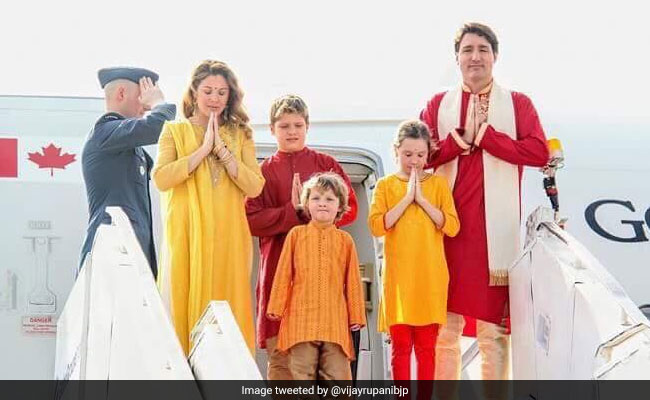
Justin Trudeau and family during India visit
Image via NDTV, originally tweeted by @vijayrupanibjp
Canadian prime minister Justin Trudeau’s visit was a disaster that has little parallel in India’s recent diplomatic history. But as the Canadian prime minister returned home on Saturday after almost a week of recurrent diplomatic missteps, ironically, it may have provided the opportunity to reset relations between Canada and India.
On Saturday, Indian government officials were angry at suggestions by Canadian officials that India was responsible for Khalistani terrorist Jaspal Atwal getting a visa to India and used his presence to embarrass Trudeau.
Trudeau, in his meeting with prime minister Narendra Modi, also complained that his visit had been shadowed by a single issue. Atwal got a visa because he was taken off the blacklist some years ago. But he was part of a number of Trudeau’s own events that did not involve the Indian government at all.
A prime ministerial visit to a foreign country for a week with a thin official component is always fraught with danger. In addition, moving the official meetings to the very end of the trip indicated that the government meetings were an after-thought. Most foreign leaders who throw in other events almost always front-load the official meetings, and then go on to business or tourism events.
Here, it was clear from the start that Trudeau came to India to score with his Sikh constituency back home — four out of the six cabinet ministers who travelled with him were Sikh, as were an overwhelming number of MPs who also travelled with him. Until the media barrage in India forced the Canadian side to change tack, Trudeau was not even ready to meet Amarinder Singh, chief minister of Punjab. Even the Canadian high commissioner’s official reception was a celebration of Punjab with the prime minister himself waltzing in on bhangra beats.
Comments Off on India’s largest newspaper on Justin Trudeau’s “disaster visit”
February 25, 2018
Feature History – Russo-Japanese War
Feature History
Published on 28 May 2017Hello and welcome to Feature History, featuring a Russian and Japanese disagreement, and why you don’t record when sick.
Comments Off on Feature History – Russo-Japanese War
February 23, 2018
“…the Trudeaus playing ‘Mr Dressup and Family’ in exotic locations on the taxpayers’ dime isn’t the problem”
The press is having a hard time presenting Justin Trudeau’s India trip in a positive light, which clearly pains the teeny-bopper Trudeau fan club that composes a large part of the Canadian media. Ted Campbell sees the trip as a series of wasted opportunities to begin healing the breach between India and Canada:
I’ve taken my time in commenting on the prime minister’s trip to India. To say that I’m very disappointed is to put it mildly … I’m disappointed and a little embarrassed to be a Canadian. But the Trudeaus playing “Mr Dressup and Family” in exotic locations on the taxpayers’ dime isn’t the problem. We have, in fact, a serious problem as far as India is concerned and we, Canada, one of India’s oldest and firmest friends is in danger of being seen as an adversary. That’s a problem and it is, in my mind, a HUGE problem for Canada.
As Vishnu Prakash, former Indian envoy to Canada, told Indian news site The Print on Monday, ““Over the years, the Canadian political establishment, across the spectrum (whether it is the NDP, Conservatives or Liberals) has been mollycoddling Khalistani elements. Under the Trudeau government, this has increased. He had himself appeared on a Khalistani platform in Toronto in April last year.” It, the “mollycoddling Khalistani elements,” has been going on since at least the 1980s, back when Indira Ghandi’s government cracked down (1984) and nearly provoked a civil war and even in 1985 when Air India flight 182 was bombed, almost certainly an attack organized by Canadians, in Canada, as retaliation. Then the governments of the day spent 20 years and over $100 million on an investigation that retired Supreme Court Justice John Major described as a “cascading series of errors” by the government, writ large, including, especially, the RCMP and CSIS. India was not impressed.
India was less impressed when Canadian political parties began to actively court the Canadian the entire Indo-Canadian community but failed to condemn Sikh separatism. Canadians, including Brian Mulroney, Jean Chrétien, Stephen Harper and Justin Trudeau have “explained,” correctly, that people are allowed to support unpopular causes here in Canada, so long as they don’t break our laws, but India, not unreasonably, given Canada’s own history of separatist violence, would like something more. But the Sikh vote is active and “efficient” and all parties want it and that seems, to India, anyway, to mean turning a blind eye to the (disputed)
factassertion that the Khalistan independence movement is centred in and funded from Canada … Prime Minister Trudeau made thing worse, according to The Hindu, when “On April 30, [2017] Mr. Trudeau addressed a parade for ‘Khalsa Day’, which included floats glorifying Sikh militant leaders Jarnail Singh Bhindranwale, Amreek Singh and former General Shahbeg Singh who were killed in the siege of the Golden Temple and Operation Bluestar in June 1984.” That act appears to have crossed a line, leading to what the whole world is now interpreting as a major diplomatic snub […]The big issue is not the rather gentlemanly snub of Justin Trudeau by India’s highest officials; our prime minister appears more interested in having an all expenses paid vacation with his family than in doing the nation’s business in any event; the real issue is the Canadian political actions that made it politically necessary for Prime Minister Modi to administer that snub at all.
What Canada needs to do now is repair relations with India, and that may require Prime Minister Trudeau to look very, very closely at any ties any of his ministers may have with the Khalistan independence movement, he says there are none, and either making them sever all ties with separatists or severing them from the Liberal cabinet, caucus and even the Party. Andrew Scheer needs to do the same with the Conservatives and Jagmeet Singh needs to speak out for national unity ~ if it’s good for Canada then it’s good for India, too. On this issue, at least, politics should indeed, stop at the water’s edge.
Of course, when you allow things like this to happen, diplomacy becomes a much trickier profession than normal:
Sweet Mother of God. No family fashion photoshoot in Hello! magazine is going to fix this one. https://t.co/rLvI7ip8Vh
— Terry Glavin (@TerryGlavin) February 21, 2018
In Britain, the Daily Mail published the comments from a lot of Indians who have been offended by Trudeau’s choices of clothing on the visit so far:
Justin Trudeau has been ridiculed on social media by Indians for his ‘tacky’ and over the top outfit choices while on his first visit to their nation as Prime Minister.
While many praised his clothing during the first two days of his trip, patience was wearing thin by the time he attended a Bollywood gala on Tuesday night, before the tide turned against him on Wednesday.
Ministers, authors, journalists and ordinary Indians lined up to mock him on Wednesday, saying his wardrobe was ‘fake and annoying’.
Perhaps taking note of the criticism, the Canadian leader donned a suit on Thursday as he visited Jama Masjid, one of India’s largest mosques.
Leading the criticism was Omar Abdullah, former chief minister of Jammu and Kashmir, who tweeted on Wednesday saying Trudeau’s preening was ‘all just a bit much.’
‘We Indians do not dress like this every day sir, not even in Bollywood.’
Bhaavna Arora, a bestselling Indian author, also chimed in, accusing Trudeau of wearing ‘fancy dress’ and saying she found it ‘fake and annoying’.
Shekhar Gupta, founder of Indian newspaper The Print also mocked the Canadian Prime Minister, accusing him of ‘running a week-long “election campaign” in India in fancy dress.’
Comments Off on “…the Trudeaus playing ‘Mr Dressup and Family’ in exotic locations on the taxpayers’ dime isn’t the problem”
February 19, 2018
Genghis Khan – Temüjin the Child – Extra History – #1
Extra Credits
Published on 17 Feb 2018As a child, Temüjin was afraid of the world, saddened by its cruelty and an outcast from his own tribe. But his mother, Hoelun, passed on her risk-taking personality to him, a boy who would one day become the famed conqueror Genghis Khan.
Comments Off on Genghis Khan – Temüjin the Child – Extra History – #1
February 17, 2018
How a Concubine became the Empress of China – Wu Zetian l HISTORY OF CHINA
IT’S HISTORY
Published on 5 Aug 2015Wu Zetian was the first and only Empress of China. Skillfully, she worked her way up, entering the imperial court of Emperor Tang Taizong as a concubine. After his death she would marry his son, Emperor Kaozong. Later she would ruthlessly dethrone two of her own sons and take power herself, effectively introducing an interregnum to the Tang dynasty. During her very own Zhou dynasty she was known as a kind and fair ruler and made Buddhism state religion. Learn all about the Biography of one of the most popular and at the same time merciless women in Chinese history in today’s episode of IT’S HISTORY.
Comments Off on How a Concubine became the Empress of China – Wu Zetian l HISTORY OF CHINA
February 15, 2018
HMS Sutherland to conduct Freedom of Navigation exercise (FONOPS) in the South China Sea
Gareth Corfield on the current voyage of the Royal Navy frigate HMS Sutherland (F81):
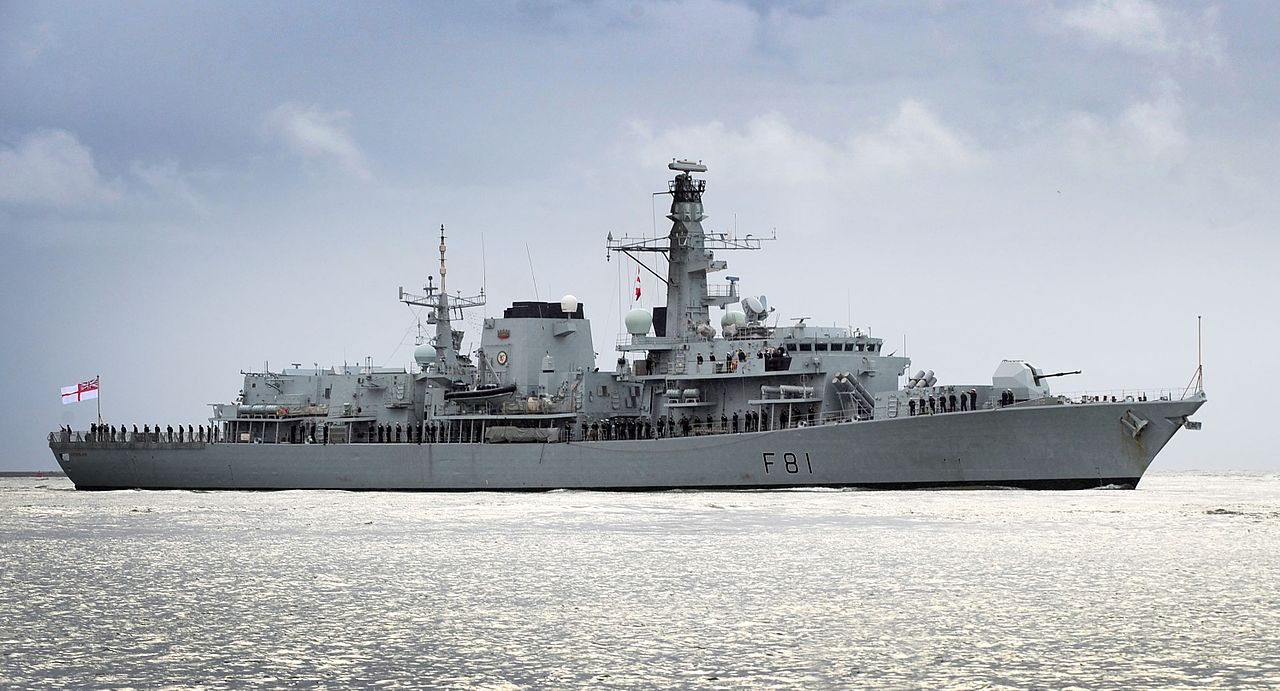
HMS Sutherland (F81), a Type 23 frigate of the Royal Navy
Photo by Vicki Benwell, RN and released by the Ministry of Defence.
A British warship has set sail for the South China Sea, paving the way for aircraft carrier HMS Queen Elizabeth to do the same thing in three years’ time.
HMS Sutherland, a Type 23 frigate, will sail through the disputed region on her way home from Australia, as much to fly the flag in foreign climes as to carry out a dry run ahead of the nation’s flagship doing the same thing in 2021.
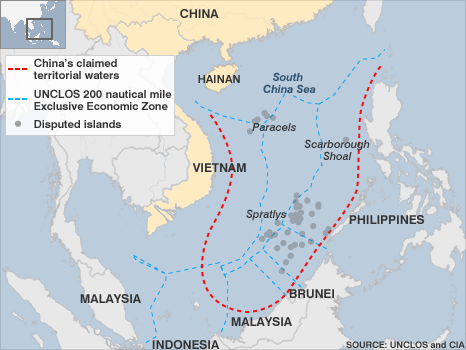
The South China Sea is one of the world’s naval choke points. Very high values of trade (the total value was estimated by the Daily Telegraph as £3.8tn) either originates in or passes through the sea. The region is under dispute chiefly because of China, which is trying to extend its territorial limits (and thus the area it can directly control) by building artificial islands to embiggen its borders.
Sutherland will be carrying out a freedom of navigation exercise, which is where a warship sails through a disputed bit of sea to send the message “you can’t stop us doing this”. The idea is to reinforce the notion that international waters, where anyone has right of free passage, can’t be unilaterally claimed by one country.
Comments Off on HMS Sutherland to conduct Freedom of Navigation exercise (FONOPS) in the South China Sea
February 13, 2018
Feature History – Seven Years’ War
Feature History
Published on 14 Jan 2017Hello and welcome to Feature History, featuring the Seven Years’ War, an overdue video, and the reason you don’t record after just waking up
Comments Off on Feature History – Seven Years’ War
QotD: Mark Twain on Indian weather
I believe that in India ‘cold weather’ is merely a conventional phrase and has come into use through the necessity of having some way to distinguish between weather which will melt a brass door-knob and weather which will only make it mushy.
Mark Twain, Following the Equator: A Journey Around the World, 1897.
Comments Off on QotD: Mark Twain on Indian weather
January 30, 2018
The Three Teachings – Taoism, Buddhism, Confucianism l HISTORY OF CHINA
IT’S HISTORY
Published on 1 Aug 2015The Three Teachings Taoism, Buddhism and Confucianism have been a backbone of Chinese society and culture since the bronze age. The Three teachings are still intertwined strongly with today’s China. There are different interpretations to China’s chore faiths. Over time, different dynasties favoured different faiths, if only to define themselves against their predecessor. Ultimately though, its all about the philosophy of combining spirituality with every day life. All about the Three Teachings now on IT’S HISTORY.
Comments Off on The Three Teachings – Taoism, Buddhism, Confucianism l HISTORY OF CHINA
January 29, 2018
Cheng I Sao – Pirate Queen – Extra History
Extra Credits
Published on 27 Jan 2018She was the most ferocious pirate China had ever known. She was a powerful fleet commander, a sharp businesswoman, and a consummate strategist. She was Cheng I Sao, leader of the Pirate Confederation, and she lived her life on her terms.
Comments Off on Cheng I Sao – Pirate Queen – Extra History
January 24, 2018
January 21, 2018
Sun Tzu – The Art of War l HISTORY OF CHINA
IT’S HISTORY
Published on 8 Aug 2015Sun Tzu’s The Art of War is a book on military strategies written around 500 BC, between the collapse of the Zhou dynasty and the rise of the first emperor of imperial China. Today Tzu’s guidelines are still as applicable as ever. They are still being read by military commanders, politicians and businesspeople all over the world. Also known as “Master Sun’s Military Methods”, the book explains basics like the “Strategy of Attack”, “Moving the Army” and even “Employing Spies” in 13 short chapters, restricting itself to general principles rather than detailed instructions of strategy and tactics. Learn all about this timeless and influential military masterpiece on IT’S HISTORY.
Comments Off on Sun Tzu – The Art of War l HISTORY OF CHINA
January 14, 2018
POWs in Japan – Great War Remembrance – Marasesti I OUT OF THE TRENCHES
The Great War
Published on 13 Jan 2018Ask your questions here: http://outofthetrenches.thegreatwar.tv
In today’s episode, Indy answers questions about the state of the prisoner of war camps in Japan, the ways in which WW1 is remembered in Germany and the food shortages in the Ottoman Empire, plus he takes a closer look at the Battle of Marasesti.
Comments Off on POWs in Japan – Great War Remembrance – Marasesti I OUT OF THE TRENCHES


