Forgotten Weapons
Published 24 Dec 2022After (formally) joining World War Two in the wake of Pearl Harbor, the United States endured a series of defeats at the hands of the Japanese. The Philippines garrison fell, Wake Island fell, Guam fell. British possessions in Southeast Asia teetered and fell as well — the campaign was not going well for the Allies.
The first American offensive of the war would come on August 7th, 1942 with the landing of the 1st and 5th Marines at Red Beach on Guadalcanal. Part of a multi-prong assault (the nearby Japanese bases on Tulagi and Gavutu/Tanambogo were also captured at the same time), the attack on Guadalcanal was made to secure the airstrip under Japanese construction there. If the island became an operational Japanese air base, Allied supply shipping to Australia would come under threat, and this could imperil the whole area of operations.
Fortunately for the Marines, US intelligence massively overestimated the Japanese force on Guadalcanal. It was in fact only a few hundred infantry, leading a work force of about 3,000 laborers (mostly Koreans). They thought the US landings were just a small raid, and dispersed into the jungle to wait for the US departure. Instead, the Marines were there to take the airfield and hold it. They were not, however, very well prepared. The Navy suffered a massive defeat in the waters off Guadalcanal the very next night, and would pull out of the area August 9th, leaving the Marines with dangerously low supplies of food, ammunition, and other essentials.
(more…)
April 18, 2023
Guadalcanal’s Red Beach Landing: America’s First Offensive in WW2
April 16, 2023
4,000 German teens trapped in Tarnopol – WW2 – Week 242 – April 15, 1944
World War Two
Published 15 Apr 2023Thousands of German soldiers, mostly new teenage recruits, are obeying Hitler’s “Fortress Directive” and are surrounded in Tarnopol; it does not go well for them. German forces in Ukraine manage to all pull back across the Dniester, but they are under serious pressure in the Crimea. Meanwhile, in India, the Japanese siege of Kohima continues, and in China they are poised to launch a gigantic offensive.
(more…)
April 15, 2023
Type 68 North Korean Tokarev/High Power Hybrid
Forgotten Weapons
Published 18 May 2020The Type 68 is a North Korean hybrid of the Tokarev and the High Power, used as a military service pistol until replaced by the Beak-Du-San copy of the CZ75. The general outline of the gun is a copy of the Tokarev, with a modular removable fire control group, lack of manual safety, and tall thin sights. It is chambered for 7.62x25mm, and uses a magazine identical to the standard Tokarev except for not having a magazine catch cut, as the Type 68 has a heel magazine release.
Internally, the High Power elements include a detent-retained barrel pin, use of a solid barrel cam instead of a 1911/Tokarev swinging link, and a fixed barrel bushing. Two patterns of markings exist, one with a date and North Korean marking, and one (like this example) with only a serial number.
North Korean guns of all types are very rare in the United States. A very small number of Type 68s have come into the US, generally through Central America (probably via Cuba) and South Africa (via Rhodesia/Zimbabwe).
Update: It appears that the original design work for these was done by an independent engineering firm in Yugoslavia. The design (a TT33 with High Power type locking and angled slide serrations) was not completed in time for the trials that would lead to adoption of the Yugoslav M57, and the drawings were transferred to “another country” — probably North Korea.
(more…)
April 14, 2023
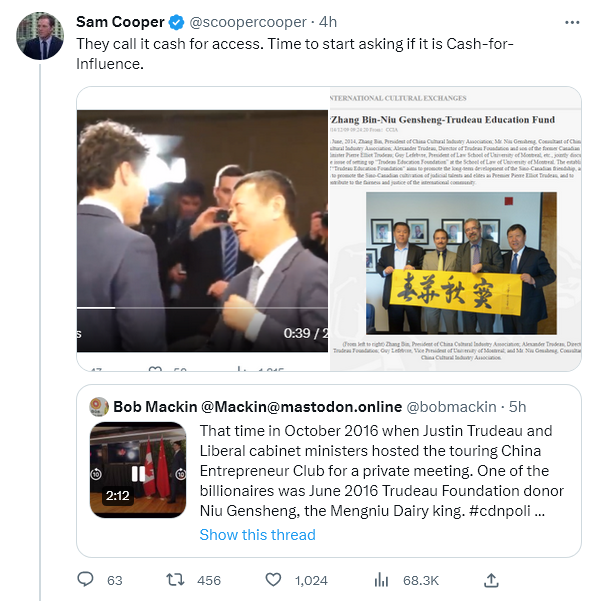
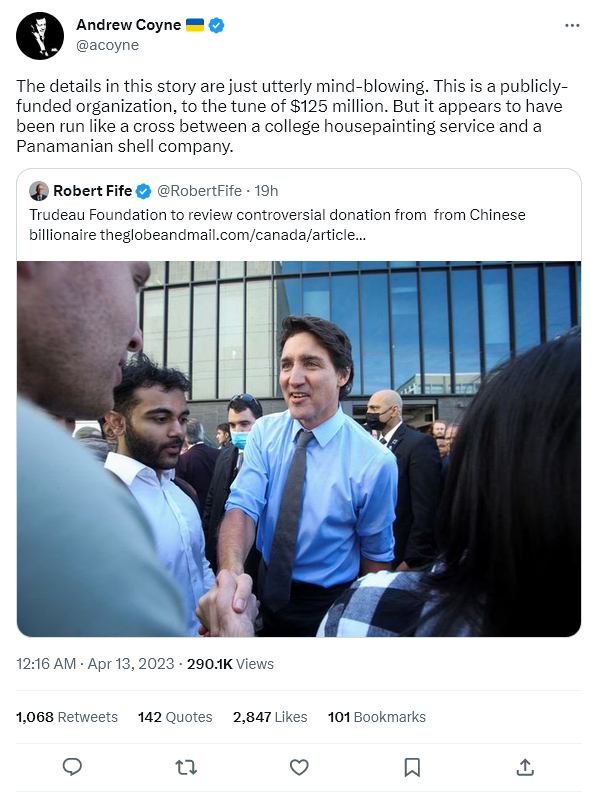
From “cash for access” it’s a very short step to “cash for influence”
Ted Campbell shut down his blog some time ago — unfortunately for those of us interested in Canadian military affairs — but he’s still active on Twitter. Here he responds to a tweet from Sam Cooper of Global News:
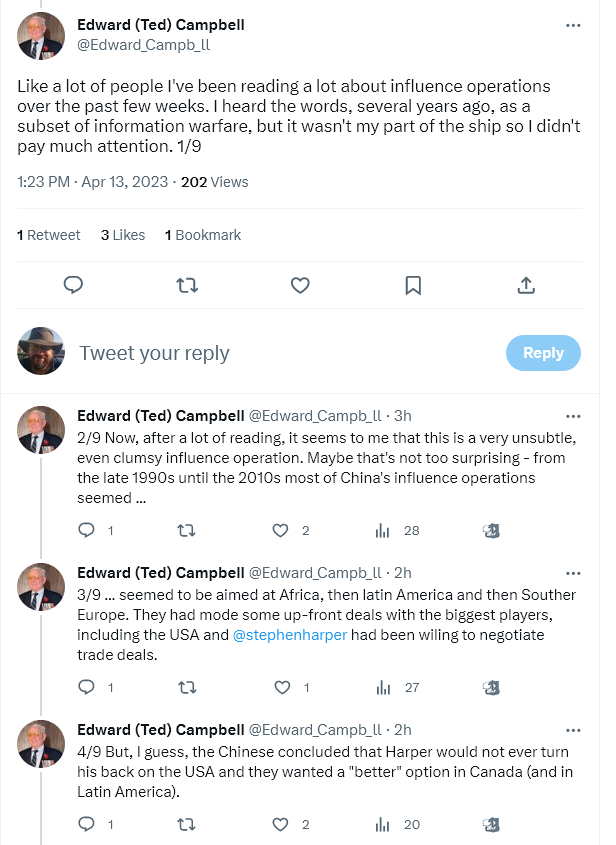
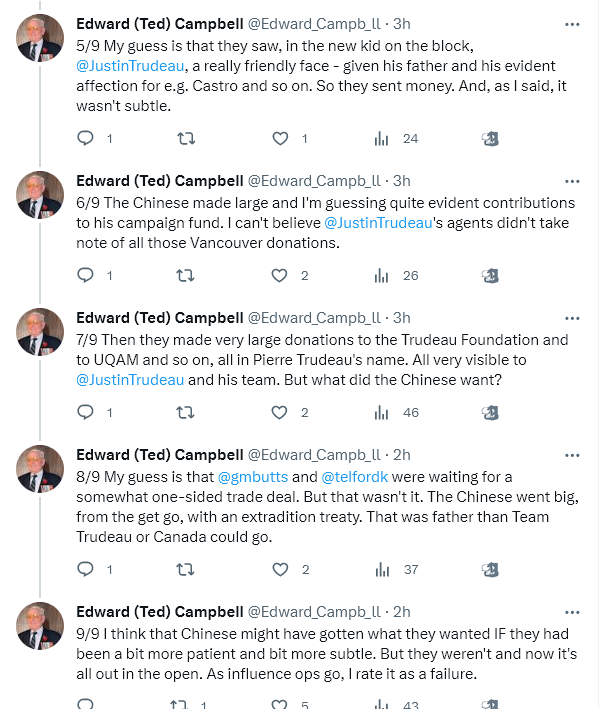
Andrew Coyne highlights some of the boggling details in this thread:
QotD: The three great strategic sins
The first sin is the sin of of not having a strategy in the first place, what we might call “emotive” strategy. As Clausewitz notes, policy (again, note above how what we’re calling strategy is closest to policy in Clausewitz’ sense) is “subject to reason alone” whereas the “primordial violence, hatred and enmity” is provided for in another part of the trinity (“will” or “passion”). To replace policy with passion is to invert their proper relationship and court destruction.
The second sin is the elevation of operational concerns over strategic ones, the usurpation of strategy with operations, which we have discussed before. This is, by the by, also an error in managing the relationship of the trinity, allowing the general’s role in managing friction to usurp the state’s role in managing politics.
Perhaps the greatest example of this is the Japanese attack on Pearl Harbor; an operational consideration (the destruction of the US Pacific Fleet) and even the tactics necessary to achieve that operational objective, were elevated above the strategic consideration of “should Japan, in the midst of an endless, probably unwinnable war against a third-rate power (the Republic of China) also go to war with a first-rate power (the United States) in order to free up oil-supplies for the first war”. Hara Tadaichi’s pithy summary is always worth quoting, “We won a great tactical victory at Pearl Harbor and thereby lost the war.”
How does this error happen? It tends to come from two main sources. First, it usually occurs most dramatically in military systems where the military leadership – which has been trained for operations and tactics, not strategy, which you will recall is the province of kings, ministers and presidents – usurps the leadership of the state. Second, it tends to occur when those military leaders – influenced by their operational training – take the operational conditions of their planning as assumed constants. “What do we do if we go to war with the United States” becomes “What do we do when we go to war with the United States” which elides out the strategic question “should we go to war with the United States?” entirely – and catastrophically, as for Imperial Japan, the answer to that unasked question of should we do this was clearly Oh my, NO.
(Bibliography note: It would hardly be fitting for me to declare these errors common and not provide examples. Two of the best case-studies I have read in this kind of strategic-thinking-failure-as-organizational-culture-failure are I. Hull, Absolute Destruction: Military Culture and the Practices of War in Imperial Germany (2005) and Parshall and Tully, Shattered Sword: The Untold Story of the Battle of Midway (2005). Also worth checking out, Daddis, “Chasing the Austerlitz Ideal: The Enduring Quest for Decisive Battle” in Armed Forces Journal (2006): 38-41. The same themes naturally come up in Daddis, Withdrawal: Reassessing America’s Final Years in Vietnam (2017)).
The third and final sin is easy to understand: a failure to update the strategy as conditions change. Quite often this happens in conjunction with the second sin, as once those operational concerns take over the place of strategy, it becomes difficult for leaders to consider new strategy as opposed to simply new operations in the pursuit of strategic goals which are often already lost beyond all retrieval. But this can happen without a subordination failure, due to sunk-costs and the different incentives faced by the state and its leaders. The classic example being functionally every major power in the First World War: by 1915 or 1916, it ought to have been obvious that no gains made as a result of the war could possibly be worth its continuance. Yet it was continued, both because having lost so much it seemed wrong to give up without “victory” and also because, for the politicians who had initially supported the war, to admit it was a useless waste was political suicide.
Bret Devereaux, “Collections: The Battle of Helm’s Deep, Part VIII: The Mind of Saruman”, A Collection of Unmitigated Pedantry, 2020-06-19.
April 9, 2023
New Offensive in the Crimea – WW2 – Week 241 – April 8, 1944
World War Two
Published 8 Apr 2023The Soviets are finally going to try and push the Axis out of Sevastopol and the Crimea. They also continue to drive the Axis back in Transnistria. Over in Burma and Northeastern India, the Japanese have the Allies under siege at not one, but two towns, and are also attacking Imphal from several points, but the Japanese have way bigger future plans up their sleeves in China.
(more…)
April 6, 2023
Japan is weird, example MCMLXIII
John Psmith reviews MITI and the Japanese Miracle by Chalmers Johnson:
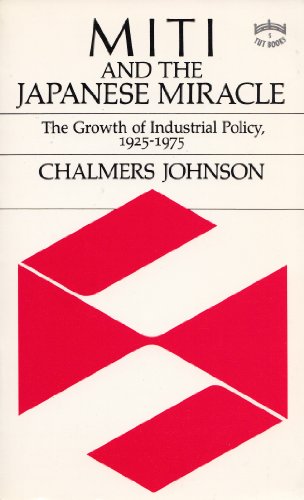
I’ve been interested in East Asian economic planning bureaucracies ever since reading Joe Studwell’s How Asia Works (briefly glossed in my review of Flying Blind). But even among those elite organizations, Japan’s Ministry of International Trade and Industry (MITI) stands out. For starters, Japanese people watch soap operas about the lives of the bureaucrats, and they’re apparently really popular! Not just TV dramas; huge numbers of popular paperback novels are churned out about the men (almost entirely men) who decide what the optimal level of steel production for next year will be. As I understand it, these books are mostly not about economics, and not even about savage interoffice warfare and intraoffice politics, but rather focus on the bureaucrats themselves and their dashing conduct, quick wit, and passionate romances … How did this happen?
It all becomes clearer when you learn that when the Meiji period got rolling, Japan’s rulers had a problem: namely, a vast, unruly army of now-unemployed warrior aristocrats. Samurai demobilization was the hot political problem of the 1870s, and the solution was, well … in many cases it was to give the ex-samurai a sinecure as an economic planning bureaucrat. Since positions in the bureaucracy were often quasi-hereditary, what this means is that in some sense the samurai never really went away, they just hung up their swords — frequently literally hung them up on the walls of their offices — and started attacking the problem of optimal industrial allocation with all the focus and fury that they’d once unleashed on each other. According to Johnson, to this day the internal jargon of many Japanese government agencies is clearly and directly descended from the dialects and battle-codes of the samurai clans that seeded them.
This book is about one such organization, MITI, whose responsibilities originally were limited to wartime rationing and grew to encompass, depending who you ask, the entire functioning of the Japanese government. Because this is the buried lede and the true subject of this book: you thought you were here to read about development economics and a successful implementation of the ideas of Friedrich List, but you’re actually here to read about how the entire modern Japanese political system is a sham. This suggestion is less outrageous than it may sound at first blush. By this point most are familiar with the concept of “managed democracy,” wherein there are notionally competitive popular elections, culminating in the selection of a prime minister or president who’s notionally in charge, but in reality some other locus of power secretly runs things behind the scenes.
There are many flavors of managed democracy. The classic one is the “single-party democracy”, which arises when for whatever reason an electoral constituency becomes uncompetitive and returns the same party to power again and again. Traditional democratic theory holds that in this situation the party will split, or a new party will form which triangulates the electorate in just such a way that the elections are competitive again. But sometimes the dominant party is disciplined enough to prevent schisms and to crush potential rivals before they get started. The key insight is that there’s a natural tipping-point where anybody seeking political change will get a better return from working inside the party than from challenging it. This leads to an interesting situation where political competition remains, but moves up a level in abstraction. Now the only contests that matter are the ones between rival factions of party insiders, or powerful interest groups within the party. The system is still competitive, but it is no longer democratic. This story ought to be familiar to inhabitants of Russia, South Africa, or California.
The trouble with single-party democracies is that it’s pretty clear to everybody what’s going on. Yes, there are still elections happening, there may even be fair elections happening, and inevitably there are journalists who will point to those elections as evidence of the totally-democratic nature of the regime, but nobody is really fooled. The single-party state has a PR problem, and one solution to it is a more postmodern form of managed democracy, the “surface democracy”.
Surface democracies are wildly, raucously competitive. Two or more parties wage an all-out cinematic slugfest over hot-button issues with big, beautiful ratings. There may be a kaleidoscopic cast of quixotic minor parties with unusual obsessions filling the role of comic relief, usually only lasting for a season or two of the hit show Democracy. The spectacle is gripping, everybody is awed by how high the stakes are and agonizes over how to cast their precious vote. Meanwhile, in a bland gray building far away from the action, all of the real decisions are being made by some entirely separate organ of government that rolls onwards largely unaffected by the show.
April 3, 2023
Goodbye Manstein… Hello Model – WW2 – Week 240 – April 1, 1944
World War Two
Published 1 Apr 2023As the Allies prepare to close in on Germany from all fronts, a shake up of the German military leadership can only achieve so much…
(more…)
March 26, 2023
Plandemic? Manufactured crisis? Mass formation psychosis?
In The Conservative Woman, James Delingpole lets his skeptic flag fly:

“Covid 19 Masks” by baldeaglebluff is licensed under CC BY-SA 2.0


Tell me about your personal experiences of Covid 19. Actually, wait, don’t. I think I may have heard it already, about a million times. You lost all sense of smell or taste – and just how weird was that? It floored you for days. It gave you a funny dry cough, the dryness and ticklishness of which was unprecedented in your entire coughing career. You’ve had flu a couple of times and, boy, when you’ve got real flu do you know it. But this definitely wasn’t flu. It was so completely different from anything you’ve ever known, why you wouldn’t be surprised to learn that it had been bioengineered in a lab with all manner of spike proteins and gain-of-function additives, perhaps even up to and including fragments of the Aids virus …
Yeah, right. Forgive me for treading on the sacred, personal domain of your lived experience. But might I cautiously suggest that none of what you went through necessarily validates lab-leak theory. Rather what it may demonstrate is the power of susceptibility, brainwashing and an overactive imagination. You lived – we all did – through a two-year period in which health-suffering anecdotes became valuable currency. Whereas in the years before the “pandemic”, no one had been much interested in the gory details of your nasty cold, suddenly everyone wanted to compare notes to see whether they’d had it as bad as you – or, preferably, for the sake of oneupmanship, even worse. This in turn created a self-reinforcing mechanism of Covid panic escalation: the more everyone talked about it, the more inconvertible the “pandemic” became.
Meanwhile, in the real world, hard evidence – as opposed to anecdotal evidence – for this “pandemic” remained stubbornly non-existent. The clincher for me was a landmark article published in January 2021 by Simon Elmer at his website Architects For Social Housing. It was titled “Lies, Damned Lies and Statistics: Manufacturing the Crisis”.
In it Elmer asked the question every journalist should have asked but which almost none did: is this “pandemic” really as serious as all the experts, and government ministers and media outlets and medics are telling us it is? The answer was a very obvious No. As the Office for National Statistics data cited by Elmer clearly showed, 2020 – Year Zero for supposedly the biggest public health threat since “Spanish Flu” a century earlier – was one of the milder years for death in the lives of most people.
Let’s be clear about this point, because something you often hear people on the sceptical side of the argument say is, “Of course, no one is suggesting that Covid didn’t cause a horrific number of deaths.” But that’s exactly what they should be suggesting: because it’s true. Elmer was quoting the Age Standardised Mortality statistics for England and Wales dating back to 1941. What these show is that in every year up to and including 2008, more people died per head of population than in the deadly Covid outbreak year of 2020. Of the previous 79 years, 2020 had the 12th lowest mortality rate.
Covid, in other words, was a pandemic of the imagination, of anecdote, of emotion rather than of measured ill-health and death. Yet even now, when I draw someone’s attention to that ONS data, I find that the most common response I get is one of denial. That is, when presented with the clearest, most untainted (this was before ONS got politicised and began cooking the books), impossible-to-refute evidence that there was NO Covid pandemic in 2020, most people, even intelligent ones, still choose to go with their feelings rather with the hard data.
This natural tendency many of us have to choose emotive narratives over cool evidence makes us ripe for exploitation by the cynical and unscrupulous. We saw this during the pandemic when the majority fell for the exciting but mendacious story that they were living through a new Great Plague, and that only by observing bizarre rituals – putting strips of cloth over one’s face, dancing round one another in supermarkets, injecting unknown substances into one’s body – could one hope to save oneself and granny. And we’re seeing it now, in a slightly different variant, in which lots of people – even many who ought to know better – are falling for some similarly thrilling but erroneous nonsense about lab-leaked viruses.
It’s such a sexy story that I fell for it myself. In those early days when all the papers were still dutifully trotting out World Health Organisation-approved propaganda about pangolins and bats and the apparently notorious wet market (whatever the hell that is) in Wuhan, I was already well ahead of the game. I knew, I just knew, as all the edgy, fearless seekers of truth did that it was a lab leak wot done it. If you knew where to dig, there was a clear evidence trail to support it.
We edgy, fearless truth seekers knew all the names and facts. Dodgy Peter Daszak of the EcoHealth Alliance was in it up to the neck; so too, obviously, was the loathsomely chipper and smugly deceitful Anthony Fauci. We knew that all this crazy, Frankenvirus research had initially been conducted in Chapel Hill, North Carolina, but had been outsourced to China after President Obama changed the regulations and it became too much of a hot potato for US-based labs. And let’s not forget Ukraine – all those secret bio-research labs run on behalf of the US Deep State, but then exposed as the Russians unhelpfully overran territory such as Mariupol.
Germany Invades Hungary – WW2 – Week 239 – March 25, 1944
World War Two
Published 25 Mar 2023Germany occupies Hungary this week to prevent any possible Hungarian defection from the war, the Soviets continue pushing back the Axis in Ukraine, pressing them ever more toward Romania, the Japanese advance on Imphal and Kohima continues, but Allied attacks in Italy and Japanese ones on Bougainville come to their ends.
(more…)
March 25, 2023
Canada’s ChiCom influence scandal – “All of the damage has been self-inflicted”
The Trudeau government has been expending a lot of time, effort, and political capital trying to avoid an open scandal. So much, so typical. What isn’t typical for the federal Liberals is just how badly they’re going about doing everything all of a sudden:
None of this ought to have been a shock, and none of it needed to put the Prime Minister’s Office in its current state of calcified pickle. After all, rumours and off-the-record chats about this stuff have been going around for literally years.
No, how this crew has chosen to handle these stories at every single step has made the scandal worse for themselves. Every. Single. Step. All of the damage has been self-inflicted.
This government is the epitome of an organization that is tactically smart and strategically dumb. Not only has their damage control mirrored the response of the SNC scandal (that ended so well for them), but every misstep has had the result of slowly backing the prime minister into rhetorical traps he has set for himself. This is a government that knows how to win the daily news cycle by losing the game. One that can’t distinguish between legitimate criticism and bad-faith partisan attack — probably because it is so insular and bunker-bound that it sees the world before it divided between loyalists and blood enemies. It’s symptomatic of leadership that is in its final stages of terminal fatigue, and doesn’t yet realize it. These guys cannot help but win themselves to death.
[…]
Imagine, as more stories hit the wire, the government had skipped all of those unnecessary weeks of obfuscation and deflection and simply appointed a special rapporteur to examine the need for a public inquiry. In this counterfactual, let’s also assume that the person he picked isn’t a long-time personal friend. What if Trudeau took allegations of interference seriously at the outset, and his party avoided stunts like skipping committee meetings and filibustering to prevent the testimony of his chief of staff, Katie Telford?
Where would they be today if they hadn’t squandered every iota of credibility and goodwill with the press, the NDP, and his own intelligence services? To put it more directly, what if they hadn’t spent the past few weeks acting as if they had something to hide?
Would they be better off? Maybe?
As an aside, I notice that many of the Liberal proxies are out in force on social media attacking the media and CSIS in an effort to defend the sitting government. I have to ask: how’s that working for y’all? Are you getting the sense that Global News and Sam Cooper and the Globe and Mail have been successfully cowed? Have their CSIS sources stopped leaking? Has Jagmeet Singh been brought to heel?
I’m going to put something out for consideration: Perhaps the denials, obfuscations and attacks are only making the scandal worse. They’re convincing journalists that there’s a real story here while prompting an already pissy collection of national security sources to leak harder.
Beria’s Reward for Ethnic Cleansing – War Against Humanity 100
World War Two
Published 23 Mar 2023Authoritarian regimes on both sides, in the Soviet Union, Nazi Germany, and Imperialist Japan the terror is once again escalating. The bombing war from both sides see continued death of civilians, while Harris of the RAF, Spaatz of the USAAF, and Supreme Allied Commander Eisenhower are getting into a fight about how the bombers should be used for the upcoming D-Day.
(more…)
March 24, 2023
Only a paper dragon?
In UnHerd, Edward Luttwak suggests that China’s military may be much more apparent than real:
The day after Li Keqiang, China’s departing Prime Minister and the last of Beijing’s moderates, called for more market liberalisation to reach this year’s 5% growth target, Xi Jinping responded by announcing a muscle-flexing 7.2% increase in China’s defence spending. That is certainly consistent with Xi’s truculent stance (he replied to Nancy Pelosi’s recent Taiwan visit with a series of ballistic missile launches), and with his official promise to the Communist Party that China will become the world’s dominant power by 2049. But what do those percentages actually mean?
The declared total of China’s newly increased defence budget at 1.56 trillion yuan amounts to $230 billion, according to the current exchange rate. If that were the case, it would mean that China is falling further behind the United States, whose own fiscal 2023 defence spending is increasing to $797 billion (and actually more, since that figure does not include its funding for military construction or the added help to Ukraine).
China’s own figure is also generally assumed by experts to be greatly understated — not by fiddling the numbers one by one, but rather by wholesale exclusions, such as the attribution of research-and-development spending to civilian budgets. Even if a commando team of elite forensic accountants were sent into action to uncover China’s actual defence spending, with another team dispatched to determine what’s missing from the US budget, we would still only have a very loose indication of how much actual military strength China and the United States hope to add.
But one thing can be said with absolute certainty: each side is adding less than the rising numbers imply.
In China’s case, a manpower shortage undercuts military spending in the PLA’s ground forces and naval forces, and soon it will affect manned air units as well. The PLA ground forces now stand at some 975,000, a very small number for a country that has 13,743 miles of borders with 14 countries — including extreme high-mountain borders where internal combustion engines lose power, jungle-covered borders where remote observation is spoiled by foliage, Russian-river borders with endemic smuggling, and the border with India’s Ladakh where an accumulation of unresolved Chinese intrusions have forced each side to deploy substantial ground forces, with at least 80,000 on the Chinese side.Except for Ladakh, which now resembles a war-front, borders are not supposed to be guarded by army troops but by border police. And China did in fact have a substantial dedicated border force, but it was abolished for the same reason that the PLA ground army is so small: a crippling shortage of physically fit Chinese men willing to serve in these regions. Cities and towns, by contrast, do not seem afflicted by such severe manpower shortages, leading to the weird phenomenon on Nepal’s main border crossing to Tibet where, according to an acquaintance, a group of freezing Cantonese city policemen were checking travellers and “guarding the border”. (They said they had been “volunteered” for two months.)
A very different take on the Wuhan Coronavirus pandemic
At The Conservative Woman, Dr. Mike Yeadon lays out his case for doubting that there ever actually was a novel coronavirus in the first place:

Wuhan Institute of Virology.
Wikimedia Commons.
I’ve grown increasingly frustrated about the way debate is controlled around the topic of origins of the alleged novel virus, SARS-CoV-2, and I have come to disbelieve it’s ever been in circulation, causing massive scale illness and death. Concerningly, almost no one will entertain this possibility, despite the fact that molecular biology is the easiest discipline in which to cheat. That’s because you really cannot do it without computers, and sequencing requires complex algorithms and, importantly, assumptions. Tweaking algorithms and assumptions, you can hugely alter the conclusions.
This raises the question of why there is such an emphasis on the media storm around Fauci, Wuhan and a possible lab escape. After all, the “perpetrators” have significant control over the media. There’s no independent journalism at present. It is not as though they need to embarrass the establishment. I put it to readers that they’ve chosen to do so.
So who do I mean by “they” and “the perpetrators”? There are a number of candidates competing for this position, with their drug company accomplices, several of whom are named in Paula Jardine’s excellent five-part series for TCW, Anatomy of the sinister Covid project. High on the list is the “enabling” World Economic Forum and their many political acolytes including Justin Trudeau and Jacinda Ardern.
But that doesn’t answer the question why are they focusing on the genesis of the virus. In my view, they are doing their darnedest to make sure you regard this event exactly as they want you to. Specifically, that there was a novel virus.
I’m not alone in believing that myself at the beginning of the “pandemic”, but over time I’ve seen sufficient evidence to cast strong doubt on that idea. Additionally, when considered as part of a global coup d’état, I have put myself in the position of the most senior, hidden perpetrators. In a Q&A, they would learn that the effect of a released novel pathogen couldn’t be predicted accurately. It might burn out rapidly. Or it might turn out to be quite a lot more lethal than they’d expected, demolishing advanced civilisations. Those top decision-makers would, I submit, conclude that this natural risk is intolerable to them. They crave total control, and the wide range of possible outcomes from a deliberate release militates against this plan of action: “No, we’re not going to do this. Come back with a plan with very much reduced uncertainty on outcomes.”
The alternative I think they’ve used is to add one more lie to the tall stack of lies which has surrounded this entire affair. This lie is that there has ever been in circulation a novel respiratory virus which, crucially, caused massive-scale illness and deaths. In fact, there hasn’t.
Instead, we have been told there was this frightening, novel pathogen and ramped up the stress-inducing fear porn to 11, and held it there. This fits with cheating about genetic sequences, PCR test protocols (probes, primers, amplification and annealing conditions, cycles), ignoring contaminating genetic materials from not only human and claimed viral sources, but also bacterial and fungal sources. Why for example did they need to insert the sampling sticks right into our sinuses? Was it to maximise non-human genetic sequences?
Notice the soft evidence that our political and cultural leaders, including the late Queen, were happy to meet and greet one another without testing, masking or social distancing. They had no fear. In the scenario above, a few people would have known there was no new hazard in their environment. If there really was a lethal pathogen stalking the land, I don’t believe they’d have had the courage or the need to act nonchalantly and risk exposure to the virus.
Most convincingly for me is the US all-cause mortality (ACM) data by state, sex, age and date of occurrence, as analysed by Denis Rancourt and colleagues. The pattern of increased ACM is inconsistent with the presence of a novel respiratory virus as the main cause.
If I’m correct that there was no novel virus, what a genius move it was to pretend there was! Now they want you only to consider how this “killer virus” got into the human population. Was it a natural emergence (you know, a wild bat bit a pangolin and this ended up being sold at a wet market in Wuhan) or was it hubristically created by a Chinese researcher, enabled along the way by a researcher at the University of North Carolina funded by Fauci, together making an end run around a presidential pause on such work? Then there’s the question as to whether the arrival of the virus in the general public was down to carelessness and a lab leak, or did someone deliberately spread it?
March 22, 2023
A 60 Minutes show on the US Navy that wasn’t a hit piece?
CDR Salamander is pleased at the way the CBS team for 60 Minutes presented their US Navy coverage in a recent show:
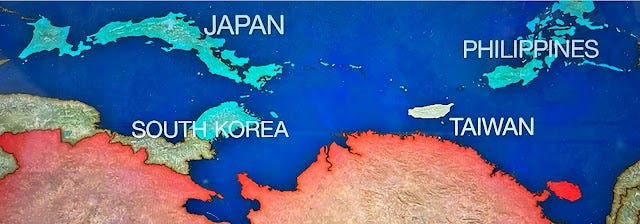
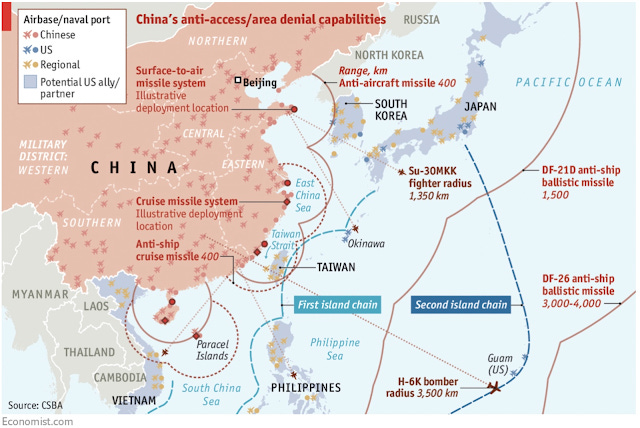
How China views their eastern seaboard in a military sense.
Screencapture detail from 60 Minutes.
A regular topic of conversation here […] is the lack of discussion in the public space about the importance of a strong Navy to our republic’s economic and military security. Sure, inside our salons, slack channels, and email threads we talk to each other a lot, but we seem to have a hard time getting our message out to the general public.
Sunday night’s 60 Minutes was an exception to the rule. There is a lot of credit to go around here. First of all, you have to give credit to the 60 Minutes team fronted by Norah O’Donnell and lead producers Keith Sharman and Roxanne Feitel. This two-segment effort was not just on a topic we all are interested in, it was just plain good journalism.
Sure, I have a nit to pic here and there, but that is just my nature. Perfect? No … but it is one of the best bits of solid, down the middle journalism about our Navy and its challenges I have seen from a major network for a long time.
If you missed it, CBS has published the video and transcript that I’m going to pull some bits from below for conversation.
The second segment was more meatier than the first, but the first is important. It isn’t just where Big Navy got a chance to make a run at media capture with the “C-2 to the Big Deck at sea” show that we all love, but it will introduce many people to someone who is very good at his job and representing the Navy, Admiral Samuel Paparo, USN.
He gets your attention early by, even though clearly well prepared and sticking to scripted talking points and marketing pitches here and there of questionable utility, he also spoke in blunt terms in a way we don’t hear enough in venues such as this:
Admiral Samuel Paparo commands the U.S. Pacific Fleet, whose 200 ships and 150,000 sailors and civilians make up 60% of the entire U.S. Navy. We met him last month on the aircraft carrier USS Nimitz deployed near the U.S. territory of Guam, southeast of Taiwan and the People’s Republic of China, or PRC.
Norah O’Donnell: You’ve been operating as a naval officer for 40 years. How has operating in the Western Pacific changed?
Admiral Samuel Paparo: In the early 2000s the PRC Navy mustered about 37 vessels. Today, they’re mustering 350 vessels.
…
60 Minutes has spent months talking to current and former naval officers, military strategists and politicians about the state of the U.S. Navy. One common thread in our reporting is unease, both about the size of the U.S. fleet and its readiness to fight. The Navy’s ships are being retired faster than they’re getting replaced, while the navy of the People’s Republic of China or PRC, grows larger and more lethal by the year. We asked the commander of the U.S. Pacific Fleet, Admiral Samuel Paparo, about this on our visit to the USS Nimitz, the oldest aircraft carrier in the Navy.
Admiral Samuel Paparo: We call it the Decade of Concern. We’ve seen a tenfold increase in the size of the PRC Navy.
Norah O’Donnell: Technically speaking, the Chinese now have the largest navy in the world, in terms of number of ships, correct?
Admiral Samuel Paparo: Yes. Yes.
Norah O’Donnell: Do the numbers matter?
Admiral Samuel Paparo: Yes. As the saying goes, “Quantity has a quality all its own.”
This is exactly how the answer needs to be delivered. No squish, no excessive spin — acknowledge the reality of where we are.
More of this from more senior leaders.
There was some subtlety as well. When he first said this, about 10-seconds later I decided to rewind to listen to it again.
Norah O’Donnell: And if China invades Taiwan, what will the U.S. Navy do?
Admiral Samuel Paparo: It’s a decision of the president of the United States and a decision of the Congress. It’s our duty to be ready for that. But the bulk of the United States Navy will be deployed rapidly to the Western Pacific to come to the aid of Taiwan if the order comes to aid Taiwan in thwarting that invasion.
Norah O’Donnell: Is the U.S. Navy ready?
Admiral Samuel Paparo: We’re ready, yes. I’ll never admit to being ready enough.
Did you catch that? He can’t say, “We’re not ready” as if the call comes, we can and will execute what we are tasked … and initially will be ready to do what we can with the reduced numbers we have … but everyone knows there is a huge asterisk next to “ready”.
We don’t have enough escort ships. We don’t have enough VLS tubes. We don’t have a large enough airwing with long enough legs. We don’t have enough reliable and robust tanking. We don’t have much of a bench … so, we are “ready” – but not even close to being “ready enough”. A subtle distinction with not so subtle implications.
We also need to give a nod to our Navy for not having only the 4-stars talk to CBS. LCDR David Ash, USN got some good face time with the camera, and his fellow LCDR Matthew Carlton, USN blessed us with his superb deployment stash.
60 Minutes‘ graphics department also gets credit for the video that the pic at the top of this post is a screen capture of.
Add “PLARF” to you handy list of military acronyms for future reference:
There was another point where Admiral Paparo put a marker down that someone can pick up and run with … hey, I think I’ll do that now;
Norah O’Donnell: How much do you worry about the PLA Rocket Force?
Admiral Samuel Paparo: I worry. You know, I — I’d be a fool to not worry about it. Of course I worry about the PLA Rocket Force. And of course I work every single day to develop the tactics and the techniques and the procedures to counter it, and to continue to develop the systems that can also defend– against them.
Norah O’Donnell: About how far are we from mainland China?
Admiral Samuel Paparo: Fifteen hundred nautical miles.
Norah O’Donnell: They can hit us.
Admiral Samuel Paparo: Yes they can. If they’ve got the targeting in place, they could hit this aircraft carrier. If I don’t want to be hit, there’s something I can do about it.
Ahhhhh, yes. Time to bring back one of my favorite graphics.
Draw a 1,500nm circle from the PLARF launch sites and look at what land based airfields, bases, depots and facilities of all sorts are located under that threat. They cannot move. A navy and sea based facilities can.
Undersold point, but Paparo is leaving it there for you to run with.