
The pop-culture image of elephants in battle is an awe-inspiring one: massive animals smashing forward through infantry, while men on elephant-back rain missiles down on the hapless enemy. And for once I can surprise you by saying: this isn’t an entirely inaccurate picture. But, as always, we’re also going to introduce some complications into this picture.
Elephants are – all on their own – dangerous animals. Elephants account for several hundred fatalities per year in India even today and even captured elephants are never quite as domesticated as, say, dogs or horses. Whereas a horse is mostly a conveyance in battle (although medieval European knights greatly valued the combativeness of certain breeds of destrier warhorses), a war elephant is a combatant in his own right. When enraged, elephants will gore with tusks and crush with feet, along with using their trunks as weapons to smash, throw or even rip opponents apart (by pinning with the feet). Against other elephants, they will generally lock tusks and attempt to topple their opponent over, with the winner of the contest fatally goring the loser in the exposed belly (Polybius actually describes this behavior, Plb. 5.84.3-4). Dumbo, it turns out, can do some serious damage if prompted.
Elephants were selected for combativeness, which typically meant that the ideal war elephant was an adult male, around 40 years of age (we’ll come back to that). Male elephants enter a state called “musth” once a year, where they show heightened aggressiveness and increases interest in mating. Trautmann (2015) notes a combination of diet, straight up intoxication and training used by war elephant handlers to induce musth in war elephants about to go into battle, because that aggression was prized (given that the signs of musth are observable from the outside, it seems likely to me that these methods worked).
(Note: In the ancient Mediterranean, female elephants seem to have also been used, but it is unclear how often. Cassius Dio (Dio 10.6.48) seems to think some of Pyrrhus’s elephants were female, and my elephant plate shows a mother elephant with her cub, apparently on campaign. It is possible that the difficulty of getting large numbers of elephants outside of India caused the use of female elephants in battle; it’s also possible that our sources and artists – far less familiar with the animals than Indian sources – are themselves confused.)
Thus, whereas I have stressed before that horses are not battering rams, in some sense a good war elephant is. Indeed, sometimes in a very literal sense – as Trautmann notes, “tearing down fortifications” was one of the key functions of Indian war elephants, spelled out in contemporary (to the war elephants) military literature there. A mature Asian elephant male is around 2.75m tall, masses around 4 tons and is much more sturdily built than any horse. Against poorly prepared infantry, a charge of war elephants could simply shock them out of position a lot of the time – though we will deal with some of the psychological aspects there in a moment.
A word on size: film and video-game portrayals often oversize their elephants – sometimes, like the Mumakil of Lord of the Rings, this is clearly a fantasy creature, but often that distinction isn’t made. As notes, male Asian (Indian) elephants are around 2.75m (9ft) tall; modern African bush elephants are larger (c. 10-13ft) but were not used for war. The African elephant which was trained for war was probably either an extinct North African species or the African forest elephant (c. 8ft tall normally) – in either case, ancient sources are clear that African war elephants were smaller than Asian ones.
Thus realistic war elephants should be about 1.5 times the size of an infantryman at the shoulders (assuming an average male height in the premodern world of around 5’6?), but are often shown to be around twice as tall if not even larger. I think this leads into a somewhat unrealistic assumption of how the creatures might function in battle, for people not familiar with how large actual elephants really are.
The elephant as firing platform is also a staple of the pop-culture depiction – often more strongly emphasized because it is easier to film. This is true to their use, but seems to have always been a secondary role from a tactical standpoint – the elephant itself was always more dangerous than anything someone riding it could carry.
There is a social status issue at play here which we’ll come back to […] The driver of the elephant, called a mahout, seems to have typically been a lower-status individual and is left out of a lot of heroic descriptions of elephant-riding (but not driving) aristocrats (much like Egyptian pharaohs tend to erase their chariot drivers when they recount their great victories). Of course, the mahout is the fellow who actually knows how to control the elephant, and was a highly skilled specialist. The elephant is controlled via iron hooks called ankusa. These are no joke – often with a sharp hook and a spear-like point – because elephants selected for combativeness are, unsurprisingly, hard to control. That said, they were not permanent ear-piercings or anything of the sort – the sort of setup in Lord of the Rings is rather unlike the hooks used.
In terms of the riders, we reach a critical distinction. In western media, war elephants almost always appear with great towers on their backs – often very elaborate towers, like those in Lord of the Rings or the film Alexander (2004). Alexander, at least, has it wrong. The howdah – the rigid seat or tower on an elephant’s back – was not an Indian innovation and doesn’t appear in India until the twelfth century (Trautmann supposes, based on the etymology of howdah (originally an Arabic word) that this may have been carried back into India by Islamic armies). Instead, the tower was a Hellenistic idea (called a thorkion in Greek) which post-dates Alexander (but probably not by much).
This is relevant because while the bowmen riding atop elephants in the armies of Alexander’s successors seem to be lower-status military professionals, in India this is where the military aristocrat fights. […] this is a big distinction, so keep it in mind. It also illustrates neatly how the elephant itself was the primary weapon – the society that used these animals the most never really got around to creating a protected firing position on their back because that just wasn’t very important.
In all cases, elephants needed to be supported by infantry (something Alexander (2004) gets right!) Cavalry typically cannot effectively support elephants for reasons we’ll get to in a moment. The standard deployment position for war elephants was directly in front of an infantry force (heavy or light) – when heavy infantry was used, the gap between the two was generally larger, so that the elephants didn’t foul the infantry’s formation.
Infantry support covers for some of the main weaknesses elephants face, keeping the elephants from being isolated and taken down one by one. It also places an effective exploitation force which can take advantage of the havoc the elephants wreck on opposing forces. The “elephants advancing alone and unsupported” formation from Peter Jackson’s Return of the King, by contrast, allows the elephants to be isolated and annihilated (as they subsequently are in the film).
Bret Devereaux, “Collections: War Elephants, Part I: Battle Pachyderms”, A Collection of Unmitigated Pedantry, 2019-07-26.
March 21, 2023
QotD: The elephant as a weapon of war
March 19, 2023
The Japanese Invade India! – WW2 – Week 238 – March 18, 1944
World War Two
Published 18 Mar 2023Operation U-Go, Renya Mutaguchi’s invasion of India, is in full swing this week, as his men aim at Imphal and Kohima; three Soviets Fronts batter their way through the Axis positions all over Ukraine; and there is a huge Allied bombing campaign at Cassino in Italy, which mistakenly kills a lot of Allied soldiers. That’s one busy week.
(more…)
March 16, 2023
Field Marshal Slim’s one and only demotion … from lance-corporal back down to private
William Slim, arguably the best British general of the Second World War, didn’t have the fastest start to his military career, as recounted in an article by Frank Owen, the editor of the WW2 South East Asia theatre publication Phoenix. This and many others appear in Dr. Robert Lyman’s upcoming book Slim, Master of War:
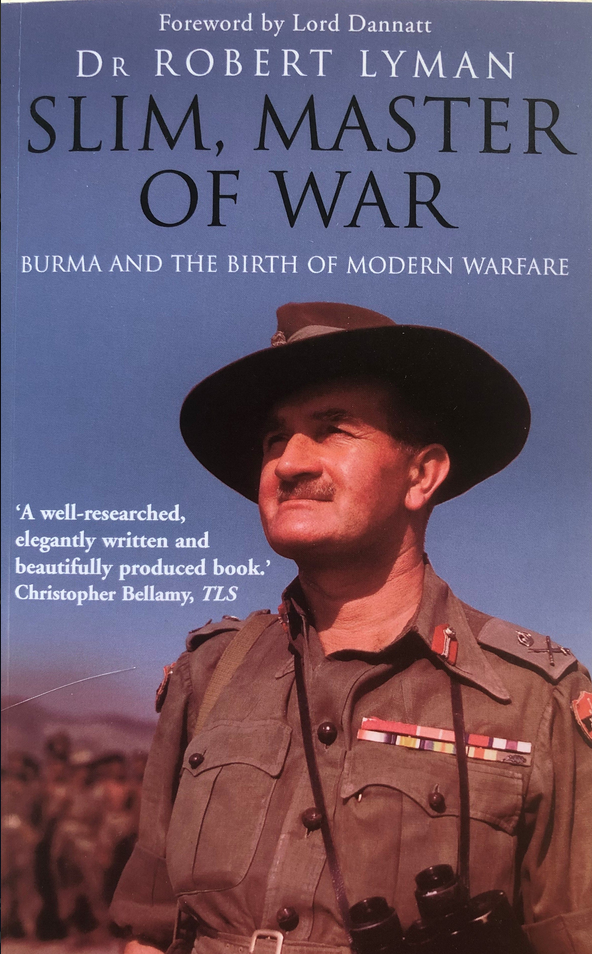
The General stood on an ammunition box. Facing him in a green amphitheatre of the low hills that ring the Palel Plain, sat or squatted the British officers and sergeants of the 11th East African Division. They were then new to the Burma Front and were moving into the line the next day. The General removed his battered slouch hat, which the Gurkhas wear and which has become the headgear of the 14th Army. “Take a good look at my mug”, he advised. “Not that I consider it to be an oil painting. But I am the Army Commander and you had better be able to recognize me — if only to say “Look out, the old b…. is coming round”.
Lieutenant-General Sir William Slim, KCB, CB, DSO, MC (“Bill”) is 53, burly, grey and going a bit bald. His mug is large and weather beaten, with a broad nose, jutting jaw, and twinkling hazel eyes. He looks like a well-to-do West Country farmer, and could be one. For he has energy and patience and, above all, the man has common sense. However, so far Slim has not farmed. He started life as a junior clerk, once he was a school teacher, and then he became the foreman of a testing gang in a Midland engineering works. For the next 30 years Slim was a soldier.
He began at the bottom of the ladder as a Territorial private. August 4, 1914, found him at Summer camp with his regiment. The Territorials were at once embodied in the Regular Army, and Slim got his first stripe as lance-corporal. A few weeks later he was a private again, the only demotion that this Lieutenant-General has suffered.
It was a sweltering, dusty day and the regiment plodded on its twenty-mile route march down an endless Yorkshire lane. At that time British troops still marched in fours, so that Lance-Corporal Slim, as he swung along by the side of his men, made the fifth in the file, which brought him very close to the roadside. There were cottages there and an old lady stood at the garden gate.
“I can see her yet”, Slim reminisces. “she was a beautiful old lady with her hair neatly parted in the middle and wearing a black print dress. In her hand she held a beautiful jug, and on the top of that jug was a beautiful foam, indicating that it contained beer. She was offering it to the soldier boys.”
The Lance-Corporal took one pace to the side and grasped the jug. As he did, the column was halted with a roar. The Colonel, who rode a horse at its head, had glanced back. Slim was hailed before him and “busted” on the spot. The Colonel bellowed “Had we been in France you would have been shot.” Slim confides, “I thought he was a damned old fool – and he was. I lost my stripe, but he lost his army.” In truth he did, in France in March 1918. Bill soon got his stripe back.
Now in this corner of Palel Plain, one of India’s bloodiest battlefields and the scene of one of his greatest victories, Slim tells the officers and men of the 11th Division, “I have commanded every kind of formation from a section upwards to this army, which happens to be the largest single one in the world.” (At that time, Slim had under his command half a million troops.) “I tell you this simply that you shall realize I know what I am talking about. I understand the British soldier because I have been one, and I have learned about the Japanese soldier because I have been beaten by him. I have been kicked by this enemy in the place where it hurts, and all the way from Rangoon to India where I had to dust-off my pants. Now, gentlemen, we are kicking our Japanese neighbours back to Rangoon.”
Slim commanded the rear guard of the army that retreated from Burma in 1942. He is proud of that. His men marched and fought for a hundred days and nights and across a thousand miles. But this retreat was no Dunkirk. Says Slim “We brought our weapons out with us, and we carried our wounded, too. Dog-tired soldiers, hardly able to put one foot in front of another, would stagger along for hours carrying or holding up a wounded comrade. When at last they reached India over those terrible jungle mountains they did not go back to an island fortress and to their own people where they could rest and refit. The Army of Burma sank down on the frontier of India, dead beat and in rags. But, they fought here all through the downpour of the monsoon, and they saved India until a great new Army – which is this one – could be built up to take the offensive once again. In those days, if anyone had gone to me with a single piece of good news I would have burst out crying. Nobody ever did.”
He tells another story. One day he entered a jungle glade in a tank. In front of him stood a group of soldiers, in their midst the eternal Tommy. Assuming an optimism which he did not feel, Slim jumped out of the tank and approached them. “Gentlemen!” he said (which is the nice way that British generals sometimes address their troops) “Things might be worse!”
“‘Ow could they be worse?” inquired the Tommy.
“Well, it could rain” said Slim, lightly. He adds “And within quarter of an hour it did.”
March 12, 2023
Zhukov hits the Ground Running – WW2 – Week 237 – March 11, 1944
World War Two
Published 11 Mar 2023The Soviets launch not one, not two, but three offensives in Ukraine this week, designed to destroy the entire southern wing of the German forces. The Japanese counterattack against the Americans on Bougainville finally begins after months of preparations, but there are more Japanese attacks elsewhere that get going: the operation to invade India.
(more…)
March 11, 2023
Why Japan Surrendered in WW2: Stalin or the Bomb?
Real Time History
Published 10 Mar 2023
It’s common wisdom that the nuclear bombs dropped over Hiroshima and Nagasaki caused the Japanese surrender at the end of the 2nd World War. However, there has been a fierce historical debate if this narrative omits the role of the Soviet invasion of Manchuria in August 1945 — or if this invasion was actually the main cause for the surrender.
(more…)
March 10, 2023
The evolution of a slur
Scott Alexander traces the reasons that we can comfortably call British people “Brits” but avoid using the similar contraction “Japs” for Japanese people:
Someone asks: why is “Jap” a slur? It’s the natural shortening of “Japanese person”, just as “Brit” is the natural shortening of “British person”. Nobody says “Brit” is a slur. Why should “Jap” be?
My understanding: originally it wasn’t a slur. Like any other word, you would use the long form (“Japanese person”) in dry formal language, and the short form (“Jap”) in informal or emotionally charged language. During World War II, there was a lot of informal emotionally charged language about Japanese people, mostly negative. The symmetry broke. Maybe “Japanese person” was used 60-40 positive vs. negative, and “Jap” was used 40-60. This isn’t enough to make a slur, but it’s enough to make a vague connotation. When people wanted to speak positively about the group, they used the slightly-more-positive-sounding “Japanese people”; when they wanted to speak negatively, they used the slightly-more-negative-sounding “Jap”.
At some point, someone must have commented on this explicitly: “Consider not using the word ‘Jap’, it makes you sound hostile”. Then anyone who didn’t want to sound hostile to the Japanese avoided it, and anyone who did want to sound hostile to the Japanese used it more. We started with perfect symmetry: both forms were 50-50 positive negative. Some chance events gave it slight asymmetry: maybe one form was 60-40 negative. Once someone said “That’s a slur, don’t use it”, the symmetry collapsed completely and it became 95-5 or something. Wikipedia gives the history of how the last few holdouts were mopped up. There was some road in Texas named “Jap Road” in 1905 after a beloved local Japanese community member: people protested that now the word was a slur, demanded it get changed, Texas resisted for a while, and eventually they gave in. Now it is surely 99-1, or 99.9-0.1, or something similar. Nobody ever uses the word “Jap” unless they are either extremely ignorant, or they are deliberately setting out to offend Japanese people.
This is a very stable situation. The original reason for concern — World War II — is long since over. Japanese people are well-represented in all areas of life. Perhaps if there were a Language Czar, he could declare that the reasons for forbidding the word “Jap” are long since over, and we can go back to having convenient short forms of things. But there is no such Czar. What actually happens is that three or four unrepentant racists still deliberately use the word “Jap” in their quest to offend people, and if anyone else uses it, everyone else takes it as a signal that they are an unrepentant racist. Any Japanese person who heard you say it would correctly feel unsafe. So nobody will say it, and they are correct not to do so. Like I said, a stable situation.
He also explains how and when (and how quickly) the use of the word “Negro” became extremely politically incorrect:
Slurs are like this too. Fifty years ago, “Negro” was the respectable, scholarly term for black people, used by everyone from white academics to Malcolm X to Martin Luther King. In 1966, Black Panther leader Stokely Carmichael said that white people had invented the term “Negro” as a descriptor, so people of African descent needed a new term they could be proud of, and he was choosing “black” because it sounded scary. All the pro-civil-rights white people loved this and used the new word to signal their support for civil rights, soon using “Negro” actively became a sign that you didn’t support civil rights, and now it’s a slur and society demands that politicians resign if they use it. Carmichael said — in a completely made up way that nobody had been thinking of before him — that “Negro” was a slur — and because people believed him it became true.
March 8, 2023
Perhaps the Prime Minister ran out of glitterbomb distractions?
In The Line, Matt Gurney speculates on why the federal government needed to be “punched in the face” for literally weeks before finally taking (some) action:

Let’s acknowledge something right at the top: no one really knows what the hell the prime minister proposed yesterday. Not in any specific policy sense, at any rate. But boy, did we ever learn something about how the Liberals are viewing this politically.
After weeks of bobbing and weaving and throwing out fistfuls of increasingly ridiculous chaff, Justin Trudeau has belatedly agreed to a series of actions to probe Chinese electoral interference in Canada. And maybe other interference? We don’t know. We do know it’ll involve NSICOP, which is an acronym in desperate need of an agreed-upon pronunciation, if Monday’s press conference was any guide. NSICOP is a joint House-Senate committee that reviews various matters relating to Canada’s national security and intelligence (read this on its website and you’ll know more than 99.9 per cent of Canadians do about NSICOP). There’s also going to be a splash of the National Security and Intelligence Review Agency (NSIRA), plus a special rapporteur. The special rapporteur will apparently be given broad powers and, should they recommend a full public inquiry, the PM will accept that.
Hell of an endorsement for someone who hasn’t been selected yet. It’s almost like the PM decided he had to make an announcement before he was ready to actually share many details about that announcement, for some reason. Like the announcement itself was the point. Weird, eh? Wonder what that was about. In any case, all we know is it’ll be an eminent Canadian.
Shoutout to all you eminent Canadians out there, I guess. Brush up those cover letters.
Winston Churchill frequently has this attributed to him: “You can depend upon the Americans to do the right thing. But only after they have exhausted every other possibility.” Our Canadian version might be that you can depend on Prime Minister Trudeau to do something, but only after he’s exhausted all of his glitterbombs on distracting public attention.
The way that the Liberals responded wasn’t shocking. They only have a few plays left in their playbook, and we’ve seen something just like this only a few weeks ago. (Which is why I’m wondering if they actually only have the single play left, come to think of it.) The Liberals have responded to the barrage of news stories over Chinese interference exactly the way they did over their controversial gun-control amendments from the fall. First, deny there’s a problem. Then accuse anyone saying there’s a problem of being Donald Trump 2.0 or somesuch. Then just cut right to the chase and call them racist. When that doesn’t work, wait a few days to see if the problem goes away. When it doesn’t — indeed, when it gets worse — that’s when you finally admit that you can’t just yell “DISINFORMING MAGA BIGOTS!” at people and watch as your problem magically evaporates.
With guns, after everything else failed, they withdrew the amendments (though I imagine they’ll try again, though probably with no better luck). With China interference, it was agreeing to some kind of process. All the unfilled blanks notwithstanding, even the fact that something is being agreed to shows a dawning of political reality in the PMO: ignoring this and hoping the leaks stop if you called enough people racist Trumpers wasn’t going to work. Clearly, sometime in the last few days, the PM and his staff reached the acceptance stage, and concluded that either they had to admit that there was enough here to warrant some kind of serious process, or they could just start randomly talking about abortion in the hopes that people fell for that.
No, no, wait. They tried that anyway.
It would be fascinating to know what specifically led to the mental breakthrough that enabled Monday’s announcement. Weeks of denials, evasions and counterattacks, a day of performatively fretting about abortion, and then, zap!, we’re getting an rapporteur — an eminent one! — and a process. Maybe they looked at some internal polling. Maybe they’re worried about a big scoop that’s yet to land. Or maybe they’re just tired of being on the defensive and figured that the proposals would stand a decent chance of smothering the issue to death with pillows stuffed with bureaucracy and abbreviations.

March 7, 2023
The lab leak in Wuhan was bad, but the cover-up after the fact is much worse
Jon Miltimore outlines some of the recent confirmations of so many conspiracy theorists’ speculations about the origin of the Wuhan Coronavirus:

Wuhan Institute of Virology.
Wikimedia Commons.
More than three years after the Covid-19 outbreak, the world is still reeling from the virus and the global response to it.
Some 6.8 million people have already died from the virus, according to official statistics, including an estimated 1.1 million Americans. Each day the toll climbs higher; globally, more than 10,000 people die each week.
A bevy of government assessments now indicate that the likely source of the virus was not a wet market, but the Wuhan Institute of Virology, which for years has dabbled in the creation of chimeric coronaviruses.
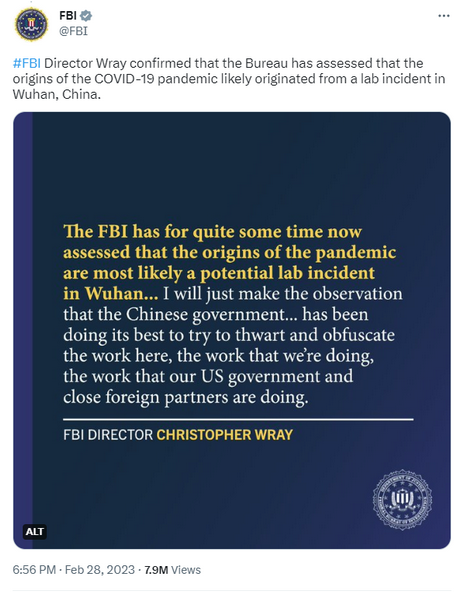
Last Sunday, the Wall Street Journal reported that the US Department of Energy had concluded the Wuhan lab was likely the origin of the pandemic. Days later the FBI chimed in, declaring that “the Bureau has assessed that the origins of the COVID-19 pandemic likely originated from a lab incident in Wuhan, China”.
If true, it’s not hyperbole to say this would be the greatest scandal of the century.
As the Washington Post reported nearly two years ago, State Department cables had previously warned of safety issues at the WIV, where researchers were studying bat coronaviruses. The cables were sent after science diplomats made a January 2018 visit to the Wuhan lab on behalf of the US embassy in Beijing. What the officials found at the lab, which in 2015 had become China’s first facility to achieve the maximum level of international bioresearch safety, shocked them.
Bad, even shocking, to those who refused to listen to the whistleblowers early in the pandemic. Worse, however, is the complicity of western government and media in the cover-up:
While the US government’s involvement in the Wuhan lab leak scandal may have been inadvertent, its attempt to avoid potential responsibility and conceal the truth is now apparent.
From the beginning of the pandemic, Dr. Fauci — the same Dr. Fauci whose agency awarded a $3.7 million grant to EcoHealth Alliance, which funded coronavirus research at the Wuhan lab — became the leading voice denying the possibility that Covid-19 could have emerged from the WIV.
It was “molecularly impossible” for viruses at Wuhan to have mutated into the current viral strain, he claimed in October 2021. In April the previous year he called the lab-leak-theory “a shiny object that will go away soon”, later noting that the virus’ “mutations” were “totally consistent with a jump of a species from an animal to a human”. In May 2020, he told National Geographic that “everything … strongly indicates” that the virus “evolved in nature”, calling the lab-leak theory a “circular argument”.
Scientists are of course entitled to their opinions, but there are two big problems that accompany Fauci’s public statements.
The first problem is that while these statements were being issued publicly, a different conversation was taking place privately, The New York Times noted Tuesday.
“… in 2020, many of those scientists who would become the most stalwart critics of the lab-leak theory privately acknowledged that the origins of the pandemic were very much up for debate”, writes David Wallace-Wells, “and that a laboratory leak was a perfectly plausible — perhaps even the most likely — explanation for the emergence of SARS-CoV-2 in Wuhan a few months earlier.”
We know this because a series of emails obtained by BuzzFeed through FOIA requests show that some of the world’s top virologists initially believed that the lab-leak hypothesis was at least as plausible as natural evolution theory. Specifically, the virologist and natural biologist Kristian Andersen described the new virus as “inconsistent with expectations from evolutionary theory”. In another email, Jeremy Farrar, the incoming head scientist of the World Health Organization, summarized the perspectives of scientists who concluded the “accidental release theory” was the likeliest scenario — “70:30” or “60:40” in favor. (Farrar put the odds at 50-50.)
These views were not made public, however. And following a Feb. 1 conference call arranged by Fauci, scientists published a paper in Nature expressing their belief that the most likely scenario was that the virus naturally evolved on its own.
“Our analyses clearly show that SARS-CoV-2 is not a laboratory construct or a purposefully manipulated virus”, the scientists, including the initially skeptical Andersen, emphatically noted.
So just a few months into the pandemic, scientific researchers were raising concerns in private, but governments pushed legacy media and social media platforms to police public discourse and to actively suppress public doubts of exactly the same sort that the experts were discussing among themselves.
March 5, 2023
MacArthur and Nimitz Go Head-to-Head – Week 236 – March 4, 1944
World War Two
Published 4 Mar 2023The American attacks against the Admiralty Islands are successful, but this causes real tensions between commanders Douglas MacArthur and Chester Nimitz. Much of this week is taken up by planning and meetings on both sides — Adolf Hitler plans the occupation of Hungary, Josef Stalin plans new offensives in Ukraine, and the Allies plan to reconfigure their whole front in Italy. It’s all the prelude to an explosion of action.
(more…)
Dinosaurs, Mammoths, and the Greek Myths
toldinstone
Published 20 Aug 2021Did dinosaur fossils inspire the mythical griffin? Did mammoth bones shape the story of the Gigantomachy? Were the cyclopes modeled on the skulls of dwarf elephants? This video investigates some of the fascinating intersections between fossils and the Greek myths.
This video is part of a collaboration with @NORTH 02 Check out their video “Scimitar Cats, Cave Bears, and Behemoths” for more on the fossils that so fascinated the ancient Greeks and Romans: https://youtu.be/lpU-F3EQ4v4
(more…)
March 4, 2023
Nigel Biggar’s Colonialism: A Moral Reckoning
In The Critic, Robert Lyman reviews a recent book offering a rather more nuanced view of the British empire:
The book is a careful analysis of empire from an ethical perspective, examining a set of moral questions. This includes whether the British Empire was driven by lust or greed; whether it was racist and condoned, supported or encouraged slavery; whether it was based on the conquest of land; whether it entailed genocide and or economic exploitation; whether its lack of democracy made it illegitimate; and whether it was intrinsically or systemically violent.
Biggar’s proposition is simple: that we look at Britain’s history without assuming the zero-sum position that imperialism and colonialism were inherently bad, that motives and agency need to be considered and that good did flow from bad, as well as bad from good.
Whether he succeeds depends on the reader’s willingness to appreciate these moral or ethical propositions, and to re-evaluate accordingly. In my view, he has mounted a coolly dispassionate defence of his proposition, challenging the hysteria of those who suggest that the British Empire was the apotheosis of evil. Biggar’s calm dissection of these inflated claims allows us to see that they say much more about the motivations, assumptions and political ideologies of those who hold these views than they do about what history presents to us as the realities of a morally imperfect past.
He reminds us that British imperialism had no single wellspring. Most of us can easily dismiss the notion that it was a product of an aggressive, buccaneering state keen to enrich itself at the expense of peoples less able to defend themselves. Equally, it is untrue that economic motives drove all imperialist or colonial endeavour, or that economics (business, trade and commerce) was the primary force sustaining the colonial regimes that followed.
As Biggar asserts, both imperialism and colonialism were driven from different motivations at different times. Each ran different journeys, with different outcomes depending on circumstances. The assertion that there is a single defining imperative for each instance of imperial initiative or colonial endeavour simply does not accord with the facts.
Whilst other issues played a part, it was social, religious and political motives which drove the colonial endeavour in the New World from the 1620s: security and religion drove the subjugation of Catholic (and therefore Royalist) Ireland in the 1650s; social and administrative factors led to the settlement in Australia from 1788; and social and religious imperatives drove the colonisation of New Zealand in the 1840s.
In circumstances where trade and the security of trade was the primary motive for imperialism — think of Clive in the 1750s, for example — a wide variety of outcomes ensued. Some occurred as a natural consequence of imperialism. In India, Clive’s defeat of the Nawab Siraj-ud-Daulah in 1757 was in support of a palace coup that put Siraj’s uncle Mir Jafar on the throne of Bengal, thus allowing the East India Company the favoured trading status that Siraj had previously rejected.
This led in time to the Company taking over the administrative functions of the Bengal state (zamindars collected both rents for themselves and taxes for the government). Seeking to protect its new prerogatives, it provided security from both internal (civil disorder and lawlessness) and external threats (the Mahratta raiders, for example). The incremental, almost accidental, accrual of power that began in the early 1600s stepped into colonial administration 150 years later, leading to the transfer of power across a swathe of the sub-continent to the British Crown in 1858.
Biggar’s argument is that, running in parallel with this expansion came a host of other consequences, not all of which can be judged “bad”. We may not like what prompted the colonial enterprise at the outset (not all of which was morally contentious, such as the need to trade), but we cannot deny that good things, as well as bad, followed thereafter.
February 27, 2023
Luftwaffe Defeated in One Week?! – War Against Humanity 099
World War Two
Published 26 Feb 2023Allied and German Air Forces fight fierce battles over Europe with civilians caught in the crossfire, while Joseph Stalin and Lavrenti Beria deport two entire ethnicities of half a million in just one week.
(more…)
February 26, 2023
Tojo Takes Control – Week 235 – February 25, 1944
World War Two
Published 25 Feb 2023Now that the Americans have seized the Marshall Islands, they can bypass the Japanese base at Truk. This impels Prime Minister Hideki Tojo to shake up both army and navy command, and he even takes personal control over the Japanese Army. On the Anzio Front, Lucian Truscott replaces John Lucas as Allied Commander. In the field, the Allies win a big victory in Burma, and in Ukraine, the Soviets are still on the move.
(more…)
February 24, 2023
QotD: Relearning lessons as old as warfare
The people of Asia had changed, true. The day of the gunboat and a few Marines would never return. But that was not the whole story. The people of the West had changed, too. They forgot that the West had dominated not only by arms, but by superior force of will.
During the summer of 1950, and later, Asians would watch. Some, friends of the West, would even smile. And none of them would ever forget.
News reports in 1950 talked of vast numbers, overwhelming hordes of fanatic North Koreans, hundreds of monstrous tanks, against which the thin United States forces could not stand. In these reports there was truth, but not the whole truth.
The American units were outnumbered. They were outgunned. They were given an impossible task at the outset.
But they were also outfought.
In July, 1950, one news commentator rather plaintively remarked that warfare had not changed so much, after all. For some reason, ground troops still seemed to be necessary, in spite of the atom bomb. And oddly and unfortunately, to this gentleman, man still seemed to be an important ingredient in battle. Troops were getting killed, in pain and fury and dust and filth. What had happened to the widely heralded pushbutton warfare where skilled, immaculate technicians who had never suffered the misery and ignominy of basic training blew each other to kingdom come like gentlemen?
In this unconsciously plaintive cry lies buried a great deal of the truth why the United States was almost defeated.
Nothing had happened to pushbutton warfare; its emergence was at hand. Horrible weapons that could destroy every city on earth were at hand — at too many hands. But pushbutton warfare meant Armageddon, and Armageddon, hopefully, will never be an end of national policy.
Americans in 1950 rediscovered something that since Hiroshima they had forgotten: you may fly over a land forever; you may bomb it, atomize it, pulverize it and wipe it clean of life — but if you desire to defend it, protect it, and keep it for civilization, you must do this on the ground, the way the Roman legions did, by putting your young men into the mud.
T.R. Fehrenbach, This Kind of War: A Study in Unpreparedness, 1963
February 23, 2023
Type 99 Arisaka Sniper Rifles
Forgotten Weapons
Published 29 Nov 2016The Japanese Army made significant use of snipers (or in today’s terminology, designated marksmen) as part of its infantry combined arms doctrine, and produced about 22,000 Type 97 sniper rifles for use in WWII and the Sino-Japanese War. In 1941, shortly after the adoption of the new 7.7mm rifle cartridge, it was decided that a sniper rifle variant of the Type 99 should be made in addition to the Type 97 (which was basically a scoped Type 38).
Testing through 1941 determined that there was almost no practical difference in accuracy between scoped examples of the Type 99 long and short rifles, and so the short rifle was chosen to be the basis for the Type 99 sniper (the Type 99 long rifles would drop from production altogether pretty quickly anyway). About 1,000 of the scoped 99s were manufactured by the Kokura Arsenal using the same 2.5x scope as on the Type 97 sniper, while the Nagoya Arsenal instead used a 4x scope, offering more magnification at the expense of a narrower field of view. Nagoya would produce approximately 10,000 of these rifles, with 4x scopes except for a period between serial numbers 5,000 and 7,000 with 2.5x scopes (most likely the remainder stored at Kokura when that plant ceased production). The rifles made into snipers were given no special selection criteria; simply taken at random from normal production. The utility of the weapon in Japanese practice came not from it being mechanically more accurate than any other issue rifle, but rather from the optical sight allowing better exploitation of that standard rifle’s inherent accuracy.
(more…)


