
World War Two
Published 18 Feb 2023The Allies bomb the monastery atop Monte Cassino in Italy, but just to the Northwest it’s the Germans attacking them at Anzio this week. In the Soviet Union, the Axis break out of the Korsun Pocket, but at great cost, and in the Pacific comes a major Allied raid on the Japanese base at Truk and landings on Eniwetok Atoll.
(more…)
February 19, 2023
The Destruction of Monte Cassino – Week 234 – February 18, 1944
Comments Off on The Destruction of Monte Cassino – Week 234 – February 18, 1944
February 18, 2023
Nikki Haley’s presidential bid is clearly doomed because … she uses her middle name? Let me read that again.
Jim Treacher (whose name I should now probably put in scare quotes because it’s a nom-de-plume) explains why Nikki Haley is a no-hoper in the next Republican presidential primaries:
As I revealed over a decade ago, “Jim Treacher” isn’t my real name. This is just a message-board pseudonym that got way out of hand, and now I guess I’m stuck with it. My government name is Robert Sean Medlock, but my parents have always called me Sean. I don’t know why they didn’t just name me Sean Robert Medlock, but I was in no position to argue my case at the time because I couldn’t talk yet.
So now, every time I need to fill out paperwork somewhere, I have to explain that I go by my middle name. Doctors, dentists, car repairs, insurance, what have you. The routine is kind of annoying, but at this point I’m used to it.
I’m not deceiving anybody by using my middle name. It’s just my name, man. Lots of people go by their middle name.
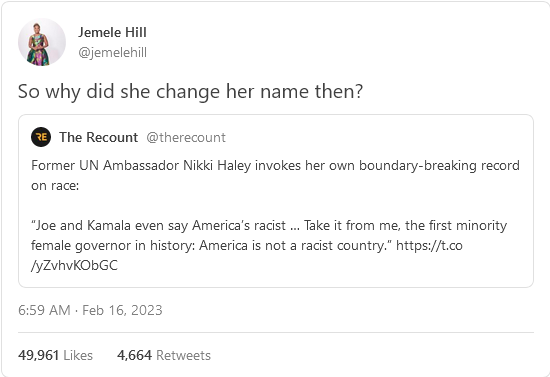
In other news: This week Nikki Haley announced she’s running for president. I don’t know if she has a shot, but the libs sure seem to think so. They’re already attacking her for … going by her middle name.
Check out this idiot:
She didn’t. Her birth name was Nimarata Nikki Randhawa. Not “Nimrata”, as it’s commonly misspelled by supposedly sophisticated libs:
My goodness. Guess it runs in the family, huh?
The Randhawa family referred to their daughter as Nikki, which is Punjabi for “little one”. And she changed her last name to Haley when she married a man named Michael Haley.
Y’know, like Hillary Rodham did when she married Bill Clinton.
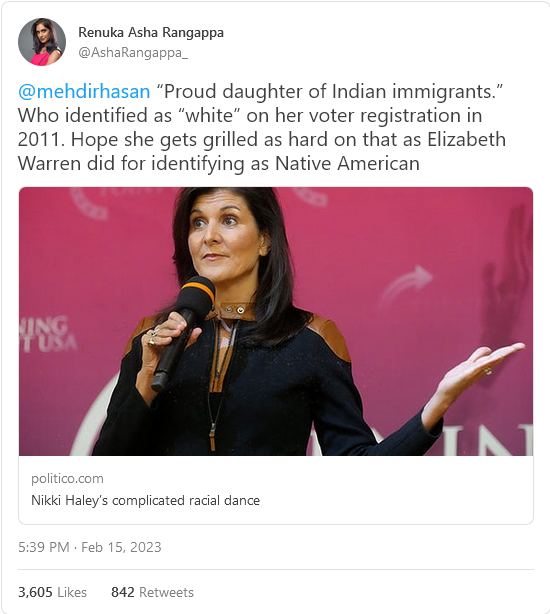
Here’s another dummy, who of course works for CNN:
Yeah. Wait. What?
And if that scandal wasn’t enough to sink Nikki Haley’s chances utterly, CNN’s Don Lemon helpfully points out that she’s way, way, way past her peak:
Now, you know I’m not one to cry sexism often. Frankly, when I found out a hot college professor of mine had been fired for doing a #MeToo, I was offended for not being involved. I’d gone to office hours, for godsakes. But there is sexism this week we have to call out. Nikki Haley announced she is running for president. She’s a reasonable Republican candidate who is, of course, a long shot against Trump. There are plenty of ways to criticize her politics, but for some reason a bunch of people we are meant to respect tried to say that the real problem is that she’s a woman, that she’s not young, and that she’s Indian.
You may think I’m exaggerating.
Here is Don Lemon on CNN: “Nikki Haley isn’t in her prime. Sorry”, he says, looking to camera, a little smile on his face. “When a woman is considered to be in her prime in 20s and 30s and maybe 40s …” His co-hosts, both women, balk. (“Prime for what?”) But Lemon keeps going. Watch the extremely stressful video here, where he goes on … and on … about how Nikki Haley, who is 51, cannot criticize Biden’s age. Because women peak in their 20s, and she’s long past that.
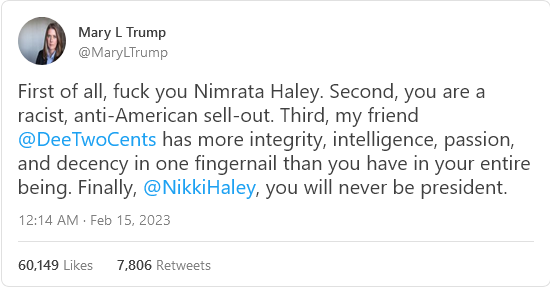
Or here’s progressive hero Mary Trump, Donald’s niece, who disavowed him and became a star of the intelligentsia. She decided that the best way to insult Nikki Haley this week was by highlighting that she’s Indian, because Nikki is her middle name. Again, this is a real statement Mary Trump released on Twitter: “First of all, fuck you Nimrata Haley.” Sorry, I’m slow: If you’re a white person trying to insult someone who’s not white and you do it by highlighting their race, what’s that called again? I’m sure there’s a Robin DiAngelo chapter on this somewhere.
Comments Off on Nikki Haley’s presidential bid is clearly doomed because … she uses her middle name? Let me read that again.
February 17, 2023
Spy ballooning has a remarkably long history (that’s clearly still ongoing)
In The Line, Scott Van Wynsberghe outlines the history of balloons in wartime and (as many are now aware from recent events) in peacetime:
China’s balloon spying is shocking on so many levels that you can take your pick. There is the ultra-flagrant violation of foreign sovereignty, the stunningly surreal air of denial exhibited by Beijing, and the fearful sense that something in the world order just lurched. There is also puzzlement: what, balloon spying is still a thing? Indeed it is, and its centuries-long history is instructive as to what China is now doing. It also makes clear that the U.S. is no innocent victim here but rather a past offender with a cleaned-up act.
Among the first major studies of aerial reconnaissance was a book brought out by military author Glenn B. Infield way back in 1970. In a way, Infield was charting unknown territory. When he addressed balloons in particular, he traced their use in spying to the many wars associated with the French Revolutionary and Napoleonic eras. In 1794, he related, the French military officer Jean-Marie-Joseph Countelle made an ascent at the city of Maubeuge in order to monitor enemy forces in the area. In the process, Countelle became the first balloon spy.
As technology improved, other firsts followed. By the 1850s, cameras were mounted on French military balloons. In the 1860s, during the American Civil War, Union forces battling the Confederacy used balloons trailing telegraphic wires, which transmitted immediate updates from the balloonists. Yet technology cut both ways. By the early 1900s, balloons had a nemesis in sight, in the form of winged and powered aircraft.
The inevitable showdown occurred in the First World War, and it was ugly. Large numbers of observation balloons were used by all sides in the conflict, and WWI historian Denis Winter claims the Germans alone deployed 170 of them in France by 1917. Typically, such balloons were tethered in place near the frontline, floating at several thousand feet, with telephone wires dangling to the ground. Although they seemed vulnerable, they were actually protected from below by anti-aircraft units, which blasted at any enemy plane that got too close. However, the reverse was also true, with balloons themselves being fired at from the ground. By 1915, says aviation writer Ralph Barker, the British were losing at least a dozen balloons a month from all forms of enemy action. Those balloonists who were not shot to pieces often had to bail out, putting their faith in parachutes that did not always work. (Horrified onlookers called them “balloonatics.”) The fighter pilots responsible for much of this mayhem — which they called “balloon-busting” — may not have had an easy time, but some of them scored heavily, with one Frenchman named Coiffard tallying 28 balloons. Although observation balloons managed to make it to the end of the war, it was a near-run thing. According to author Linda Hervieux, nobody after the war was talking about repeating that experience in any future fighting.
[…]
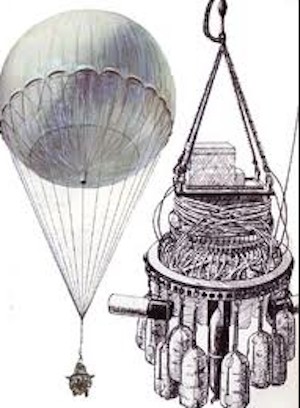
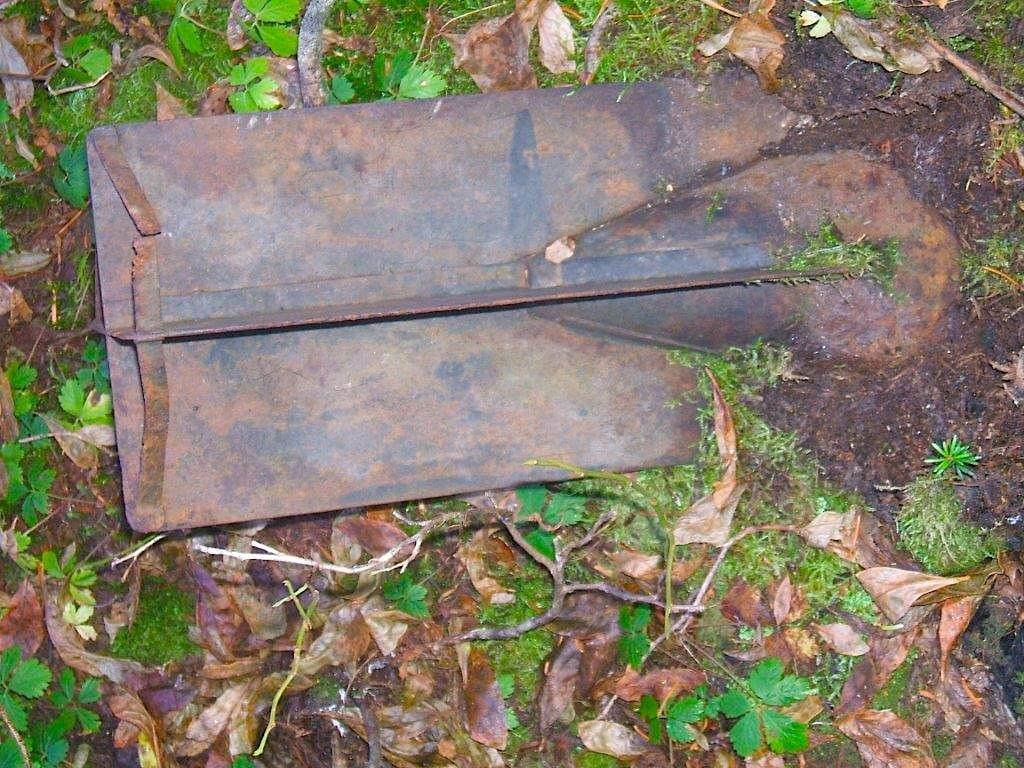
Once the Second World War was underway, some propaganda leafleting did occur, but secret balloon activity seemed to be at a low level. That was very misleading, because one of the tensest moments in ballooning history was playing out in the background, but it occurred amid so much security that the entire tale took years to emerge. In 1944, Japan launched the first of over 9,000 bomb-rigged balloons across the Pacific. Robert C. Mikesh, in a comprehensive 1973 monograph issued by the Smithsonian Institution, noted that almost a thousand of the balloons may have reached North America, but the true number is unknowable, because so many came down in remote wilderness. (One was found by forestry workers in British Columbia as late as 2014.) Mikesh tabulated 285 known incidents, ranging from Alaska all the way south to Baja California and as far inland as Manitoba. Both the U.S. and Canada clamped down hard on any news about the balloons, for fear of providing Tokyo valuable feedback about the results of the campaign. (In other words, balloon counterintelligence became a priority.) In general, the balloons did not cause a lot of harm, but one of them slaughtered six people in Oregon in 1945. By a strange fluke, one of the few groups in the U.S. that knew the full story of the balloons was an element of the Black community. The all-Black 555th Parachute Infantry Battalion was sent to the U.S. West to handle emergencies caused by the balloons.
The remains of a Japanese balloon bomb found in the Monashee Mountains near Lumby, BC in 2014. It was detonated on-site by the bomb disposal unit of Maritime Forces Pacific of the Royal Canadian Navy.
There is a strong temptation to blame the Japanese balloon bombs for what happened next, because the U.S. unaccountably entered the Cold War as the most pugnacious exponent of clandestine ballooning up to that time. Whatever the explanation, the epic struggle between the United States and the Union of Soviet Socialist Republics plunged U.S. ballooning into a tangle of psychological warfare, shadowy science, under-the-table finances, and clandestine belligerence indistinguishable from military attacks. Plus, UFOs and breakfast foods were involved (seriously).
Comments Off on Spy ballooning has a remarkably long history (that’s clearly still ongoing)
America’s War on Japanese Shipping – WW2 Special Documentary
World War Two
Published 15 Feb 2023We’ve covered in great depth the Battle of the Atlantic and the war by and against German U-Boats, but what about the other side of the world? Why has the war on Japanese shipping been so much quieter? There are several very specific reasons for that, which we look at today.
(more…)
Comments Off on America’s War on Japanese Shipping – WW2 Special Documentary
February 14, 2023
China’s awkward actions on the world stage do not charm the neighbours
CDR Salamander explains why the BRIC (Brazil-Russia-India-China) “coalition” is as unlikely to occur in the real world as any other opium pipe-dream:
Yes, the USA and Canada had our Balloons of February, but in the last year or so, what has China been doing to seem like a pleasant alternative to the United States to the rest of the world?
Her largest neighbor? They get sticks:
The root cause is an ill-defined, 3,440km (2,100-mile)-long disputed border.
Rivers, lakes and snowcaps along the frontier mean the line can shift, bringing soldiers face to face at many points, sparking a confrontation.
The two nations are also competing to build infrastructure along the border, which is also known as the Line of Actual Control. India’s construction of a new road to a high-altitude air base is seen as one of the main triggers for a deadly 2020 clash with Chinese troops.
How bad is the situation?
Despite military-level talks, tensions continue. In December 2022 troops clashed for the first time in more than a year.
It happened near the Tawang sector of Arunachal Pradesh state, the eastern tip of India. Some soldiers suffered minor injuries.
De-escalation work has taken place since a major clash in June 2020. The Galwan Valley battle — fought with sticks and clubs, not guns — was the first fatal confrontation between the two sides since 1975.
At least 20 Indian and four Chinese soldiers died.
Another face-off in January 2021 left troops on both sides injured. It took place near India’s Sikkim state, between Bhutan and Nepal.
The “I” and “C” in the B.R.I.C. are not going to be close friends, ever — one of the reasons I roll my eyes at those who propose the BRIC nations as some kind of power block — something only slightly sillier than the Cold War “Non Aligned Movement.”
With the “B” being the basket case Brazil (always the nation of the future, and always will be), and the “R” being Russia, I mean, child please.
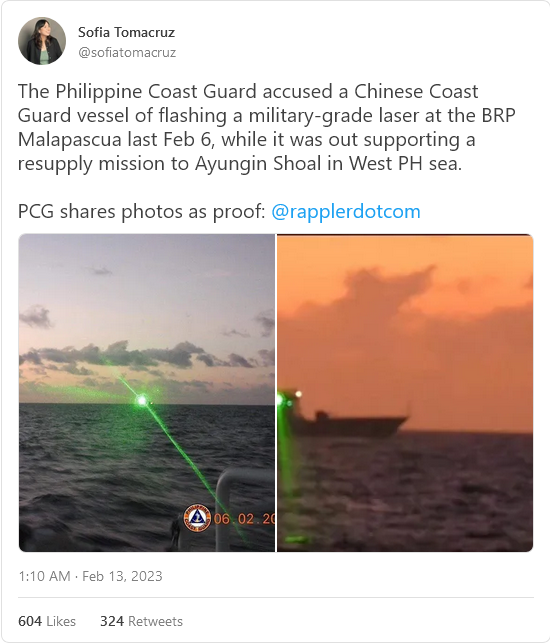
Another nation that if the PRC was just slightly more subtle and less arrogant they might have a chance to make things more difficult for the USA-Japan-Australia defense concerns is The Philippines. They had a window in the last couple of decades, but … if they’re doing this;
The PRC Wolf Warrior Lack of Charm Campaign perhaps may play well internally — and that may be all they care about — but there was a window not long ago that the PRC was playing smart on the world stage — making significant impact in Australia and having the USA happy to let them set up Confucius Institutes at our major universities, etc … but the last decade or so they somehow decided to play a different game.
Comments Off on China’s awkward actions on the world stage do not charm the neighbours
February 12, 2023
German Desperation in Korsun Pocket – Week 233 – February 11, 1944
World War Two
Published 11 Feb 2023It is crisis mode in the Korsun Pocket this week for the Axis troops surrounded, but they are also losing ground all over the Eastern Front this week, including the big prize of Nikopol. In Italy, it is a different story as the Germans play offense at Anzio, though with only small gains.
(more…)
Comments Off on German Desperation in Korsun Pocket – Week 233 – February 11, 1944
February 10, 2023
When “Taffy 3” kicked the ass of the pride of the Imperial Japanese Navy
Chris Bray isn’t a milblogger, but I thought his summary of the Battle of Leyte Gulf was pretty darned good:
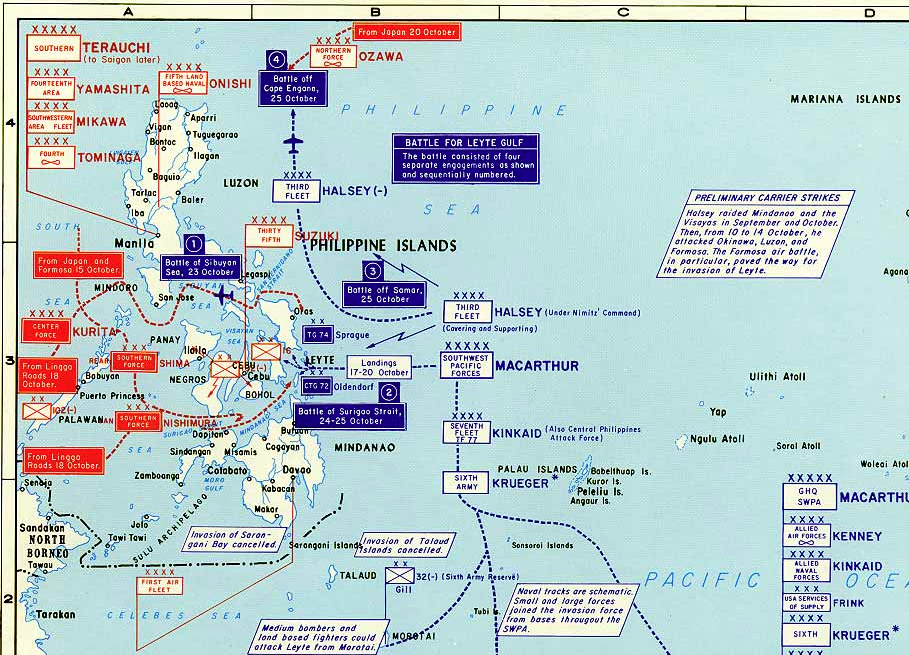
In October of 1944, US troops landing on Leyte Island in the Philippines were menaced from the sea by an enormous Japanese naval fleet that was divided into three separate attack forces.
Detail of the West Point Military Atlas: World War II: Asia-Pacific Invasion of Leyte, October 1944 map.
https://www.westpoint.edu/sites/default/files/inline-images/academics/academic_departments/history/WWII%20Asia/ww2%2520asia%2520map%252029.jpgSummarizing aggressively, the American ground forces were protected against an attack from the sea by the US Navy’s Third Fleet, commanded by Bull Halsey. But Halsey suddenly wasn’t there anymore, taking the bait of a decoy attack force [of de-planed Japanese carriers] and chasing it out into the sea. The Third Fleet’s departure uncovered Leyte Gulf, and the largest of the Japanese attack forces sailed in. Disaster became likely.
There were two American naval task forces in the path of the Japanese attack force, Taffy 2 and Taffy 3, but neither were meant for serious naval combat. They were supporting forces, designed to help the troops on the ground: a few escort carriers, a few lightly armed destroyer escorts, a very few destroyers. Aircraft on the American escort carriers were armed with 100-pound bombs to provide close air support to the infantry. The Japanese First Task Force had four battleships, eight cruisers, and eleven destroyers. One of the Japanese battleships was the Yamato, armed with 18-inch guns. The Japanese attack force sailed directly into contact with Taffy 3, which didn’t realize they were about to face the main Japanese attack force until they were already within range of its guns.
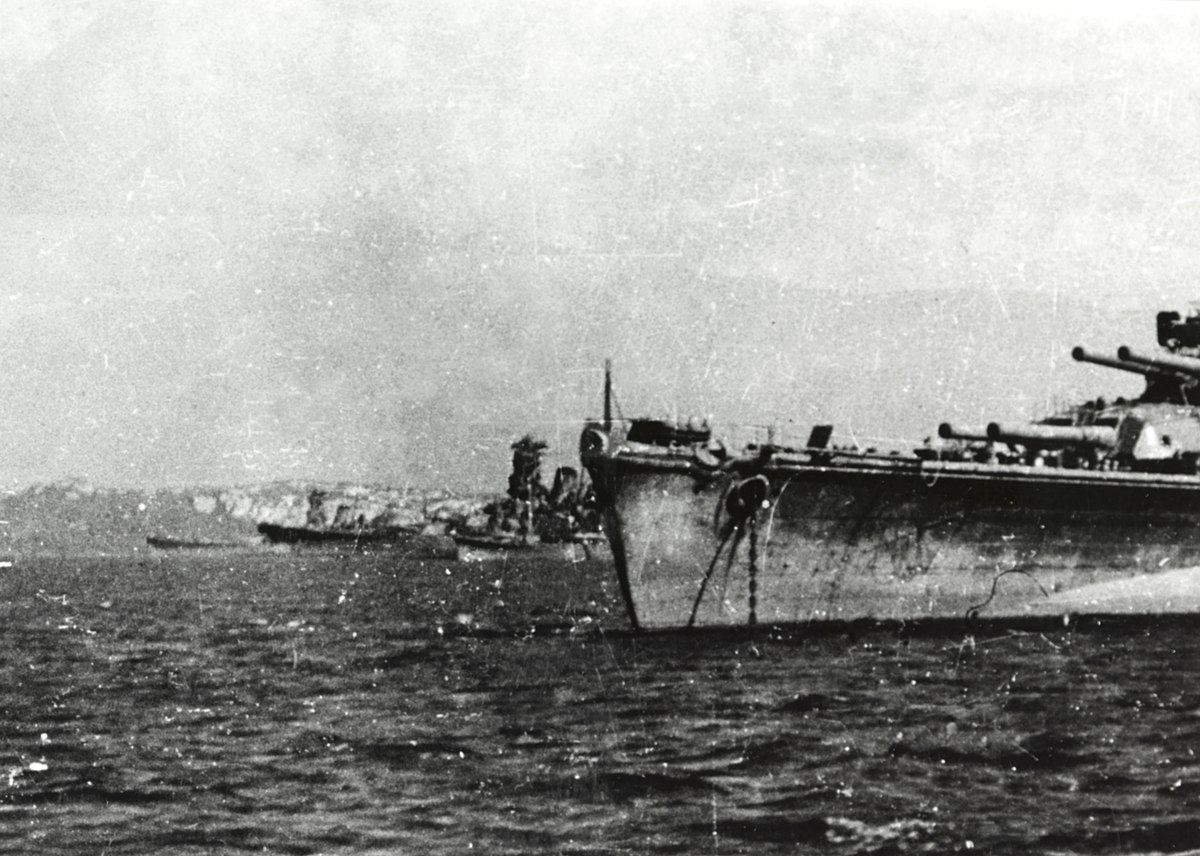
Imperial Japanese Navy ships at anchor in Brunei, Borneo shortly before the Battle of Leyte Gulf. Left to right, Musashi, Yamato, an unidentified cruiser, and Nagato.
Photo by Kazutoshi Hando from the US Naval History and Heritage Command collection.The commander of Taffy 3, Rear Admiral Clifton Sprague, saw immediately that his task force couldn’t survive the engagement, so he tried to salvage what he could: He ordered his destroyers and destroyer escorts to attack, to cover the hoped-for withdrawal of the escort carriers. The resulting battle is one of the best-known in naval history — and one of the least plausible, because Taffy 3 kicked the everloving shit out of that much larger Japanese attack force, compelling the Japanese to withdraw in the panicked belief that they’d sailed into the bulk of Halsey’s Third Fleet.
If you haven’t read [the late] James Hornfischer’s magnificent book about the battle, The Last Stand of the Tin Can Sailors, you should read it. The details are far beyond anything that could be summarized in a single short piece. But the battle was won by a remarkable combination of disciplined obedience, independent audacity, and a paradoxically disciplined disobedience — by men aggressively refusing to obey orders that threatened their cause.
The Fletcher-class destroyer USS Johnston (DD-557), sunk in the Battle off Samar, 25 October, 1944.
US Navy photo with enhancement work by Wild Surmise via Wikimedia Commons.The battle began with one of the US Navy’s most famous moments. Before Sprague had time to order anyone to do anything, the captain of the Johnston, one of Taffy 3’s few destroyers, turned to attack the Japanese fleet. We have confused and contradictory accounts of the orders given by Cmdr. Ernest Evans, because the man who gave them, and most of the men who heard them, died soon afterward, but he is supposed to have said something like this:
1.) We’re under the guns of a much larger Japanese fleet.
2.) Survival is not to be expected.
3.) Hard left rudder, all ahead flank.
We’re all going to die; attack. The Johnston sank, and Evans died, but his first torpedo run blew the bow off a Japanese cruiser — setting the tone of the fight.

Comments Off on When “Taffy 3” kicked the ass of the pride of the Imperial Japanese Navy
February 8, 2023
The King of Siam’s Massaman Curry
Tasting History with Max Miller
Published 7 Feb 2023
(more…)
Comments Off on The King of Siam’s Massaman Curry
February 7, 2023
Big Sky fascism, according to the New York Times
In The Free Press, Walter Kirn expresses dismay to discover that he’s been living in a “quasi-fascist” state for 30 years and didn’t even notice until the Grey Lady informed him about it recently:

Just a few weeks back, I sat down with my morning coffee, opened up the paper and learned that I now live in a quasi-fascist state. It said so in the paper.
The paper wasn’t a local publication but one from a couple thousand miles away, the New York Times, whose glossy Sunday magazine included a lengthy, illustrated feature with the five-alarm headline How Montana Took a Hard Right Turn Toward Christian Nationalism. To illustrate the state’s alleged swerve toward neo-fascist theocratic rule — a dire development I’d somehow missed — the story included a scary gothic photo, heavily filtered to bring out its dark tones, of a ghostly white cross on a bare hillside reflected in a passing rearview mirror. It also included, of course, a Yellowstone reference and Kevin Costner’s name — right up top, where the search engines would see them.
Since moving to small-town Montana from New York City over 30 years ago, I’d lived through at least a couple of cycles of ominous national coverage of my state. Without going into the details, let me assure you that this article was bunk, as exaggerated as the photo.
But fiction is fact where Montana is concerned, particularly on the country’s coasts, where tales are told about the country’s interior that the country’s interior lacks the clout to counter, much as our guns lack the range to bring down aircraft. Despite our legendary swagger, Montanans are largely helpless against the country’s more powerful forces. The missiles on our prairies aren’t missiles we asked for, just missiles that formidable others wished to plant here. They make us a target, but we don’t control them.
Do I sound defensive? Perhaps I am.
I live in a state with zero big-league sports teams, not a single Fortune 500 corporation, and no national media influence to speak of — unless you count made-up shows about fake ranchers slugging it out in scripted brawls. I’m one of about a million residents, all of whom, no matter their circumstances, are up against the myth-making machines of cities and states of imperial wealth and numbers. And imperial attitudes, dare I say, which emerge in their basic, perennial story about us: those folks from the steppes and mountains are growing restless, including the ones who’ve just moved there to go skiing, who appear to be worse than the ones already living there, who we’ve always found unsettling enough.
When the spy balloon floated across America, the rest of the country got a taste, perhaps, of Montana’s stoic colonial impotence. For days, we could point, but we weren’t allowed to shoot — great-power diplomacy prevented it. Americans may think we’re tough, as Montanans may think they’re tough, but it seems that we’re tough in the way that actors in westerns are: only with the permission of the director, only symbolically. Down went the balloon on Saturday to much applause, but the spectacle was pure cinema by then, like a fistfight on Yellowstone that draws fake blood.
But at least we proud Montanans kept our honor. We spied the lurking villain, we called the sheriff, we warned our neighbors, we did what we could do. I suspect we’ll continue in this role, watchful vigilantes of the skies. There’s trouble afoot – you can feel it everywhere, particularly if you dwell near nuclear missiles, particularly if you live where there’s no cover — and someone has to stand lookout on the hill.
Comments Off on Big Sky fascism, according to the New York Times
February 6, 2023
TikTok – threat and menace
At Wrong Side of History, Ed West linked to this post by Gurwinder on the TikTok threat to western civilization:

For thousands of years, humans sought to subjugate their enemies by inflicting pain, misery, and terror. They did this because these were the most paralyzing emotions they could consistently evoke; all it took was the slash of a sword or pull of a trigger.
But as our understanding of psychology has developed, so it has become easier to evoke other emotions in complete strangers. Advances in the understanding of positive reinforcement, driven mostly by people trying to get us to click on links, have now made it possible to consistently give people on the other side of the world dopamine hits at scale.
As such, pleasure is now a weapon; a way to incapacitate an enemy as surely as does pain. And the first pleasure-weapon of mass destruction may just be a little app on your phone called TikTok.
[…]
Other platforms, like Facebook and Twitter, use recommendation algorithms as features to enhance the core product. With TikTok, the recommendation algorithm is the core product. You don’t need to form a social network or list your interests for the platform to begin tailoring content to your desires, you just start watching, skipping any videos that don’t immediately draw your interest. Tiktok uses a proprietary algorithm, known simply as the For You algorithm, that uses machine learning to build a personality profile of you by training itself on your watch habits (and possibly your facial expressions.) Since a TikTok video is generally much shorter than, say, a YouTube video, the algorithm acquires training data from you at a much faster rate, allowing it to quickly zero in on you.
The result is a system that’s unsurpassed at figuring you out. And once it’s figured you out, it can then show you what it needs to in order to addict you.
Since the For You algorithm favors only the most instantly mesmerizing content, its constructive videos — such as “how to” guides and field journalism — tend to be relegated to the fringes in favor of tasty but malignant junk info. Many of the most popular TikTokers, such as Charli D’Amelio, Bella Poarch, and Addison Rae, do little more than vapidly dance and lip-sync.
Individually, such videos are harmless, but the algorithm doesn’t intend to show you just one. When it receives the signal that it’s got your attention, it doubles down on whatever it did to get it. This allows it to feed your obsessions, showing you hypnotic content again and again, reinforcing its imprint on your brain. This content can include promotion of self-harm and eating disorders, and uncritical encouragement of sex-reassignment surgery. There’s evidence that watching such content can cause mass psychogenic illness: researchers recently identified a new phenomenon where otherwise healthy young girls who watched clips of Tourette’s sufferers developed Tourette’s-like tics.
A more common way TikTok promotes irrational behavior is with viral trends and “challenges”, where people engage in a specific act of idiocy in the hope it’ll make them TikTok-famous. Acts include licking toilets, snorting suntan lotion, eating chicken cooked in NyQuil, and stealing cars. One challenge, known as “devious licks”, encourages kids to vandalize property, while the “blackout challenge”, in which kids purposefully choke themselves with household items, has even led to several deaths, including a little girl a few days ago.
The Chinese government — not wishing this kind of insanity spreading among their own people — have ensured that it’s only foreigners getting the full TikTok experience:
Last month FBI Director Chris Wray warned that TikTok is controlled by a Chinese government that could “use it for influence operations”. So how likely is it that one such influence operation might include addicting young Westerners to mind-numbing content to create a generation of nincompoops?
The first indication that the Chinese Communist Party is aware of TikTok’s malign influence on kids is that it’s forbidden access of the app to Chinese kids. The American tech ethicist Tristan Harris pointed out that the Chinese version of TikTok, Douyin, is a “spinach” version where kids don’t see twerkers and toilet-lickers but science experiments and educational videos. Furthermore, Douyin is only accessible to kids for 40 minutes per day, and it cannot be accessed between 10pm and 6am.
Has the CCP enforced such rules to protect its people from what it intends to inflict on the West? When one examines the philosophical doctrines behind the rules, it becomes clear that the CCP doesn’t just believe that apps like TikTok make people stupid, but that they destroy civilizations.
Comments Off on TikTok – threat and menace
February 5, 2023
Leningrad: NO STEP BACK! – Week 232 – February 4, 1944
World War Two
Published 4 Feb 2023The Allies begin a new operation in the Pacific this week: assaulting the Marshall Islands. They also make big attacks from their beachhead in Italy at Anzio, but these are called off after only a few days in the face of heavy enemy resistance. However, in the USSR there are several successes against the Axis, as they are pushed back both in the far north and the far south of the front, and still surrounded near Korsun.
(more…)
Comments Off on Leningrad: NO STEP BACK! – Week 232 – February 4, 1944
February 1, 2023
Changing views of Gandhi
In UnHerd, Pratinav Anil recounts some of the changes to Gandhi’s reputation and place in Indian public memory:
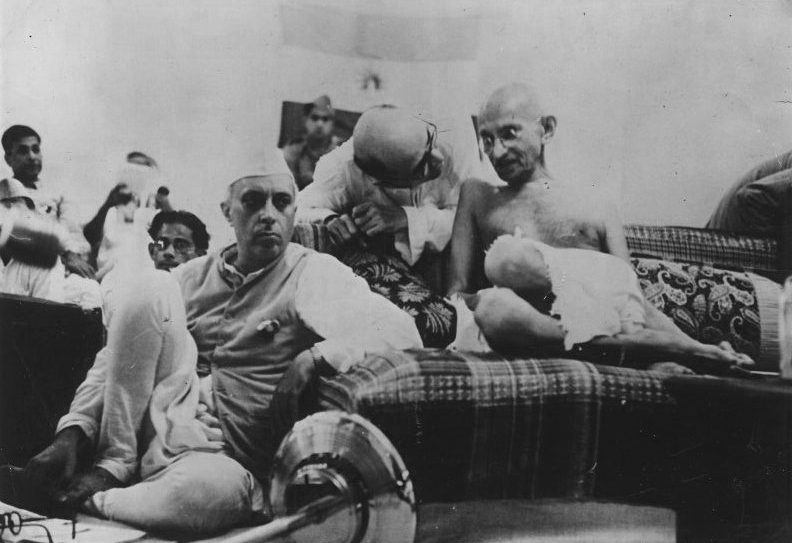
Nehru with Gandhi, August 1942.
Photographer unknown, public domain image via Wikimedia Commons.
Gandhi, poor fellow, had his ashes stolen on the 150th anniversary of his birth. “Traitor”, scrawled the Hindu supremacist malcontents on a life-size cut-out of the Mahatma at the mausoleum. That was a couple of years ago, but it’s a sentiment that’s grown shriller since. Unsurprisingly. In government as in schools, in newsrooms as on social media, the founding father’s defenders are being put out of business by his detractors. His Congress Party, after 50 years of near-uninterrupted rule since independence in 1947, is now in ruins, upstaged by the Bharatiya Janata Party. Hindu supremacists have stolen the show, while India’s Muslims, Christians, and Dalits are persecuted. With the changing of the guard, Gandhi’s extravagant ideal — unity in diversity — has gone the way of his ashes.
His reputation, too, is in tatters. Last year, the National Theatre staged a play about his assassination. But The Father and the Assassin centred not on Gandhi but Godse, the man who killed him 75 years ago this week. Here is a tender portrait of a tortured soul, a blushing boy raised as a girl to propitiate the gods who had taken away his three brothers, who becomes radicalised and blames Gandhi for betraying Hindus and mollycoddling Muslims, so causing Partition. It is no accident that Godse was a card-carrying Hindu supremacist, a member of the parent organisation of the BJP, to which India’s new ruler Narendra Modi belongs. Today, statues of Godse are going up across the country just as statues of Gandhi are being pulled down across the world.
Needless to say, this is a most disturbing development. Yet the reaction of liberals, Indian as well as Western, has been no less troubling. An unthinking anti-imperialism of old has joined up with an unthinking anti-Hindu supremacism of new to beget a bastardised Gandhi. What we have is not a creature of flesh and blood, possibly a great if also flawed man, but rather a deified hero. This is the Gandhi with a saintly halo around him who greets you from Indian billboards, grins at you from rupee notes, stares down at you from his plinth on Westminster’s Parliament Square, and, in Ben Kingsley’s portrayal of him, slathered in a thick impasto of fake tan, moves you to a standing ovation.
This is the easily comestible fortune-cookie Gandhi you encounter in airport bestsellers such as Ramachandra Guha’s double-decker hagiography, and also the sartorial icon whose wire-rim glasses were emulated by Steve Jobs. There is the Gandhi of the gags, most famous for a retort he probably never made: asked what he thought of Western civilisation, the Mahatma is reported to have replied: “I think it would be a good idea.” Ba-dum ching! Then there’s the Christological Gandhi, a modern messiah turning the other cheek: “An eye for an eye leaves the whole world blind.” There’s also Gandhi the self-help guru: “Be the change that you wish to see in the world.” One could go on.
Here’s where the historian in me says, would that it were so simple. Gandhi was no liberal. And if those who sing his praises today knew a little more about Gandhi the man, rather than Gandhi the saint, their adulation would very quickly dry up. The fact is that the Mahatma hasn’t aged well. He detested democracy, defended the caste system, and had a deeply disturbing relationship with sex.
None of this should surprise us. Unlike some of the more cerebral thinkers of his cohort, figures such as Ambedkar and Periyar, Gandhi possessed a shallow mind. The product of a rather parochial education, admittedly the best that could be bought in turn-of-the-century western India, he struggled to juggle academic and conjugal demands. His precocious marriage to Kasturbai at 13 was a misalliance, perennially troubled by his suspicions of her infidelity. Not the sharpest knife in the drawer, he dropped out of Samaldas College. It was only in London, where he went to read law, that his horizons widened.
Then again, not for the better.
Comments Off on Changing views of Gandhi
January 31, 2023
The Allied Flying Aces of World War Two – Documentary Special
World War Two
Published 30 Jan 2023Young, daring, and handsome, the Allied fighter aces of World War Two have captivated the public with their thrilling exploits. Join us as we take a look at the top scorers! Thanks to Curiosity Stream for sponsoring today’s video.
(more…)
Comments Off on The Allied Flying Aces of World War Two – Documentary Special
January 29, 2023
Anzio Begins – Allies Already Pinned Down – Week 231 – January 28, 1944
World War Two
Published 28 Jan 2023Some big news is the Allies amphibious offensive to hit the Germans behind their lines at Anzio in Italy, some other big news is that after nearly two and a half years, the Soviets have broken the siege of Leningrad and their twin northern offensives keep pushing back the enemy. Yet more big news is that the Soviets have managed to surround and cut off over 50,000 Axis troops near Korsun. This is one big week of action!
(more…)
Comments Off on Anzio Begins – Allies Already Pinned Down – Week 231 – January 28, 1944
January 24, 2023
The Vietnam War still has echoes in US politics
In UnHerd, Dominic Sandbrook outlines the end of US involvement in the Vietnam War:
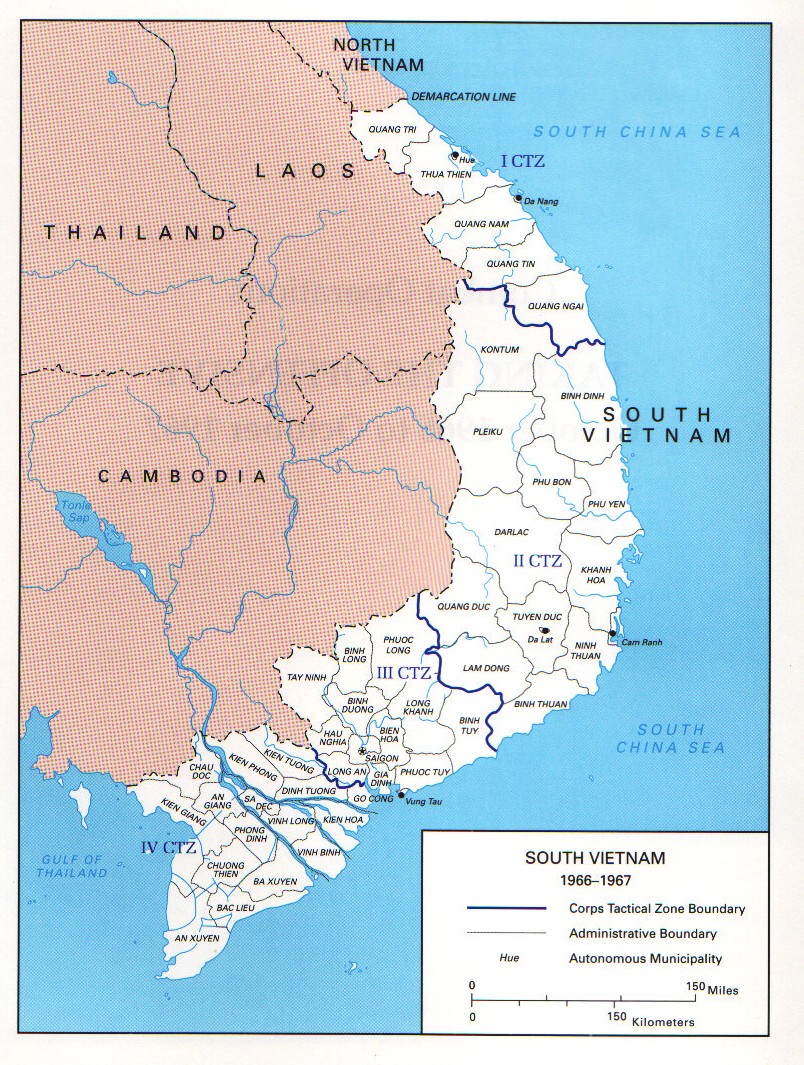
From George L. MacGarrigle, The United States Army in Vietnam: Combat Operations, Taking the Offensive, October 1966-October 1967. Washington DC: Center of Military History, 1998. (Via Wikimedia)
In the course of his troubled presidency, Richard Nixon spoke 14 times to the American people about the war in Vietnam. It was in one of those speeches that he coined the phrase “the silent majority”, while others provoked horror and outrage from those opposed to America’s longest war. But of all these televised addresses, none enjoyed a warmer reaction that the speech Nixon delivered on 23 January 1973, announcing that his Secretary of State, Henry Kissinger, had achieved a breakthrough in the Paris peace talks with the North Vietnamese.
At last, Nixon said, the war was over. At a cost of 58,000 American lives and some $140 billion, not to mention more than two million Vietnamese lives, the curtain was falling. The last US troops would be brought home. South Vietnam had won the right to determine its own future, while the Communist North had pledged to “build a peace of reconciliation”. Despite the high price, Nixon insisted Americans could be proud of “one of the most selfless enterprises in the history of nations”. He had not started the war, but it had dominated his presidency, earning him the undying enmity of those who thought the United States should just get out. But the struggle had been worth it to secure “the right kind of peace, so that those who died and those who suffered would not have died and suffered in vain”. He called it “peace with honour”.
Fifty years on, Nixon’s proclamation of peace with honour has a bitterly ironic ring. As we now know, much of what he said that night was misleading, disingenuous or simply untrue. South Vietnam was in no state to defend itself, and collapsed just two years later. The North Vietnamese had no intention of laying down their weapons, and resumed the offensive within weeks. And Nixon and Kissinger never seriously thought they had secured a lasting peace. They knew the Communists would carry on fighting, and fully intended to intervene with massive aerial power when they did. But then came Watergate. With Nixon crippled, Congress forbade further intervention and slashed funding to the government in Saigon. On 30 April 1975, North Vietnamese tanks crashed through the gates of the presidential palace, and it really was all over.
Half a century later, have the scars of Vietnam really healed? It remains not only America’s longest war but one of its most divisive, comparable only with the Civil War in its incendiary cultural and political impact. The fundamental narrative trajectory of the late Sixties — the turn from shiny space-age Technicolor optimism to strident, embittered, anti-technological gloom — would have been incomprehensible without the daily images of suffering and slaughter on the early evening news. It was Vietnam that destroyed trust in government, in institutions, in order and authority. In 1964, before Lyndon Johnson sent in combat troops after the Gulf of Tonkin incident, fully three-quarters of Americans trusted the federal government. By 1976, a year after the fall of Saigon, not even one in four did so.
It was in the crucible of Vietnam, too, that you can spot many of the tensions that now define American politics. Perhaps the most potent example came in May 1970, after Nixon invaded nominally neutral Cambodia to eliminate the North Vietnamese Army’s jungle sanctuaries. First, on 4 May, four students were shot and killed by the National Guard during a demonstration at Kent State University, Ohio. Then, on 8 May, hundreds more students picketed outside the New York Stock Exchange, only to be attacked by several hundred building workers waving American flags.
The “hard hat riot”, as it became known, was the perfect embodiment of patriotic populist outrage at what Nixon’s vice president, leading bribery enthusiast Spiro Agnew, called “the nattering nabobs of negativism … an effete corps of impudent snobs who characterise themselves as intellectuals”. Today it seems almost predictable, just another episode in the long-running culture wars. But at the time it seemed genuinely shocking. And with his brilliantly ruthless eye for a tactical advantage, Nixon saw its potential. When he invited the construction workers’ leaders to the White House two weeks later, he knew exactly what was doing. “The hard hat will stand as a symbol, along with our great flag,” he said, “for freedom and patriotism and our beloved country”.
Comments Off on The Vietnam War still has echoes in US politics


