
World War Two
Published 21 Jan 2023The Allies have reached the linchpin of the German defenses in Italy, but a first attack proves disastrous. It does, though, divert troops from where they soon plan to make landings behind enemy lines. Meanwhile in the USSR, the huge Soviet offensive in the north makes great gains against the stunned Axis forces.
(more…)
January 23, 2023
Monte Cassino, the Battle Begins – Ep 230 – January 21, 1944
Comments Off on Monte Cassino, the Battle Begins – Ep 230 – January 21, 1944
QotD: Rice farming
There are a lot of varieties of rice out there, but the key divide we want to make early is between dry-rice and wet-rice. When we’re talking about “rice cultures” or “rice agriculture”, generally, we mean wet-rice farming, where the rice is partially submerged during its growing. Wild rice, as far as we can tell, began as a swamp-grass and thus likes to have quite a lot of water around, although precisely controlling the water availability can lead the rice to be a lot more productive than it would be in its natural habitat. While there are varieties of rice which can be (and are) farmed “dry” (that is, in unflooded fields much like wheat and barley are farmed), the vast majority of rice farming is “wet”. As with grains, this is not merely a matter of different methods of farming, but of different varieties of rice that have been adapted to that farming; varieties of dry-rice and wet-rice have been selectively bred over millennia to perform best in those environments.
Wet-rice is farmed in paddies, small fields (often very small – some Chinese agronomists write that the ideal size for an individual rice field is around 0.1 hectare, which is just 0.24 acres) surrounded by low “bunds” (small earthwork walls or dykes) to keep in the water, typically around two feet high. Because controlling the water level is crucial, rice paddies must be very precisely flat, leading to even relatively gentle slopes often being terraced to create a series of flat fields. Each of these rice paddies (and there will be many because they are so small) are then connected by irrigation canals which channel and control the water in what is often a quite complex system.
The exact timing of rice production is more complex than wheat because a single paddy often sees two crops in a year and the exact planting times vary between areas; one common cycle on the Yangtze is for a February planting (with a June harvest) followed by a June planting (with a November harvest). In other areas, paddies planted with rice during the first planting might be drained and sown with a different plant entirely (sometimes including wheat) in the intervening time.
The cycle runs thusly: after the heavy rains of the monsoons (if available), the field is tilled (or plowed, but as we’ll see, manual tillage is often more common). The seed is then sown (or transplanted) and the field is, using the irrigation system, lightly flooded, so that the young seedlings grow in standing water. Sometimes the seed is initially planted in a dedicated seed-bed and then transferred to the field, rather than being sown there directly; doing so has a positive impact on yields, but is substantially more labor intensive. The water level is raised as the plant grows; agian this is labor intensive, but increases yields. Just before the harvest the fields are drained out and allowed to dry out, before the crop is harvested and then goes into processing.
Rice is threshed much like grain (more often manually threshed and generally not threshed with flails) to release the seeds, the individual rice grains, from the plant. That is going to free the endosperm of the speed, along with a hull around it and a layer of bran between the two. Hulling was traditionally done by hand-pounding, which frees the seed from the hull, leaving just the endosperm and some of the bran; this is how you get brown rice, which is essentially “whole-grain” rice. While it is generally less tasty, the bran actually has quite a lot of nutrients not present in the calorie-rich endosperm. Whereas white rice is produced by then milling or polishing away the bran to produce a pure, white kernal of the endosperm; it is very tasty, but lacks many of the vitamins that brown rice has.
Consequently, while a diet of mostly brown rice can be healthy, a diet overwhelmingly of white rice leads to Thiamine deficiency, known colloquially as beriberi. My impression from the literature is that this wasn’t as much an issue prior to the introduction of mechanical milling processes for rice. Mechanical milling made producing white rice in quantity cheap and so it came to dominate the diet to the exclusion of brown rice, producing negative health effects for the poor who could not afford to supplement their rice-and-millet diet with other foods, or for soldiers whose ration was in rice. But prior to that mechanical milling, brown rice was all that was available for the poor, which in turn meant less Thiamine deficiency among the lower classes of society.
Bret Devereaux, “Collections: Bread, How Did They Make It? Addendum: Rice!”, A Collection of Unmitigated Pedantry, 2020-09-04.
Comments Off on QotD: Rice farming
January 21, 2023
When the SS Go Too Far – War Against Humanity 096
World War Two
Published 20 Jan 2023The internal conflict between Poland and the other United Nations Allies deepens as Churchill faces them with diplomatic defeat over Soviet land grab. In the Occupied Netherlands and Poland the Nazis continue their atrocities.
(more…)
Comments Off on When the SS Go Too Far – War Against Humanity 096
January 15, 2023
Time to Liberate Leningrad! – Ep 229 – January 14, 1944
World War Two
Published 14 Jan 2023Three Soviet Fronts launch major offensives to try and finally free Leningrad, under siege for nearly two and a half years now. The Soviets are, in fact, making attacks along most of the Eastern Front. In the South Pacific, the Allies step up their aerial assault to wreck Rabaul’s air power, thus neutralizing it as a base.
(more…)
Comments Off on Time to Liberate Leningrad! – Ep 229 – January 14, 1944
January 8, 2023
“Russians 27 miles from Poland!” – Ep 228 – January 7, 1944
World War Two
Published 7 Jan 2023That’s what the headlines say as the Red Army continues its advance in Ukraine. There are also plans afoot for a northern offensive to end the siege of Leningrad. There are also plans afoot for an Allied amphibious attack in Italy at Anzio. Both of these are set to go off within a couple weeks, so January promises to be full of active conflict.
(more…)
Comments Off on “Russians 27 miles from Poland!” – Ep 228 – January 7, 1944
January 1, 2023
Canadians Take Little Stalingrad – WW2 – 227 – December 31, 1943
World War Two
Published 31 Dec 20221943 reaches its end with no end in sight for the war. In Italy, the Canadians take Ortona after bloody close fighting, the US Marines advance on New Britain, and a new Soviet offensive makes huge gains in the USSR. This isn’t enough for the Allies, though, who have a big shake up in their European Command to help prepare for future attacks.
(more…)
Comments Off on Canadians Take Little Stalingrad – WW2 – 227 – December 31, 1943
QotD: The amazing economic impact of mobile phones in the developing world
We also know why too. Being able to contact people means that markets complete, contracts and transactions are possible. It’s no longer necessary to near randomly meet someone physically in order to be able to organise a transaction. Thus more transactions happen – the value added in voluntary transactions being that GDP which is increasing.
Tim Worstall, “Mobile Phones Cut The Murder Rate – For the Same Reason They Grow The Economy”, Continental Telegraph, 2019-05-30.
Comments Off on QotD: The amazing economic impact of mobile phones in the developing world
December 25, 2022
Stalin’s Christmas Surprise – Major Offensives to Come – WW2 – 226 – December 24, 1943
World War Two
Published 24 Dec 2022Twas the night before Christmas and the war was grinding on. The Moro River Campaign continues in Italy with Canadian infantry pushing past the Gully and into “Little Stalingrad”. Generally, the Allied advance to Rome is turning into a stalemate though, but Winston Churchill still believes an amphibious landing is the way to break this. Joseph Stalin also has some pretty big plans to bring the USSR back to its pre-Barbarossa borders. In the Pacific, there is attrition over Rabaul and stalemate on Bougainville.
(more…)
Comments Off on Stalin’s Christmas Surprise – Major Offensives to Come – WW2 – 226 – December 24, 1943
December 23, 2022
A Jungle Miracle – War Against Humanity 092
World War Two
Published 22 Dec 2022Two escapes, one from the Nazis in Kovno (Kaunas) Lithuania, from the prison at Fort IX, and one from Japanese terror on Panay in the Philippines this week, will help to document the crimes of the Axis powers.
(more…)
Comments Off on A Jungle Miracle – War Against Humanity 092
December 18, 2022
A Super Bomber to Break Japan – WW2 – 225 – December 17, 1943
World War Two
Published 17 Dec 2022This war has now lasted as long as the Great War did, but there’s no signs of it slowing. The Soviets have three offensives going on on the Eastern Front, in Italy the Allies are attacking at San Pietro and over the Moro River, in the Pacific there are Allied landings on New Britain, but in Pacific Command, the big talk is all about a new super bomber.
(more…)
Comments Off on A Super Bomber to Break Japan – WW2 – 225 – December 17, 1943
December 11, 2022
An Amphibious Landing to take Rome? – 224 – December 10, 1943
World War Two
Published 10 Dec 2022There are plans afoot to hit the enemy from behind in Italy. Allied leaders are meeting again in Cairo to go over other plans, notably what to do about China and Burma. There is active fighting on two fronts in Italy too, though this week it doesn’t go particularly well for the Allies. Attacks in the USSR are unsuccessful for the Soviets, but do go well for the Germans, and there are Allied attacks by air in the Marshall Islands and over France.
(more…)
Comments Off on An Amphibious Landing to take Rome? – 224 – December 10, 1943
December 10, 2022
United States Empire – The Spanish-American War
The Great War
Published 9 Dec 2022The Spanish-American War (fought in Cuba and the Philippines) kickstarted US global ambitions and expanded their influence far beyond the borders of the United States. At the same time the war marked the endpoint of the decline of Spain as a global power.
(more…)
Comments Off on United States Empire – The Spanish-American War
The “Dark” Ages were fine, actually — History Hijinks
Overly Sarcastic Productions
Published 5 Aug 2022Curb your Crusading – the artwork, literature, and scholarship are far more interesting.
SOURCES & Further Reading: China: A History by John Keay, Byzantium & Sicily & Venice by John Julius Norwich, Great Courses Lecture series Foundations of Western Civilization by Thomas F. X. Noble lectures 27 through 38: “The Emergence of the Catholic Church”, “Christian Culture in Late Antiquity”, “Muhammad and Islam”, “The Birth of Byzantium”, “Barbarian Kingdoms in the West”, “The World of Charlemagne”, “The Carolingian Renaissance”, “The Expansion of Europe”, “The Chivalrous Society”, “Medieval Political Traditions I”, “Medieval Political Traditions II”, and “Scholastic Culture”.
(more…)
Comments Off on The “Dark” Ages were fine, actually — History Hijinks
December 9, 2022
Canada’s “historic” shift toward the Indo-Pacific is … more marketing than strategy
In The Line, retired Canadian Lieutenant General Mike Day distills down all the airy phrases to see just what the Canadian government is actually going to do in the Indo-Pacific as opposed to merely talking about it:
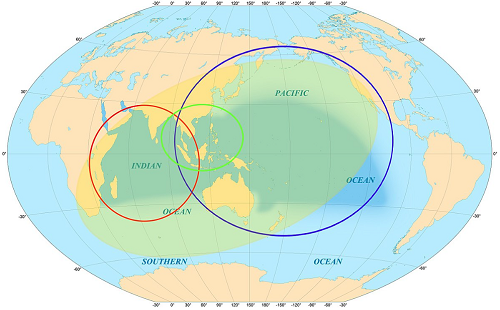
“Red circle/oval roughly depicts the Indian Ocean region. Blue circle/oval covers the Pacific region. Green oval covers ASEAN. Yellow overlay covers the Indo Pacific.”
Map annotation by Eric Gaba via Wikimedia Commons.
A formal public-policy statement from the Government of Canada is a rare thing. It is even rarer when it is not just a speech but a published written document. The rarest of these is undoubtedly when such a document focuses on foreign policy. When Foreign Affairs Minister Mélanie Joly recently pitched her “once-in-a-generation shift” toward the Indo-Pacific, much was made of why Canada was doing it and what it would achieve. No fewer than four cabinet ministers took part in the announcement. Canada will, they announced, step up naval patrols of the region, continue to expand trade with China while also tightening our protections of intellectual property and ownership rules for strategic industries, and use “Team Canada” trade missions to boost commercial links with other growing regional economic powers, including India. We seek also to expand our intelligence and cybersecurity links with allies and partners in the region.
Now that the dust on the rhetoric has settled, closer examination reveals that this might simply be an exercise of branding separate activities into a marketing-friendly bundle, as opposed to a coherent plan focused on achieving specific outcomes.
In examining the document two approaches are equally useful in assessing value: whether the content has some substance and whether the policy framework is sufficiently robust to hang various activities and plans on its body.
Three hints are provided as to why the new plan might not be the cornerstone of Canada’s foreign policy that it portends to be. Firstly, operating in the “National Interest”, a phrase used six separate times over the 26 pages, is given neither form nor function and lacks any definition. It is reminiscent of the Cheshire Cat talking to Alice asking her “where do you want to get to”. When Alice replies that “I don’t much care …” the Cheshire Cat wisely suggests that “Then it doesn’t matter which way you go.” With no definition of national interests pretty much anything can be hand waved as to being necessary and required, or not, for its achievement.
This leads in turn to the second hint that the plan might be more posturing than substance. Lacking the single aimpoint of operating in the national interest, the “objectives” supposedly fill that gap by providing a set of specific achievements which in combination would be a sufficiently clear aimpoint. But normally objectives can, and should, be thought of as something specific and measurable, allowing plans to be developed to achieve them. “Save 100 dollars this month” or perhaps, in more relevant terms, “Increase our trade in the Indo-Pacific region by 100 per cent over the five years of this policy enactment.” Plans can then be developed to achieve those objectives. But reviewing those objectives reveals that they are themselves actions, not end-states. It appears that the policy is based on “doing, not achieving”. I am reminded of my sons many years ago. When asked if their rooms were clean, they would reply, “I’m cleaning it.” The process was enduring but we most certainly disagreed on the value of the activity as opposed to achieving a measurable result. Under this construct the government can claim that as long as Canada is doing stuff the policy should be considered a success.
Comments Off on Canada’s “historic” shift toward the Indo-Pacific is … more marketing than strategy
V-1: Hitler’s Deluded Revenge Plan – War Against Humanity 090
World War Two
Published 8 Dec 2022Japanese planes bomb Calcutta when it is still being crushed by the weight of the Bengali famine. Adolf Hitler and Albert Speer are obsessively trying to increase war production so Germany can begin launching its vengeance weapon against Britain. The wars of resistance continue across the Balkans with continued brutality and a new resistance force emerges in Italy.
(more…)
Comments Off on V-1: Hitler’s Deluded Revenge Plan – War Against Humanity 090


