
Geographics
Published 20 Sep 2022
(more…)
December 7, 2022
Pearl Harbor: Before and After December 7th
Comments Off on Pearl Harbor: Before and After December 7th
December 6, 2022
The coming of the Korean War
In Quillette, Niranjan Shankar outlines the world situation that led to the outbreak of the Korean War in 1950:
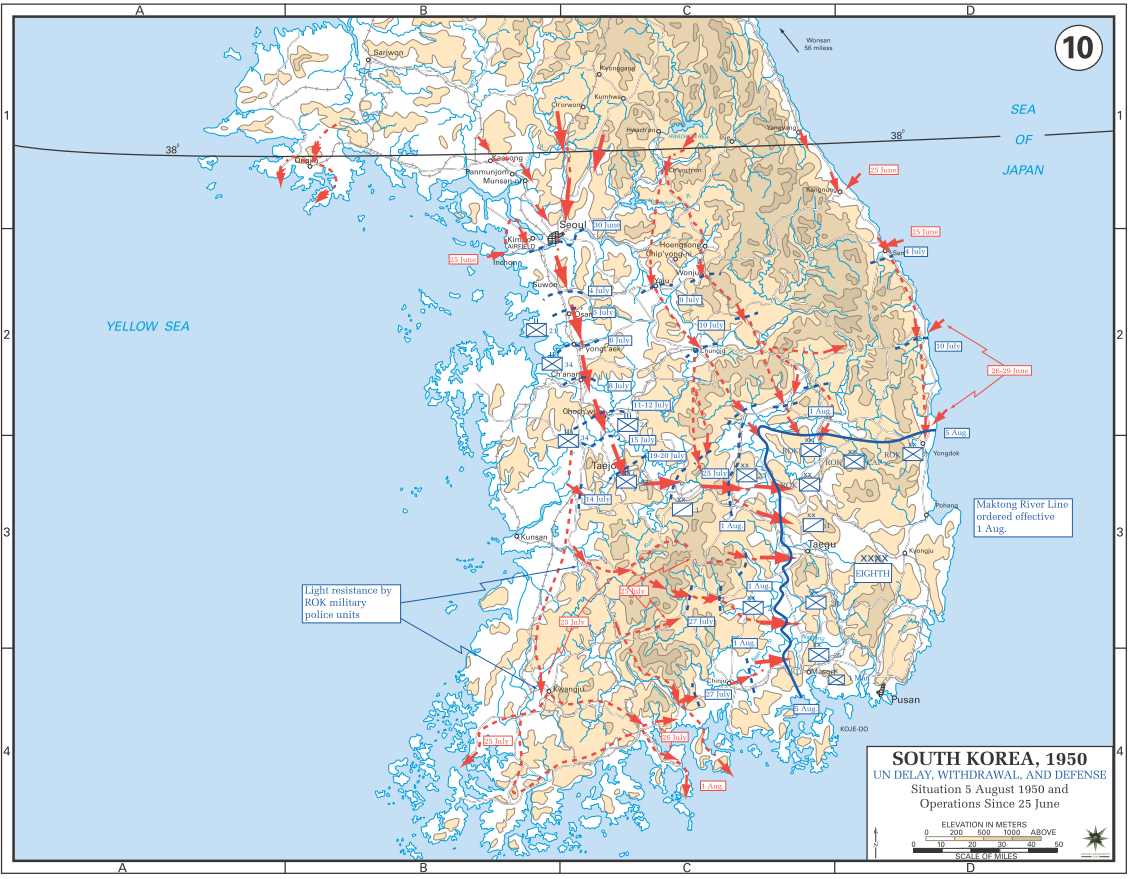
Initial phase of the Korean War, 25 June through 5 August, 1950.
Map from the West Point Military Atlas — https://www.westpoint.edu/academics/academic-departments/history/korean-war
The Korean War was among the deadliest of the Cold War’s battlegrounds. Yet despite yielding millions of civilian deaths, over 40,000 US casualties, and destruction that left scars which persist on the peninsula today, the conflict has never received the attention (aside from being featured in the sitcom M*A*S*H) devoted to World War II, Vietnam, and other 20th-century clashes.
But like other neglected Cold War front-lines, the “Forgotten War” has fallen victim to several politicized and one-sided “anti-imperialist” narratives that focus almost exclusively on the atrocities of the United States and its allies. The most recent example of this tendency was a Jacobin column by James Greig, who omits the brutal conduct of North Korean and Chinese forces, misrepresents the underlying cause of the war, justifies North Korea’s belligerence as an “anti-colonial” enterprise, and even praises the regime’s “revolutionary” initiatives. Greig’s article was preceded by several others, which also framed the war as an instance of US imperialism and North Korea’s anti-Americanism as a rational response to Washington’s prosecution of the war. Left-wing foreign-policy thinker Daniel Bessner also alluded to the Korean War as one of many “American-led fiascos” in his essay for Harper’s magazine earlier this summer. Even (somewhat) more balanced assessments of the war, such as those by Owen Miller, tend to overemphasize American and South Korean transgressions, and don’t do justice to the long-term consequences of Washington’s decision to send troops to the peninsula in the summer of 1950. By giving short shrift to — or simply failing to mention — the communist powers’ leading role in instigating the conflict, and the violence and suffering they unleashed throughout it, these depictions of the Korean tragedy distort its legacy and do a disservice to the millions who suffered, and continue to suffer, under the North Korean regime.
Determining “who started” a military confrontation, especially an “internal” conflict that became entangled in great-power politics, can be a herculean task. Nevertheless, post-revisionist scholarship (such as John Lewis Gaddis’s The Cold War: A New History) that draws upon Soviet archives declassified in 1991 has made it clear that the communist leaders, principally Joseph Stalin and North Korean leader Kim Il-Sung, were primarily to blame for the outbreak of the war.
After Korea, a Japanese imperial holding, was jointly occupied by the United States and the Soviet Union in 1945, Washington and Moscow agreed to divide the peninsula at the 38th parallel. In the North, the Soviets worked with the Korean communist and former Red Army officer Kim Il-Sung to form a provisional “People’s Committee”, while the Americans turned to the well-known Korean nationalist and independence activist Syngman Rhee to establish a military government in the South. Neither the US nor the USSR intended the division to be permanent, and until 1947, both experimented with proposals for a united Korean government under an international trusteeship. But Kim and Rhee’s mutual rejection of any plan that didn’t leave the entire peninsula under their control hindered these efforts. When Rhee declared the Republic of Korea (ROK) in 1948, and Kim declared the Democratic People’s Republic of Korea (DPRK) later that year, the division was cemented. Each nation threatened to invade the other and began preparing to do so.
What initially prevented a full-scale attack by either side was Washington’s and Moscow’s refusal to provide their respective partners with support for the military reunification of the peninsula. Both superpowers had withdrawn their troops by 1949 to avoid being dragged into an unnecessary war, and the Americans deliberately withheld weapons from the ROK that could be used to launch an invasion.
However, Stalin began to have other ideas. Emboldened by Mao Zedong’s victory in the Chinese Civil War and frustrated by strategic setbacks in Europe, the Soviet premier saw an opportunity to open a “second-front” for communist expansion in East Asia with Beijing’s help. Convinced that Washington was unlikely to respond, Stalin gave Kim Il-Sung his long-sought “green-light” to reunify the Korean peninsula under communist rule in April 1950, provided that Mao agreed to support the operation. After Mao convinced his advisers (despite some initial difficulty) of the need to back their Korean counterparts, Red Army military advisers began working extensively with the Korean People’s Army (KPA) to prepare for an attack on the South. When Kim’s forces invaded on June 25th, 1950, the US and the international community were caught completely off-guard.
Commentators like Greig, who contest the communists’ culpability in starting the war, often rely on the work of revisionist historian Bruce Cumings, who highlights the perpetual state of conflict between the two Korean states before 1950. It is certainly true that there were several border skirmishes over the 38th parallel after the Soviet and American occupation governments were established in 1945. But this in no way absolves Kim and his foreign patrons for their role in unleashing an all-out assault on the South. Firstly, despite Rhee’s threats and aggressive posturing, the North clearly had the upper hand militarily, and was much better positioned than the South to launch an invasion. Whereas Washington stripped Rhee’s forces of much of their offensive capabilities, Moscow was more than happy to arm its Korean partners with heavy tanks, artillery, and aircraft. Many KPA soldiers also had prior military experience from fighting alongside the Chinese communists during the Chinese Civil War.
Moreover, as scholar William Stueck eloquently maintains, the “civil” aspect of the Korean War fails to obviate the conflict’s underlying international dimensions. Of course, Rhee’s and Kim’s stubborn desire to see the country fully “liberated” thwarted numerous efforts to establish a unified Korean government, and played a role in prolonging the war after it started. It is unlikely that Stalin would have agreed to support Pyongyang’s campaign to reunify Korea had it not been for Kim’s persistent requests and repeated assurances that the war would be won quickly. Nevertheless, the extensive economic and military assistance provided to the North Koreans by the Soviets and Chinese (the latter of which later entered the war directly), the subsequent expansion of Sino-Soviet cooperation, the Stalinist nature of the regime in Pyongyang, Kim’s role in both the CCP and the Red Army, and the close relationship between the Chinese and Korean communists all strongly suggest that without the blessing of his ideological inspirators and military supporters, Kim could not have embarked on his crusade to “liberate” the South.
Likewise, Rhee’s education in the US and desire to emulate the American capitalist model in Korea were important international components of the conflict. More to the point, all the participants saw the war as a confrontation between communism and its opponents worldwide, which led to the intensification of the Cold War in other theaters as well. The broader, global context of the buildup to the war, along with the UN’s authorization for military action, legitimized America’s intervention as a struggle against international communist expansionism, rather than an unwelcome intrusion into a civil dispute among Koreans.
Comments Off on The coming of the Korean War
QotD: Mao Zedong’s theory of “Protracted War”
The foundation for most modern thinking about this topic begins with Mao Zedong’s theorizing about what he called “protracted people’s war” in a work entitled – conveniently enough – On Protracted War (1938), though while the Chinese Communist Party would tend to subsequently represent the ideas there are a singular work of Mao’s genius, in practice he was hardly the sole thinker involved. The reason we start with Mao is that his subsequent success in China (though complicated by other factors) contributed to subsequent movements fighting “wars of national liberation” consciously modeled their efforts off of this theoretical foundation.
The situation for the Chinese Communists in 1938 was a difficult one. The Chinese Red Army has set up a base of power in the early 1930s in Jiangxi province in South-Eastern China, but in 1934 had been forced by Kuomintang Nationalist forces under Chiang Kai-shek to retreat, eventually rebasing over 5,000 miles away (they’re not able to straight-line the march) in Shaanxi in China’s mountainous north in what became known as The Long March. Consequently, no one could be under any illusions of the relative power of the Chiang’s nationalist forces and the Chinese Red Army. And then, to make things worse, in 1937, Japan had invaded China (the Second Sino-Japanese War, which was a major part of WWII), beating back the Nationalist armies which had already shown themselves to be stronger than the Communists. So now Mao has to beat two armies, both of which have shown themselves to be much stronger than he is (though in the immediate term, Mao and Chiang formed a “United Front” against Japan, though tensions remained high and both sides expected to resume hostilities the moment the Japanese threat was gone). Moreover, Mao’s side lacks not only the tools of war, but the industrial capacity to build the tools of war – and the previous century of Chinese history had shown in stark terms how difficult a situation a non-industrial force faced in squaring off against industrial firepower.
That’s the context for the theory.
What Mao observed was that a “war of quick decision” would be one that the Red Army would simply lose. Because he was weaker, there was no way to win fast, so trying to fight a “fast” war would just mean losing. Consequently, a slow war – a protracted war – was necessary. But that imposes problems – in a “war of quick decision” the route to victory was fairly clear: destroy enemy armed forces and seize territory to deny them the resources to raise new forces. Classic Clausewitzian (drink!) stuff. But of course the Red Army couldn’t do that in 1938 (they’d just lose), so they needed to plan another potential route to victory to coordinate their actions. That is, they need a strategic framework – remember that strategy is the level of military analysis where we think about what our end goals should be and what methods we can employ to actually reach those goals (so that we are not just blindly lashing out but in fact making concrete progress towards a desired end-state).
Mao understands this route as consisting of three distinct phases, which he imagines will happen in order as a progression and also consisting of three types of warfare, all of which happen in different degrees and for different purposes in each phase. We can deal with the types of warfare first:
- Positional Warfare is traditional conventional warfare, attempting to take and hold territory. This is going to be done generally by the regular forces of the Red Army.
- Mobile Warfare consists of fast-moving attacks, “hit-and-run”, performed by the regular forces of the Red Army, typically on the flanks of advancing enemy forces.
- Guerrilla Warfare consists of operations of sabotage, assassination and raids on poorly defended targets, performed by irregular forces (that is, not the Red Army), organized in the area of enemy “control”.
The first phase of this strategy is the enemy strategic offensive (or the “strategic defensive” from the perspective of Mao). Because the enemy is stronger and pursuing a conventional victory through territorial control, they will attack, advancing through territory. In this first phase, trying to match the enemy in positional warfare is foolish – again, you just lose. Instead, the Red Army trades space for time, falling back to buy time for the enemy offensive to weaken rather than meeting it at its strongest, a concept you may recall from our discussions of defense in depth. The focus in this phase is on mobile warfare, striking at the enemy’s flanks but falling back before their main advances. Positional warfare is only used in defense of the mountain bases (where terrain is favorable) and only after the difficulties of long advances (and stretched logistics) have weakened the attacker. Mobile warfare is supplemented by guerrilla operations in rear areas in this phase, but falling back is also a key opportunity to leave behind organizers for guerrillas in the occupied zones that, in theory at least, support the retreating Red Army (we’ll come back to this).
Eventually, due to friction (drink!) any attack is going to run out of steam and bog down; the mobile warfare of the first phase is meant to accelerate this, of course. That creates a second phase, “strategic stalemate” where the enemy, having taken a lot of territory, is trying to secure their control of it and build new forces for new offensives, but is also stretched thin trying to hold and control all of that newly seized territory. Guerrilla attacks in this phase take much greater importance, preventing the enemy from securing their rear areas and gradually weakening them, while at the same time sustaining support by testifying to the continued existence of the Red Army. Crucially, even as the enemy gets weaker, one of the things Mao imagines for this phase is that guerrilla operations create opportunities to steal military materiel from the enemy so that the factories of the industrialized foe serve to supply the Red Army – safely secure in its mountain bases – so that it becomes stronger. At the same time (we’ll come back to this), in this phase capable recruits are also be filtered out of the occupied areas to join the Red Army, growing its strength.
Finally in the third stage, the counter-offensive, when the process of weakening the enemy through guerrilla attacks and strengthening the Red Army through stolen supplies, new recruits and international support (Mao imagines the last element to be crucial and in the event it very much was), the Red Army can shift to positional warfare again, pushing forward to recapture lost territory in conventional campaigns.
Through all of this, Mao stresses the importance of the political struggle as well. For the guerrillas to succeed, they must “live among the people as fish in the sea”. That is, the population – and in the China of this era that meant generally the rural population – becomes the covering terrain that allows the guerrillas to operate in enemy controlled areas. In order for that to work, popular support – or at least popular acquiescence (a village that doesn’t report you because it supports you works the same way as a village that doesn’t report you because it hates Chiang or a village that doesn’t report you because it knows that it will face violence reprisals if it does; the key is that you aren’t reported) – is required. As a result both retreating Red Army forces in Phase I need to prepare lost areas politically as they retreat and then once they are gone the guerrilla forces need to engage in political action. Because Mao is working with a technological base in which regular people have relatively little access to radio or television, a lot of the agitation here is imagined to be pretty face-to-face, or based on print technology (leaflets, etc), so the guerrillas need to be in the communities in order to do the political work.
Guerrilla actions in the second phase also serve a crucial political purpose: they testify to the continued existence and effectiveness of the Red Army. After all, it is very important, during the period when the main body of Communist forces are essentially avoiding direct contact with the enemy that they not give the impression that they are defeated or have given up in order to sustain will and give everyone the hope of eventual victory. Everyone there of course also includes the main body of the army holed up in its mountain bases – they too need to know that the cause is still active and that there is a route to eventual victory.
Fundamentally, the goal here is to make the war about mobilizing people rather than about mobilizing industry, thus transforming a war focused on firepower (which you lose) into a war about will – in the Clausewitzian (drink! – folks, I hope you all brought more than one drink for this …) sense – which can be won, albeit only slowly, as the slow trickle of casualties and defeats in Phase II steadily degrades enemy will, leading to their weakness and eventual collapse in Phase III.
I should note that Mao is very open that this protracted way of war would be likely to inflict a lot of damage on the country and a lot of suffering on the people. Casualties, especially among the guerrillas, are likely to be high and the guerrillas own activities would be likely to produce repressive policies from the occupiers (not that either Chiang’s Nationalists of the Imperial Japanese Army – or Mao’s Communists – needed much inducement to engage in brutal repression). Mao acknowledges those costs but is largely unconcerned by them, as indeed he would later as the ruler of a unified China be unconcerned about his man-made famine and repression killing millions. But it is important to note that this is a strategic framework which is forced to accept, by virtue of accepting a long war, that there will be a lot of collateral damage.
Now there is a historical irony here: in the event, Mao’s Red Army ended up not doing a whole lot of this. The great majority of the fighting against Japan in China was positional warfare by Chiang’s Nationalists; Mao’s Red Army achieved very little (except preparing the ground for their eventual resumption of war against Chiang) and in the event, Japan was defeated not in China but by the United States. Japanese forces in China, even at the end of the war, were still in a relatively strong position compared to Chinese forces (Nationalist or Communist) despite the substantial degradation of the Japanese war economy under the pressure of American bombing and submarine warfare. But the war with Japan left Chiang’s Nationalists fatally weakened and demoralized, so when Mao and Chiang resumed hostilities, the former with Soviet support, Mao was able to shift almost immediately to Phase III, skipping much of the theory and still win.
Nevertheless, Mao’s apparent tremendous success gave his theory of protracted war incredible cachet, leading it to be adapted with modifications (and variations in success) to all sorts of similar wars, particularly but not exclusively by communist-aligned groups.
Bret Devereaux, “Collections: How the Weak Can Win – A Primer on Protracted War”, A Collection of Unmitigated Pedantry, 2022-03-03.
Comments Off on QotD: Mao Zedong’s theory of “Protracted War”
December 5, 2022
Edmund Burke
At Samizdata, Niall Kilmartin republishes part of a much older post out as background on Edmund Burke (who I haven’t yet read):
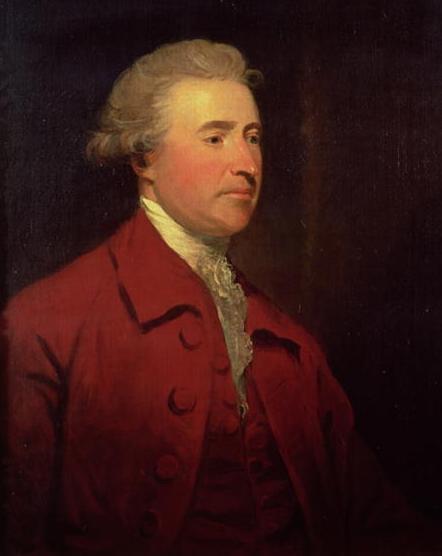
Portrait of Edmund Burke (1729-1797), circa 1770-1780 after a painting of 1774 by James Northcote.
Original in the Royal Albert Museum & Art Gallery via Wikimedia Commons.
When I first started reading Edmund Burke, it was for the political wisdom his writings contained. Only many years later did I start to benefit from noticing that the Burke we know – the man proved a prophet by events and with an impressive legacy – differed from the Burke that the man himself knew: the man who was a lifelong target of slander; the one who, on each major issue of his life, gained only rare and partial victories after years or decades of seeing events tragically unfold as he had vainly foretold. Looking back, we see the man revered by both parties as the model of a statesman and thinker in the following century, the hero of Sir Winston Churchill in the century after. But Burke lived his life looking forwards:
- On America, an initial victory (repeal of the Stamp Act) was followed by over 15 years in the political wilderness and then by the second-best of US independence. (Burke was the very first member of parliament to say that Britain must recognise US independence, but his preferred solution when the crisis first arose in the mid-1760s was to preserve – by rarely using – a prerogative power of the British parliament that could one day be useful for such things as opposing slavery.)
- He vastly improved the lot of the inhabitants of India, but in Britain the first result of trying was massive electoral defeat, and his chosen means after that – the impeachment of Warren Hastings – took him 14 years of exhausting effort and ended in acquittal. Indians were much better off, but back in England the acquittal felt like failure.
- Three decades of seeking to improve the lot of Irish Catholics, latterly with successes, ended in the sudden disaster of Earl Fitzwilliam’s recall and the approach of the 1798 rebellion which he foresaw would fail (and had to hope would fail).
- The French revolutionaries’ conquest of England never looked so likely as at the time of his death in 1797. It was the equivalent of dying in September 1940 or November 1941.
It’s not surprising that late in his life he commented that the ill success of his efforts might seem to justify changing his opinions. But he added that, “Until I gain other lights than those I have“, he would have to go on being true to his understanding.
Burke was several times defeated politically – sometimes as a direct result of being honest – and later (usually much later) resurged simply because his opponents, through refusing to believe his warnings, walked into water over their heads and drowned, doing a lot of irreversible damage in the process. Even when this happened, he was not quickly respected. By the time it became really hard to avoid noticing that the French revolution was as unpleasant as Burke had predicted, all the enlightened people knew he was a longstanding prejudiced enemy of it, so “he loses credit for his foresight because he acted on it”, as Harvey Mansfield put it. (Similarly, whenever ugly effects of modern politics become impossible to ignore, people like us get no credit from those to whom their occurrence is unexpected because we were against them “anyway”.)
Lastly, I offer this Burke quote to guide you when people treat their success in stealing something from you (an election, for example) as evidence of their right to do so:
“The conduct of a losing party never appears right: at least, it never can possess the only infallible criterion of wisdom to vulgar judgments – success.”
Comments Off on Edmund Burke
December 3, 2022
QotD: Mantetsu and the Kwantung Army
Thus the South Manchuria Railway Corporation, originally contracted to develop a defunct line in a disputed territory, soon developed into a full-spectrum enterprise. Pretty much all heavy industry in the Japanese areas of Manchuria were divisions of Mantetsu. But since all the heavy industry depended on mines, and transportation, and food and housing for workers, and banks, and schools for the workers’ children, etc., pretty soon Mantetsu ran all of that, too. By the late 1920s, you could argue that Mantetsu was almost its own country.
It even had its own army, and that’s where things get really interesting.
The Kwantung Army was the security force assigned to the South Manchuria Railway Zone. The Japanese weren’t stupid; they knew the perils of independent commands far from home, and they rotated units through with some regularity. Nonetheless, the command staff remained fairly stable over the years … and so did Mantetsu’s.
The Japanese weren’t stupid, but they were people, and people being people, soon enough the lines between the Kwantung Army and Mantetsu began to blur. And since the lines between Mantetsu, the Imperial Army, and the government were already pretty blurry, pretty soon the concerns of one became the concern of all. (Nor was the Navy left out, though I’m not discussing them in order to keep it simple. They were up to their eyeballs in Mantetsu, too, because warships need lots of steel and steel comes from Manchuria).
A small but highly committed and totally ideologized faction developed inside the Kwantung Army. Several, in fact, and one of them (the Imperial Way faction) attempted an actual coup d’etat in 1936. It was put down, and the Imperial Way faction dissolved (in theory), but the problem of an intensely ideologized officer corps remained. Long story short, you had a small group of highly ideologized officers garrisoning a remote province pulling the entire Empire into big, unwinnable wars.
One could make the case that World War II in the Pacific was ultimately caused by about fifteen or twenty guys in the Kwantung Army.
That’s overly reductionist, but it highlights the huge problem with organizations slipping the leash. In theory, there was a clear chain of command, and even the head of the Kwantung Army was a down it a ways — he was subordinate to the Army Council, which was subordinate to the War Minister, who was subordinate to the Parliament, who were subordinate to the Emperor. In theory, lots of people could’ve sacked Gen. Araki, or his mini-me Ishiwara Kanji (a lieutenant colonel through most of it). Equally in theory, Mantetsu had no say in any of it — the Kwantung Army was a formation of the Imperial Japanese Army, not Mantetsu’s private security force.
But in reality, Mantetsu was so wired in to the Japanese government that in a lot of cases, it was the government. But not always, because the same could be said about the Army, and the Navy, both of which were also wired into Mantetsu up to the very top (or vice versa, your choice). And Mantetsu had their Media arm, of course, as did the Army and Navy …
What all this boiled down to, then, was a power vacuum. I know, that seems weird, but a skilled bureaucratic infighter like Ishiwara never lacked for groups to play against each other. The Army and Navy would oppose on principle any move that seemed to aggrandize the other, neither could go against Mantetsu (and neither could control it), and all had to pay at least lip service to the civilian government. Because of this, real power fell to whomever had the balls to grab it …
… which was the officer corps of the Kwantung Army. They assassinated at least two Manchurian warlords, staged a number of false flag attacks on their own positions, and generally got up to however you say “standard issue Juggalo fuckery” in Japanese, up to and including a full-scale war with China.
Severian, “Slipping the Leash”, Founding Questions, 2022-08-27.
Comments Off on QotD: Mantetsu and the Kwantung Army
November 30, 2022
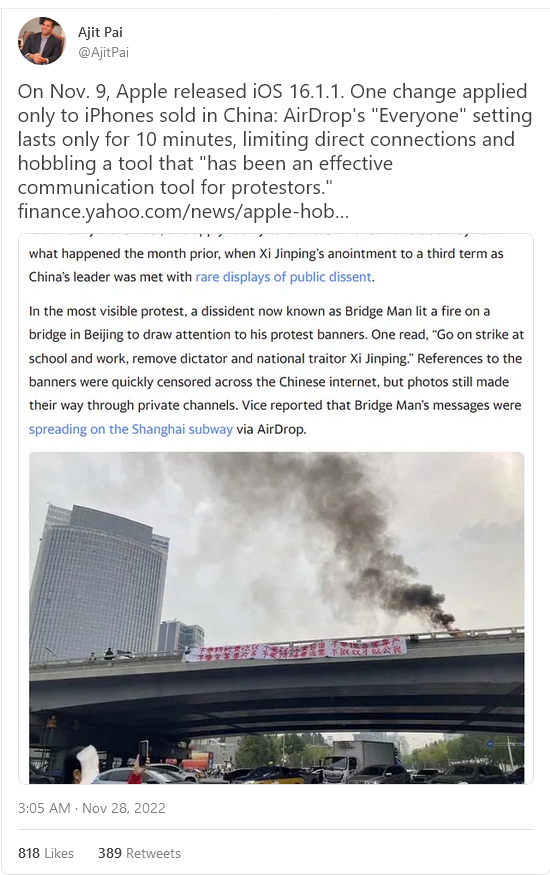
The widespread anti-lockdown protests in China … and how Apple is helping suppress them
N.S. Lyons admires what can only be described as potentially revolutionary protests across many of China’s big cities and resisting further lockdowns by the government:
Something extraordinary happened in China over the weekend. Not long ago I wrote at length, if in a rather different context, about the vital importance of courage in the defense of the true and the human against the cold, mechanistic evil that is nihilistic technocracy, the machine whose Conditioners forever lust after total control – not only over men, but ultimately over reality itself. Well, now we have just seen a stunning example of such courage in the streets of China, where people rose up to reassert their human dignity in the face of the most dehumanizing machine of control in the world today: the Chinese Communist Party’s “zero-Covid” terror-state.
For three years now, the Chinese government has maintained its policy of draconian city-wide lockdowns, endless daily mass testing and biomedical surveillance, digital Covid-passes that arbitrarily govern every aspect of daily life, vast camps to house those dragged into quarantine for weeks (or longer) at a time, and, more recently, such innovations as “closed-loop” factories, where workers are forced to work, sleep, and “live” completely isolated from the outside world so that they can continue to produce your iPhones.
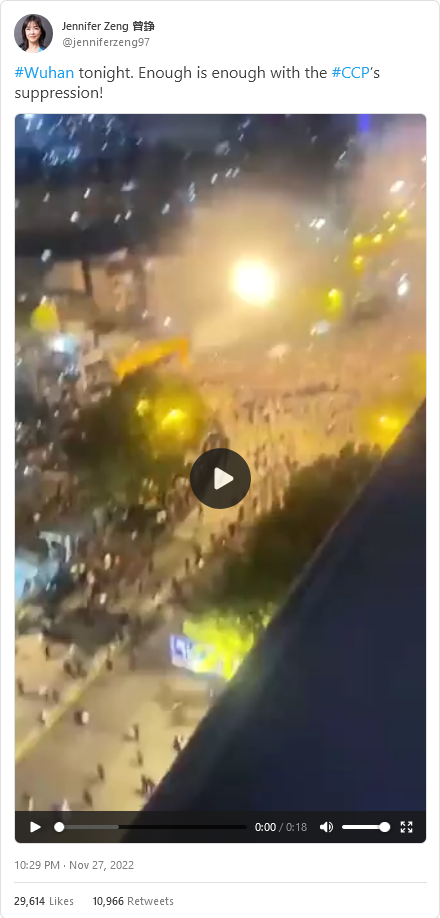
But now over the past several days protests have erupted in at least a dozen cities and 79 universities across the country, with spontaneous demonstrations – often begun by only a handful of people, or even a single individual – quickly drawing crowds of hundreds, even thousands, of people willing to fearlessly demand an end to the zero-Covid nightmare.
In Wuhan, where it all began, swarming crowds smashed down containment barriers and “liberated” locked-down neighborhoods:
[…]
All across the country, many thousands of these protesters spontaneously echoed many of the same lines:
We don’t want PCR tests. We want to eat.
We don’t want Cultural Revolution. We want reform.
We don’t want lockdowns. We want freedom.
We don’t want a Great Leader. We want the vote.
We don’t want lies. We want dignity.
We aren’t slaves. We are citizens.
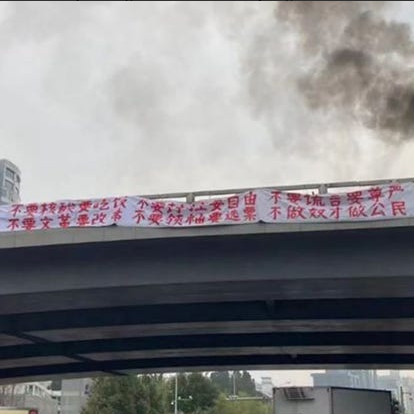
These are conspicuously the same lines as those of a banner hung from a Beijing bridge by a lone (since disappeared) protester, Peng Lifa, on the 13th of October, just ahead of the CCP’s 20th Party Congress and Xi Jinping’s re-coronation as Chinese leader for life.
Now, as recordings of the anti-lockdown protests are swiftly censored online, Chinese netizens have often simply been replying with “We saw it” – a phrase referring not just to the protests, but to Peng Lifa’s message.
His final and most striking line, on a second banner, happens to have been:
“Refuse to go to class. Go on strike. Remove the traitor Xi Jinping.”
And indeed in many protests over the last few days the people’s frustration with zero-Covid tyranny translated into something more: an outpouring of raw anger against the CCP and Xi.
Of course, China’s ruling Communist regime isn’t without its loyal supporters and useful idiots like Apple:
Maybe something will come of the COVID lockdown protests in China. Maybe not, if you’re old enough to remember the guy who stood in front of the tank in Tiananmen Square, and who was never identified nor ever seen again. More likely, the Chinese Communist Party will crack down again, and the people of China will become compliant again.
And the West will turn a blind eye. Again.
Here’s what was in the latest iPhone update, according to Zachary M. Seward of Quartz:
Hidden in the update was a change that only applies to iPhones sold in mainland China: AirDrop can only be set to receive messages from everyone for 10 minutes, before switching off. There’s no longer a way to keep the “everyone” setting on permanently on Chinese iPhones. The change, first noticed by Chinese readers of 9to5Mac, doesn’t apply anywhere else.
In other words, Chinese iPhone users can’t do or say anything without the CCP knowing about it. Dissent can be quashed before it even starts. The Chinese people can be kept under the CCP’s thumb. And Apple is helping.
Comments Off on The widespread anti-lockdown protests in China … and how Apple is helping suppress them
November 28, 2022
Near Peer: China (Understanding the Chinese Military)
Army University Press
Published 29 Jul 2022This film examines the Chinese military. Subject matter experts discuss Chinese history, current affairs, and military doctrine. Topics range from Mao, to the PLA, to current advances in military technologies. “Near Peer: China” is the first film in a four-part series exploring America’s global competitors.
(more…)
Comments Off on Near Peer: China (Understanding the Chinese Military)
November 27, 2022
The Costliest Day in US Marine History – WW2 – 222 – November 26, 1943
World War Two
Published 26 Nov 2022The Americans attack the Gilbert Islands this week, and though they successfully take Tarawa and Makin Atolls, it is VERY costly in lives, and show that the Japanese are not going to be defeated easily. They also have a naval battle in the Solomons. Fighting continues in the Soviet Union and Italy, and an Allied conference takes place in Cairo, a prelude for a major one in Teheran next week.
(more…)
Comments Off on The Costliest Day in US Marine History – WW2 – 222 – November 26, 1943
November 26, 2022
Why so Deadly? – Battle of Okinawa 1945
Real Time History
Published 25 Nov 2022The American invasion of Okinawa was the last big island operation on the Pacific Front. It took the US Marines and Army troops several months to defeat the last Japanese resistance on the island in one of the costliest American victories of the 2nd World War — but in the end not even Japanese Kamikaze attacks and using the civilian population could avert the outcome.
(more…)
Comments Off on Why so Deadly? – Battle of Okinawa 1945
November 25, 2022
The Secret Radio in Auschwitz – War Against Humanity 088
World War Two
Published 24 Nov 2022In Auschwitz the inmates gathering evidence of Nazi crimes score two successes, while the RAF score a direct hit on Goebbels as they set Berlin aflame. In the Pacific the accidental sinking of the SS Suez Maru triggers a Japanese war crime.
(more…)
Comments Off on The Secret Radio in Auschwitz – War Against Humanity 088
Our old, comfortable geopolitical certainties are becoming less comfortable and less certain
In The Line, Matt Gurney discusses a few of the things he heard at the recent Halifax International Security Forum:

First, though, I wanted to explore that grim feeling that swept over me as Forum president Peter Van Praagh stepped up to the lectern and opened the formal proceedings with a review of the geopolitical situation, and how we got here.
From his prepared remarks (slightly trimmed):
Last year … we marked the 20th anniversary of 9/11. It was not an auspicious anniversary. Just months earlier, the United States and its allies withdrew their troops from Afghanistan and discarded the hopes and dreams of so many Afghans … [it] was a low point for Afghanistan and indeed, for all of us. … It was the culmination of 20 years of good intentions. And bad results:
The decisions made in the immediate aftermath of 9/11, North Korea going nuclear, Russia’s invasion of Georgia, the Great Recession, Iran, the Arab Spring and the Syrian civil war, the surge of refugees — more than at any time in human history, the successful rise of populist politics, the higher than necessary death toll from coronavirus, Hong Kong losing its freedoms, January 6 and its wake, climate-change disasters, and our withdrawal from Afghanistan …
It was a tragic end to a 20-year tragic era.
That’s a pretty depressing list. Right?
As a student of history, I always strive to avoid too much recency bias. Most of the things you hear described as “unprecedented” aren’t anything remotely close to that. The general public has a memory of a few years — maybe a generation. We definitely do face some novel challenges today, but we are still better off than most generations in human history, and it’s not even close.
Still. Van Praagh offered a bleak if concise catalogue of tragedy and struggle. And there are some notable absences. The Iraq War, for instance, is probably worth noting as a specific event, not just part of the Sept. 11th fallout. Perhaps the Libyan intervention as well. Some of China’s more aggressive actions, especially at home, also come to mind.
But as I mulled over that terse version of early-21st-century history, something else jumped out at me: most of those threats were things that happened far away and to other people.
I mentioned recency bias above, so it’s only fair to note a different bias: “far away” and “other people” depends on the vantage point, doesn’t it? Every event listed above was a direct and local tragedy for the people caught in the middle of it, who don’t have the luxury of viewing these events at a comfortable remove, the way the West generally has.
The pandemic, of course, did not spare the West. Nor did the Great Recession, the toll of a changing climate and the populist upheavals roiling the democracies. Those are local problems for us all.
The military challenges, though, are getting more and more local, aren’t they? North Korea seemed far away once; today it’s using the Pacific Ocean’s vital sealanes for target practice and providing some of the munitions being used against civilians in Europe. Libya, Syria and the other migration crises posed real societal and political challenges for Europe, but nothing like what the continent has been bracing for in the event of either crippling energy shortages or an outright escalation into a military conflict, potentially nuclear conflict, with Russia. China’s growing ambitions and willingness to use force pose direct challenges to the West and its prosperity; American financier Ken Griffin recently made the headlines when he observed that if Chinese military action were to cut off or disrupt American access to Taiwanese semiconductor chips, the immediate impact on the U.S. economy would be between five and 10 per cent of GDP. That would be a Great Depression-sized bodyblow, and it could happen almost instantly and without much warning.
Pondering Van Praagh’s list later on, it occurred to me that the more remote threats to core Western security and economic interests were also more remote in time. The closer Van Praagh’s summation of crises came to the present, the more immediate and near to us they became.
Comments Off on Our old, comfortable geopolitical certainties are becoming less comfortable and less certain
November 24, 2022
Can I make an AUTHENTIC Katana from wood?
Rex Krueger
Published 23 Nov 2022Historical weapon, beautiful construction & a great holiday gift, Katanas have it all!
Patrons get all plans early: http://www.patreon.com/rexkrueger
Get the FREE templates!: https://www.rexkrueger.com/store (scroll down to bottom of page).
(more…)
Comments Off on Can I make an AUTHENTIC Katana from wood?
A History of Ketchup
Tasting History with Max Miller
Published 12 Jul 2022
(more…)
Comments Off on A History of Ketchup
November 20, 2022
Printing books in China is economical, but also allows China to censor what you print
In the latest SHuSH newsletter, Kenneth Whyte explains why some of Sutherland House’s books are now being printed in China … and illustrates some of the risks of having them printed there:
We decided last spring to offshore some of our book printing to China (see “The Crisis in Book Publishing”, SHuSH 138). It was not a difficult decision. The difference in price is enormous.
For instance. Next week we’re releasing a book called The Prison Lady: True Stories and Life Lessons from Both Sides of the Bars by Phyllis Taylor. Presales have been strong. We need to print more copies. We can’t go back to the original Chinese printer, which charged us $2.08/copy, because it takes months to get books from Guangzhou to Toronto. We need the books now. So we shopped around. The best North American price we could find is $4.39/copy.
Why is that a problem? The book is a paperback priced at $22.95. The retailer takes half that, leaving us $11.50. After our distributor and sales agent take their fees and we pay the author her royalty, we’re left with $6.32 out of which we pay for editing, cover art, design, overhead, and shipping. And printing. If the printing bill comes to $4.39 a copy, we make no money.
Those of the economics of a straightforward paperback. A friend of mine recently called about a quote from a Canadian printer for a full-color illustrated book that came in at $15.31/copy. It seemed steep, so I sent the exact same specs to a Chinese printer who quoted $5.27/copy.
[…]
Our initial plan was to print four of our spring books in China (we’re also using printers in Turkey and India). The files for the first two of the four were delivered last month. On Nov. 7, we received the following email from the printer:
After more detailed review of some of the written content of these two books, there are some significant censorship concerns related to certain references to Taiwan, Hong Kong, and China.
As you may be aware, China vehemently enforces a “one China” principle in which Hong Kong and Taiwan are part of the “one China”. Therefore, China censorship will not allow any reference to either Hong Kong or Taiwan as its own country.
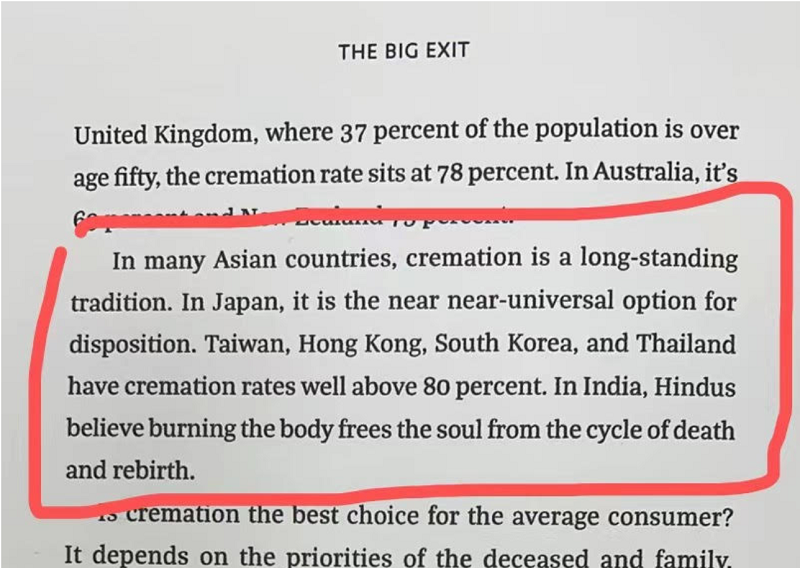
With this in mind, there is some “sensitive wording” on page 46 of The Big Exit that would not be possible to print in China due to it implying that Hong Kong and Taiwan are “countries”.
The Big Exit isn’t about politics. It’s a book about end-of-life choices or, more particularly, how we can dispose of the remains of a billion boomers over the next several decades without wrecking the planet (conventional burial and cremation are both environmentally reckless). The censorship issue arose in this paragraph, which the printer helpfully circled in bright red:
I grant that while Hong Kong still shows up in a lot of data as its own country, it is technically an administrative region of China. Taiwan’s independence is also disputed by China. Against China’s claims, we have the Frank Zappa rules of diplomacy which recognize as “a real country” any place with its own beer and its own airline. Taiwan and Hong Kong both qualify.
In any event, we are now printing The Big Exit in India.
Comments Off on Printing books in China is economical, but also allows China to censor what you print
A Conspiracy to kill America’s President? – WW2 – 221 – November 19, 1943
World War Two
Published 19 Nov 2022A torpedo attack against the President; a Marine invasion in the central Pacific that turns very bloody in a hurry; German counterattacks in the Soviet Union; a bombing raid in Italy against a secret weapons site — all of that this week.
(more…)
Comments Off on A Conspiracy to kill America’s President? – WW2 – 221 – November 19, 1943


