Quotulatiousness

February 25, 2023

Rise of Franco – The Spanish Rif War 1921-1926

Filed under: Africa, Europe, France, History, Military — Tags: , , , , , — Nicholas @ 04:00

The Great War
Published 24 Feb 2023

The Rif War between Spain and the Rif Republic gave rise to a young Spanish officer named Francisco Franco — who later would become Spanish dictator. After Spain had almost lost the war against the Rifi people, they got help from France and WW1 hero Philippe Pétain.
(more…)

February 18, 2023

British Empire Crackdown in South Africa – Boer War 1899-1902

Filed under: Africa, Britain, History, Military, Railways — Tags: , , , , , — Nicholas @ 04:00

The Great War
Published 17 Feb 2023

The 2nd Boer War saw the British Empire bring to bear the entire imperial might to put to rest a dispute with the Boer Republics in South Africa. With scorched earth tactics and the use of concentration camps, the Boer War was a glimpse of what was to come in 20th century warfare.
(more…)

February 17, 2023

Vektor CR21: South Africa’s Futuristic Bullpup

Filed under: Africa, History, Military, Weapons — Tags: , , , , , — Nicholas @ 02:00

Forgotten Weapons
Published 30 Apr 2018

The CR-21 was a private effort to create a new rifle for the South African military in the 1990s. Bullpup designs were all the rage at the time (Austria has the AUG, France had the FAMAS, the UK had the SA80, etc), and so a company called Lyttelton Engineering Works (now part of Denel Land Systems) created a bullpup conversion design for the South African R4 (Galil). It was given a very fluid, futuristic look, and equipped with a fiber optic optic without any iron sights. The action and magazines remained original R4/Galil, however.

The weapon was promoted to the South African military as an economical upgrade package for the R4 rifles already in service, but was met with little interest. Further efforts to sell the weapon to South African police and international military or security customers similarly met with no success. In total, only 200 complete rifles were made, plus parts for another 200. They achieved some notoriety in fictional media because of their looks, including use in the film District 9. As often happens, however, becoming popular in film or video games does not equate to commercial success.

Many thanks to the anonymous collector who let me take a look at this piece and bring you a video on it!
(more…)

February 11, 2023

Tank Chats #167 | French Panhard EBR | The Tank Museum

Filed under: Africa, France, History, Military, Weapons — Tags: , , , , , , , — Nicholas @ 02:00

The Tank Museum
Published 28 Oct 2022

How much do you know about the Panhard EBR? Join David Willey for this week’s Tank Chat as he covers the development, design and use of this French armoured car.
(more…)

January 14, 2023

Of course the Egyptologists would deny it – Great Pyramid conspiracy theories

Filed under: Africa, History, Science — Tags: , , — Nicholas @ 03:00

At Astral Codex Ten, Scott Alexander looks at one of the persistent Great Pyramid conspiracy theories:

The Great Pyramid of Khufu (Cheops) in Giza, Egypt, the oldest of the Seven Wonders of the Ancient World.
Photo by Nian Aldin Thune via Wikimedia Commons.

Some conspiracy theories center on finding anomalies in a narrative. For example, Oswald couldn’t have shot Kennedy, because the bullet came from the wrong direction. Or: the Egyptians couldn’t have built the Pyramids, because they required XYZ advanced technology. I like these because they feel straightforwardly about styles of processing evidence

(Remember, I use the word “evidence” in a broad sense that includes bad evidence. By saying that some conspiracy theory has “evidence”, I’m not suggesting it’s justifiable, just that someone somewhere has asserted that they believe it for some particular reason. For example, someone might say they believe in alien abductions because of eyewitnesses who claim to have been abducted; I’ll be calling the eyewitnesses “evidence” without meaning to assert it is any good.)

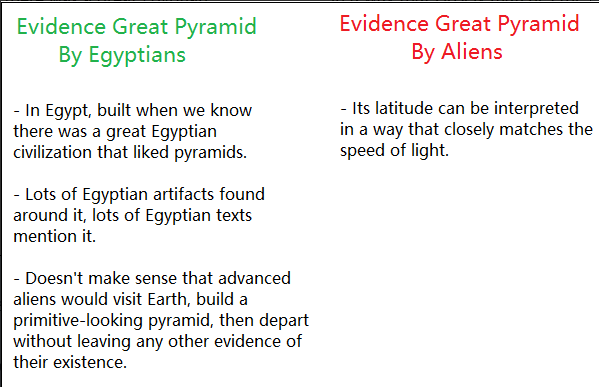
Consider the pseudohistory claims I discuss in The Pyramid And The Garden. The Great Pyramid’s latitude in standard notation equals, to within seven decimal places, the speed of light in tens of millions of meters per second. In a strict sense, this is a one-in-a-million chance, although the post tries to explain why this might be less impressive than it sounds.

So the evidence in favor of “aliens who knew the speed of light built the Great Pyramid” is that it would explain this otherwise baffling coincidence. The evidence against is everything else we know about history, archaeology, architecture, and common sense. Why would superadvanced aliens have visited Earth, created one primitive stone structure, and left without doing anything else? Why does the Great Pyramid look so much like other Egyptian pyramids, and fit into our narrative of Egyptian history so well? What about marks on the Great Pyramid suggesting it was made with primitive tools? Et cetera.

You can sort of see how someone with weird evidence-processing styles might get this wrong. The fact on the right is compact, simple, and quantifiable (the two numbers match to about six digits, so it’s a one-in-a-million coincidence). The facts on the left are vague and holistic.

The mainstream archaeologist has to explain away the evidence on the right. Maybe “has to” is a strong phrase — they can just say “that’s weird, but the common sense evidence is so great that I choose to dismiss it as coincidence”. But it’s an awkward hole in their theory. I talk about how you might go about explaining it away here.

But the conspiracy theorist has to explain away the evidence on the left. This is a harder task. Sometimes you can just stretch a lot of things to make it work — I’ve seen people argue that the supposed mentions in Egyptian texts are less definitive than imagined. But one very strong explanation would be “archaeologists are so invested in protecting the mainstream narrative that they cover up all the evidence that would prove me right”, ie a conspiracy. This neatly sweeps aside a lot of the problem.

January 1, 2023

QotD: The amazing economic impact of mobile phones in the developing world

Filed under: Africa, Asia, Economics, Quotations, Technology — Tags: , , — Nicholas @ 01:00

One of the interesting findings about mobile phones is that they grow the economy. In a country without a general landline network – ie, all the poor ones – 10% of the population gaining a mobile increases GDP by 0.5%. No, not the growth rate goes up from 2% to 2.01%. But an additional 0.5% of GDP each year. Which is, by the standards of these things, pretty big.

We also know why too. Being able to contact people means that markets complete, contracts and transactions are possible. It’s no longer necessary to near randomly meet someone physically in order to be able to organise a transaction. Thus more transactions happen – the value added in voluntary transactions being that GDP which is increasing.

Tim Worstall, “Mobile Phones Cut The Murder Rate – For the Same Reason They Grow The Economy”, Continental Telegraph, 2019-05-30.

December 13, 2022

Egypt’s postwar Nazi military advisors

Filed under: Africa, Books, Germany, History, Middle East, Military, WW2 — Tags: , , , — Nicholas @ 03:00

In The Critic, James Barr reviews a book on the roles of former Nazi military and political figures in the Egyptian forces, Nazis on the Nile: The German Military Advisers in Egypt 1949-1967 by Vyvyan Kinross:

One of the paradoxes of the early postwar era is that, after Germany’s defeat, the Nazis were vilified at the same time that their expertise was sought after by both Cold War superpowers. Germans played key roles in both sides’ space programmes. Less infamous is the part they also went on to play in the Egyptian rocket programme, one of the subjects in this fascinating and disturbing book.

After suffering a humiliating defeat in the war that followed the establishment of Israel, the Egyptians wanted revenge. As the British had refused to help them — despite maintaining a deeply unpopular and large presence astride the Suez Canal — Egypt’s sybaritic King Farouq turned to his enemy’s enemy instead. In 1949 he commissioned an Afrika Korps general, Artur Schmitt, to review the Egyptian army.

Having checked in to a Cairo hotel under the name “Herr Goldstein”, Schmitt inspected Egyptian units and went on to Syria to survey Israel from the Golan Heights. The Egyptians’ failure to combine tanks, artillery and infantry effectively, he decided, explained their “inability to take advantage of the early stages of fighting to wipe the State of Israel off the map”.

Schmitt’s forthright conclusions were unwelcome, and he did not stay long. But some younger Egyptian army officers shared his views and, after they had overthrown Farouq in 1952, they picked up where the king had left off. Within days they offered Fritz Voss, the former head of the Skoda arms factory in Pilsen, the job of masterminding the retraining of the army and the establishment of a military industrial base that could produce jet aircraft and missiles.

Voss in turn invited old contacts to join him, including Wilhelm Beisner, an SS officer who had been part of Einsatzkommando Egypt, which would have spearheaded the Holocaust in Palestine had Rommel won at El Alamein. The Germans found Egyptian working conditions challenging. “Here one has to act much more slowly than in Prussia,” complained a German instructor who found “Oriental sloppiness” irritating. Of forty tanks lined up for a parade to celebrate the first anniversary of the coup, just twelve made it past the junta’s rostrum.

The author, Vyvyan Kinross, is a consultant by profession. He has advised Arab governments and clearly understands the fundamental problems. “The battle” for the Germans, he writes, “was always to reconcile finance, resourcing and the expertise required to execute a sophisticated manufacturing process with the challenging conditions and logistics that prevailed in a country that was late to industrialise and financially underpowered.”

December 8, 2022

Is the Luftwaffe Defeated in 1943? – WW2 Documentary Special

World War Two
Published 7 Dec 2022

Outnumbered and outproduced, the once mighty Luftwaffe is battling to hold its own across three fronts. Every month brings new pain for the force. But the Luftwaffe still has a few tricks up its sleeves and can make the Allies bleed heavily. If only Hitler and the Nazi leadership weren’t sabotaging its chances …
(more…)

November 12, 2022

Climate imperialism

Michael Shellenberger on the breathtaking hypocrisy of first world nations’ rhetoric toward developing countries’ attempts to improve their domestic energy production:

What’s worse, global elites are demanding that poor nations in the global south forgo fossil fuels, including natural gas, the cleanest fossil fuel, at a time of the worst energy crisis in modern history. None of this has stopped European nations from seeking natural gas to import from Africa for their own use.

Rich nations have for years demanded that India and Pakistan not burn coal. But now, Europe is bidding up the global price of liquified natural gas (LNG), leaving Pakistan forced to ration limited natural gas supplies this winter because Europeans — the same ones demanding Pakistan not burn coal — have bid up the price of natural gas, making it unaffordable.

At last year’s climate talks, 20 nations promised to stop all funding for fossil fuel projects abroad. Germany paid South Africa $800 million to promise not to burn coal. Since then, Germany’s imports of coal have increased eight-fold. As for India, it will need to build 10 to 20 full-sized (28 gigawatts) coal-fired power plants over the next eight years to meet a doubling of electricity demand.

This is climate imperialism. Rich nations are only agreeing to help poor nations so long as they use energy sources that cannot lift themselves out of poverty.

Consider the case of Norway, Europe’s second-largest gas supplier after Russia. Last year it agreed to increase natural gas exports by 2 billion cubic meters, in order to alleviate energy shortages. At the same time, Norway is working to prevent the world’s poorest nations from producing their own natural gas by lobbying the World Bank to end its financing of natural gas projects in Africa.

The IMF wants to hold hostage $50 billion as part of a “Resilience and Sustainability Trust” that will demand nations give up fossil fuels and thus their chance at developing. Such efforts are working. On Thursday, South Africa received $600 million in “climate loans” from French and German development banks that can only be used for renewables. The Europeans hope to shift the $7.6 billion currently being invested by South Africa in electricity infrastructure away from coal and into renewables.

Celebrities and global leaders say they care about the poor. In 2019, the Duchess of Sussex, Meghan Markle, Prince Harry’s wife, told a group of African women, “I am here with you, and I am here FOR you … as a woman of color.” Why, then, are they demanding climate action on their backs?

November 2, 2022

Feeding King Tut

Filed under: Africa, Food, History, Middle East — Tags: , , , , — Nicholas @ 04:00

Tasting History with Max Miller
Published 1 Nov 2022
(more…)

October 17, 2022

QotD: Julius Nyerere

When I worked for three years in the 1980s in the East African country of Tanzania, I was outraged by the quite unnecessary state of impoverishment and pauperism to which the policies of the long-time president, Julius K. Nyerere, had reduced the population. These policies – collectivisation of agriculture, destruction of commercial farming and the elimination of incentives for peasants to produce anything, one-party political control over every detail of daily life – were so obviously counterproductive of Nyerere’s repeatedly stated aim to develop his country economically and lift it from its poverty that I long concluded that he must be some kind of fool or intellectual incompetent. But it was I who was the fool.

One day, the not very difficult thought occurred to me that Nyerere’s stated aim was not the real aim, that the aim of his policies was not the economic development of the country or anything like it, but rather the maintenance of himself and his cronies in power. Once I made this simple assumption, I could see what should have been obvious to me from the first: that far from being a miserable failure, Nyerere was a brilliant and outstanding success. Not only had he maintained himself in power for more than twenty years with very little challenge, apart from an early attempt at a coup by the army, but he had successfully managed to present himself to the world as a man of outstanding principle: indeed, there are even now moves afoot by the Catholic Church, to which he was more attached even than he was to Kim Il Sung, to canonise him, notwithstanding his imprisonment of political opponents and his forced removal of the peasantry from where it was living into collectivised villages. One of his miracles was to have extracted huge sums of aid money from the willing dupes of Scandinavia and elsewhere, which disappeared in Tanzania as water through sand but was so essential to him in the maintenance of his power.

If the aim of politicians is the attainment of power, Nyerere was one of the most successful politicians of the twentieth century, and very far from the fool or incompetent that I had thought him.

Theodore Dalrymple, “Brexit Doesn’t Mean Brexit”, Law & Liberty, 2019-04-15.

September 22, 2022

RAF Coastal Command vs U-Boats

The History Guy: History Deserves to Be Remembered
Published 5 Oct 2020

The contest between aircraft and U-Boats during the Second World War was one of competing technological innovations, culminating with a decisive struggle in the summer of 1943. The History Guy tells the forgotten story of the development of anti-submarine warfare and the contest between the aircraft of RAF Coastal Command and U-Boats of the Kriegsmarine in the Bay of Biscay.
(more…)

September 21, 2022

QotD: Why postwar western economic and humanitarian “interventions” almost always failed

… it is a general truism that the majority of persons who run for office in North America and various European countries do so because they sincerely want to help and improve their communities/countries. However, in all of Africa and most of Asia, persons who seek public office do so for one purpose, and one purpose only: to steal everything that they can get away with. So when some ignorant, naïve, American shows up with buckets full of money, oblivious of the culture and the longstanding, entrenched, corruption, and with an announced intention to make the local community more like an American community, they are welcomed with open arms while suppressing their snickering. This also explains something where Americans exhibit willful blindness: other cultures don’t play fair. Honesty is seen as the trait of fools. Fools are to be taken advantage of. Especially in trade and diplomacy. Just look at China.

Prior to the Cold War, America’s interference in other countries’ internal affairs was practically nonexistent outside of the Caribbean where America’s preoccupation was with the stability in the region. What went on in Egypt, Thailand, Argentina, or Greece was none of our business, nor did we frankly care. However, having just survived the cataclysm of WWII, and the realization that Communism was a danger bent on world domination, and that each country that became Communist made that possibility much more likely changed that laissez faire attitude 180 degrees. Whereas NATO was formed for the purpose of deterring a military attack on Western Europe by the Soviet Union (the generals mentally fighting the last war as is always the case, not realizing that the war now was ideological and propagandistic rather than military), diplomats began to question how to best combat Communist insurgencies in the Third World. The arrived (wrong) conclusion was that the reason a country became Communist was because the dirt-poor people were so desperate that they became Marxists in order to improve their lives, so if the West helped poor countries economically Communists could not gain a foothold. As such, they ignored the fact that most Communist movements are organized and headed not by poor people, but by a cadre of power-hungry middle-class intellectuals.

As has been mentioned, the first approach was with foreign aid. The second was with military intervention, in Korea, Vietnam, Santo Domingo, Grenada, and Lebanon. Although such interventions were mostly successful, they carried a heavy price as American blood was spilled in foreign countries. America’s supposed allies hardly helped at all, including the citizens of the countries (Korea and Vietnam) that themselves were in danger of being conquered by Communist forces.

Armando Simón, Schlimmbesserung“, New English Review, 2022-06-16.

August 30, 2022

How did Rome defend its empire? ⚔️

Filed under: Africa, Europe, History, Italy, Middle East, Military — Tags: , , — Nicholas @ 02:00

HistoryMarche
Published 29 Apr 2022

🚩 In this video we analyze the three defensive strategies the Roman Empire deployed from c.27BC to 350 AD, as described in Edward Luttwak’s book The Grand Strategy of the Roman Empire.
(more…)

August 4, 2022

Barbarian Europe: Part 5 – The Vandals in Africa

Filed under: Africa, Europe, History — Tags: , , , , — Nicholas @ 04:00

seangabb
Published 21 May 2021

In 400 AD, the Roman Empire covered roughly the same area as it had in 100 AD. By 500 AD, all the Western Provinces of the Empire had been overrun by barbarians. Between April and July 2021, Sean Gabb explored this transformation with his students. Here is one of his lectures. All student contributions have been removed.
(more…)

« Newer PostsOlder Posts »

Powered by WordPress