
Insider Business
Published 21 Jan 2023Making authentic Tyrian purple dye starts with extracting a murex snail gland. After a series of painstaking steps, Tunisian dye maker Mohamed Ghassen Nouira turns as much as 45 kilograms of snails into a single gram of pure Tyrian purple extract. When he’s done, he can sell it for $2,700. Some retailers sell a gram of the pigment for over $3,000. In comparison, 5 grams of synthetic Tyrian purple costs under $4.
So, why is real Tyrian purple so hard to make? And is that why it’s so expensive?
(more…)
January 20, 2024
Why Tyrian Purple Dye Is So Expensive | So Expensive | Insider Business
Comments Off on Why Tyrian Purple Dye Is So Expensive | So Expensive | Insider Business
January 15, 2024
SS77: South Africa Builds a GPMG on the Shoulders of Giants
Forgotten Weapons
Published 13 Oct 2023In the 1970s, South Africa began looking for a domestic-production GMPG to replace its inventory of FN MAG machine guns. The MAG was an excellent weapon, but the ones in South Africa were getting old and worn out, and with the country under international embargo over Apartheid, new guns and parts were not available from FN.
The SS-77 (named for its two designers, Richard Joseph Smith and Lazlo Soregi) began development in 1977, with initially prototypes built by Lyttleton Engineering Works in 1978. The design took elements from several other excellent machine guns — the side-locking action form the SG43 Goryunov, the barrel release and feed mechanism from the MAG, and the gas system from the PK. After an extensive series of testing and tweaking, the gun was formally adopted by the South African Defence Forces in 1986, and went into serial production. Despite the development cycle, the guns still proved to have significant problems in the field. The gas piston was liable to break, along with problems of broken extractors, loose pins, and other issues. The guns were actually recalled from military service and rebuilt in the early 1990s. Following that redesign program, the gun has proven very reliable and successful in service.
A Mini-SS design was also adopted, essentially the same gun scaled down to 5.56mm. Initial plans were to produce a conversion kit to allow the regular SS-77 to use either caliber, but these were never actually produced.
(more…)
Comments Off on SS77: South Africa Builds a GPMG on the Shoulders of Giants
January 11, 2024
Pushing back against the Colonialism Narrative
At Samizdata, Brendan Westbridge praises Nigel Biggar’s 2023 book Colonialism: A Moral Reckoning:
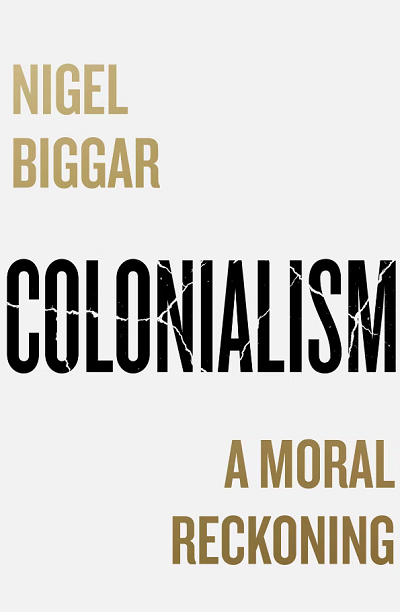
He examines the various claims that the “de-colonisers” make: Amritsar, slavery, Benin, Boer War, Irish famine. In all cases he finds that their claims are either entirely ungrounded or lack vital information that would cast events in a very different light. Amritsar? Dyer was dealing with political violence that had led to murder. Some victims had been set alight. Anyway, he was condemned for his actions by the British authorities and, indeed, his own standing orders. Slavery? Everyone had it and Britain was the first to get rid of it. Benin? They had killed unarmed ambassadors. Irish famine? They tried to relieve it but they were quite unequal to the size of the task. In the case of Benin he comes very close to accusing the leading de-coloniser of knowingly lying. The only one of these where I don’t think he is so convincing is the Boer War. He claims that Britain was concerned about the future of the Cape and especially the Simonstown naval base and also black rights. I think it was the pursuit of gold even if it does mean agreeing with the communist Eric Hobsbawm.
He is far too polite about the “de-colonisers”. They are desperate to hammer the square peg of reality into their round-hole of a theory. To this end they claim knowledge they don’t have, gloss over inconvenient facts, erect theories that don’t bear scrutiny and when all else fails: lie. Biggar tackles all of these offences against objectivity with a calmness and a politeness that you can bet his detractors would never return.
The communists – because they are obsessed with such things and are past masters at projection – like to claim that there was an “ideology” of Empire. Biggar thinks this is nonsense. As he says:
There was no essential motive or set of motives that drove the British Empire. The reasons why the British built an empire were many and various. They differed between trader, migrant, soldier, missionary, entrepreneur, financier, government official and statesman. They sometimes differed between London, Cairo, Cape Town and Calcutta. And all of the motives I have unearthed in this chapter were, in themselves, innocent: the aversion to poverty and persecution, the yearning for a better life, the desire to make one’s way in the world, the duty to satisfy shareholders, the lure of adventure, cultural curiosity, the need to make peace and keep it, the concomitant need to maintain martial prestige, the imperative of gaining military or political advantage over enemies and rivals, and the vocation to lift oppression and establish stable self-government. There is nothing morally wrong with any of these. Indeed, the last one is morally admirable.
One of the benefits of the British Empire is that it tended to put a stop to local wars. How many people lived because of that? But that leads us on to another aspect. Almost no one ever considers what went on before the Empire arrived. Was it better or worse than went before it? Given that places like Benin indulged in human sacrifice, I would say that in many cases the British Empire was an improvement. And if we are going to talk about what went before what about afterwards? He has little to say about what newly-independent countries have done with their independence. The United States, the “white” (for want of a better term) Commonwealth and Singapore have done reasonably well. Ireland is sub-par but OK. Africa, the Caribbean and the Indian sub-continent have very little to show for themselves. This may explain why Britain needed very few people to maintain the Empire. At one point he points out that at the height of the Raj the ratio of Briton to native was 1 to 1000. That implies a lot of consent. Tyrannies need a lot more people.
The truth of the matter is that talk of reparations is rooted in the failure of de-colonisation. If Jamaica were a nicer place to live than the UK, if Jamaica had a small boats crisis rather than the UK then no one would be breathing a word about reparations or colonial guilt. All this talk is pure deflection from the failure of local despots to make the lives of their subjects better.
Biggar has nothing to say about what came after the empire and he also has little to say about how it came about in the first place – so I’ll fill in that gap. Britain acquired an empire because it could. Britain was able to acquire an Empire because it mastered the technologies needed to do it to a higher level and on a greater scale than anyone else. Britain mastered technology because it made it possible to prosper by creating wealth. That in itself was a moral achievement.
Comments Off on Pushing back against the Colonialism Narrative
November 12, 2023
Who Destroyed The Library of Alexandria? | The Rest is History
The Rest is History
Published 21 Jul 2023Step back in time with renowned historians Dominic Sandbrook and Tom Holland as they embark on an enthralling journey to explore the enigmatic tale of the Library of Alexandria’s destruction. Join them as they uncover the who, what, and why behind one of history’s greatest losses.
#LibraryOfAlexandria #DominicSandbrook #TomHolland
Comments Off on Who Destroyed The Library of Alexandria? | The Rest is History
November 10, 2023
Luftwaffe Drilling and US M6 Survival Rifle
Forgotten Weapons
Published 8 Sept 2014Today we’re looking at a pair of military survival rifles. One is a Luftwaffe M30 drilling — the most finely finished and luxurious survival rifle ever issued by a military force. The other is a US Air Force M6 survival gun — spartan and utilitarian — the polar opposite of the M30.
(more…)
Comments Off on Luftwaffe Drilling and US M6 Survival Rifle
October 20, 2023
Zulu Kingdom’s Last Stand – The Anglo-Zulu War 1879
Real Time History
Published 18 Oct 2023The Anglo-Zulu War in 1879 is one of the most well known colonial wars of the British Empire. And while the British ultimately won and annexed the Zulu Kingdom, at the Battle of Isandlwana they suffered one of their worst defeats.
(more…)
Comments Off on Zulu Kingdom’s Last Stand – The Anglo-Zulu War 1879
September 30, 2023
Why did the North Africa Campaign Matter in WW2?
The Intel Report
Published 8 Jun 2023As Erwin Rommel’s Afrika Korps rolled into Egypt in 1942, the only thing standing between them and Cairo and the Suez Canal was the British 8th Army. In this video we look at what was at stake for both sides, and why the North African campaign made a crucial impact on the outcome of the Second World War.
(more…)
Comments Off on Why did the North Africa Campaign Matter in WW2?
September 25, 2023
Something, something “sins of the fathers”, something, something Elon Musk
Chris Bray provides an example of how “mainstream psychosis” has become the new normal, at least among academics and our so-called “elites”:
My argument is not “the news media lies”, or “there’s a lot of misleading discourse”. My argument is that whole overlapping layers of high-status America — in academia, in media, and in politics — are psychotic, fully detached from reality and living in their own bizarre mental construction of a fake world. I don’t mean this figuratively, or as colorful hyperbole. I mean that the top layers of our most important institutions are actually, literally populated by people who are insane, who have cultivated a complete mental descent through the looking glass.
So: Jill Lepore.
Lepore is as high-status as it’s possible to be. She holds an endowed chair at Harvard, she has a Bancroft, and she’s been on the masthead at the New Yorker for almost two decades. She has about as much institutional validation as an academic historian can get. And she just published an essay that wouldn’t be out of place in foot-high crayon letters on the wall of a mental institution.
“What happened to antisemitic rants before social media”, is the actual subhed. You see, before Twitter, people who said that Jews were bad were very marginal, and no one ever listened to them. At the risk of giving away too much personal information, I’m writing this in a bar, and the bartender is giving me some fairly aggressive side-eye over the burst of nervous laughter that I just dropped. Musk’s grandfather was named J.N. Haldeman, and he wrote a lot about how much he didn’t like Jews, and here’s what Lepore has to say about that:
But Haldeman’s legacy casts light on what social media does: the reason that most people don’t know about Musk’s grandfather’s political writings is that in his lifetime social media did not exist, and the writings of people like him were not, therefore, amplified by it. Indeed, they were very unlikely to circulate widely, and are now quite rare.
Jill Lepore has a PhD in history, and she thinks that antisemitic speech was quite rare before social media. Here’s a link to a non-paywalled version of the essay, and I encourage you to go read it. Otherwise you’re going to struggle to believe me. See for yourself, and then come back and I’ll talk about it.
How, if you want to argue that negative statements about Jews had little reach before social media, do you explain … Jewish history? Why didn’t they have time for the bread to rise, Jill? Before Twitter, screeds against Jews “were very unlikely to circulate widely,” except for, I don’t know, Mein Kampf? We dip the parsley in the salt water to remember the bitter tears of our ancestors, who never faced any antisemitism because it was very marginal and never allowed to circulate widely.
It gets better, though, because Haldeman was born in Minnesota, then raised in Canada, and then moved to South Africa two years after the formal implementation of apartheid. He wrote white supremacist tracts in apartheid South Africa, and Lepore maintains that the reach of his racist literature was sharply limited by the absence of social media. See, it was very rare to be able to read racist views in apartheid South Africa.

Comments Off on Something, something “sins of the fathers”, something, something Elon Musk
August 16, 2023
Facts about Africa’s Geography never taught in schools | Thomas Sowell
Thomas SowellTV
Published 20 Nov 2021
(more…)
Comments Off on Facts about Africa’s Geography never taught in schools | Thomas Sowell
July 15, 2023
The French Intifada
Ed West on the origins of the rising violence in French towns and cities:
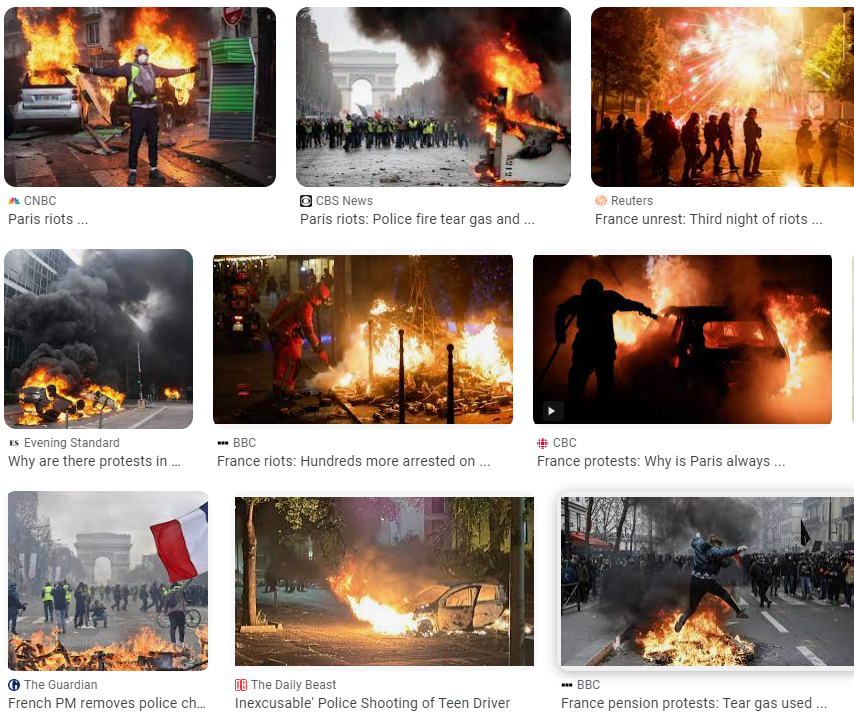
I ran an image search for “Paris rioting” and there was a plentiful supply of fiery, eye-catching photos. Not all of these are from the most recent outbreak of violence, but they are certainly representative of how the legacy media is covering the situation.
The recent violence in Paris and elsewhere, which saw attempts to ram the home of a mayor, once again highlighted the trouble the country has with integration. But the French police union describing themselves as being “at war with vermin” illustrated the different mindset to the English-speaking world, and the far more belligerent approach to the problems of diversity.
Like Britain, the Netherlands, Germany and Sweden, France has had difficulties assimilating the children of immigrants from beyond Europe, yet its recent history has proved especially violent and troubled. Britain has jihadi terrorism – 2017 was especially grim – but it has never reached such intensity. Today, as over 130,000 police officers stand guard to protect the Republic on the day of its celebration, it is worth considering the journey that brought it to such a state.
Analysts have often compared Britain’s state multiculturalism with France’s system of laïcité, which tends to downplay the existence of “communities” even to the point of not taking demographic statistics. Although neither country’s approach has entirely been a success, France’s refusal to recognise immigrants as anything but French has often been blamed for the widespread sense of alienation.
Others point to the housing system, which tends towards concentrations of North and West Africans in suburban banlieues, or the less laissez-faire economic policy which results in higher unemployment (in exchange for better social security).
While they no doubt play a part, the biggest single difference is history, as Andrew Hussey recounted back in 2014 in The French Intifada, in particular France’s history with North Africa. To put it in British terms, imagine that Britain’s rule in Pakistan had involved not a small number of administrators and soldiers but instead hundreds of thousands of British settlers arriving in the country, many with the intention of making it a “new America” (i.e. driving the natives out).
That Britain had declared Pakistan an integral part of the country, and that, rather than scarpering in indecent haste when the empire began to disintegrate, Britain had dug in to preserve its rule in a sadistic war of independence, one in which natives and white settlers committed countless atrocities against each other.
And that this violence had spilled into Britain with assassination attempts and terrorism, by both sides, destabilising the country to the point where there was talk of a coup. And that this was happening just as large-scale immigration to the colonial power was taking place.
Britain experienced nothing like as much violence in the dying days of empire, and indeed the only real comparison with our history was the moment when there was almost all-out conflict between Britain’s Protestant and Irish Catholic populations before the First World War.
If French politicians so casually talk of “civil war” between its right wing and the Algerian-descended population, it is because it has already played out this conflict before – one that was never healed, and so invites a sequel.
Comments Off on The French Intifada
June 27, 2023
QotD: Nelson Mandela, Thabo Mbeki, and the ANC
Needless to say, this is not the story that Western media was telling me about South Africa in the late 90s. Rather they were focused on the dashing and heroic figure of Nelson Mandela. Speaking of which, where exactly was Mandela while all this was going on? Flying around Europe and America getting fêted by celebrities, mostly, and getting sidelined by his much nastier but more effective comrades, including his wife (soon to be ex-wife) Winnie. Mandela may have been president, but he barely had control over his own cabinet, let alone the country. As one of his comrades from the Robben Island prison put it: “there is something very simple and childlike about him. His moral authority, the strength of his principles and his generosity of spirit are all derived from that simplicity. But he will be easily manipulated by those who are quicker, more subtle, and more sophisticated.”
The impression Johnson gives is very much that of a man in way over his head, and when Mandela did try to assert himself, the results were usually buffoonish:
He declared that the solution to continuing violence in KwaZulu-Natal was for everyone to join the ANC … In 1995 he told a May Day rally that if the IFP continued to resist the ANC he would cut off all funding to KwaZulu-Natal, the most populous province. This was a completely unconstitutional threat which had to be quickly retracted. Similarly, when he dismissed Winnie from government he failed to read the constitution and thus had to reappoint her and later dismiss her again. Visiting Tanzania, he announced that: “We are going to sideline and even crush all dissident forces in our country.”
Mandela also made a lot of genuinely very big-hearted speeches pitching a “rainbow nation” vision of South Africa and begging whites not to flee the country, but every time the interests of justice conflicted with those of the ANC, he showed himself to be a party man first and foremost. The most revolting examples of this are two incidents in which independent prosecutors were investigating ANC atrocities (in one case a massacre of dozens of protestors, the other case an incident where some Zulus were kept in a cage inside a local ANC party HQ and tortured for months), and Mandela staked the full power of his moral authority on blocking the inquiries. In the case of the massacre, Mandela went so far as to declare that he had ordered the gunmen to shoot, which everybody knew to be a lie, but which meant that any attempt to pursue the coverup would mean taking down Mandela too. Nobody had the stomach to face that prospect, so the prosecutors dropped the case.
If Mandela was a figurehead, then who was really in charge? The answer is the main character of this book: Thabo Mbeki, the deputy president. Mbeki is a villain of almost Shakespearean proportions — paranoid, controlling, obsessive, bad with crowds yet charming in person. Even before Mandela was out of prison, he was already angling for the number two spot, shaping the narrative, quietly interposing himself between the charismatic Nobel peace prize winner and the true levers of power.
This was bad news for South Africa, because in contrast to Mandela’s “rainbow nation” optimism, Mbeki was a committed black nationalist who immediately set about purging whites from the government and looting white wealth, with little regard for whether this might kill the goose that lays the golden eggs. Johnson ascribes a psychological motivation to all this, asserting that Mbeki suffered from a crushing inferiority complex vis-a-vis the white elites, and quoting several truly bizarre and unhinged public speeches in support of his diagnosis. A more prosaic explanation would just be that like many tyrants in the making, Mbeki sought to create and elevate “new men”, men who owed him everything and whose loyalty could thereby be assured.
Whatever the case, Mbeki quickly began to insist that South Africa’s military, corporations, and government agencies bring their racial proportions into exact alignment with the demographic breakdown of the country as a whole. But as Johnson points out, this kind of affirmative action has very different effects in a country like South Africa where 75% of the population is eligible than it does in a country like the United States where only 13% of the population gets a boost. Crudely, an organization can cope with a small percentage of its staff being underqualified, or even dead weight. Sinecures are found for these people, roles where they look important but can’t do too much harm. The overall drag on efficiency is manageable, especially if every other company is working under the same constraints.
John Psmith, “REVIEW: South Africa’s Brave New World, by R.W. Johnson”, Mr. and Mrs. Psmith’s Bookshelf, 2023-03-20.
Comments Off on QotD: Nelson Mandela, Thabo Mbeki, and the ANC
June 17, 2023
Why Rommel Lost the Battle for North Africa
Real Time History
Published 16 Jun 2023The North African campaign of WW2 is one of the most famous ones. The almost mythical story of the British “Desert Rats” defeating Erwin Rommel’s Afrika Korps. But why did Rommel lose in North Africa?
(more…)
June 1, 2023
Recent discoveries in ancient DNA
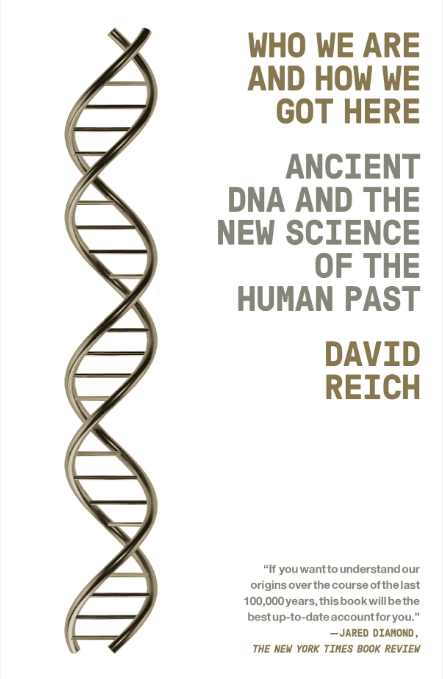
The Psmiths, John and Jane, decided to jointly review a book by David Reich called Who We Are and How We Got Here: Ancient DNA and the New Science of the Human Past. This is Jane’s first contribution to an extended email thread between the Psmiths:
The problem with history is that there just isn’t enough of it. We’ve been around for, what, fifty thousand years? Conservatively.1 And we’ve barely written things down for a tenth of that. Archaeological excavation can take you a little farther back, but as the archaeologists always like to remind us, pots are not people. If you get lucky with a society that made things out of durable materials in a cold and/or dry environment (or you get very lucky with anaerobic preservation of organic materials, like in ice or bogs), maybe you can trace a material culture’s expansion and contraction across time and space. But that won’t tell you whether it’s a function of people moving and taking their stuff with them, or people’s neighbors going “ooh, using string to make patterns on your pots, that’s cool” and copying it. It certainly doesn’t tell you what their descendants were doing several thousand years later, potentially in an entirely different place and probably using an entirely different suite of technologies. Trying to understand what happened in the human past based on the historical and archaeological records is like walking into a room where a bomb has gone off and trying to reconstruct the locations of all the objects before the explosion. You can get some idea, but it’s all very broad strokes. And actually it’s worse than that, because it wasn’t just one explosion, it was lots, and we wouldn’t even know how many if we didn’t have a way of winding the clock back. But these days we do, and it’s ancient DNA.
Sometime between when my grandfather gave me a copy of Luca Cavalli-Sforza’s Genes, Peoples, and Languages for my birthday and when you and I decided to read Reich’s book together, two big things happened: humans got really, really good at sequencing and reading genomes, and Svante Pääbo’s lab in Leipzig got really, really good at extracting DNA from ancient bones. (How they developed their procedures is actually a really interesting story, which Pääbo retells in his book, but Reich — whose lab uses the same techniques on an industrial scale — gives a good, brief summary of how it works.) Together, these two advances unlocked … well, not quite everything about the deep past, but an absolutely enormous amount. Suddenly we can track the people, not just the pots, and the story is more complicated and fascinating than anything we might have expected. I’ve written elsewhere about some of the aDNA discoveries about human evolution (Neanderthal admixture, the Denisovans, etc.), but I’m even more excited about what ancient DNA reveals about our more recent past. Luckily, that’s what Reich spends most of the book on, with discussion of ancient ghost populations who now exist only in admixture and then chapters on the specific population genetic histories of Europe, India, North America, East Asia, and Africa, each of which contains some discoveries that would make (at least the more sensible) archaeologists and historical linguists go “well, duh” and others that are real surprises.
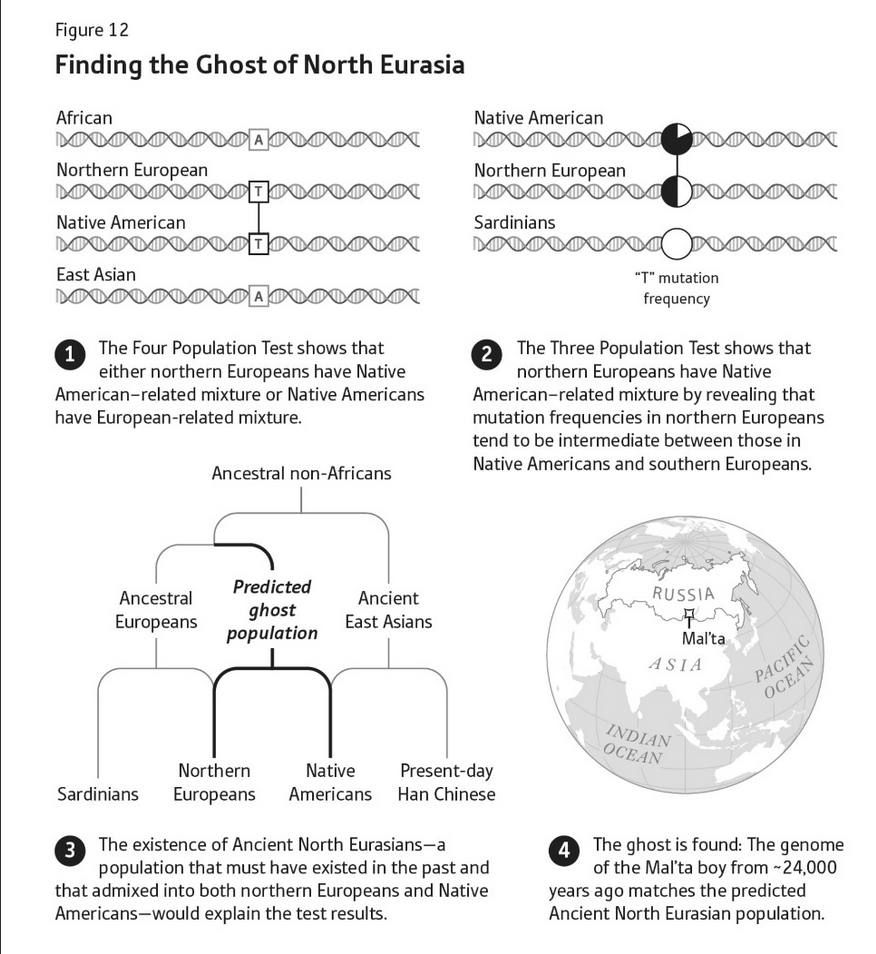
One of the “duh” stories is the final, conclusive identification of the people who brought horses, wagons, and Indo-European languages to Europe with the Yamnaya culture of the Pontic Steppe and their descendants. (David Anthony gives a very good overview of the archaeological case for this in The Wheel, the Horse, and Language, including some very cool experimental archaeology about horse teeth; you have my permission to skim the sections on pots.) My favorite surprising result, though, comes from a little farther north. People usually assume that Native Americans and East Asians share a common ancestor who split from the ancestors of Europeans and Africans before dividing into those two populations, but when Reich’s lab was trying to test the idea they found, to their surprise, that in places where Northern European genomes differ from Africans’, they are closer to Native Americans than to East Asians. Then, using a different set of statistical techniques, they found that Northern European populations were the product of mixture between two groups, one very similar to Sardinians (who are themselves almost-unmixed descendants of the first European farmers) and one that is most similar to Native Americans. They theorized a “ghost” population, which they called the “Ancient North Eurasians”, who had contributed DNA both to the population that would eventually cross the Bering land bridge and to the non-Early European Farmer ancestors of modern Northern Europeans. Several years later, another team sequenced the genome of a boy who died in Siberia 24kya and who was a perfect match for that theorized ghost ANE population.
But we’ve already established that I’m the prehistory nerd in this family; were you as jazzed as I was to read about the discovery of the Ancient North Eurasians?
1. That’s the latest plausible date for the arrival of full “behavioral modernity” in Africa, though our genus goes back about two million years, tool use probably three million, and I think there’s a good case that Homo was meaningfully “us” by 500kya. (That’s “thousand years ago” in “I talk about deep history so much I need an acronym”, fyi.)
Comments Off on Recent discoveries in ancient DNA
May 26, 2023
QotD: After Africa’s “first dance of freedom”
[…]
When I worked briefly as a junior doctor in Rhodesia, as it then still was, under a settler or colonial regime, I noticed something else whose significance it took me years to appreciate, being far less an observer and thinker than Leys.
Black doctors were paid the same as white doctors, unlike in neighboring South Africa; but while I lived like a king on my salary, the black doctors on the same salary lived in penury and near-squalor. Why was that?
The answer was really rather obvious, though it took me a long time to realize it. While I had only myself to consider, the black doctors, being at the very peak of the African pyramid as far as employment was concerned, had to share their salary with their extended family and others: It was a profound social obligation for them to do so and was, in fact, morally attractive.
This, of course, did not prevent them from wishing as individuals to live at the European standard; but this was impossible so long as the colonial regime lasted. Once this elite had its hand on power, however, it had both the means and opportunity to outdo that standard to assuage its sense of humiliation, but the social obligations to look after the extended family and others remained. There was no legitimate way to satisfy these voracious demands other than by gaining and keeping control of political power over the country, which is why the struggle for such control was often so ruthless and bloody. When, in addition, the model of power they had in their minds was that of the colonial ruler, who were in effect salaried philosopher-kings whose prestige was maintained by a lot of ceremonial flimflam (white helmets with egret feathers, splendid uniforms, and the like), it was hardly surprising that the first dance of freedom was actually like a bestiary of bizarre rulers.
The first dance is now nearly over, and if Africa has not settled down to be a realm of political maturity and freedom exactly, there are many fewer bizarre dictators on the continent than there once were. If it is rarely advisable to oppose the political incumbent too openly or fiercely, there is nothing like the quasi-totalitarianism tempered by incompetence that was once so prevalent.
Theodore Dalrymple, “Rule Reversal”, Taki’s Magazine, 2017-09-02.
Comments Off on QotD: After Africa’s “first dance of freedom”
May 24, 2023
The Original PB&J from 1901
Tasting History with Max Miller
Published 23 May 2023
(more…)
Comments Off on The Original PB&J from 1901


