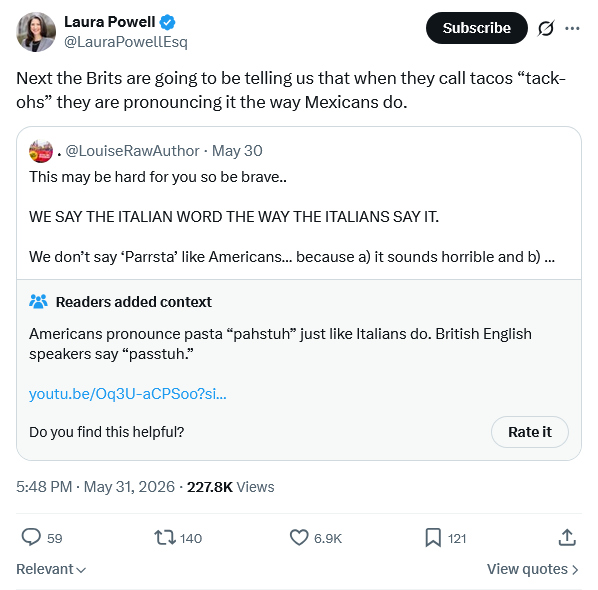
ESR explains why American mispronunciations of Spanish or Italian words tend to be less offensive to those cultures than equivalent British linguistic manglings:
Ah, yet another round of the great pasta-pronunciation debate.
My credentials to speak on this: I am American. I have lived in Great Britain. I have lived in Italy. I pay attention to descriptive phonology. And I was at one time bilingual in English and Spanish.
These facts make me an expert witness on this issue.
Yes, Brits do in fact systematically mispronounce words like “pasta” and “taco” in a way Americans find amusing. But the interesting part of this story is the reason *why* Americans pronounce these words in a way much closer to the Italian and Spanish originals.
It isn’t superior virtue or worldly sophistication or anything like that. It’s the result of an important feature of the American linguistic environment that it doesn’t share with the British one, and which Americans themselves seldom even notice.
Many Americans have heavy exposure to the phonology of Spanish. Brits do not. The result is even that even those of us who are completely monolingual (which is most of us) tend to have models for two phonological systems in our heads rather than one; the second one being Spanish.
There’s a video about this somewhere on YouTube by a linguist, an English one as it happens, who explains that Americans attempting to reproduce the vowel sounds of a foreign language often bend it to try and fit it into the five-vowel system of Spanish. And this is true even when they don’t actually speak Spanish themselves.
One consequence is that even Americans who don’t know Spanish pronounce it tolerably well. Intelligibly, at least. Same goes for Italian, the phonology is slightly different but similar enough.
We crash-land on languages that have vowel systems quite unlike either English or Spanish. There are good reasons that when an American says “pasta” or “taco” his pronunciation is quite unlikely to make a native wince or laugh, but there is no such guarantee about French. Or German. Or Russian. Or just about anything else.
We’re just as lost as the Brits are trying to pronounce those languages. The difference is that, unlike a Brit, we may not mispronounce the local language in a way that makes it sound like a mangled version of English. Americans are likely to make it sound like a mangled version of Spanish instead.