
Adrian Goldsworthy. Historian and Novelist
Published 20 Aug 2025Following on from videos about military planning under the Republic, and about forts and garrisons, today we will begin to look at one of the big debates in the study of the Roman army and the Roman empire — did the Romans plan in a rational and informed way how to secure and defend their empire for the long term future. In short, did the Roman emperors and their advisors have a Grand Strategy which informed their decisions. This time, we will think about how this all started, and in particular Edward N. Luttwak, The Grand Strategy of the Roman Empire (1976), which really kicked off and did much to shape the debate.
January 25, 2026
Grand Strategy of the Roman Empire – Part ONE, the start of the debate
Comments Off on Grand Strategy of the Roman Empire – Part ONE, the start of the debate
QotD: Dostoevsky’s views on revolutionaries in Demons
In a novel about political radicalism you might expect the ideas to take center stage, but here they’re treated as pure comic relief (if you’ve read The Man Who Was Thursday, the vibe is very similar). The guy who wants to kill all of humanity and the guy who wants to enslave all of humanity have some seriously conflicting objectives (and don’t forget the guy who just wants to kill himself and the guy who refuses to say what his goal is), yet they all belong to the same revolutionary society. The leader of their society takes it to an extreme, he has no specific ideas at all. His political objectives and philosophical premises are literally never mentioned, by him or by others. What he has is boundless energy, an annoying wheedling voice,1 and an infinite capacity for psychological cruelty. But all these impressive capacities are directed at nothing in particular, just at crushing others for the sheer joy of it,2 at destruction without purpose and without meaning.
Does that seem unrealistic? That ringleader was actually based on a real life student revolutionary named Sergey Nechayev, whose trial Dostoevsky eagerly followed. Nechayev wrote a manifesto called The Catechism of a Revolutionary, here’s an excerpt from that charming document:
The revolutionary is a doomed man. He has no personal interests, no business affairs, no emotions, no attachments, no property, and no name. Everything in him is wholly absorbed in the single thought and the single passion for revolution … The revolutionary despises all doctrines and refuses to accept the mundane sciences, leaving them for future generations. He knows only one science: the science of destruction … The object is perpetually the same: the surest and quickest way of destroying the whole filthy order … For him, there exists only one pleasure, one consolation, one reward, one satisfaction – the success of the revolution. Night and day he must have but one thought, one aim – merciless destruction.
The ideas don’t matter, because at the end of the day they’re pretexts for desires — the desire to dominate, the desire to obliterate the world, the desire to obliterate the self, the desire to negate.3 Just as in their parents’ generation the desire for status came first and wrapped itself in liberal politics in order to reproduce and advance itself, so in their children the desire for blood and death reigns supreme, and the radical politics serve only as a mechanism of self-justification and a lever to pull. This is not a novel about people, and it’s also not a novel about ideas. It’s a novel about desires, motives, urges, and the ways in which we construct stories to make sense of them.
John Psmith, “REVIEW: Demons, by Fyodor Dostoevsky”, Mr. and Mrs. Psmith’s Bookshelf, 2023-07-17.
- To Dostoevsky’s own surprise, when he wrote the main bad guy of the story, he turned out a very funny, almost buffoonish figure. He may be the most evil person in literature who’s also almost totally comic.
- Dostoevsky is notorious for dropping hints via the names of his characters — applied nominative determinism — and this one’s name means something like “supremacy”.
- Or as another famous book about demons once put it:
I am the spirit that negates
And rightly so, for all that comes to be
Deserves to perish wretchedly;
‘Twere better nothing would begin.
Thus everything that your terms, sin,
Destruction, evil represent —
That is my proper element.
Comments Off on QotD: Dostoevsky’s views on revolutionaries in Demons
January 24, 2026
Modern biochemistry through a trio of Nora Ephron movies
Not being a movie fan, I was only vaguely aware of the author Nora Ephron’s work being turned into movies, but Unbekoming uses three of them (When Harry Met Sally, Sleepless in Seattle, and You’ve Got Mail) to help illustrate one of the major reasons why so many relationships go sour:
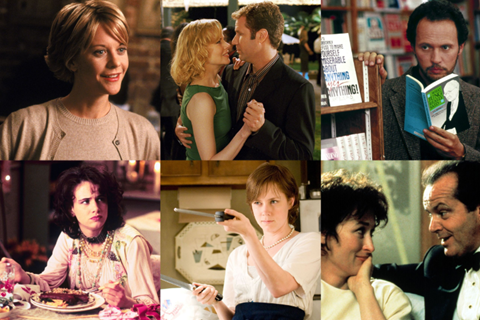
I think this shows stills from Nora Ephron romantic comedies.
The films show what was delivered. But neither fully explains why the delivery was so effective — why millions of women watched these films repeatedly, quoted them to friends, absorbed their vocabulary of magic and clockwork as though it described something they already knew.
The films resonated because they did describe something these women already knew. They just misnamed its source.
The Altered Audience
By the time When Harry Met Sally appeared in 1989, hormonal contraception had been widely available for nearly three decades. The women watching Ephron’s films in theaters — women in their twenties and thirties, the target demographic — were largely women who had been on the pill since adolescence. Many had never experienced an adult month with their natural hormonal cycles intact.
This matters because the pill doesn’t merely prevent pregnancy. It alters brain chemistry, affects mood, suppresses libido, and — most remarkably — changes who women are attracted to.
Research has documented that women on hormonal contraception prefer different types of men than women who are cycling naturally. The pill disrupts the normal attraction toward genetic diversity, causing women to prefer men with similar immune markers rather than complementary ones. Women who meet their partners while on the pill often experience a dramatic shift in attraction when they stop taking it. The man who felt right becomes somehow wrong. The spark disappears. The relationship that seemed stable reveals itself as empty.
The films gave this experience a name: settling. They told women that the absence of “magic” meant they were with the wrong partner — not that they were chemically disconnected from their own desire.
The Misnamed Feeling
Consider what a woman on hormonal contraception might actually be experiencing:
Suppressed libido — the pill is documented to reduce sexual desire, sometimes dramatically. A woman with chemically suppressed desire might experience her stable relationship as passionless, as “clockwork”, without recognizing that the suppression is pharmaceutical rather than relational.
Altered mood — studies show significantly elevated rates of depression and anxiety among pill users. A woman experiencing low-grade, chemically-induced depression might feel that something essential is missing from her life, that she’s “settling”, that the right partner would make her feel alive again.
Disrupted attraction — if the pill alters who women are attracted to, then a woman who chose her partner while on hormonal contraception may genuinely feel reduced attraction to him. The films told her this meant he was the wrong partner. The chemistry told a different story.
Ephron’s films offered a romantic explanation for what was partly a pharmaceutical experience. The vocabulary of “magic” versus “clockwork”, of transformation versus settling, gave women language for feelings they couldn’t otherwise explain. Of course the stable partner feels insufficient. Of course you’re still searching. Of course something is missing. The films validated the dissatisfaction and pointed toward a romantic solution: find the right partner, and the feeling will resolve.
But if the dissatisfaction was partly chemical — induced by years of synthetic hormones disrupting natural mood, desire, and attraction — then finding the right partner couldn’t resolve it. The search would continue indefinitely, the “magic” always receding, the next partner eventually revealing himself as another disappointment.
The Perfect Delivery Mechanism
This is why the films worked so well as cultural programming. They didn’t need to persuade women to feel dissatisfied; the pill had already accomplished that. They only needed to provide a framework that directed that dissatisfaction toward romantic optimization rather than pharmaceutical questioning.
A woman who felt disconnected from her partner, experienced low desire, struggled with mood, and sensed that something fundamental was missing had two possible interpretations:
- Something is wrong with this relationship — I need to find someone who makes me feel alive
- Something is wrong with my body — I need to understand what these hormones are doing to me
The films relentlessly promoted the first interpretation. They never acknowledged the second. They couldn’t — the entire romantic comedy structure depends on the premise that the right partner resolves the longing. If the longing is chemical, the genre collapses.
So millions of women absorbed the lesson: the problem is the partner, not the pill. Keep searching. The magic is out there. When you find him, you’ll know.
And they searched, and the years passed, and the window narrowed, and many of them discovered too late that what they were searching for couldn’t be found in another person — because what they had lost was connection to themselves.
Update: Fixed missing URL.
Comments Off on Modern biochemistry through a trio of Nora Ephron movies
Britain’s Amelia phenomenon
On his Substack, Fergus Mason talks about the new Queen of English Resistance, Amelia:

Amelia, the new queen of the British right.
Independent journalism is a pretty grim business right now. Writing about the state of our poor broken country can be soul-destroying. Good news is thin on the ground; new calamities seem to arrive daily, either a fresh atrocity committed by an illegal immigrant or some new Labour assault on our freedom. So it’s nice when something a little more light-hearted comes along — even if it does make some serious points, too.
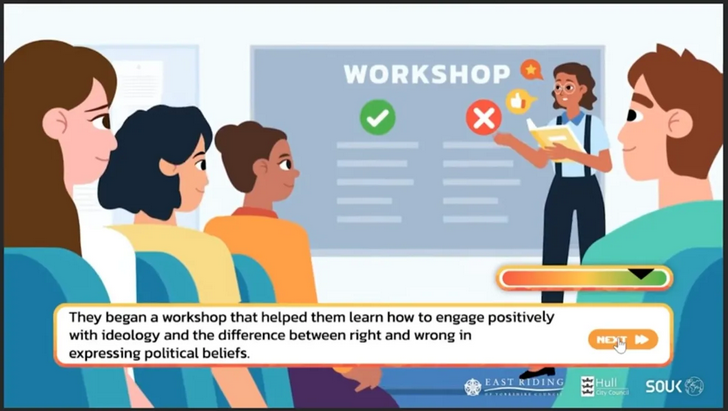
A couple of weeks ago the media started reporting a new online game funded by Prevent, the government’s (completely dysfunctional) department for diverting people away from extremism. Commissioned by Hull City Council and produced by “creative social enterprise” Shout Out UK, the game — called Pathways — is intended to “Encourage learning about the concept of extremism and radicalisation through the process of choice and safe exploration”.
As games go, this is a spectacularly dull one. Players choose a character, from a very limited selection — there are two, one male and one female, but they’re both called Charlie and use they/them pronouns. They then have to navigate their character through a series of scenarios, answering multiple-choice questions. The idea is that if you give the “wrong” answers you’ll get referred to Prevent, but it soon becomes obvious that almost any answers will get you referred to Prevent. The constant theme is that there are approved views and ways of acting — which don’t, for example, include doing research to find out if something you saw on the internet is true or not — and that, if you deviate from this, the state will step in to “support” you. A lot of this support looks suspiciously like re-education:
[…]
Of course, if you know much about the online right, you’ll probably see the problem already. As one stunned Reddit user commented, “Wait, are you telling me they made the cute goth e-girl the ‘racist’? Do they understand how the internet works?”
Well, they certainly do now.
The Daily Telegraph published an article about Pathways on 9 January, bringing the game to public notice. That same day, X user Bovril-Gesellschaft posted “I think I’m in love with Amelia”. It seemed many other right-wingers were too, because within hours Amelia memes were appearing in large numbers. Mostly produced with AI, these depicted Amelia in a wide range of styles (probably reflecting their creators’ personal tastes), but all featured her purple hair and most stuck with the outfit of a pink dress and purple hoodie or cardigan the game depicted her in. Images ranged from cartoons in the style of the original game to photorealism. […]
There’s a lot to laugh about in this. For example, brightly coloured “danger hair” has generally been the hallmark of women on the far left. Amelia subverts this by giving our new heroine her distinctive purple bob. Will we see the pro-Hamas nuts and trans cultists abruptly return to natural hair colours to dissociate themselves from Amelia? That would be funny.

Potato Digger at War: Marlin Model 1917 Machine Gun
Forgotten Weapons
Published 27 Aug 2025John Browning’s first machine gun design was a gas operated system that used a swinging lever instead of a linear piston. He presented the first prototype to Colt in 1890, and it went into production in 1895. The US Navy bought a couple hundred, but the Army opted not to adopt it (much to Colt’s surprise). It was offered for sale internationally, but didn’t become very popular until World War One broke out.
By this time, Colt had improved it a bit with a finned detachable barrel, and they started getting orders for thousands of the guns from Belgium, Russia, Canada, Britain, and elsewhere. Unable to keep up with demand, they licensed the design to the Marlin company. Marlin made a few additional improvements (pistol grip attachment, sights, and access door for clearing malfunctions) and made several thousand for allied nations as well as 2,500 fort he US Army to use as training guns in 1917. They further improved the design by changing it to a linear gas piston, and sold some 38,000 to the US military for aircraft use.
3D animation of the Colt 1895 mechanism from vbbsmyt: • Browning 1895 ‘Potato digger’
Marlin 7MG Aircraft Gun: • Marlin 7MG aka Model 1917 Aircraft Machine…
(more…)
Comments Off on Potato Digger at War: Marlin Model 1917 Machine Gun
QotD: General Electric
Today, General Electric is a company in decline. After a series of problems following the financial crisis of 2008, the company has steadily sold off assets and divisions in an effort to fix its financial problems. In 2019, Harry Markopolos, the guy who sniffed out Bernie Madoff, accused them of $38 billion in accounting fraud. The stock has been removed from the Dow Jones Industrial composite. […] General Electric transformed from a company that made things into a financial services company that owned divisions that made things. Like the American economy in the late 20th century, the company shifted its focus from making and creating things to the complex game of financializing those processes.
Like many companies in the late 20th century, General Electric found that their potential clients were not always able to come up with the cash to buy their products, so they came up with a way to finance those purchases. This is an age-old concept that has been with us since the dawn of time. Store credit is a way for the seller to profit from the cash poor in the market. He can both raise his price and also collect interest on the payments made by his customers relying on terms.
For American business, this simple idea turned into a highly complex process, involving tax avoidance strategies and the capitalization of the products and services formerly treated as business expenses. Commercial customers were no longer buying products and services, but instead leasing them in bundled services packages, financed at super-low interest rates and tax deductible. Whole areas of the supply chain shifted from traditional purchases to leased services.
[…]
That is the real lesson of General Electric. The company became something like the old Mafia bust-outs. The whole point of the business was to squeeze every drop of value from clients and divisions. Instead of running up the credit lines and burning down the building for the insurance, General Electric turned the human capital of companies into lease and interest payments. They were not investing and creating, they were monetizing and consuming whatever it touched. […] The cost of unwinding the company back into a normal company will be high, maybe too high for them to survive. The same can be said of the American economy. It will have to be unwound, but there will be no bailout. Instead, it will have to unwind quickly and painfully, in order to become a normal economy again. [NR: According to Wiki, “GE Aerospace, the aerospace company, is GE’s legal successor. GE HealthCare, the health technology company, was spun off from GE in 2023. GE Vernova, the energy company, was founded when GE finalized the split. Following these transactions, GE Aerospace took the General Electric name and ticker symbols, while the old General Electric ceased to exist as a conglomerate.“]
The Z Man, “GE: The Story Of America”, The Z Blog, 2020-06-29.
Comments Off on QotD: General Electric
January 23, 2026
“Functional illiteracy was once a social diagnosis, not an academic one”
On Substack, Maninder Järleberg illuminates the problem of functional illiteracy in higher education in the west:
The Age of Functional Illiteracy
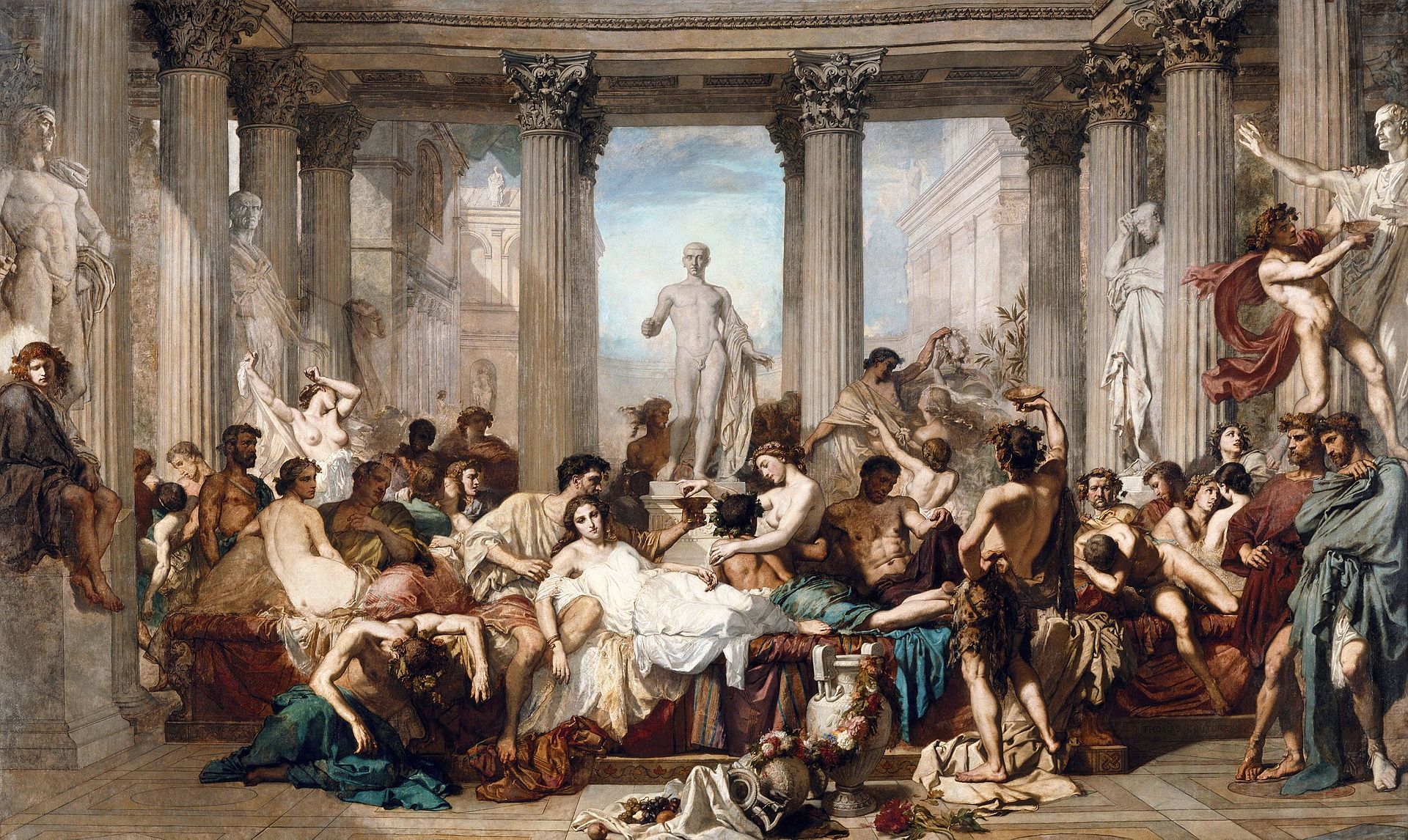
Functional illiteracy was once a social diagnosis, not an academic one. It referred to those who could technically read but could not follow an argument, sustain attention, or extract meaning from a text. It was never a term one expected to hear applied to universities. And yet it has begun to surface with increasing regularity in conversations among faculty themselves. Literature professors now admit — quietly in offices, more openly in essays — that many students cannot manage the kind of reading their disciplines presuppose. They can recognise words; they cannot inhabit a text.
The evidence is no longer anecdotal. University libraries report historic lows in book borrowing. National literacy assessments show long-term declines in adult reading proficiency. Commentators in The Atlantic, The Chronicle of Higher Education, and The New York Times describe a generation for whom long-form reading has become almost foreign. A Victorian novel, once the ordinary fare of undergraduate study, now requires extraordinary accommodation. Even thirty pages of assigned reading can provoke anxiety, resentment, or open resistance.
It would be dishonest to ignore the role of the digital world in this transformation. Screens reward speed, fragmentation, and perpetual stimulation; sustained attention is neither required nor encouraged. But to lay the blame solely at the feet of technology is a convenient evasion. The crisis of reading within universities is not merely something that has happened to the academy. It is something the academy has, in significant measure, helped to produce.
The erosion of reading was prepared by intellectual shifts within the humanities themselves—shifts that began during the canon wars of the late twentieth century. Those battles were never only about which books should be taught. They were about whether literature possessed inherent value, whether reading required discipline, whether difficulty was formative or oppressive, and whether the humanities existed to shape students or merely to affirm them. In the decades that followed, entire traditions of reading were dismantled with remarkable confidence and astonishing speed.
The result is a moment of institutional irony. The very disciplines charged with preserving literary culture helped undermine the practices that made such culture possible. What we are witnessing now is not simply a failure of students to read, but the delayed consequence of ideas that taught generations of readers to approach texts with suspicion rather than attention, critique rather than encounter.
This essay is part of a larger project to trace that history, to explain how a war over the canon helped usher in an age in which reading itself is slipping from our grasp, and why the consequences of that war are now returning to the academy with unmistakable force.
The Canon Wars: A Short Intellectual History
To understand the present state of literary studies, one must return to the canon wars of the 1980s and 1990s — a conflict that reshaped the humanities with a speed and finality few recognised at the time. Although remembered now as a dispute about which books deserved a place on the syllabus, the canon wars were in truth a contest over the very meaning of literature and the purpose of a humanistic education.
In the decades after the Second World War, the curriculum in most Western universities still rested upon a broadly shared assumption: that certain works possessed enduring value, that they spoke across time, and that an educated person should grapple with them. This conviction, however imperfectly applied, formed the backbone of the humanities. It was also increasingly at odds with a new intellectual climate shaped by post-1968 radicalism, the rise of identity politics, and the importation of French theory.
By the early 1980s, tensions that had simmered beneath the surface erupted into public view. The most emblematic flashpoint came at Stanford University in 1987–88, when student demonstrators chanted, “Hey hey, ho ho, Western Culture’s got to go!” in protest of the university’s required course on Western civilisation. The course was soon dismantled, replaced by a broader, more ideologically framed program. What happened at Stanford quickly reverberated across the country. Departments revised reading lists, restructured curricula, and abandoned long-standing core requirements.
On one side of the debate stood defenders of the canon—figures such as Harold Bloom, Allan Bloom, E.D. Hirsch, and Roger Kimball—who argued that the great works formed a kind of civilisational inheritance. The canon, they insisted, was not a museum of privilege but a record of human striving, imagination, and achievement. On the other side were scholars like Edward Said, Toni Morrison, Henry Louis Gates Jr., Gayatri Spivak, and Homi Bhabha, who contended that the canon reflected histories of exclusion and domination, and that expanding or dismantling it was a moral imperative.
But beneath these arguments lay a deeper philosophical rift. The defenders assumed that literature possessed intrinsic value, that texts could be read for their beauty, their insight, or their power. The critics, armed with concepts drawn from Foucault, Derrida, and Barthes, argued that literature was inseparable from structures of power, that meaning was unstable, and that reading was less an act of discovery than an exposure of hidden ideological operations.
The canon wars ended not with a negotiated peace but with a decisive transformation. The traditional canon was not merely expanded; its authority was dissolved. And with it dissolved a set of shared assumptions about why we read at all.
Comments Off on “Functional illiteracy was once a social diagnosis, not an academic one”
The Rise and Fall of Watneys – human-created video versus AI slop
YouTuber Tweedy Misc released what he believed was the first attempt to discuss Watneys Red Barrel, the infamous British beer that triggered the founding of the Campaign for Real Ale (CAMRA). His video didn’t show up in my YouTube recommendations, but a later AI slop video that clearly used Tweedy’s video as fodder did get recommended and I even scheduled it for a later 2am post because it seemed to be the only one on the topic. I’m not a fan of clanker-generated content, but I was interested enough to set my prejudices aside for a treatment of something I found interesting. Tweedy’s reaction video, on the other hand, did appear in my recommendations a few weeks later, and I felt it deserved to take precedence over the slop:
And here’s the AI slop video if you’re interested:
Dear Old Blighty
Published Dec 20, 2025Discover how Watneys Red Barrel went from Britain’s biggest-selling beer to its most hated pint in just a few short years. This video explores how corporate brewing, keg beer, and ruthless pub control nearly destroyed traditional British ale, sparked a nationwide consumer revolt, and gave birth to CAMRA. From Monty Python mockery to boycotts in local pubs, Watneys became a national punchline and a cautionary tale in business failure. Learn how one terrible beer accidentally saved British brewing culture, revived real ale, and reshaped how Britain drinks forever.
#Watneys #BritishBeer #UKNostalgia #RealAle #CAMRA #BritishPubs #RetroBritain #LostBrands #BeerHistory #DearOldBlighty
Comments Off on The Rise and Fall of Watneys – human-created video versus AI slop
Canadian schizophrenia: “Resist US aggression!” but also “Disarm law-abiding civilians!”
Returning to a topic I’ve been mocking all week on the socials, in The Line, Matt Gurney gently suggests to the Canadian government that it’s just not reasonable to expect Canadian civilians to wage some kind of fierce guerilla war against a feared American invasion while actively disarming Canadians who legally own guns:

A lot has happened, is the thing. A lot is still happening. And it all seems to be happening faster.
But it’s still worth slowing things down just a little bit when the news stories arrive in particularly baffling sequences. Consider just two you may have seen this week: Canada is thinking about fighting an insurgency in case the Americans invade us, and Canada is also working hard to disarm its civilian population. Can I just interject here a moment and suggest that these goals are at odds? That this might be a stupid way of doing things? That the Canadian federal right hand would be shocked and appalled to discover what the left hand was doing?
Let’s take a minute and set up the insurgency thing. It comes from an article published this week in The Globe and Mail. Canadian soldiers are not frantically digging trenches quite yet. The overall consensus is that a U.S. invasion of Canada is unlikely. But clearly, the current trajectory of U.S. geopolitics has shifted the prospect from “batshit crazy” to “it would be weird but we should probably think about it”. So the military is thinking about it — it’s now a contingency being considered, just like the military plans for natural disasters or less bizarre military scenarios, like a war requiring a mobilization or an attack by a terror group or hostile nation on Canadian soil.
And what is the military thinking? Allow me to quote from the Globe:
The two senior government officials said military planners are modelling a U.S. invasion from the south, expecting American forces to overcome Canada’s strategic positions on land and at sea within a week and possibly as quickly as two days.
Canada does not have the number of military personnel or the sophisticated equipment needed to fend off a conventional American attack, they said. So, the military envisions unconventional warfare in which small groups of irregular military or armed civilians would resort to ambushes, sabotage, drone warfare or hit-and-run tactics.
One of the officials said the model includes tactics used by the Afghan mujahedeen in their hit-and-run attacks on Russian soldiers during the 1979-1989 Soviet-Afghan War. These were the same tactics employed by the Taliban in their 20-year war against the U.S. and allied forces that included Canada. Many of the 158 Canadian soldiers killed in Afghanistan from 2001 to 2014 were struck by improvised explosive devices or IEDs.
Mmm. This yogurt is tasty.
Let me say three things here: first, I can confirm some of the Globe‘s reporting via my own sources. I know for a fact that members of the Canadian Armed Forces are talking, in a very conceptual, high-level way, about what an insurgency against an invader could and would look like in Canada. I do not know of any serious plans or preparations. But discussions? Absolutely. Second, the plan above, in very vague terms, is probably about correct, in terms of how the Canadian population could resist an invader. The actual shooting war would be over almost immediately — the U.S.’s military advantage would be overwhelming. I think two days is optimistic, frankly. I’m not sure it would take much more than two hours to smash any meaningful military resistance.
So, longer term insurgency against a larger and more advanced force would be the only real option, and in that kind of fight, we’d have some real advantages. We’d be a tougher nut to crack, in many ways, than either Iraq or Afghanistan.
But only if we don’t hobble ourselves first. And this brings us to the third point I’d like to make: did you notice the part about “armed civilians”? Because I sure did.
Civilians, sometimes augmented by experienced military personnel in technical and leadership roles, are always the backbone of an insurgency. They have to be. Insurgencies are hit-and-run affairs, and you can’t do that if you’re driving a tank back to a base. In order to be effective, the population must be armed, or somehow have the means to arm itself. Not to be cute, but the resistance being armed is a necessary precondition for a successful armed resistance.
And we are disarming ourselves.
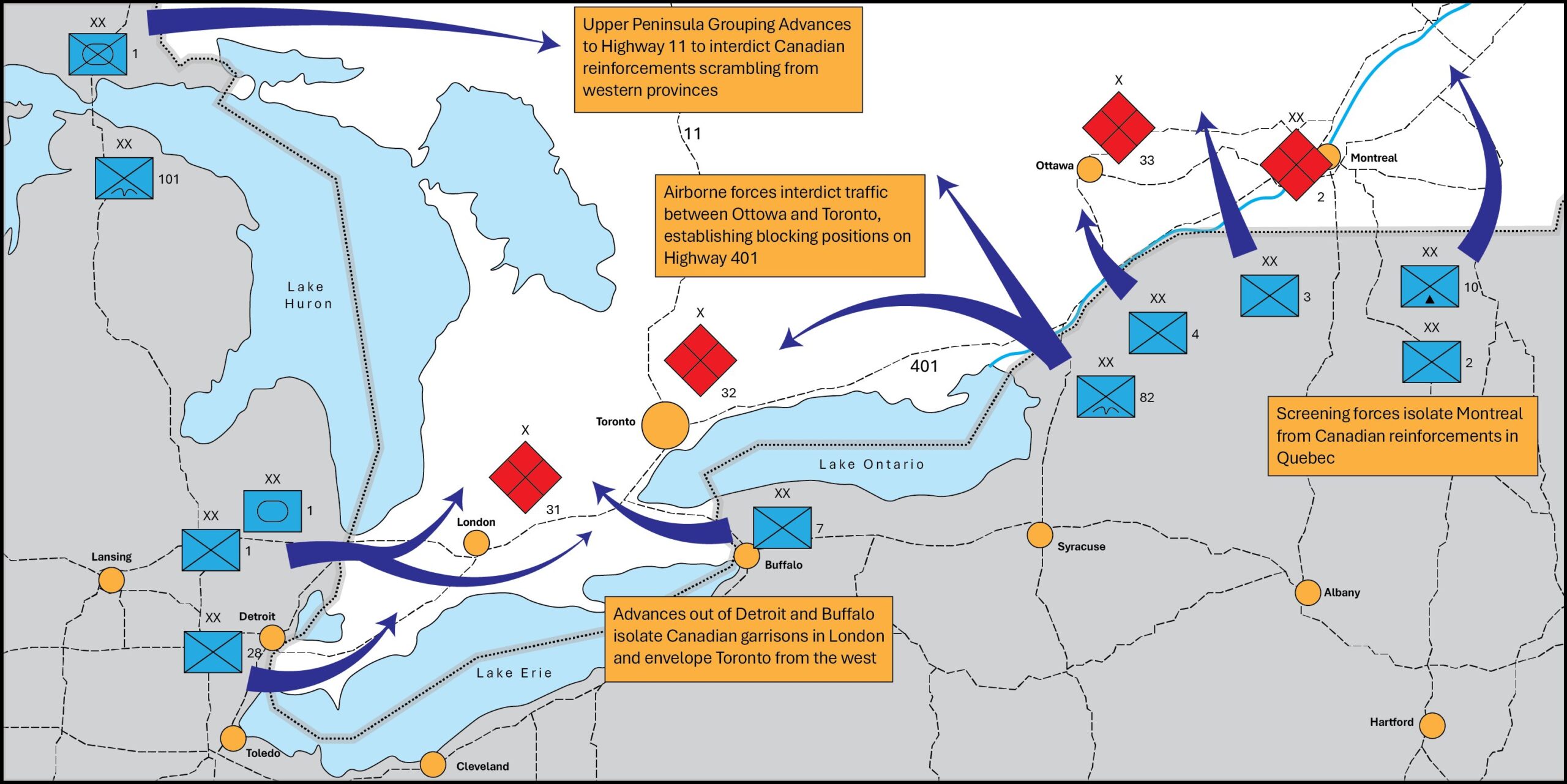
For the record, Canada and the US have historically had plans to defend against one another even at times we’ve otherwise been very peaceful and friendly. About a year ago, Big Serge suggested updates to the old US “War Plan Red” scenario invasion of Canada:
The country’s political and economic center of gravity is the urban corridor from Toronto to Montreal, but a significant share of the Canadian Army is dispersed, with large garrisons in Quebec, Halifax, and the western provinces. Only handful of brigades are garrisoned in the critical theater.
Manifest Destiny, 2025? Big Serge’s updated map for the old US War Plan Red for a military invasion of Canada.
The war will be won quickly and decisively, without massive destruction of Canadian cities, if American forces can establish blocking positions to isolate the urban corridor from peripheral Canadian garrisons. In this maneuver scheme, we utilize highly mobile elements including 1st Cavalry Division and airborne forces to block the highways into Toronto, while an eastern screening group isolates the urban centers from reinforcements scrambling in from Quebec.
Proving my near-Nostradamus-level ability to foresee the future, I remarked that “As to why Trump would want to invade a frozen failed state on the brink of bankruptcy, even Big Serge doesn’t have an answer”. Now, of course, the biggest risk to US security would come from Canadian “snowbirds” in Florida, Texas, and Arizona, who may be prone to driving their motor homes or golf carts to attack ICE and US Border Patrol facilities before the Bingo games start at 8.
WW1: 1 Million Vs 1 Million at the Marne | EP 3
The Rest Is History
Published 1 Sept 2025What extraordinary events saw the French — already on the brink of defeat — take on the formerly formidable German army in a remarkable counter-offensive on the 4th of September, in France, in a clash that would later become known as the Miracle on the Marne? Why was this such a decisive moment in the events of the First World War How did it relate to the famous Schlieffen plan? Did it really see the French charging into battle in Renault taxis? And, why did it become one of the most legendary moments in all of French history?
(more…)
Comments Off on WW1: 1 Million Vs 1 Million at the Marne | EP 3
QotD: The peasant – historically, the overwhelming majority of humanity
We’re actually doing two things in this series. First, of course, we’ll be discussing what we know about the patterns of life for peasant households. But we’re also laying out a method. The tricky thing with discussing peasants, after all, is that they generally do note write to us (not being literate) and the writers we do have from the past are generally uninterested in them. This is a mix of snobbery – aristocrats rarely actually care very much how the “other half” (again, the other 95%) live – but also a product of familiarity: it was simply unnecessary to describe what life for the peasantry was like because everyone could see it and most people were living it. But that can actually make investigating the lives of these farming folks quite hard, because their lives are almost never described to us as such. Functionally no one in antiquity or the middle ages is writing a biography of a small peasant farmer who remained a peasant farmer their whole life.1 But the result is that I generally cannot tell you the story of a specific ancient or medieval small peasant farmer.
What we can do, however is uncover the lives of these peasant households through modelling. Because we mostly do have enough scattered evidence to chart the basic contours, as very simply mathematical models, of what it was like to live in these households: when one married, the work one did, the household size, and so on. So while I cannot pick a poor small farmer from antiquity and tell you their story, I can, in a sense, tell you the story of every small farmer in the aggregate, modelling our best guess at what a typical small farming household would look like.
So that’s what we’re going to do here. This week we’re going to introduce our basic building blocks, households and villages, and talk about their shape and particularly their size. Then next week (hopefully), we’ll get into marriage, birth and mortality patterns to talk about why they are the size they are. Then, ideally, the week after that, we’ll talk about labor and survival for these households: how they produce enough to survive, generation to generation and what “survival” means. And throughout, we’ll get a sense of both what a “typical” peasant household might look and work like, and also the tools historians use to answer those questions.
But first, a necessary caveat: I am a specialist on the Roman economy and so my “default” is to use estimates and data from the Roman Republic and Roman Empire (mostly the latter). I have some grounding in modelling other ancient and medieval economies in the broader Mediterranean, where the staple crops are wheat and barley (which matters). So the models we’re going to set up are going to be most applicable in that space: towards the end of antiquity in the Mediterranean. They’ll also be pretty applicable to the European/Mediterranean Middle Ages and some parts – particularly mortality patterns – are going to apply universally to all pre-modern agrarian societies. I’ll try to be clear as we move what elements of the model are which are more broadly universal and which are very context sensitive (meaning they differ place-to-place or period-to-period) and to the degree I can say, how they vary. But our “anchor point” is going to be the Romans, operating in the (broadly defined) iron age, at the tail end of antiquity.
Bret Devereaux, “Collections: Life, Work, Death and the Peasant, Part I: Households”, A Collection of Unmitigated Pedantry, 2025-07-11.
- And, as we’ll see, these societies generally have almost no social mobility, so extremely few – functionally none – of the sort of people who write to us will have ever been peasant farmers.
Comments Off on QotD: The peasant – historically, the overwhelming majority of humanity
January 22, 2026
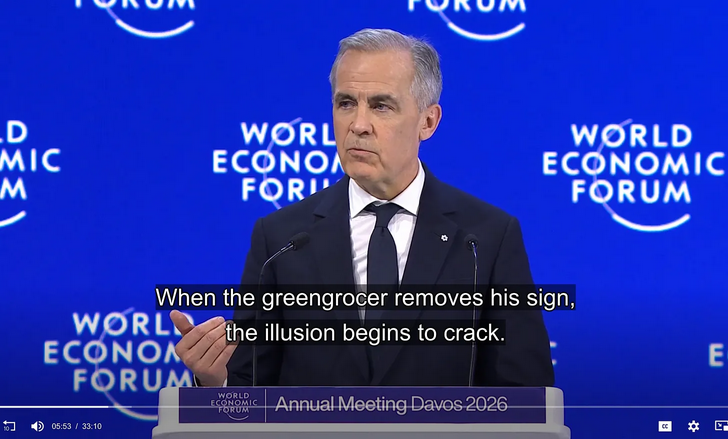
Carney in Davos … “the mismatch between message and messenger is … very special”
I make it a point not to listen to politicans’ speeches, as I need to keep my blood pressure within safe ranges for health reasons. A lot of Canadian commentators have been gushing with praise for Prime Minister Mark Carney’s bloviations at the WEF gabathon in Davos, because of course they have. Brave Mr. Carney standing up to the Bad Orange Man and getting ovations from the kind of people he’s most comfortable dealing with. How very nice for him. But as Chris Bray explains, it didn’t play quite as well with the rest of the non-Davos-attending world:
Mark Carney gave a speech in Davos, that fortress of democratic pluralism where hotel rooms inside the security zone cost thousands of dollars a night and no one with an expense account has to be lonely because the massive security forces don’t try to interfere with all the sex trafficking, which is very democratic. Anyway, the speech was stunning and brave, and everybody clapped a lot.
Someone put the word “flexes” next to the word “Canada”, apparently not intending to cause laughter, but yes: Mark Carney flexed and warned and puffed himself up like a man who’d just eaten the wrong part of the fugu.
You should watch it. Don’t try to eat or drink during the speech, because you’ll choke, and push any breakable household goods away from the reach of what will soon be your flailing arms, but you should watch him perform this extraordinary set of stranded symbols. The mismatch between message and messenger is … very special.
I was physically paralyzed as an effect of hearing this sentence from this face for a full ten seconds, and then I spasmed. It’s like watching Erich Honecker stand up to the East German regime. “We cannot tolerate misogyny, warns Jack the Ripper.”
Carney hinted broadly that the rules are breaking down in international relationships …
… which for the first time in a long time are being reshaped by mere power, a rare thing on the global stage, because there’s meanness and bullying and a rejection of friendly norms and restraint from … someone very bad, not that he was naming names, and so Canada is turning to new partners, extending the hand of friendship to nations and leaders that still care about rules and values and democracy.
The central banker who was selected as his country’s head of government before he’d ever stood for election to any office anywhere ever, the prime minister of a country where the government had just been rebuked by its courts for faking a national security emergency so it could suspend the rule of law and crush dissent, gave a real tubthumper about democracy and the rule of law.
The total absence of connection between “things being said” and “things being done” sets a record, here.




Comments Off on Carney in Davos … “the mismatch between message and messenger is … very special”
Dresden Part 1 – Targets, Tangents & Genocide
HardThrasher
Published 20 Jan 2026Was Dresden a war crime or a late-war military decision made in cold blood? The firebombing of Dresden (13–14 Feb 1945) remains one of the most infamous episodes of the WW2 history: a firestorm, a shattered city, and a death toll that still sparks argument today.
But most of what “everyone knows” about Dresden is wrong. In Part 1 of this two-part series, you and I will dig into the real reasons Dresden became a target. We also ask the uncomfortable questions: Was Dresden an “innocent” city? How Nazi was it? And what does Dresden reveal about the logic — and limits — of strategic bombing? And because this is my video and I’ll do as I damn well please, we’ll also do a quick overview of nearly 1,000 years of history, because why not. Thus in this you will also get the Northern Crusades, a discussion of pottery, a smattering of Central European history and long discussion of how the Nazis subverted power and used it to abuse people whilst being wildly incompetent at the basics
00:00 – Start
04:39 – Part 1 – A Brief History of Everything in Central Europe
17:36 – Rise of the Nazis and the Nuremberg Laws
30:25 – Military and Industrial Dresden
34:03 – Failure to Prepare for War
40:37 – How did it become a target?
52:37 – Survivor’s Club
(more…)
California considering a new way to kill the golden goose
When I first heard about California’s proposed “Billionaire Tax” I thought it was a joke — nobody could be that economically illiterate. But I was wrong and the state really does seem to want to make their state economy a new case study in economics courses of the future. J.D. Tuccille explains why the tax, if implemented, is likely to impact a lot more folks who don’t rank as plutocrats:

California’s potential adoption of a one-time 5 percent “billionaire tax” on the net worth of high-value individuals is already sending wealthy residents fleeing for the exits. By one estimate, at least a trillion dollars has moved beyond the reach of state officials. But a new analysis says the tax may be even more onerous than advertised. Californians may need to get used to the sight of moving vans leaving the state.
Give Us 5 Percent of Everything You Own
Sponsored by a chapter of the Service Employees International Union, the proposed billionaire tax is set to appear as an initiative on the California ballot in November. According to the summary approved by state Attorney General Rob Bonta, the measure “imposes one-time tax of up to 5% on taxpayers and trusts with covered assets valued over $1 billion; covered assets include businesses, securities, art, collectibles, and intellectual property, but exclude real property and some pensions and retirement accounts”. If passed, the tax would apply to people resident in California as of January 1, 2026 — a retroactive element bound to be challenged in court.
[…]
Five Percent Understates the Pain
“The 2026 Billionaire Tax Act, a California ballot initiative, would ostensibly impose a one-time tax of 5 percent on the net worth of the state’s billionaires,” notes Jared Walczak for the Tax Foundation. “Due, however, to aggressive design choices and possible drafting errors, the actual rate on taxpayers’ net worth could be dramatically higher. One particularly momentous policy choice has the potential to strip the founders of some of the world’s largest companies of their controlling interests and force them to sell off a significant portion of their shares.”
According to Walczak, there are many ways in which the initiative creates situations under which “tax liability would be vastly more than 5 percent of net worth”. He focuses on six of them: valuations based on voting interests; assessment rules that can overvalue privately held businesses; excessive underpayment penalties that encourage overvaluing privately held businesses; anti-avoidance rules that tax more than the amount of transfers; provisions on spousal assets and debt to relatives that would tax nonresidents’ assets; and deferrals that would tax wealth that no longer exists.
As an example, Walczak points to the initiative’s means for valuing voting shares that aren’t publicly traded. DoorDash founder Tony Xu owns 2.6 percent of the company but controls 57.6 percent of voting rights. The initiative specifies, “the percentage of the business entity owned by the taxpayer shall be presumed to be not less than the taxpayer’s percentage of the overall voting or other direct control rights.”
That means Xu could be taxed on his voting rights rather than his economic stake in the company. That turns a $2.41 billion ownership interest into a $4.17 billion tax liability. It could force the conversion of voting shares to common stock for sale (subject to capital gains tax), and loss of control of the company.
The other provisions examined by Walczak also impose potential tax liabilities far beyond the 5 percent claimed by the initiative’s sponsors.
Charles Fain Lehman explains that the proposed tax will end up making everyone in California worse off:
… If you pick up all of Google’s employees and put them in Texas — where some of California’s billionaires might look to relocate — then one might assume they would be just as productive.
That would be a reason for non-Californians to be relatively sanguine about the wealth tax’s effects. Yes, it will be bad for California fiscally. But the titans of technology and entertainment can just set up shop in a red state and continue their work unabated.
But what if cities themselves have some additive effect? What if there’s something special about Los Angeles or San Francisco per se? What if the specific concentration of human capital in a specific place yields more than the output you’d expect if you put that same capital in a different place?
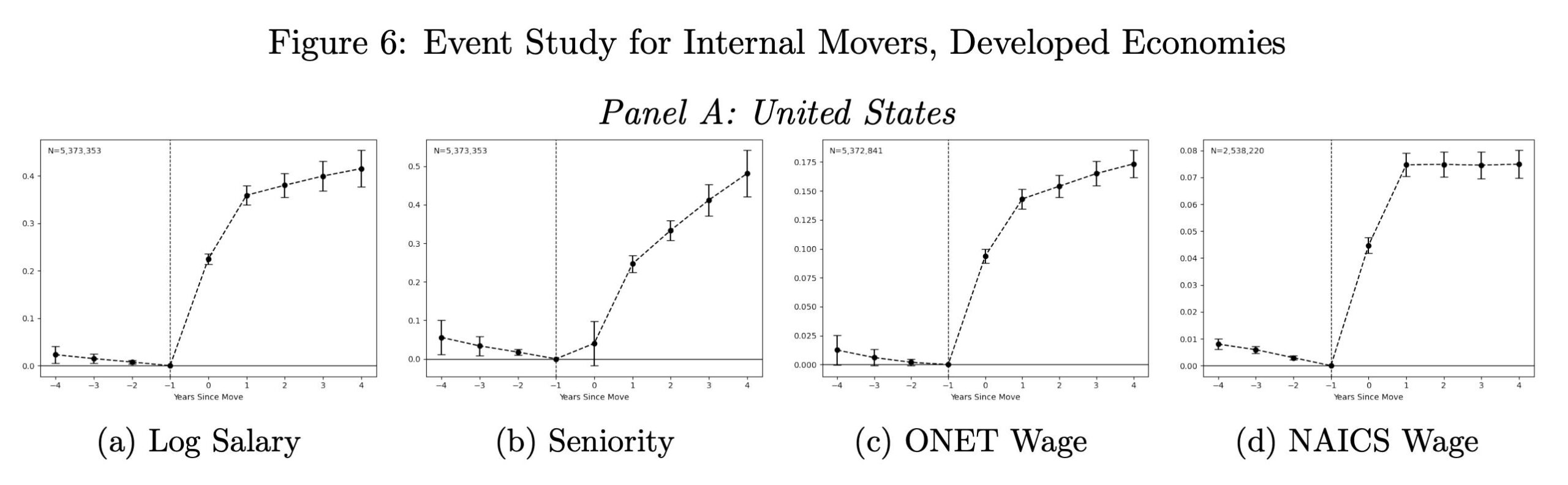
Source: Bhalothia et al, fig. 6.
As it turns out, that’s exactly what happens. Take recent research from economists at UC San Diego and Northwestern University. They use data on over 500 million LinkedIn users across 220,000 cities worldwide to ask how moving from one city to another affects an employee’s wages (a measure of their productivity). Because they observe the same people moving multiple times, they can disentangle the effects on wages of moving to a given city from the qualities of the people moving between cities.
The results are remarkable. The authors estimate that 93 percent of global wage variation is attributable to city effects, rather than to the qualities of workers themselves. That effect shrinks when you’re talking about movement within the developed world — someone moving from Bangalore to San Francisco gets a bigger wage bump than someone moving from Omaha to San Francisco, for example. But even looking at movers within their own developed country, cities explain something like 30 to 50 percent of the variance in wages.
In other words: it’s not just that people with better skills move to otherwise more desirable cities. Cities themselves make people worth more — meaning that they also increase total productivity and output, and therefore make the economy stronger.
How can it be that where you work is so important for how much you produce? The basic answer is what economists call agglomeration effects, the gains that come when firms cluster together. Agglomeration effects come, in general, from lowered barriers to exchange — of material goods, but also of ideas. Lots of start-up founders move to San Francisco because that’s where they can meet other start-up founders, and be on “the cutting edge” of what’s happening in their field. That’s only possible in a specific physical place.
Even if you put all the start-up founders in the same new part of Texas, moreover, they would still be worse off. Agglomeration economies come also from local culture and supportive industry infrastructure. Los Angeles as a city is built to support entertainers; San Francisco is built to support programmers. If you move those industries to Miami or Austin, neither city will be able to offer the same amenities — which is why both have struggled in their efforts to replace their Californian counterparts.
In other words: if California’s major industries leave California, they can’t be rebuilt somewhere else. Dismantle Silicon Valley, and you can’t just put it back together in Miami. We’ll still have technology companies, sure. But all else equal, they will be less productive than they would have been if they had stayed put. And we’ll all pay the price.
D’Joan, C’Mell, and the Rediscovery of Man
Feral Historian
Published 29 Aug 2025Cordwainer Smith, through short stories and novellas, tells a sprawling history spanning thousands of years and an entire galaxy. In this one, I’m looking at a single narrative thread of that world, the gulf between man and animal and the partnerships that make humanity whole again after a long span of cultural stagnation and loss of vitality.
00:00 Intro
02:19 Partners and Divisions
05:15 Heading Down to Clown Town
15:53 Mans’ Other Friend
19:22 NorstriliaThe first month’s ad revenue from this video will be donated to 2 animal rescues. https://pauseforpawsaz.com/ and https://sites.google.com/site/catalli…
(more…)
Comments Off on D’Joan, C’Mell, and the Rediscovery of Man


