
seangabb
Published 31 Jan 2026Greece: A Brief History, c.700 BC – 500 AD
This section explains the most important structural innovation of Greek civilisation: alphabetic writing.It contrasts the Greek alphabet with the complex writing systems of Egypt and Mesopotamia, showing how earlier scripts restricted literacy to priestly and bureaucratic elites. By encoding sound rather than meaning, the Greek alphabet transformed writing into a general-purpose tool.
The section explores how this made possible secular literature, philosophy, mathematics, and science. Figures such as Euclid and Eratosthenes are discussed, along with the emergence of written proof, abstraction, and cumulative intellectual traditions.
The central claim is that without alphabetic writing, there is no secular intellectual life in the modern sense.
June 1, 2026
The Ancient Greeks: 01 – What Made Them Special? (d) Alphabetic Writing: the Rise of Secular Thought
May 31, 2026
How the Nazis Got Rich Preparing Germany for War – Death of Democracy 17 – Q1 1937
World War Two
Published 30 May 2026By March 1937, Nazi Germany had renewed dictatorship, buried Versailles, and turned rearmament into a corruption machine.
Berlin, March 31, 1937. Adolf Hitler’s regime appears stronger than ever. The Enabling Act is extended for another four years, the civil service is bound more tightly to Hitler personally, and Germany formally rescinds its signature from the war-guilt clause of the Versailles Treaty.
But behind the speeches about honor, work, and national revival, another transformation is underway.
In the first quarter of 1937, Nazi Germany moves deeper into an economy built around rearmament, Party patronage, racial exclusion, corporate privilege, and theft. The new German Corporation Law weakens ordinary shareholder control and strengthens management boards. Industrial giants profit from military preparation. Jewish property becomes a field of extortion and enrichment. Hitler himself grows wealthy through book royalties, image rights, hidden payments, and political slush funds.At the same time, the regime tightens control over public life. Civil servants are required to serve the Nazi state without reservation. Journalists, professors, doctors, artists, and Jewish Germans are pushed out of public and professional life. Concentration camp roundups expand beyond political opponents. And on Palm Sunday, Pope Pius XI’s Mit brennender Sorge is read from Catholic pulpits across Germany, openly challenging Nazi ideology.
This episode looks at Germany in the first quarter of 1937: a moment when dictatorship no longer needs to look revolutionary. It looks administrative, profitable, respectable — and permanent. This is the story of how power, profit, propaganda, and fear helped turn a modern state into a robber regime preparing for war.
0:00 Berlin, March 31, 1937
0:47 A World in Crisis
01:10 Germany Extends the Legal Shell of Dictatorship
01:23 Civil Servants Bound to Hitler
01:51 Hitler Rejects the Versailles War-Guilt Clause
02:21 The Enabling Act Is Renewed
02:48 Göring in Rome, Reassurances in Warsaw
03:44 The New Corporation Law
04:00 The Catholic Church Challenges Nazi Ideology
05:08 Police Roundups and Expanding Concentration Camps
05:46 Press, Education, Medicine, and Culture Under Control
08:20 The Nazi Economy: Private Profit, State Power
09:41 Aryanization and Organized Theft
10:20 Rearmament, Industry, and Oligarch Profits
12:21 How Hitler Personally Got Rich
14:55 The Party Mood: Confidence at the Top
15:22 German Public Sentiment and Victor Klemperer
16:20 Analysis: How Results Become Consent
17:06 Conclusion: The Quiet Theft of Democracy
18:27 Never Forget / Support TimeGhost
The Battle Of Jutland: How Britain Should Have “ANNIHILATED” Germany’s Fleet & Won EASILY
History Undone with James Hanson
Published 13 Dec 2024James Hanson is joined by Rear Admiral Dr Chris Parry and the YouTuber and naval historian @Drachinifel to discuss the Battle of Jutland. It was the largest naval battle of the First World War and the only time the British and German fleets went head to head.
So just how significant was it and should it have ended differently? This is History Undone.
QotD: Pornography, old school
It’s interesting to contrast today’s mainstream porn actresses, with their breast augmentations and Brazilian waxes, with the variety of natural bodies from earlier years. These women have breasts, bellies and hips. They have body hair. Some are skinny, some are fat, most are somewhere in between.
And they’re beautiful.
They pose nude or in skivvies, alone and in groups, as pinups and in hard-core activities that prove the internet generation didn’t invent kink — our great-grandparents did.
Regina Lynn, “This Old Porn Is New Again”, Wired News, 2005-09-09.
May 30, 2026
Buying W.W. Greener: Tales from the Golden Age of Surplus
Forgotten Weapons
Published 7 Jan 2026I am joined today by Val Forgett III of Navy Arms for the first in a series of videos telling some of his stories form growing up in the golden age of surplus, with a father who was one of the largest arms dealers in the US. Today, we are talking about how his father ended up owning the W.W. Greener company for five days, and taking a look at a sniper rifle from the Greener museum collection — a .280 Ross fitted with a Zeiss optic used by Greener’s nephew to significant effect in the First World War.
Minor correction: The guns Val still has were duplicates for Edward VII, not Edward VI.
In addition, Mr Bailey’s story has a happy ending. Val’s father gave him the machine tools from the Greener shop and prepaid for six months lease on a nearby building for him to start his own business. He eventually partnered with a former Greener employee named Leonard Onions and they formed Bailons Gunmakers Ltd, which was in business for many years.
(more…)
May 29, 2026
Julius Caesar: the final verdict
Adrian Goldsworthy. Historian and Novelist
Published 29 Oct 2025This week the questions are all about Julius Caesar, and in particular:
What were his motives? Did he aim at reform/revolution from the start?
Also, how was he viewed by the wider population after the Ides of March?
QotD: What is volley fire and what is it for?
Volley fire can cover for the slow reload rate of guns or crossbows in two ways. The first are volley fire drills designed to ensure a continuous curtain of fire; the most famous of these is the “counter-march”, a drill where arquebuses or muskets are deployed several ranks deep (as many as six). The front rank fires a volley (that is, they all fire together) and then rush to the back of their file to begin reloading, allowing the next rank to fire, and so on. By the time the last rank has fired, the whole formation has moved backwards slightly (thus “counter” march) and the first rank has finished reloading and is ready to fire. The problem this is solving is the danger of an enemy, especially cavalry, crossing the entire effective range of the weapon in the long gap between shots. This, by the by, was the volley fire tactic that was being used in China with crossbows before gunpowder; I don’t know that anyone ever did volley-and-charge with crossbows, which lack the lethality of muskets.
The other classic use is volley-and-charge. Because firearms are very lethal but slow to reload, it could be very effective to march in close order right up to an enemy, dump a single volley by the entire unit into them to cause mass casualties and confusion and then immediately charge with pikes or bayonets to try to capitalize on the enemy being demoralized and confused. You can see variations on this tactic in things like the 17th century Highland Charge or the contemporary Swedish Gå–På (“go on”). By charging rather than waiting to reload, the attacker could take advantage of the high lethality of firearms without suffering the drawback of long reload times.
Crucially, note that volley-and-charge works because it compresses a lot of lethality into a very short time, which I suspect is why we don’t see it with bows or crossbows (but do see it with javelins, which may have shorter range and far fewer projectiles, but seem to have had higher lethality per projectile). As we’re going to see in a moment, the lethality of bows or crossbows against armored, shielded infantry – even in close order – was pretty low at any given moment and needed to add up over an extended period of shooting. By contrast, muskets were powerful enough to defeat most armor and thus to disable or kill basically anyone they hit, limited of course by reload time: with a reload time of as much as 30 seconds for earlier matchlocks, a line of musketeers might only be able to fire a few times at an advancing infantry unit (which might take two or three minutes to walk through effective range) and given the limited accuracy of smoothbore muskets, only the last shots would hit at a high level. By contrast, a unit doing volley-and-charge is compressing probably close to 50% of the lethality of sustained shooting, devastating moment and then immediately charging.
Putting that much lethality into a singular instant was valuable from a morale perspective and of course it enabled a unit to quick march through the enemy’s effective range, stopping only briefly to fire and charge, limiting losses from steady enemy fire. But as we’re going to see, the lethality of bows (and, to a significant extent, crossbows) was much lower and so couldn’t be effectively compressed into that single, devastating, confusing moment.2
Bret Devereaux, “Collections: Why Archers Didn’t Volley Fire”, A Collection of Unmitigated Pedantry, 2005-05-02.
- On drill and in particular, counter-march volley fire with crossbows, see Andrade, The Gunpowder Age (2016), 149-160.
- It also didn’t generate a smokescreen to help with the final rushing charge, whereas a musket-and-bayonet unit might benefit significantly from firing and then charging through and out of its own obscuring smoke into a terrified and confused enemy.
May 28, 2026
“Seamen tend to be wary of authority, unless it is wisely exercised”
In UnHerd, Peter Hitchens considers the plight of the Royal Navy, much diminished from its years (centuries, actually) of greatness:

Our own Royal Navy is famous for its mutinies, in HMS Bounty in 1789, at Spithead and the Nore in 1797, and most recently at Invergordon in 1931. It is a curious organisation, its hammocks once filled by the cruel Press Gangs kidnapping innocent men and forcing them to sea and possible death, its discipline for many years enforced by the cruel cat o’ nine tails and the occasional shooting of an admiral to encourage the others. But it stood between us and the world, without trying to take over the state, and it was very beautiful, and many of us loved it. In London and the big seaport cities, bluejackets in their Edwardian uniforms were still a common sight in my childhood. They were reassuring, not overbearing. Since 1901, when horses failed at the task, Navy men have pulled the gun carriage on which Royal coffins (and Churchill’s) have rested at state funerals, an extraordinarily moving sight. These were our defenders, upon whom, as Charles II’s Articles of War first proclaimed, “under the Good Providence of God, the safety, honour and welfare of this realm do chiefly depend”.
In an era when soldiers were often despised, or even feared, sailors were not. Think of Kipling’s 1890 poem “Tommy”, intended to change the drunken delinquent reputation of Queen Victoria’s redcoats:
For it’s “Tommy this, an’ Tommy that, an’ Chuck him out, the brute!”
But it’s “Saviour of ‘is country” when the guns begin to shoot.In George Orwell’s perfect novel Coming Up for Air, Edwardian civilians are appalled when a young man signs up for the Army: “‘Well now! Listed for a soldier! Just think of it! A fine young fellow like that!’ It just shocked them. Listing for a soldier, in their eyes, was the exact equivalent of a girl’s going on the streets.”
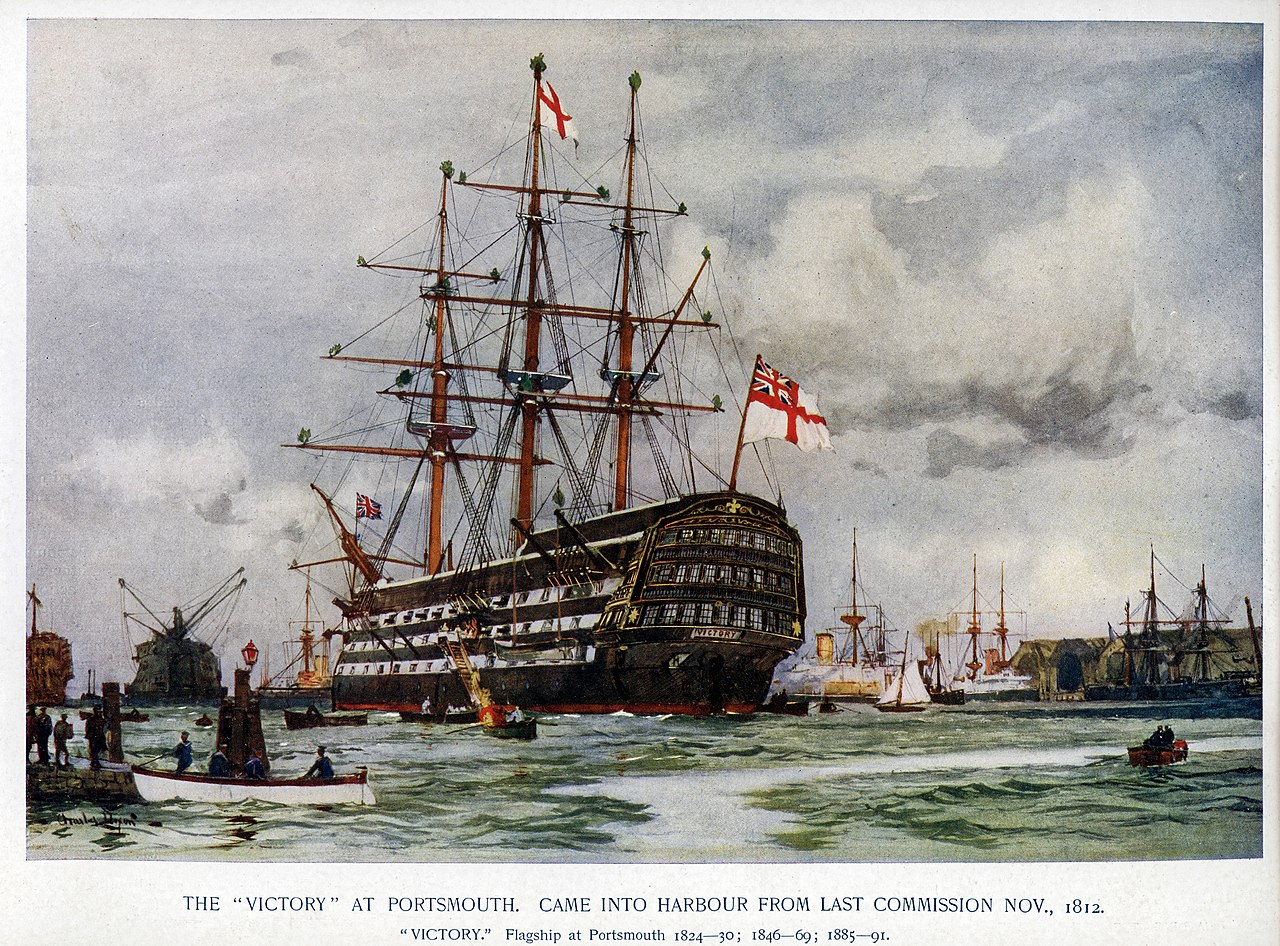
“HMS Victory in Portsmouth Harbour”
Painting by Charles Edward Dixon (1872-1934) via Wikimedia Commons.But sailors, possibly because they were at sea so much, were idealised as “hearts of oak” manning the wooden walls (and later the steel walls) of England. And the same was true for officers, credited above all with the great victory at Trafalgar in 1805, which secured national safety and prosperity for the rest of that century. They had a reputation for taciturnity and bluffness, which never does anyone any harm, and they often lived up to it. The fictional Jack Aubrey, in Patrick O’Brian’s witty and clever books about the Napoleonic wars, is a perfect rendering of this type. They tell terrible jokes. They don’t say much, just “Kiss me, Hardy” (Nelson as he died); “There seems to be something wrong with our bloody ships today, Chatfield” (Beatty at Jutland, as British warships repeatedly blew up under German fire); and “Continue to engage the enemy” (Warburton-Lee at Narvik, dying on his bridge after smashing up Hitler’s destroyer fleet and so making a cross-Channel invasion impossible).
And so the word “Navy” had, for many years, a useful commercial magic if you were selling something a bit manly and bluff, such as Navy Cut tobacco and Navy Rum, or even Senior Service cigarettes. But it did not have the yelling, martinet character of the Army. I have never yet seen a naval officer’s uniform that fits properly, and when sailors are marched aboard their ships (does this still happen?), the drill is far from pernickety. Close contact with the Navy — both my parents were in it, and so were most of their friends, some of my schoolteachers and many of the parents of my schoolfellows — revealed a dry, faintly sarcastic view of the outside world which had never been to sea. Even my mother, an ocean-going snob who would die of shame if she heard me use the word “toilet”, had mastered the sarcasm of the fleet. More than once I jumped with surprise when I heard her icily remarking about some inadequate if feeble attempt at recompense. “Well, that’s damned nice of him”, she’d say, which, for a Fifties married middle-class woman in a respectable suburb, was going it a bit.
QotD: Re-defining economic liberalism
A liberal “rhetoric” explains the good features of the modern world compared with earlier and later illiberal régimes — the economic success of the modern world, its arts and sciences, its kindness, its toleration, its inclusiveness, and especially its massive liberation of more and more people from violent hierarchies ancient and modern. Its enemies claim that it also explains alleged evils, such as the reduction of everything to money or the loss of community or the calamity of immigration by non-Christians. But they are mistaken.
Dierdre McCloskey, “The power of liberalism can combat oppression in all its forms”, The Economist, 2020-01-08.
May 27, 2026
The Korean War Week 101 – Another Week, Another POW Riot – May 26, 1952
The Korean War by Indy Neidell
Published 26 May 2026In the wake of the kidnapping of the Koje-Do POW camp commandant, UN Commander Mark Clark is busy really working on expanding security at all the POW camps in Korea and gaining total internal control of them. However, the damage done to the UN’s global reputation by the whole incident is considerable, and at the negotiating table the Communists denounce the UN and UN Chief Delegate Turner Joy leaves his post to return to the states. The war in the field goes on as always, with the Philippine Battalion Combat Team seeing success in the field.
The Real T26 “Tanker” M1 Garand
Forgotten Weapons
Published 5 Jan 2026The name “tanker” has been applied to shortened M1 Garand rifles for a long time and today we are looking at one of the rifles that was the genesis of that concept. It actually has nothing to do with tanks; the idea for a shortened M1 came from the Pacific Warfare Board of the US Army, looking for a handier weapon for jungle fighting. During 1944 when this idea was proposed, Springfield Arsenal was already independently working on the M1E5, a very similar paratrooper version of the M1. The PWB ordered the 6th Infantry Division in the Philippines to make 150 samples for testing, of which two were sent back to Springfield for testing.
In testing, the T26 showed the same problems as the M1E5 — excessive recoil, noise, and concussion. Despite this, 15,000 were recommended for production in the summer of 1945, but the war ended before any production actually took place. The name “tanker” came later, when companies started making cut-down Garands for commercial sale and thought that marketing them as specialized tanker weapons would help them sell.
Thanks to the Springfield Armory National Historic Site for giving me access to this truly unique specimen from their reference collection to film for you! Don’t miss the chance to visit the museum there if you have a day free in Springfield, Massachusetts: https://www.nps.gov/spar/index.htm
(more…)
May 26, 2026
Gingerbread for Washington’s Army
Tasting History with Max Miller
Published 2 Dec 2025Beautifully spiced gingerbread cookies formed in a sea goat mold
City/Region: England | Philadelphia, Pennsylvania
Time Period: 1773Christopher Ludwick was a true hero of the American Revolution. A German immigrant, he made his fortune in part by baking gingerbread in Philadelphia, and then used his baking knowledge, patriotic spirit, and all of his fortune to aid the American cause.
These gingerbread cookies are not as gingery as many modern ones, but the addition of mace, coriander seeds, and caraway seeds makes for a complex spiciness that is delicious. If you have gingerbread molds, these are a great time to use them, and if you don’t, they’re still delicious as cut-out cookies.
To Make Ginger-bread
Take a pound and a half of treacle, two eggs beaten, half a pound of brown sugar, an ounce of ginger beaten and sifted; of cloves, mace, and nutmegs all together half an ounce, beaten very fine, coriander-seeds and carraway-seeds of each half an ounce, two pounds of butter melted; mix all these together, with as much flour as will knead it into a pretty stiff paste; then roll it out, and cut it into what forms you please; bake it in a quick oven on tin plates; a little time will bake it.
— The Universal Cook or, the Lady’s Complete Assistant by John Townshend, 1773
May 25, 2026
Enoch Powell, in person
I posted an excerpt from Niccolo Soldo’s post on Enoch Powell last week, which might be why Substack called my attention to this post from Francis Turner, which includes some memories of personal interaction with Powell during a visit Powell paid to Turner’s father in the early 1980s:

No wonder he was vilified for telling the truth … he was completely correct.
As I commented on Niccolo’s post I had the fortune to meet Enoch Powell in the early 1980s. I think it would have been about April 1983 but I could be wrong. I don’t recall the reason Powell came, it could have been something to do with the Bible or Greek Patristics, it could have been theology, it could have been Gladstone or it could have been something totally different that I can’t guess. Anyway he spent a few days with my father for some reason and the two of them got on like a house on fire.
Both were Cambridge educated classicists, though my father was there a decade after Powell, and they had a number of other things in common. They were of essentially the same social class and similar background. Both had been in intelligence in WW2 and concentrated on the Japanese front. Both had been to India — my father as missionary, Powell as soldier in WW2. Both had learned Indian languages — Powell learned Urdu, my father Tamil. Both had worked with “working class” people — my father as a vicar in Rochdale, Powell as MP in Wolverhampton. They also shared a similar political outlook, though I don’t think they discussed politics much beyond sharing their distaste for Europe.
What I recall of those few days was what a nice man Enoch Powell was. As I mentioned in the comment, he helped me with my homework, which was Herodotus. I recall him, in addition to giving me specific advice, discussing with me and my father the various dialects of ancient Greek and how remarkable it was that an educated Greek in Constantinople could have read Herodotus written a thousand years or more earlier without much difficulty. I also recall him encouraging my father to learn German and even Russian because “you’ve learned two non Indo-European languages already, so both will be easy for you as a classicist”.1 Since Powell spoke (or at least read and wrote) multiple Indo-European languages, including both of those, he may have been optimistic but his encouragement undoubtedly helped.
He entirely failed to mention to me that he’d spent years as an academic studying Herodotus and had actually published a well known book about his work. But that did explain how he could know precisely what passage I was having trouble with from just the first few words.
One thing that stood out was his intellect. He wasn’t in any way patronizing but he made little attempt to disguise his brains. He started off assuming you could more or less keep up and would adjust down until you did. He was also curious about new things. I don’t think he was faking it when he asked me about home computers and what good they were for. I’m not entirely sure I gave him a good answers but the questions he asked helped me realize that I really enjoyed programming them and that therefore a computer programmer might be a good career.
The other main thing that he taught me was to distrust the media. He gave some specific examples regarding the IRA and Northern Ireland and how the BBC and the newspapers had exaggerated certain events. He also pointed out that the media had to pick and choose what to report on and that they could prioritize some events over others.
One other thing. Part of his background was (Anglican) Christianity. He might not have gone to church every day, but he certainly did go on Sundays and if the opportunity presented itself he would attend Matins or Evensong. It was just the sort of thing one did. And one behaved accordingly.
- Quote not exact because it was 45 years ago
George Washington “basically started the world’s first global war”
On his Substack, Ed West talks about a book he had intended to write, but “put it on the back burner” for too long and the moment has passed:
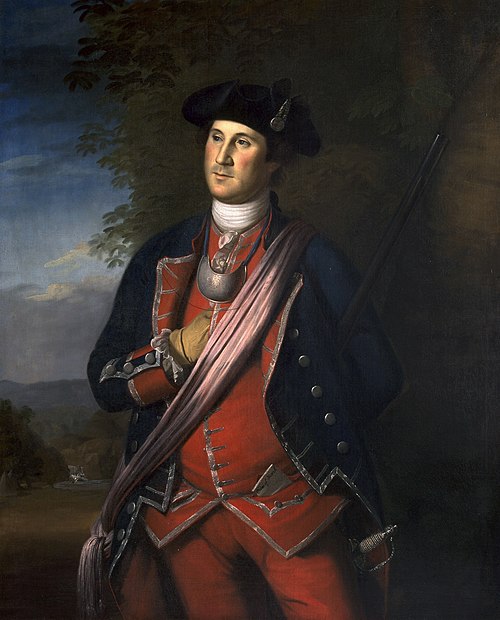
George Washington in the uniform of the Virginia Regiment, 1772.
Portrait by Charles Willson Peale (1741-1827) from the Washington and Lee University collection via Wikimedia Commons.
The story would start in the 1750s. The first truly world war is in full flow, as Britain and France battle for supremacy of the continent and the oceans. In North America, British colonial troops fight side by side with soldiers from the old country, who mock the bumpkin locals with their ditty “Yankee Doodle“. But, rivalries aside, they both know what they’re fighting for: if Louis XV’s absolute monarchy wins, all their liberties will be gone.
In a heroic battle the British regular and colonial forces take the French stronghold of Fort Duquesne and rename it Fort Pitt, after cabinet minister William Pitt “the elder” – it later becomes Pittsburgh. By 1763 the French are driven out of North America altogether. The British colonies are safe. One officer particularly shines during this war, and diarist Horace Walpole writes how “The volley fired by a young Virginian in the backwoods of America set the world on fire”.
That Virginian was George Washington. Born in Wakefield in Westmoreland County, this British hero was the great-grandson of an Essex clergyman thrown out of the church for drunkenness, and who had landed in that colony in 1657. Washington was an impressive man in every way – standing at 6’2″, with enormous hands and feet and a massive nose, he was notably strong and able to throw objects immense distances (although many of these accounts improved in the telling).
Despite having almost no teeth, like any good British patriot, Washington was very proper about his appearance, insisting on bringing a selection of fine linen shirts even into the backwoods. A conservative by nature and with ambitions to serve as an officer in His Majesty’s forces, he didn’t like the new fashion for shaking hands, preferring the more formal bow.
A major at 21, Washington’s first job was to lead his men into the Ohio Valley to warn away any Frenchmen they found there. The following year, 1754, and now a lieutenant-colonel, he went back and built Fort Necessity close to Fort Duquesne, where he stumbled upon a contingent of enemy troops. They ran for their muskets and Washington ordered his company to fire. Ten Frenchmen were killed, including their lieutenant, and the incident would spark a war in North America between the two great powers, which in 1756 linked up with a Europe-wide conflict later known as the Seven Years’ War. It’s strange to think that, as well as being the first president of a future global superpower, Washington basically started the world’s first global war.
But what if France had won that struggle? Would French-controlled colonies in North America have formed constitutions centred on the rights to life, liberty and the pursuit of happiness, not to mention the often-overlooked right to property? Would they have enshrined religious tolerance or the right to free speech? Trial by jury? Innocence until proven guilty? Hell, no! And if it wasn’t for us, my thesis went, you’d be speaking French.
Without England’s history of Parliamentary freedom, habeas corpus, Magna Carta and the jury system, the colonies would never have developed as they did. Neither would they have the same commercial spirit, downstream of their Puritan and Quaker inheritance.
I think I came up with the proposal after reading David Hackett Fischer’s Albion’s Seed, one of the most discussed and popular analyses of American culture. This great work of history and anthropology charts the foundation of the country’s cultural folkways through four migrations – East Anglian Puritans to New England, Cavaliers from England’s south and south-west to Virginia, the mostly northern Quakers to the middle colonies, and Borderers from Ulster to the Appalachians.
I was always very interested in founder effects, whereby colonies come to take on aspects of the mother country which subsequently disappear back home. This is reflected in the fact that many “Americanisms” are actually old English words, like fall, trash and garbage, even “gotten”. It’s also true to some extent of the American accent, developing out of various regional dialects which have since been flattened by the dominance of London. This is especially the case with Ocracoke Island in North Carolina, which apparently is the closest thing to Shakespearean English, although I fear that if I went there this would no longer be true, and they’d all say “like” four times in every sentence and tell you they’re “reaching out”.
Did The Taranto Raid Inspire Pearl Harbor?
TimeGhost Cartographic
Published 24 May 2026In November 1940, the British Royal Navy launched a daring carrier strike against the Italian fleet at Taranto. The attack shocked the world, crippled Italian naval power in the Mediterranean, and demonstrated just how devastating naval air power could be against battleships at anchor. But the consequences of Taranto didn’t end in Italy.
In this episode, we explore the aftermath of the raid, the race to understand how it had been achieved, and why military observers around the world paid such close attention to what happened there. From British convoy operations in the Mediterranean to Japanese investigations into shallow-water torpedo attacks, this episode examines how one raid would echo far beyond the harbor at Taranto.
How did the British make the attack possible? What lessons did foreign observers take away from it? And why did some nations react to the raid very differently than others?


