
… it is not a bad time to remind ourselves how lucky we are to live on this damp little island.
I don’t mean this in a jingoistic way, and certainly when you look closely there is little to recommend Henry V’s brutal French raid. What there is to celebrate, of course, is Shakespeare’s poetic rendering of the campaign. It is our literary, scientific, technological, economic, political and philosophical achievements, rather than just our military milestones that we should occasionally pause to remember, amid our usual self-criticism.
All my life I have been told that Britain is in decline. But stand back and take a long, hard look. Even by relative standards, it just is not true. We have recently overtaken France (again) as the fifth largest economy in the world and are closing on Germany. We have the fourth largest defence budget in the world, devoted largely to peace-keeping. We disproportionately contribute to the world’s literature, art, music, technology and science.
We have won some 123 Nobel prizes, more than any other country bar America (and more per capita than America), and we continue to win them, with 18 in this century so far. In the field of genetics, which I know best, we discovered the structure of DNA, invented DNA fingerprinting, pioneered cloning and contributed 40 per cent of the first sequencing of the human genome.
On absolute measures, we are in even better shape. Income per capita has more than doubled since 1965 — in real terms. In those days, three million households lacked or shared an inside lavatory, most houses did not have central heating and twice as many people as today had no access to a car. When they did it was expensive, unreliable and leaked fumes.
In the 1960s even though there were fewer people in Britain, rivers were more polluted, the air was dirtier, and there were fewer trees, otters and buzzards. Budget airlines, mobile phones, search engines and social media were as unimaginable as unicorns. Sure, there was less obesity and fewer traffic jams, but there were more strikes, racism and nylon clothing. People spent twice as much of their income on food. There may be political angst about immigrants, but Britain is far more at ease with its multicultural self today than we might have dared to hope in the 1960s.
Matt Ridley, “Britain’s Best Years”, MattRidley.com, 2015-01-01.
May 19, 2016
QotD: A contrarian view of “Britain in decline”
April 11, 2016
QotD: What can a billionaire buy that most people can’t?
In a way most of us don’t really understand how differently we live from even a very short time ago. Read the comments in this excellent piece from Sarah Hoyt.
http://accordingtohoyt.com/2016/01/08/burning-rousseau-in-effigy/#comments
The fact is that right now just about everybody in the Developed nations can afford products that are better and cheaper than anything has ever been made. For instance my car is almost ten years old and has never required major maintenance and the body is as free of exterior rust as when it was new. The computer I’m writing this on is more powerful than ANY computer that you could buy in 1980. The clothes I’m wearing are more durable and sewn better than anything you could buy in 1950. And everything is essentially so cheap that just about everybody can afford it.
The fact is that, because of the constant improvement of manufacturing techniques the difference between the highest quality and lowest quality goods has become essentially nonexistent.
[…]
The great gap in lifestyles due to wealth is by and large gone, which begs the question, what can the wealthy buy with their money? The answer isn’t very pleasant.
What they buy is access and power. You don’t have to look much further than Warren Buffett, George Soros or Tom Steyer to see that. Or the Koch Brothers for that matter. All of these people and other have created large influence building organizations for the sole purpose of influencing the rest of us stupid schmucks to do what they want us to. What they want us to do all too often is to give up the liberties and standard of living that our parents and grandparents worked so hard to build and retreat back to a lifestyle that will not compete with our “betters.” Sorry, but I’m not going for that.
J.C. Carlton, “What Can A Billionaire Buy That Most People Can’t?”, The Arts Mechanical, 2016-03-30.
March 30, 2016
QotD: The spendthrift governor, Nelson Rockefeller
In 15 years as governor of New York, Nelson A. Rockefeller, popularly known as “Rocky,” was as careful with the public’s money as he was with his own — which is to say, he spent lavishly, impulsively, and often indiscriminately. New Yorkers have been paying the bill ever since. As portrayed in Richard Norton Smith’s new biography, Rockefeller believed that there was no problem (least of all a lack of cash) too big to yield to a big-money solution. “As much as I loved Nelson,” Smith quotes the financier Frank Zarb, “his meter didn’t start until you reached a billion dollars.”
Rocky’s meter began to spin soon after he became governor of New York in 1959, and it accelerated as time went on. To be sure, every level of American government was expanding during the 1960s and 1970s. But Rockefeller made an outlier of the Empire State. He quadrupled the state budget and quintupled state debt, including off-the-books public-authority borrowing. He created the nation’s most lavish Medicaid program, designed to draw down maximum federal aid to the state while saddling New York City and county governments with half the non-federally reimbursed cost. He pushed through a collective bargaining law that would bequeath to New Yorkers the nation’s highest level of public-sector unionization. Though New York had been a cradle of open-handed liberalism, its state and local taxes, relative to personal income, were slightly below the national average when Rockefeller took office, according to Census data. By 1974, the combined burden had nearly doubled to a level well above the 50-state norm — where it has remained ever since.
Smith demonstrates that Rockefeller’s profligacy was at least as much a matter of personal disposition as political preference. There’s no small irony in this: Rocky’s grandfather, John D. Rockefeller, Sr., built his Standard Oil mega-fortune on penny-pinching attention to detail. As one story goes, even as a wealthy man, “Senior” was delighted to discover he could eke out a slightly larger profit by encouraging his employees to use one less drop of solder on each tin can of Standard Oil kerosene.
E.J. McMahon, “Hiya, Big Spender! For good or ill, Nelson Rockefeller’s legacy lives on”, City Journal, 2014-12-04.
February 16, 2016
February 3, 2016
QotD: The wealthy and their status-signalling spending habits
If you want an illuminating example of the fact that there is more to the way that prices work in a free market than can be captured by the pragmatic calculations of cold-eyed util-traders, consider the luxury-goods market and its enthusiastic following among people who do not themselves consume many or any of those goods. One of the oddball aspects of rich societies such as ours is the fact that when people pile up a little bit more disposable income than they might have expected to, they develop a taste for measurably inferior goods and outdated technologies: If you have money that is a little bit obscene, you might get into classic cars, i.e., an outmoded form of transportation; if your money is super-dirty obscene, you get into horses, an even more outmoded form of transportation.
Or consider the case of fine watches: Though he — and it’s a “he” in the overwhelming majority of cases — may not be eager to admit it, a serious watch enthusiast knows that even the finest mechanical timepiece put together by magical elves on the shores of Lake Geneva is, as a timekeeping instrument, dramatically inferior to the cheapest quartz-movement watch coming out of a Chinese sweatshop and available for a few bucks at, among other outlets, Wal-Mart. (To say nothing of the cheap digital watches sold under blister-pack at downscale retailers everywhere, or the clock on your cellphone.) But even as our celebrity social-justice warriors covet those high-margin items — and get paid vast sums of money to help sell them, too — they denounce the people who deal in less rarefied goods sold at much lower profit margins.
If economic “exploitation” means making “obscene profits” — an empty cliché if ever there were one — then Wal-Mart and the oil companies ought to be the good guys; not only do they have relatively low profit margins, but they also support millions of union workers and retirees through stock profits and the payment of dividends into pension funds. By way of comparison, consider that Hermès, the luxury-goods label that is a favorite of well-heeled social-justice warriors of all sorts, makes a profit margin that is typically seven or eight times what Wal-Mart makes, even though, as rapper Lloyd Banks discovered, its $1,300 sneakers may not always be up to the task. If Wal-Mart is the epitome of evil for selling you a Timex at a 3 percent markup, then shouldn’t Rolex be extra-super evil?
Kevin D. Williamson, “Who Boycotts Wal-Mart? Social-justice warriors who are too enlightened to let their poor neighbors pay lower prices”, National Review, 2014-11-30.
January 29, 2016
QotD: Summing up the Wal-Mart fortunes
One of the obvious points being made, as is now traditional, concerning the great wealth of the Walton family, those inheritors of Sam Walton’s cash and stock. It’s not actually all that difficult to get people riled up about a store paying an average of $8.80 an hour (for non-supervisory staff) when the people who own the company have some $150 billion in wealth. However, that’s not actually the correct response. And insisting upon a change in public policy so that some of that wealth is paid to those workers, or that it should be taxed away in some manner, would be very much the wrong answer. For, you see, those Waltons actually deserve that $150 billion: we should be absolutely overjoyed that they have it in fact.
[…]
So, we get $250 billion a year and the Waltons, the inheritors of the man who started it all off, get $150 billion. We get more than they do: that sounds like a pretty good deal really. Except that is of course to grossly overstate what they are getting. That mountain of cash they’ve got is not an annual figure: that’s the capital value, their wealth, not the income from one year. Our benefit is what we save in one year. That value of WalMart stock is the net present value of everything that WalMart is expected to make in profits from now until eternity (although obviously we use a discount rate so that something 40 years out is given less importance than something next year). So we need to adjust our $250 billion figure in the same manner to make the two numbers comparable.
The easiest way to do that is simply to ignore discounting and to also impose a 20 year time limit. Neither assumption is correct but it’ll give us a nice rough and ready guess at the capital value to us all of those annual savings. And the answer if we do it that way is that the current value of WalMart’s existence to the rest of us is $5 trillion. That’s the number that is comparable to that $150 billion family fortune. They’re both the net present values of future income streams which does indeed make them comparable even if that value to us is calculated in a much simpler manner than the way the stock market values WalMart.
At which point it looks like we’re getting a massive bargain. We get $5 trillion and the people who made it happen only get $150 billion? Why aren’t we cheering in the streets over this rather than demonstrating in them about how awful it all is?
Tim Worstall, “The Waltons Deserve Their Hundred Fifty Billion; The Rest Of Us Gain $5 Trillion From Walmart’s Existence”, Forbes, 2014-11-29.
January 24, 2016
QotD: There are no Veblen goods at Wal-Mart
People buy Rolex watches for reasons other than their timekeeping excellence, just as people buy Ferraris and horses for reasons other than going to the store to pick up a gallon of milk and a loaf of bread. Economists talk about “Veblen goods,” which are more valued because of their high prices rather than in spite of them, coveted not for their conventional utility but for their exclusivity. Owning a Rolls-Royce isn’t about the car — it’s about you. Which is why you see magazines such as The Robb Report — one of those glossies full of “bland advertisements for being wealthy,” as the novelist William Gibson put it — for sale in places such as Wal-Mart, where the typical customer is not actually in the market for a yacht or Kiton overcoat. If you’ve ever seen the heartbreaking sight of a young woman stopping a Wal-Mart checker three-fourths of the way through ringing up her purchases — because she does not have enough money to pay for what’s left in her cart — then you can be pretty sure that what’s going in her sack is more or less the opposite of Veblen goods.
Ironically, the anti-Wal-Mart crusaders want to make life worse for people who are literally counting pennies as they shop for necessities. Study after study has shown that Wal-Mart has meaningfully reduced prices: 3.1 percent overall, by one estimate — with a whopping 9.1 percent cut to the price of groceries. That comes to about $2,300 a year per household, savings that accrue overwhelmingly to people of modest incomes, not to celebrity activists and Ivy League social-justice crusaders.
Ultimately, these campaigns are exercises in tribal affiliation. The Rolex tribe, and those who aspire to be aligned with it, signal their status by sneering at the Timex tribe — or by condescending to it as they purport to act on its behalf, as though poor people were too stupid to know where to find the best deal on a can of beans. Or call it the Trader Joe’s tribe vs. the Wal-Mart tribe, the Prius tribe vs. the F-150 tribe.
Kevin D. Williamson, “Who Boycotts Wal-Mart? Social-justice warriors who are too enlightened to let their poor neighbors pay lower prices”, National Review, 2014-11-30.
January 19, 2016
Non-conspicuous consumption of quality
Don Boudreaux on the amazingly thin line that now separates many of the quality consumption goods of the ultra-rich from the nearly as high quality goods of ordinary North American consumers:
This list includes also non-prescription pain relievers, most other first-aid medicines and devices such as Band-Aids, and personal-hygiene products such as toothpaste, dental floss, and toilet paper. (I once saw a billionaire take two Bayer aspirin – the identical pain reliever that I use.) This list includes also gasoline and diesel. Probably also contact lenses.
A slightly different list is one drawn up in response to this question: When can median-income consumers afford products that, while not as high-quality as those versions that are bought by the super-rich, are nevertheless virtually indistinguishable – because they are quite close in quality – to the naked eye from those versions bought by the super-rich? On this list would be most clothing. For example, an ordinary American man can today afford a suit that, while it’s neither tailor-made nor of a fabric as fine as are suits that I suspect are worn by most billionaires, is nevertheless close enough in fit and fabric quality to be indistinguishable by the naked eye from expensive suits worn by billionaires. (I suspect that the same it true for women’s clothing, but I’m less expert on that topic.)
Ditto for shoes, underwear, haircuts, corrective eye-wear, collars for dogs and cats, pet food, household bath towels and ‘linens,’ tableware and cutlery, automobile tires, hand tools, most household furniture, and wristwatches. (You’d have to get physically very close to someone wearing a Patek Philippe – and you’d have to know what a Patek Philippe is – in order to determine that that person’s wristwatch is one that you, an ordinary American, can’t afford. And you could stare at that Patek Philippe for months without detecting any superiority that it might have over your quartz-powered Timex at keeping time.) Coffee. Tea. Beer. Wine. (There is available today a large selection of very good wines at affordable prices. These wines almost never rise to the quality of Chateau Petrus, d’yquem, or the best Montrachets, but the differences are often quite small and barely distinguishable save by true connoisseurs.)
I’ve made this point about the wines before (I’ve tasted each of those wines, but don’t believe the price difference justifies buying them over nearly-as-good equivalents that lack the prestige factor), but Don is talking a much wider range of goods and services where there’s barely any real quality difference between “ordinary” and what the very richest among us can obtain.
December 14, 2015
QotD: Veblen goods
… the point about a Veblen Good is not that sales rise when prices do. Rather, it’s that a Veblen Good is desirable because it is expensive. It is a way of showing that you can afford to buy something expensive. That you can afford something expensive is a sign of social status (well, it is in our society, where having lots of money and thus being able to buy something expensive is a sign of social status. It’s possible to imagine other societal forms which don’t include this).
The archetypal example was certain of the Vanderbilt women who would have diamonds implanted into their backs, where they would be visible to people at parties given the low cut backs of dresses at the time. The point of such implantations simply being to show that one had enough money (and perhaps little enough sense in a pre-antibiotic era) to have a diamond implanted over one’s spine. There’s a story that Mick Jagger had a diamond implanted into one of his teeth for the same sort of reason at one point (removed when it promoted caries).
The point being that a Veblen Good does signal something, and as such the greater the price the more desirable the ability to transmit that signal. But it doesn’t go as far as stating that the more the price rises then the higher sales go.
Tim Worstall, “Being Quoted In The New York Times Is Great But…”, Forbes, 2014-11-22.
November 27, 2015
Wealth, inequality, and billionaires
Several months ago, the Washington Post reported on a new study of wealth and inequality that tracked how many billionaires got rich through competition in the market and how many got rich through political “connections”:
The researchers found that wealth inequality was growing over time: Wealth inequality increased in 17 of the 23 countries they measured between 1987 and 2002, and fell in only six, Bagchi says. They also found that their measure of wealth inequality corresponded with a negative effect on economic growth. In other words, the higher the proportion of billionaire wealth in a country, the slower that country’s growth. In contrast, they found that income inequality and poverty had little effect on growth.
The most fascinating finding came from the next step in their research, when they looked at the connection between wealth, growth and political connections.
The researchers argue that past studies have looked at the level of inequality in a country, but not why inequality occurs — whether it’s a product of structural inequality, like political power or racism, or simply a product of some people or companies faring better than others in the market. For example, Indonesia and the United Kingdom actually score similarly on a common measure of inequality called the Gini coefficient, say the authors. Yet clearly the political and business environments in those countries are very different.
So Bagchi and Svejnar carefully went through the lists of all the Forbes billionaires, and divided them into those who had acquired their wealth due to political connections, and those who had not. This is kind of a slippery slope — almost all billionaires have probably benefited from government connections at one time or another. But the researchers used a very conservative standard for classifying people as politically connected, only assigning billionaires to this group when it was clear that their wealth was a product of government connections. Just benefiting from a government that was pro-business, like those in Singapore and Hong Kong, wasn’t enough. Rather, the researchers were looking for a situation like Indonesia under Suharto, where political connections were usually needed to secure import licenses, or Russia in the mid-1990s, when some state employees made fortunes overnight as the state privatized assets.
The researchers found that some countries had a much higher proportion of billionaire wealth that was due to political connections than others did. As the graph below, which ranks only countries that appeared in all four of the Forbes billionaire lists they analyzed, shows, Colombia, India, Australia and Indonesia ranked high on the list, while the U.S. and U.K. ranked very low.
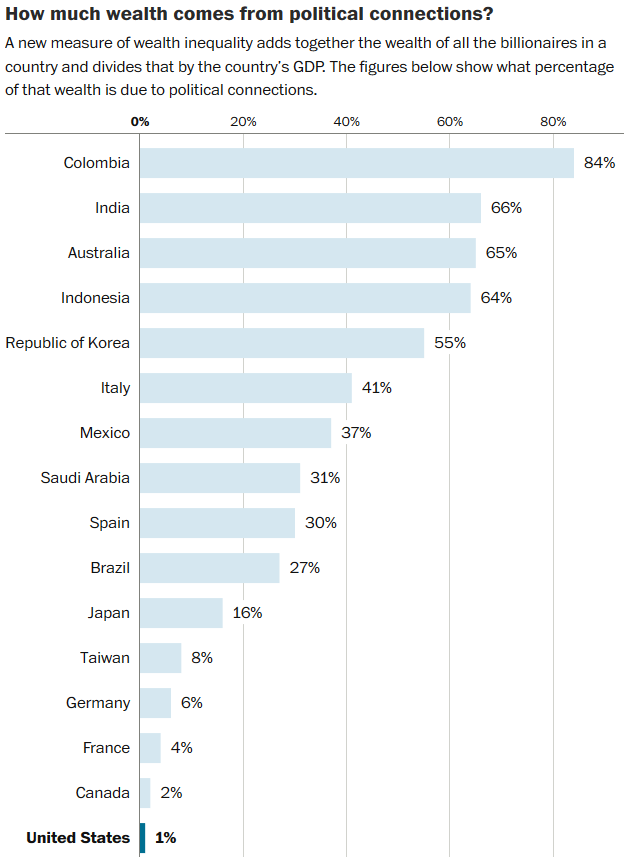
Looking at all the data, the researchers found that Russia, Argentina, Colombia, Malaysia, India, Australia, Indonesia, Thailand, South Korea and Italy had relatively more politically connected wealth. Hong Kong, the Netherlands, Singapore, Sweden, Switzerland and the U.K. all had zero politically connected billionaires. The U.S. also had very low levels of politically connected wealth inequality, falling just outside the top 10 at number 11.
When the researchers compared these figures to economic growth, the findings were clear: These politically connected billionaires weighed on economic growth. In fact, wealth inequality that came from political connections was responsible for nearly all the negative effect on economic growth that the researchers had observed from wealth inequality overall. Wealth inequality that wasn’t due to political connections, income inequality and poverty all had little effect on growth.
October 2, 2015
An Orgy of Innovation (Everyday Economics 5/7)
Published on 20 Apr 2015
The list of famous inventions from the last few centuries is long, and you may even be making use of one right now — laptops, smartphones, tablets, and televisions, for instance. There are countless unsung improvements, too, that make our daily lives much easier. We’ve all benefited from zip top sandwich bags, twist bottle caps, and long-lasting batteries, to name a few!
The economic historian Deirdre McCloskey coined the term “innovationism” to describe the phenomenal rise in innovation over the past couple hundred years. While there have always been inventors and innovators, that number exploded after the eighteenth century, contributing to what we’ve described in previous videos as the “Hockey Stick of Human Prosperity.”
Why has innovation grown so rapidly? Economist Douglass North argues it has to do with institutions such as property rights, non-corrupt courts, and rule of law, which lay the foundation for innovation to take place. Others attribute the rise to factors such as education or access to reliable energy. McCloskey argues that what really kicked innovation into high gear is a change in attitude — ordinary people who once celebrated conquerers and kings began to celebrate merchants and inventors.
In this video, we discuss these ideas further. After all, a better understanding of what drives innovation could help poor countries that still live on the handle of the “Hockey Stick” reach a much greater level of prosperity.
September 25, 2015
An economic theory of avant garde and popular art
Published on 3 Sep 2015
When do artists sell out and when do they keep their artistic integrity?
September 3, 2015
The beer ineQuality index
I took a couple of weeks off over the summer and subsequently forgot some of the interesting articles I’d intended to link to from the blog (but no sensible person comes here for breaking news, do they?). Here’s one from the wonderfully named Worthwhile Canadian Initiative blog:
The conventional Canadian view is that American beer is bad; watery and weak. Yet American breweries produce some of the world’s best beers — superb brews coming out of microbreweries across the country.
What is striking about the United States is the country’s level of inequality — or, to be more precise, the beer quality inequality. Countries like Germany, Belgium — the Scandinavian countries in general — have much less variation in the quality of their beer.
The question is: why? Does beer quality inequality result from other forms of inequality, like disparities in income and wealth? Or do the forces that produce income inequality also produce beer quality inequality? Is it a spurious correlation, or is the armchair empiricist’s observation that the US has more beer ine-quality simply wrong?
The income-causes-beer quality inequality story is easily told. Some people are poor. They demand cheap beer, and cheap beer is necessarily poor quality. Some people are rich. They demand high quality beer, and are willing to pay for it. Hence, in theory, we would expect income inequality to produce beer quality inequality. As an empirical observation, the US has substantially more income and beer quality inequality than other rich countries, including Canada, while Scandinavian countries have some of the lowest levels of income and beer inequality in the world (here). So income inequality causes beer quality inequality: Q.E.D.
This story is plausible, and there may be some truth to it. The problem with it is that not everybody drinks beer. Take a country like England, for example. There beer was traditionally a working man’s drink — the upper classes sipped Pimm’s on the lawn, or perhaps a gin and tonic. If the rich aren’t drinking beer, an increased concentration of income in the hands of the richest 1 percent will have no impact on the variation in beer quality.

September 1, 2015
August 24, 2015
Billionaires, good and bad
In the Washington Post, Ana Swanson examines the good and bad (for economic growth) of the billionaire class:
Over the past few decades, wealth has become more concentrated in the hands of a few global elite. Billionaires like Microsoft founder Bill Gates, Mexican business magnate Carlos Slim Helú and investing phenomenon Warren Buffett play an outsized role in the global economy.
But what does that mean for everyone else? Is the concentration of wealth in the hands of a select group a good thing or a bad thing for the rest of us?
You might be used to hearing criticisms of inequality, but economists actually debate this point. Some argue that inequality can propel growth: They say that since the rich are able to save the most, they can actually afford to finance more business activity, or that the kinds of taxes and redistributive programs that are typically used to spread out wealth are inefficient.
Other economists argue that inequality is a drag on growth. They say it prevents the poor from acquiring the collateral necessary to take out loans to start businesses, or get the education and training necessary for a dynamic economy. Others say inequality leads to political instability that can be economically damaging.
A new study that has been accepted by the Journal of Comparative Economics helps resolve this debate. Using an inventive new way to measure billionaire wealth, Sutirtha Bagchi of Villanova University and Jan Svejnar of Columbia University find that it’s not the level of inequality that matters for growth so much as the reason that inequality happened in the first place.
Specifically, when billionaires get their wealth because of political connections, that wealth inequality tends to drag on the broader economy, the study finds. But when billionaires get their wealth through the market — through business activities that are not related to the government — it does not.


