The Great War
Published 14 Mar 2020Sign up for Curiosity Stream and Nebula: https://curiositystream.com/thegreatwar
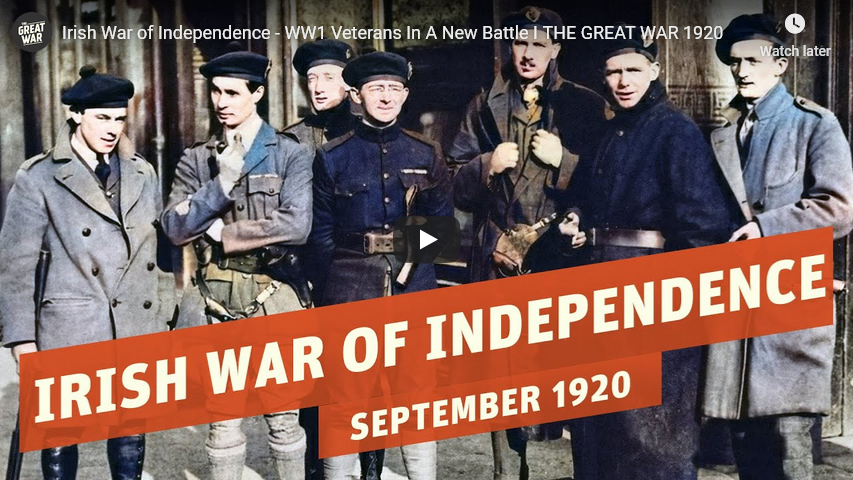
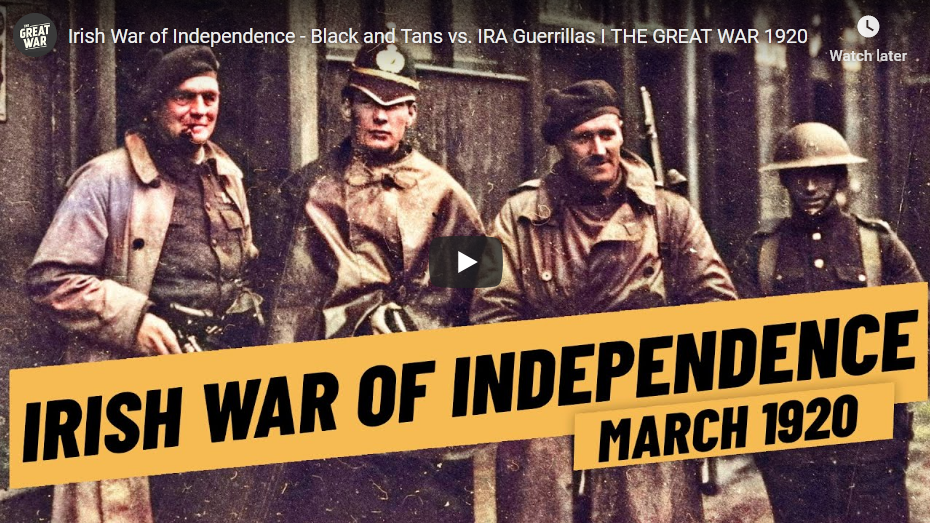
The movement for more Irish self determination had turned into a full out revolutionary movement by 1919. The British Empire was losing control over Ireland and by early 1920 was in a full out guerrilla war against the Irish Republican Army (IRA). To regain control more police forces were recruited with wide ranging authorities – and a lack of actual police training. With their mismatched equipment made from war supplies, they soon got the nickname “Black and Tans”.
» SUPPORT THE CHANNEL
Patreon: https://www.patreon.com/thegreatwar
Merchandise: https://shop.spreadshirt.de/thegreatwar/» SOURCES
Bowen, Tom, “The Irish Underground and the War of Independence 1919-21” Journal of Contemporary History Vol. 8, No. 2 (Apr., 1973), pp. 3-23
Hopkinson, Michael, The Irish War of Independence, (Montreal & Kingston : McGill-Queen’s University Press, 2002)
Leeson, David, The Black and Tans: British Police and Auxiliaries in the Irish War of Independence, 1920-1921, (Oxford : Oxford University Press, 2011)
Lowe, W.J., “Who Were the Black-and-Tans”, History Ireland (Autumn 2004)
Townshend, Charles, The Republic: The Fight for Irish Independence 1918-1923, (London : Penguin Books, 2013)
» SOCIAL MEDIA
Instagram: https://instagram.com/the_great_war
Twitter: https://twitter.com/WW1_Series
Reddit: https://reddit.com/r/TheGreatWarChannel»CREDITS
Presented by: Jesse Alexander
Written by: Mark Newton, Jesse Alexander
Director: Toni Steller & Florian Wittig
Director of Photography: Toni Steller
Sound: Toni Steller
Editing: Jose Gamez, Toni Steller
Mixing, Mastering & Sound Design: http://above-zero.com
Maps: Daniel Kogosov (https://www.patreon.com/Zalezsky)
Research by: Mark Newton
Fact checking: Florian WittigChannel Design: Alexander Clark
Original Logo: David van StepholdA Mediakraft Networks Original Channel
Contains licensed material by getty images
All rights reserved – Real Time History GmbH 2020

March 15, 2020
Irish War of Independence – Black and Tans vs. IRA Guerrillas I THE GREAT WAR 1920
January 8, 2020
Trump versus Iran (and significant parts of the US and western media)
Kurt Schlicter‘s take on the way President Trump has been breaking recent US habits in their dealings with Iran:

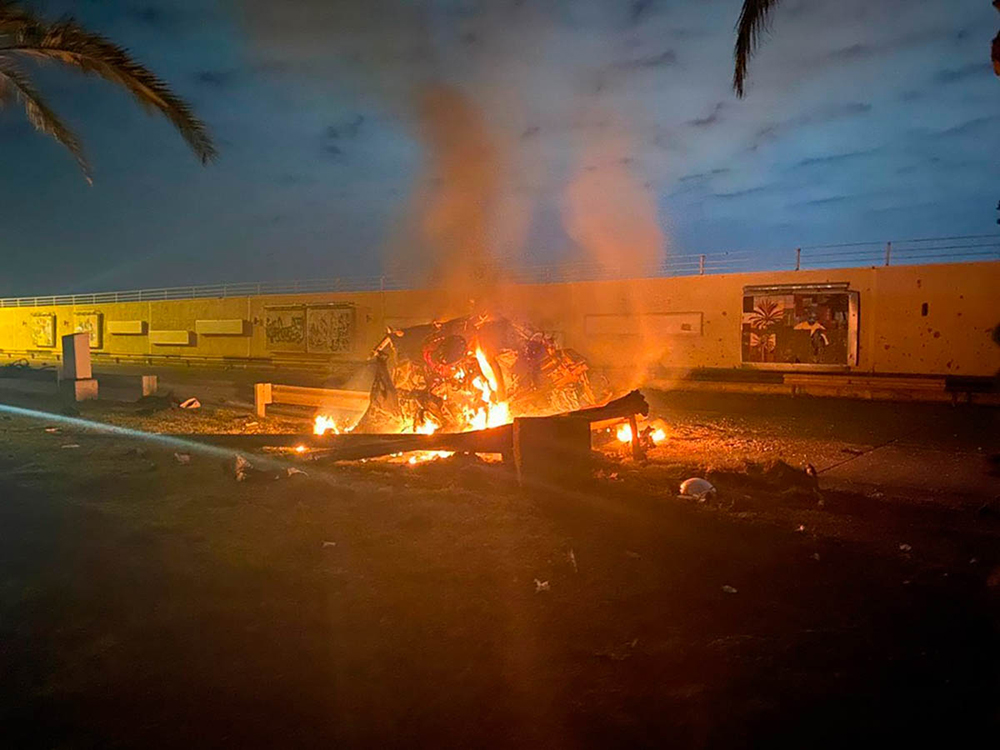
A burning vehicle at Baghdad International Airport following an American airstrike, early Friday, Jan. 3, 2020. The Pentagon said Thursday that the U.S. military has killed Gen. Qassem Soleimani, the head of Iran’s elite Quds Force, at the direction of President Donald Trump.
Photo from the Iraqi Prime Minister’s Press Office via Wikimedia Commons.
The Iranians had been getting uppity for a while, but then their punks killed an American contractor in a rocket attack on a U.S. base – and let’s not get distracted about whether we should still be there. They killed an American. We are there, and you don’t get a pass on murdering U.S. citizens because we may or may not have a good reason for them still being there. You get dead.
See, for too long we were asking the wrong question when tinpot dictators dared hurt Americans. We asked, “What would a gender-fluid Oppression Studies major at Yale do?” As I have observed before, the correct question is “WWJC do?” – “What would Julius Caesar do?”
Trump ordered hard hits at five Shiite militia weapon sites, and not with any warnings either. They got one of ours, we got about two dozen of theirs. Like the old joke about 1,000 lawyers at the bottom of the sea, that’s a good start.
The Iranians, whose Islamic Revolutionary Guard Corps is the ultimate source of most of the Shiite terror in the world, decided to respond in what they thought was a clever way: send a few thousand of their camo-clad dummies to attack the embassy and hope and pray a bunch of them got mowed down on camera. In the meantime, wave a lot of banners, burn some stuff, and pound on the reinforced glass for the press’s benefit.
But apparently, no one told the “mourners,” as the austere scholars at the endlessly useless New York Times dubbed the members of Islamic Antifa, that they were supposed to get smoked. They went home with the embassy unseized. Getting martyred en masse is not that much fun when you’re just one sucker out of dozens – heck, they may run of virgins.
See, Trump made it clear he was not playing. There would be no Benghazi II: Bagdad Boogaloo on his watch, and he acted well before 13 hours ran on the clock. Rejecting the elite’s preferred model of craven submission to every Third World cretin with a grievance and a camera, the Trump administration flew some Apache gunships over the crowd of unwashed morons, kicking off some flares, and generally sending the unequivocal message that if those SOBs had a problem, the AH-64s had a 30mm solution.
And then the administration sent in 100 Marines, about a company, on Ospreys as a quick reaction force and alerted the ready brigade at Ft. Bragg to start shutting 82nd Airborne Division paratroopers into theater.
Whatever the opposite of “stand down” is, Trump ordered that.
December 27, 2019
Imagine John Lennon as a huge hypocrite
As Mark Steyn pointed out, it isn’t hard to do:
In his Christmas sermon five years ago, the Bishop of Shrewsbury described John Lennon’s ghastly dirge “Imagine” as “heart-chilling”. Here’s what I had to say about it, and about secularism and a common culture, in the Christmas issue of The Spectator a decade earlier:
At my daughter’s school this year, the holiday concert concluded with John Lennon’s “Imagine”. The school had thoughtfully printed the lyric on the program, and the teacher, inviting the parents to sing along, declared the number summed up what we were all “praying” for. Indeed. The droning vamp began, and John’s anthem for cotton-candy nihilists rent the air:
Imagine there’s no heaven
It’s easy if you try
No hell below us
Above us only sky
Imagine all the people
Living for today …Ah, that’s the message of the season, isn’t it? Back in the Sixties, John opined that the Beatles were bigger than Jesus Christ, which was a wee bit controversial in those unenlightened times but which appears to be no more than a prosaic statement of fact as far as the music department’s priorities are concerned. These days, “Imagine” has achieved the status of secular hymn, no doubt because of its inclusive message:
Imagine there’s no countries
It isn’t hard to do
Nothing to kill or die for
And no religion, too …Hey, happy holidays!
You may say he’s a dreamer, but he’s not. A couple of years ago, it emerged that Lennon was a very generous contributor not just to organizations that support and fund the IRA, but to the IRA itself. He could certainly imagine there’s no countries, nothing to kill or die for and no religion, too, but until that blessed day he was quite happy to support a religiously discriminatory organization that blows up grannies at shopping centres in order to get out of one country and join another. How heartening to know that, though he grew rich peddling illusory pap to the masses, he didn’t fall for it himself.
“Imagine” didn’t go over wild with the parents, who mumbled along unenthusiastically. To be honest, I’d prefer John and Yoko’s peacenik dirge, “(Happy Xmas) War Is Over”, though that might be a little premature and anyway that song suffers from the disadvantage of mentioning Xmas. On the radio you can hear “Frosty” and “Rudolph” and James Taylor’s new post-9/11 version of “Have Yourself A Merry Little Christmas”, but anyone with young children finds themselves exposed to a strange alternative repertoire of unseasonal favourites. My friend Tammy emerged from her daughter’s kindergarten concert in a rage: not just no Christmas carols, but no “Jingle Bells”. The only song she recognized was Lionel Bart’s spectacular melisma pile-up from Oliver!, “Whe-e-e-e-ere Is Love?”, which is not designed to be sung en masse. “They sounded like they were dying,” she fumed, before going off to beard the school board, who explained that “Jingle Bells” had been given the heave-ho on the grounds that it might be insensitive to those of a non-jingly persuasion.
September 15, 2019
QotD: “Whenever I hear the word ‘culture’ I reach for my Browning”
This, attributed to Goering but rather indited by some other nutjob mediocrity, is among my favourite phrases. Often I cite it with glee. I know just what he meant; rarely has one the chance to empathize with Nazis. Monsters they were, but also human, and if we lose the means to recall what made them tick, we are disadvantaged against their successors.
Ditto with Islamic terrorists, incidentally. Unless we can see them, sometimes, from the angle that makes them most attractive, we miss the whole picture. Know the enemy, I say. The worst psychopath may offer to share some droll humour. It is my firm belief that even liberals and progressives can be charming, sometimes.
I wonder which part of Mr Browning’s works Herr Goering would reach for? Would it be an earlier work, as Paracelsus or Sordello? A later, such as Jocoseria or Asolando? Me, I think I would start with a dilatory romp through the Dramatic Idylls, then hunker down with The Ring and the Book.
David Warren, “Include me in”, Essays in Idleness, 2017-08-30.
September 4, 2019
Japan, the Bureaucratic War Machine | BETWEEN 2 WARS I 1931 Part 2 of 3
TimeGhost History
Published on 3 Sep 2019In Japan there has been a gradual increase of militarism since the Great War and in 1931 the country goes to war again when they invade Chinese Manchuria based on a false flag terrorist strike at the Mukden railway junction.
Join us on Patreon: https://www.patreon.com/TimeGhostHistory
Subscribe to our World War Two series: https://www.youtube.com/c/worldwartwo…
Hosted by: Indy Neidell
Written by: Spartacus Olsson
Directed by: Spartacus Olsson and Astrid Deinhard
Executive Producers: Bodo Rittenauer, Astrid Deinhard, Indy Neidell, Spartacus Olsson
Creative Producer: Joram Appel
Post-Production Director: Wieke Kapteijns
Research by: Joram Appel and Spartacus Olsson
Edited by: Danile Weiss
Sound design: Marek KaminskySources:
A TimeGhost chronological documentary produced by OnLion Entertainment GmbH.
Sources:
James Fulcher, The Bureaucratization of the State and the Rise of Japan (1988)
Katō Yōko, “The debate on fascism in Japanese historiography”, in: Sven Saaler and Christopher W.A. Szpilman (ed.), Routledge Handbook of Modern Japanese History (2018), 225-236.
Ethan Mark, “Japan’s 1930s crisis, fascism, and social imperialism”, in: Sven Saaler and Christopher W.A. Szpilman (ed)., Routledge Handbook of Modern Japanese History (2018), 237-250.
Penolepe Francks, “The path of economic development from the late nineteenth centre to the economic miracle”, in: Sven Saaler and Christopher W.A. Szpilman (ed)., Routledge Handbook of Modern Japanese History (2018), 267-278.
Sandra Wilson and Robert Cribb, “Japan’s colonial empire”, in: Sven Saaler and Christopher W.A. Szpilman (ed)., Routledge Handbook of Modern Japanese History (2018), 77-91.
Mark R. Peattie, “Nanshin: The ‘Southward Advance’, 1931-1941, as a Prelude to the Japanese Occupation of Southeast Asia”, in: Peter Duus e.a., The Japanese Wartime Empire, 1931-1945 (2010), 190-242.
From the comments:
TimeGhost History
13 minutes ago
This is the third of several episodes that cover the developments in East Asia leading to World War Two. In this episode we look at how Japan by 1931 has developed to be on the brink of a fascist state without anyone specifically taking power or staging a coup. The democratic reforms from the past four decades are dying a death by a thousand cuts as the Japanese administration and military simply take one small decision after the other that erodes freedom, dials back democracy, and inevitably leads to war. It’s an anonymous, mechanic, gradual movement towards global conflict proceeding with clockwork precision.This episode also sees the first change to the Between 2 Wars set as Astrid and Wieke have started adapting the set to the changing themes, while we move closer and closer to the outbreak of WW2 — we’d love to hear what you think!
August 9, 2019
What’s happening in Jammu and Kashmir?
Pieter J. Friedrich reports on recent events concerning the unique constitutional status of Jammu and Kashmir within the Republic of India:
Terror grips the most militarized zone in the world after India’s Central Government terminated Jammu and Kashmir’s 70-year-old “special status” as the first step towards stripping the disputed region of statehood entirely.
Internationally infamous as the world’s hottest potential nuclear flashpoint, J&K originally acceded to India in 1947 only on the condition that the newly-formed country be restricted from interfering in the domestic affairs of the mountainous northern region. The agreement was sealed between the last king of J&K, Maharaja Hari Singh Dogra, and the representative of the British crown, Governor-General Lord Mountbatten. In 1949, when passage of the constitution formed the Republic of India, the Maharaja’s conditions for accession were enshrined in Article 370.
The crux of the article – in combination with Article 35A of 1954 – was that, while J&K accepted India’s handling of issues like defense and foreign policy, the state otherwise reserved the right to autonomy in handling its domestic affairs. Kashmiris, thus, lived under their own distinct laws. Notably, citizens of other parts of India were prohibited from settling permanently or owning property in Kashmir. In the eyes of many Kashmiris, this prevented settler colonialism. On August 5, 2019, the President of India abolished this “special status” by decree.
Simultaneously, Home Minister Amit Shah – charged with India’s internal security – introduced a bill in the upper house of parliament to strip J&K of statehood, downgrade it to a “Union Territory,” and partition the region.
As Shah did this, the Central Government shut down Kashmir. It imposed a virtual curfew, banning movement of the public, shuttering educational institutions, and barring all public assemblies or meetings. It severed communications, cutting off phone and internet access. And it conducted arrests of mainstream Kashmiri political leaders – such as former chief ministers Mehbooba Mufti and Omar Abdullah – on unknown charges.
India’s ruling Bharatiya Janata Party, which was just re-elected in May, campaigned on promises to scrap J&K’s “special status.” The BJP’s manifesto alleged that it was “an obstacle in the development of the state,” while Shah insisted it stood in the way of of Kashmir becoming an “integral party of India permanently” and was necessary for “national security.” Indeed, the tumultuous region has suffered a significant influx in violence in recent years.
Since 2014, when Prime Minister Modi’s regime first came to power, terrorist incidents in J&K have nearly tripled and security forces deaths have nearly doubled. According to a July 2019 UN report, independent bodies documented 159 security forces deaths in 2018 – a figure comparable to US troop fatalities in Iraq in 2009. The latest round of escalating tensions traces back to at least 2010, when mass protests erupted over an “encounter killing” of three civilians by Indian Army troops. Protests again erupted in 2016. During suppression efforts, security forces killed hundreds of protesters.
The Central Government has responded by flooding J&K with more and more soldiers. The small region – slightly smaller than the United Kingdom – is already occupied by a bare minimum of 500,000 troops. Since late July 2019, India has deployed nearly another 50,000.
Delhi has additionally responded by repeatedly dissolving J&K’s elected state government, imposing direct rule three times since 2015. The last time was in June 2018, after India’s ruling BJP withdrew from a coalition with then J&K Chief Minister Mufti – apparently because she advocated “reconciliation” instead of a “muscular security policy” as the most effective solution to the Kashmir conflict. Elections have not been allowed since 2014.
The ongoing occupation as well as the long-term use of direct rule – imposed for approximately ten of the past 42 years – contribute to the perception of Kashmiris that they are nothing more than vassals within the Republic of India.
June 23, 2019
The state of play in the Strait of Hormuz
Arthur Chrenkoff wonders what would happen if Iran gave a war, but nobody came:

A satellite view of the Strait of Hormuz, 30 December 2001.
Jacques Descloitres, MODIS Land Rapid Response Team, NASA/GSFC via Wikimedia Commons.
Nearly twenty per cent of world crude oil shipments (from the Arab Gulf producers) go out to the rest of the world through the Strait of Hormuz, which Iran is threatening to close (hence its recent attacks on oil tankers).
However, through a combination of fracking, increased mainline well production and greater efficiencies, the United States is now finally energy self-sufficient. For all that America cares, Iran could cut off all the traffic through the Strait and it would have a minimal impact on the domestic economy, some minor logistical adjustments aside.
Nearly two thirds of the oil that travels through the Strait ships to Asia instead, and specifically to China, India, Japan and Korea, which are significantly more dependent on that oil to power their energy-hungry, export-oriented economies than other regions of the world.
China, notably, has been Iran’s tacit international ally. If Iran wants to interfere with the free navigation in its backyard and in so doing antagonise one of its few remaining backers, it should be left alone to do so.
These circumstances – the US doesn’t need the Gulf oil, China does – should convince the United States to stand back and not involve itself yet another time as the world sheriff to enforce the rules of international law and maintain the open international trading system. The rest of the world all too often free-rides on America’s good graces (not to mention its blood and treasure), while at the same time reserving the right to castigate the superpower for its interventionism. Why not let the world experience what it’s like without having the US solve all their problems (while getting all their blame)? Maybe the European Union or the United Nations can do something [canned laughter]. Or maybe the most affected Asian nations can try to solve their own oil supply problems. Good luck, lads.
June 19, 2019
Avoiding a hot war with Iran
Jay Currie responds to a recent article at ZeroHedge, on the US-Iran situation:

The game map for Gulf Strike, an early 1980s board wargame by Victory Games.
Image from https://pbem.brainiac.com/vg.htm
The article outlines all the ways that this approach to war with Iran would be folly and while I don’t necessarily agree with all the points made, the general point that massive force however strategically deployed will almost certainly produce results that the US and the rest of the world will not like one little bit. While you can bomb the Hell out of Iran, Iran has a number of retaliatory options ranging from the possibility of an EMP hit (they may have a rudimentary nuke) to closing the Strait of Hormuz to using Hezbollah sleeper cells in the US to hit critical infrastructure. While I have no doubt the US could beat Iran in a straight war, it would be long, bloody, politically suicidal for Trump and nasty for ordinary Americans.
Worse, it would be a strategic error. If the US leaves its current sanctions in place the Iranian economy will grind to something of a halt. Support for the current Iranian regime, already shakey, will decline. Yes, the current regime will continue with its provocations – I have no doubt it was Iranians who put holes in the sides of two tankers. But, so what?
Exciting as a hot war with Iran would be for assorted policy wonks, it would be an expensive exercise in futility compared to a longer term cold war with some clever extras.
First off, the Americans should make it very clear to the Iranians and the world that while they are committed to freedom of navigation, they are not interested in massive responses to minor incidents. If there is to be any response at all to the tanker mines (if that is what they were) it should be very local indeed. Find the boat in the video and sink it (or one very much like it – no need to be too picky).
Second, using US cyber assets – such as they are – it is time to see just how effectively infrastructure can be disrupted rather than destroyed. A sense of humour would be a huge asset here. Being able to cut into TV broadcasts is one thing, telling jokes at the Ayatollah’s expense is another.
Third, the Israelis did a very good business in the selective assasination of Iran’s nuclear scientists. A similar tactic against Iranian civil and military officials engaged in terrorism or attacks on shipping would be throughly demoralizing for the Iranian regime.
On point two, I’m reminded of a key scene in Robert Heinlein’s “If This Goes On—” (later published in expanded form in Revolt in 2100), where the United States has fallen under the control of religious fanatics (vaguely Christian, but carefully not identified with any then-current sect) so that “The Prophet” occupies the role of head of state and unquestioned all-powerful religious leader. The current Prophet performs a televised annual “miracle” where he is seen on-camera to transform into Nehemiah Scudder, the First Prophet, and give blessings and advice to the current Prophet and to the American people. The conspirators manage to take over the central TV feed and replace the “genuine” Prophet’s message with a skilled actor’s portrayal of Scudder calling America to arms to overthrow the false Prophet. This is the start of the armed rebellion against the Prophet. In the technology of the story, this required a strike team to attack and occupy the physical studio where the broadcast originated — literally a suicide mission. In our digital world, the “strike team” might never need to leave Fort Meade (or wherever the data centre might be)…
June 12, 2019
QotD: Militant Islam and the Western media
Mark Steyn is a brave man. He doesn’t talk about his death threats or his security measures, but his public life speaks for itself. For the fifth anniversary of the Muhammad cartoon controversy, he stood on a stage in Copenhagen with the Danes who were not yet in hiding along with Lars Vilks, the Swedish cartoonist who had survived physical attacks, arson, at least three assassination plots, and an Al Qaeda hit list. Steyn returned for the tenth anniversary observance, a few months after the Charlie Hebdo massacre, but by then no cartoonists were left — they were all in hiding, including Vilks, after yet another attempt on his life.
“I’m always willing to stand with the guys in Denmark,” says Steyn. “But the reason all these left-wing Europeans end up on a stage with an eccentric right-wing Canadian like me is that no real A-list stars will agree to be there. At the tenth anniversary both the American State Department and the British Foreign Office even issued official warnings to their citizens to stay away from the Danish Parliament, where we were holding the ceremony. What kind of signal does that send? Why don’t the artists show up for these things? Why aren’t the movie stars there? When Theo Van Gogh was assassinated, no one at the Oscars had a word to say about it. They didn’t even put him in the obituary montage. And yet they congratulate themselves on their moral courage. George Clooney wears a Je suis Charlie Hebdo pin. Helen Mirren wears a brooch. But they were not with Charlie. Those guys died alone. This is gesture politics. No one would stand with them. I honour the genuine courage of Ayaan Hirsi Ali. Ayaan’s point is absolutely right — in the end you have to share the risk. Charlie Hebdo supported the Danish cartoonists, but the rest of the world didn’t. If every newspaper had published those cartoons, there would have been no point in killing anyone because there would have been too many people to kill. Instead, nobody stands with them, and so the small publication that does ends up massacred. The writer of the comic strip Doonesbury in America [Garry Trudeau] attacked the decision of PEN to honour Charlie Hebdo. Well, they were lying on the floor, bleeding and dying. I don’t think they noticed.”
The Danish cartoon controversy was actually the first moment the American press had been challenged by Islam and could do something in response — and their reaction was a spectacular failure of will and principle. In several countries around the world, it was actually against the law to publish the Danish cartoons, but many editors stepped up, published them anyway, and suffered the civil and criminal consequences. In the United States — where there was no such law — no major publication would print them.
Mark Steyn, interviewed by John Bloom, “Mark Steyn, Cole Porter and Free Speech”, Quadrant, 2017-05-11.
January 11, 2019
Jagmeet Singh’s plight
Federal NDP leader Jagmeet Singh will finally get his chance to win a seat in Parliament on February 25 in the Burnaby South byelection. Things have not been going well for Singh since he was elected leader in 2017. At that time, I thought he would be a serious threat to Justin Trudeau’s popularity with the media (Justin’s teeny-bopper fan club) and allow the NDP to be taken more seriously as a potential government. That hasn’t happened and Singh’s media coverage has been much more critical than any NDP leader might have expected. Andrew Coyne explains:
It is safe to say Singh has not proved quite the rock star New Democrats hoped when they elected him leader in October 2017. Undertaker would be closer to the mark. While the party trundles along at a little under 17 per cent in the polls, about its historic average, Singh himself is in single digits, slightly behind Elizabeth May as Canadians’ choice for prime minister.
Singh’s trajectory is a cautionary tale on the importance of experience in politics. With just six years in the Ontario legislature, Singh was barely ready for the job of provincial leader, still less the much sharper scrutiny to which federal leaders are subject. It has showed.
He appears frequently to be poorly briefed, on one memorable occasion having to ask a member of caucus, in full view of the cameras, what the party position was on a particular issue. He badly mishandled what should have been a softball question on where he stood on Sikh terrorism, and alienated many in the party with his knee-jerk expulsion of Saskatchewan MP Erin Weir for what appeared to be no worse a crime than standing too close to women at parties.
The decision not to seek a seat in the House until now has robbed him of what visibility the leader of a third party can expect, though his manifest weakness as a communicator makes it debatable whether this is a plus or a minus. Fundraising has dried up. Party morale is in freefall. Caucus members speak openly, if not on the record, of their desire to be rid of him.
For the Liberals, on the other hand, Singh is the answer to all their prayers. The prime minister’s own approval ratings may have dropped precipitously, but as long as the NDP vote can be kept to current levels of support or less the Liberals are unlikely to lose. (The NDP’s average share of the popular vote when the Conservatives win: 19.5 per cent. When the Liberals win: 14.8 per cent.) And nothing so guarantees a calamitous NDP showing as Singh’s continued leadership.
Hence the curious unspoken subtext of the Burnaby South race, with Liberals more or less openly rooting for him to win — and New Democrats hardly less publicly hoping he loses.
December 28, 2018
November 13, 2018
A Kristallnacht album
9 November, 1938. The Germans called it Kristallnacht, the “Night of Broken Glass”, Reichspogromnacht or simply Pogromnacht. Elisheva Avital tells the story of a photo album from that terrible event that came into her grandfather’s possession at some point during World War 2:
November 8, 2018
80 years on from Kristallnacht
Jerrold Sobel reminds us that 80 years ago today, the Nazis got their desired pretext to launch a domestic terror campaign against the Jews:

Destroyed shopfront of a Jewish business in Magdeburg, November 9, 1938.
Photo Bundesarchiv Bild 146-1979-046-19, via Wikimedia Commons.
Hitler came into power in 1933 with a plan to expand Germany’s rule and to completely annihilate world Jewry. During this time between his ascension and 1938, progressively strident anti-Semitic laws known as the Nuremberg Laws were enacted in which governmental policies regulated every aspect of Jewish life.
As conditions increasingly worsened for Jews, a Polish Jewish student, Herschel Grynszpan, whose family was being deported after a lifetime living in Germany, acted out against the Nazis and assassinated a German diplomat, Ernst vom Rath, on November 7, 1938. Hitler could not have been happier: it was the pretext he had been seeking to up the ante of anti-Semitism from “law-based” to mob violence.
By November 9, rioting was already in full swing in all quarters of the Reich, which by this time included Austria. Minister of propaganda Josef Goebbels encouraged Hitler to allow further punishment of the Jews through more “spontaneous demonstrations” of violence. According to Goebbels’s diary, Hitler responded: “[D]emonstrations should be allowed to continue. The police should not be withdrawn. For once the Jews should get the feel of popular anger.”
And did they ever. On the nights of November 9 and 10, 1938, unspeakable assaults upon Jewish women and men took place in Germany and Austria. When the majority of the mayhem finally ended on November 11, 30,000 Jewish men had been arrested and taken to concentration camps. Although figures vary, at least 100 fatalities were initially reported, the number growing into the hundreds due to subsequent mistreatment of those arrested.
Over 1,400 synagogues were burnt to the ground, and more than 7,500 businesses were likewise looted and torched. Jewish hospitals, homes, and schools fared no better. Those two nights of havoc would ignominiously become known as Kristallnacht: the night of the broken glass.
Soon, the world came to know the depredations wrought upon the Jewish people those nights. It was just the beginning, a precursor to the greatest ethnic mass murder of a people in the history of the world: the Holocaust.
November 5, 2018
Who Was Guy Fawkes? – Anglophenia Ep 18
Anglophenia
Published on 5 Nov 2014Remember, remember the 5th of November: Guy Fawkes is one of Britain’s most infamous figures. Who’s the man behind the mask made famous by V For Vendetta and the protest group Anonymous? Siobhan Thompson explains.
June 27, 2018
Canada’s euphemistically named “High Risk Returnees”
Judith Bergman on the Canadian government’s kid-gloves approach to dealing with Canadian citizens who return to Canada after volunteering to serve with terrorist organizations:
Canadians who go abroad to commit terrorism – predominantly jihadists, in other words – have a “right to return” according to government documents obtained by Global News. They not only have a right of return, but “… even if a Canadian engaged in terrorist activity abroad, the government must facilitate their return to Canada,” as one document says.
According to the government, there are still around 190 Canadian citizens volunteering as terrorists abroad. The majority are in Syria and Iraq, and 60 have returned. Police are reportedly expecting a new influx of returnees over the next couple of months.
The Canadian government is willing to go to great (and presumably costly) lengths to “facilitate” the return of Canadian jihadists, unlike the UK, for example, which has revoked the citizenship of ISIS fighters so they cannot return. The Canadian government has established a taskforce, the High Risk Returnee Interdepartmental Taskforce, that, according to government documents:
“… allows us to collectively identify what measures can mitigate the threat these individuals may pose during their return to Canada. This could include sending officers overseas to collect evidence before they depart, or their detention by police upon arrival in Canada.”
Undercover officers may also be used “to engage with the HRT [High Risk Traveler] to collect evidence, or monitor them during their flight home.”
In the sanitizing Orwellian newspeak employed by the Canadian government, the terrorists are not jihadis who left Canada to commit the most heinous crimes, such as torture, rape and murder, while fighting for ISIS in Syria and Iraq, but “High Risk Travelers” and “High Risk Returnees”.
The government is fully aware of the security risk to which it is subjecting Canadians: According to the documents, “HRRs [High Risk Returnees] can pose a significant threat to the national security of Canada”. This fact raises the question of why the government of Canada is keen to facilitate these people’s “right of return” — when presumably the primary obligation of the government is to safeguard the security of law-abiding Canadian citizens.