
The oldest way of war was what Native North Americans called – evocatively – the “cutting off” way of war (a phrase I am borrowing from W. Lee, “The Military Revolution of Native North America” in Empires and Indigines, ed. W. Lee (2011)), but which was common among non-state peoples everywhere in the world for the vast stretch of human history (and one may easily argue much of modern insurgency and terrorism is merely this same toolkit, updated with modern weapons). The goal of such warfare was not to subjugate a population but to drive them off, forcing them to vacate resource-rich land which could then be exploited by your group. To do this, you wanted to inflict maximum damage (casualties inflicted, animals rustled, goods stolen, people captured) at minimum risk, until the lopsided balance of pain you inflicted forced the enemy to simply move away from you to get out of your operational range.
The main tool of this form of warfare (detailed more extensively in A. Gat, War in Human Civilization (2006) and L. Keeley, War Before Civilization (1996)) was the raid. Rather than announcing your movements, a war party would attempt to advance into enemy territory in secret, hoping (in the best case) to catch an enemy village or camp unawares (typically by night) so that the population could be killed or captured (mostly killed; these are mostly non-specialized societies with limited ability to incorporate large numbers of subjugated captives) safely. Then you quickly get out of enemy territory before villages or camps allied to your target can retaliate. If you detected an incoming raid, you might rally up your allied villages or camps and ambush the ambusher in an equally lopsided engagement.
Only rarely in this did a battle result – typically when both the surprise of the raid and the surprise of the counter-raid ambush failed. At that point, with the chance for surprise utterly lost, both sides might line up and exchange missile fire (arrows, javelins) at fairly long range. Casualties in these battles were generally very low – instead the battle served both as a display of valor and a signal of resolve by both sides to continue the conflict. That isn’t to say these wars were bloodless – indeed the overall level of military mortality was much higher than in “pitched battle” cultures, but the killing was done almost entirely in the ambush and the raid.
We may call this the first system of war. It is the oldest, but as noted above, never entirely goes away. We tend to call this style “asymmetric” or “unconventional” war, but it is the most conventional war – it was the first convention, after all. It is also sometimes denigrated as primitive, but should not be judged so quickly – first system armies have managed to frustrate far stronger opponents when terrain and politics were favorable.
Bret Devereaux, “Collections: The Universal Warrior, Part IIa: The Many Faces of Battle”, A Collection of Unmitigated Pedantry, 2021-02-05.
May 3, 2023
QotD: The first system of war
April 24, 2023
QotD: The Baader-Meinhof phenomenon
A little joke for psychologists there.
In 1994, someone left a comment on the website of the St. Paul Pioneer Press (Minnesota) saying that he had heard two references to the Red Army Faction, AKA the Baader-Meinhof gang — a 1970s German terrorist organisation — in the space of 24 hours, having never previously been aware of them. This somehow provided a new name for a cognitive bias. Don’t let anyone tell you that posting online comments on regional newspaper websites is a waste of time.
Otherwise known as frequency bias, the Baader-Meinhof phenomenon is a combination of selective attention bias (paying more attention to some things than to others) and confirmation bias (looking for things that you agree with or which serve your purposes in some way).
Arnold Zwicky added another aspect when he wrote about the significance of things happening recently, describing the “recency illusion” as …
… the belief that things YOU have noticed only recently are in fact recent.
The classic example is people’s tendency to notice a certain type of car once they own one themselves, especially when they bought it recently.
Of course it is possible that the thing you’ve just started noticing is truly becoming more frequent. I have noticed more shirts, flags and other merchandise related to Arsenal FC recently. This may be because the team is doing very well this season and I am more conscious of them as a result. Or it may be that Arsenal fans are less coy about showing their support after years of under-performing. What is less likely is that there are significantly more Arsenal fans than there were before.
Christopher Snowden, “Sudden deaths and the Baader-Meinhof phenomenon”, The Snowden Substack, 2023-01-21.
April 11, 2023
QotD: Being the target of a death threat
[…]
And about that security plan: carrying a firearm is nearly useless without very specific kinds of mental preparation. It’s not just that you have to think through large ethical issues about when to draw and when to fire (equivalently, when to threaten lethal force and when to use it). You also need good defensive habits of mind. Carrying a firearm is no good if an adversary wins the engagement before you have time to draw.
The most basic good habit of mind is maintaining awareness of your tactical environment. From what directions could you be attacked? Is there a way for an assailant to come up behind you for a hand-to-hand assault, or to line up a shooting position from beyond hand-to-hand range where you couldn’t see it? Are you exposed through nearby windows?
One advantage I had going in was reading Robert Heinlein as a child. This meant I soaked up some basic tactical doctrine through my pores. Like: when you go to a restaurant, sit with your back to a wall, preferably in a corner, in a place with good sightlines but not near a window. When you sit down, think about possible threat axes and which direction to bail out in if you have to.
Advice I’ve gotten from people with counterterrorism training includes this lesson: watch your environment and trust your instincts. Terrorists, criminals, and crazies don’t tend to blend in well even when they’re trying. If someone nearby looks or feels out of place in your surroundings, or behaves in a way not appropriate to the setting, pay attention to that; check your escape routes and make sure you can reach your weapons quickly.
How careful you have to be depends on the threat model you’re planning against. I’m not going to talk about mine in detail, because that might compromise my security by telling bad guys what expectations to game against. But I will say that it assigns a vanishingly small probability to professionals with scoped rifles; the background culture of both Iranian terrorists and their Arab proxies makes it extremely difficult for them to train or recruit snipers, and I am reliably informed that the Iranians couldn’t run professional hit teams in the U.S. anyway – too difficult to exfiltrate them, among other problems.
This, along with some other aspects of the threat model I won’t discuss, narrows the range of plausible threats to something an armed and trained individual with good backup from law enforcement has a reasonable hope to be able to counter. And the good backup from law enforcement is not a trivial detail; real life is not a Soldier of Fortune story or a running-man thriller, and a sane security plan uses all the resources available from your connections to the society around you.
Eric S. Raymond, “Fourteen months of carrying”, Armed and Dangerous, 2010-09-21.
April 2, 2023
QotD: The (in-)effectiveness of chemical weapons against “Modern System” armies
But let’s put that in a real-world context. Five Japanese doomsday cultists used about five liters of sarin in a terror attack on a Tokyo Subway in 1995, deployed, in this case, in a contained area, packed full to the brim with people – a potential worst-case (from our point of view; “best” case from the attackers point of view) situation. But the attack killed only 12 people and injured about a thousand. Those are tragic, horrible numbers to be sure – but statistically insignificant in a battlefield situation. And no army could count on ever being given the kind of high-vulnerability environment like a subway station in an actual war.
In order to produce mass casualties in battlefield conditions, a chemical attacker has to deploy tons – and I mean that word literally – of this stuff. Chemical weapons barrages in the First World War involved thousands and tens of thousands of shells – and still didn’t produce a high fatality rate (though the deaths that did occur were terrible). But once you are talking about producing tens of thousands of tons of this stuff and distributing it to front-line combat units in the event of a war, you have introduced all sorts of other problems. One of the biggest is shelf-life: most nerve gasses (which tend to have very high lethality) are not only very expensive to produce in quantity, they have very short shelf-lives. The other option is mustard gas – cheaper, with a long shelf-life, but required in vast quantities (during WWII, when just about every power stockpiled the stuff, the stockpiles were typically in the many tens of thousands of tons range, to give a sense of how much it was thought would be required – and then think about delivering those munitions).
[…]
But that’s not the only problem – the other problem is doctrine. Remember that the modern system is all about fast movement. I don’t want to get too deep into maneuver-warfare doctrine (one of these days!) but in most of its modern forms (e.g. AirLand Battle, Deep Battle, etc) it aims to avoid the stalemate of static warfare by accelerating the tempo of the battle beyond the defender’s ability to cope with, eventually (it is hoped) leading the front to decompose as command and control breaks down.
And chemical weapons are just not great for this. Active use of chemical weapons – even by your own side – poses all sorts of issues to an army that is trying to move fast and break things. This problem actually emerged back in WWI: even if your chemical attack breaks the enemy front lines, the residue of the attack is now an obstruction for you. […] A modern system army, even if it is on the defensive operationally, is going to want to make a lot of tactical offensives (counterattacks, spoiling attacks). Turning the battle into a slow-moving mush of long-lasting chemical munitions (like mustard gas!) is counterproductive.
But that leaves the fast-dispersing nerve agents, like sarin. Which are very expensive, hard to store, hard to provision in quantity and – oh yes – still less effective than high explosives when facing another expensive, modern system army, which is likely to be very well protected against such munitions (for instance, most modern armored vehicles are designed to be functionally immune to chemical munitions assuming they are buttoned up).
This impression is borne out by the history of chemical weapons; for top-tier armies, just over a century of being a solution in search of a problem. The stalemate of WWI produced a frantic search for solutions – far from being stupidly complacent (as is often the pop-history version of WWI), many commanders were desperately searching for something, anything to break the bloody stalemate and restore mobility. We tend to remember the successful innovations – armor, infiltration tactics, airpower – because they shape subsequent warfare. But at the time, there were a host of efforts: highly planned bite-and-hold assaults, drawn out brutal et continu efforts, dirigibles, mining and sapping, ultra-massive artillery barrages (trying a wide variety of shell-types and weights). And, of course, gas. Gas sits in the second category: one more innovation which failed to break the trench stalemate. In the end, even in WWI, it wasn’t any more effective than an equivalent amount of high explosives (as the relative casualty figures attest). Tanks and infiltration tactics – that is to say, the modern system – succeeded where gas failed, in breaking the trench stalemate, with its superiority at the role demonstrated vividly in WWII.
Bret Devereaux, “Collections: Why Don’t We Use Chemical Weapons Anymore?”, A Collection of Unmitigated Pedantry, 2020-03-20.
January 16, 2023
“The Commission has no power to find liability. Its report will not bind the government”
Donna Laframboise continues to cover the Emergencies Act inquiry submissions, including one from Queen’s University law professor Bruce Pardy:
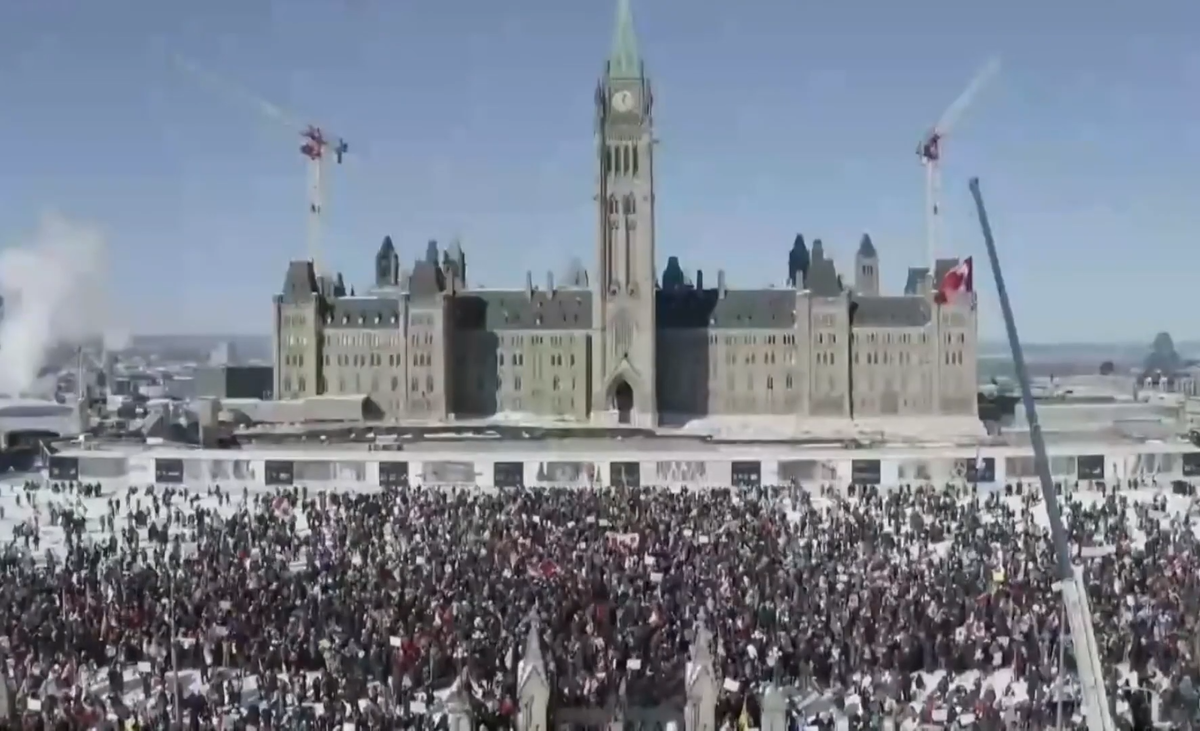
A screenshot from a YouTube video showing the protest in front of Parliament in Ottawa on 30 January, 2022.
Photo via Wikimedia Commons.
Shortly after the Emergencies Act commission finished listening to witnesses, he authored a grim opinion piece in the Toronto Sun.
His expectations are exceedingly low. In his words, the commission’s
mandate is not to rule on the legality of the government’s actions but to inquire into “the circumstances that led to the declaration being issued and the measures taken for dealing with the emergency”. The Commission has no power to find liability. Its report will not bind the government. The Commission is ritual, and the purpose of ritual is performance not outcome – to make it appear that there is accountability without having to provide it. [bold added]
Let us hope he’s mistaken, and that Commissioner Paul Rouleau has a pleasant surprise in store for us. Whatever happens, Pardy’s article provides a useful history lesson. It describes the series of events that prompted the use of similar legislation the last time around:
Between 1963 and 1970, the Front de libération du Québec (FLQ) committed hundreds of bombings and several robberies, killing six people, including Quebec deputy premier Pierre Laporte. In response, Pierre Trudeau’s government invoked the War Measures Act.
Six murders – including the politically motivated kidnapping and execution of a deputy premier. Seven years of violence. Hundreds of bombings. Compare and contrast to the three-week festive, bouncy-castle, hot-tub trucker protest in which not a single person was robbed, bombed, or murdered.
Times sure have changed. Today, the same Canadian federal government that talks constantly about equity, diversity, and inclusion failed to do a single thing to make the protesting truckers feel as though their concerns, perspectives, or lives mattered. Diversity is something the government preaches, but doesn’t practice. Disagree with the Prime Minister and you’re a fringe minority with unacceptable views. Inclusion is a fancy word that makes politicians feel good about themselves, but it isn’t a principle that informs their actual behavour.
December 13, 2022
Well, the modern Weimarites were getting overdue for another putsch…
Apparently, we just missed having a new German Reich last week, due to the lack of a few key ingredients, including mass support, weapons, good planning, and competent coup leaders … or maybe the German government just over-reacted to a non-existential threat:
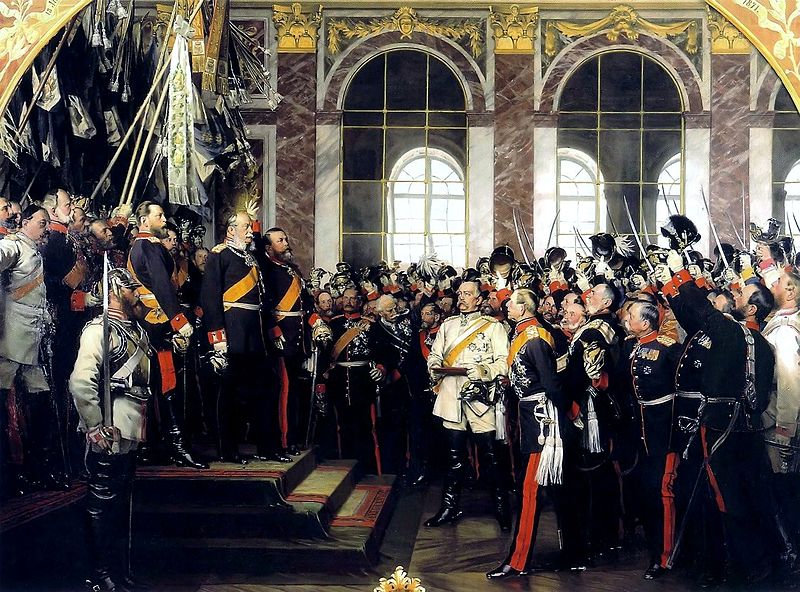
The proclamation of Prussian king Wilhelm I as German Emperor at Versailles, by Anton von Werner. The first two versions were destroyed in the Second World War. This version was commissioned by the Prussian royal family for chancellor Bismarck’s 70th birthday.
The German state oversaw one of its largest anti-terror operations in its modern history last week. Approximately 3,000 police officers arrested 54 suspects in raids carried out on Wednesday morning. Those arrested were members of the Reichsbürger – one of the oddest and most obnoxious movements to have emerged in Germany in recent years. It is alleged that those arrested were conspiring to overthrow the state and install a shadow government headed by an obscure German nobleman.
German chancellor Olaf Scholz was clearly pleased with himself after the raid. He hailed it as an example of Germany’s “defensive democracy” (wehrhafte Demokratie) in action. This refers to the modern German state’s willingness to curtail certain democratic freedoms to protect itself from the far right.
The Reichsbürger are deeply reactionary, anti-democratic and conspiratorial. They claim that the old German Reich, which collapsed at the end of the First World War, was never legally abolished and that modern-day Germany is therefore an illegal construct. They believe Germany’s democracy is a sham, which conceals a secret deep state pulling the strings behind the scenes. In its place, the Reichsbürger want to recreate the Germany of the late 19th century, which includes reinstalling a Kaiser as ruler.
The fact that such a bizarre movement has been growing in size – from around 19,000 supporters in 2019 to an alleged 23,000 in 2022, according to the police – shows us that something is clearly going wrong in Germany. The Reichsbürger have not been growing in a political vacuum. Indeed, they have grown partly as a response to the German government’s authoritarian handling of the Covid pandemic. The Reichsbürger’s black, white and red flags (the colour of the flag of the old pre-1918 German Reich) could often be seen at anti-lockdown demonstrations. This made it all too easy for the pro-lockdown lobby to present any opposition to Covid restrictions as the product of far-right conspiracy theorists.
The Reichsbürger have also been violent at times. During a raid on a Reichsbürger building in 2016, three police officers were injured and one was killed. Earlier this year, one member ran over and seriously injured a policeman with his car. They also have members with military skills. Some of those arrested last week were former German soldiers, including a member of an elite military unit (the KSK).
Yet it is important not to exaggerate the threat the Reichsbürger pose to the German state. Which is what the government deliberately seems to be doing. Interior minister Nancy Faeser spoke of the alleged plotters as a “terrorist threat”, despite the fact those arrested looked more like confused pensioners than hardened insurgents. Indeed, the alleged head of the conspiracy, a 71-year-old member of a largely unknown former noble family, is called “Prince Reuss” (or Prince Henry XIII). A relative of the prince told reporters that, while the “prince” does have nutty ideas and is bitter about his loss of social status, it is hard to imagine him as the ringleader of a conspiracy. At the time of writing, there is also no trace of the huge cache of military hardware that was alleged to be somewhere on the prince’s estate – although some swords, rifles and crossbows have been found.
November 5, 2022
Repost: Remember, Remember the Fifth of November
Today is the anniversary of the Gunpowder Plot:
Everyone knows what the Gunpowder Plotters looked like. Thanks to one of the best-known etchings of the seventeenth century we see them “plotting”, broad brims of their hats over their noses, cloaks on their shoulders, mustachios and beards bristling — the archetypical band of desperados. Almost as well known are the broad outlines of the discovery of the “plot”: the mysterious warning sent to Lord Monteagle on October 26th, 1605, the investigation of the cellars under the Palace of Westminster on November 4th, the discovery of the gunpowder and Guy Fawkes, the flight of the other conspirators, the shoot-out at Holbeach in Staffordshire on November 8th in which four (Robert Catesby, Thomas Percy and the brothers Christopher and John Wright) were killed, and then the trial and execution of Fawkes and seven others in January 1606.
However, there was a more obscure sequel. Also implicated were the 9th Earl of Northumberland, three other peers (Viscount Montague and Lords Stourton and Mordaunt) and three members of the Society of Jesus. Two of the Jesuits, Fr Oswald Tesimond and Fr John Gerard, were able to escape abroad, but the third, the superior of the order in England, Fr Henry Garnet, was arrested just before the main trial. Garnet was tried separately on March 28th, 1606 and executed in May. The peers were tried in the court of Star Chamber: three were merely fined, but Northumberland was imprisoned in the Tower at pleasure and not released until 1621.
[. . .]
Thanks to the fact that nothing actually happened, it is not surprising that the plot has been the subject of running dispute since November 5th, 1605. James I’s privy council appears to have been genuinely unable to make any sense of it. The Attorney-General, Sir Edward Coke, observed at the trial that succeeding generations would wonder whether it was fact or fiction. There were claims from the start that the plot was a put-up job — if not a complete fabrication, then at least exaggerated for his own devious ends by Robert Cecil, Earl of Salisbury, James’s secretary of state. The government’s presentation of the case against the plotters had its awkward aspects, caused in part by the desire to shield Monteagle, now a national hero, from the exposure of his earlier association with them. The two official accounts published in 1606 were patently spins. One, The Discourse of the Manner, was intended to give James a more commanding role in the uncovering of the plot than he deserved. The other, A True and Perfect Relation, was intended to lay the blame on Garnet.
But Catesby had form. He and several of the plotters as well as Lord Monteagle had been implicated in the Earl of Essex’s rebellion in 1601. Subsequently he and the others (including Monteagle) had approached Philip III of Spain to support a rebellion to prevent James I’s accession. This raises the central question of what the plot was about. Was it the product of Catholic discontent with James I or was it the last episode in what the late Hugh Trevor-Roper and Professor John Bossy have termed “Elizabethan extremism”?
November 30, 2021
Dynamite Luke Dillon and the Welland Canal
The History Guy: History Deserves to Be Remembered
Published 29 Nov 2021Around 7 in the evening on April 21, 1900 two large explosions rocked the hamlet of Thorold, Ontario. It was an act of terrorism, an attempt to breach the locks of the Welland canal — a ship canal connecting Lake Ontario to Lake Erie, allowing ships to bypass Niagara Falls. Three men were arrested, but who were these “dynamitards”? It would be two years before the identity of their notorious leader would be revealed.
This is original content based on research by The History Guy. Images in the Public Domain are carefully selected and provide illustration. As very few images of the actual event are available in the Public Domain, images of similar objects and events are used for illustration.
You can purchase the bow tie worn in this episode at The Tie Bar:
https://www.thetiebar.com/?utm_campai…All events are portrayed in historical context and for educational purposes. No images or content are primarily intended to shock and disgust. Those who do not learn from history are doomed to repeat it. Non censuram.
Find The History Guy at:
Patreon: https://www.patreon.com/TheHistoryGuy
Please send suggestions for future episodes: Suggestions@TheHistoryGuy.netThe History Guy: History Deserves to Be Remembered is the place to find short snippets of forgotten history from five to fifteen minutes long. If you like history too, this is the channel for you.
Awesome The History Guy merchandise is available at:
https://teespring.com/stores/the-hist…Script by THG
#history #thehistoryguy #Canada

November 13, 2021
Creation of Israel
The Cold War
Published 1 Jun 2019Our series on the history of the Cold War period continues with a documentary on the creation of Israel, Zionist movement, reactions and diplomatic maneuvers of other states and the build-up to first Arab-Israeli war
Consider supporting us on Patreon: https://www.patreon.com/thecoldwar
October 5, 2021
Lars Vilks, RIP
Mark Steyn remembers Swedish artist Lars Vilks, best known for his defence of free speech rights after coming under (literal) attack by Islamist terrorists enraged that he drew a cartoon of Mohammed:

Lars Vilks, 1946-2021.
Cropped from a larger image by OlofE via Wikimedia Commons.
Yesterday, Sunday afternoon, he was being driven in a bulletproof car by two of his protection officers when there occurred what Swedish police regard as a freak collision with a truck. An almighty fire ensued and neither Lars nor the policemen survived; the driver of the other vehicle is seriously wounded and in hospital. This all happened near Markaryd, about an hour north-east of Helsingborg, where Lars was born. Helsingborg, like many Swedish cities, is utterly transformed, which is why Lars Vilks ended his life in an unmarked car being driven home under police protection from a guarded lunch with an old friend.
[…]
Lars was very funny about his newfound celebrity: He carried with him a picture of a Pakistani mob that had been whipped into a frenzy by somewhat inaccurate intelligence, so they were all jumping up and down in the streets demanding “DEATH TO LARISH”. And for a while that day in Copenhagen we all called him Larish: “Hey, Larish, another beer?”, etc.
Larish was likewise a hoot about two of the first jihadists sent to dispatch him. He came home one night to find that a couple of Kosovars had set his kitchen alight. As they escaped across the snowy field heady with the warm glow of their glorious victory over the infidel, they chanced to glance down and noticed that that warm glow was because they’d accidentally set their trousers on fire. After some effort to extinguish the blaze, they were forced to abandon their flaming pantaloons and scamper off into the chill night in their jihadist BVDs. Alas, the best-laid plans and all that: in addition to being trouserless in a Nordic winter, they had neglected to remove from their smouldering pants the charred driving licenses and other identifying documentation. Police were able to track them down rather easily, not least because they were the only two men in Scandinavia taking a late-night stroll in their Y-fronts.
When Lars told this story in Copenhagen, the whole room was roaring with laughter. Afterwards we all went to dinner. And news came to us somewhere between the soup and digestifs that a one-legged Chechen from Belgium, seething with resentment at Lars and the rest of us infidels, had prematurely self-detonated in his Copenhagen hotel room while assembling his package and preparing to hop into Paradise. And we all had a grand laugh about that, too. As I put it that day, Islamic terrorists are like Yosemite Sam, forever shoving the stick of dynamite in their own pants – until one day Yosemite Ahmed manages to get it right. After the bombing of the Conservative Party conference in 1984, the IRA taunted Mrs Thatcher: “You have to be lucky every day, we only have to be lucky once.”
Those jihad incompetents with the smoking trousers would modify the line: We only have to be competent once. Al-Qa’eda had put a six-figure bounty on Lars’ head, and there was no shortage of takers. In Ireland, the gardai arrested four men and three women from Waterford and Cork for a well-advanced plot to fly to Stockholm and kill him. At the height of the so-called “Troubles” you’d have been hard put to find five men in Waterford willing to travel to London to kill Mrs Thatcher or Willie Whitelaw. But an obscure artist in southern Sweden? Pas de problème!
As the report in the Daily Mail shows, the circumstances of Vilks’ death are at the very least, suspicious:
Swedish police investigating the car crash death of a controversial artist who had survived multiple assassination attempts after drawing a cartoon of the Prophet Mohammed cannot explain why his car was travelling so fast.
Lars Vilks, 75, was killed on Sunday when the police car he was travelling in veered onto the wrong side of the road and collided with a truck in Markaryd, in the Swedish province of Kronoberg.
Both vehicles caught fire and the truck driver, 45, was taken to hospital with serious injuries, while the two police protection officers and Vilks were killed.
Investigators believe there were no external influences that led to the deaths and say the crash may have been caused by a burst tyre.
However, they are unable to explain why the car was travelling at around 100mph, according to witnesses, in a 68mph zone.
September 24, 2021
From Handmaid’s Tale cosplay to eco-terrorism
Connor Tomlinson outlines the many performative and disruptive projects of Roger Hallam:
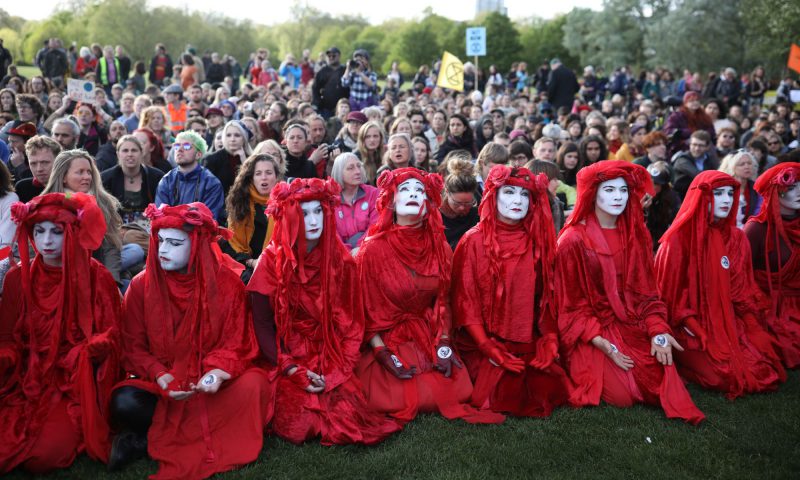
Insulate Britain gluing themselves to the M25 for a week has already produced a four-car collision, with victims airlifted to hospital, and delayed a mother’s treatment, leaving her paralysed by a stroke. Despite these events, activists claim they “don’t accept that we put lives at risk”. It’s vital that legal and cultural action is taken to insulate Britons from this dangerous brand of eco-extremism.
As Dan Wootton’s interview with activist Liam Norton explained, the endangerment of lives to exercise political pressure would classify Insulate Britain as ecological terrorists. The action Insulate Britain wishes to force government to take is “to produce within four months a legally binding national plan to fully fund” the insulation of all Britain’s 29 million homes with taxpayer cash. Essentially, they’re sitting in the motorway, blocking your work commute, so the state can take and spend more of your pay-check.
Insulate Britain is another in a long line of activist vanity projects engineered to make headlines by founder Roger Hallam. Starting with “Stop Killing Londoners” in 2017, Hallam went on to co-create Extinction Rebellion; before being ousted over his comments concerning the Holocaust. But Hallam’s alarmist and extremist rhetoric preceded this insensitive remark. In, 2019, Hallam said “forcing the governments to act” or “bring[ing] them down and create[ing] a democracy fit for purpose” will require “some [to] die in the process”. This “democracy” would, paradoxically, be a “socialist project”, with Hallam in the ideological driving seat.
Hallam’s prior protests demonstrated a similar indifference to human suffering. Hallam was arrested at Heathrow Airport for aiming to fly drones into active airspace and ground commercial flights. His “Heathrow Pause” protests constituted a terror threat, in that drones could cause flights to be grounded or collide and crash. Again, Hallam was willing to risk lives to make headlines.
All of these movements claim the sole solutions to apocalyptic emergencies are the appointment of Hallam himself to a position of public power which lets him implement whichever solutions he deems necessary. His PhD at Kings College on “civil disobedience” exposes Hallam’s own egoism in comparing himself to MLK and Gandhi. This was also an indictment of modern university radicalism; echoed by Dr. Charlie Gardner of the University of Kent making the same comparison in a lecture, calling himself “a hero of our times”, and refusing to disavow Hallam when I challenged him on it.
When I first heard of the M25 protests, I thought they’d be allowed to carry on for a token amount of time to get their actions into the media and then they’d be cleared off by the police. I was quite astonished to find that they were permitted to stay in place for several hours and that the police were being quite solicitous of their health and protecting them from any attempt at counter-protest by the stranded motorists. I’m now worried that the next time they try this, the motorists will have learned that the police aren’t there to enforce the law and be tempted to take it into their own hands.
September 11, 2021
Twenty years on
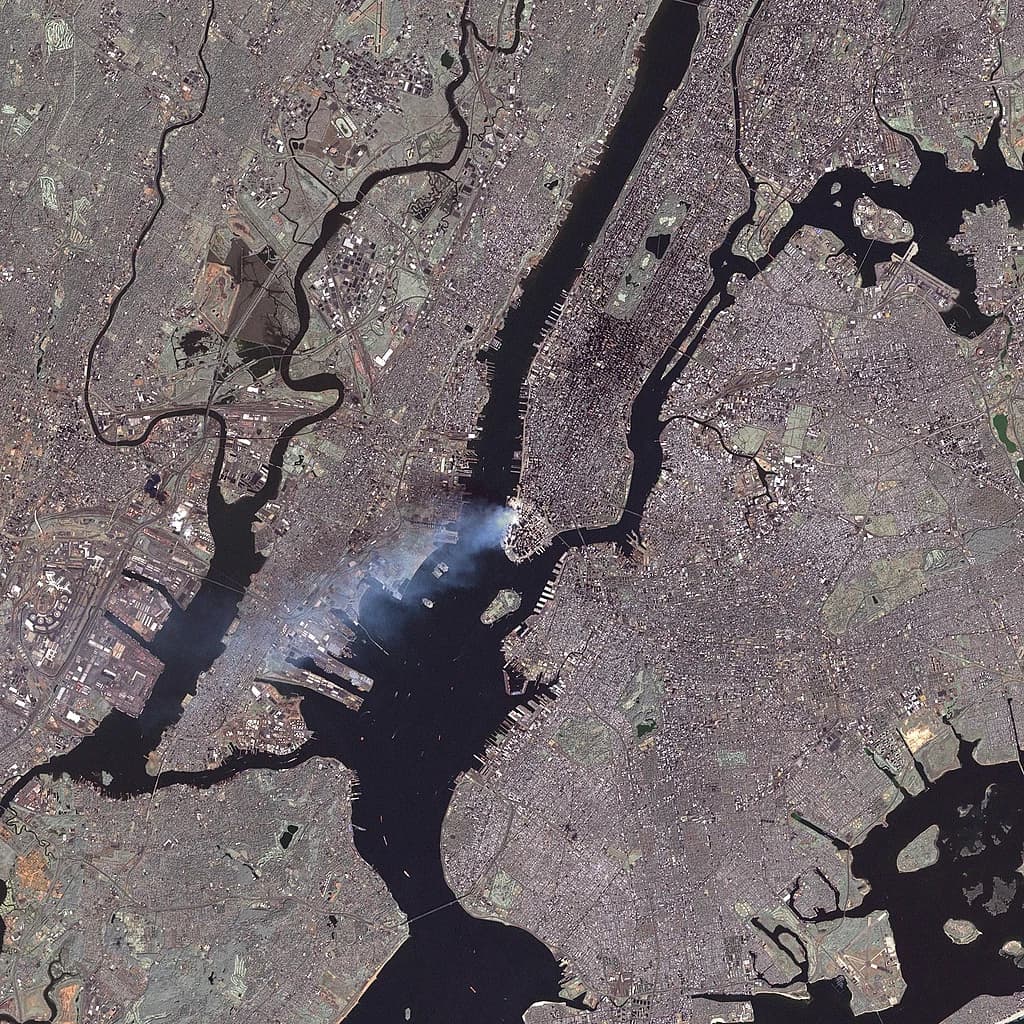
Mark Steyn‘s observations:
We shall not resume our anniversary observances today. The war is lost, at home and abroad. On the domestic front, we doubled the rate of Muslim immigration to the west and began assimilating ourselves with Islam’s strictures on freedom of expression and the like. The decade-and-a-half since the Danish Mohammed cartoons has been one long remorseless surrender on core western liberties. When a school teacher gets beheaded in the street, there is no outrage at the act, just a mild regret that he should have been foolish enough to provoke his own fate. Even the milder jests from the immediate post-9/11 era — the cartoon of the woman trying on new burqas in the changing room and wondering, “Does my bomb look big in this?” — would not be published today.
In the broader society, our rulers quickly determined that it was easier to punish us than our enemies. The post-9/11 security state surely helped soften up western populations for the Chi-Com-19 lockdowns, in which entire nations have been reduced to TSA-administered airports.
As for the war overseas, it ended with a military that can do everything except win handing the keys to Afghanistan back to the guys who pulled off 9/11 — and apologizing for the two-decade inconvenience by gifting the mullahs with some of the most expensive infrastructure on the planet plus an air force, approximately five assault rifles for every Taliban fighter, and express check-in for the forty-seven per cent of the Afghan population that apparently served as US translators.
The position of the United States is far weaker than it was twenty years ago. Around the planet, the assumption of friends and enemies alike is that the American moment is over and the future belongs elsewhere. They are making their dispositions accordingly. It is not a question of wishing “the post-American world”, but of accepting the known facts.
David Warren reposted his thoughts from the fifteenth anniversary:
A generation or more is necessary to see any large event in some historical perspective. That the fall of the Berlin Wall was a “large event” we could see immediately, but not what it portended. The political world would be transformed, but the New World Order that George Bush Senior foresaw was a mirage. Ditto with events since 9/11.
Several thousand were killed on that day in 2001 — the anniversary of the Ottoman defeat at the Gates of Vienna. This was a comparatively small number, by modern standards. The rich symbolism of this Islamist operation was lost on the West, which no longer cares for history or legend. A brilliant assault of “asymmetric warfare”, it fulfilled all of its objectives. The torch has since been passed from the more moderate al-Qaeda to the more fanatic Daesh, and will be passed again in due course. Osama bin-Laden personally lost face by being hunted down and killed like a rat, but his vision of a restored Islamic Caliphate survives him. It inspires still the young in heart and mind.
The immediate intention was to humiliate the “Great Satan”; to awaken the sleeping giant and make him blindly thrash; to goad him into self-destructive behaviour as he struck against an enemy he could neither locate nor understand. Beyond this: to expose him as a paper tiger, tilting a balance of power, and transferring initiative from the mightily-armed “Crusader” to the nimble “Jihadi”. Within the Muslim world: to show that only the radical Salafist faction could get results, could change the direction of history and, as it were, “make Arabia great again”.
As I suggested above, we are still too close to this event to grasp its full significance; but after fifteen years we in the West are in a much worse position than we were on the 10th of September, 2001. We showed, as the Islamists predicted, that we did not have the stamina to prevail, even against weak adversaries; that America and allies could only fight “Vietnams”. Our will is shaken, and to Salafist delight, we have by now expressed contrition for fourteen centuries of Christian defence against Islamic aggression. We bow respectfully, as our culture is insulted, and as versions of Shariah are imposed. In disregard of our own security, we have thrown our borders open to massive Muslim immigration. We follow, at every junction, the course of sentimentality, and adapt to the certainty of defeat. After each hit we call for grief counsellors.
On MeWe, Byron Clark reposted a transcript of the call Todd Beamer made from United Airlines flight 93 that morning:
Todd: Hello … Operator … listen to me … I can’t speak very loud. – This is an emergency. I’m a passenger on a United flight to San Francisco. We have a situation here … Our plane has been hijacked … can you understand me?
Lisa: (exhaling a deep breath to herself) I understand … Can the hijackers see you talking on the phone?
Todd: No
Lisa: Can you tell me how many hijackers are on the plane?
Todd: There are three that we know of.
Lisa: Can you see any weapons? What kind of weapons do they have?
Todd: Yes … they don’t have guns … they have knives – they took over the plane with knives.
Lisa: Do you mean … like steak knives?
Todd: No, these are razor knives … like box cutters.
Lisa: Can you tell what country these people are from?
Todd: No … I don’t know. They sound like they’re from the mid-east.
Lisa: Have they said what they want?
Todd: Someone announced from the cockpit that there was a bomb on board. He said he was the captain and to stay in our seats and stay quiet.
He said that they were meeting these men’s demands and returning to the airport… It was very broken English, and… I’m telling you…it sounded fake!
Lisa: Ok sir, please give me your name.
Todd: My name is Todd Beamer.
Lisa: Ok Todd … my name is Lisa … Do you know your flight number? If you can’t remember, it’s on your ticket.
Todd: It’s United Flight 93.
Lisa: Now Todd, can you try to tell me exactly what happened?
Todd: Two of the hijackers were sitting in first class near the cockpit. A third one was sitting near the back of the coach section. The two up front got into the cockpit somehow; there was shouting. The third hijacker said he had a bomb. It looks like a bomb. He’s got it tied to his waist with a red belt of some kind.
Lisa: So is the door to the cockpit open?
Todd: No, the hijackers shut it behind them.
Lisa: Has anyone been injured?
Todd: Yes, they … they killed one passenger sitting in first class. There’s been lots of shouting. We don’t know if the pilots are dead or alive. A flight attendant told me that the pilot and copilot had been forced from the cockpit and may have been wounded.
Lisa: Where is the 3rd hijacker now Todd?
Todd: He’s near the back of the plane. They forced most of the passengers into first class. There are fourteen of us here in the back. Five are flight attendants. He hasn’t noticed that I slipped into this pantry to get the phone. The guy with the bomb ordered us to sit on the floor in the rear of the plane … oh Jesus. Help!
Lisa: Todd … are you ok? Tell me what’s happening!
Todd: Hello … We’re going down … I think we’re going to crash … Wait – wait a minute. No, we’re leveling off … we’re ok. I think we may be turning around … That’s it – we changed directions. Do you hear me … we’re flying east again.
Lisa: Ok Todd … What’s going on with the other passengers?
Todd: Everyone is … really scared. A few passengers with cell phones have made calls to relatives. A guy, Jeremy, was talking to his wife just before the hijacking started. She told him that hijackers had crashed two planes into the World Trade Center … Lisa is that true??
Lisa: Todd … I have to tell you the truth … it’s very bad. The World Trade Center is gone. Both of the towers have been destroyed.
Todd: Oh God — help us!
Lisa: A third plane was taken over by terrorists. It crashed into the Pentagon in Washington DC. Our country is under attack … and I’m afraid that your plane may be part of their plan.
Todd: Oh dear God. Dear God … Lisa, will you do something for me?
Lisa: I’ll try … if I can … Yes.
Todd: I want you to call my wife and my kids for me and tell them what’s happened. Promise me you’ll call.
Lisa: I promise – I’ll call.
Todd: Our home number is 201 353-1073 … You have the same name as my wife … Lisa … We’ve been married for 10 years. She’s pregnant with our 3rd child. Tell her that I love her … (choking up) … I’ll always love her … (clearing throat) We have two boys … David, he’s 3 and Andrew, he’s 1 … Tell them … (choking) tell them that their daddy loves them and that he is so proud of them. (clearing throat again) Our baby is due January 12th … I saw an ultra sound … it was great … we still don’t know if it’s a girl or a boy … Lisa?
Lisa: (barely able to speak) I’ll tell them, I promise Todd.
Todd: I’m going back to the group — if I can get back I will …
Lisa: Todd, leave this line open … are you still there?
Lisa: (dials the phone) Hello, FBI, my name is Lisa Jefferson, I’m a telephone supervisor for GTE. I need to report a terrorist hijacking of a United Airlines Flight 93 … Yes I’ll hold.
Goodwin: Hello, this is Agent Goodwin … I understand you have a hijacking situation?
Lisa: Yes sir, I’ve been talking with a passenger, a Todd Beamer, on Flight 93 who managed to get to an air phone unnoticed.
Goodwin: Where did this flight originate, and what was its destination?
Lisa: The flight left Newark New Jersey at 8 A.M. departing for San Francisco. The hijackers took over the plane shortly after takeoff, and several minutes later the plane changed course – it is now flying east.
Goodwin: Ms. Jefferson … I need to talk to someone aboard that plane. Can you get me thru to the planes phone?
Lisa: I still have that line open sir, I can patch you through on a conference call … hold a mo …
Todd: Hello Lisa, Lisa are you there?
Lisa: Yes, I’m here. Todd, I made a call to the FBI, Agent Goodwin is on the line and will be talking to you as well.
Todd: The others all know that this isn’t your normal hijacking. Jeremy called his wife again on his cell phone. She told him more about the World Trade Center and all.
Goodwin: Hello Todd. This is Agent Goodwin with the FBI. We have been monitoring your flight. Your plane is on a course for Washington, DC. These terrorists sent two planes into the World Trade Center and one plane into the Pentagon. Our best guess is that they plan to fly your plane into either the White House or the United States Capital Building.
Todd: I understand … hold on … I’ll … I’ll be back …
Lisa: Mr. Goodwin, how much time do they have before they get to Washington?
Goodwin: Not long ma’am. They changed course over Cleveland; they’re approaching Pittsburgh now. Washington may be twenty minutes away.
Todd: (breathing a little heavier) The plane seems to be changing directions just a little. It’s getting pretty rough up here. The plane is flying real erratic … We’re not going to make it out of here. Listen to me … I want you to hear this … I have talked with the others … we have decided we would not be pawns in these hijackers suicidal plot.
Lisa: Todd, what are you going to do?
Todd: We’ve hatched a plan. Four of us are going to rush the hijacker with the bomb. After we take him out, we’ll break into the cockpit. A stewardess is getting some boiling water to throw on the hijackers at the controls. We’ll get them … and we’ll take them out. Lisa … will you do one last thing for me?
Lisa: Yes … What is it?
Todd: Would you pray with me?
They pray: Our father which art in Heaven
Hallowed be thy name,
Thy kingdom come, thy will be done
on earth as it is in heaven.
Give us this day our daily bread,
And forgive us our trespasses
As we forgive our trespassers,
And lead us not into temptation
But deliver us from evil
For thine is the kingdom, and the power, and the glory
Forever … Amen
The Lord is my shepherd, I shall not want …
He makes me to lie down in green pastures
He leads me beside the still waters
He restores my soul
He leads me in paths of righteousness
for His name’s sake
Yea, though I walk through the valley of the shadow of death
I will fear no evil, for thou art with me …
Todd: (softer) God help me … Jesus help me … (clears throat and louder)
Are you guys ready? …
Let’s Roll …
September 9, 2021
QotD: Terrorism
Victor Davis Hanson, Ripples of Battle, 2004.
July 20, 2021
Kurt Westergaard, RIP
Mark Steyn on the life and work of cartoonist Kurt Westergaard:
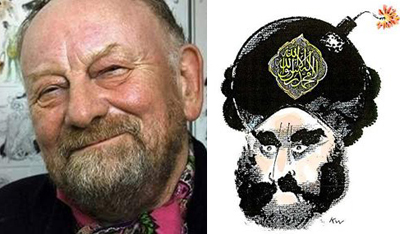
Kurt Westergaard and I were successive winners of the Danish Free Press Society’s Sappho Award. I was very flattered to find myself in his company, but couldn’t honestly say I deserved to be. Kurt was one of the bravest men of our time – not because he was inclined to bravery, but simply because, when it was required, he met the challenge and never backed down.
Sixteen years ago Flemming Rose of the Danish newspaper Jyllands-Posten decided to conduct a thought experiment in public after an author casually revealed that he couldn’t find any Danish artist willing to illustrate his book about “the Prophet Mohammed” (as the BBC now routinely styles him). So Flemming called twelve cartoonists and invited them to depict the late Prophet. Kurt Westergaard’s cartoon was the memorable one, and the one you recall as the years roll by. It was a pithy visual jest: Mohammed’s turban as a bomb with a lit fuse. See picture at top right.
“I attempted to show that terrorists get their spiritual ammunition from parts of Islam, and with this spiritual ammunition, and with dynamite and other explosives, they kill people,” Kurt told my old newspaper The National Post a few years back. “I showed this in a cartoon and what happened? They want to kill me, so I think I was right.”
An otherwise courtly, cultured Dane, Kurt Westergaard had a somewhat arresting dress code, preferring le rouge et le noir, the colors of anarchists, although, as a practical matter, it’s hard for a man of advanced years to carry off red trousers, whatever his motivation. He would qualify his pantaloons by explaining that he was not a political anarchist but a cultural one. Still, one can gather from the garb alone that Westergaard was no “right-winger”. Like most of the men and women I have shared a stage with in Europe this century, he was an old Sixties radical sufficiently principled to think the same kind of jokes he’d applied to church, monarchy, parliament and every other societal institution should also be applied to Islam. He never wanted to be a “free speech hero”, but gamely bore the burthen once it had been dropped on him. He certainly never wanted to be world-famous, albeit more so in Mogadishu than Manhattan and Lahore than Los Angeles. It cost him a comfortable retirement, weakened his health, and an ever more craven culture denied him the consolations of monetary exploitation. When I expressed sympathy, he laughed and said he’d do the same cartoon all over again even knowing what he was in for.
The blood lust began with a trio of imams on the make shopping the twelve cartoons (plus three cruder fakes) round the Muslim world, and leaving it to the usual Islamonutters to take it from there: In nothing flat, over two hundred people were dead – which meant that CNN & Co were obliged to cover the story. They did so by modifying Westergaard’s cartoon, with Mohammed’s face pixilated, as if he’d entered the witness protection programme. If only. In reality, it was that dwindling band of people who believe in free speech – and, indeed, free speech itself – that found itself in the witness protection programme.
QotD: Lenin’s “Hanging Order”
Elsewhere, Lenin declared that “The proletariat needs state power, the centralized organization of force, the organization of violence, for the purpose of crushing the resistance … and for the purpose of leading the great mass of the population … in the work of organizing a socialist economy.”
In August 1918, Lenin sent his now famous “Hanging Order” telegram. It instructed local Bolsheviks in the Penza region to deal harshly with the farmers (kulaks) who owned land there and were standing in the way of its nationalization. The British historian Robert Service discovered it in Soviet archives in the 1990s. It read as follows:
Comrades! The insurrection of five kulak districts should be pitilessly suppressed. The interests of the whole revolution require this because ‘the last decisive battle’ with the kulaks is now underway everywhere. An example must be made.
- Hang (absolutely hang, in full view of the people) no fewer than one hundred known kulaks, fatcats, bloodsuckers.
- Publish their names.
- Seize all grain from them.
- Designate hostages, in accordance with yesterday’s telegram.
Do it in such a fashion, that for hundreds of miles around the people see, tremble, know, shout: “The bloodsucking kulaks are being strangled and will be strangled.”
Telegraph receipt and implementation.
Yours, Lenin.
P.S. Use your toughest people for this.
That chilling telegram ushered in the “Red Terror” which murdered Russians by the tens of thousands over the next two years.
Lawrence W. Reed, “How Germany’s ‘Deal With the Devil’ Backfired and Changed History”, Foundation for Economic Education, 2021-04-16.


