Quotulatiousness

March 30, 2019

Canada and the Battle of the Atlantic, part 4 by Alex Funk

Filed under: Cancon, History, Military, WW2 — Tags: , , , , — Nicholas @ 05:00

Editor’s Note: This series was originally published by Alex Funk on the TimeGhostArmy forums (original URL – https://community.timeghost.tv/t/canada-and-the-battle-of-the-atlantic-part-2-edited/1434).
Sources:

  • Far Distant Ships, Joseph Schull, ISBN 10 0773721606 (An official operational account published in 1950, somewhat sensationalist)
    [Schull’s book was published in part because the funding for the official history team had been cut and they did not feel that the RCN’s contribution to the Battle of the Atlantic should have no official recognition. It is very much an artifact of its era, and needs to be read that way. A more balanced (and weighty) history didn’t appear until the publication of No Higher Purpose and A Blue Water Navy in 2002, parts 1 and 2 of the Official Operational History of the RCN in WW2, covering 1939-1943 and 1943-1945, respectively.]
  • North Atlantic Run: the Royal Canadian Navy and the battle for the convoys, Marc Milner, ISBN 10 0802025447 (Written in an attempt to give a more strategic view of Canada’s contribution than Schull’s work, published 1985)
  • Reader’s Digest: The Canadians At War: Volumes 1 & 2 ISBN 10 0888501617 (A compilation of articles ranging from personal stories to overviews of Canadian involvement in a particular campaign. Contains excerpts from a number of more obscure Canadian books written after the war, published 1969)
  • All photos used exist in the Public Domain and are from the National Archives of Canada, unless otherwise noted in the caption.

I have inserted occasional comments in [square brackets] and links to other sources that do not appear in the original posts. A few minor edits have also been made for clarity.

Part 4 — 1940: The fall of France, the battle begins, and the RCN dreams of expansion

Continued from Joseph Schull’s Far Distant Ships:

German infantry and armour were sweeping along the western coast of France, driving into the sea the broken fragments of British and French divisions. Here and there, at isolated bays and harbours, a few battalions of soldiers might be rescued by ship; a few hundreds out of the hundreds of thousands of refugees might be saved. Parties of engineers from England might be landed ahead of the advancing enemy to conduct vitally important demolitions. In this work the Canadian destroyers joined with many British ships.

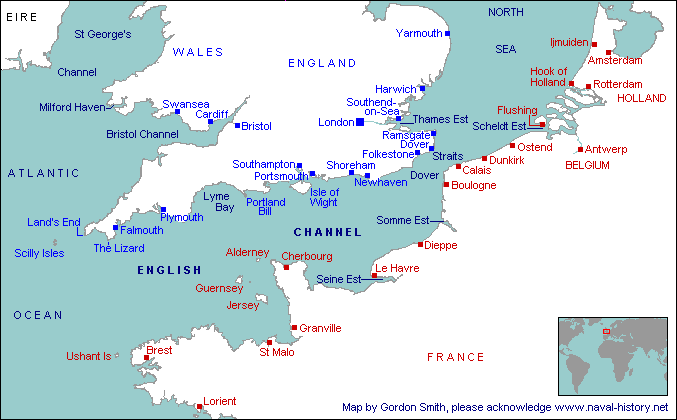
The English Channel and the northern coast of France, 1940.
Map from www.naval-history.net

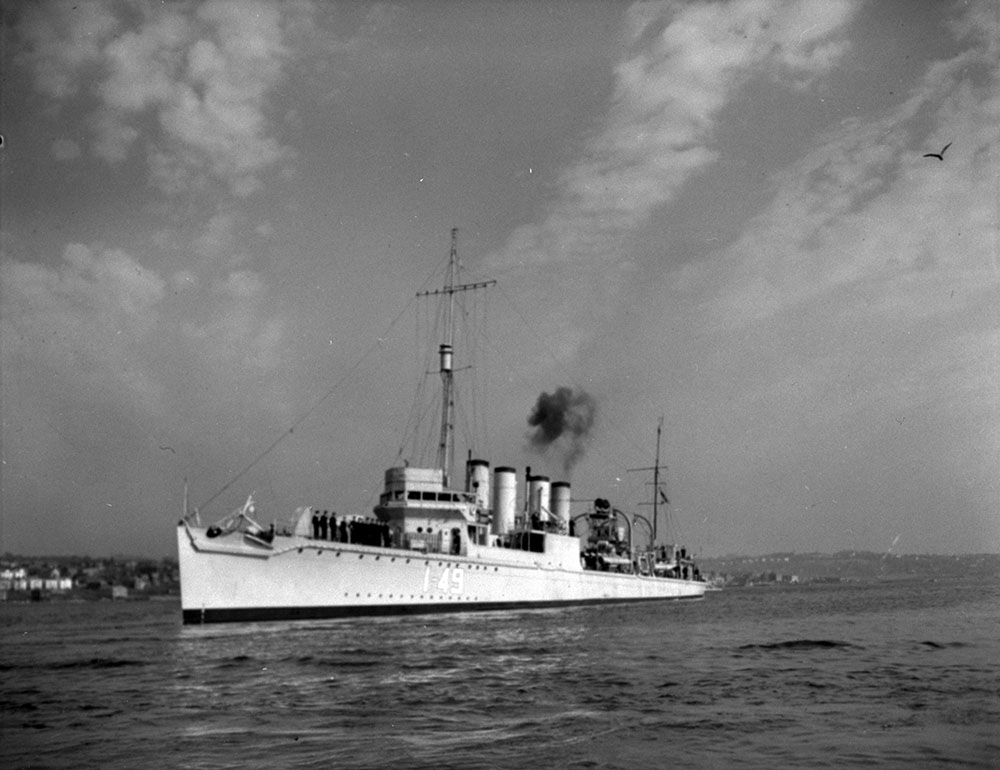
Restigouche and St. Laurent, at sea on June 9, saw from thirty miles distant the flames of Le Havre rising six hundred feet into the night sky. On June 11 they were off St. Valéry en Caux in the neighbourhood of Dieppe, assisting the British destroyer Broke to embark wounded. Part of the British 51st Division was holding a six-mile line in the vicinity but reported itself “in no immediate need of evacuation.” St. Laurent moved a little way up the coast to Veules and took on board forty French troops. She returned to the neighbourhood of St. Valéry an hour or so later to find Restigouche and the British destroyer still standing by for evacuation.

At about eight o’clock in the morning five or six salvoes splashed into the water a hundred yards from St. Laurent and Restigouche. A German battery had taken up position on the cliffs behind the town and there was no longer any possibility of embarking troops. The three destroyers engaged the battery, although they were unable to observe the fall of their shells behind the three hundred foot cliff. When they broke off after a desultory action, Canadian ships had exchanged their first fire with the German enemy.

In North Atlantic Run, Marc Milner explains the Canadian government’s concerns about protecting the eastern seaboard, initially limiting the number of RCN ships that could be sent to European waters:

Undoubtedly the alteration of this policy owed something to the stationing at Halifax of the RN’s Third Battle Squadron, a force of aged battleships and light cruisers intended to provide anti-raider protection for mercantile convoys and more than sufficient to guarantee a credible deterrence along Canada’s Atlantic coast. The alteration of the previous policy also inaugurated the principle of loaning ships to the RN, which became “for a considerable period the dominant element of RCN policy.”

The government’s change of heart not only suited the navy’s burning desire to join in the “active operations” of more distant waters but was also perhaps a response to growing public pressure for a more active involvement in the war. In April 1940, before the invasion of Norway began, Mackenzie King confessed to his diary that the pride of the nation demanded that Canada increase its military commitment overseas from a single division to a full corps. The slow expansion of the navy could not keep up with the national desire to pick up where the Canadian Corps had left off in 1918. Even Colonel Ralston, the minister of Defence, confessed that the military involvement in the land war would have to grow, although “we could have used our money more effectively if it had been confined to air and naval matters.” Canadians, the prime minister’s private secretary wrote years after the war, remained remote from the war, “despite the very large part Canadian airmen and sailors were taking in actual combat,” until the army landed in Sicily in July 1943.

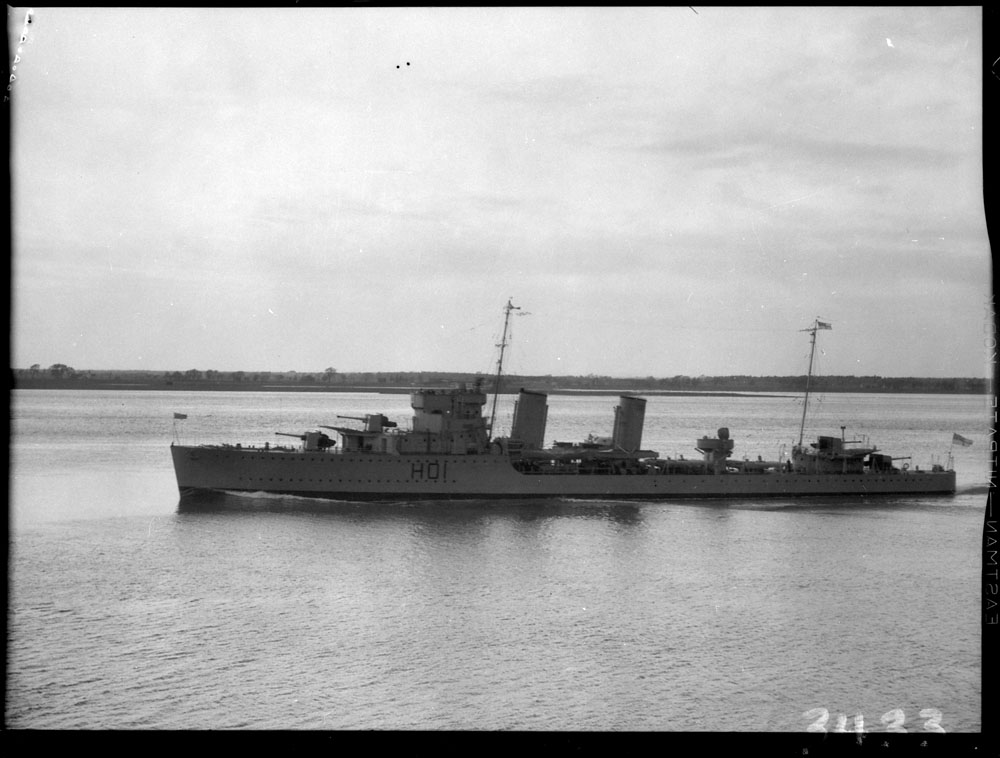
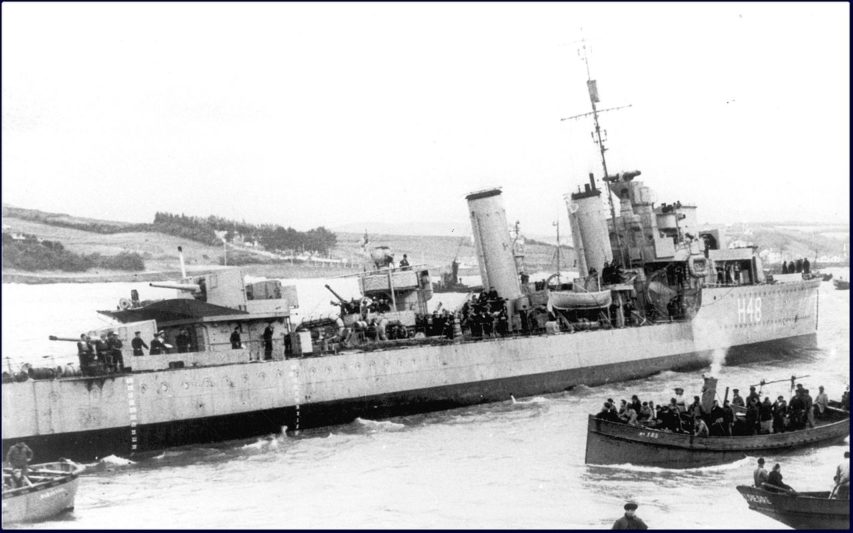
On June 21, the day of France’s humiliation at Compiègne, HMCS Fraser was sent far down the west coast near the Franco-Spanish frontier, to land a Royal Navy evacuation party and to patrol off St. Jean-de-Luz, one of the last remaining French ports unblocked by German forces (this was part of Operation Aerial, the evacuations from the west coast of France). At dawn on the 23rd she was sent north to Arcachon to pick up Canadian and South African diplomats. Transferring them from the sardine fishing boat they had escaped in was no easy task, but eventually all were delivered safely aboard and then transferred to the cruiser HMS Galatea for transport back to England. Fraser returned to St. Jean-de-Luz and was joined by Restigouche and several British destroyers. “The melancholy tumult of evacuation was now fully underway. Boatloads of defeated soldiers and destitute civilians were streaming out from the jetties to the liners, tramp steamers, trawlers and pleasure craft which jostled each other in the rough waters of the harbour. Destroyers threaded a dangerous way among the thronging ships, marshaling the loaded vessels into groups for escort to England while other destroyers zigzagged outside on anti-submarine patrol.” In the dreary 48 hours of the St. Jean-de-Luz evacuation, 16,000 soldiers escaped.

HMCS Fraser (H48), commanded by Commander W.B. Creery, on the 25th of June, 1940 off St. Jean-de-Luz, three days before her loss.
Photo from the Canadian Navy Heritage Project, via Wikimedia Commons.

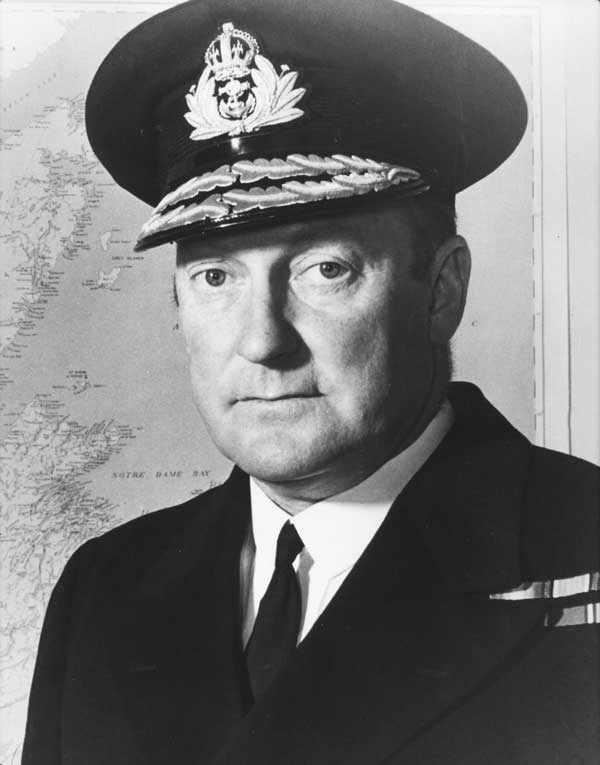
Rear Admiral W.B. Creery, at the time commanding officer of the Fraser, described the final evacuation to Reader’s Digest years later:

The Germans occupied Bordeaux and swept south. By the morning of June 25th, they were within 25 miles of St. Jean-de-Luz. The French, to conform to the armistice terms, had advised that all evacuation must cease by 1 p.m. Fraser had been ordered to remain in harbour during the final evacuation but we had difficulty finding a safe anchorage. We had to re-anchor twice. on the last attempt we held firm — for a reason we were not to discover until later.

We decided to remain where we were until the return of Sub-Lieutenant William Landymore who had been sent away in our motorboat to try and persuade some Belgian trawler skippers to sail to England instead of Spain. Suddenly the officer of the watch, who had a slight stammer, exclaimed “G-G-Good G-G-God, there’s a g-g-gun!” I looked where he was pointing. On a hill a small force of soldiers had appeared with a field gun and a tank. We couldn’t make out their nationality, but ships in harbour are sitting ducks and there was only one thing to do. We ordered the merchant ships to proceed to sea and had to watch several boatloads of evacuees turn sadly back to shore. Our motorboat returned and Landymore sent the boat’s crew swarming up the falls but remained in the boat himself. I was anxious to go to action stations and weigh anchor but it took all hands to hoist the boat.

All was going reasonably well until a steadying line parted, the boat canted sharply outboard and Landymore was catapulted into the sea. Just as this happened I was told the anchor had apparently fouled a cable on the bottom of the harbour and could not be hoisted. And the officer of the watch reported that there were now “a number” of field guns on the hill and they appeared to be taking aim at us. So we fished Landymore out of the sea, slipped our cable and departed in haste if not in dignity.

The merchant ships headed for England, escorted by several RN destroyers. Fraser and Restigouche were ordered to join the British cruiser Calcutta in a sweep north in search of an enemy ship of which there had been a vague report. No such ship was found and toward dusk the flag officer turned his small force toward home.

Joseph Schull continues this particular narrative in Far Distant Ships:

It was now about ten o’clock in the evening, with a fresh breeze, a moderate swell and visibility of one and a half miles. Fraser was off the starboard bow of Calcutta a mile and a half distant, Restigouche was on the cruiser’s port quarter a mile and a half to the left of her and slightly astern. The ships were travelling at high speed, with the possibility of attack by submarine or from the air at any time. They had been in continuous action for nearly a week, carrying on rescue work and embarking troops and refugees under threat of submarine attack, air attack and every harassment of a general evacuation. Fraser‘s commanding officer had had one night’s sleep in the preceding ten and there is little likelihood that the captain of the Calcutta had had more.

As the ships steamed on, just visible to each other in the darkness, Calcutta signalled for “single line ahead” and Fraser altered course to comply. Her commanding officer’s intention was to turn inward toward Calcutta, run back down to starboard of her and come into station astern. On the cruiser’s bridge, however, when the dim silhouette of Fraser was seen altering to port ahead, the assumption was made that she intended to come across Calcutta‘s bows and pass down her port side. At the speed the ships were making, the destroyer would had had little room to cross in front; and Calcutta‘s captain therefore ordered a sharp turn to starboard; at the same time giving the order for one blast to be sounded on the siren.

The turn to starboard by the cruiser and the turn to port by the destroyer put the two ships on courses converging with fatal rapidity. Calcutta‘s signal blast for a starboard turn was Fraser‘s first warning of approaching disaster; and nothing could now be done to avert it. The vessels were swinging under helm and moving together at a combined speed of thirty-four knots. Engines were put astern and wheels reversed but no order could take effect in time. The ships covered the last two hundred yards intervening between them in less than eleven seconds and Calcutta, still swinging to starboard, sheared her way through the forward part of Fraser. The destroyer’s forepart broke clean off and floated away bottom up. Her entire bridge, with the captain and bridge personnel, was lifted onto Calcutta‘s bow and remained there, swaying and groaning above the cruiser’s forecastle.

Restigouche was in station about fifteen hundred yards astern of Calcutta. With the crash of the impact she raced up alongside Fraser and worked her way inward toward the afterpart of the broken ship. Rocking in a heavy swell which threatened to dash her against the jagged mass of steel, Restigouche brought her stern around to touch the stern of Fraser. While the hulls of the two ships ground perilously together, sixty of Fraser‘s crew, including one stretcher case, were safely transferred. For the men already in the water, Restigouche and Calcutta lowered boats, dropped carley floats and let down scramble-nets along their sides.

Fraser‘s bow had floated away, carrying the cries of its marooned occupants into the darkness. Restigouche coming up from astern, had at first mistaken it for a half-submerged wreck. When she identified it for what it was, she endeavoured to work alongside, but just as she was approaching, the bow capsized. The men clinging to the guard-rails were thrown into the water and had to be picked up by the ships’ boats. Altogether, in spite of darkness and a rising swell, 16 officers and 134 men were rescued. Forty-seven Canadians and nineteen British sailors were lost.

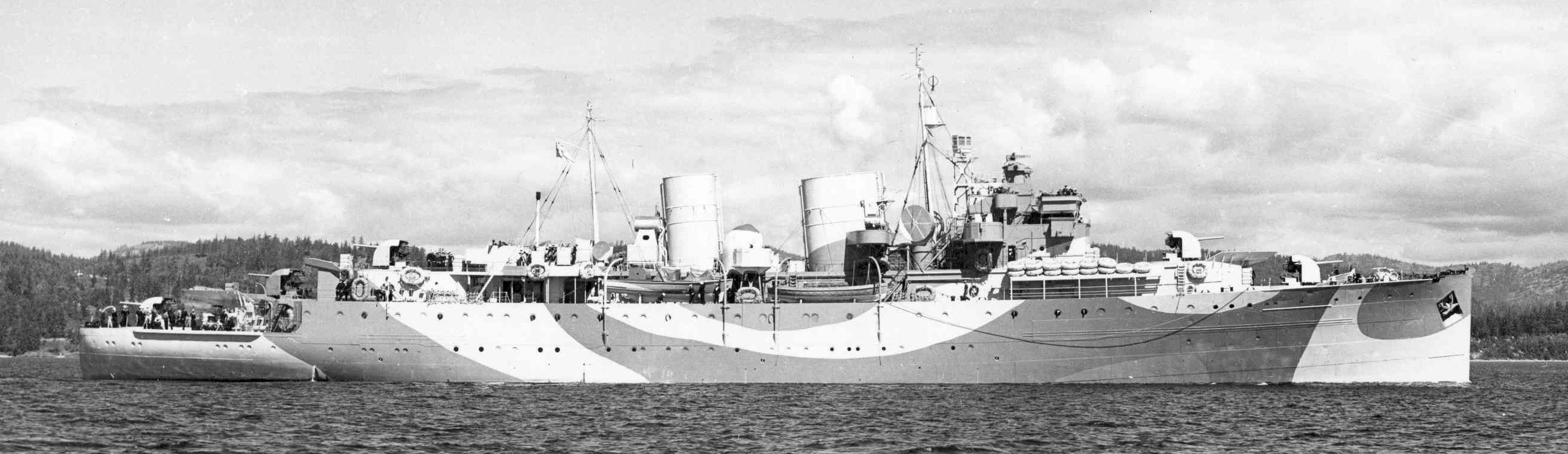
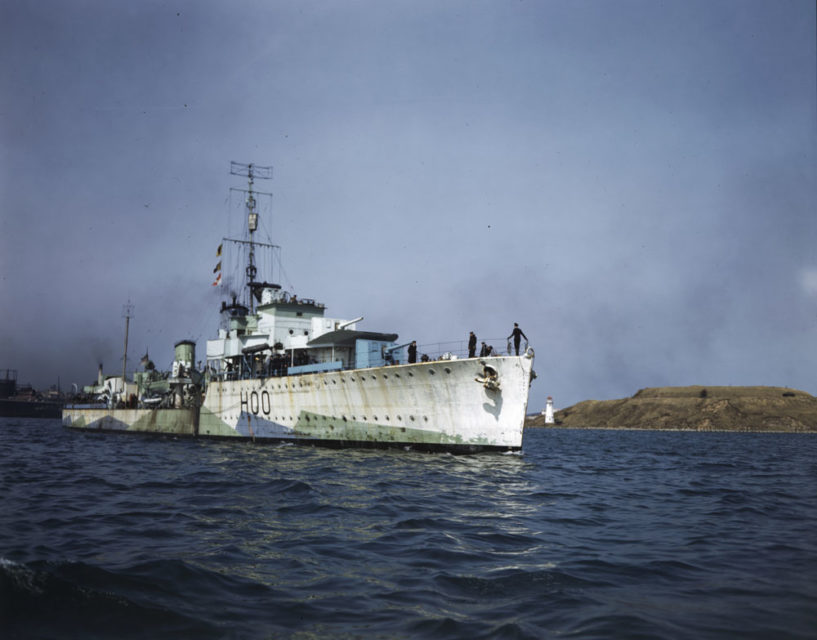
The River-class destroyer HMCS Restigouche, May 1942.
Canada. Department of National Defence / Library and Archives Canada / ecopy.

Schull continues in Far Distant Ships:

The loss of Fraser, heavy blow though it was for the navy and for the homes of forty-seven Canadians, was a minor incident of those disastrous days; one of the casualties which were as certain to occur under conditions of prolonged and incessant strain as under direct shellfire. Nor could it be lingered upon. …

Skeena, Restigouche, and St. Laurent now turned with scores of British ships to a desperate battle for convoy routes through the southwestern approaches. The U-boats were beginning to arrive in greater numbers; the Luftwaffe was everywhere over the channel and far out to sea. The great ports of the south and east were under constant attack; in their scanty hours in harbour between U-boat hunts and the rescue of survivors from sunken vessels, Canadian destroyers landed men to assist in combatting air raids.

[Editor’s Note: By early July the Admiralty faced the hard decision to re-arrange the whole supply system that Britain now depended upon for food, fuel, armaments, and ammunition. The large southern and eastern ports were under bombing attack frequently enough to rule out receiving and unloading merchant convoys, without risking unacceptably high ship losses. The ports on the Mersey and Clyde rivers, being further away from German airfields, must accept the majority of the cargo from North America and elsewhere. The convoys had to be routed through the northwestern approaches, minimizing the risk of air attack. The escort vessels also had to shift to their new operational area; the remaining three Canadian destroyers in British waters would now operate from Liverpool, Greenock, Rosyth, and eventually Londonderry (where new port facilities were being hurriedly constructed).]

March 29, 2019

Canada and the Battle of the Atlantic, part 3 by Alex Funk

Filed under: Cancon, History, Military, WW2 — Tags: , , , , — Nicholas @ 05:00

Editor’s Note: This series was originally published by Alex Funk on the TimeGhostArmy forums (original URL – https://community.timeghost.tv/t/canada-and-the-battle-of-the-atlantic-part-1-edited/1433).

Sources:

  • The Far Distant Ships, Joseph Schull, ISBN 10 0773721606 (An official operational account published in 1950, somewhat sensationalist)
    [Schull’s book was published in part because the funding for the official history team had been cut and they did not feel that the RCN’s contribution to the Battle of the Atlantic should have no official recognition. It is very much an artifact of its era, and needs to be read that way. A more balanced (and weighty) history didn’t appear until the publication of No Higher Purpose and A Blue Water Navy in 2002, parts 1 and 2 of the Official Operational History of the RCN in WW2, covering 1939-1943 and 1943-1945, respectively.]
  • North Atlantic Run: the Royal Canadian Navy and the battle for the convoys, Marc Milner, ISBN 10 0802025447 (Written in an attempt to give a more strategic view of Canada’s contribution than Schull’s work, published 1985)
  • Reader’s Digest: The Canadians At War: Volumes 1 & 2 ISBN 10 0888501617 (A compilation of articles ranging from personal stories to overviews of Canadian involvement in a particular campaign. Contains excerpts from a number of more obscure Canadian books written after the war, published 1969)
  • All photos used exist in the Public Domain and are from the National Archives of Canada, unless otherwise noted in the caption.

I have inserted occasional comments in [square brackets] and links to other sources that do not appear in the original posts. A few minor edits have also been made for clarity.

Part 3 — The professionals and the amateurs

Marc Milner picks up the story in North Atlantic Run:

While the operational side of the navy chafed at the bit, the shore side got on with the daunting work of expansion. The first task was to provide both personnel and ships for the system of defended ports. Acquisition of the ships was a manageable problem, though the results were far from satisfactory. By the end of 1939 the RCN had managed to beg, borrow, or buy over sixty auxiliary vessels of all shapes and sizes, enough to fill out the minesweeping, anti-submarine, and harbour duties of the defended ports. Many of the ships were unreliable or unsuitable for their assigned roles and therefore badly needed replacement. In fact, few were worthy of long-term service in any but the most menial tasks.

The bulk of the auxiliary vessels taken into the RCN came from other government departments. Manning them posed no problem because most of the ships’ crewmen transferred to naval service, enlisting in the RCN Reserves, Special Service, which respected their peculiar skills (for example, ice clearance). Retired officers of the Royal Navy resident in Canada, of whom about forty were designated for duty with the RCN, also helped fill the gap in manpower.

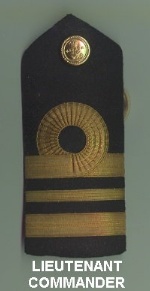
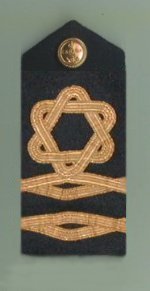
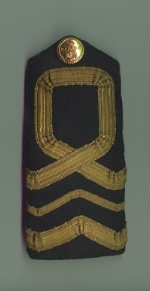
[Editor’s Note: In general, the regular RCN consisted of professional officers and ratings who planned to continue in the navy after the war. The RCNR were professional seamen in civilian life who would return to their profession at the end of hostilities. RCNR men were highly prized in the navy for their sea-going skills. The RCNR Special Service was (I believe) just a designation for RCNR officers and ratings who had specialized skills, like icebreaking experience, over and above ordinary merchant navy experience. The RCNVR were “hostilities-only” volunteers, with a core of longer-term reservists who had some limited experience before the war. RCNR and RCNVR officers had slightly different rank insignia than RCN officers, as summarized by the Canadian Military Police Virtual Museum:]

Regular Officers in the RCN wore gold stripes on their epaulettes or on the cuffs. The uppermost stripe incorporated the “Executive Curl”. This was a holdover from the early days of the Royal Navy when officers responsible for ship handling and command were separate from other officers such as Surgeons and Engineers. Engineers were granted the curl in 1915 and by 1919 the rest of the branches had been granted it.

Officers of the Royal Canadian Navy Volunteer Reserve (RCNVR) wore similar rank insignia to those of the Regular Navy, however the stripes were of a different pattern, being a zig zag design. This of course lead to the RCNVR being nicknamed the “Wavy Navy”. [The epaulette on the left is of an RCN Lieutenant Commander. The one on the right] is that of an RCNVR Lieutenant Commander. Officers of the Royal Canadian Navy Reserve (RCNR) [in the middle] wore another special pattern of rank stripes. In this case, the curl resembled a Star of David. An RCNR Lieutenant’s rank is illustrated. These patterns of special insignia were discontinued in the mid 1950’s, after which Regular and Reserve Officers wore identical rank insignia.

Marc Milner continues:

With the dispatch of the second — and final — draft of volunteer reservists (RCNVR) to the coast on 10 September, the RCN exhausted its cadre of readily available and “trained” personnel. The first plan for further mobilization was tabled on 17 September and called for an active strength of 5,472 all ranks by the end of March 1940, rising to seven thousand by the same date in 1941. As with other personnel projections in the early months of the war, this first one was based on the needs of home defence and the availability of ships. The RCN proved rather successful at cobbling together its auxiliary fleet, and the projections for March 1940 were surpassed much earlier. Yet, despite this early trend towards rapid growth, expansion in 1939 and 1940 was choked by shortages of every conceivable type. Sailors went without proper naval uniforms because no one foresaw, at the end of 1939, that the navy’s strength would rise to ten thousand by September 1940. Further, until 1943 the “key to expansion” as the Naval Staff liked to call it, was the shortage of training staff, a shortfall which the RN unwilling to help alleviate.

What the navy badly wanted were skilled men: men whom they were losing in large numbers to the other two services, particularly the air force. For the RCN did not even have the necessary housing to take in the throngs of eager and qualified volunteers waiting to join up. The problem occasioned debate at the first Naval Staff meeting in January of 1940. The urgent need for temporary accommodation was stressed, “in order that recruiting programme could be proceeded with before the new rapidly expanding RCAF seized all the best — and particularly most skilled, men”. The RCN also found that it had to lower the minimum age of entry from twenty-one to nineteen in order to counter the ravages of the air force on available manpower.

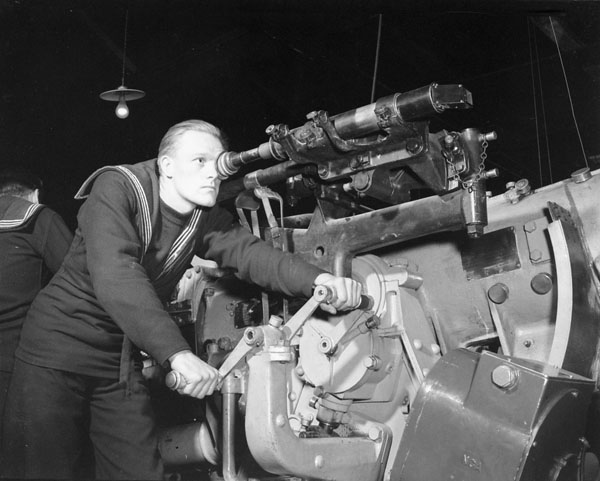
RCN rating operating the training mechanism of a 4.7-inch gun, Royal Canadian Navy Gunnery School, Halifax, Nova Scotia, 1940.
Canada. Dept. of National Defence / Library and Archives Canada / PA-104416

Despite the struggle over manpower and the navy’s reluctance to expand too quickly, the growth of the navy soon acquired a snowball effect which it seemed incapable — or perhaps undesirous — of firmly controlling. At the end of 1939 the Naval Staff anticipated a completed wartime strength (after three years) of 1,500 officers and 15,000 ratings. This figure was reached and passed in half the time. But the really hectic pace of expansion did not begin until after the fall of France and Norway. Up to that point the RCN had planned a very deliberate and selective growth, as Vice-Admiral Nelles, Chief of the Naval Staff (CNS), explained to the naval minister in January 1940.

Macdonald had broached the subject of giving preferences in RCNVR commissions to members of prominent yacht clubs. In an illuminating statement Nelles made it clear to the minister what role “Sunday Sailors” would play in Canada’s war at sea. “The RCN is in need of many men before this war is over,” Nelles wrote, “but the [types] of ships suitable to Canadian service conditions [Tribal-class destroyers or small inshore-patrol ships] are more suited to the employment of professional seamen than of amateur small boat yachtsmen.” The CNS’s comment was no idle remark on an easily dismissed subject. Earlier in the same day Nelles had received a memorandum from his director of Naval Personnel, who, no doubt responding to the minister’s inquiry, refused to countenance the mythical value of “Sunday Sailors”. Yachting, the DNP reported to his chief, had about as much to do with modern naval skills as flying a kite had to do with modern air operations. None the less, in order to find employment for these eager warriors, Nelles informed Macdonald that he was prepared to release fifty young yachtsmen to the Royal Navy “to serve in the more interesting appointments overseas and represent Canada at the scene of active operations”. His words suggest clearly what Nelles and the navy felt of keeping the fleet in home waters. In terms of manpower this option offered an alternative to simply turning recruits away, and they would not be lost to either Canada or the war effort. The loan scheme was approved, and it was initially decided to send all RCNVR recruits in excess of 4,500 to serve in the RN. Though this plan was later drastically altered, the incident illustrates the selective nature of the navy’s expansion before the fall of Western Europe, the desire to participate in the “active” theatre, and the problems inherent in trying to expand from too small a base.

Back at sea, the phony war was one of drudgery for the RCN, aside from its participation in the capture of the SS Hannover in the Caribbean. Shuttling convoys back and forth between the defended ports of Canada to meeting points offshore, the odd troop transport across the ocean, coastal convoys between ports. All essential, but not the work the navy had been hoping for.

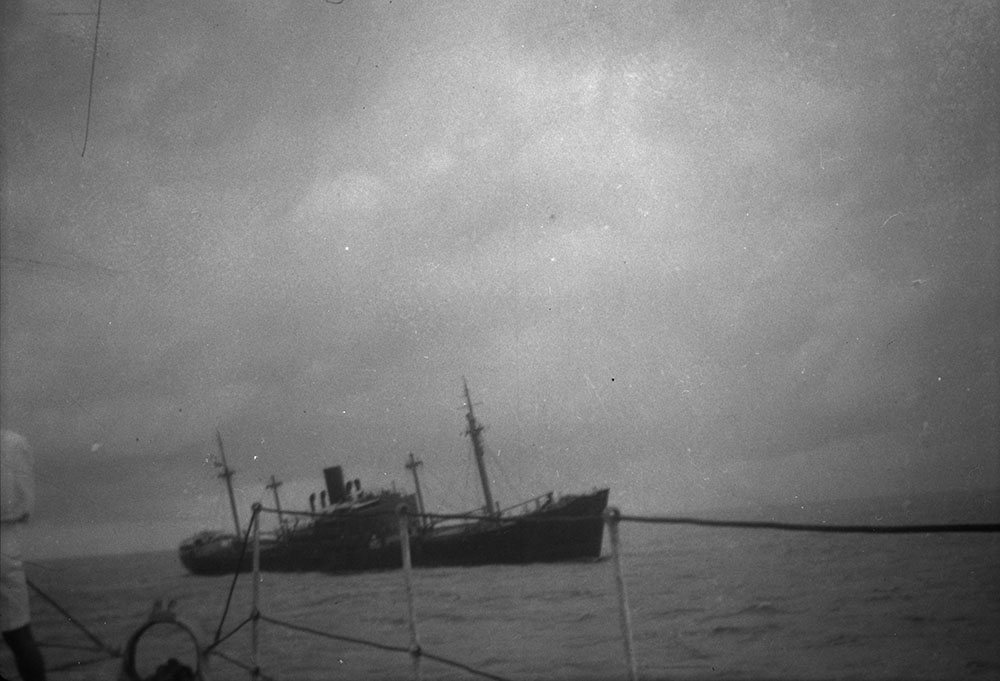
HMS Dunedin and HMCS Assiniboine intercepted the blockade runner SS Hannover in early March, 1940. Later, this vessel was converted into an escort aircraft carrier, HMS Audacity.
Canada. Dept. of National Defence / Library and Archives Canada / PA-104055

They got their wish soon enough. The phony war ended quite spectacularly in the spring of 1940, and a request was sent from London to Ottawa for “all available destroyers”, even as the BEF fought to disengage itself and form a secure position from which to evacuate. The cabinet eventually more or less agreed, even thought it meant virtually stripping Canada herself of naval defenses.

The fall of France left some senior Canadian politicians, Mackenzie King among them, more concerned than ever for the vulnerability of Canada’s vast coastline. However, both the Canadian Chiefs of Staff and the British, including Prime Minister Churchill (by whose opinion Mackenzie King set great store), were able to convince the Canadian prime minister that Canada’s first line of defence was the English Channel.

The navy mustered four destroyers for travel to Europe. Joseph Schull writes of their departure and first subsequent action in Far Distant Ships:

In Halifax, on the afternoon of the 24th [of May], the Canadian destroyers Restigouche, Skeena and St. Laurent were preparing to go to sea on an unscheduled voyage. Leaves had been cancelled, libertymen summoned back to their ships and all prospect of an Empire Day celebration ruined with truly naval efficiency. The mood on board St. Laurent was particularly black, as she had been recalled from one convoy and was under orders for sea again before a man could step ashore. The mess deck “buzz”, discredited and discouraged by nine months of unvarying monotony, gave promise only of another local convoy run. If there was any bright feature of the day it must have been the mild spring weather which had enabled the men to relieve their crowded mess decks by sending heavy clothes and miscellaneous cold weather gear ashore.

With early evening came the familiar “cable party fall in” and the equally familiar call for sea dutymen to muster. The destroyers nosed their way out of the harbour while men on watch speculated without much curiosity over the fact that there appeared to be no convoy in evidence.

The explanation came several hours later. There was to be no convoy this time and no turning back to Halifax after twenty-four hours. The lambie coats left in Halifax would not be seen by their owners for a considerable time. An urgent cable from the United Kingdom had arrived at Ottawa the day before. Invasion was an imminent possibility and every ship which Canada could send was required in British waters.

Restigouche, Skeena and St. Laurent were on their way. Assiniboine and Ottawa were in refit in Halifax and would not be operational until about the middle of June. Saguenay could not make the crossing as she was also badly in need of refit. Fraser, en route to Bermuda, had been assigned to the Jamaica Force of the Royal Navy in March to conduct Caribbean patrols. En route to Bermuda, had been ordered to continue her voyage, refuel at Bermuda and proceed directly to the United Kingdom.

The first wartime passage of the three destroyers was uneventful but scarcely monotonous. By day and by night the men went through intensive air raid and anti-submarine exercises. The commanding officer of Restigouche saw the efficiency of his ship increase rapidly during the voyage and suggested that the improvement “was no doubt accelerated by the realization of the ship’s company that we were rapidly approaching an extremely active war zone.”

It may well have been so. While still a day’s steaming from the United Kingdom the ships were ordered to a position of Ushant on an abortive submarine hunt; and when they finally secured at Plymouth on June 1 the evacuation of Dunkirk was at its height. The First Lord of the Admiralty found time for cordial words to the newcomers:

    The presence of units of the Royal Canadian Navy in our midst inspires us all to a still harder effort. Confident both of your skill and of your valour we wish you good luck in the fierce and exacting toil which lies before you.

March 28, 2019

Canada and the Battle of the Atlantic, part 2 by Alex Funk

Filed under: Cancon, History, Military, WW2 — Tags: , , , , — Nicholas @ 05:00

Editor’s Note: This series was originally published by Alex Funk on the TimeGhostArmy forums (original URL – https://community.timeghost.tv/t/canada-and-the-battle-of-the-atlantic-part-1-edited/1433).

Sources:

  • The Far Distant Ships, Joseph Schull, ISBN 10 0773721606 (An official operational account published in 1950, somewhat sensationalist)
    [Schull’s book was published in part because the funding for the official history team had been cut and they did not feel that the RCN’s contribution to the Battle of the Atlantic should have no official recognition. It is very much an artifact of its era, and needs to be read that way. A more balanced (and weighty) history didn’t appear until the publication of No Higher Purpose and A Blue Water Navy in 2002, parts 1 and 2 of the Official Operational History of the RCN in WW2, covering 1939-1943 and 1943-1945, respectively.]
  • North Atlantic Run: the Royal Canadian Navy and the battle for the convoys, Marc Milner, ISBN 10 0802025447 (Written in an attempt to give a more strategic view of Canada’s contribution than Schull’s work, published 1985)
  • Reader’s Digest: The Canadians At War: Volumes 1 & 2 ISBN 10 0888501617 (A compilation of articles ranging from personal stories to overviews of Canadian involvement in a particular campaign. Contains excerpts from a number of more obscure Canadian books written after the war, published 1969)
  • All photos used exist in the Public Domain and are from the National Archives of Canada, unless otherwise noted in the caption.

I have inserted occasional comments in [square brackets] and links to other sources that do not appear in the original posts. A few minor edits have also been made for clarity.

Part 2 — The Admiralty takes control

On August 26, just a few days before the official outbreak of war, a single word Admiralty telegram was received in Ottawa from London: FUNNEL. With that message all British merchant vessels passed under Admiralty control. The same transfer took place in Canada on the same day. No Canadian-registered ship, no merchant ship in any Canadian port could sail without the authority of the Royal Canadian Navy. Naval control officers faced an enormous task. All British merchant vessels in North American waters would have to be gathered in from the wide face of the sea, assembled, bunkered, stored, provided with codes and orders. Vessels of every type would have to be formed into orderly fleets, sailed at precise times and by specified routes with the precision of a crack railway, all in absolute secrecy. Halifax stirred once again with the grim vitality of a key port in a world at war. Ships put in, their schedules interrupted, their captains angry, demanding explanations they didn’t get. Painting parties descended to defile clean white ships with the drab gray of military vessels. Old naval guns were mounted on merchantmen and a few ships were issued machine guns.

[Editor’s Note: Unlike the Royal Navy’s comparatively vast administrative resources for organizing convoys, the RCN had to draw heavily upon a small number of retired RN and RCN officers living in Canada and the United States to gather enough officials to establish convoy control in Canadian ports (the same pool would also be used to recruit convoy commodores). It’s difficult for modern readers, used to networked computers with online databases, to realize just how much literal paperwork had to be created and maintained from scratch to even begin organizing the convoy system from North America to the UK: that it was done at all is amazing. That it was done about as well as could be hoped is incredible.]


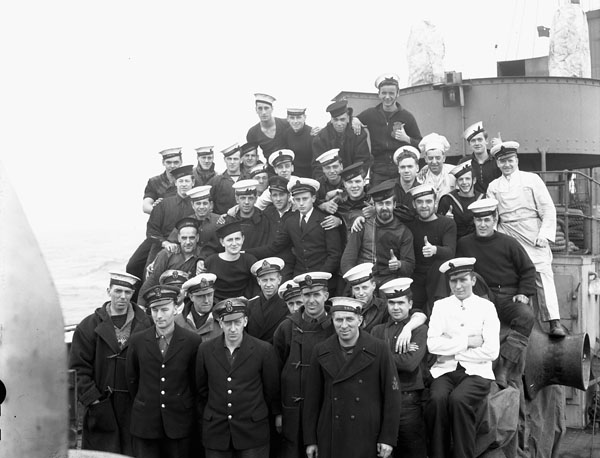
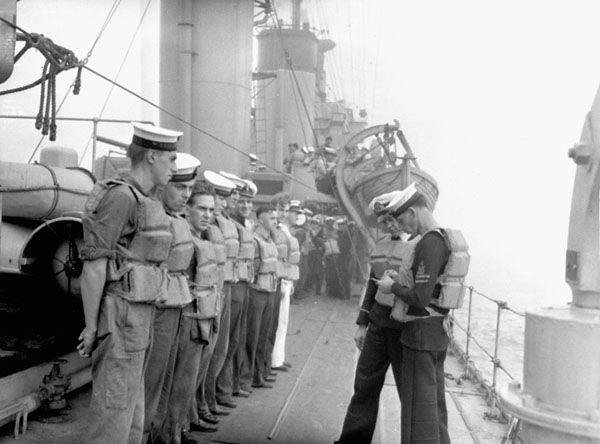
Ratings mustered along the starboard side of HMCS Assiniboine at sea, ca. September 1940.
Canada. Dept. of National Defence / Library and Archives Canada / PA-104105

On August 31st HMCS Fraser and St. Laurent were re-deployed to the east coast from the west coast.

On September 16th, six days after Canada declared war, the destroyers St. Laurent and Saguenay moved out through the Halifax approaches. Following behind were the 18 merchant ships of convoy HX-1, Halifax to the UK. Awaiting them offshore were the Royal Navy cruisers HMS Berwick and HMS York. The crossing was uneventful, but these 18 were the first of a grand total of 25,343 merchant vessels that would sail from North America under Canadian escort.

To briefly discuss the convoy system itself, it’s fairly simple: merchant vessels sail in organized groups rather than on their own and are provided some form of naval escort to protect them from hostile vessels. Even lightly guarded convoys are immensely preferable to ships sailing on their own, reducing the width of the target area and forcing any potential attacker to weigh the risk of counter-attack by the escorts. [Editor’s Note: It may seem odd to landlubbers like most of us, but even a large convoy is not much easier to find than a single ship in the wide ocean. Fewer discrete targets requires more search time by enemy submarines and surface raiders.] The speedier the convoy, the better, but the limited speed of many of the merchant ships necessitated a system of fast and slow convoys with different starting points in the Americas, and different codes for identification. The merchant vessels are described by Alan Easton, captain of the corvette HMCS Baddeck in 50 North: Canada’s Atlantic Battleground [Easton’s book is factual in most ways except for the dialogue and some of the names being changed]:

We sailed to Sydney, Nova Scotia. There we spent the night, topped up with fuel and stood out of the harbour early the next morning, where we were to await the convoy we had been instructed to escort. Many ships were lying at anchor that morning in the fine, land-locked harbour, ships of numerous different Allied and neutral nations, for this was the assembly port for the eastbound slow Atlantic convoys in those days. As we moved back and forth off the harbour mouth, I fell to examining the ships as they came out, one behind the other at intervals of three or four minutes, led by the Commodore’s ship. It was always intensely interesting to me to gaze at the ships. The more weatherbeaten and decrepit the ship, the more attractive she was to me; she had a story to tell and I could sometimes discern a part of it by just looking. The newest might have been ten years old, the oldest perhaps forty or fifty. Some were built of iron — the inch-thick plating of the 1880s, before the days of steel. They were large and small, from about nine hundred tons to nine thousand. You could tell almost at a glance their nationality, or the country in which they were built, by the shape of their hulls and the construction of their upperworks. But as they came out they flew their ensigns, soon to be hauled down, so that you could not mistake their identity. They were all heavily laden, few that were not down to their Plimsoll marks and some with little freeboard, perhaps four feet between the water and the well deck.

The first ship moved slowly, marking time as it were, to allow the others to take their stations, so that the whole could form into three columns. Soon after noon, the Commodore seemed to be satisfied that all were in their correct places for he ran up a flag hoist indicating that the speed of the convoy was to be seven knots. When every ship had signified that she understood his signal, the Commodore hauled his flags down and the engines of this heterogeneous collection of vessels simultaneously moved faster, although to the onlooker there was no perceptible change in speed.

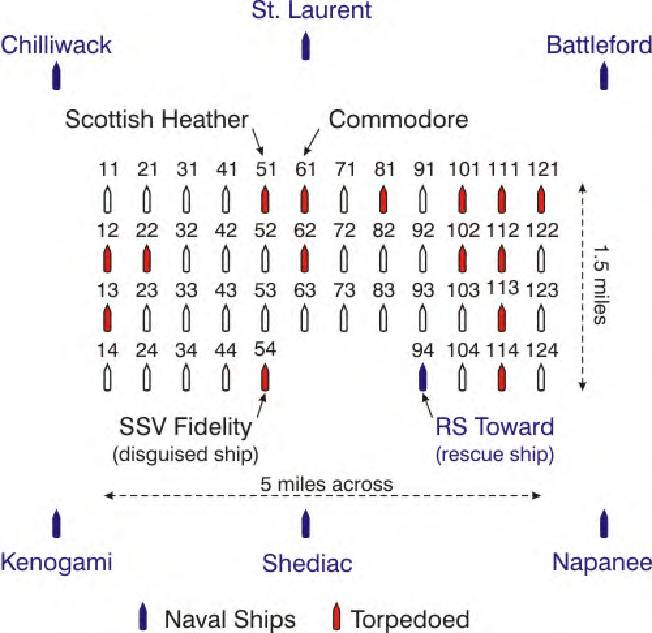
The fast/slow system was implemented fairly early on, and by August 1940 slow convoys were more often being formed in Sydney, Nova Scotia, the faster convoys in Halifax. By 1941, fast convoys left every six days and made the crossing in around 13 to 14 days. Slow convoys left every six days as well, but took 16 to 17 days to cross. The size of the convoys varied. The largest convoy to ever make the crossing was HXS-300 consisting of 167 ships, but a good benchmark was 40 or so merchant vessels. These ships are positioned in a grid with nine columns, 920 metres apart, and in each column five ships, 550 metres apart. Ships carrying dangerous cargoes, such as gas, fuel, or explosives are placed in the centre, the position that affords the most protection against enemy torpedoes. The convoy commodore, in most cases a retired naval officer, is on board one of the merchant ships to take defensive measures as required and ensure coordination with the escort.

[Editor’s Note: An image from Swansea Docks showing the schematic arrangement of slow convoy ONS-154 returning to Halifax later in the war:]

Convoy ONS-154 in December, 1942. The numbers indicate the column and row designations for each merchant ship in the convoy.
Image by Ron Tovey, Swansea Docks – click the image to visit his site.

The following system of codes was used for identification of trans-Atlantic convoys:

    HX: Fast convoys (9 knots or over) sailing from Halifax (or later New York)
    SC: Slow convoys (under 9 knots) sailing from Sydney, Halifax, or New York
    ON: westbound convoys sailing from Great Britain to North America
    ONS: slow westbound convoys sailing from Great Britain to North America

The following system of call letters was used for identification of coastal convoys:

    BX: Boston to Halifax
    XB: Halifax to Boston
    SQ: Sydney to Quebec City (via the St. Lawrence River)
    QS: Quebec to Sydney

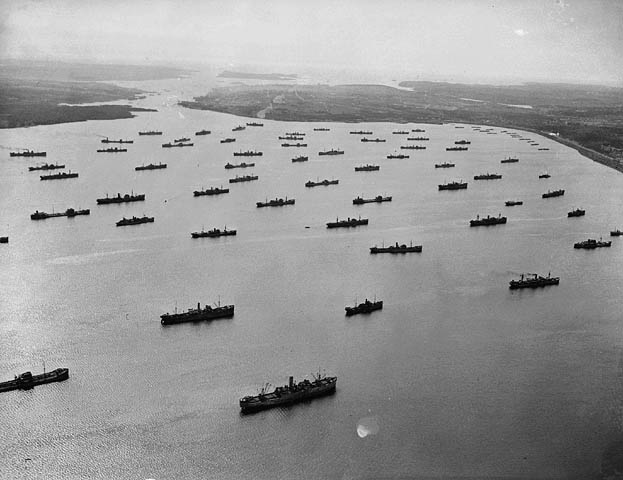
Convoy forming in Bedford Basin, 1 April, 1942
Canada. Dept. of National Defence / Library and Archives Canada / PA-112993

There was much debate among Canadian politicians as to the role Canada would play in the war in general. In the first few weeks, much debate was had as to which services would receive what money, and how they would be integrated into the allied war effort. Prime Minister Mackenzie King had somewhat sold the war to the nation as being different from the last war [Editor’s Note: where Canada provided an over-strength army corps for the Western Front, suffering nearly 60,000 combat deaths, slightly more than the US combat losses in that war]. Finance Minister J. L. Ralston publicly envisaged a program that would be “practical rather than spectacular”. The Prime Minister spoke of protecting Canada by sending food and raw materials to Britain and building a navy and air force and munitions industry, even the first musings of what would become the BCATP [British Commonwealth Air Training Plan] (though these early plans paled in comparison to what it would eventually become.) Canada would contribute vast amounts of resources to the allied cause, but there was not going to be a need for a large land army to fight and die in Europe. The army was just as short of equipment as the navy was and the air force consisted of 3100 men and 270 mostly obsolete aircraft, with just 19 modern Hurricanes. The old issue of conscription that had led to riots in Montreal in 1917 immediately reappeared, and an important provincial election in Quebec had been called within two weeks of the declaration of war in almost direct response to it. [Editor’s Note: The risk of another conscription crisis haunted the Canadian government from the very start of the war: English Canada was heavily in favour, but Quebec was just as opposed, and the ruling Liberal Party couldn’t risk losing their support in Quebec.] What soldiers Canada did have departed Halifax as part of convoy TC-1 in early December, and by the end of the month Canada had 15,000 men in England (the 1st Canadian Infantry Division).

It is the opinion of my sources that the idea of a limited war were extremely favorable to the navy and air force in the early months. Canadian naval vessels and aircraft fighting alongside the United Kingdom was seen as an appropriate contribution, whilst at the same time, seen as far less costly in terms of lives than a large expeditionary army, which Mackenzie King was steadfastly opposed to (fear of conscription crisis was ever present). Canada’s merchant fleet was at Britain’s disposal without question, combined with the vast natural resources she could provide, quite nicely rounded out the “limited war” concept. Industrial military capacity was small, almost non-existent, and building ships, aircraft and munitions would help it grow.

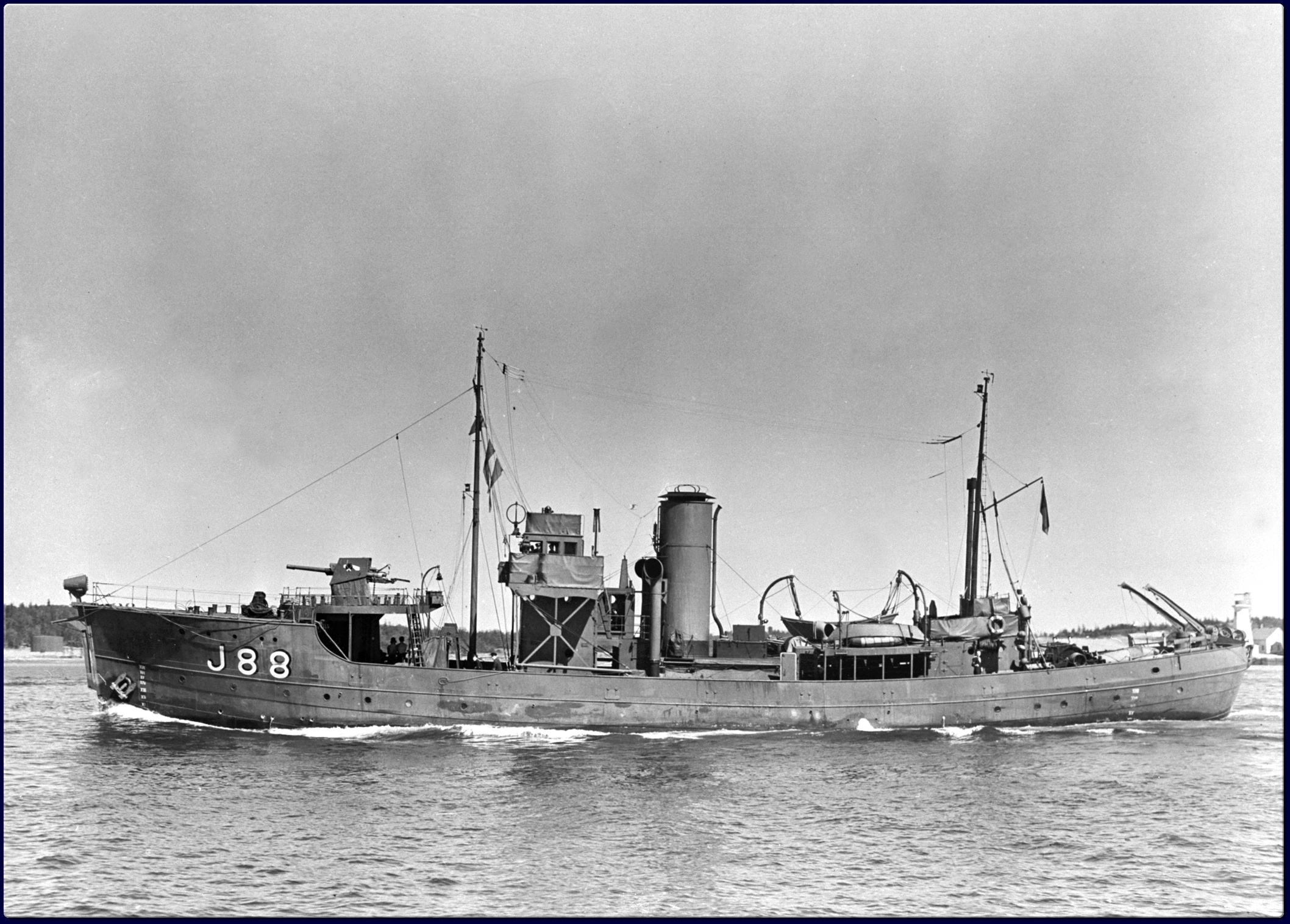
Focusing specifically on the navy itself, what few ships it had were immediately deployed on patrols and put to work escorting coastal convoys within coastal waters, and trans-Atlantic convoys to a handover point mid-voyage. The reserves were activated and sent to the coasts. In November all the Canadian destroyers were placed under the command of the Royal Navy’s North America and West Indies station (somewhat to the Government’s dismay, although not the navy’s: most RCN officers had close peacetime ties to the British squadron and felt it was the natural choice. They had actually requested this at the start of the war and had been refused by the government, who wanted the RCN’s ships kept close to home.) This placement also had the benefit of assuring the RCN that they would participate in the types of operations they had trained for; fleet work, or sweeps for surface raiders. October 1939 saw the purchase of a another destroyer, re-named HMCS Assiniboine in Canadian service. These seven River-class destroyers would form the backbone of the navy well into 1943. A modest attempt had been made in 1938 to give Canadian yards some experience building warships with a minesweeper program. Despite the dispersal of the contracts to both Atlantic and Pacific yards for four Fundy-class minesweepers, the Canadian shipbuilding industry was unprepared for the demands wartime was to make of it.

Undated photograph of RCN minesweeper HMCS Fundy (J88).
Canadian Navy Heritage website. Image Negative Number NP-1404 via Wikimedia Commons.

In North Atlantic Run, Marc Milner discusses the Ottawa front of the RCN’s early wartime struggles:

In the government the navy actually had a friend, as it discovered when planners began to submit estimates for expansion. As the late Admiral L.W. Murray, RCN (in September 1939, the Director of Operations and Training) recalled, the navy was given a carte blanche to plan its growth over the succeeding four or five years. When in February 1940 Murray and the deputy minister presented the first wartime naval estimates before the Finance Committee of the cabinet, they passed despite a “fine-tooth comb” inspection. The fact was that the navy’s expansion and its attendant shipbuilding programs suited the government’s intention to profit from what was seen as a limited European war. The prime minister, W.L. Mackenzie King, was steadfastly opposed to fielding yet another large army in Europe, which might lead to high casualties and a call for conscription. Rather, his government sought to channel Canada’s war effort into the sinews of war and into much less personnel-intensive services such as the air force and the navy. Both of these services also offered excellent opportunities for the development of Canadian industry.

The link between industrial and naval expansion also went deeper than simply the building of ships. In July 1940, the expansion of the navy was given impetus by the appointment of a separate minister of Defence for the Naval Service. King chose Angus L. Macdonald, former premier of Nova Scotia. Although once rather uncharitably described as “lightweight”, Macdonald was extremely popular in his home province and a strong voice for Nova Scotia in Ottawa. Macdonald and two other prominent Nova Scotians, Colonel J.L. Ralston, the Minister of Defence, and J.L. Ilsley, the Minister of National Revenue, formed the right wing of King’s cabinet — what J.W. Dafoe called the “Tory Imperialists”. All supported a full war effort, a position that led in 1944 to a bitter break between King and the two defence ministers over the issue of conscription. But apart from Macdonald’s desire to see Canada fully represented at the front, he shared many of King’s beliefs, including the notion that the preservation of the free world depended upon the retention of power in Canada by the Liberal Party.

Macdonald also believed that Canada could and should progress industrially from the war. Long a crusader for the re-industrialization of Nova Scotia, he saw an opportunity to funnel some of government investment into his own province. There was, moreover, a direct link between industrial growth and a large navy. “What use could it be to increase our agricultural production … or to put forth the magnificent industrial effort that we have,” Macdonald asked in 1945, “unless this food and these munitions could be got safely across the sea?” Although in the end he failed to restore to Nova Scotia its past lustre, this was precisely the rationale used to justify building destroyers in Halifax during the war. In the most fundamental sense, then, the aspirations of the [full-time, professional] navy and the government coincided.

February 9, 2019

HMS Dreadnought – Guide 001

Filed under: Britain, History, Military, Technology — Tags: , , , — Nicholas @ 02:00

Drachinifel
Published on 12 Dec 2018

HMS Dreadnought, the first dreadnought battleship and game changer for the British Royal Navy, is today’s subject.

Want to support the channel? – https://www.patreon.com/Drachinifel

Want to talk about ships? https://discord.gg/TYu88mt

Music – https://www.youtube.com/c/NCMEpicMusic

December 19, 2018

HMCS Haida – Guide 027 (Special)

Filed under: Cancon, History, Military, WW2 — Tags: , , , , — Nicholas @ 02:00

Drachinifel
Published on 13 Aug 2017

The most successful Canadian warship, HMCS Haida, is the subject of today’s video

The robotic narration on this video is painfully irritating!

Update, 14 February 2021: Drachinifel updated the narration at some point after I posted the original.

December 16, 2018

The Last British Battleship?

Filed under: Britain, History, Japan, Military — Tags: , — Nicholas @ 02:00

Mark Felton Productions
Published on 13 Nov 2018

Does a British battleship still exist? Yes, but not in Britain. Find out the full fascinating story of the last of her kind.

Support my channel by becoming a Patron: https://www.patreon.com/markfeltonpro…

Photos: Nesmad, Ningyou, nattou, Mikasa Historic Memorial Warship
Video: YouTube Creative Commons

December 14, 2018

Dreadnought: The Battleship that Changed Everything

Filed under: Britain, France, Germany, History, Military, Russia, WW1 — Tags: , , , — Nicholas @ 02:00

Historigraph
Published on 24 Nov 2018

So it’s probably worth noting here that when Dreadnought made all other battleships irrelevant, it didn’t do so equally. For example, Japan had constructed two ‘semi-dreadnoughts’ a couple of years earlier, with more 10-inch guns than was standard at the time. The Americans too were moving towards building an ‘all-big-gun’ battleship, but they were much slower at getting them built than the British.

If you enjoyed this video and want to see more made, consider supporting my efforts on Patreon: https://www.patreon.com/historigraph

Sources:
Robert K. Massie, Dreadnought: Britain, Germany and the Coming of the Great War
Ben Wilson, Empire of the Deep: The Rise and Fall of the British Navy

December 2, 2018

Preliminary report posted on the sinking of Norwegian frigate Helge Ingstad

Filed under: Europe, Military — Tags: , , , — Nicholas @ 05:00

The Accident Investigation Board of Norway (AIBN) and the Defense Accident Investigation Board of Norway (DAIBN) have made their initial joint report on the sinking of HNoMS Helge Ingstad available to the public:

HNoMS Helge Ingstad after grounding, 13 November 2018.
Photo via The Drive.

“This report is a preliminary presentation of the AIBN’s investigations relating to the accident and does not provide a full picture,” the report warns up front. “The report may contain errors and inaccuracies.”

Based on what the investigators have determined so far, Helge Ingstad entered the fjord heading south and checked in with the Fedje Maritime Traffic Center, or Fedje VTS, at around 2:40 AM local time. Any ship over 80 feet long has to alert this control center before entering due to the narrow nature of the waterway.

The ship was traveling at approximately 20 miles per hour and had its navigation lights on. The ship’s Automatic Identification System (AIS) transponder was set to “receive only” mode, meaning that it was not transmitting its own position and other information to ships in the area.

At 3:40 AM, personnel on Helge Ingstad‘s bridge began to turn control of the ship over the next watch. At that time, the ship’s crew was aware of three northbound ships on its radar screen and had also visually observed “an object with many lights was observed lying still just outside the Sture terminal,” according to the report.

Sola did not leave the terminal until 3:45 AM. Less than 15 minutes later, the tanker’s crew radioed the Fedje VTS to inquire about a contract on their radar that was sailing with its AIS transponder apparently off.

At 4:00 AM, Fedje VTS identified the ship in question as probably Helge Ingstad and the tanker and the frigate began communicating directly. Approximately one minute later, the two ships collided.

[…]

A final report on the incident should contain more thorough explanations of exactly how the final moments of the collision played out and recommendations for the Norwegian Navy to try and prevent these sorts of accidents in the future. “So far, the AIBN has not seen any indication of technical systems not working as intended up until the time of the collision,” the report notes.

Separate from its findings regarding the events leading to the collision, the AIBN has also uncovered a serious technical issue that could have impacts well beyond this particular accident. Norwegian officials have alerted both the country’s navy and Spanish shipbuilder Navantia, which built the Helge Ingstad and Norway’s four other Fridtjof Nansen-class frigates, with concerns they have about the basic “watertight integrity” of the ships.

“The AIBN has found safety critical issues relating to the vessel’s watertight compartments,” an annex to the main report explains. “This must be assumed to also apply to the other four Nansen-class frigates. It cannot be excluded that the same applies to vessels of a similar design delivered by Navantia, or that the design concept continues to be used for similar vessel models.”

Update, 24 June 2019: The Norwegian government has decided to scrap the ship rather than undertake repairs.

November 29, 2018

The Royal Navy’s “Nelsol” and “Rodnol” – a battleship design driven by lessons from Jutland

Filed under: Britain, History, Military, Technology, WW1, WW2 — Tags: , , , — Nicholas @ 05:00

One of my favourite quirky ship designs is profiled at Naval Gazing: HMS Nelson and HMS Rodney. These two ships, known derisively by the names “Nelsol” and “Rodnol” (because of their odd profile resemblance to a class of RN oilers, whose names all ended in “-ol”), were the first post-WW1 British battleships designed to incorporate the bitter lessons learned at the battle of Jutland in 1916. Their construction was also influenced by the round of naval treaty talks that aimed to stop a renewed naval arms race and limit the major navies in both number and size of ships.

HMS Nelson profile drawing as she appeared circa 1931.
Image by Emoscopes via Wikimedia Commons.

At the end of WWI, the Royal Navy faced a crisis. During the war, it had suspended new capital ship construction except for a handful of battlecruisers, while the American and Japanese building programs had continued to churn out ships that were more modern than the bulk of the British fleet. Worse, the British battlefleet had seen hard war service, and many of the early dreadnoughts were in bad shape and essentially unfit for further service. New battleships would be needed, ships that fully reflected the lessons of the war.

HMS Nelson off Spithead for the 1937 Fleet Review. Anchored in the background are two Queen Elizabeth-class battleships and two cruisers of the London class.
Photo via Wikimedia Commons.

The most important of these was the need for an all-or-nothing armor scheme, as developed in the US. The war had seen major improvements in armor-piercing shells, and they required significantly more armor than previous vessels. However, the increased range gave designers a way out. Previously, the size of citadels had been set by the need to preserve stability and buoyancy if the ends were riddled. At long range, the many hits necessary to riddle the ends would not happen, and the citadel could be shrunk to thicken the armor. The British also looked to improve on the 15″ gun due to the proliferation of 16″ weapons in the American and Japanese navies. They investigated the triple turret, abandoned a decade earlier amid fears of increased mechanical complexity, and the 18″ gun under the cover name of 15″/B.

Two parallel design series were started, one for battleships, the other for battlecruisers. As this series was developed, the designers saw a serious problem with the battlecruisers. The boiler uptakes would leave large holes in the armored deck, and if the ship was headed towards the enemy, shells might be able to pass through the holes and into the aft magazines. The solution was to move all three turrets forward of the engines, on the basis of war experience showing that ships rarely if ever engaged targets directly aft.

November 26, 2018

Will the Kriegsmarine Rule the Waves? – WW2 – 013 24 November 1939

Filed under: China, Europe, Germany, History, Japan, Military, Russia, WW2 — Tags: , , , , , — Nicholas @ 04:00

World War Two
Published on 24 Nov 2018

The European Allies seek a countermeasure to the mysterious German mines, in China the Japanese advance, and in Poland it is the beginning of the Warsaw Ghetto.

WW2 day by day, every day is now live on our Instagram account @World_war_two_realtime https://www.instagram.com/world_war_t…

Join us on Patreon: https://www.patreon.com/TimeGhostHistory
Or join The TimeGhost Army directly at: https://timeghost.tv

Written and Hosted by: Indy Neidell
Produced and Directed by: Spartacus Olsson and Astrid Deinhard
Executive Producers: Bodo Rittenauer, Astrid Deinhard, Indy Neidell, Spartacus Olsson
Research by: Indy Neidell
Edited by: Wieke Kapteijns and Spartacus Olsson
Community Manager: Joram Appel

Coloring by Spartacus Olsson and Norman Stewart
Norman’s pictures https://oldtimesincolor.blogspot.com/

Archive by Screenocean/Reuters https://www.screenocean.com

A TimeGhost chronological documentary produced by OnLion Entertainment GmbH

November 20, 2018

Gordon Lightfoot’s “Wreck of the Edmund Fitzgerald

Filed under: Cancon, History, Media, USA — Tags: , , , , — Nicholas @ 03:00

Mark Steyn devotes a column to the work of Canadian singer/songwriter Gordon Lightfoot, particularly his very well-known ballad on the loss of the Edmund Fitzgerald on Lake Superior in 1975:

Edmund Fitzgerald, 1971
Detail of a photo from Wikimedia Commons

When it comes to trains and boats and planes, Gordon Lightfoot has hymned all three, but it’s the middle mode of transportation that produced the song he’s proudest of:

    The ship was the pride Of the American side
    Coming back from some mill in Wisconsin
    As the big freighters go
    It was bigger than most
    With a crew and good captain well seasoned…

In November 1975 Lightfoot chanced to be reading Newsweek‘s account of the sinking of a Great Lakes freighter in Canadian waters. He’s a slow and painstaking writer, which is one reason he’s given up songwriting – because it takes too much time away from his grandkids. But that day forty-three years ago the story literally struck a chord, and he found himself scribbling away, very quickly:

    The legend lives on From the Chippewa on down
    Of the big lake they called Gitche Gumee
    The lake, it is said Never gives up her dead
    When the skies of November turn gloomy…

“Gitche gumee” is Ojibwe for “great sea” – ie, Lake Superior – as you’ll know if you’ve read your Longfellow, which I’m not sure anyone does these days. Evidently Hiawatha was on the curriculum back east across Lake Huron in young Gordy’s Orillia schoolhouse. The Gitche Gumee reference may be why, when I first heard “The Wreck of the Edmund Fitzgerald“, I assumed its subject had sunk long before the song was written. In fact, it sank on November 10th 1975 – just a few days before Lightfoot wrote the number. When she’d launched in 1958, the Edmund Fitzgerald was the largest ship on the Great Lakes, and, when she passed through the Soo Locks between Lakes Superior and Huron, her size always drew a crowd and her captain was always happy to entertain them with a running commentary over the loudspeakers about her history and many voyages. For seventeen years she ferried taconite ore from Minnesota to the iron works of Detroit, Toledo and the other Great Lakes ports …until one November evening of severe winds and 35-feet waves:

    The wind in the wires
    Made a tattle-tale sound
    And a wave broke over the railin’
    And every man knew
    As the captain did too
    ‘Twas the witch of November come stealin’…

And about seventeen miles from Whitefish Bay the Edmund Fitzgerald sank, with the loss of all 29 lives. It remains the largest ship ever wrecked on the Great Lakes, launched in 1958 to take advantage of the new St Lawrence Seaway (to be opened by the Queen and President Eisenhower on an inaugural voyage by the Royal Yacht Britannia the following year) and specifically constructed to be only a foot less than the maximum length permitted. Edmund Fitzgerald was the then chairman of Northwestern Mutual Life Insurance of Milwaukee, and, as far as I’m aware, the only insurance company executive to be immortalized in a song title. Fifteen thousand people showed up for the ship’s launch at River Rouge, Michigan. It took Mrs Fitzgerald three attempts to shatter the champers against the bow, and then there was a further half-hour’s delay as the shipyard workers tried to loosen the keel blocks. After which the ship flopped into the water, crashed against a pier, and sent up a huge wave to douse the crowd. One spectator promptly had a heart attack and died.

And then came seventeen happy years. Even in the twenty-first century, there is something especially awful and sobering about death at sea: it is in a certain sense a reminder of the fragility of security and modernity. Whenever I’m in, for example, St Pierre et Miquelon, the last remaining territory of French North America, I stop by the monument aux marins disparus, sculpted in 1964 and to which many names have been added in the years since – because a ship put out, and somewhere on the horizon the great primal forces rose up from the depths and snapped it in two like a matchstick.

November 19, 2018

What we know about the sinking of the HNoMS Helge Ingstad near Bergen

Filed under: Europe, Military — Tags: , , , — Nicholas @ 03:00

The Verdigris blog has a very interesting analysis of what seems to have happened leading up to the collision of the Norwegian frigate HNoMS Helge Ingstad and the tanker Sola TS in the restricted waters near Bergen:

HNoMS Helge Ingstad, a Fridtjof Nansen-class frigate commissioned in 2009.
Photo detail via Wikimedia Commons

The island west of the collision location is Alvoyna in the Oygarden municipality, and the oil terminal at Sture is a busy port that receives large tankers such as the Sola TS which was involved in the collision. Otherwise the islands in this area are relatively sparsely populated with just 4,900 or so inhabitants across the whole municipality. From that we can assume that there would be few lights at night to mark the shoreline, with the exception of the oil terminal which would be brightly lit. The channel is approximately 2 miles wide but is relatively deep, narrowing south of Sture into a channel little over a mile wide.

The collision occurred at approximately 0400 local time on Thursday 8th November 2018. Sunset the previous evening was at approximately 1623; sunrise would not be until 0821. There was no moon; the moon set at around 1718 the previous day and would not rise until 0847. We cannot be certain of the weather conditions which may have restricted visibility. However, there is no evidence of weather or high seas on the radar picture and if visibility was restricted by rain or fog, a ship would be unlikely to be sailing at high speed.

Finally the ships involved. Sola TS is a Maltese flagged oil tanker of 62,000 tonnes. We know she had 23 personnel onboard and after the collision was reported to have little or no damage. Merchant ships are usually well built, especially when carrying petroleum cargoes which if leaked could have devastating environmental consequences; consequently the lack of damage is hardly a surprise. As a result they are sluggish, slow to manoeuvre or accelerate/decelerate. They are not, however, considered to be ‘restricted in their ability to manoeuvre’, a special condition identified in the International Regulations for the Prevention of Collision at Sea – the IRPCS or ‘Rules of the Road’ – this is a condition applied only to vessels which are restricted by their work, such as picking up or laying submarine cables or pipelines, launching or recovering aircraft, carrying out underway replenishment, etc. Sola TS might have been slow to manoeuvre, but she is not exceptional and is unlikely to have carried any special status. Sola TS had a tug, Tenax, in company and might conceivably have been considered to be under tow; however, once again no special status is conferred unless the nature of the tow made it particularly difficult to alter course. The tug is more than likely to have been pacing the tanker, probably not connected and likely a precaution for a fully laden oil tanker in narrow waters.

Helge Ingstad, by contrast, is a Fridtjof Nansen-class air defence frigate of just 5,290 tonnes. Lightly built for speed and manoeuvrability, warships are invariably less robust than merchant ships, but are more tightly compartmented and have more complex damage control arrangements to compensate.

Very quickly after the collision, the Helge Ingstad was run ashore to prevent the ship sinking, but the ship slid down further into the water, despite attempts to keep her close in shore, and eventually slipped down almost completely beneath the waterline:

HNoMS Helge Ingstad after grounding, 13 November 2018.
Photo via The Drive.

The consensus among the commenters is that the ship can probably be re-floated, but that the damage to the electronic gear onboard most likely renders her a complete loss:

Regardless of the circumstances, the loss of Helge Ingstad, even temporarily, is a major blow to the Royal Norwegian Navy, which relies on the Fridtjof Nansen-class as its primary surface combatants, especially in a time of increased tensions between Norway and its NATO allies and Russia. The frigate had been on its way back from a massive NATO-led exercise, called Trident Juncture, the largest such drill in decades, when the accident occurred.

If it turns out that Helge Ingstad is a total loss, which seems likely at this point, it could have a significant impact on Norwegian naval operations for years to come. In the meantime, we will continue to follow this story closely and provide any additional updates as they become available.

October 31, 2018

Some Criticism of The Infographics Show – Best World War 2 Battleships and Battlecruisers

Filed under: Britain, Germany, History, Japan, Military, USA, WW2 — Tags: , , , — Nicholas @ 02:00

iChaseGaming
Published on 10 Oct 2018

There is something called Wikipedia. You can find it here: https://en.wikipedia.org/wiki/Main_Page

October 12, 2018

How Underwater Explosions damage Ships and Subs #Military101

Filed under: Military, Science, Technology, Weapons — Tags: , , — Nicholas @ 02:00

Military History Visualized
Published on 15 Sep 2017

This video looks at how underwater explosions damage ships and submarines. Script was proof-read by a physicist and is based on US Navy/Army and/or academic sources.

»» SUPPORT MHV ««
» patreon – https://www.patreon.com/mhv

Military History Visualized provides a series of short narrative and visual presentations like documentaries based on academic literature or sometimes primary sources. Videos are intended as introduction to military history, but also contain a lot of details for history buffs. Since the aim is to keep the episodes short and comprehensive some details are often cut.

August 27, 2018

Critique of a retro-futuristic battleship design

Filed under: History, Military, WW2 — Tags: , , , — Nicholas @ 05:00

At Naval Gazing, a bit of informed criticism of a September 1940 Popular Mechanics article on the future of battleships:

I recently ran across the following spread from a 1940 edition of Popular Mechanics. It’s an interesting study in the way that outsiders get warship design very, very wrong.

Click to see full-size image.

« Newer PostsOlder Posts »

Powered by WordPress